
Pallet Rack / Ridg-U-Rak Seismic Base
Ridg-U-Rak Pallet Rack with Seismic Base Isolation
Ridg-U-Rak pallet rack engineered for seismic sites, with the Pellegrino Seismic Base Isolation System dissipating up to 85% of the seismic energy exerted on the rack. Designed, permitted and installed by Material Handling USA — Salt Lake City and nationwide.

85%
Seismic energy dissipated
25%
Stronger than Northridge / Loma Prieta
100+
Shake table simulations
80+
Years Ridg-U-Rak has built rack
Rack That Is Engineered for the Ground It Stands On
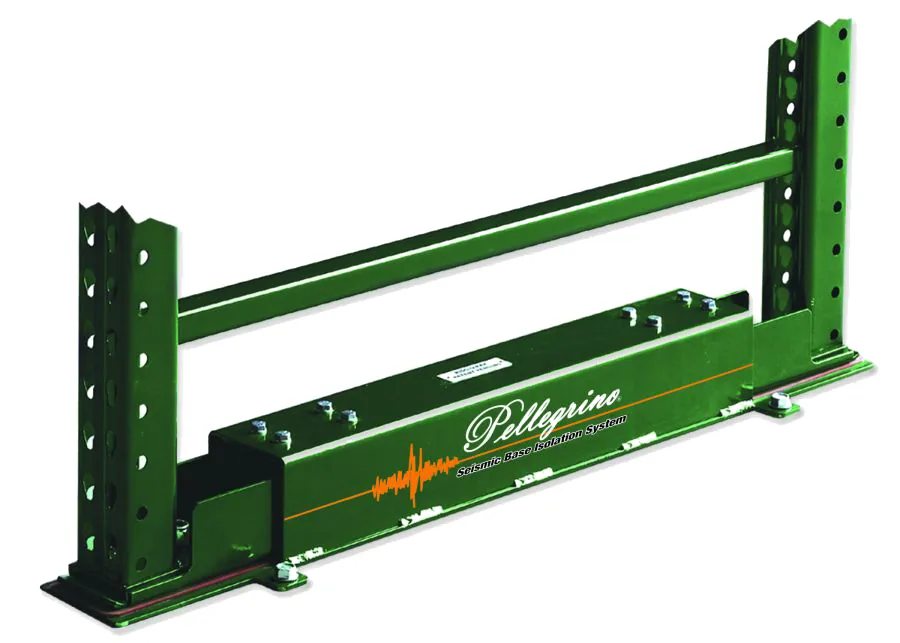
Picture a busy Saturday in a warehouse club: shoppers in the aisles, 16 ft rack loaded to the top beam on both sides, and the floor starts to move. That scenario is why FEMA published FEMA 460, Seismic Considerations for Steel Storage Racks Located in Areas Accessible to the Public, and it is the problem Ridg-U-Rak set out to solve with the Pellegrino Seismic Base Isolation System.
A conventional rack frame is bolted hard to the slab. In an earthquake it has no choice but to absorb the ground motion, which is what tips pallets, unseats beams, bends columns and pulls anchors. A base-isolated frame does the opposite: the isolation unit is positioned between the two columns of the upright frame and anchored to the floor, and it allows the rack structure to move rather than fight the slab. Ridg-U-Rak states the system dissipates up to 85% of the seismic energy exerted on a pallet rack storage system during an earthquake.
Material Handling USA is a Ridg-U-Rak dealer and an ISDA member dealer. We quote the frames, the beams, the isolators and the engineering as one package, handle the permit drawings, and install. If you are starting from a layout instead of a part list, use the Pallet Rack Configurator to lay the system out first and send it straight to our team. More on the manufacturer is on our Ridg-U-Rak page.
Building on a seismic site?
Send us the site address, pallet weights and building height. We will size the frames for your Seismic Design Category and tell you honestly whether base isolation is worth it on your project.
Request a Pallet Rack Quote Open the Pallet Rack Configurator Call (800) 326-4403
How Seismic Base Isolation Works on a Pallet Rack
Base isolation is a structural strategy borrowed from bridges and hospitals and adapted to a storage rack. Four things happen in order.
Isolator anchored to the slab
The unit is set between the two columns at the base of the upright frame and anchored to the concrete, replacing the hard connection between column and floor with a controlled one.
Ground moves, rack lags
When the slab accelerates, the isolator lets the rack structure travel instead of transmitting the full input motion up the columns.
Energy is dissipated
That relative movement absorbs energy at the base — up to 85% of the seismic energy exerted on the system, according to Ridg-U-Rak — so far less reaches the loaded beam levels.
Rack stays standing, product stays on the pallet
In Ridg-U-Rak’s shake table program the isolated racks came through the most powerful anticipated earthquake with little or no merchandise shedding or rack damage.
What base isolation is not
It is not a substitute for engineered frames, correct anchors, load plaques or rack inspection, and it does not add pallet capacity. It reduces the seismic demand on a properly designed system. Every installation still needs a design that reflects your site, slab and loading, reviewed by the authority having jurisdiction.
Seismic Risk, Hazard Maps and Seismic Design Categories
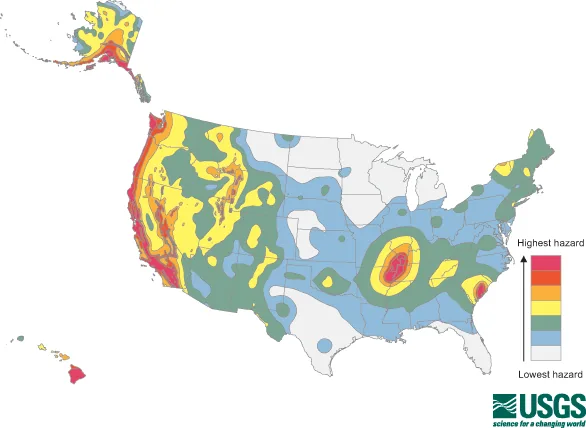
Seismic rack design starts with geography. The U.S. Geological Survey publishes national seismic hazard maps that describe the ground motions expected at a given probability level, and building codes translate that into a Seismic Design Category (SDC) for the structure — six categories from A through F. Structures posing minimal seismic risk fall in SDC A; those with the highest risk fall in SDC E or F. As the category rises, the code requires progressively more rigorous design and detailing.
The SDC is not purely about shaking. It also reflects how the building is used, including how many people would be affected by a failure and whether the facility has to keep functioning after an event. That is why a rack layout that prices one way in Kansas prices differently on the Wasatch Front or in California — the steel is doing more work.
For Utah buyers this is not theoretical. Salt Lake County sits on the Wasatch Fault, and the rack we install along the Wasatch Front is engineered accordingly and permitted before it goes up. See our guide to pallet rack permitting in Utah and our Salt Lake City pallet rack page for local detail.
| Seismic Design Category | Expected shaking | What it means for your rack |
|---|---|---|
| A | Minimal expected ground shaking | Basic structural integrity and anchorage |
| B | Low ground shaking | Anchorage plus modest seismic detailing |
| C | Moderate ground shaking | Seismic force resisting design becomes a real driver of frame sizing |
| D | Strong ground shaking — most of the Wasatch Front and coastal California | Full seismic design, engineered anchorage, stricter detailing and inspection |
| E / F | Very strong shaking near a major active fault | The most rigorous requirements; base isolation and heavier frames are frequently justified |
Ridg-U-Rak provides seismic services with most quotes, matching the rack structure quote to the hazard area for the installation address. We ask for that address on the first call for exactly this reason.
What the Shake Table Testing Actually Showed
The claims on this page come out of a physical test program, not a brochure adjective. Ridg-U-Rak ran more than 100 earthquake simulations across five weeks at the Structural Engineering Earthquake Simulation Laboratory (SEESL) at the University at Buffalo, using one of two 23 ft × 23 ft shake tables that move in three dimensions to replicate real earthquakes. Loads, product configurations and base arrangements were all varied, and independent consultants and laboratory investigators measured the effect of each simulation level on both the rack and the stored product.
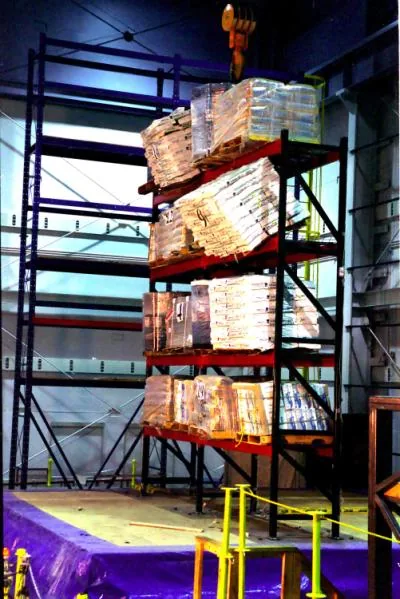 Loaded bay on the shake tableFull pallet loads on a complete bay, instrumented and ready. Testing varied load levels, product types and base arrangements rather than running one idealized case.
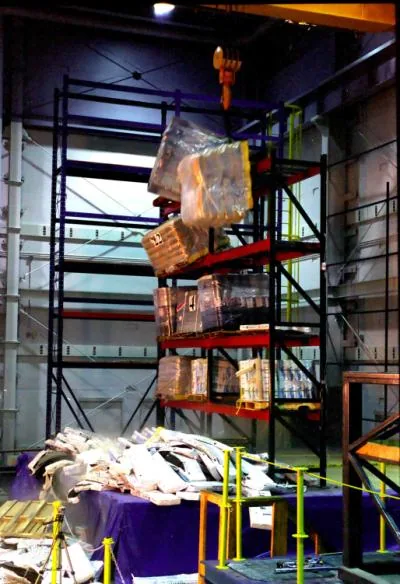 Fixed-base rack during a severe eventThe fixed-base sequence shows what a hard-anchored frame does under severe input: product sheds off the beams into the aisle long before the frame itself gives up.
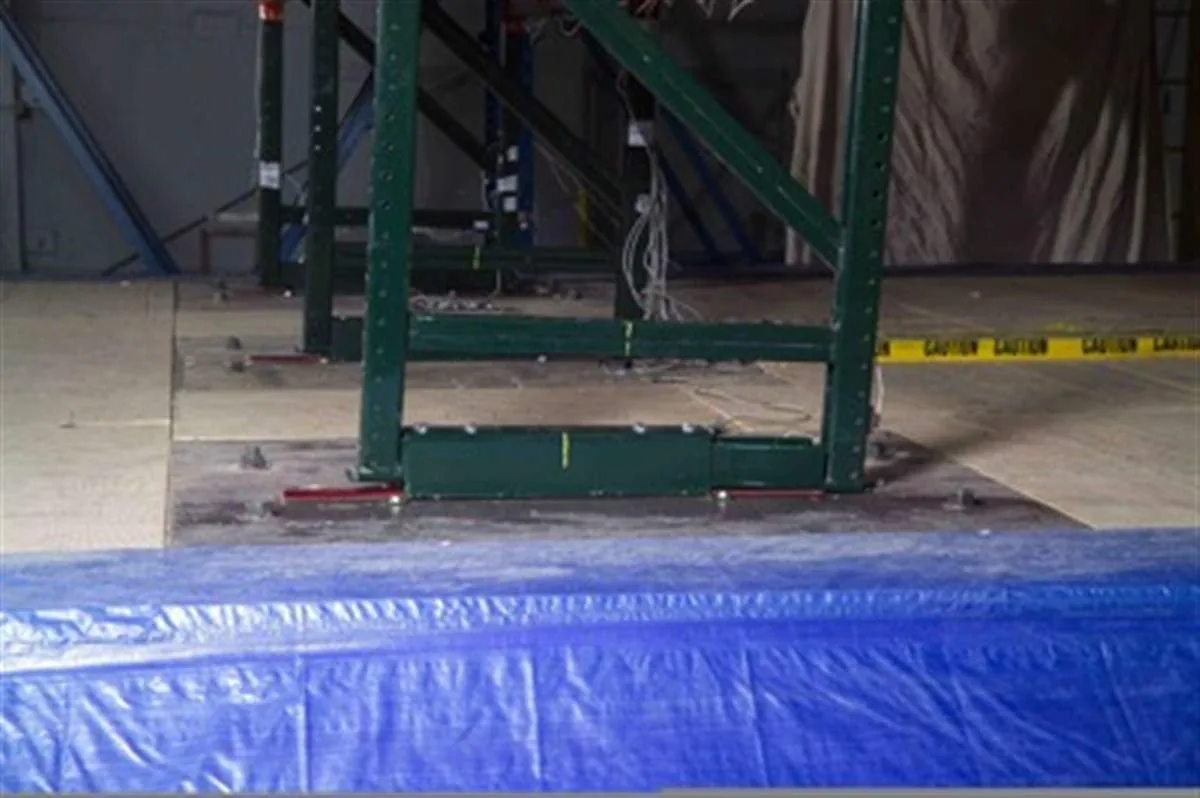 Base-isolated frame under testWith the isolator between the columns, the frame travels on the table instead of absorbing the full input. Ridg-U-Rak reports little or no merchandise shedding or rack damage at the highest simulated levels.
- Performance target: the levels outlined in FEMA 460
- Design basis event per AC156 — about 25% more intense than Northridge (6.7) and Loma Prieta (6.9)
- Up to 85% of seismic energy dissipated at the base
- Measured by independent consultants and laboratory investigators, not by marketing
- Result claimed by the manufacturer: little or no merchandise shedding or rack damage
Which Ridg-U-Rak System Carries the Load
Base isolation is an addition to a rack system, not a rack system by itself. Ridg-U-Rak builds three selective families, and the frame you choose has as much influence on seismic behavior as the isolator does. All three use roll-formed or structural columns with 100% welded uprights, large base plates and offset anchor holes.
 Teardrop (Ridg-U-Tier II)Boltless, tool-free, 2″ vertical adjustability. Column sizes of 3″×1-5/8″, 3″×2-1/4″, 3″×3″ and 4″×3″ with 2-2 through 6-2 step beams. Ridg-U-Rak’s patented Springlock mechanism replaces the older pinch-pin for positive beam-to-column engagement, and a center reinforcing rib adds bracing strength. Connection is compatible with widely available teardrop systems, so it drops into most existing warehouses.
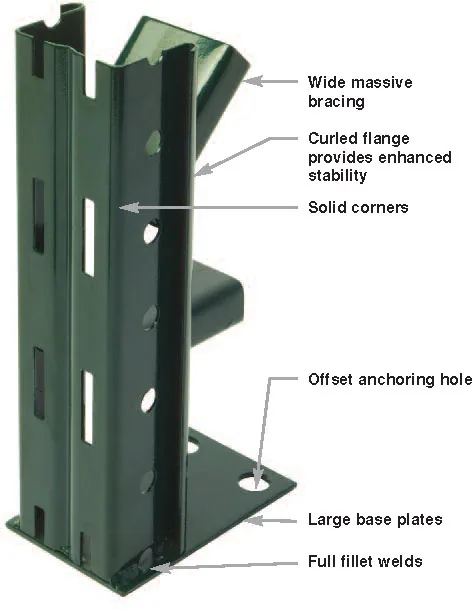 Original SlottedHook-and-slot automatic lock, 4″ vertical adjustability. Column sizes of 3″×2-1/4″, 3″×3″ and 4″×3″. Patented six-bend roll-formed columns with 180° return flanges, 100% welded uprights, wide bracing, large base plates and offset anchor holes — the profile family we quote most often when a high seismic design category drives frame design.
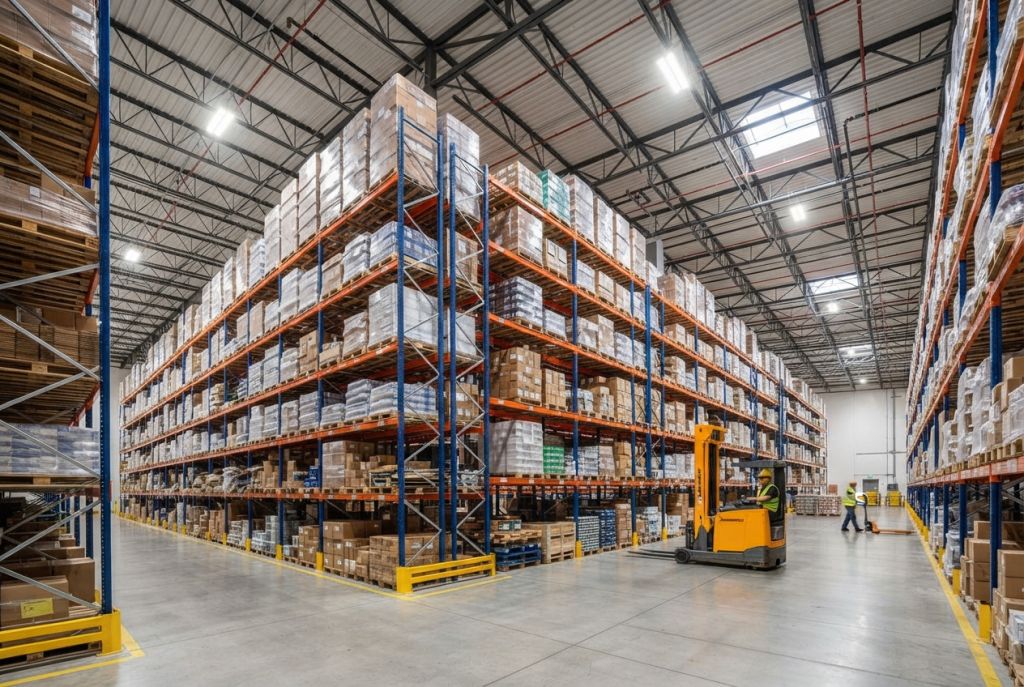 Structural Bolted RackHot-rolled channel columns, bolted connections. Where impact exposure, very heavy unit loads or a demanding seismic design category calls for more section than a roll-formed column can provide, Ridg-U-Rak builds the same system in structural steel. Heavier to install, but far more tolerant of forklift contact in tight aisles and cold storage.
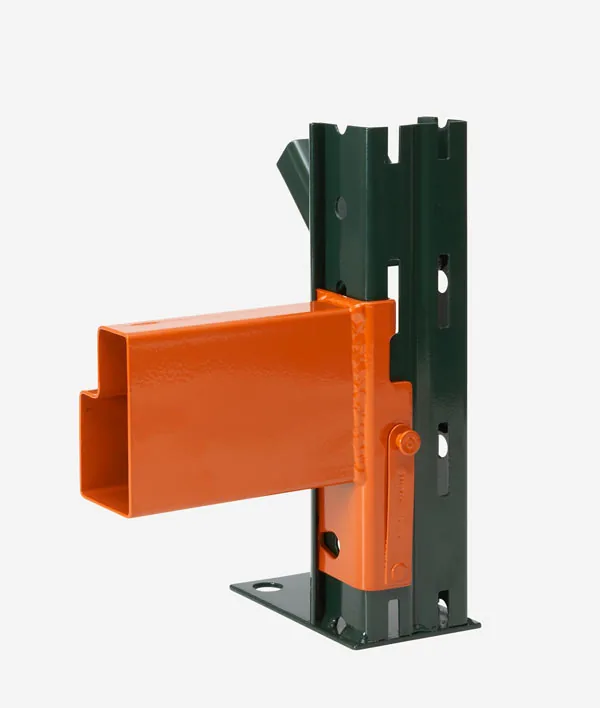
Beam-to-column connection matters more than most buyers think
Under the current RMI specification the beam-to-column connection is one of the most important variables in frame capacity — Ridg-U-Rak lists it first. The slotted family uses a hook-and-slot connection with an automatic lock and 4″ vertical adjustability; the teardrop family uses the patented Springlock automatic lock with 2″ adjustability and no tools.
In a seismic frame, a stiffer, better-engaged connection at the lower beam levels can be the difference between a frame that rates for your load and one that does not. It is also why mixing brands of beams into an existing rack line is a bad idea on a seismic site: the connection you assumed in the calculation is no longer the connection you installed.
Compare the wider family on our selective pallet rack and structural pallet rack pages.
Frame capacity tables are a starting point, not an answer
Ridg-U-Rak states plainly that traditional frame capacity tables are no longer valid as a design basis under ANSI MH16.1. Capacity depends on the connection, the average-to-maximum load ratio, base plates, anchors, number and spacing of beam levels, beam sizes, column profile and section properties, the seismic design criteria for the location, the frame height-to-depth ratio and the importance factor for retail versus industrial storage. Existing systems designed to older specifications are carried forward under their original specification unless the rack is reconfigured or relocated.
Anchoring, Base Plates and the Slab Underneath
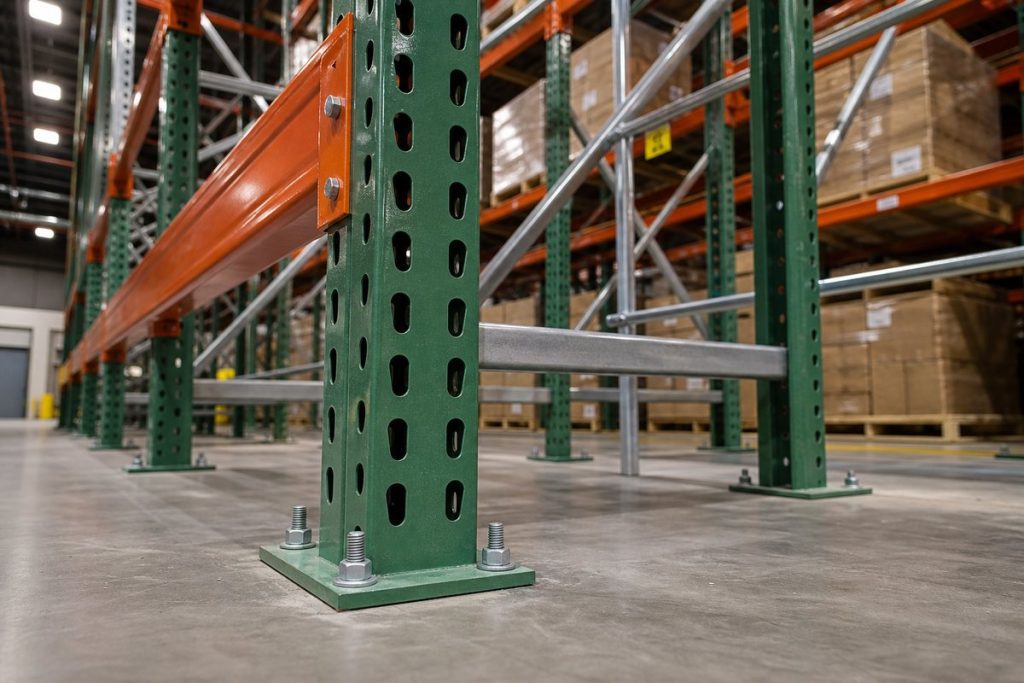
On a seismic project, the interface between column and concrete does most of the quiet work. Ridg-U-Rak requires all rack frames to be anchored to the concrete floor regardless of height, with a minimum of one anchor per rack column, and its installation guides direct the installer to the anchoring details on the approved Ridg-U-Rak drawings rather than to a rule of thumb. Anchors must be installed perpendicular to the base plate surface within a ±6° tolerance.
Three things get engineered together: base plate size and thickness, the anchor type, diameter and embedment, and the slab itself — thickness, reinforcement, joints and what is under it. A slab that is thin, cracked, or built over poor subgrade limits what any anchor can develop, which is why we ask about slab details before quoting a tall system.
Read more on pallet rack anchor bolts, and if you have existing rack, start with a rack inspection and repair assessment before adding height or load.
| Design input | Why it matters | What we need from you |
|---|---|---|
| Site address | Sets the seismic design data and hazard category for the installation | Street address, not just the city |
| Slab thickness, reinforcement and age | Governs the anchor type and the load an anchor can develop | Slab details, core data or original drawings if available |
| Frame height and depth | Height-to-depth ratio is a primary driver of frame design | Clear building height and any obstructions |
| Pallet weight and distribution | Average-to-maximum load ratio changes the frame calculation | Heaviest pallet, typical pallet, pallets per level |
| Occupancy | A retail environment accessible to the public carries a higher importance factor | Whether the public will be in the aisles |
| Lift equipment and aisle width | Drives impact exposure and guard requirements | Truck type and planned aisle dimensions |
Seismic Accessories and Frame Options
These are the components we specify most often on seismic pallet rack projects. Each one either spreads load into the slab, keeps the geometry the engineer assumed, or protects the frame from the damage that quietly invalidates the design.
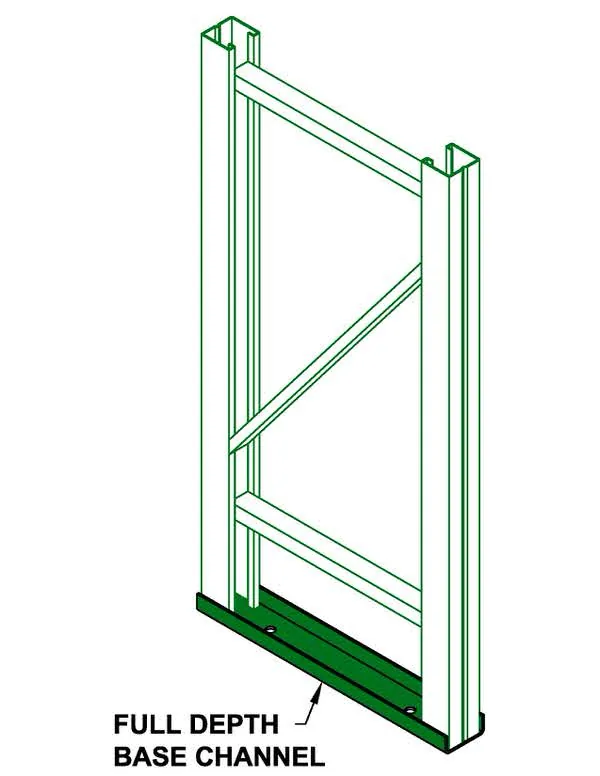 Full Depth Base ChannelA channel that runs the full frame depth and ties both columns together at the floor, spreading anchor loads across a wider footprint. Commonly specified on tall frames and in higher seismic design categories.
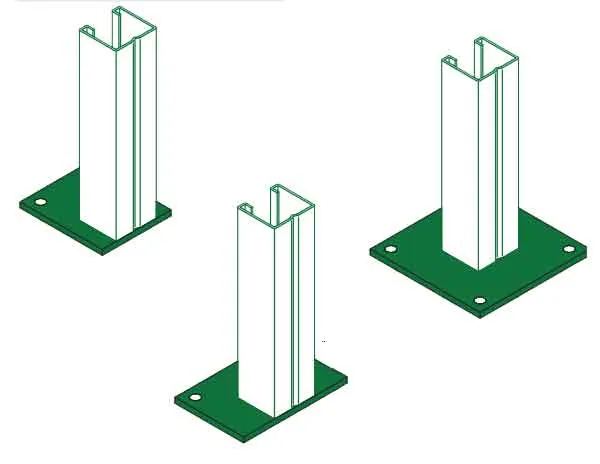 Base Plates & FootplatesLarger base plates and offset anchor holes are standard on Ridg-U-Rak uprights. Plate size, thickness and anchor pattern are engineered per installation — a bigger seismic demand means more plate and more anchors, not a heavier beam.
 AnchorsRidg-U-Rak requires every rack frame to be anchored to the concrete floor regardless of height, with anchors installed perpendicular to the base plate within a ±6° tolerance and the anchor schedule taken from the approved installation drawings.
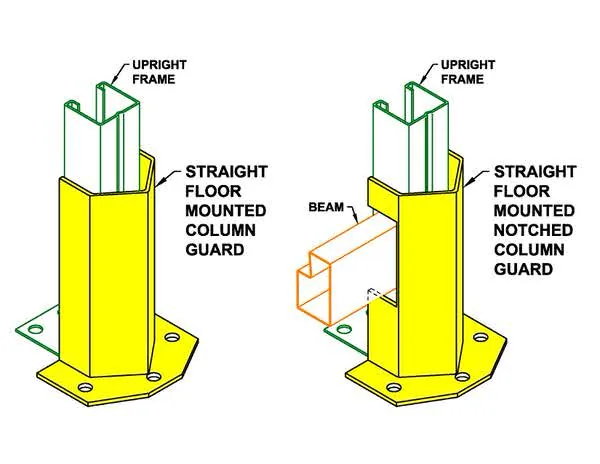 Column GuardsStraight and notched floor-mounted guards protect the bottom of the column, where a struck upright can pull anchors or bend a base plate. Impact damage is the most common reason a seismically engineered frame stops performing as designed.
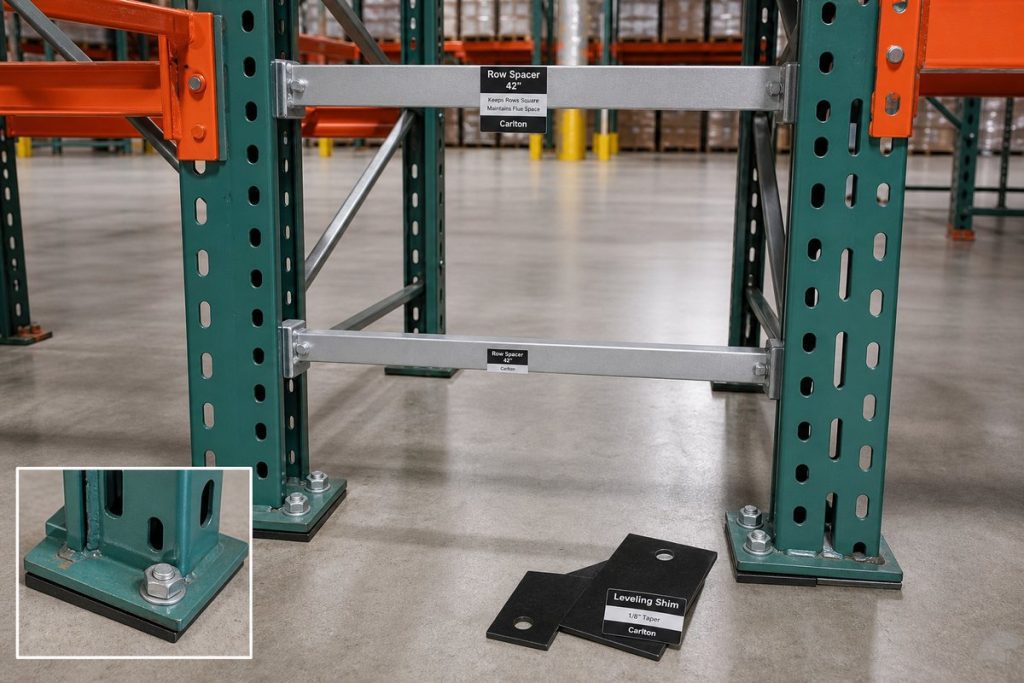 Row Spacers & ShimsRow spacers tie back-to-back rows together so the pair acts as one structure down the aisle; shims keep frames plumb on an out-of-level slab, which matters more than most buyers expect in seismic design.
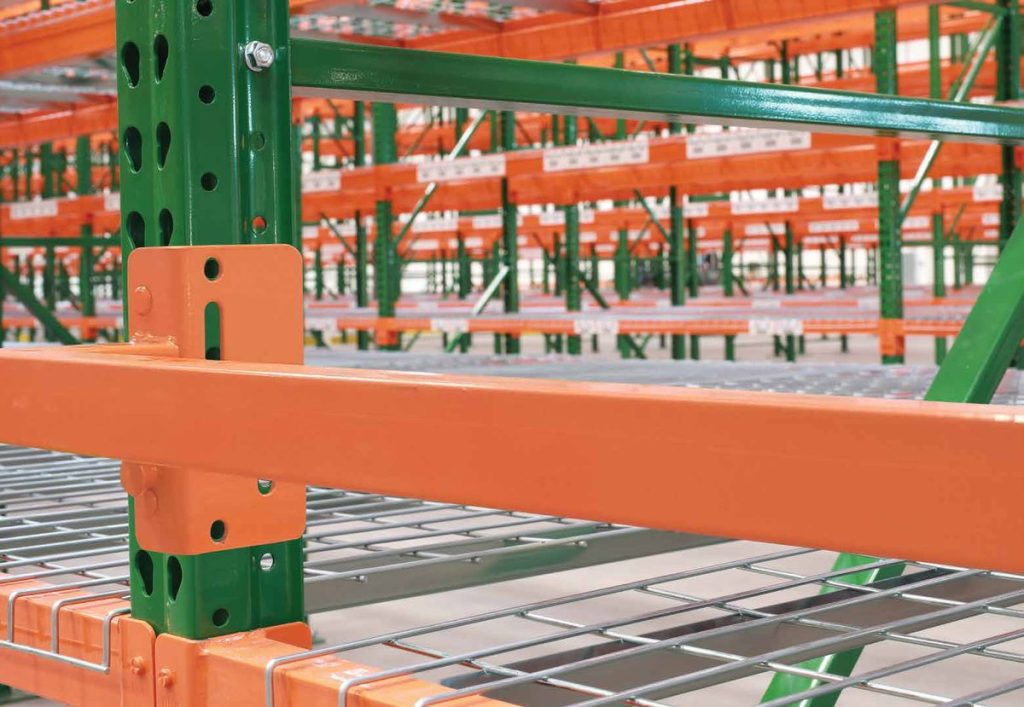 Wire Decking & Safety SupportsWelded wire decking reduces dust build-up, improves light and sprinkler penetration, and keeps small items from falling through. Steel safety supports add reinforcement under pallets and for hand-stacked loads.
Not sure which frame options your Seismic Design Category needs?
That is an engineering question, and it is the part we do for free before you buy. Send us the layout and site and we will spell out the base plates, anchors and guards your project actually requires.
Request a Pallet Rack Quote Pallet Rack Design Services Call (800) 326-4403
Where Seismic Base Isolation Earns Its Cost
Ridg-U-Rak identifies high-cube retail outlets, super stores, warehousing and storage facilities as the primary markets for the Pellegrino system. In practice the decision comes down to what a spill costs you — in product, in downtime, in exposure to people in the aisles.
 Distribution & 3PL WarehousesSelective rack, high pallet turns, tight recovery windows. Base isolation protects both the inventory and the ability to ship the next morning — the cost of a week of downtime usually dwarfs the cost of the isolators.
 Food, Beverage & Cold StorageDense, heavy, high-value pallets in a hard environment. Freezer floors and heavy loads at height make seismic detailing critical, and a spill inside a freezer is far more expensive to clean up than one in ambient storage.
 High-Bay & Narrow AisleTall frames, narrow aisles, reach trucks. Height-to-depth ratio is one of the biggest drivers of frame design under the current RMI specification, so tall narrow-aisle systems are where seismic engineering earns its keep.
 Retrofit of Existing RackIsolators can be added to racks already standing — including rack built by other manufacturers — which makes them a practical upgrade after a rack inspection, a reconfiguration or a change in occupancy.
Other environments we specify seismic rack for
Published Figures and Where They Come From
Every number on this page traces to a manufacturer or standards-body source. We do not publish capacities for your project without an engineered design behind them.
| Item | Published figure | Source |
|---|---|---|
| Energy dissipated by the isolation system | Up to 85% of the seismic energy exerted on the rack system | Ridg-U-Rak, Pellegrino Seismic Base Isolation System |
| Design event | Approximately 25% more intense than the Northridge (6.7) and Loma Prieta (6.9) earthquakes | Ridg-U-Rak / Pellegrino brochure (AC156 “design basis” earthquake) |
| Performance target | Performance levels outlined in FEMA 460 | Ridg-U-Rak / Pellegrino brochure |
| Testing program | More than 100 earthquake simulations over five weeks of testing | Ridg-U-Rak, Structural Engineering Earthquake Simulation Laboratory (SEESL), University at Buffalo |
| Test equipment | One of two 23 ft × 23 ft three-dimensional shake tables | Ridg-U-Rak / SEESL at the University at Buffalo |
| Retrofit | Can be installed on new or existing systems, including racks from other manufacturers | Ridg-U-Rak / Pellegrino brochure |
| Anchoring requirement | All rack frames anchored to the floor regardless of height | Ridg-U-Rak Selective Rack Installation Guide |
| Governing standard | ANSI MH16.1 (2023 edition referenced by the 2024 IBC) | Rack Manufacturers Institute (RMI) |
RMI R-Mark certification, in plain terms
The manufacturer is a founding and executive-level member of the Rack Manufacturers Institute and holds R-Mark certifications for manufacturer, systems and installation. R-Mark is a voluntary program in which a manufacturer demonstrates it can design, manufacture and install rack systems that comply with ANSI MH16.1 (rack), MH16.3 (cantilever) and MH26.2 (rack decking). The distinctions matter when you read a proposal:
- Certified manufacturer — the company designs and manufactures the primary structural components and maintains the certification program.
- Certified system — that manufacturer designed the system to the current ANSI MH16.1 and stamped site-specific Load Application and Rack Configuration (LARC) drawings.
- Certified installation — a Registered Design Professional approved the design, a qualified inspector verified the installation against the LARC drawings, and an R-Mark certified installation plaque is posted at the site.
- Individual parts and components cannot be called R-Mark certified on their own.
- Published load tables alone are never the basis of a certified system.
Our claim discipline
We will tell you what Ridg-U-Rak publishes, what ANSI MH16.1 and the IBC require, and what your engineered drawings say. We will not tell you a product makes your building code compliant — that determination belongs to your engineer of record and your authority having jurisdiction.
How a Seismic Rack Project Runs With Us
Site and load review
We collect the installation address, slab details, building height, pallet weights and counts, lift equipment and whether the public will be in the aisles.
Layout and engineering
We lay out the system, size frames and beams for your Seismic Design Category, and determine whether base isolation, heavier columns or a full depth base channel is the better answer.
Drawings and permit
Sealed drawings and load plaques go to your local building department. In Utah, pallet rack commonly requires a permit — we handle that submission.
Installation
Our crews build to the approved drawings, anchor to the specified schedule and pattern, plumb and shim the frames, and post the load plaques.
Handover and inspection
You get the drawing set and load plaques, and we set you up for periodic rack inspection so the system keeps performing the way it was engineered.
We are headquartered in Salt Lake City and install nationwide. Utah, Idaho, Nevada, Wyoming and Colorado projects are our home turf, and the Wasatch Front is a high seismic hazard area — so most of the rack we sell here is seismic rack, not a special case.
Shop Online at MaterialHandling-USA.com
Need rack accessories, guards or handling equipment you can buy online today? Our e-commerce store lists stocked products with published pricing.
Ridg-U-Rak Seismic Base Isolation FAQs
What is the Pellegrino Seismic Base Isolation System?
How much earthquake can it handle?
Can base isolators be retrofitted to pallet rack we already own?
Does the isolator get in the way of forklift operations?
How was the system tested?
Does installing base isolation make my rack code compliant?
Do published frame capacity tables tell me what my frames will hold?
What is a Seismic Design Category and why does it change my quote?
Is Ridg-U-Rak RMI R-Mark certified?
What do you need from me to quote a seismic rack system?
Related Pallet Rack Products & Resources
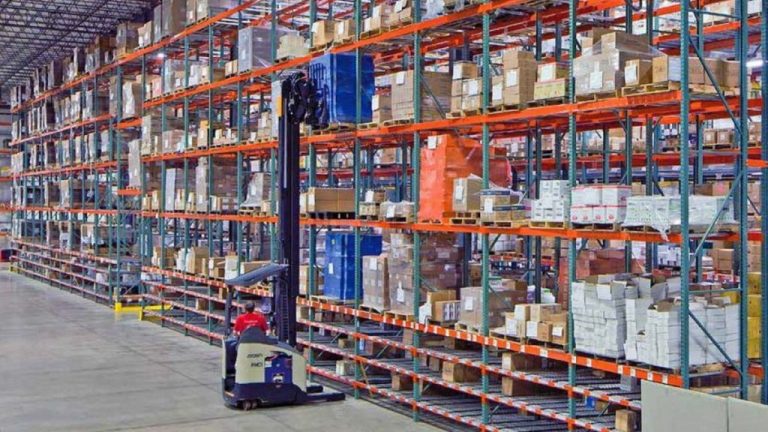 Pallet Rack SystemsEvery rack type we design and install, with the trade-offs between density and selectivity.
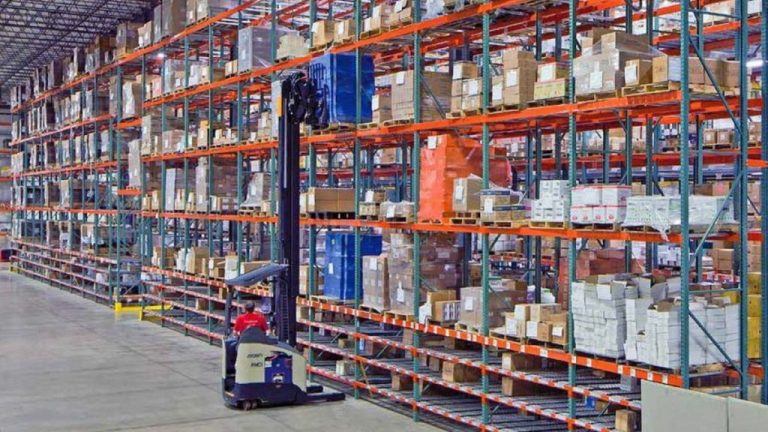 Selective Pallet RackThe workhorse system Ridg-U-Rak seismic frames are usually built as — specs, sizes and layout rules.
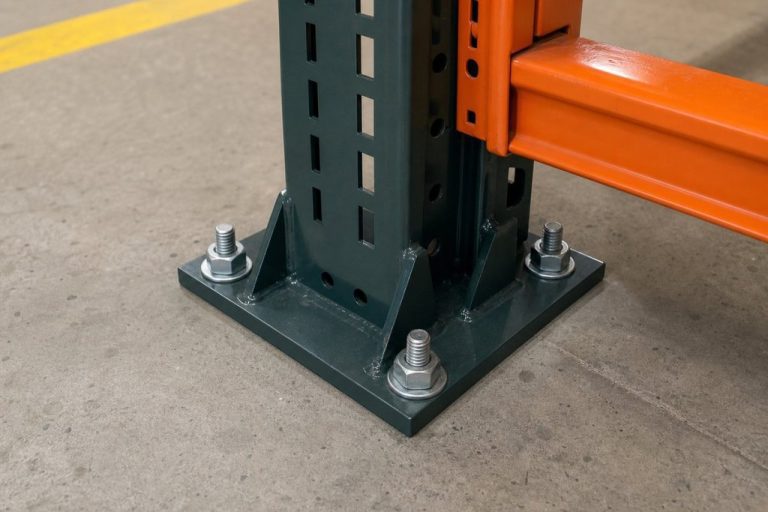 Pallet Rack Anchor BoltsAnchor types, embedment, slab requirements and the mistakes that fail an inspection.
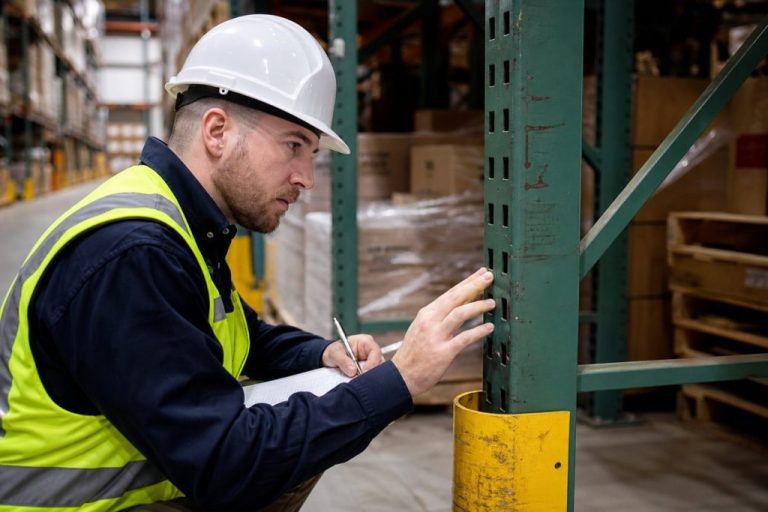 Rack Repair & InspectionPeriodic inspection, damage criteria and repair — the step that keeps a seismic design valid.
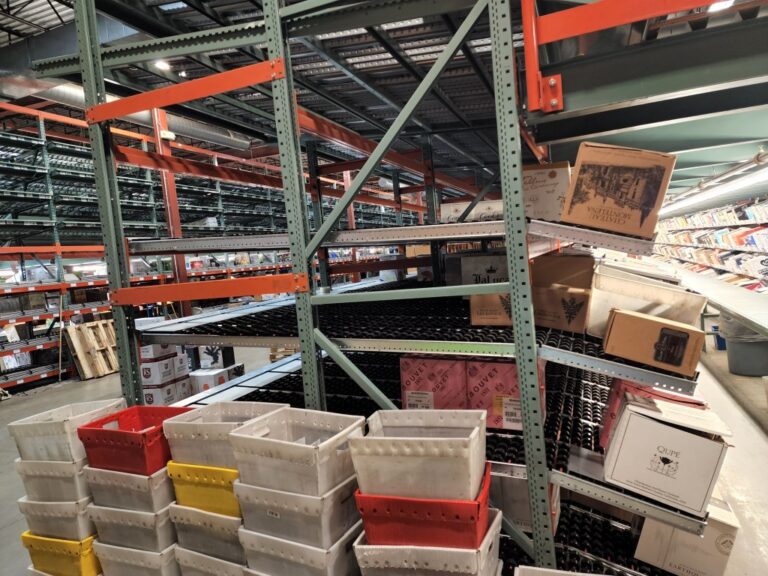 Pallet Rack Permitting in UtahWhat the building department wants to see before rack goes up on the Wasatch Front.
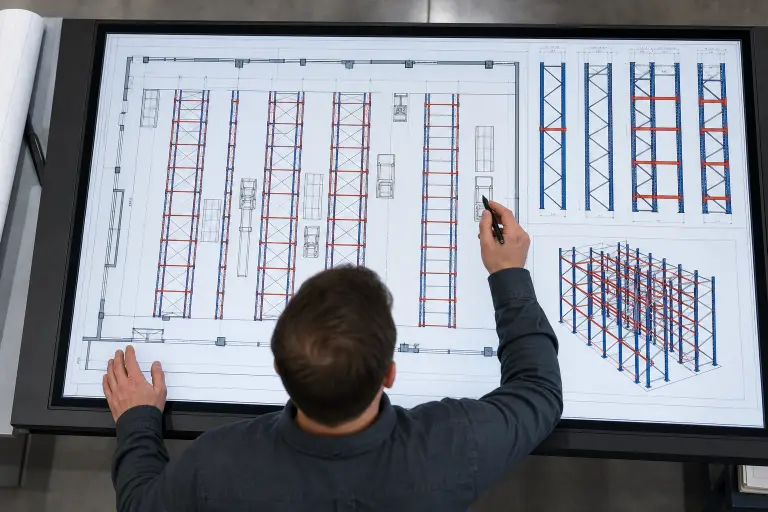 Pallet Rack ConfiguratorLay out your bays, beams and levels online and send the configuration straight to our engineers.
Get Seismic Pallet Rack Engineered for Your Site
Send us the installation address, pallet weights and building height. We will size Ridg-U-Rak frames for your Seismic Design Category, tell you whether Pellegrino base isolation is justified, and quote the drawings, permit and installation with it.
Ready to configure your pallet rack system?
Use our guided configurator to choose the right configuration, review your parts and submit it for checkout or a formal quote.