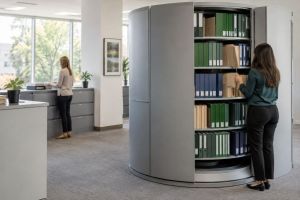
A records room in a Utah County building rarely fails all at once. It fills a shelf at a time. Personnel folders creep into the space that purchasing used to occupy, public-records requests stack up beside the copier, and the student transcripts everyone said were archived are still within arm's reach because nobody trusts the index.
By the time a facilities manager gets asked to fix it, the paper has already cost the office. Staff walk the same aisle twice. A request sits open a day longer than it should. And the answer arrives as a request for more square footage the building doesn't have.
Rotary file storage for Utah County and school district offices solves that differently. It puts a second filing face into the same footprint and lets one person reach most of it from one spot. The equipment is the easy part. The work is matching the unit to the record series, the retention rules and the people who pull the files.
Who Needs Rotary File Storage for Utah County and School District Offices
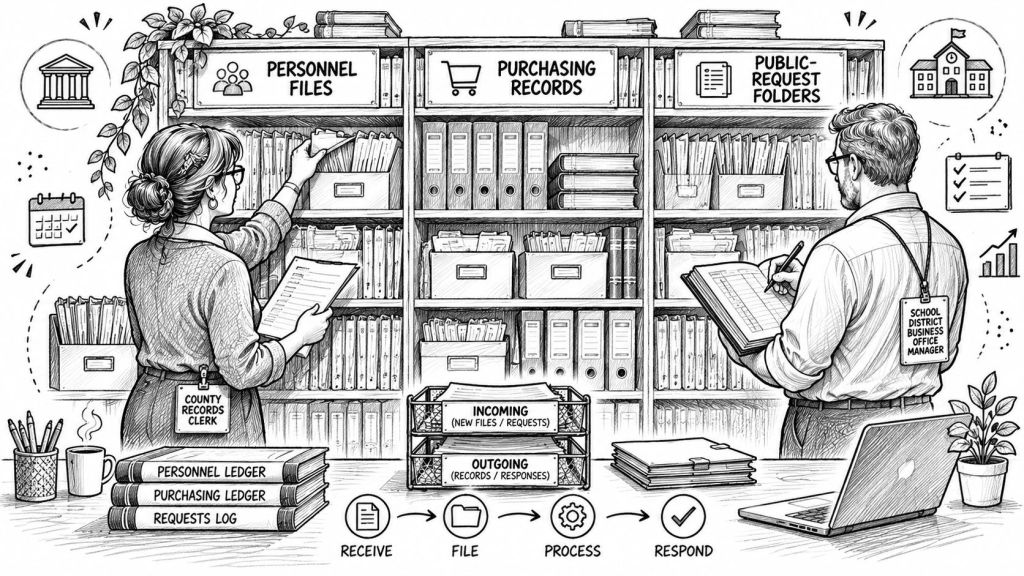
Say a district business office keeps personnel files, purchasing records and a growing stack of public-request folders in one room. Three people pull from it daily. Two know where things are. The third is a substitute covering the front counter, and every request turns into a phone call to someone who is in a meeting.
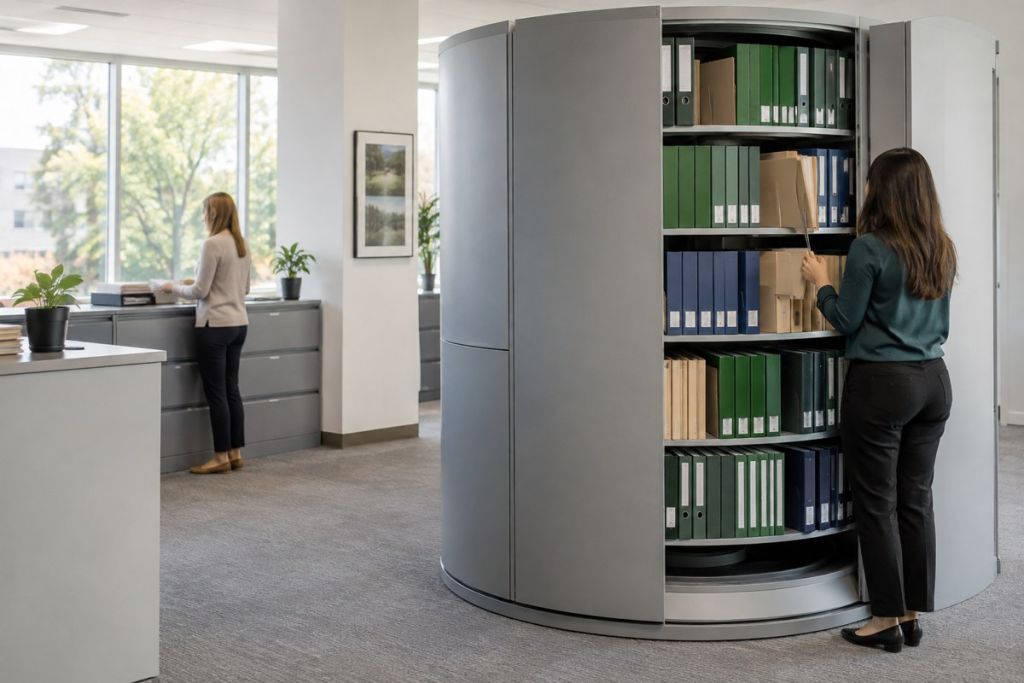
That room is the case for a rotary unit. A rotary cabinet turns a wall of folders into a short rotation. One operator stands in one place and reaches sections on both sides of a moving shell, which is why the format survived the move to digital records instead of disappearing with the paperless office.
This guide is for the people who specify and then live with these rooms: facilities managers, records officers, operations leads, procurement staff and maintenance teams across county and district buildings.
What the room has to hold
- Personnel and payroll files. Confidential, long-retention and pulled mostly by one or two people in HR.
- Purchasing and finance records. High volume, short active life, constant retrieval during audits and year-end close.
- Board minutes and meeting packets. Permanent records that get requested years after the meeting.
- Student records and transcripts. Restricted access, frequent registrar and front-office pulls, and a formal record series in their own right.
- Public-records request files. Arrive through an online portal, by email or in person, and often all three on the same morning.
That last category is what makes retrieval speed as important as capacity. A unit that stores 40,000 folders but buries the open request behind six rotations loses to a smaller unit with a better index.
Scale isn't the only argument for planning. The Utah State Archives holds a Murray City School District collection covering roughly 1960 to 1965 that occupies 0.70 cubic feet and was transferred to the archives in December 2015 after passing through the Murray City Museum, as the Utah State Archives education records guide documents. Even that small a collection needed controlled custody decades after anyone stopped adding to it.
Material Handling USA works with government and education customers from its Salt Lake City headquarters. A look at an administrative office storage project in West Valley City shows how a records room gets built around retrieval rather than raw capacity, and the Times-2 rotary file options for Utah collect the local configurations.
Before you call anyone, make a two-column list. On the left, every record type in the room. On the right, who retrieves it and how often. If a line has no name next to it, that material belongs in archive shelving, not in your premium access space.
Rotary File Configurations Compared for Utah Offices
Four configurations come up in nearly every county and district file room conversation, and they are not interchangeable. Each one controls a different mix of access, custody and continuity, so the choice should follow the retention obligations attached to each record series in the room rather than the raw folder count.
| Configuration | Best Fit | Access Method | Floor Footprint | Main Trade-off |
|---|---|---|---|---|
| Two-sided manual rotary | Shared records room with one trained operator | Hand or pedal rotation to reach each section | Compact | Access depends on operator position |
| Multi-tier rotary | High-volume personnel or student files in one location | Rotation to reach rear sections | Dense for its footprint | Single point of failure that needs locks and sign-out |
| Motorized vertical carousel | Confidential files that need tracked retrieval | Operator call-up from a control point | Vertical footprint | Higher purchase cost plus a dedicated circuit, so confirm power and a manual fallback before ordering |
| Lateral or fixed shelving | Low-volume archives and inactive boxes | Direct walk-in access | Larger floor area per file | Lower density and limited access control |
Two-sided manual rotary. The operator turns the shell by hand or with a pedal and reaches both faces from one position. It is the least expensive route to density and the easiest to live with in a room where one or two people do most of the pulling. The Times-2 rotary file cabinets are the version most offices compare first.
Multi-tier rotary. More sections stacked into the same footprint, which is how a records room absorbs a decade of growth without a remodel. Understand what you are accepting. If the unit jams or a key goes missing, an entire series goes out of reach until someone fixes it, and for a series with a long retention period that gap has to close fast. Lock control and a named keyholder matter more here than anywhere else in the room.
Motorized vertical carousel. A bin comes to the operator on command, which suits tracked retrieval and long shifts on your feet. It is also the option where cost and electrical work decide the project before capacity does. Confirm the circuit and the manual fallback before you sign, because a confidential series still has to be retrievable during a power outage or a service call.
Lateral or fixed shelving. Walk-in access, lowest cost per file, least density, weakest access control. Use it for boxes nobody requests and stop trying to make it serve active folders.
Density carries a second trade-off that buyers underrate. A single rotary unit can hold a large share of an office's active files in one location, so locks, sign-out logs and a second retrieval path stop being optional. Published descriptions of high-capacity arrangements show how far that goes: some rotary configurations hold the equivalent of 17 four-drawer filing cabinets in three eight-tier units, with about 50% of stored items visible immediately and the rest a pedal rotation away, according to Places Journal's history of the filing cabinet. When that much of a series sits behind one door, the lock policy becomes part of records governance rather than facilities housekeeping.
Capacity claims differ by manufacturer, so don't compare on a single number from a brochure. Request the rated capacity, the number of folders per section, the carrier depth and the shelf adjustability, then compare.
Inactive records are a different purchase entirely. When cartons sit for years and get pulled maybe twice, dense rotating equipment is wasted money. Standard archive boxes on open shelving cost less and work better, and a supplier such as Buy Archive Boxes – Filing & Archive box Discount Deals covers the container side of that plan. Mix the two systems in one room and the density lands where it pays.
The dividing line is governance. Run density for active series in one room, open shelving for inactive files that are rarely retrieved. Three questions settle which configuration you are buying: how many people retrieve files, how often they do it, and how confidential the records are. The quote should name the series each unit will hold, because the retention clock on that series is what justifies the spend.
Sizing, Layout and Access Planning Steps
Size a rotary unit around record series, not around a total folder count. Utah's Division of Archives and Records Service explains that agencies use approved retention schedules to determine how long a record series must be kept and what happens when it no longer has value, and its schedules cover state and local agencies, education agencies, courts, the Legislature and the Governor's Office, per the Utah retention schedules index. That's your sizing input.
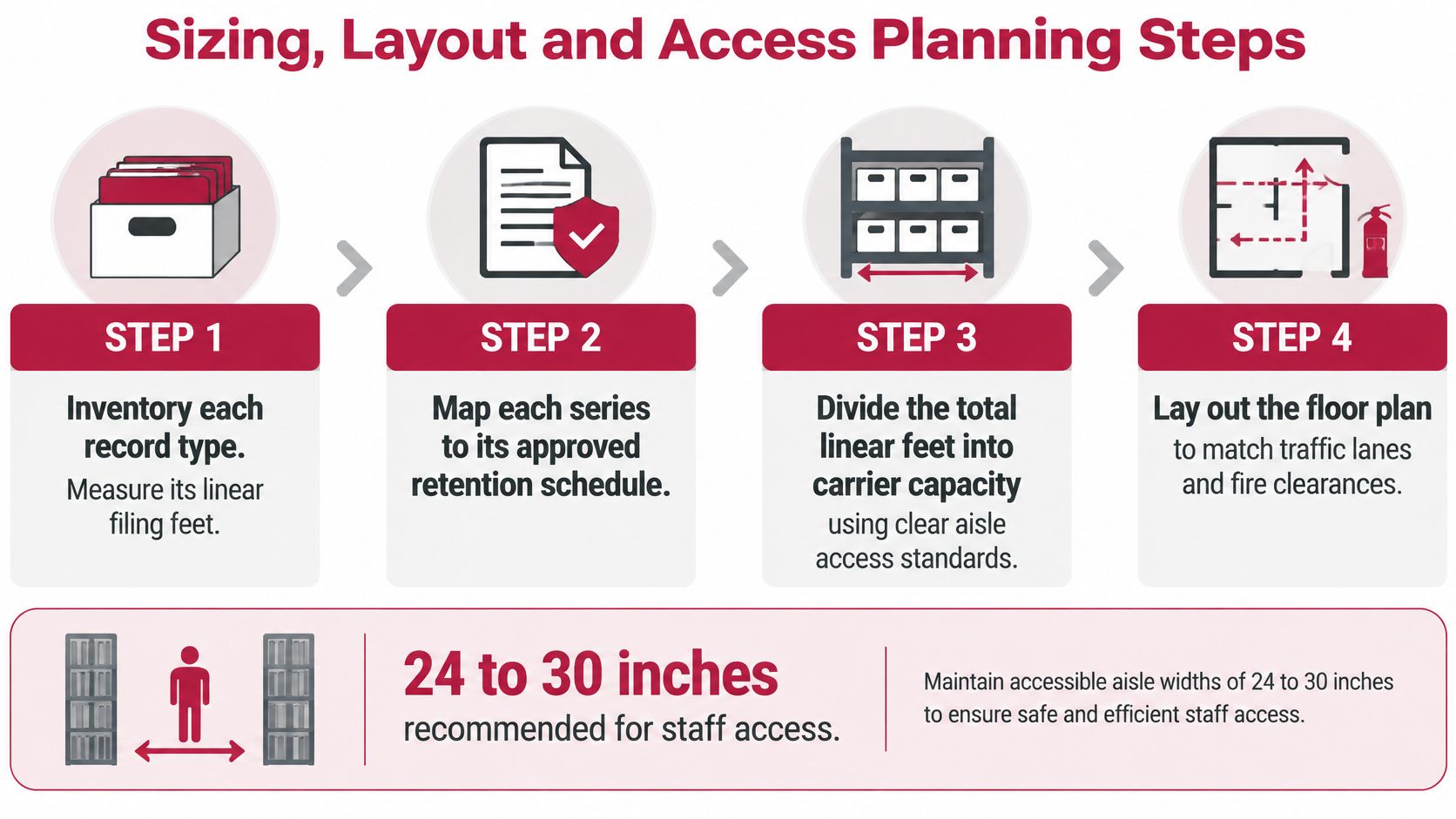
- Inventory every record type and measure its linear filing feet. Measure what's in the room, not what the last move counted. Add the folders still in desk drawers.
- Map each series to its approved schedule. Retention varies more than most buyers expect. Utah's school district schedule, for example, treats board minutes as permanent, holds some ballot records for at least 22 months, and can require personnel files for 65 years or three years after retirement or death, per the state RAMP retention schedule. Those differences drive where each series sits.
- Split the files into four piles. Active, inactive, awaiting transfer, and disposal review. Only the first pile earns prime access.
- Size for growth plus surges. Public-records requests, audits, elections and litigation holds all spike volume on a schedule you can't control.
- Place files by retrieval frequency. Active series go at operator reach. Long-retention and low-frequency material moves to outer and upper positions, where it still exists but stops consuming your best space.
- Write the access rules before you choose dimensions. Locks, check-out logs and permissions are cheaper to specify than to retrofit.
- Check the physical envelope. Floor loading, aisle clearance, ceiling height and the reach range of your shortest operator all constrain the unit size.
Practical rule: overpacked folders slow every retrieval and make inventory drift. Leave room for reclassification, because schedules get revised.
A layout planner helps you test options before committing. The mobile shelving planner walks through room dimensions and capacity so the numbers stay honest.
Three measures tell you whether the install worked: retrieval time per request, misfile incidents per month, and the share of files carrying complete disposition details.
Utah Code, Safety and Site Requirements to Confirm
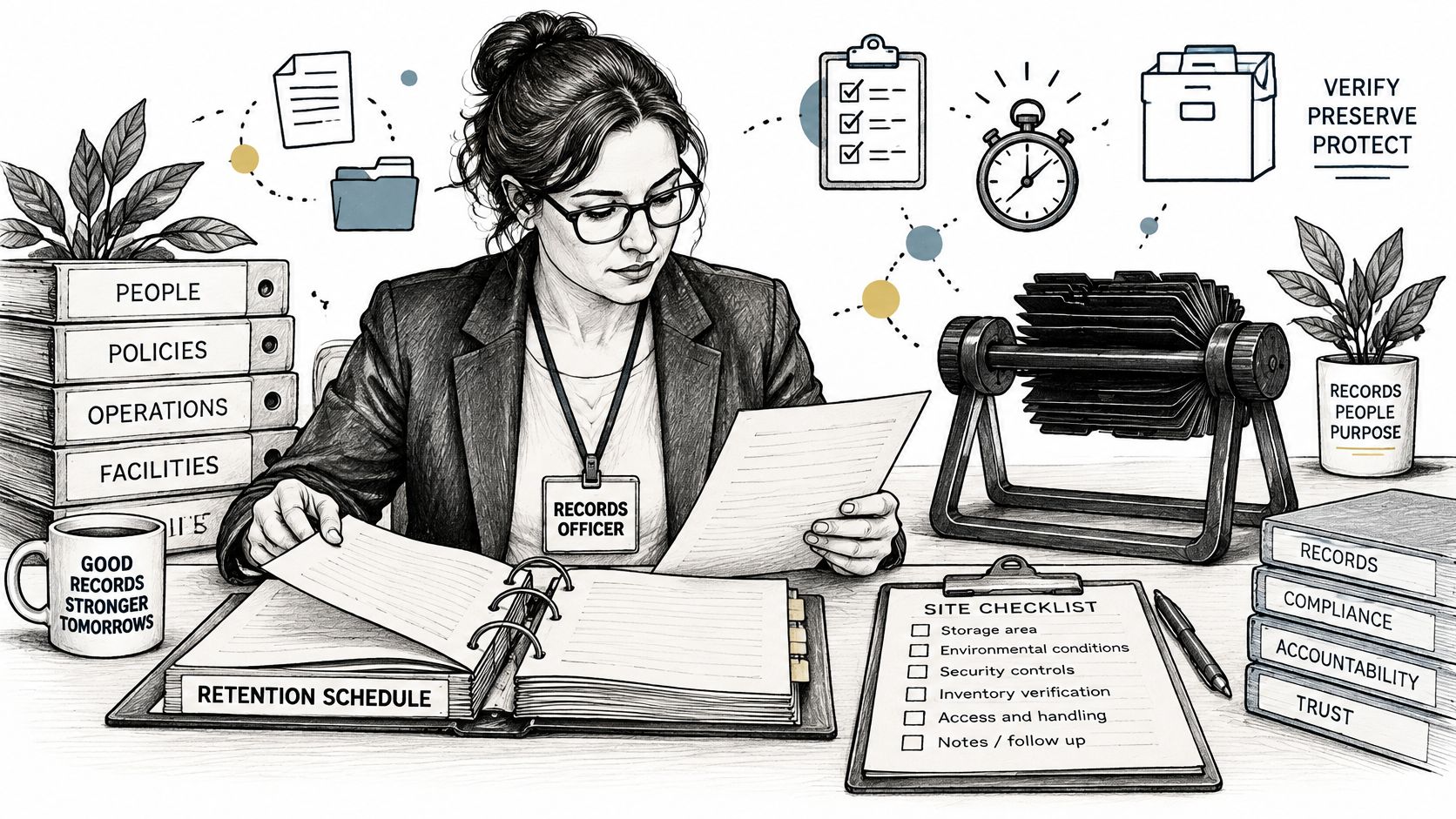
A rotary unit in a public office sits at the intersection of records law and building code, and both sides get checked before a single carrier is labeled. Run this list with your records officer and your facilities lead together, because the answers decide where each record series physically lives.
Confirm the governing schedule for every series. Utah requires local education agencies to maintain retention schedules covering all their records, and duplicate versions are supposed to be purged once the official record copy is destroyed. Destruction and transfer happen only after the minimum period clears and any litigation hold is lifted. Each series in the unit should map to an approved schedule entry before the layout is drawn, so shelf positions reflect retention categories rather than convenience.
Name one authoritative copy. Mark duplicates during indexing and pull them after the official copy is destroyed, so the unit doesn't fill with extras that carry no legal value.
Separate the confidential carriers. Student and personnel files sit behind locks, sign-out logs or user permissions. Public-request and board files can sit in a more open zone. That split matters because one carousel holding both types turns every routine access into a records review.
Get the anchor reviewed. Ask the engineer of record to check floor load, anchor pattern and seismic restraint for the loaded unit. A standard anchor detail isn't proof of anything. The review has to cover the weight of the unit fully loaded, not empty.
Walk egress with the fire marshal. Mark aisle clearances on the plan and confirm them after installation, not before.
Public-records access drives part of this. Salt Lake County's administrative schedule identifies government-record request forms as records documenting requests under Utah Code 63-2-204 and assigns meeting recordings used to create official minutes a four-year retention period unless litigation or another statute requires longer, as shown in the Salt Lake County administrative retention schedule. Use it as a comparison point for how request files and meeting records get handled. It is not Utah County's own schedule, so confirm your own series and periods before locking positions.
A vendor layout does not certify code compliance. Get written answers on anchoring, clearance and the duplicate rule, and keep them with the project file.
Installation, Lead Time and Service Planning
The install runs in phases, and each one can move your dates.
- Site survey. The installer measures floor, ceiling, doors and power at the actual location.
- Layout and permit review. Drawings and any structural or permit steps get confirmed.
- Quote approval. Configuration and accessories lock in here, which is why changes cost more later.
- Manufacturing or ordering lead time. Ask for it in writing before you promise a move-in date.
- Delivery and freight. Dock access, door widths and elevator size decide whether the unit reaches the room.
- Anchoring and installation. The unit gets leveled, anchored and tested.
- Training and first indexing. Staff learn the lock, sign-out and index rules before the first request lands.
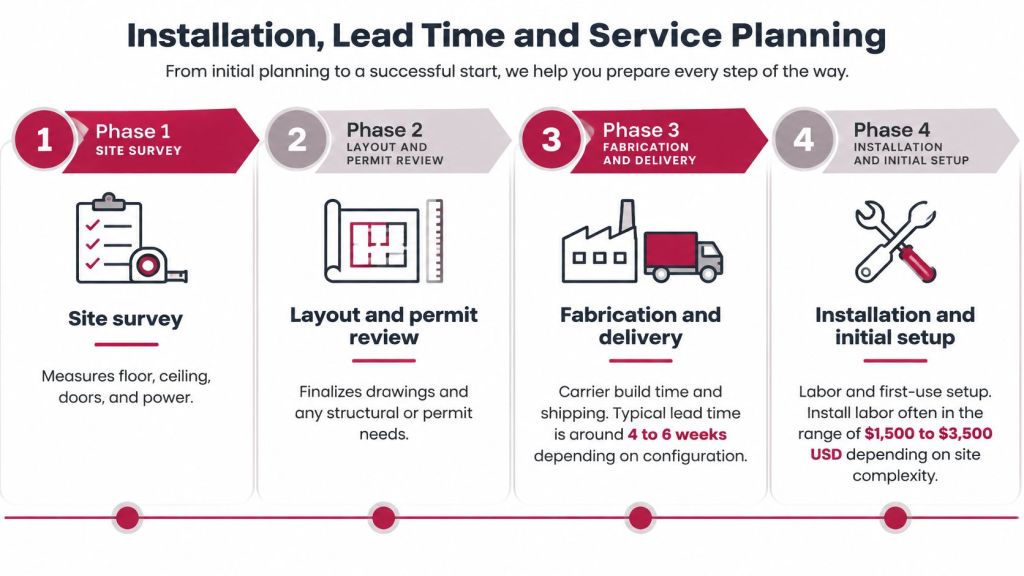
Lead times vary by configuration and site. Some common sizes are stocked at select manufacturers, subject to confirmation, and that's worth asking about early rather than assuming. Material Handling USA designs and installs storage solutions for each customer's specific needs, and its local service areas include Salt Lake City, Provo, Ogden, Park City, St. George, Logan, Lehi and Orem.
Bring these questions to the supplier:
- Maintenance terms. What's covered, for how long, and who responds.
- Parts availability. Which components are stocked and which are built to order.
- Written fallback plan. What staff do to reach records when power, software or the unit itself is unavailable.
Matching Your Office Scenario to the Right Configuration
Scenario drives configuration, and configuration drives the quote request. Here's how four common buyers sort out.
| Buyer Scenario | Likely Configuration | First Priority | Confirm Before Quoting |
|---|---|---|---|
| County records office with high retrieval demand | Multi-tier rotary with sign-out control | Retrieval time and public-request response | Peak request volume and lock needs |
| School district business office with personnel and student files | Rotary with lockable sections and indexing | Role-based access | Records officer and schedule series |
| Facilities team storing inactive archives | Fixed or lateral shelving, with rotary for active files | Low cost per file | Transfer and disposal dates |
| Procurement or finance team with mixed volumes | Motorized carousel for tracked access | Controlled retrieval | Floor loading and power needs |
For school district buyers, there's a hard requirement behind the second row. Local education agencies in Utah must have retention schedules adopted for all records, and those schedules specify how long a series is kept and what happens afterward, as the Utah State Board of Education data retention study sets out. That means files get grouped by series and retention status, not by employee or by room.
Ask for a filing plan that names the responsible records officer, the schedule number or series, the minimum retention period and the approved final action. Do that before shelves, folders, labels or permissions are set. Provo City School District's records-access policy, for example, has the superintendent designate records officers responsible for creating retention schedules and responding to district-record requests, with retention set under Utah Code Section 63G-2-604, per Provo School District policy 7040. Your district has an equivalent, and a supplier needs it.
A mixed setup is often the right answer. A school records file room project in Cottonwood Heights shows active files in dense storage with inactive material kept separate, which is the arrangement most districts land on after the first inventory.
Common Questions About Rotary File Storage in Utah
Do electronic records remove the need for a rotary unit? No. Utah guidance holds that retention periods depend on the record's content rather than its physical or digital medium, and that electronic records must stay accessible and protected against alteration, deletion, damage or loss across the retention period, per the Utah records management essentials guide. Districts still keep paper transcripts, personnel files and request packets that staff must reach during a network outage.
What usually goes wrong on the first layout? Buyers size every folder as active, mix student and finance series in one undifferentiated carousel, and skip a litigation-hold flag. Prime positions then fill with files that should have moved or waited.
How should a substitute reach files in a shared front office? Give them a labeled operator side, a sign-out log, and a key or code list held by the records officer. Not a shared open spin.
What has to fit through the building? Measure the tightest door, the corridor turn and the elevator before the quote. A unit that can't enter the records room delays the whole install.
Who signs destruction? The designated records officer, after the schedule period and any hold clears. Not the installer, and not whoever is clearing space on a Friday.
Are common sizes on the shelf? Some common sizes are stocked at select manufacturers, subject to confirmation.
Which page compares Utah options? Use the Utah Times-2 hub once you've listed series, linear feet and your access rule.
Request a Layout Review and Quote for Your Office
The work comes down to six steps. Confirm the record series and retention schedules. Choose the configuration by access pattern rather than brochure capacity. Size for normal growth plus surge space. Verify locks, anchoring and clearances. Set permissions and check-out rules. Then hold the supplier to a written installation schedule.
Send that package to the supplier along with the floor dimensions. A quote built on your record series, linear feet and access rules prices a retention control. A quote built on square footage alone prices a cabinet, and cabinets are what got the file room crowded in the first place. Material Handling USA's design team scopes records and storage rooms alongside warehouse design, pallet rack layout and permitting, stockroom design, evidence storage rooms, server cages, medical labs, in-plant offices and locker rooms, so the layout review can account for the whole room rather than a single unit.
Timing favors offices that start early. Freight, fabrication and permit review all queue up, and a records room that waits until the fiscal year ends usually installs during the busiest request season of the year.
When you're ready, request a quote with your file inventory and room dimensions. Call (800) 326-4403 to talk through a configuration, or email Sales@MH-USA.com to start a layout review. The office is at 222 S. Main St., 5th Floor, Salt Lake City, UT 84101, and the team serves customers nationwide from its Salt Lake City headquarters.
Material Handling USA designs and installs records and storage rooms for Utah county and school district offices, from the first linear-foot inventory through anchoring and installation. If your file room is holding two record series in one undifferentiated bank of cabinets, that's the right moment to fix the layout rather than add another cabinet. Visit Material Handling USA to start a layout review, or call (800) 326-4403 and walk through your record series with a specialist.