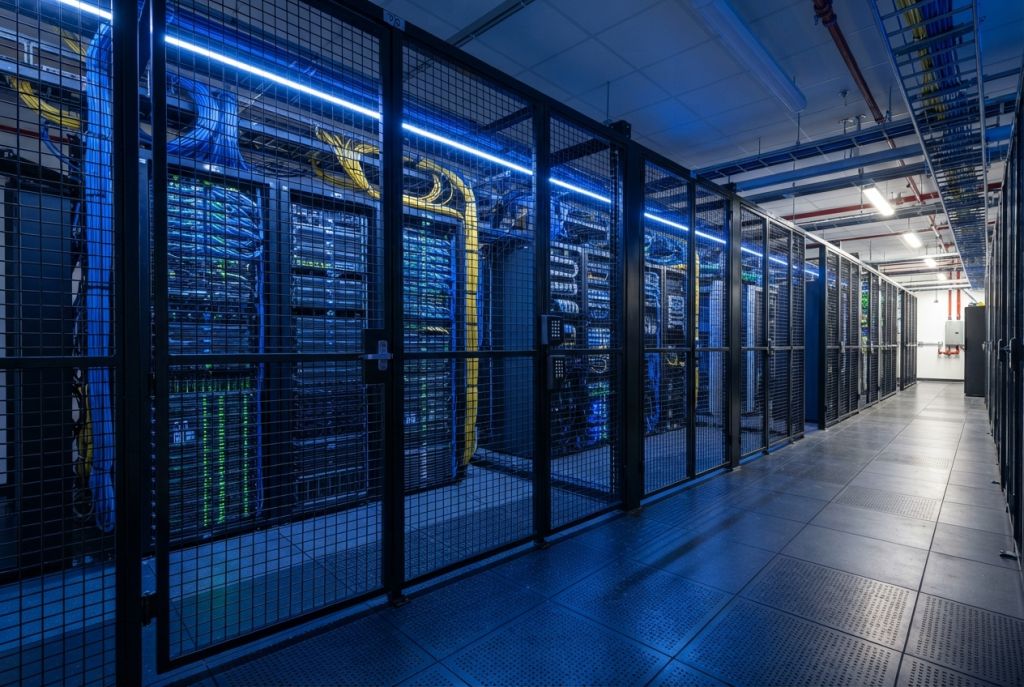
As data centers grow in complexity and value, physical security has become just as critical as cybersecurity. A single server rack can hold millions of dollars in hardware and priceless data. Data center security cages — also called colocation cages — provide the physical barrier that separates your equipment from everyone else’s while meeting compliance requirements that auditors demand.
Why Data Centers Need Physical Cages
In multi-tenant colocation facilities, dozens or hundreds of companies share floor space. Without physical separation, you’re trusting that every other tenant’s employees, contractors, and visitors will stay away from your racks. Data center cages solve this by creating individually secured enclosures within the larger facility.

Key Drivers for Data Center Caging
- Compliance: SOC 2, HIPAA, PCI-DSS, and ISO 27001 all require physical access controls for sensitive data
- Multi-tenancy: Isolate customer environments in colocation facilities
- Insurance: Carriers may require caged enclosures for high-value equipment
- Theft prevention: Server hardware, GPUs, and networking equipment are high-value targets
- Audit trails: Cages with electronic locks create access logs for compliance reporting
Data Center Cage Design Principles
1. Airflow Management
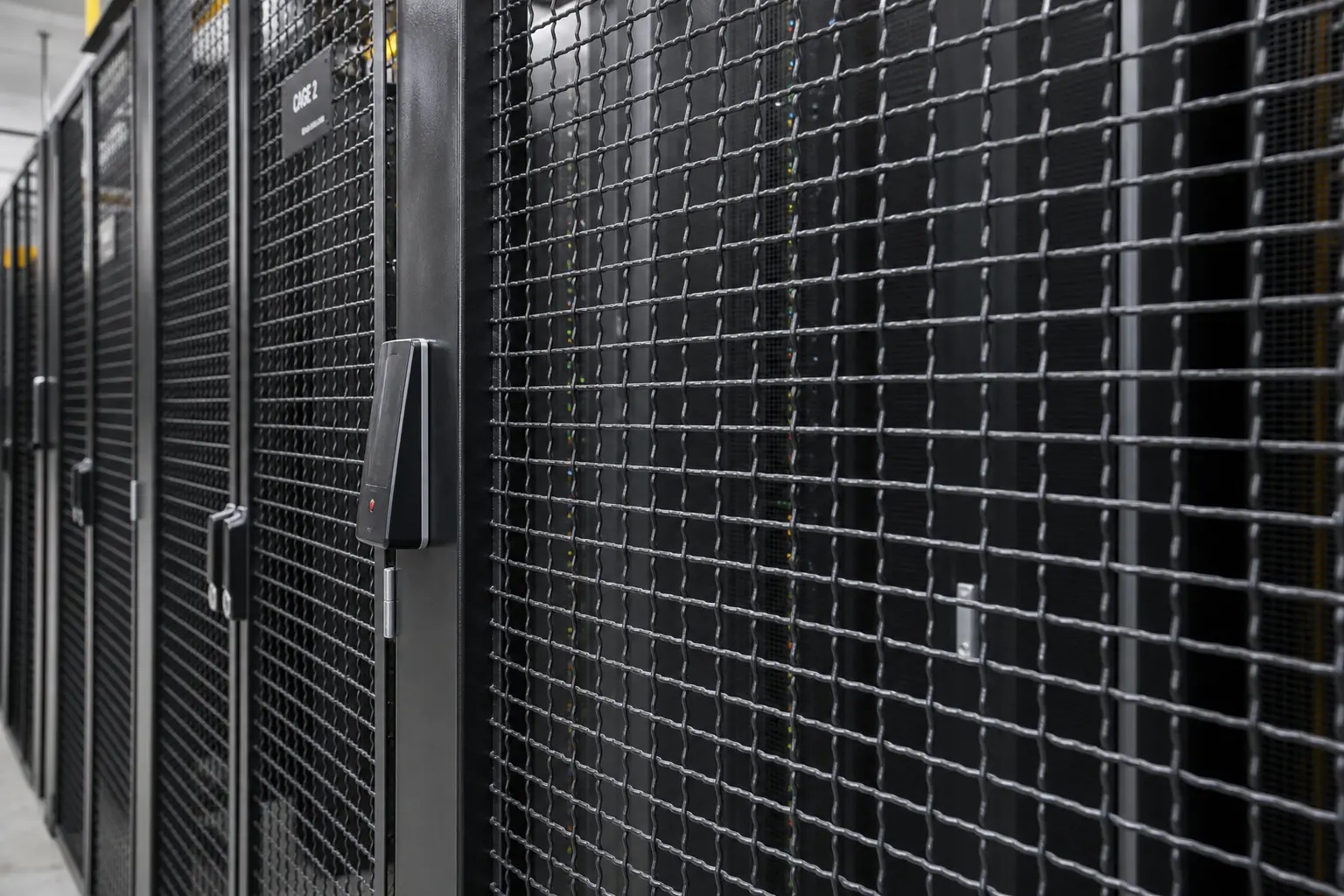
This is where data center cages differ from every other security cage application. Standard solid-panel enclosures would trap heat and cook your servers. Data center cages use specialized mesh patterns — typically a woven wire mesh or expanded metal with 60–80% open area — that allow hot and cold aisle airflow while maintaining security.
2. Precise Sizing
Data center floor space is priced by the square foot, so cages must be precisely sized. Standard configurations include:
- Quarter cabinets: 1–4 rack positions for small deployments
- Half cages: 4–8 racks, common for mid-size tenants
- Full cages: 8–20+ racks for enterprise deployments
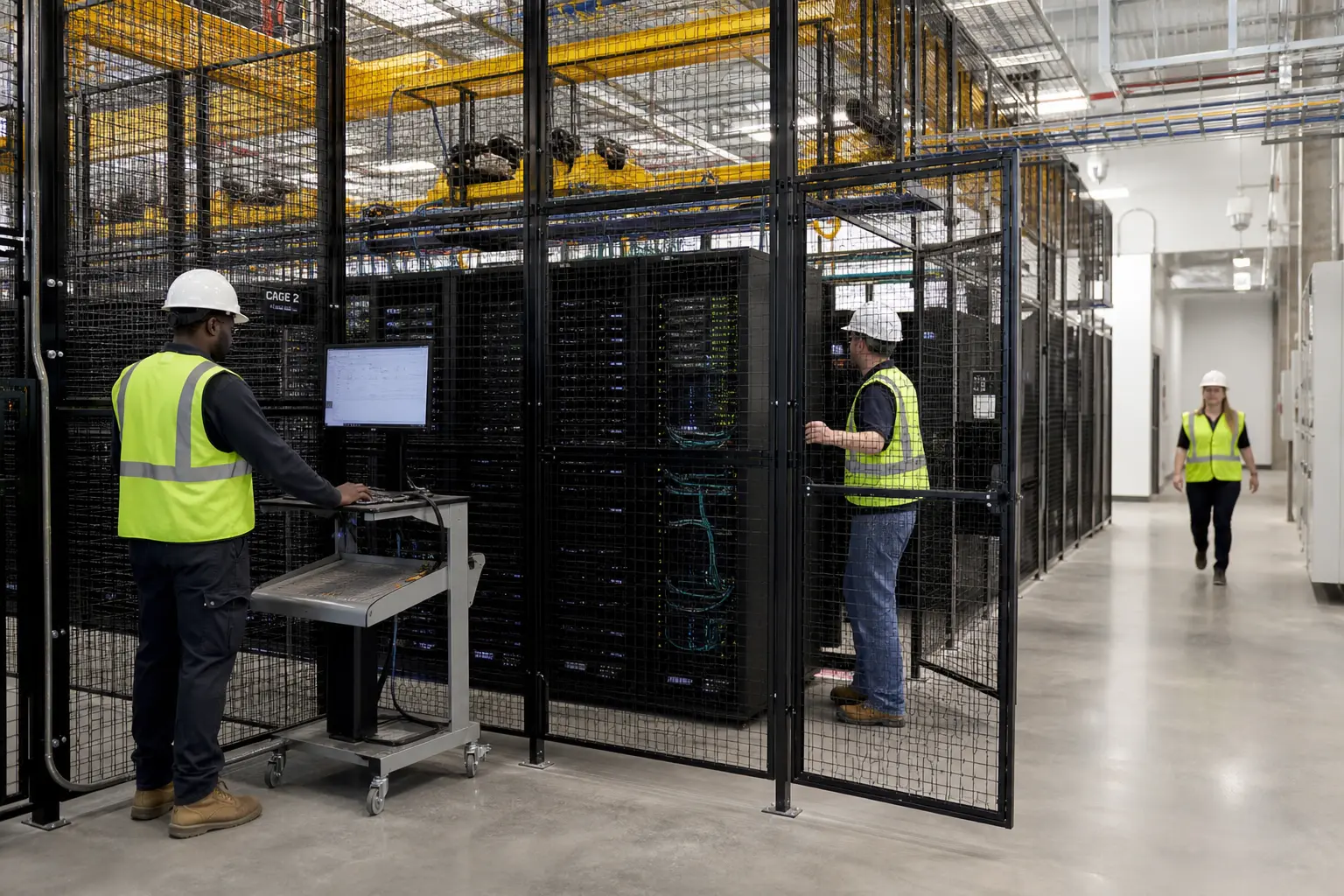
- Custom configurations: L-shaped, multi-room, or floor-to-structure ceiling heights
Panels from manufacturers like our manufacturing partners come in standard widths (1′, 2′, 3′, 4′, 5′) that combine to create any size enclosure. Custom-sized panels fill odd dimensions.
3. Ceiling Enclosure
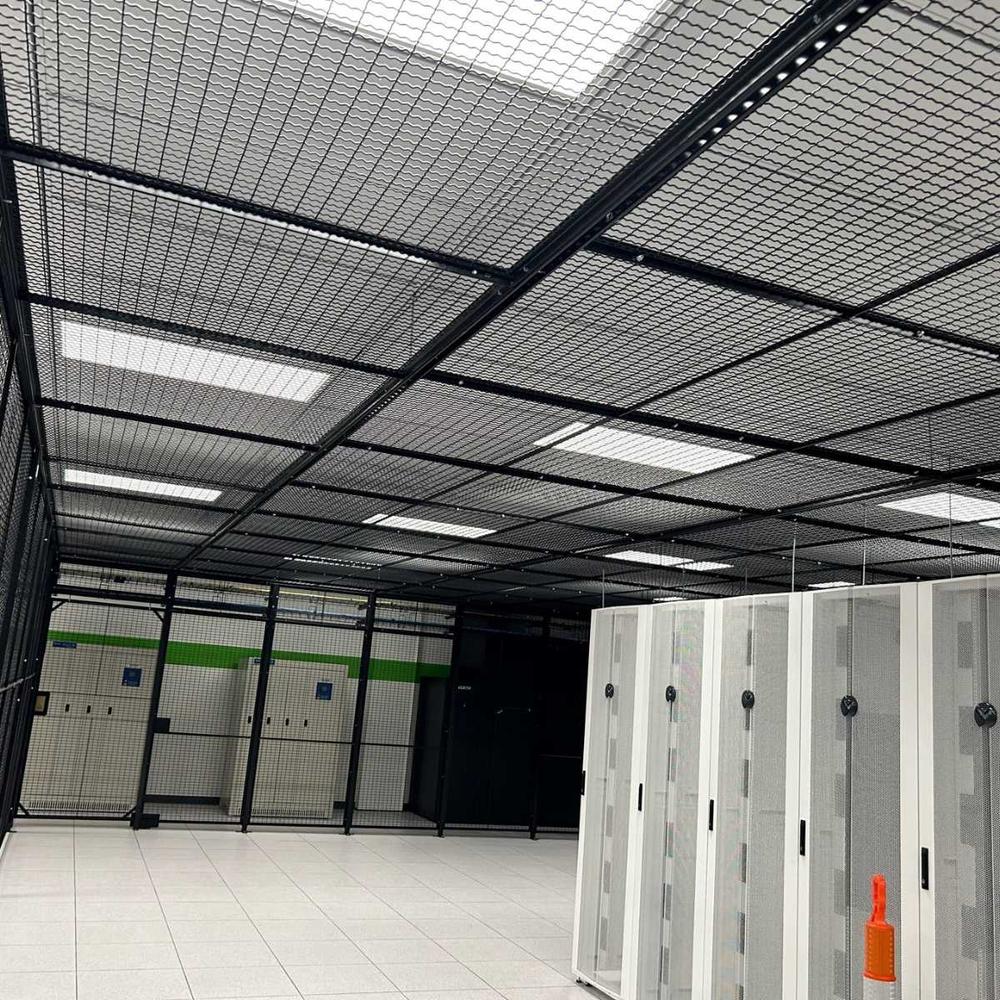
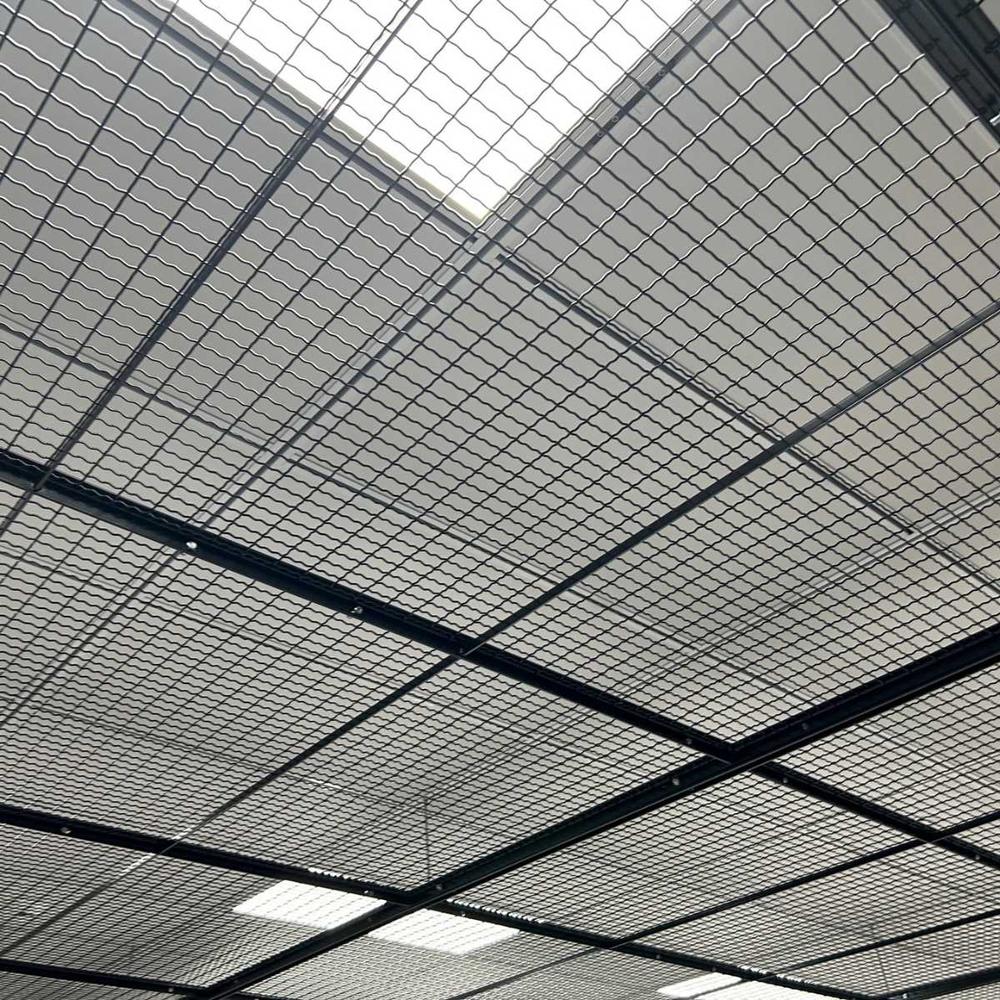
Unlike warehouse cages where ceiling panels are optional, data center cage ceilings are mandatory. Without a top, anyone can climb over — and compliance auditors will flag it immediately. Ceiling panels must still allow sprinkler coverage and cable tray access.
4. Access Control Integration
Data center cages require sophisticated access control. Options include:
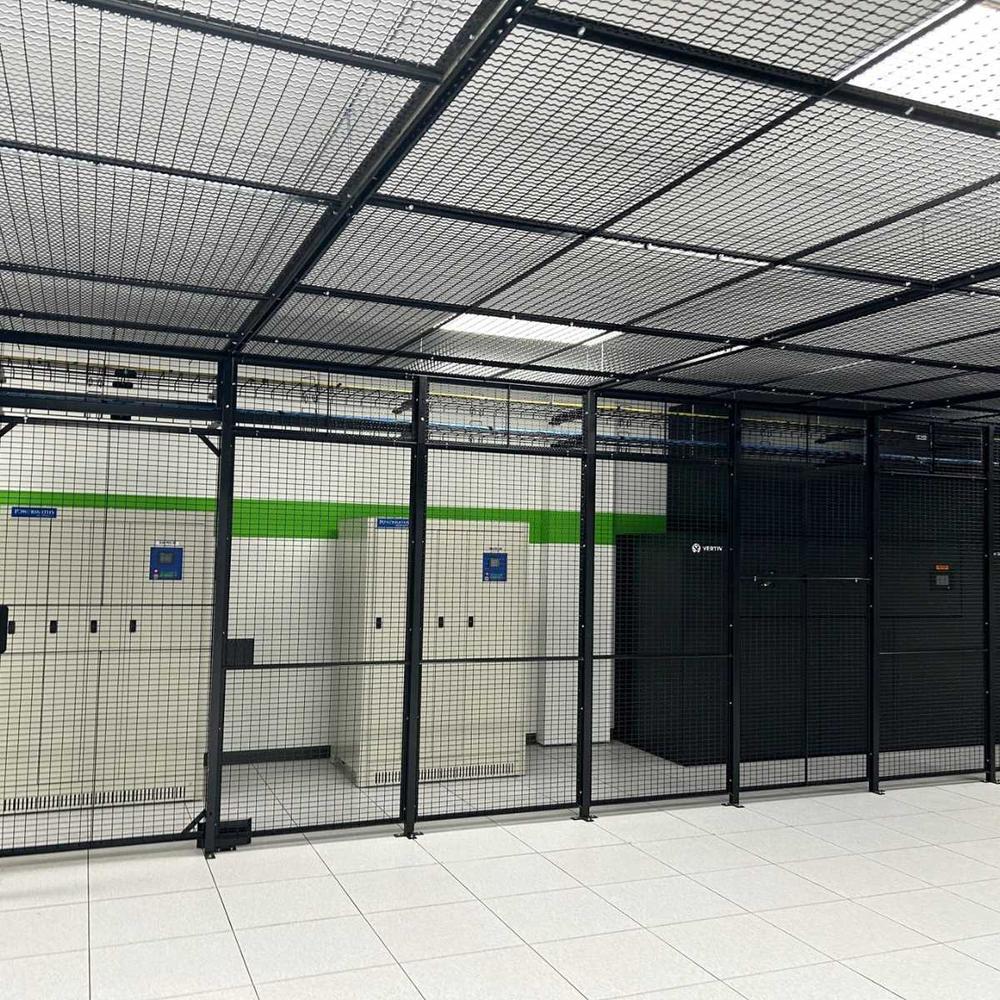
- Card readers: Proximity cards or key fobs with logged access events
- Biometric locks: Fingerprint or retinal scanners for high-security deployments
- PIN + card: Two-factor physical authentication
- Remote unlock: NOC-controlled electric strikes for visitor management
- Audit logging: Every access event timestamped and stored for compliance
MH-USA installs cages with a full range of lock and access control systems that integrate with your facility’s existing security infrastructure.
Colocation Cage Standards & Compliance
| Standard | Physical Security Requirement |
|---|---|
| SOC 2 Type II | Physical access controls with audit logs, restricted entry to authorized personnel |
| PCI-DSS | Physical barriers to cardholder data environment, access monitoring, visitor controls |
| HIPAA | Facility access controls, maintenance records, physical safeguards for ePHI |
| ISO 27001 | Physical security perimeter, entry controls, securing equipment areas |
| NIST 800-53 | Physical access authorization, monitoring, visitor control, delivery/removal controls |
Data Center Cage vs. Cabinet-Level Locking
Some facilities rely on individual rack locks instead of cages. Here’s why cages are superior for most deployments:


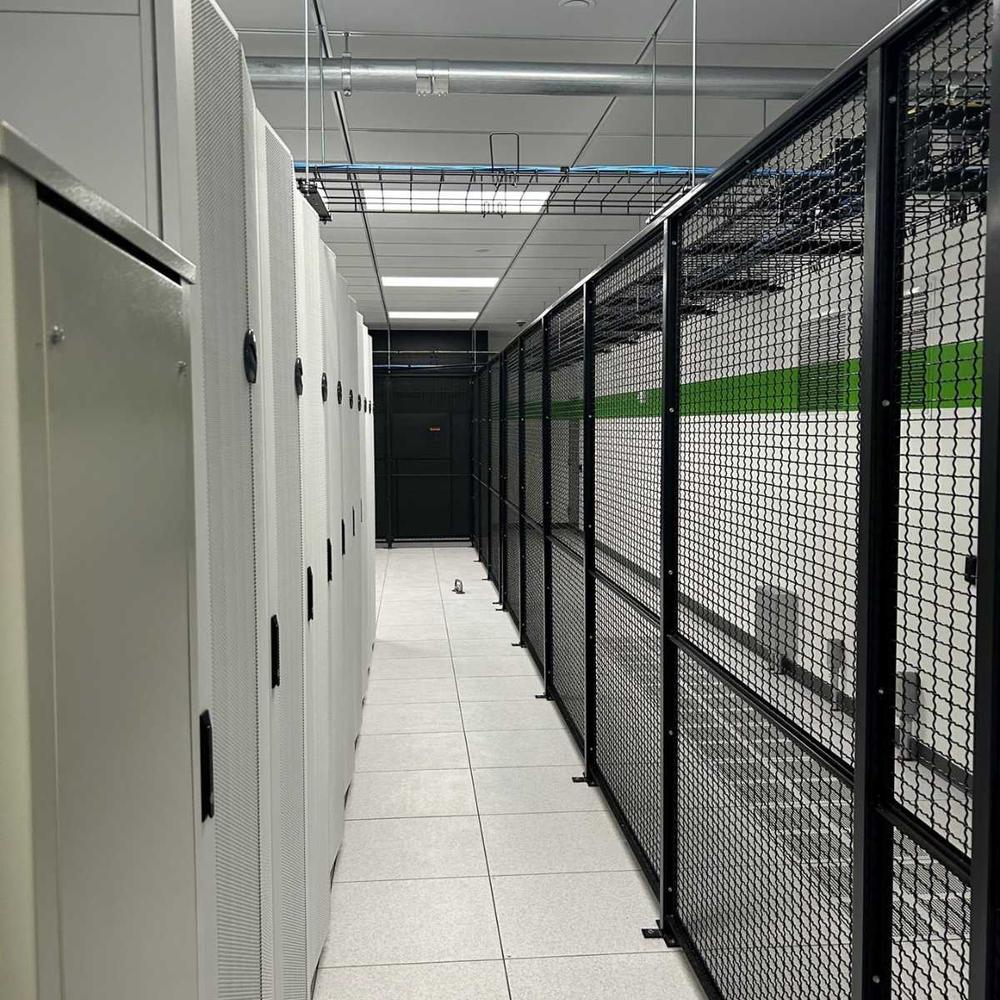
- Rear access: Cabinet locks only secure the front. Cages protect all four sides plus the ceiling.
- Cable management: Cages provide protected space for cabling between racks
- Work area: Technicians can work inside the cage without blocking aisles
- Scalability: Adding racks inside a cage is trivial; adding locks to each new cabinet isn’t
- Visual deterrent: A cage signals “keep out” far more effectively than a padlock
Installation Considerations
Floor Attachment
Data center cages typically anchor to raised floor systems or concrete subfloors. Posts can be surface-mounted (bolted to floor) or through-mounted for maximum rigidity. For raised-floor environments, post footings distribute weight across floor tiles.
Fire Suppression Compatibility
Cage mesh must not impede clean-agent fire suppression systems (FM-200, Novec 1230) or pre-action sprinklers. The open mesh design of standard wire panels provides 60–80% open area — sufficient for suppression agent distribution.
Cable Penetrations
Plan cable entry/exit points in advance. Most cages include pre-cut cable tray openings in ceiling panelsand designated wall panels for under-floor or overhead cable routing.
Need a Data Center Cage Solution?
MH-USA designsand installs data center security cages for colocation facilities, enterprise server rooms, and edge computing sites across the Western U.S.
Advanced Data Center Cage Design
Multi-Tenant Colocation Architecture
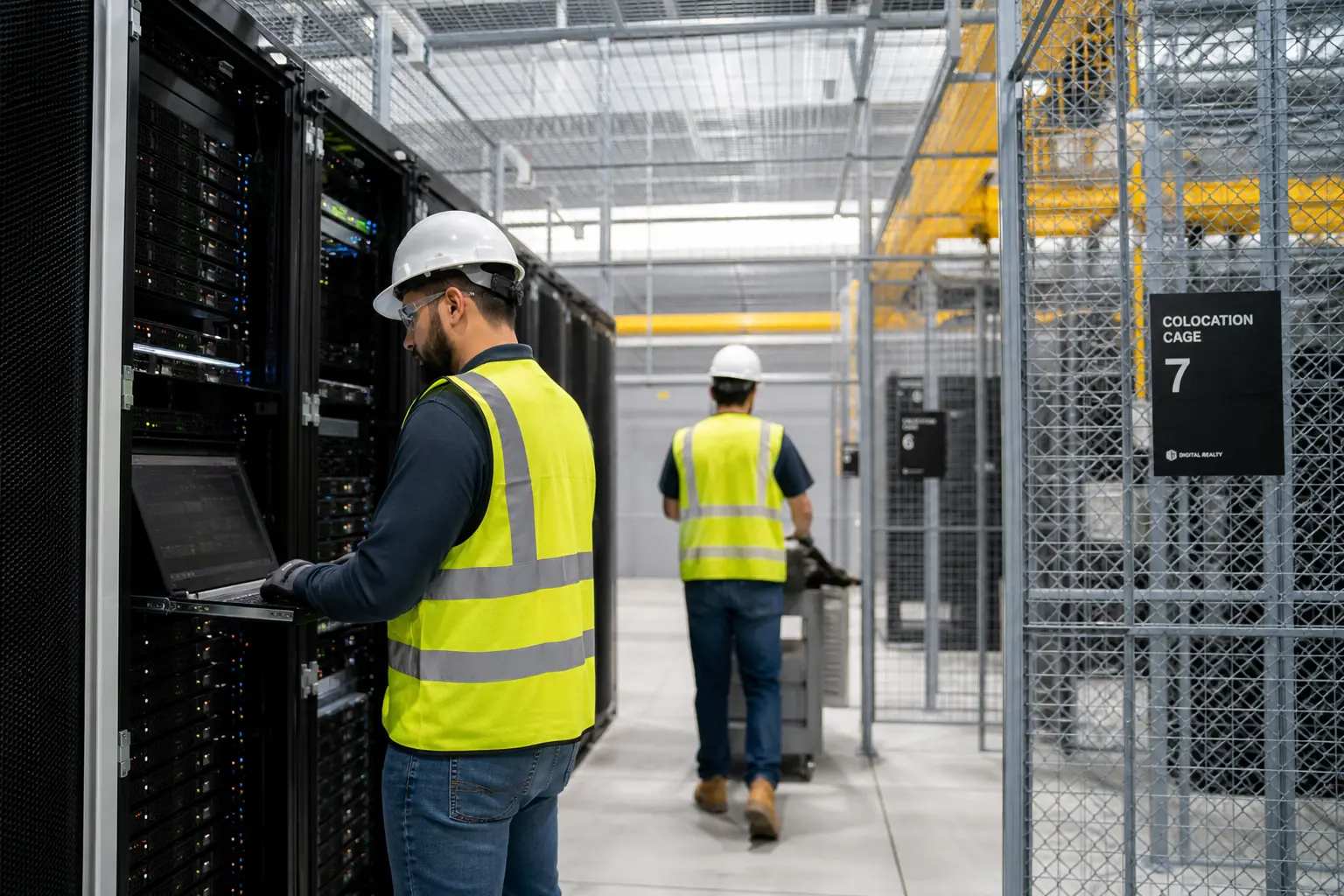
Colocation data centers serve multiple tenants in a shared facility, making cage design critical for both security and compliance. Each tenant needs a physically isolated enclosure that satisfies their compliance framework — whether that’s SOC 2, HIPAA, PCI DSS, FedRAMP, or ITAR. Cage design must balance individual tenant security with facility-wide operational efficiency.
Standard colocation cage layouts follow a pod architecture: groups of cages sharing common hot and cold aisles. Pod sizing depends on the facility’s power density, cooling strategy, and typical tenant deployment size. Small pods (4–8 cages) serve enterprise colocation markets. Large pods (20–100 cages) serve hyperscale and wholesale colocation operations.
Compliance Framework Requirements
SOC 2 Type II requires documented physical access controls with individually auditable access logs. Cages must prevent unauthorized access from all directions — floor, walls, and ceiling. Access events must be logged with user identity, timestamp, and cage identifier. PCI DSS Requirement 9 mandates physical access restrictions to cardholder data environments. This includes cage doors with electronic access control, security cameras covering cage access points, and visitor escort policies.
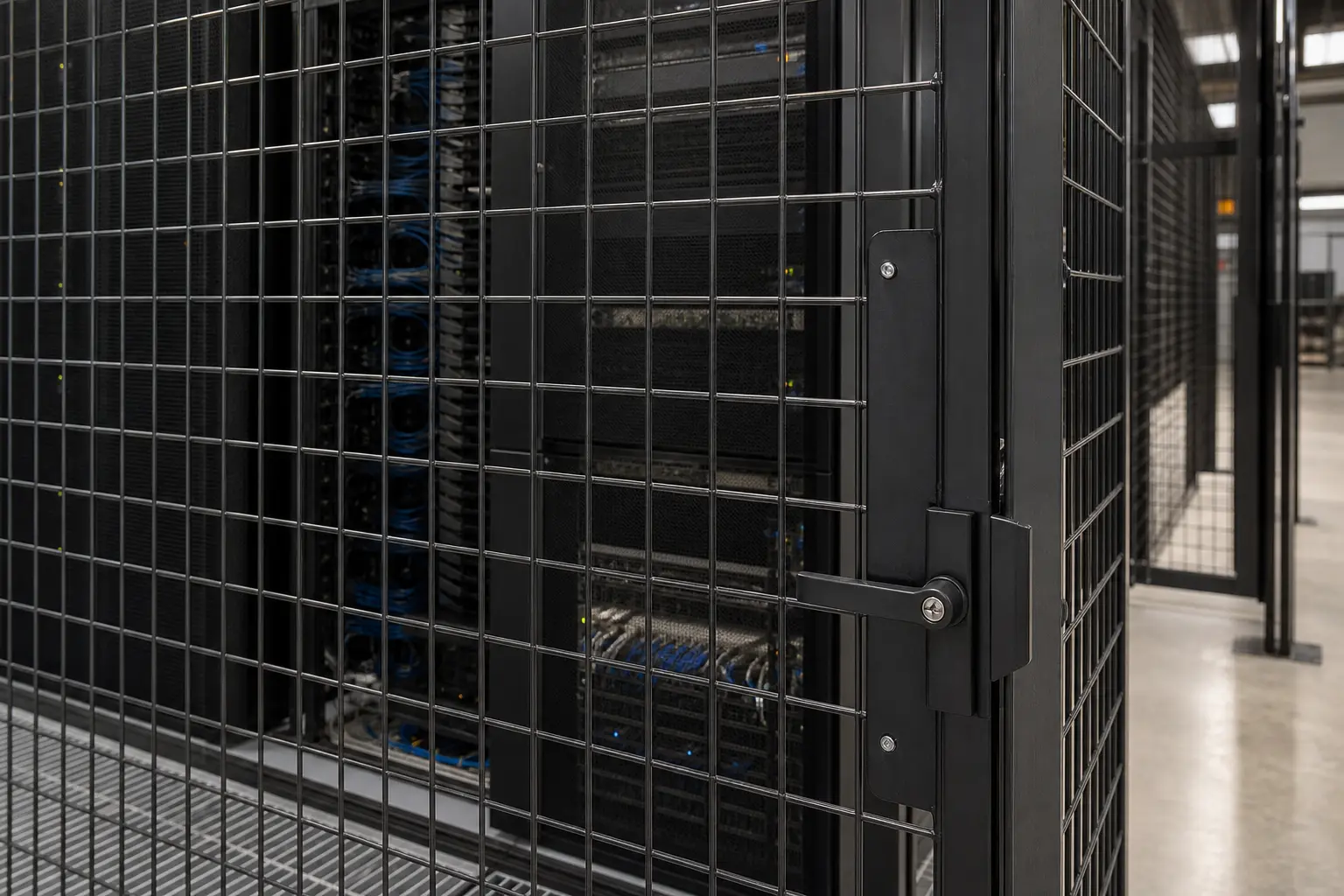

HIPAA physical safeguards require access controls on all areas containing protected health information. Data center cages housing healthcare data must have electronic access control with individual credentialsand access logs retained for six years. FedRAMP requires NIST SP 800-53 physical controls — the most stringent commercial compliance standard for data center cages.
Power & Cooling Integration
Data center cage design must integrate with power distribution and cooling infrastructure. Overhead busway runs above cage rows with whip connections dropping into individual cages. In-row cooling units position between cages for precision cooling. Hot aisle containment doors at cage row ends prevent hot air recirculation. Cable tray routing above cages carries fiber and copper between cagesand meet-me rooms.

Cage mesh must not obstruct airflow — standard 2″ × 2″ wire mesh provides adequate free area for most power densities up to 10 kW per rack. Higher density deployments may require mesh with larger openings or active airflow management within the cage. Our engineering team models airflow for every data center cage design to verify cooling sufficiency.
Scalability & Flexibility
Data center tenants grow. Cage systems must accommodate expansion without disrupting existing operations. Modular wire mesh panels allow cage expansion in any direction — adding bays, extending rows, or connecting adjacent cages to create larger enclosures. This scalability protects the facility owner’s cage infrastructure investment and gives tenants room to grow without relocating.
Why Choose Material Handling USA for Data Center Cage Design: Colocation & Server Room Security Guide
{

}
Material Handling USA brings over 30 years of experience to every security cage project. Our team has designed and installed thousands of security enclosures across warehouses, distribution centers, manufacturing plants, healthcare facilities, law enforcement agencies, and data centers throughout the Intermountain Westand nationwide.
Our Process
Every project begins with a thorough understanding of your requirements. We conduct on-site assessments (or virtual consultations for initial planning), capture detailed measurements, and discuss your security objectives, workflow needs, and budget parameters. Our engineering team creates custom CAD layouts showing exactly how your cage system will look and function — you review and approve the design before we proceed.
{
}
We source panels, doors, locks, and accessories from leading American manufacturers Products — the industry’s most trusted manufacturers. Both offer comprehensive product lines with rapid availability and proven quality. Our bulk purchasing relationships deliver competitive pricing that individual buyers can’t achieve on their own.
Professional Installation & Support
Our trained installation crews handle every aspect of cage assembly — from floor anchoring to door hanging to access control integration. We work around your schedule to minimize operational disruption. Every installation concludes with a formal inspection and documentation package. Post-installation, we remain available for adjustments, expansion, and ongoing maintenance support.
{
}
Serving the Intermountain West & Beyond
Headquartered in Salt Lake City, Utah, Material Handling USA provides direct service throughout Utah, Idaho, Colorado, Nevada, Arizona, Wyoming, and Montana. Nationwide projects are supported throughour network of installation partnersand direct-ship capabilities. Wherever your facility is located, we deliver the same quality, attention to detail, and customer service that has builtour reputation over three decades.
{
}
Request Your Free Quote
Ready to secure your facility? Contact Material Handling USA for a free, no-obligation consultation and quote. Our team responds within one business day with a preliminary assessment and next steps.
- Phone: (800) 326-4403 or (801) 328-8788
- Email: sales@mh-usa.com
- Online: Request a Quote
We look forward to helping you design the right security cage solution for your facility.
Frequently Asked Questions
How much do data center cage design: colocation & server room security guide cost?
Pricing depends on the size, configuration, wire gauge, door type, and accessories required for your specific application. Material Handling USA provides free, no-obligation quotes that include CAD layout design, material specifications, and professional installation costs. Contact us at (800) 326-4403 or email sales@mh-usa.com for a detailed estimate within 1–2 business days.
What is the installation timeline?
Most security cage projects follow a 2–3 week timeline from initial contact to completed installation. Week 1 covers site assessment and design. Week 2 handles order processing and material preparation. Week 3 is delivery and professional installation. Expedited timelines are available for urgent security needs — some projects can be completed in as little as 5 business days from initial contact.
Do you provide free site assessments?
Yes. Material Handling USA provides complimentary on-site measurementsand CAD layout design for all security cage projects. Our assessment includes detailed measurements, obstacle identification, workflow analysis, and a complete proposal with pricing. For projects outside the Wasatch Front, we can conduct virtual assessments using photosand measurements you provide.
Can security cages be customized?
Absolutely. While standard panel sizes handle most configurations, our custom security cage capabilities include non-standard dimensions, angled walls, multiple door types, height transitions, and integration with existing structures. Custom powder coat colors, galvanized finishes, and specialized hardware are also available. Our engineering team designs custom solutions that meet your exact specifications.
What warranty do security cages carry?
All security cages from Material Handling USA include manufacturer warranties covering defects in materialsand workmanship. our manufacturing partners both stand behind their products with comprehensive warranty programs. Our installation workmanship is warranted for one year, including a 90-day adjustment period where we return to tighten hardware and verify door alignment at no charge.
Do you serve locations outside Utah?
Yes. While headquartered in Salt Lake City, Material Handling USA serves the entire Intermountain West including Utah, Idaho, Colorado, Nevada, Arizona, Wyoming, and Montana with direct installation crews. Nationwide projects are supported throughour installation partner network and direct-ship capabilities. Contact us to discuss your project location.