Home » Security Cages » OSHA Machine Guarding
OSHA Machine Guarding Requirements: Wire Mesh Cage Compliance Guide
Everything you need to know about OSHA 29 CFR 1910.212 compliance, wire mesh specifications, and keeping your workers safe.
Why OSHA Machine Guarding Matters
Every year, approximately 18,000 workers suffer amputations, lacerations, and crushing injuries from unguarded machines — injuries that proper Machine Guarding could have prevented. OSHA’s machine guarding standards under 29 CFR 1910.212 exist to protect employees from these hazards, and non-compliance can result in fines exceeding $16,000 per violation.
Wire mesh machine guarding cages have become the industry standard because they satisfy OSHA requirements while maintaining visibility, airflow, and accessibility. This guide walks you through every requirement, specification, and best practice.

Key Takeaway:
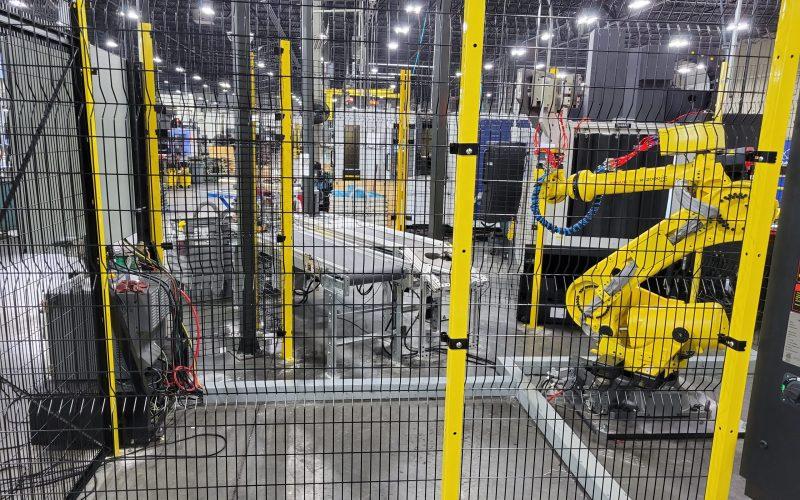
OSHA requires machine guarding on any machine part, function, or process that may cause injury. Wire mesh partitions meet all requirements when properly specified and installed.
Understanding 29 CFR 1910.212: General Requirements
OSHA’s General Requirements for All Machines (29 CFR 1910.212) mandate that:

- One or more methods of guarding must protect operators and other employees from hazards including point of operation, ingoing nip points, rotating parts, flying chips, and sparks
- Guards must be affixed to the machine where possible, or otherwise secured
- Guards must not create additional hazards (sharp edges, pinch points)
- Guards must not interfere with the machine’s operation or create a maintenance burden that tempts workers to bypass them
- Workers must not be able to reach over, under, through, or around guards to access danger zones
Wire Mesh Specifications for OSHA Compliance
Not all Wire Mesh Panel Options meet OSHA requirements. Here’s what you need to know about specifications:
Mesh Opening Size
The mesh opening size must prevent fingers and hands from reaching through to the point of operation. Industry consensus standards (ANSI/ASSP B11.19 and ISO 13857) provide guidelines for maximum opening sizes based on distance from the hazard:

| Distance from Hazard | Maximum Opening Size | Wire Gauge |
|---|---|---|
| Less than 2″ | ¼” mesh | 12 gauge minimum |
| 2″ to 4″ | ½” mesh | 10–12 gauge |
| 4″ to 15″ | 2″ mesh | 10 gauge |
| Over 15″ | Up to 6″ mesh (if hands cannot reach hazard) | 10 gauge |
Panel Height and Gap Requirements
Machine guards must be tall enough that workers cannot reach over them to the hazard zone. Standard heights range from 7 to 10 feet, with the most common being 8 feet. OSHA 29 CFR 1910.212 requires that guards prevent workers from reaching over, under, through, or around them to the hazard zone, but does not specify an exact floor gap measurement. Industry consensus standards — particularly ANSI/ASSP B11.19 and ISO 13857 — provide detailed guidance on maximum allowable gaps beneath guards based on the distance to the hazard and the type of opening. Most machine guarding manufacturers recommend keeping the bottom gap as small as practical, typically under 6 inches (150 mm), to prevent reaching or crawling under the guard.

Door and Access Requirements
Access points through Security Cage Doors must include interlocking safety switches on automated equipment. When a guard door opens, the machine must automatically stop. Manual restart should require a deliberate action — not just closing the door. For maintenance-only access panels, Security Cage Locks with lockout/tagout (LOTO) capabilities are required.
Types of Machine Guarding Applications
1. Robotic Cell Enclosures
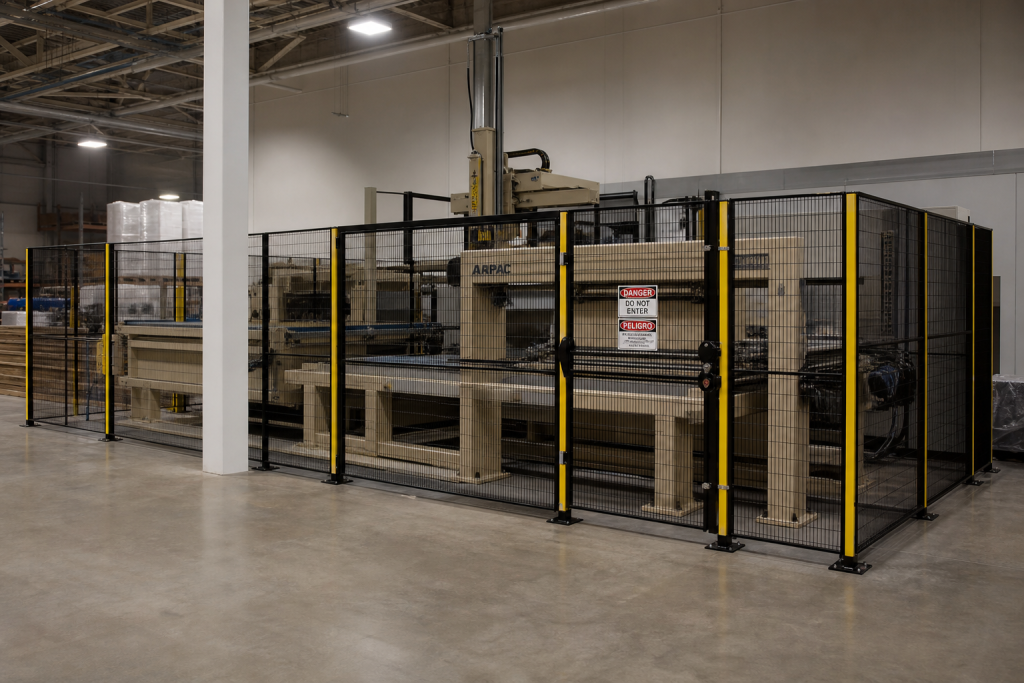
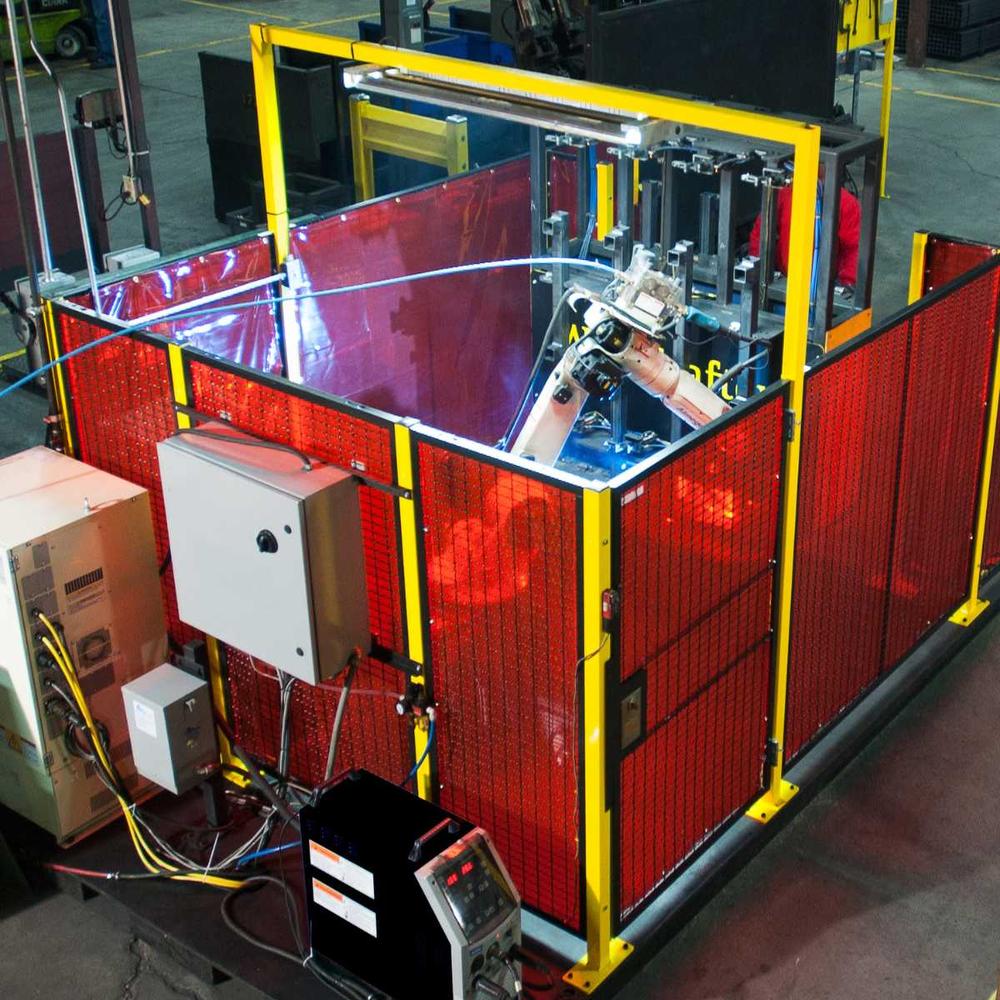
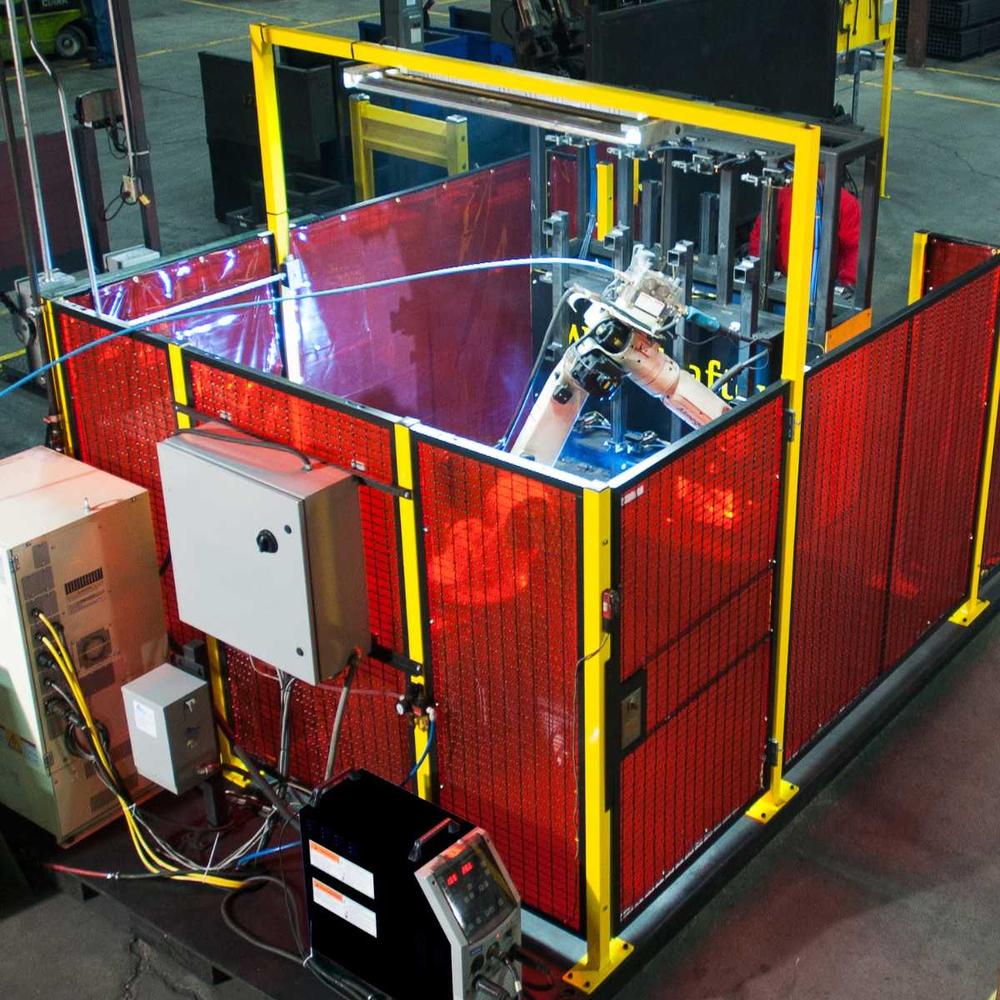
Industrial robots require full perimeter guarding. Wire mesh cages create a complete enclosure around robotic work cells, with access doors that trigger safety interlocks when opened. The mesh provides visibility for monitoring while keeping workers safely outside the robot’s range of motion.
2. CNC Machine Guards
CNC mills, lathes, and routers produce flying chips, coolant spray, and broken tooling. Wire mesh guards contain debris while allowing operators to see the workpiece. The mesh must withstand impact from thrown objects without deforming.

3. Conveyor Guarding
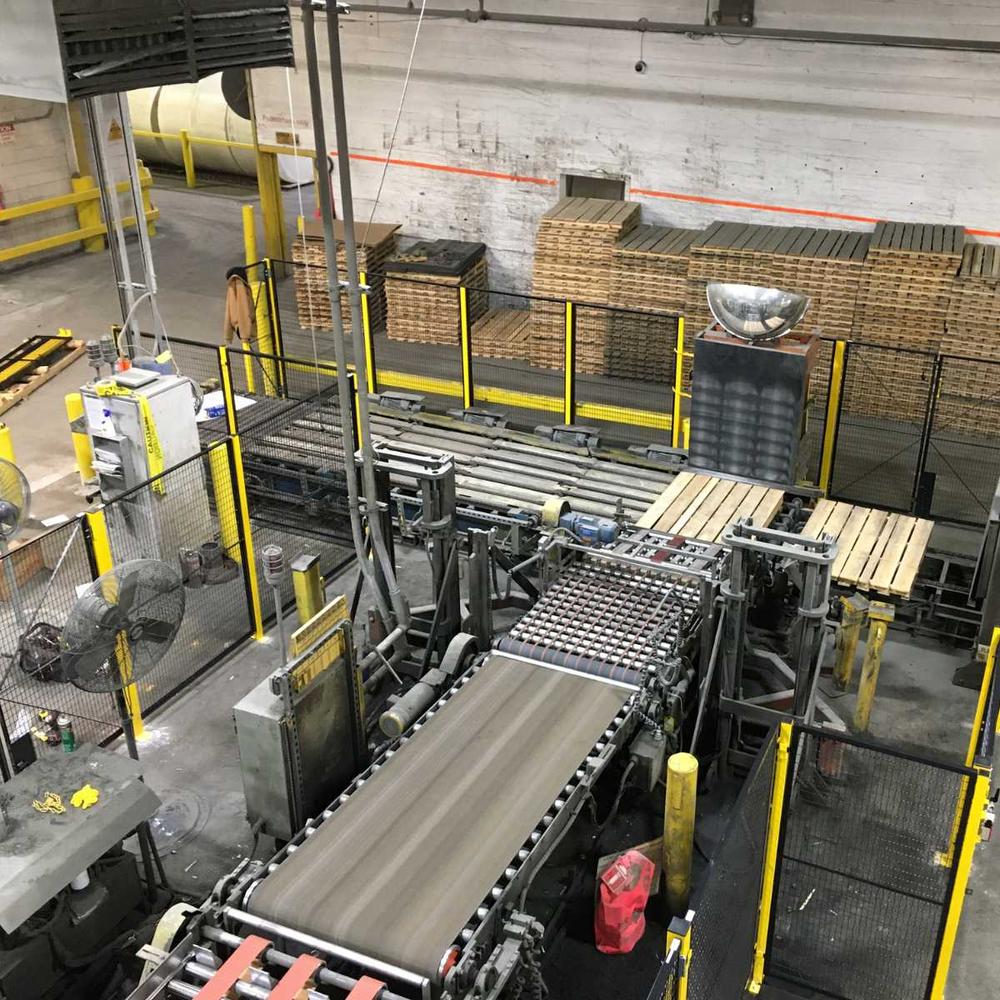
Conveyor nip points, especially at head and tail pulleys, are notorious for pulling in loose clothing and extremities. Wire mesh panels along conveyor runs protect workers while maintaining visual inspection capability. Guarding and inventory security are separate jobs on the same line — our conveyor and sortation system security cage case study explains how each barrier is specified.

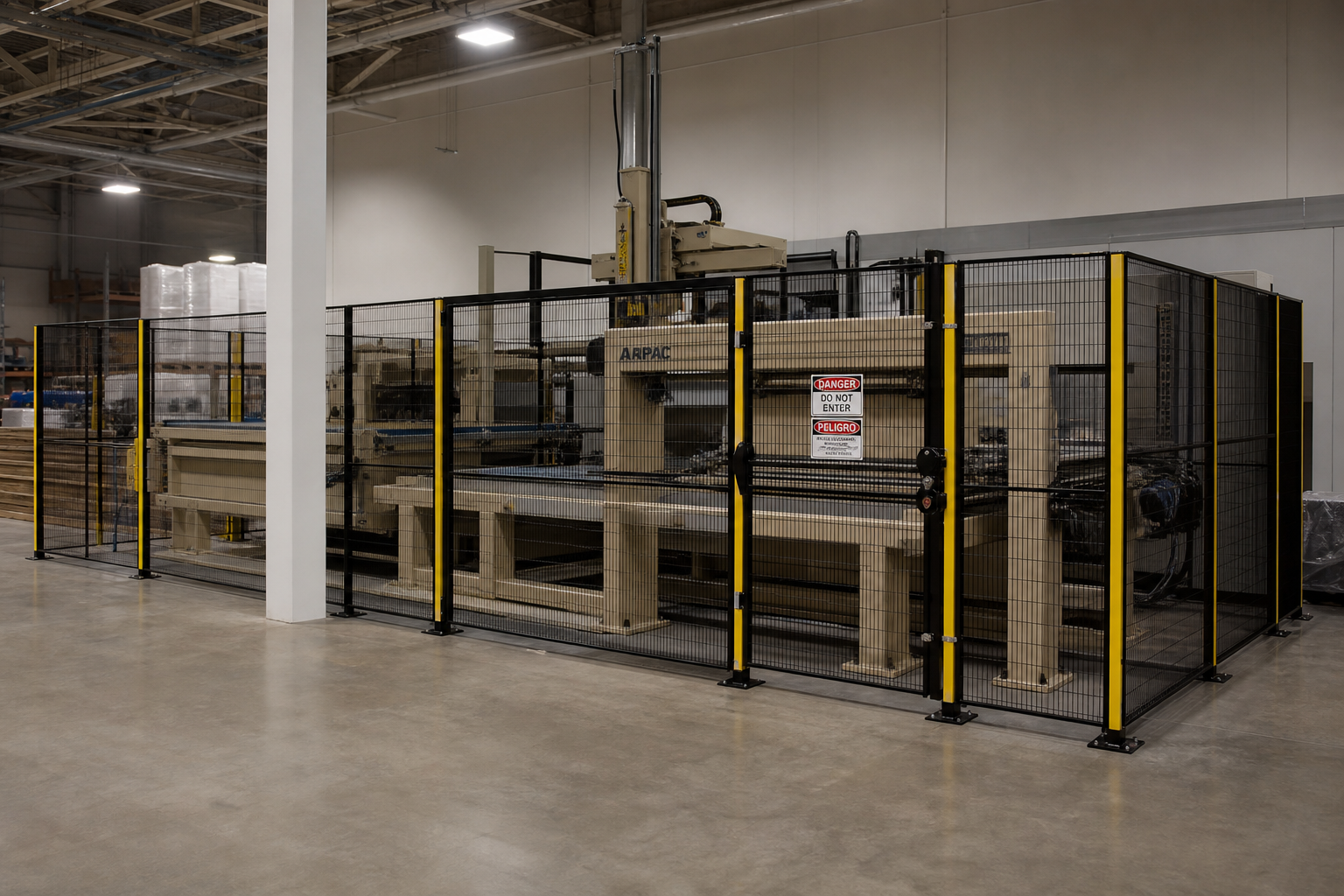
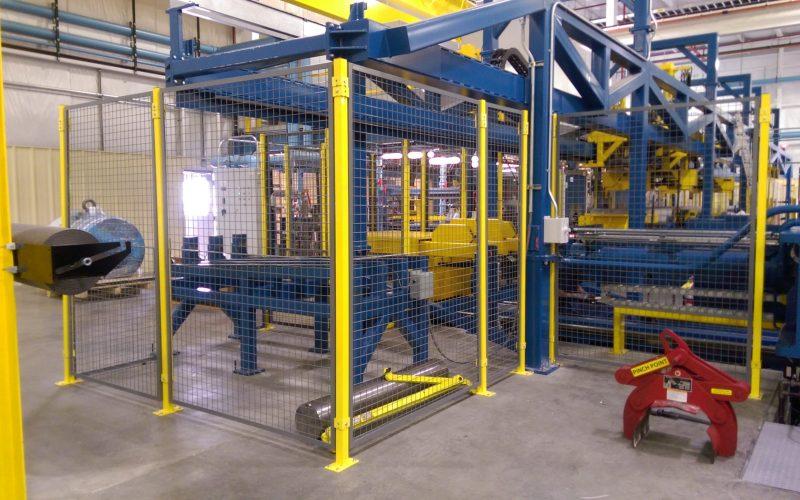
4. Press and Stamping Guards
Hydraulic and mechanical presses require barrier guards that prevent hands from entering the die area during the stroke. Wire mesh barriers mounted with light curtains provide layered protection.
OSHA Inspection Checklist for Machine Guards
Use this checklist during your regular safety audits to ensure ongoing compliance:
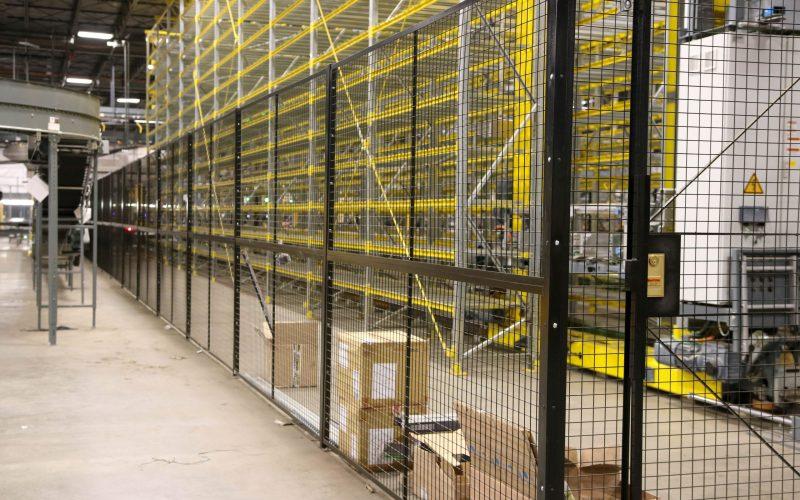
Machine Guarding Audit Checklist:

- ☐ All hazardous machine parts are fully guarded
- ☐ Guards are securely fastened and cannot be easily removed without tools
- ☐ Mesh openings are appropriate for the distance from the hazard
- ☐ Bottom gap meets ANSI B11.19 / ISO 13857 requirements for the specific hazard distance
- ☐ Guard height prevents reaching over to hazard zone
- ☐ Interlocks are functional on all access doors
- ☐ LOTO procedures are posted and accessible
- ☐ Guards show no damage, bending, or missing sections
- ☐ Employees are trained on guard purpose and never bypass guards
- ☐ Warning signs and labels are visible and legible
Wire Mesh vs Other Guarding Materials
While polycarbonate shields, steel plate guards, and light curtains all have their place, wire mesh cages offer distinct advantages for most Manufacturing Security Cages environments:
| Material | Visibility | Airflow | Impact Resistance | Cost |
|---|---|---|---|---|
| Wire Mesh | Excellent | Excellent | Very Good | $$ |
| Polycarbonate | Excellent | None | Good | $$$ |
| Steel Plate | None | None | Excellent | $$$ |
| Light Curtains | Full | Full | N/A (no barrier) | $$$$ |
Common OSHA Violations and How to Avoid Them
The most frequent machine guarding citations include:

- Inadequate point-of-operation guarding — Ensure the guard fully prevents access to the hazard zone. Measure reach distances and select appropriate mesh size.
- Missing or bypassed interlocks — Install tamper-resistant safety switches and audit them regularly. Any bypassed interlock is an automatic violation.
- Guards removed for maintenance and not replaced — Implement a guard-tracking program. Color-code guards so missing ones are immediately visible.
- Insufficient training — Document annual machine guarding training for all employees who work near guarded equipment.
- Inadequate anchoring — Guards must be bolted to the floor or machine frame. Freestanding guards that can be pushed aside don’t meet OSHA standards. Our Security Cage Installation team ensures proper anchoring.
Choosing the Right Machine Guarding System
When specifying wire mesh machine guarding, consider these factors:
- Hazard assessment: What type of hazard are you guarding against? Flying debris requires tighter mesh. Reach prevention allows larger openings.
- Access frequency: Frequent access needs hinged or sliding Security Cage Doors with interlocks. Rare maintenance access can use bolted panels.
- Environment: Corrosive or washdown environments need powder-coated or stainless steel mesh.
- Integration: Guards must work with existing machine controls, emergency stops, and LOTO systems.
- Future modifications: Custom Security Cages modular systems allow reconfiguration when production layouts change.
Need OSHA-Compliant Machine Guarding?
Our team designs and installs wire mesh machine guarding systems that meet all OSHA requirements. Free site assessments available.
OSHA Machine Guarding: Compliance Deep Dive
29 CFR 1910.212 Requirements in Detail
OSHA’s General Requirements for All Machines (29 CFR 1910.212) establishes the foundation for machine guarding compliance. The standard requires that “one or more methods of machine guarding shall be provided to protect the operator and other employees in the machine area from hazards such as those created by point of operation, ingoing nip points, rotating parts, flying chips and sparks.” This broadly written requirement gives OSHA significant enforcement flexibility.
Guards must meet specific performance criteria: they must prevent hands, arms, and other body parts from contacting dangerous moving parts. Guards must be secure — not easily removed or tampered with. Guards should not create additional hazards (sharp edges, pinch points). Guards must not interfere with machine operation or make the machine difficult to operate, as workers may bypass inconvenient guards.
Machine-Specific Guarding Standards
Beyond the general standard, OSHA has machine-specific requirements for mechanical power presses (1910.217), forging machines (1910.218), mechanical power transmission apparatus (1910.219), and woodworking machinery (1910.213). Each standard specifies guarding methods, opening sizes, and distances appropriate for the specific hazard type. Wire mesh panels satisfy guarding requirements across all these standards when properly sized and positioned.


Guard Opening Size Calculations
For mechanical power presses, OSHA Table O-10 (29 CFR 1910.217) specifies maximum allowable point-of-operation guard opening sizes based on the distance from the hazard — ranging from 0.25″ at 0.5″ distance up to 2.125″ at 17.5″+ distance. Note: Table O-10 applies specifically to mechanical power press point-of-operation guards under 29 CFR 1910.217, not to all machine guarding. For general perimeter guarding on other machine types, ANSI/ASSP B11.19 (Performance Criteria for Safeguarding) provides the applicable guard opening vs. distance requirements. Under both standards, standard 2″ × 2″ wire mesh panels are suitable when positioned at an adequate distance from the nearest hazard point — typically 6″ or more for most applications.
For hazards closer than 6″, tighter mesh is required. 1″ × 1″ mesh panels can be positioned as close as 2.5″ from the hazard. In practice, most machine guarding installations position panels at least 6″ from hazards, allowing standard mesh panels. Our engineering team calculates guard distances for every installation to ensure compliance.
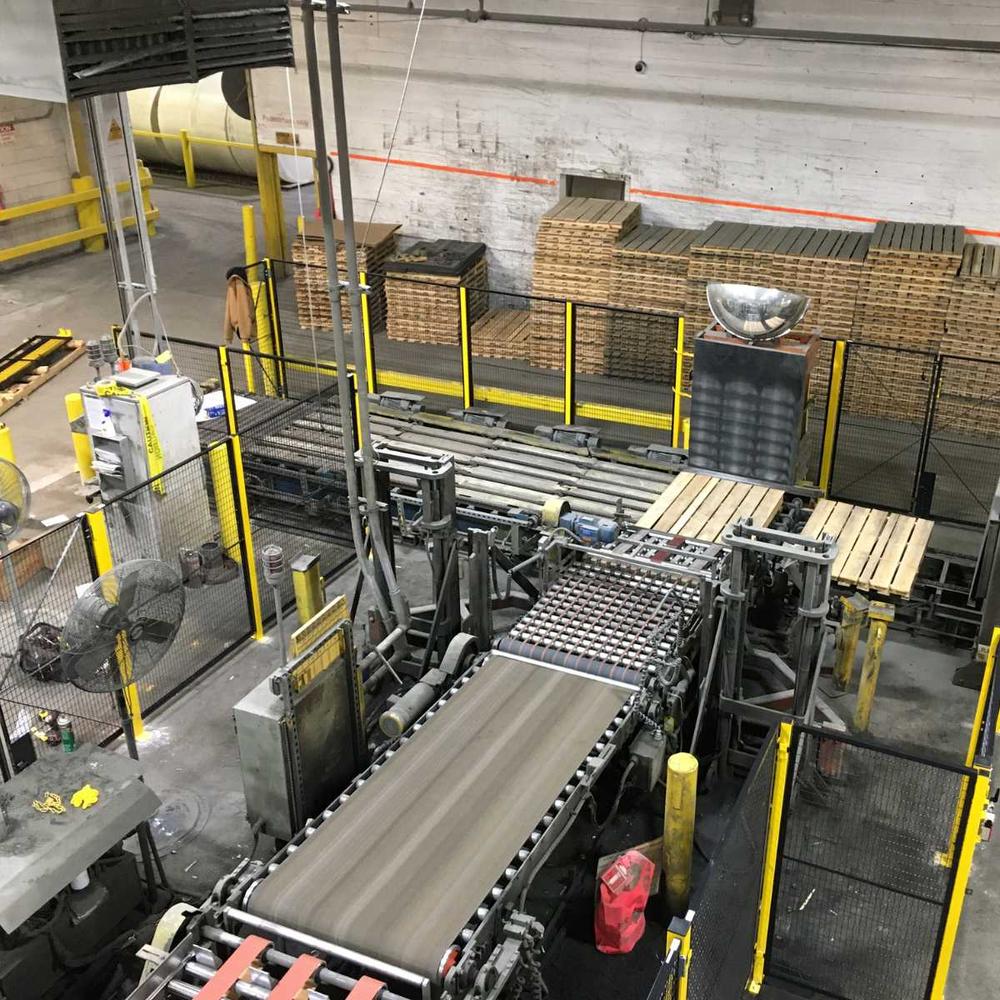
Interlocked Guard Systems
Interlocked guards connect to the machine’s safety system so that opening the guard stops the machine. This is critical for guarded zones that workers must enter regularly (for material loading, tool changes, or maintenance). Interlocked gates on wire mesh guarding panels use safety-rated switches (Allen-Bradley Guardmaster, Schmersal, SICK) that signal the machine controller to stop when the gate opens. Category 3 or Category 4 safety circuits (per ISO 13849-1) are required for applications with severe injury potential.
Documentation & Training Requirements
OSHA requires employers to train workers on machine guarding hazards, guard purpose, and prohibited guard removal. Training documentation should include guard identification for each machine, hazards the guard protects against, procedures for authorized guard removal (maintenance lockout/tagout), and reporting procedures for damaged or missing guards. Maintaining this documentation is critical for defending against OSHA citations and demonstrating due diligence in employee safety. For structured compliance training, machine guarding training for all employees can help formalize this documentation process and keep training records audit-ready.
Why Choose Material Handling USA for OSHA Machine Guarding Requirements: Wire Mesh Cage Compliance Guide
{
}
Material Handling USA brings over 30 years of experience to every security cage project. Our team has designed and installed thousands of security enclosures across warehouses, distribution centers, manufacturing plants, healthcare facilities, law enforcement agencies, and data centers throughout the Intermountain West and nationwide.
Our Process
Every project begins with a thorough understanding of your requirements. We conduct on-site assessments (or virtual consultations for initial planning), capture detailed measurements, and discuss your security objectives, workflow needs, and budget parameters. Our engineering team creates custom CAD layouts showing exactly how your cage system will look and function — you review and approve the design before we proceed.
{
}
We source panels, doors, locks, and accessories from leading American manufacturers Products — the industry’s most trusted manufacturers. Both offer comprehensive product lines with rapid availability and proven quality. Our bulk purchasing relationships deliver competitive pricing that individual buyers can’t achieve on their own.
Professional Installation & Support
Our trained installation crews handle every aspect of cage assembly — from floor anchoring to door hanging to access control integration. We work around your schedule to minimize operational disruption. Every installation concludes with a formal inspection and documentation package. Post-installation, we remain available for adjustments, expansion, and ongoing maintenance support.
{
}
Serving the Intermountain West & Beyond
Headquartered in Salt Lake City, Utah, Material Handling USA provides direct service throughout Utah, Idaho, Colorado, Nevada, Arizona, Wyoming, and Montana. Nationwide projects are supported through our network of installation partners and direct-ship capabilities. Wherever your facility is located, we deliver the same quality, attention to detail, and customer service that has built our reputation over three decades.
{
}
Request Your Free Quote
Ready to secure your facility? Contact Material Handling USA for a free, no-obligation consultation and quote. Our team responds within one business day with a preliminary assessment and next steps.
- Phone: (800) 326-4403 or (801) 328-8788
- Email: sales@mh-usa.com
- Online: Request a Quote
We look forward to helping you design the right security cage solution for your facility.
Frequently Asked Questions
What OSHA standard covers machine guarding?
The primary standard is 29 CFR 1910.212 (General Requirements for All Machines). Additional standards apply to specific equipment: woodworking (1910.213), abrasive grinding (1910.215), and mechanical power presses (1910.217).


How much does machine guarding cost?
Wire mesh machine guarding typically costs $30–$80 per linear foot installed, depending on height, mesh specification, door count, and interlocking requirements. A typical robotic cell enclosure (20′ x 20′) runs $8,000–$15,000 fully installed.
Can I use chain link fencing for machine guarding?
Chain link fencing is generally not recommended for machine guarding. The diamond pattern creates variable opening sizes, and the material flexes under impact. Read our comparison: Chain Link vs Wire Mesh.
How often should machine guards be inspected?
OSHA requires guards to be inspected during regular safety audits — most facilities do this monthly or quarterly. Interlocking switches should be tested more frequently, ideally weekly on high-use equipment.
Are there tax incentives for machine guarding?
Machine guarding equipment qualifies for Section 179 depreciation, allowing you to deduct the full cost in the year of purchase. Some states offer additional workplace safety tax credits.
What is the installation timeline?
Most security cage projects follow a 2–3 week timeline from initial contact to completed installation. Week 1 covers site assessment and design. Week 2 handles order processing and material preparation. Week 3 is delivery and professional installation. Expedited timelines are available for urgent security needs — some projects can be completed in as little as 5 business days from initial contact.
Do you provide free site assessments?
Yes. Material Handling USA provides complimentary on-site measurements and CAD layout design for all security cage projects. Our assessment includes detailed measurements, obstacle identification, workflow analysis, and a complete proposal with pricing. For projects outside the Wasatch Front, we can conduct virtual assessments using photos and measurements you provide.
Can security cages be customized?
Absolutely. While standard panel sizes handle most configurations, our custom security cage capabilities include non-standard dimensions, angled walls, multiple door types, height transitions, and integration with existing structures. Custom powder coat colors, galvanized finishes, and specialized hardware are also available. Our engineering team designs custom solutions that meet your exact specifications.
What warranty do security cages carry?
All security cages from Material Handling USA include manufacturer warranties covering defects in materials and workmanship. our manufacturing partners both stand behind their products with comprehensive warranty programs. Our installation workmanship is warranted for one year, including a 90-day adjustment period where we return to tighten hardware and verify door alignment at no charge.
Do you serve locations outside Utah?
Yes. While headquartered in Salt Lake City, Material Handling USA serves the entire Intermountain West including Utah, Idaho, Colorado, Nevada, Arizona, Wyoming, and Montana with direct installation crews. Nationwide projects are supported through our installation partner network and direct-ship capabilities. Contact us to discuss your project location.
Explore More Security Cage Solutions
Online Store
Shop at MaterialHandling-USA.com
Shop safety supplies, barriers, and floor protection online:
Crowd Control & Barriers
Anti-Fatigue Mats & Flooring
Janitorial Supplies
Browse safety & compliance products →