
Push-Back Pallet Rack
Store 2 to 6 pallets deep on gravity-fed nested carts — load from the aisle, and pallets automatically roll forward when the front position is picked. High density without forklifts entering the rack.
Talk with a pallet rack specialist. Call (800) 326-4403 or Email Sales@MH-USA.com

What Is Push-Back Pallet Rack?
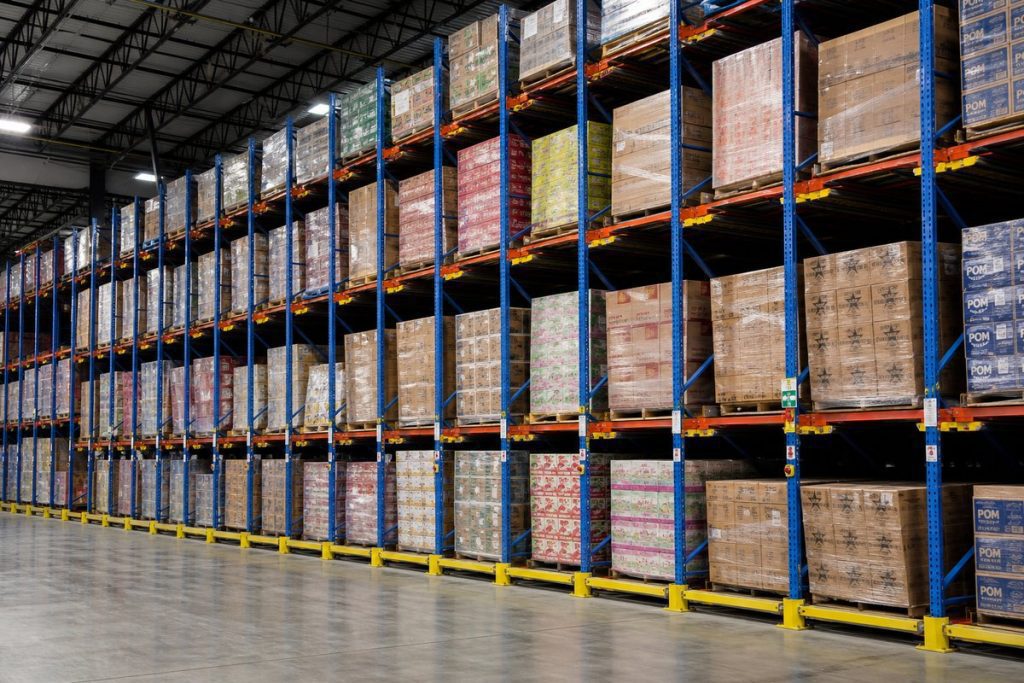
A high-density storage system where pallets are stored 2 to 6 positions deep on nested carts that ride on inclined rails — all loading and unloading happens from the aisle face.
Push-back pallet rack uses a series of nested carts on slightly inclined rails. When loading, each new pallet pushes the existing pallets back one position deeper intotherack. When the front pallet is removed for picking, gravity rolls the remaining pallets forward to the aisle face automatically.
The key advantage: the forklift never enters the rack structure. This eliminates the rack damage common in drive-in systems and dramatically speeds up cycle times. Push-back provides 40–90% more storage than selective rack while maintaining fast, aisle-based access.
Material Handling USA designs, supplies, and installs push-back pallet rack systems for distribution centers, manufacturing plants, cold storage facilities, and warehouses nationwide.
How Push-Back Rack Works
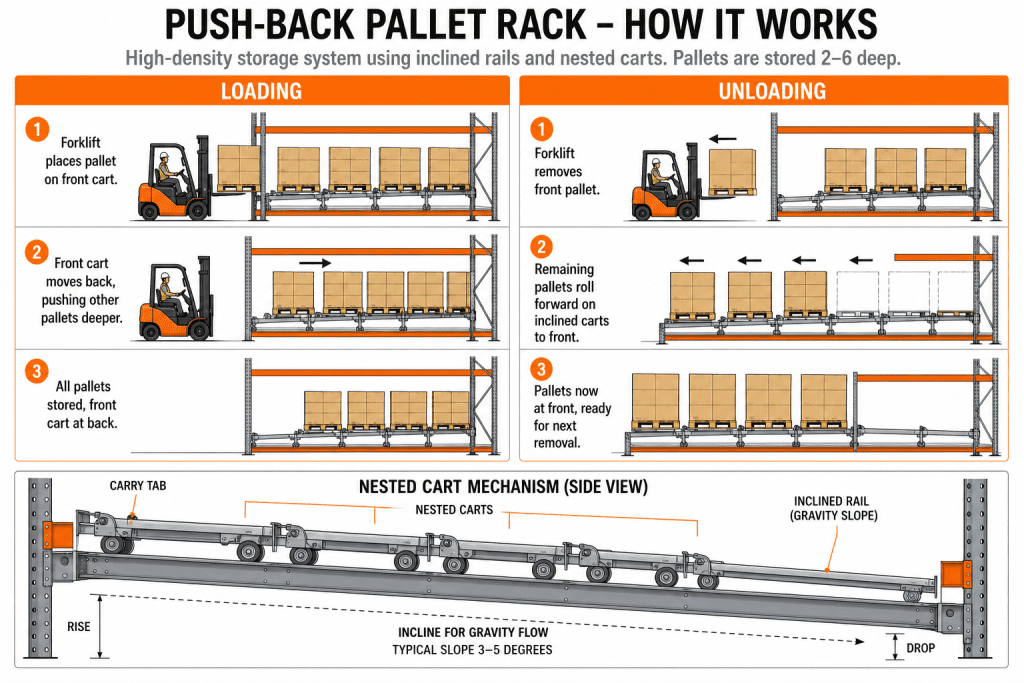
Loading: The forklift places a pallet onto the front cart. Then the next pallet pushes that cart back one position, and the new pallet sits on the next cart in the nested sequence. Each new pallet pushes all previous pallets back one position deeper.
Unloading: The forklift picks the front pallet. The inclined railsand gravity automatically roll the remaining pallets (on their carts) forward to the aisle face. The next pallet is immediately available — no waiting, no reaching deep.
System Configurations
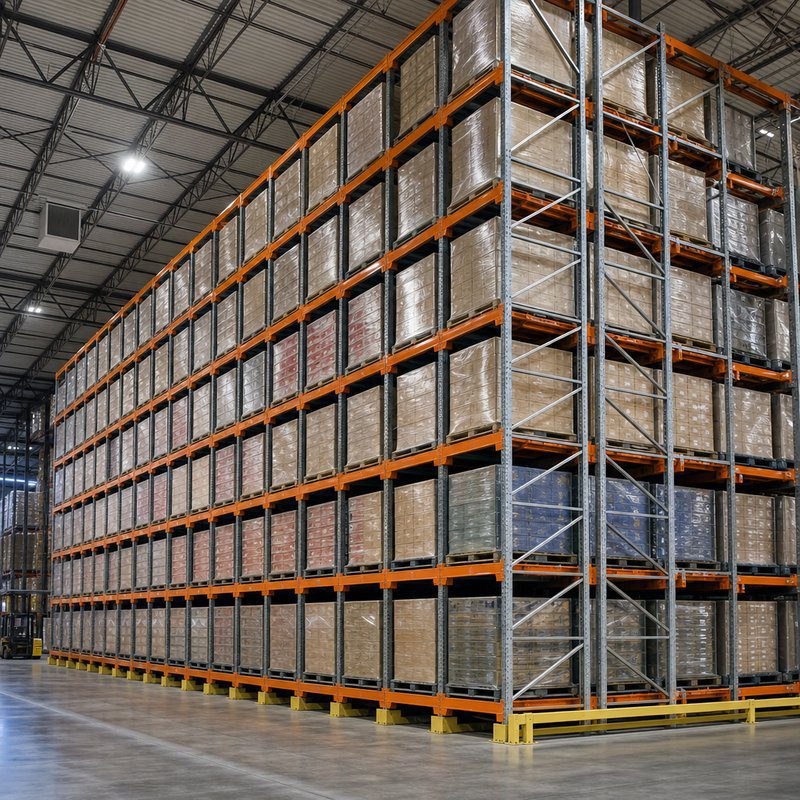
2-Deep Push-Back
The most common configuration. Each lane stores two pallets. Provides approximately 60% more storage than selective rack. Works with standard pallet sizesand beam levels.
Best for: General warehousing, first step up from selective, moderate SKU count
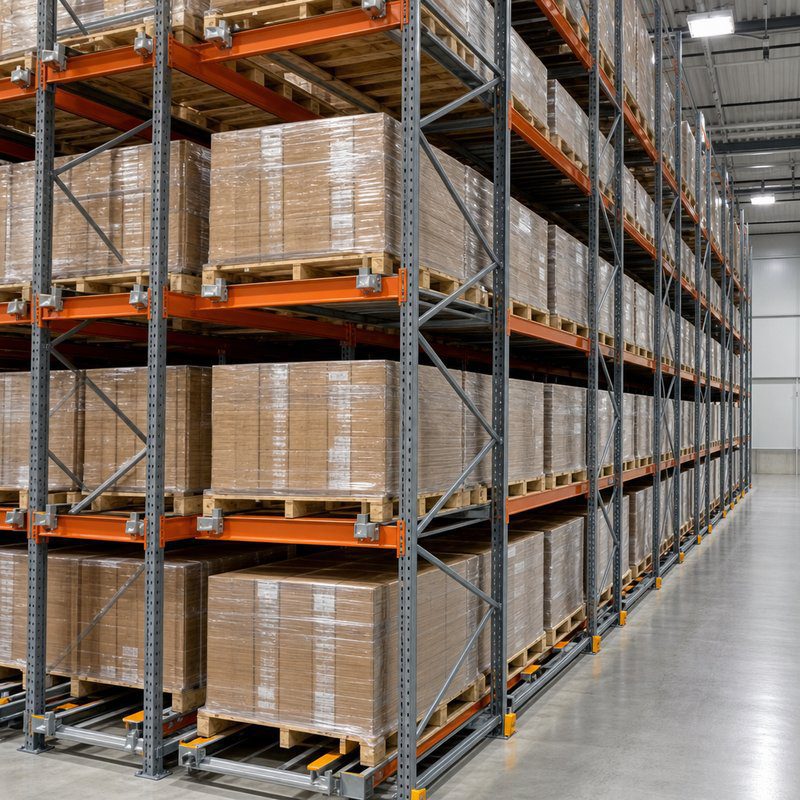
3–4 Deep Push-Back
Three or four pallets per lane on nested carts. Provides 70–80% more storage than selective. The sweet spot between density and accessibility.
Best for: Distribution centers, beverage storage, high-volume manufacturing

5–6 Deep Push-Back
Maximum push-back depth. Up to 90% more storage than selective. Uses heavier cartsand rails. Typically reserved for very high-volume, low-SKU operations.
Best for: Bulk storage rivaling drive-in, but with aisle-based accessand zero rack entry
Technical Specifications
| Parameter | Push-Back Rack | Notes |
|---|---|---|
| Depth | 2 to 6 pallets deep | 2-deep is most common |
| Cart System | Nested steel carts on inclined rails | Gravity-powered, no motors |
| Rail Incline | ~1.5% grade (rear higher than front) | Enough gravity to roll pallets forward |
| Pallet Weight | Up to 2,500 lbs per pallet typical | Heavier loads with engineered carts |
| Forklift | Standard counterbalanced or reach truck | No specialized equipment needed |
| Inventory Rotation | LIFO (last-in, first-out) | WMS can manage FIFO across lanes |
| Density Gain | 40–90% over selective | Depends on depth configuration |
| Rack Damage Risk | Very low | Forklift never enters structure |
| Compliance | RMI / ANSI MH16.1 | Seismic engineering included |
Applications & Industries
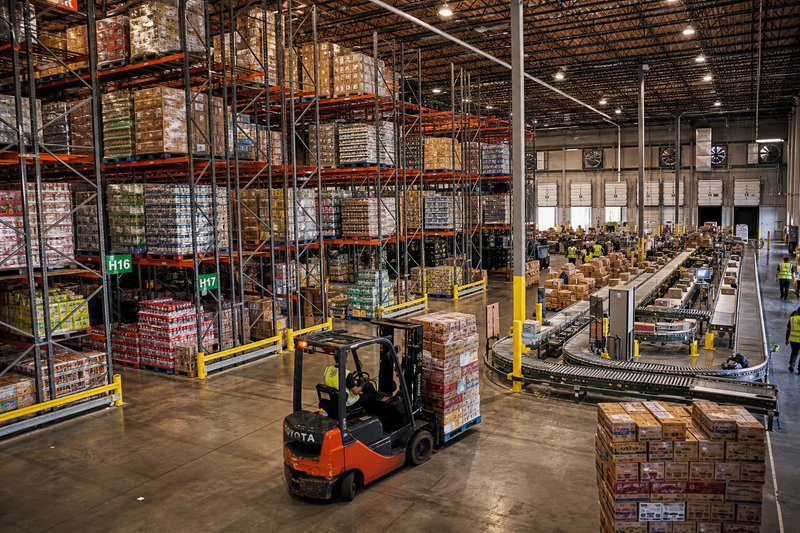
📦 Distribution Centers
The most common application. Push-back handles moderate-to-high SKU counts with multiple pallets per SKU. Faster cycle times than drive-in and less rack damage.

🍺 Food & Beverage
Beverage distributors, snack companies, canned goods — products with moderate SKU count and high volume per SKU. Push-back provides density of drive-in with speed of selective.
❄️ Cold Storage
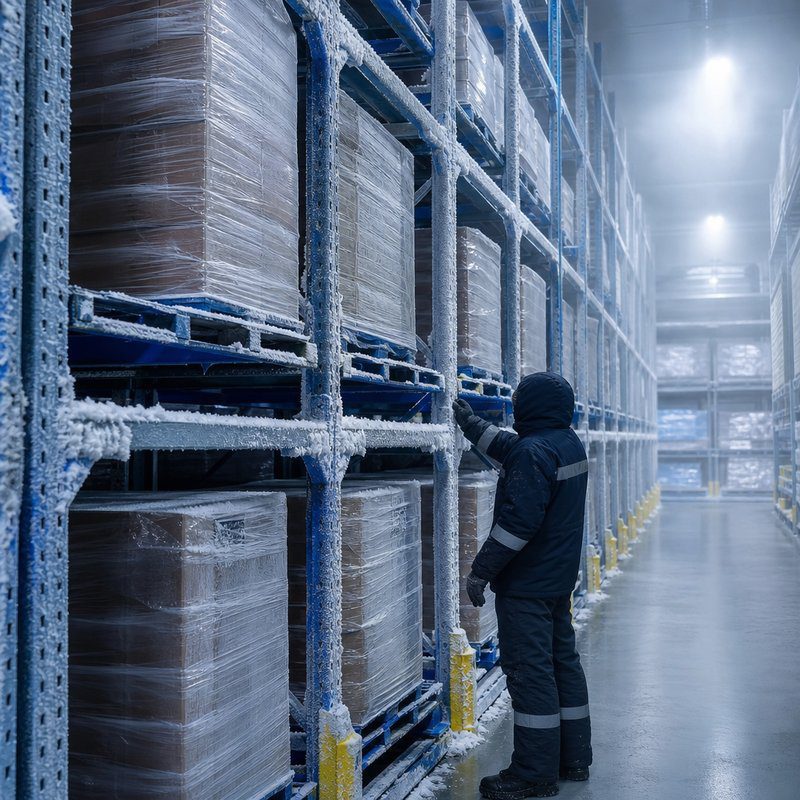
Maximize expensive cold/freezer cube without drive-in rack damage risks. Forklifts never enter the structure — reducing repairs in environments where maintenance is difficult.
🏭 Manufacturing
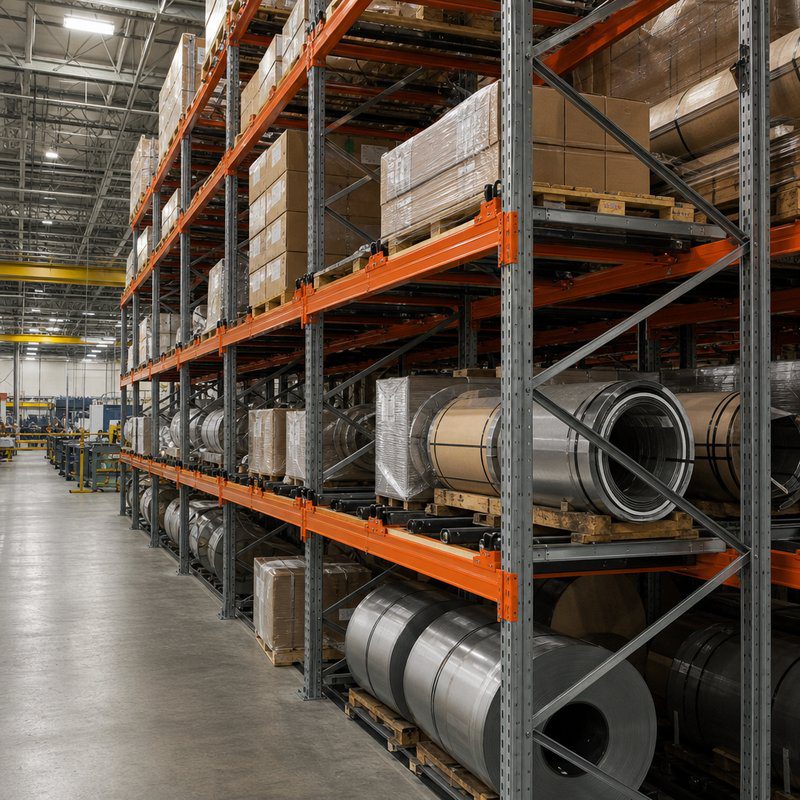
Work-in-progress storage, raw materials staging, and finished goods buffer. Push-back handles density while maintaining fast cycle times for production lines.

📋 3PL Warehousing
Third-party logistics with multiple clients. Push-back allows denser storage per client zone while keeping pick speed high. Standard components mean easy reconfiguration.

💊 Pharmaceutical & Chemical
Controlled-environment storage. Push-back provides density in temperature-controlled rooms. Gravity-fed system has no electrical components, simplifying compliance.
Push-Back vs. Other Storage Systems
| System | Selectivity | Density | Cycle Speed | Best For |
|---|---|---|---|---|
| Push-Back | ~75% | High (60%+) | Fast | Balance of density + speed |
| Selective | 100% | Standard (45%) | Fastest | Many SKUs, fast picking |
| Drive-In | Low | Very High (75%) | Slow | Few SKUs, max density |
| Pallet Flow | 100%/lane | Very High | Fast | FIFO required, perishables |
| Double Deep | ~50% | Moderate (55%) | Medium | Simple step up from selective |
Choose push-back if: You want significantly more density than selective but need faster cycle timesand less rack damage than drive-in. Ideal when you have 5–20+ pallets per SKU.
Consider alternatives if: You need strict FIFO (pallet flow), maximum possible density with few SKUs (drive-in), or 100% selectivity (selective rack).
When to Choose Push-Back Pallet Rack
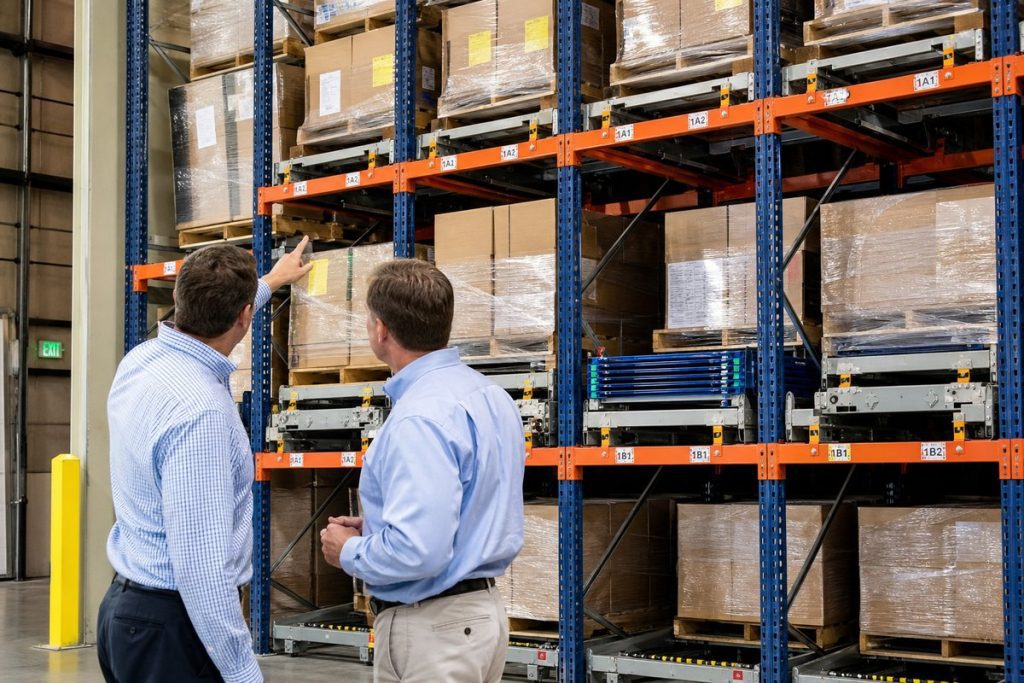
Push-back rack fills the gap between selective and drive-in — high density without sacrificing forklift aisle access. Here’s when it’s the right choice.
Ideal Conditions for Push-Back
- Moderate SKU count (10–50 SKUs) — More product variety than drive-in can handle, but not so many that you need 100% selectivity
- 2–6 pallets deep per SKU — The sweet spot for push-back. If you need 8+ deep, drive-in is more cost-effective
- Higher throughput than drive-in — Forklifts load and unload from the aisle face only. No entering lanes. Faster cycle timesand fewer impacts
- LIFO inventory is acceptable — Push-back is last-in, first-out. Each lane holds one SKU, and the front pallet is always the most recently loaded
- Existing selective rack aisles — Push-back works in standard forklift aisles. You can retrofit one side of an aisle from selective to push-back without changing your layout
Push-Back vs. Drive-In — Key Differences
| Factor | Push-Back | Drive-In |
|---|---|---|
| Depth | 2–6 deep | 5–12+ deep |
| Forklift enters lane? | No — aisle-face only | Yes — full depth |
| Rack damage risk | Low | High |
| Throughput | Higher — faster load/unload | Lower — travel into lanes |
| Operator skill needed | Standard | Advanced |
| Cost per position | Higher | Lower at depth |
💡 The Best of Both Worlds
Many warehouses combine push-back with selective rack in the same aisle. High-volume SKUs go in push-back bays on one side; lower-volume SKUs face them in selective bays. One aisle serves both needs.
Inside the Push-Back Mechanism
Understanding the cart and rail system helps you spec, operate, and maintain push-back rack correctly.
Nested Cart System
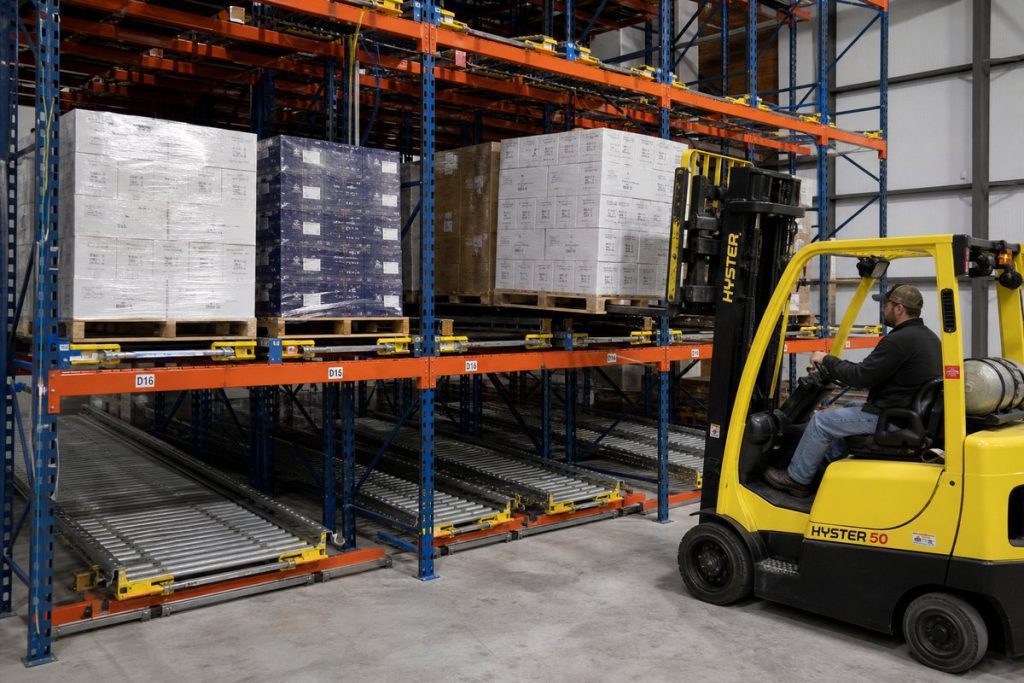
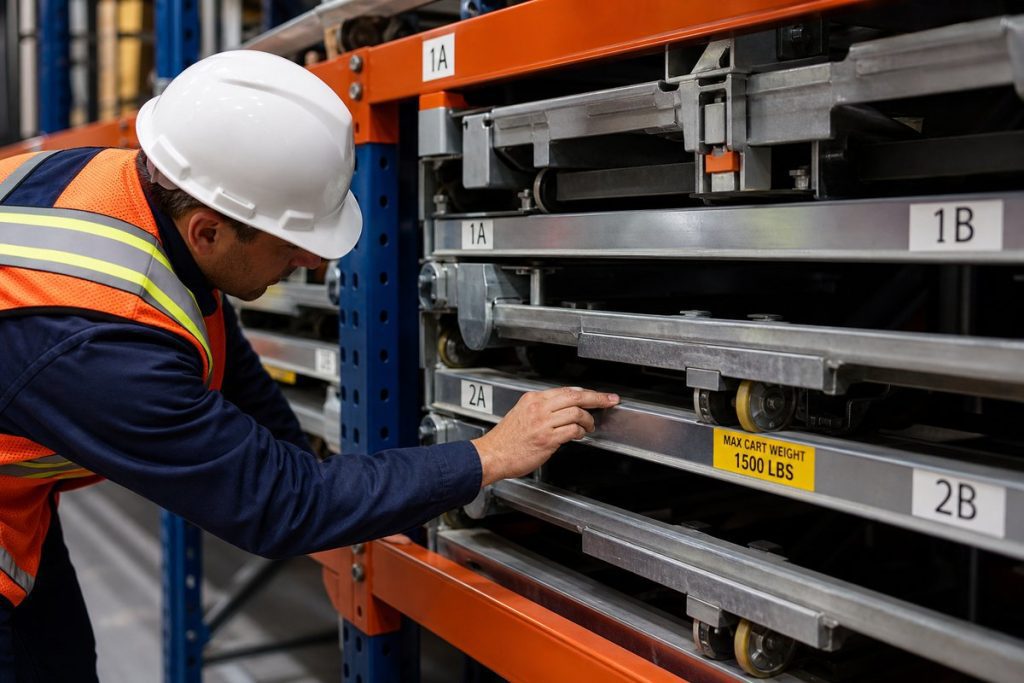
Each push-back lane contains a set of steel carts that nest inside each other on inclined rails. When a pallet is loaded, it pushes the carts (and all pallets behind it) back along the rails. When the front pallet is removed, gravity rolls the remaining pallets forward to the pick face.
The incline is critical: Rails are pitched at 1.5–3% grade — just enough for gravity to move loaded carts but gentle enough to prevent runaway pallets. The pitch is engineered for your specific pallet weight range.
Cart Types
- Standard nested carts — Steel carts with 4 or 6 wheels. Most common for loads under 3,000 lbs. Nest inside each other to maximize depth.
- Heavy-duty carts — Reinforced carts for loads up to 3,500 lbs per pallet. Wider wheels distribute weight more evenly across rails.
- Roller-based systems — Some configurations use rollers instead of carts. Better for very heavy loads but typically limited to 3–4 deep.
Installation & Safety Considerations
Push-back rack requires precise installation to function safely. Here’s what a professional installation involves.

🔧 Rail Pitch Calibration
Rails must be installed at the correct incline for your pallet weight range. Too steep = pallets roll forward too aggressively. Too shallow = pallets don’t advance to the pick face. Our crews verify pitch with digital levels on every lane.
🏗️ Seismic Requirements
Push-back systems are heavier than selective rack due to the cart/rail mechanisms. Seismic calculations must account for the dynamic loading of carts in motion during an earthquake. In Utah, PE-stamped seismic engineering is included on every MH-USA project.
⚠️ Cart Retention
Front stops prevent loaded carts from rolling out of the rack. Rear stops prevent empty carts from sliding past the load point. Both must be properly secured and inspected regularly. A missing front stop with a heavy pallet load is a serious safety hazard.
⚠️ Critical Operating Rule — Never Enter a Push-Back Lane
Push-back rack is designed for aisle-face operation only. Forklifts should never enter the lane. Unlike drive-in rack, there are no guide rails protecting uprights inside push-back lanes. An operator driving into a push-back lane can damage the cart mechanism, derail pallets, and cause a lane collapse.
What Affects Push-Back Rack Cost?
Push-back rack is a premium system — but the operational benefits often justify the investment over drive-in or selective alternatives.
📐 Depth (2, 3, 4, 5, or 6 Deep)
Each additional position deep adds another nested cart to every lane on every level. A 6-deep system costs roughly 2× more per bay than 3-deep. But the cost per pallet position drops as depth increases because you’re sharing uprightsand beams across more positions.
⚖️ Pallet Weight
Heavier pallets require heavier-duty carts, thicker rails, and stronger beams. Standard carts handle up to 2,500 lbs. Heavy-duty systems for 3,000–3,500 lb pallets cost 15–25% more. Specifying exact weights prevents over-engineering.
🔩 Cart Quality
Carts are the heart of the system. Budget carts with plastic wheels wear faster and require replacement sooner. Premium carts with steel wheelsand sealed bearings cost more upfront but last 3–5× longer in high-throughput operations.
💰 The Operational Savings Argument
Push-back rack costs more than drive-in per pallet position — but consider the operational savings: no forklift travel into lanes (faster cycle times), virtually no rack damage from forklift impacts (no repair costs), standard operator skill (lower training costs), and the ability to use standard aisles (no layout changes). For many operations, push-back pays back the premium within 18–24 months through reduced damage, faster throughput, and lower labor costs.
Maintenance & Inspection for Push-Back Rack
Push-back rack has moving parts that require regular maintenance beyond standard rack inspections.
Maintenance Schedule
| Component | Check For | Frequency |
|---|---|---|
| Cart wheels | Flat spots, debris buildup, bearing failure | Monthly |
| Rails | Debris, dents, proper pitch, loose fasteners | Monthly |
| Cart nesting | Carts seat fully, no hang-ups, smooth operation | Monthly |
| Front/rear stops | Present, secure, undamaged | Weekly |
| Uprights & beams | Standard rack inspection — dents, plumb, connectors | Monthly |
| Lane operation test | Empty lane cycles — verify carts return to pick face smoothly | Quarterly |
🔧 Common Issue — Carts Not Advancing
The #1 maintenance call for push-back rack: “pallets aren’t rolling forward.” Usually caused by debris on rails (shrink wrap fragments, broken pallet pieces), flat-spotted cart wheels, or a pallet that was loaded off-center and jammed. Regular rail cleaning and cart inspection prevents 90% of these calls. Schedule a push-back rack inspection →
Frequently Asked Questions
A high-density storage system where pallets are stored 2 to 6 deep on nested carts on inclined rails. Each new pallet pushes existing ones back. When the front is removed, gravity rolls the remaining pallets forward.
Typically 2 to 6 pallets deep. Two-deep is most common. Beyond 6, drive-in or pallet flow systems are usually more practical.
LIFO (last-in, first-out) within each lane. For FIFO, consider pallet flow rack. A WMS can manage effective FIFO across multiple lanes of the same SKU.
Standard counterbalanced forkliftsand reach trucks — no special equipment needed. All loading and unloading happens from the aisle face.
One of the safest high-density options. The forklift never enters the rack structure — eliminating the primary cause of rack damage and operator injury in drive-in systems.
More per position than selective but often more cost-effective than drive-in when factoring in reduced damage and faster cycle times. Contact Material Handling USA at (800) 326-4403 for pricing.
Explore More Pallet Rack Solutions
Need High-Density Storage Without the Complexity?
Material Handling USA designs, supplies, and installs push-back pallet rack systems for warehousesand distribution centers nationwide. Free design consultation and competitive pricing.
Online Store
Shop at MaterialHandling-USA.com
Need rack components or warehouse supplies? Shop online for fast delivery:
Warehouse Equipment & Supplies
Pallets
Stretch Wrap & Shrink Film
Shipping Labels & Tags
Shop pallet rack & accessories →