
Modular vs. Traditional Construction — Which Is Right for Your Facility?
A practical guide to choosing between modular and traditional construction for your next building project. Compare costs, timelines, quality outcomes, and long-term value.
Call (800) 326-4403 or Email Sales@MH-USA.com
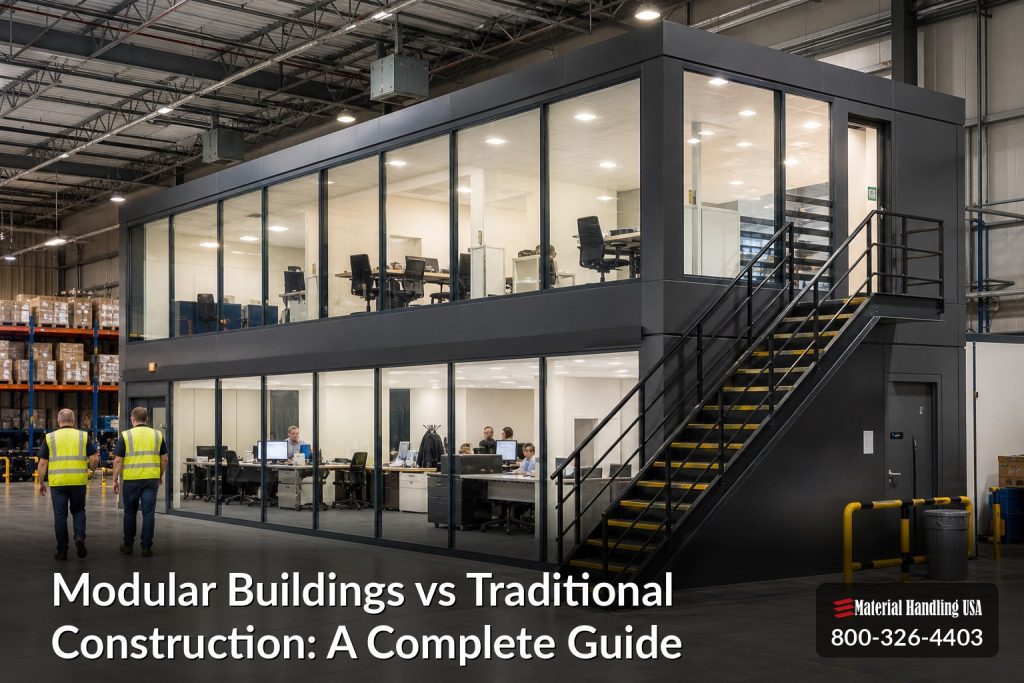
What Makes Modular Different from Traditional?
Traditional construction assembles a building on your property using raw materials — concrete, steel or wood framing, insulation, drywall, roofing, and finishes — installed by sequential trades over weeks to months. Every step depends on weather, material delivery schedules, trade availability, and inspection timing. Delays compound: if the framing crew is late, electrical can’t start, which delays drywall, which delays painting, which delays occupancy.
Modular construction manufactures your building in a factory while your site is being prepared. Walls, floors, ceilings, electrical, HVAC, and finishes are completed in controlled conditions. When the factory work is done, the building ships to your site and installs in 1–5 days. Because factory manufacturing and site preparation happen at the same time (not sequentially), the total project timeline compresses by 50–70%.

Key Advantages of Modular Construction
For most commercialand industrial applications, modular construction delivers measurable advantages over traditional methods.
Predictable Cost
Factory pricing is locked at order placement. You know the total cost before manufacturing begins. Traditional construction averages 10–15% in change orders — unexpected costs that appear mid-project when you have no leverage to negotiate.
Dramatically Faster
A modular building delivers in 4–8 weeks total. An equivalent traditional project takes 3–12 months. For businesses where time is money — lost productivity, delayed revenue, extended rental costs — the time savings often exceed the construction cost savings.
Superior Quality Control
Factory manufacturing uses jigs, fixtures, and quality checkpoints that produce consistent results. Traditional construction quality depends on the specific workers assigned to your project — and their performance on the day they’re building your walls.
Minimal Site Disruption
Traditional construction creates months of noise, dust, restricted access, and safety hazards on your property. Modular installation takes 1–5 days with no welding, no concrete, and minimal noise. Your operation barely notices.
Financial Flexibility
Modular buildings qualify for Section 179 tax deduction — full cost deducted in year one. They retain resale value and can be relocated. Traditional construction depreciates over 39 yearsand has zero resale value if you no longer need it.
Environmentally Responsible
Factory manufacturing wastes less than 5% of materials. Traditional construction wastes up to 30%. Factory processes use 67% less energy. And modular buildings can be recycled or repurposed rather than demolished into landfill waste.
The Real Cost of Traditional Construction
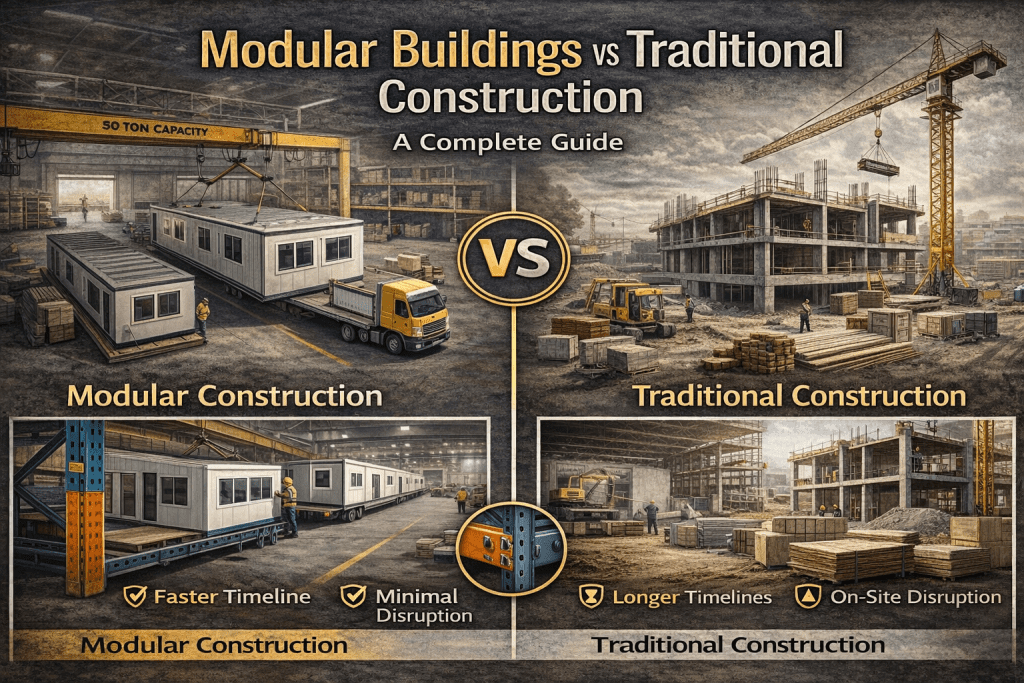
The bid price for traditional construction is just the beginning. Hidden costs accumulate throughout the project: change orders (10–15% average), weather delay costs, temporary facility costs while construction finishes late, operational disruption costs (lost productivity, rerouted operations), project management time from your staff, and extended financing costs when the project runs over schedule.
When you calculate the true total cost of ownership — including these hidden expenses plus the 39-year depreciation timeline — modular construction’s advantage grows even larger than the 20–35% headline savings. A $200,000 modular building deducted fully in year one provides more tax value than a $200,000 traditional project depreciated at $5,100 per year over 39 years.
When to Choose Modular Over Traditional
Frequently Asked Questions
Explore More Modular Building Solutions
Get a Free Comparison Quote
Tell us what you need — we’ll show you exactly what modular construction saves over traditional methods. Material Handling USA.