Inmate property storage systems are secure, inventoried, high-density systems for intake, valuables, and bulk property. Capacity must be planned against explicit limits, such as 2 cubic feet per inmate in Texas or 500 mm x 400 mm x 300 mm per property container in New Zealand, while every item needs a traceable custody record.
A jail property room has to absorb arrivals, classify belongings, protect valuables, and return the right items later. A row of lockers may hold property, but it doesn't by itself prove who received an item, where it was stored, or when it moved. The working system combines shelving, bins, lockers, cages, bags, labels, records, and controlled access.
For US buyers, the key question isn't just which shelf holds the most bags. It's whether the layout supports capacity control and chain of custody without blocking egress, creating retrieval bottlenecks, or mixing high-risk property with routine storage. Storage planning resources, including TLC Moving & Storage storage tips, can help frame the broader security issues, but correctional property rooms need facility-specific engineering.
What Inmate Property Storage Systems Do and Why They Matter
A useful system performs two jobs at the same time. It stores the required volume in a defined footprint, and it creates an auditable path from intake to release. The first job is physical. The second protects the facility when an inmate or authorized representative disputes a missing, damaged, or incorrectly released item.
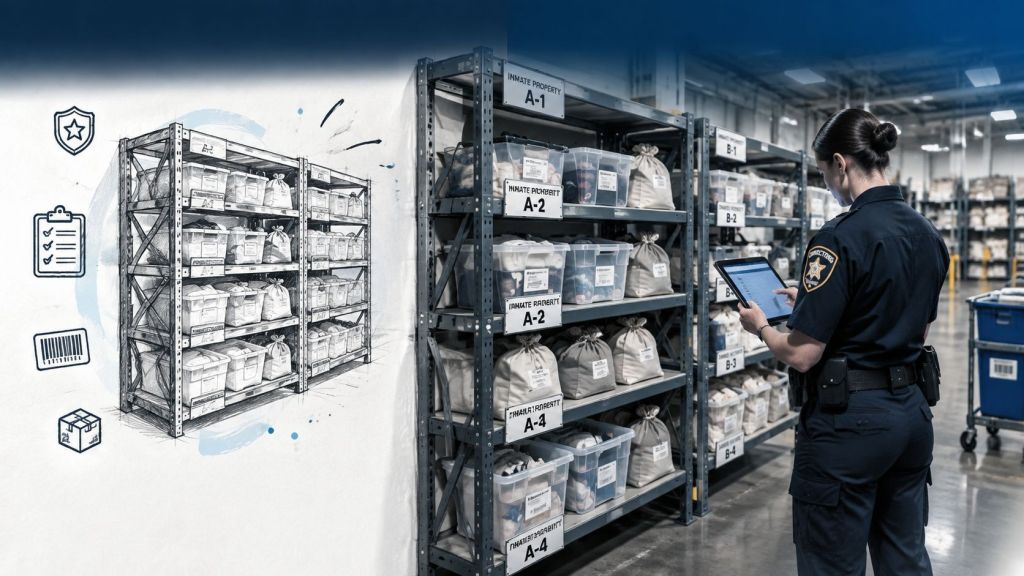
New Zealand's Prison Operations Manual sets a personal-property container limit of 500 mm x 400 mm x 300 mm. It also limits stored property during incarceration to court clothes, release clothes, and small valuables. Stored items must be labeled securely and entered into the prison information system, while valuables require separate storage in a locked cabinet or safe. The New Zealand property storage rule shows the design principle clearly, controlled volume, item identification, and restricted access.
Storage is a custody process
Canada provides another useful benchmark. Its Correctional Service limits stored personal property to 0.085 cubic metre per inmate and requires an individual locked storage space. Staff must record and tag stored items, and property beyond the limit may be removed or shipped at the inmate's expense and risk. Canada's correctional property directive connects physical capacity with inventory accountability.
That combination matters in a US jail as much as in a national correctional system. A property room that lacks a defined volume policy tends to accumulate exceptions. Exceptions become unprocessed bags, crowded aisles, duplicate searches, and claims that take staff time to resolve.
Material Handling USA's law enforcement material handling solutions can be used as a starting point for planning shelving, secure storage, and controlled property workflows. The final configuration should still be checked against the facility's policies, fire protection requirements, structural conditions, and local authority requirements.
Practical rule: Design the record path and the physical path together. A barcode or inventory entry is only useful if staff can find the assigned container without opening unrelated property.
How Property Is Classified and Tracked From Intake to Release
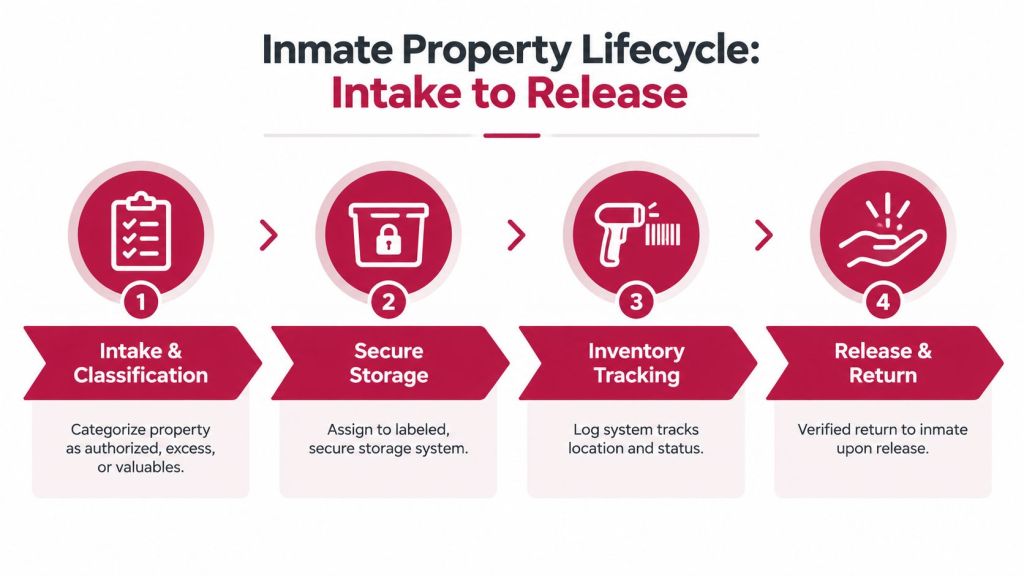
The intake counter is where a property room either gains control or loses it. Staff should identify the property class, confirm the owner, record the contents, apply a label or seal, and assign a storage location before the item leaves the intake workflow.
Separate the property classes
Most facilities need distinct handling rules for at least four groups:
- Authorized carry property: Items the inmate may keep in the housing unit or approved personal area.
- Excess property: Items that exceed the permitted volume or cannot remain with the inmate.
- Valuables: Cash, jewelry, identification, electronics, or other items needing tighter access and sometimes fire-resistant storage.
- Held or disputed property: Items retained pending investigation, release instructions, a claim, or another administrative decision.
Finland's prison property rules require staff to enter an inventory into the prisoner data system. The record includes the type and amount of each item, along with the value of objects and clothing placed in storage. The rules also state that available storage limits how much property the prison can accept, and property the prison can't store must be sent at the prisoner's expense to a named destination. Finland's property storage regulation illustrates why the intake process must connect policy to actual room capacity.
A simple way to test the workflow is to treat each bag like a library checkout. Every item needs an owner, a location, and a time-stamped status. When staff add or remove property, the record should change with it.
Use seals and records as controls
The UK framework limits a prisoner's total property, carried or stored, to two standard volumetric control boxes measuring 70 cm by 55 cm by 25 cm each. Excess property held at the prison is intended to be exceptional or temporary, and stored property must remain in bags secured with the establishment's unique seals. The UK Prisoners' Property Policy Framework demonstrates how volumetric controls and seal identity work together.
A digital tracking system should support, not replace, the physical controls. Enasys asset tracking software may support location and status records, but staff still need consistent labeling, secure staging, and documented handoffs. For teams refining forms and custody documentation, this evidence documentation guide offers a useful reference point for record structure.
Comparing Inmate Property Storage Options for Correctional Facilities
No single storage product fits every property room. High-density systems conserve floor area, while static shelving often gives faster access. Lockers and cages improve separation, but they consume more space per stored item and can increase hardware and access-control needs.
| System Type | Footprint and Capacity | Security and Tracking | Best Fit |
|---|---|---|---|
| High-density mobile shelving | Uses movable carriages to reduce inactive aisles; capacity depends on shelf depth, tier count, and bag volume | Controlled aisle access, assigned locations, barcode or inventory records | Large property volumes where floor space is limited |
| Static four-post shelving with bins | Fixed rows with adjustable shelf levels; capacity scales by shelf length and bin size | Open access unless placed in a secure room or cage; labels and location codes are essential | Routine bags and sorted property with frequent retrieval |
| Secure cages and lockers | Dedicated enclosed footprint; individual compartments or shared locker bays | Physical separation, locks, seals, and controlled key or access management | Sensitive property, authorized personal effects, or overflow requiring segregation |
| Property bags with seal control | Flexible container volume, but bags require shelf, rack, or floor staging space | Unique seals, inventory entries, and handoff records create custody control | Intake, short-term staging, and sealed release packages |
| Valuables safes and fire-rated cabinets | Small, dense storage for items that need restricted access; usable volume is limited | Locked access, separate records, and assigned custody responsibility | Cash, jewelry, documents, and other high-risk small items |
Texas jail standards allocate 2 cubic feet per inmate for inmate-property storage, with separate space for uniforms, linens, and mattresses. The standards also call for storage areas for inmate property, uniforms, towels, bedding, linens, and janitorial supplies. The Texas jail standards PDF is a practical reminder that property storage must be sized as part of the facility, not squeezed into leftover room.
Match the system to the work
Mobile shelving works well when the facility can tolerate controlled access to a moving aisle and staff retrieve grouped property in batches. Static shelving is easier to understand and can be simpler to install, but it needs more aisle area. A cage adds a clear security boundary for bulk property, while lockers support one-to-one assignment.
For personal effects that need individual access or electronic control, smart lockers may be worth comparing with conventional keyed lockers. The buyer should evaluate failure modes, emergency access, maintenance, and the time required to assign or reset compartments.
How to Size and Specify Inmate Property Storage Systems
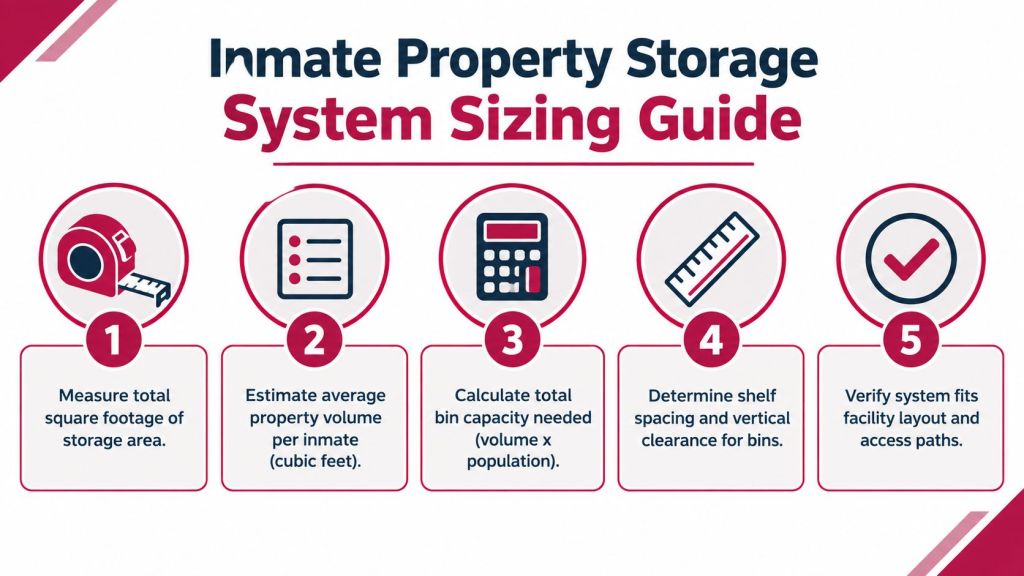
A good quote starts with measurements, not a product name. Collect the following information before asking for a layout.
Measure the room. Record length, width, ceiling height, columns, doors, sprinkler obstructions, electrical panels, drains, and fixed equipment. Mark the usable storage rectangle separately from circulation and work areas.
Document access and egress. Show door swings, required exit paths, fire equipment, staff sightlines, cart routes, and the intake counter. Don't place a deep shelf or cage where it forces staff to stage bags in a corridor.
Define the population and flow. Provide housing capacity, average admissions, release frequency, peak intake periods, and the number of staff who handle property. A room sized only for the average day may fail during a surge.
Estimate property volume. Measure representative bags or containers, then separate authorized items, excess property, valuables, and long-term holds. Use the governing policy limit where one exists. The examples above range from a fixed container size in New Zealand to 0.085 cubic metre per inmate in Canada, so a US buyer should not copy an overseas limit without agency approval.
Set retention rules. Identify how long the facility holds tangible property, valuables, disputed items, and release packages. Longer retention increases the required reserve capacity even when admissions remain stable.
Convert inputs into a layout
Use the measured bag volume and required inventory count to establish total bin or shelf capacity. Then select shelf depth, vertical spacing, and clear working height around the actual containers. Leave room for receiving, scanning, sealing, and release staging. Those areas are part of the system even though they don't store property.
Check anchoring, seismic design, fire protection, and local code requirements before fabrication. RMI and ANSI MH16.1 may apply to some rack configurations, but a qualified project engineer should confirm the correct standard for the selected equipment and building.
Material Handling USA provides free online design tools, including the Jaken Shelving Designer and other storage layout tools. A buyer can use the tool to develop a starting configuration, then submit the room dimensions and workflow for a design review.
Costs Lead Times and What Drives Them
A property room budget depends more on the complete workflow than on the price of a shelf. Steel construction, shelf gauge, finish, bin type, bag system, lockers, locks, cages, safes, labels, tracking equipment, anchorage, freight, and installation all change the project total.
Engineering can add cost when the facility needs seismic review, stamped drawings, special anchoring, or coordination with a new building. Mobile systems also require carriage design, floor checks, drive controls, and safety features. A simple static shelving layout may have fewer components but can require more floor area.
Budgeting advice: Ask for a complete installed scope. A product-only quote can omit layout engineering, freight, anchorage, field labor, electrical work, or commissioning.
Lead time depends on design approval, manufacturer production capacity, finish selections, custom dimensions, security hardware, permitting, and installation scheduling. A standard shelf configuration may move through planning more easily than a custom cage, mobile system, or integrated access-control package.
The hidden cost is often rework. If the room layout changes after fabrication, the facility may need revised drawings, field modifications, new anchors, or a second mobilization. Early approval lets the project team reserve an installation window and coordinate with construction, inspection, and turnover milestones.
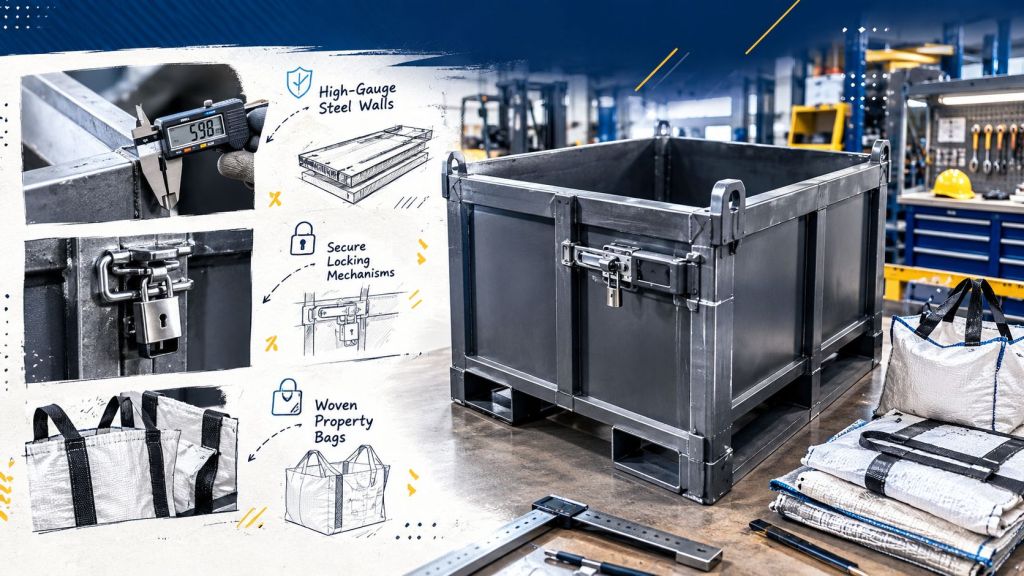
Material Handling USA offers free layouts and designs with no obligation, free quotes, competitive pricing, and fast shipping and delivery options subject to the selected configuration. Confirm the actual schedule when the design, quantities, finish, and site conditions are known.
Common Mistakes to Avoid When Planning Property Storage
The most expensive mistakes usually happen before installation. They come from treating property storage as a furniture purchase instead of a controlled process tied to the building.
Mistake one is sizing for average volume
Admissions fluctuate, and stored property can remain longer than expected. If every shelf is full on a normal week, staff have no safe place to stage new bags. Build the capacity model around approved policy, peak intake, retention, and a defined overflow plan.
Mistake two is using circulation space as reserve storage
Bags placed in egress routes create an operational and inspection problem. The fix is to draw every access path, door swing, fire device, and work zone before selecting shelf rows. Texas standards' separate storage allocations reinforce the need to plan property alongside other facility storage, not through it.
Mistake three is mixing valuables with bulk bags
Valuables need restricted access and a separate record path. New Zealand requires valuables to be stored separately in a locked cabinet or safe, while Maryland rules require a secure property room for property temporarily out of inmate custody or stored as valuables. Maryland's secure property requirements also call for an accurate inventory and secure packaging when immediate inventory isn't possible.
Mistake four is relying on labels without location control
A label identifies a bag, but it doesn't prove the bag stayed in the assigned place. Use a location code, seal record, movement record, and staff responsibility at each handoff. Maryland procedures require sealed property that cannot yet be inventoried to remain sealed in secure storage with documentation identifying the receiving and securing officer.
Mistake five is approving a product list before validating the room
Shelving may fit on paper but fail at the door, aisle, sprinkler, or structural anchor. A multi-manufacturer integrator can compare static shelving, mobile storage, cages, lockers, and safes against the same measured layout instead of forcing the room to fit one product.
Plan Your Inmate Property Storage System With a Free Design
The right system has two measurable outcomes. It holds the approved property volume without unsafe overflow, and it lets staff prove custody through labels, seals, locations, records, and controlled access.
Start by measuring the room and documenting the workflow. Classify property before selecting equipment. Then compare static shelving, mobile shelving, lockers, cages, bags, safes, and tracking tools against the facility's population, retention rules, security level, and code conditions.
Use a free design tool to build a preliminary configuration, then request a professional layout review. Material Handling USA can coordinate product selection, layout design, in-house installation, and engineering considerations for seismic and code-compliant projects. Buyers can also request a free quote without obligation.
Planning earlier can protect the construction schedule. It gives the design team time to resolve aisle, anchorage, access, and staging issues before fabrication, and it helps the facility coordinate delivery and installation with other trades.
Contact the team through the law enforcement storage page, call (800) 326-4403, or email Sales@MH-USA.com to discuss your room dimensions and property workflow.
Configure a starting layout with Material Handling USA, then submit it for a free quote and design review for your inmate property storage system. The team can compare secure shelving, lockers, cages, mobile storage, and tracking needs, with competitive pricing, quality materials, fast delivery options, and installation support.