You open a storage room and see the warning signs before anyone says a word. A box of paper records has curled at the edges, a row of electronics feels damp to the touch, and the air near the door is warmer than the middle of the room. That is where climate control storage stops being a label and becomes a system decision, because the problem is not just temperature, it's stability.
A controlled space protects more than inventory. It protects the work, the compliance trail, and the budget tied to every item that can't be replaced cleanly. For a practical overview of preservation needs in a sensitive setting, how we preserve forensic samples is a useful reference point.
What Climate Control Storage Really Means for Your Facility
A lot of facilities call any cooled room “climate controlled,” but that's too loose for sensitive inventory. Climate control storage is built to hold both temperature and humidity within a stable band, not just to blow colder air across a room. In mainstream self-storage guidance, that working range is often described as 55°F to 85°F with 30% to 50% relative humidity, using HVAC, insulation, and often dehumidification to keep conditions steady year-round, which helps reduce mold growth, warping, and rust in stored materials (Bolt Storage).
The distinction matters because many failures start with a good-sounding label and a weak envelope. A room can feel comfortable to a person and still be wrong for paper, electronics, textiles, or records that react to moisture swings. A better mental model is a stability system, not a comfort system.
For buyers, the question is simple. What are you protecting, and what changes can damage it before the product ever leaves storage?
Practical rule: If the item would make you nervous in a hot attic or damp basement, don't let a loose “climate controlled” claim be your only spec.
Facilities that handle evidence, archives, or other sensitive materials often need a tighter written envelope than a generic marketing claim. For related technical context, the storage design notes in this environmental chamber resource are worth comparing against your own project scope.
The Core Mechanics of Stable Storage Conditions
Temperature, moisture, and airflow work as one system
A cold drink “sweating” on a summer day is a simple dew point lesson. Warm air carries more moisture, and when that air hits a cooler surface, water comes out of suspension. In storage, that same effect can show up on walls, doors, shelving, or product packaging if the room isn't balanced correctly.
That's why chasing one thermostat reading isn't enough. A room can sit near the target temperature and still drift in relative humidity if air exchange, sealing, or dehumidification are weak. Sensitive items usually care more about repeated moisture swings than a small temperature change.
Thermal mass smooths out the swings
Thermal mass is the capacity of a material to absorb, store, and release heat. In practical terms, concrete, brick, water, adobe, and rammed earth can help a building resist fast temperature changes by slowing down how quickly heat moves through the structure (ScienceDirect). That doesn't replace HVAC, but it reduces how hard the system has to work to hold a steady interior.
The same idea applies to storage rooms. A well-built envelope gives the mechanical system a calmer space to control, while a leaky shell turns every opening and closing cycle into a moisture event.
Rule of thumb: If the shell leaks, the HVAC system spends its time reacting instead of stabilizing.
For readers comparing facility types, find climate controlled storage Boston is a useful example of how local conditions influence the discussion. Climate control is never just about the equipment tag. It's about whether the room stays predictable when doors open, weather changes, and the daily load shifts.
HVAC, Dehumidification, Insulation, and Air Sealing Working Together
Each component solves a different problem
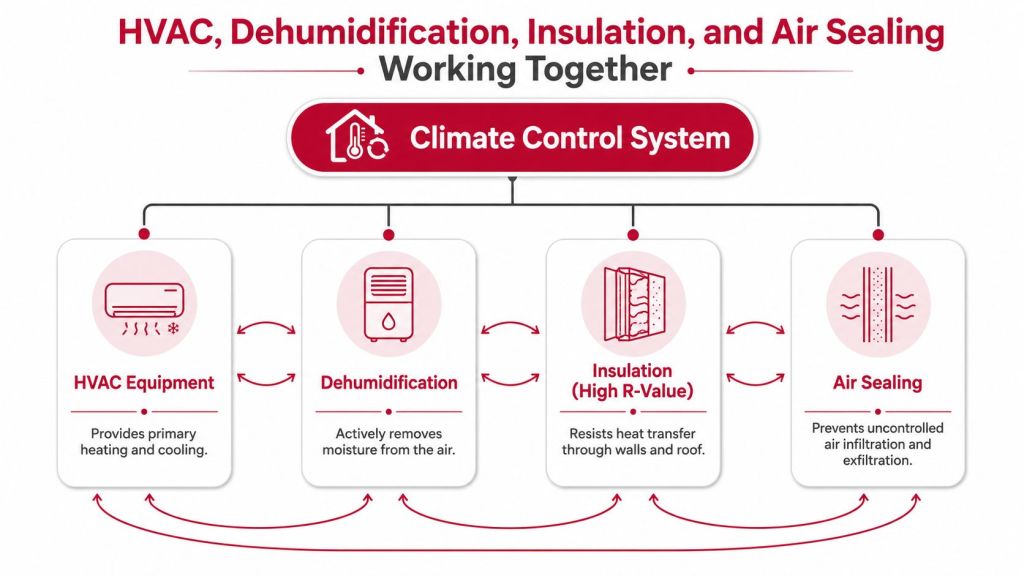
HVAC handles the core heating and cooling load. Dehumidification removes moisture that temperature control alone can miss. High-R-value insulation slows heat transfer through walls and roof. Air sealing blocks uncontrolled infiltration and exfiltration, which is where many retrofit rooms lose performance.
Used together, they give you a stable room. Used separately, they create false confidence. A storage room can have a powerful unit and still run humid if the envelope is leaky or the door cycle is heavy.
Common failure points show up fast
Short cycling is a classic problem. The system cools too quickly, shuts off, and never runs long enough to pull moisture out of the air. That can raise humidity, waste energy, and wear the equipment faster. Thermostats placed near exterior doors or warm traffic areas can also misread the room and trigger bad control decisions.
Independent storage guidance also emphasizes high-R-value insulation on all exterior walls and ceilings, vapor barriers, tight sealing around joints and frames, and enclosed units with service access for HVAC repairs (ATL Coast). Those details sound small until the room starts drifting.
For a quick side-by-side view, compare the main elements this way:
| Component | What it does | Where it fails when treated alone |
|---|---|---|
| HVAC equipment | Heats and cools the room | Can short cycle and leave humidity behind |
| Dehumidification | Pulls moisture out of the air | Can be undersized or omitted in retrofits |
| Insulation | Resists heat transfer | Gaps and weak joints leak performance |
| Air sealing | Limits uncontrolled air movement | Door leaks and penetrations upset the balance |
A useful comparison for mechanical planning is find HVAC cooling, especially when a project team is separating comfort cooling from true storage control. The same room needs more than air movement. It needs control of how air, heat, and moisture move together.
Recommended Temperature and Humidity Ranges by Material Type
One of the biggest planning mistakes is asking for a generic target and assuming it works for every stored item. The safer approach is to write the environmental envelope in the scope of work, then match it to the inventory. In specialty guidance, the Self Storage Association notes that 45% to 50% RH is preferable, while different material classes often need different targets, so the right answer depends on what's going in the room (Self Storage Association).
| Material Category | Temperature Range | Relative Humidity Range | Notes |
|---|---|---|---|
| Paper records | Stable, moderate room conditions | Low to moderate, steady humidity | Protects against curl, sticking, and brittle edges |
| Electronics | Stable room conditions | Dry enough to avoid moisture stress | Avoids condensation and corrosion risk |
| Pharmaceuticals | Written in the project spec | Tight control required | Follow the product and regulatory requirements |
| Laboratory samples | Written in the project spec | Tight control required | Confirm the exact preservation envelope in advance |
| Evidence | Stable and documented conditions | Controlled and documented humidity | Match the room to the material and chain-of-custody needs |
| Wine | Cool, steady conditions | Controlled humidity | Moisture swings can damage closures and labels |
| Art | Stable room conditions | Carefully controlled humidity | Protects surfaces, adhesives, and finishes |
| Textiles | Moderate, stable conditions | Dry and steady | Helps limit odor, mildew, and fiber stress |
The important buying point is not the table itself. It's the discipline of writing down the setpoint, the humidity band, the allowable drift, and whether the control is at the room level or the unit level. That makes bids comparable and keeps a contractor from interpreting “climate controlled” too loosely.
Buyer check: If the supplier can't tell you the environmental envelope in writing, the label is doing too much work.
Airflow and rack layout matter too. If the sensor sees the right conditions but the product sits in a dead zone, the room is still wrong where it counts. That's why the storage plan and the mechanical plan have to be built together.
Planning a New or Retrofit Climate Control Storage Project
Start with the inventory, not the equipment
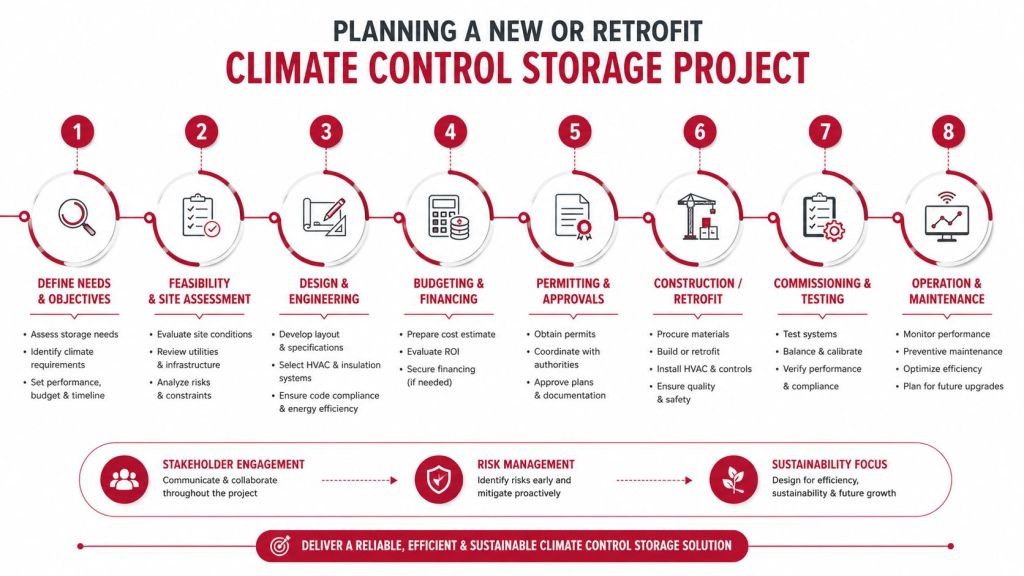
A strong project starts with a needs assessment. List what will be stored, how long it will sit, what condition it's in now, and whether any regulatory or documentation rules apply. That helps define whether you need one controlled room, multiple zones, or a more specialized chamber.
The next step is load calculation. A room packed with dense shelving, active traffic, and frequent door openings behaves differently than a low-turn archive. If you skip that planning step, the system gets sized on hope instead of actual use.
Put the sensor where the product lives
Sensor placement is one of the easiest ways to get a false read. Near an exterior wall, a door, or a supply register, the readings can look fine while the rest of the room drifts. Place monitoring where the inventory sits, and make sure the layout doesn't block air circulation.
That's where layout design earns its keep. Aisle widths, rack depth, and clear access lanes all affect airflow and service access. A tight room might save floor space, but it can make control harder and maintenance slower.
For evidence and secure rooms, the layout details are especially sensitive. A good reference point is evidence storage room design, because the storage plan has to support both environmental control and working access.
Practical takeaway: The best retrofit is usually the one that fixes the layout before it buys more equipment.
Material Handling USA's complimentary layout design service is built around that logic. Scaled drawings and 3D renderings help teams see product placement, aisle widths, code compliance clearances, and workflow before anything is ordered. That kind of planning is often what separates a stable install from a room that keeps fighting itself.
Real-World Applications Across Industries
In a pharmaceutical warehouse, the main issue is not just temperature. It's whether the storage zones let the team protect different product groups without mixing requirements across the floor. That usually means tighter documentation, monitored access, and a layout that keeps air moving where it should.
A county evidence room looks different. Secure cages, controlled humidity, and clear shelving lanes matter because paper, biological samples, and chain-of-custody items don't age well in unstable conditions. The room has to be both secure and predictable.
Manufacturing spares create another pattern. Slow-moving parts, electronics, and packaged components often sit longer than anyone planned, so pallet covers, mobile shelving, or protected stock areas can help keep dust and moisture from becoming a problem. The environmental envelope still matters, but so does access.
Laboratories often use modular buildouts to create a controlled space without waiting on a bigger building project. That can be the fastest path to a monitor-ready room when the existing footprint is already spoken for. For broader storage planning, cold storage warehouse solutions can help teams compare how different controlled environments are structured.
The inventory changes, so the control plan changes with it. That's the point. Climate control storage works best when the room, the rack, and the workflow are designed around the actual material, not around a generic storage label.
Common Pitfalls and Best Practices Checklist
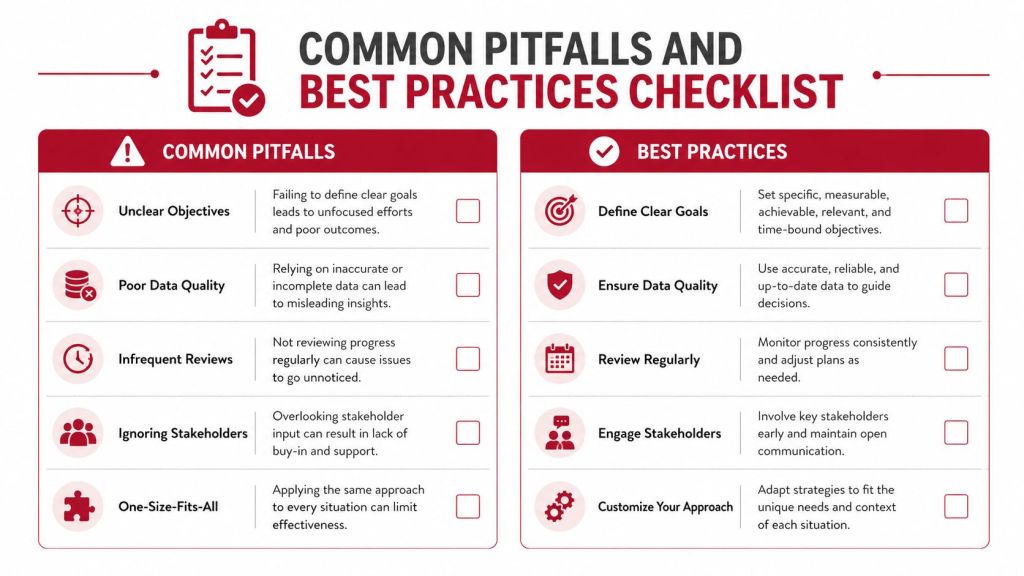
A retrofit can look fine on paper and still fail in service. The same is true for a new build that never got a real layout review. The checklist below is a quick audit tool for both.
| Common Pitfall | Better Practice |
|---|---|
| Underestimating space needs | Design for current inventory and near-term growth |
| Choosing the wrong product for the application | Match shelving, cages, or covers to the material and workflow |
| Forgetting future expansion | Keep room to scale without rebuilding the shell |
| Sealing the envelope without service access | Leave clear maintenance paths for HVAC and monitoring gear |
| Placing sensors where they read the wall | Put monitoring at the product level |
| Accepting a vague “climate controlled” label | Specify the environmental envelope in writing |
A few habits separate the better projects from the frustrating ones. First, ask for a custom layout before you commit to the final equipment list. Second, write the performance targets into the scope, not just the purchase order. Third, treat maintenance as part of the design, not as an afterthought.
If a room has to stay stable for the long haul, those details are not extras. They're the system.
Cost Drivers, ROI, Validation, and Next Steps
The biggest cost drivers are usually the ones that affect control quality most directly. HVAC sizing, insulation quality, vapor barrier integrity, dehumidification capacity, and monitoring hardware all shape how well the room holds conditions. So do the storage products inside it, especially if the design uses secure cages, mobile shelving, or pallet covers to protect the controlled space.
There's also a market reality behind the planning. In the U.S. self-storage market, climate-controlled units carried a measurable price premium in 2024, with climate control averaging about US$10 more per month than non-climate-controlled units, and the average climate-controlled rent reaching US$149 in April 2024 (Statista). A broader market estimate values the global climate controlled storage market at about US$18.7 billion in 2024, with forecasts to US$31.4 billion by 2033 at 5.9% CAGR, while another estimate places it at US$14.2 billion in 2025 and projects US$27.3 billion by 2034 at 7.8% CAGR (DataHorizzon Research). Those figures point to a market that keeps expanding, which helps explain why controlled space is often in demand.
ROI comes from fewer losses, less rework, fewer compliance headaches, and longer service life for stored materials. A room that performs well also makes audits and inspections easier because the data trail is cleaner. Validation should include sensor checks, routine inspections of seals and insulation, and documentation that shows the room is being maintained, not just installed.
Best practice: Inspect the room on a schedule, not only when something looks wrong.
For planning support, Material Handling USA offers free layouts, free quotes, fast shipping, and expert design help for controlled storage projects nationwide. If your team is comparing options for climate control storage, a custom plan can save time later by catching space, airflow, and access problems before the order is placed.
Material Handling USA can help you turn a climate control storage concept into a workable layout with the right storage products, clearances, and workflow. If you're planning a new room or fixing a retrofit that isn't holding conditions well, Material Handling USA is a practical place to start with a free quote and a custom layout conversation.