
Municipal Court Records Mobile Shelving Case Study: Canton, Mississippi
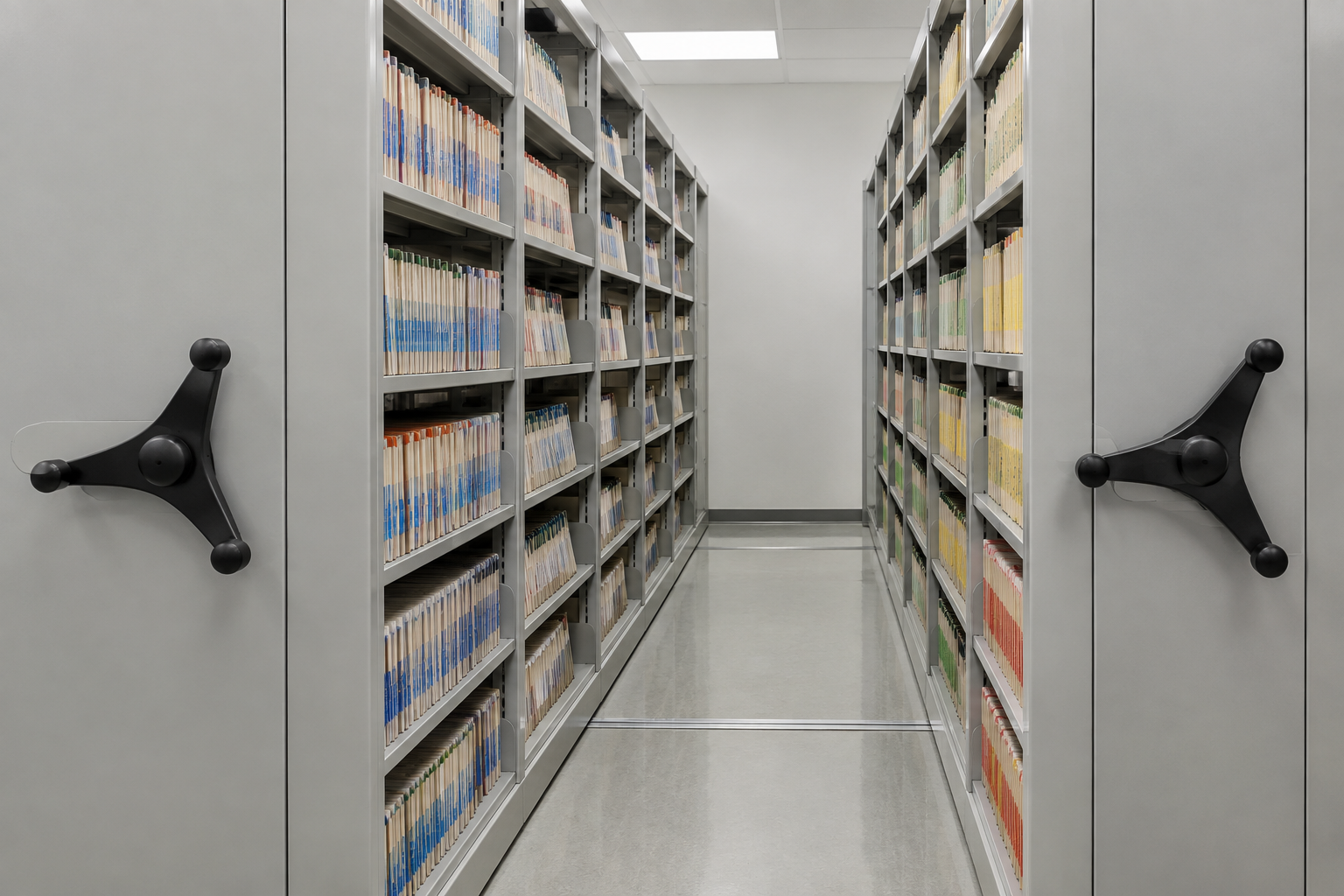
How a Mississippi city moved its court clerk case files into high-density mobile shelving with seven shelf levels, three dividers per shelf and a twin ramp instead of a sub-floor.
Customer
A city government in Canton, Mississippi
Location
Canton, Madison County, Mississippi
Product
Mobile shelving, seven shelf levels, three dividers per shelf
Application
Municipal court clerk case file storage
About the project
This project supplied high-density mobile shelving to a city government in Canton, Mississippi, the seat of Madison County, for the case file storage used by its court clerk’s office. The system was specified through the clerk’s office, which is the department that lives with the filing every day.
Material Handling USA supplied and installed a mobile shelving system laid out to an approved room drawing, configured with seven shelf levels and three file dividers per shelf and set on a twin ramp so no sub-floor construction was needed. Freight and installation were included, on an eight to ten week delivery schedule, and the project closed in September 2026.
Project scope at a glance
The situation
A court clerk’s office is one of the most file-dense operations in local government. Case files are created continuously, they carry retention obligations that outlast any single staff member, and they have to be produced quickly on request. Nothing about that volume is optional.
The storage that usually holds those files, lateral cabinets and static shelving, runs out of capacity first. Cabinets spend floor area on drawer pull space. Static shelving ranges each need a permanent aisle that stores nothing. In a city building where the courtroom, the clerk counter and public circulation all have to stay where they are, the file room cannot simply expand.
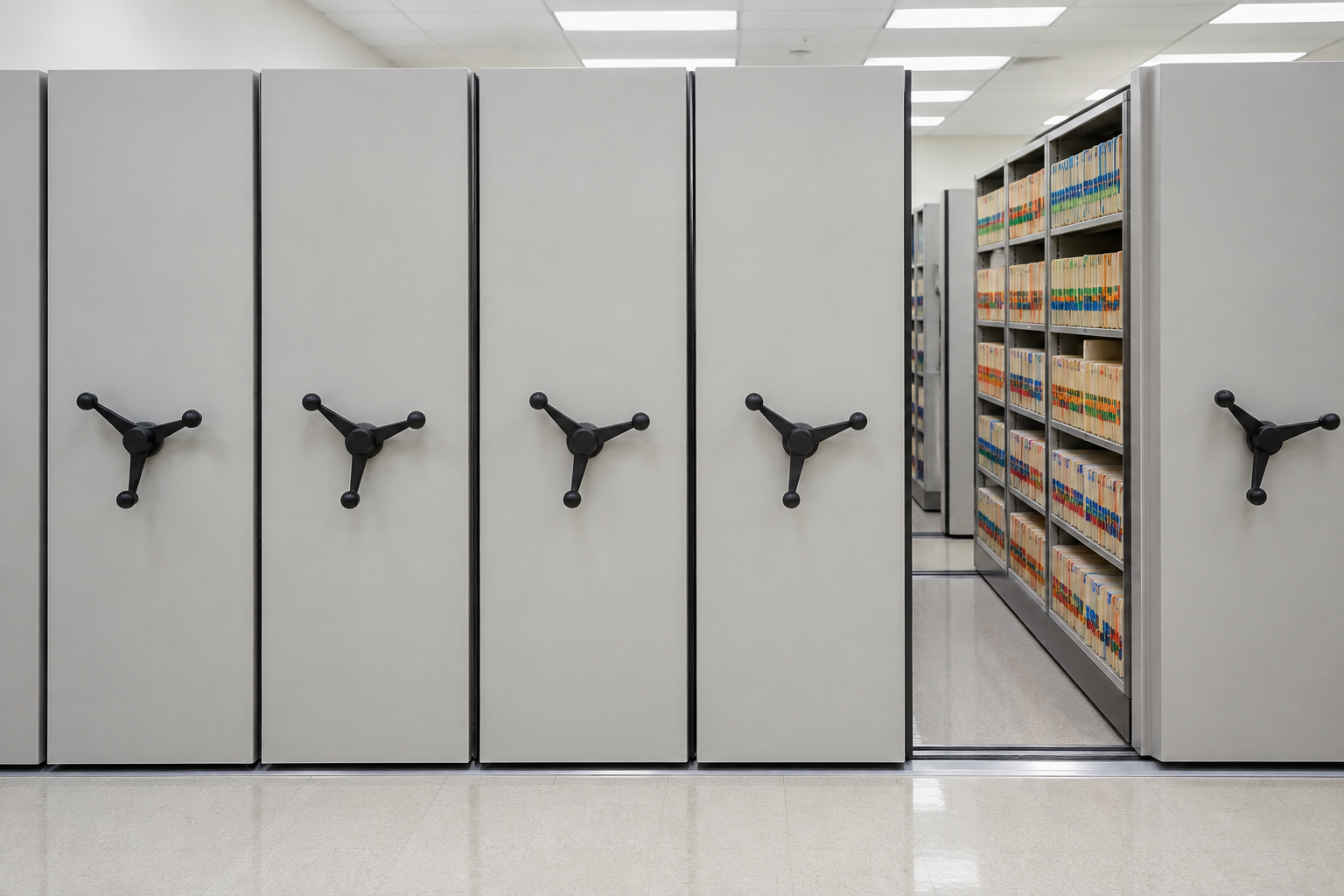
High-density mobile shelving is the standard answer because it removes the fixed aisles. The ranges roll on floor rail and share one moving aisle, which typically doubles the filing capacity of the same room.
What Material Handling USA supplied
We supplied a mobile shelving system built to the room drawing, with seven shelf levels per section and three dividers per shelf, plus a twin ramp, freight and installation.
The configuration was chosen around the material. Court case files are uniform and light, so the sections carry more, shorter shelf openings instead of fewer, taller ones. That converts room height into filing inches, which is where the capacity gain actually comes from.
Installation was part of our scope, including the rail layout and the ramp approaches, so the clerk’s office had a complete working system to load rather than a coordination problem.
Why the filing configuration matters more than the shelf count
Two systems with the same footprint and the same shelf count can behave completely differently. What separates them is whether the shelves are set up for the actual filing method.
Dividers. Three per shelf break each level into compartments. Files stand square instead of leaning, so a full shelf stays browsable and staff retrieve by position rather than by digging.
Shelf depth and level spacing. Letter and legal filing want tight vertical spacing. Get that wrong and every shelf wastes an inch or two of air, which across a full system is a whole range of lost capacity.
End-tab filing. Open-shelf filing with color-coded end tabs is far faster on shelving than folder-in-drawer filing, and it is the main reason records operations move off cabinets when they convert to mobile shelving.
Twin ramp instead of a sub-floor
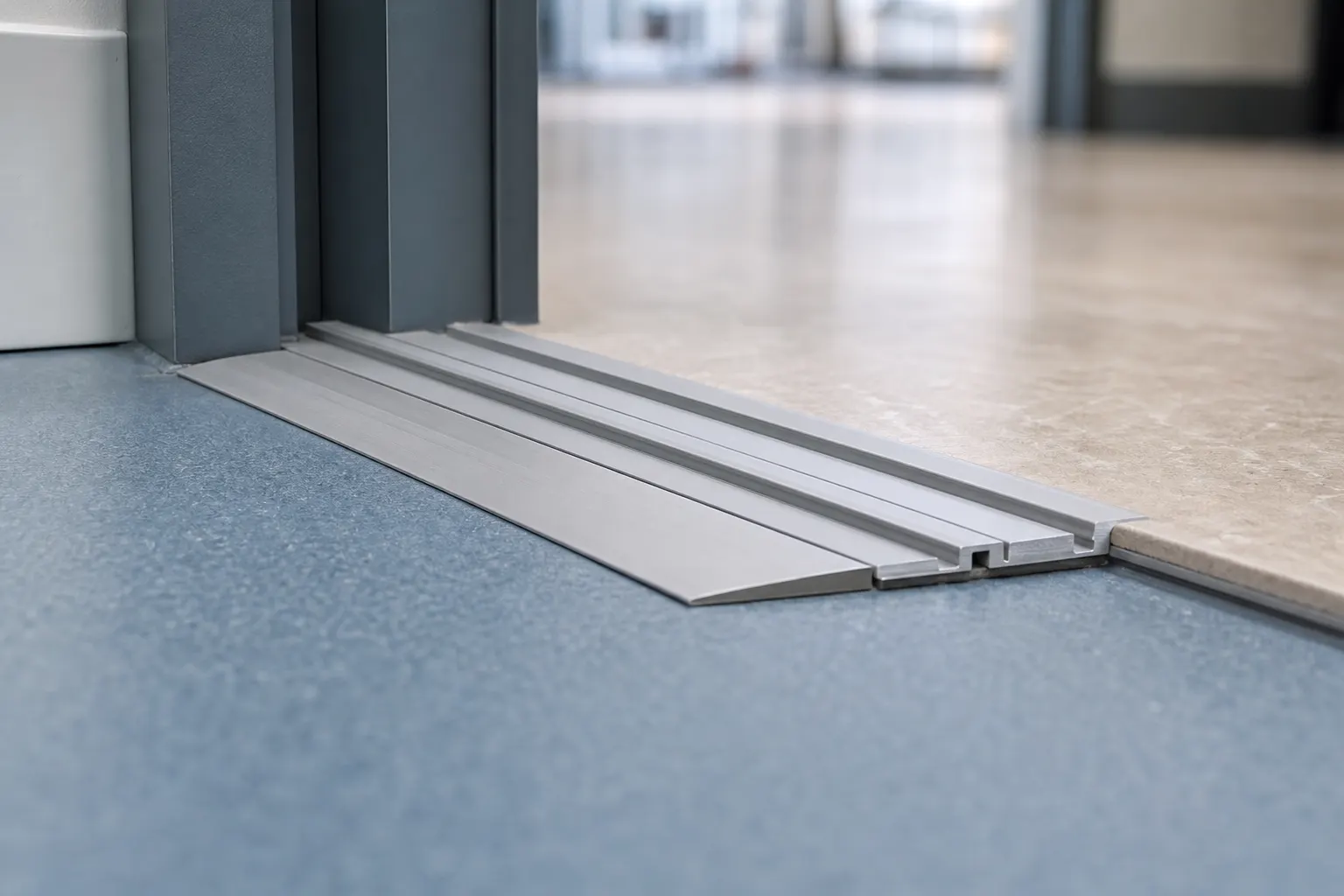
Mobile shelving runs on rail, and there are two ways to handle the height of that rail. A sub-floor decks the whole footprint level with the rail top. A twin ramp leaves the rail exposed and adds a shallow ramp on each approach side so staff and carts cross it smoothly.
The ramp was the right choice here. It costs less, installs faster, keeps doorway floor levels unchanged, and can be reconfigured later without demolition. A sub-floor earns its cost where a room needs a completely flush floor across the system, for example with continuous heavy cart traffic.
It is worth settling this question early on any records project, because it changes both the budget and the construction involvement.
What the city gained
Roughly double the filing capacity in the same room. Permanent aisles between static ranges became storage.
Files that stay orderly. Seven levels with three dividers each keep case files upright and positionally findable, which is what makes a file room work for a whole office.
No floor construction. The twin ramp kept the job to a shelving installation, with no sub-floor build and no contractor sequencing.
Headroom for retention. Partly loaded sections absorb years of new case files without another storage project.
Court, clerk and city records storage nationwide
Material Handling USA supplies and installs mobile shelving for city and county governments across the country, including court clerks, recorders, assessors, police records and city administration. Canton sits just north of Jackson in Madison County, Mississippi, and this project was delivered and installed there on the same model we use nationwide: drawing first, then fabrication, then installation by an experienced crew.
Government records projects share one shape. Retention rules mean the file volume only grows, the building cannot grow with it, and staff need same-day access to material that off-site storage would delay. Density inside the existing room is the only route that solves all three.
Related pages: election office storage case study, the county assessor records case study, and buying mobile shelving on GSA and cooperative contracts.
Call (800) 326-4403 to plan a court or city records room.
Frequently asked questions
Why do court clerk offices use mobile shelving?
How much extra capacity does mobile shelving give?
What do file dividers do?
How many shelf levels suit court files?
What is a twin ramp?
Do we need electric mobile shelving?
How long does delivery and installation take?
Do you install outside Utah?
Planning a court or city records room?
Send us the room footprint and how you file, and we will lay out a mobile shelving system that fits it, including delivery and installation. Nationwide delivery and installation.