
Mobile Shelving › Aurora Storage Products › Aurora Mobile Shelving
Aurora Mobile Shelving Systems
Track-mounted high-density shelving from Aurora Storage Products — carriages, rail, drives and shelving engineered as one system, laid out by Material Handling USA for records, evidence, library, laboratory and parts storage.

Quik-Lok
Four-post shelving carried on Aurora mobile carriages
Assist
Mechanical-assist and electric drive options
CSI
Editable specification documents for architects
GSA
Contract ordering handled on its own page
High-density storage, built around one moving aisle
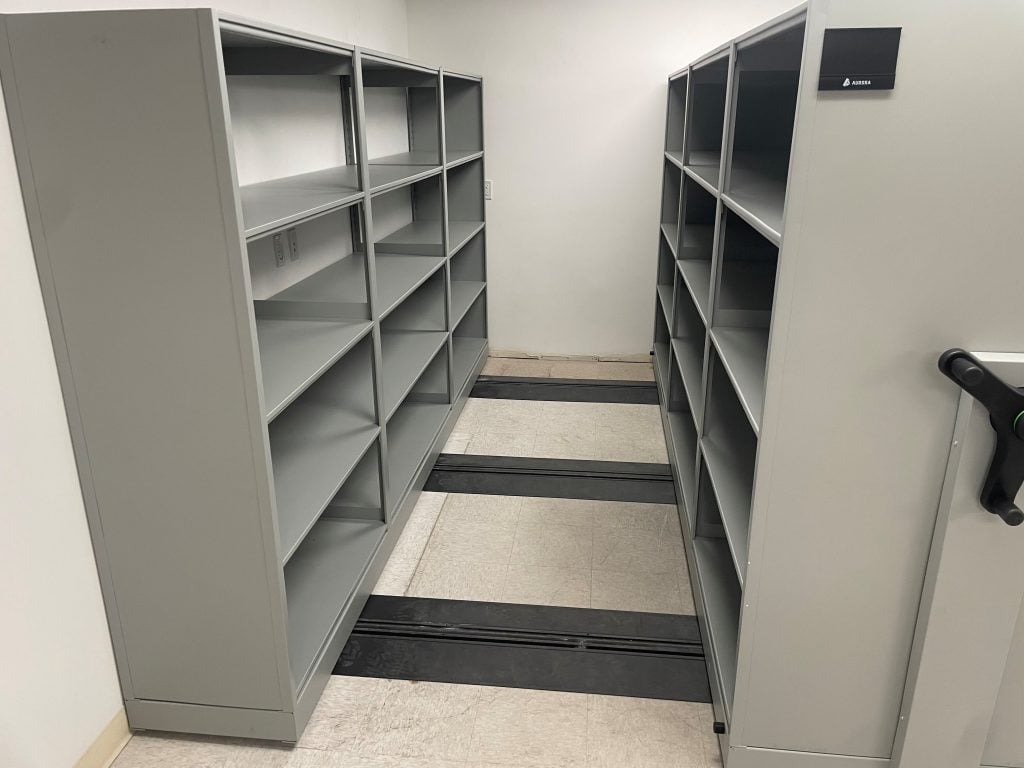
Static shelving spends most of a room on air. Every range needs its own aisle, that aisle is empty almost all of the time, and the collection grows anyway. Aurora mobile shelving removes the permanently open aisles: the shelving ranges sit on wheeled carriages that run on rail fixed to the floor, park closed against one another, and open only where somebody is working.
The result is a room that stores far more in the same footprint, or the same collection in a much smaller room — which is usually the reason a facility calls us in the first place. Records departments outgrow a file room. A police department needs the evidence room to last another decade. A library wants the stacks compressed so the floor can be given back to study space. A laboratory needs sample and document storage inside a lease it cannot expand.
What makes it work is that the whole assembly is engineered together. Aurora manufactures the carriages, the rail, the drive mechanism, the end panels and the shelving that rides on top, so shelf depth, carriage width, drive ratio and range length are specified as one system rather than assembled from unrelated parts. Material Handling USA sells that system, lays out the room, and stays involved through installation.
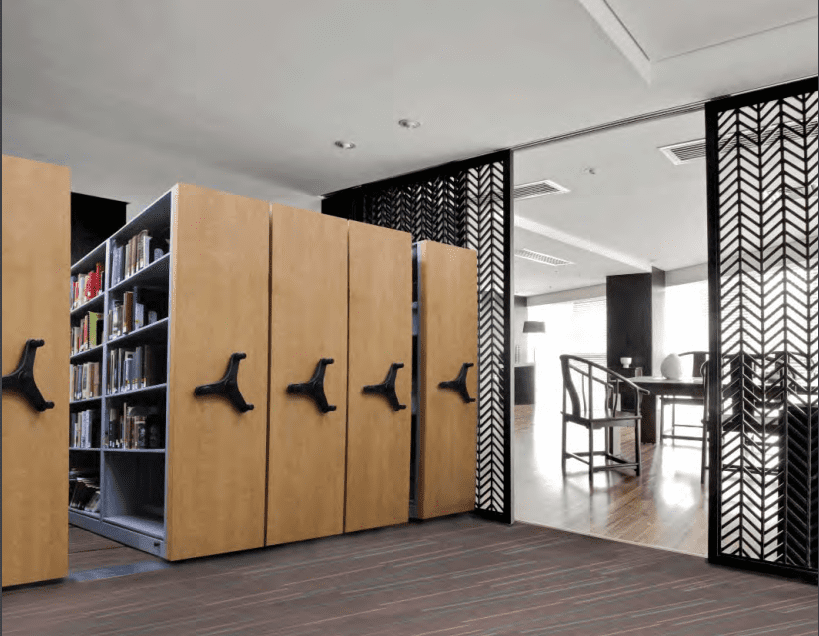
What a mobile system is made of
Four assemblies do the work. Understanding them makes the quoting conversation much faster, because most of the cost and nearly all of the site preparation lives in the first two.
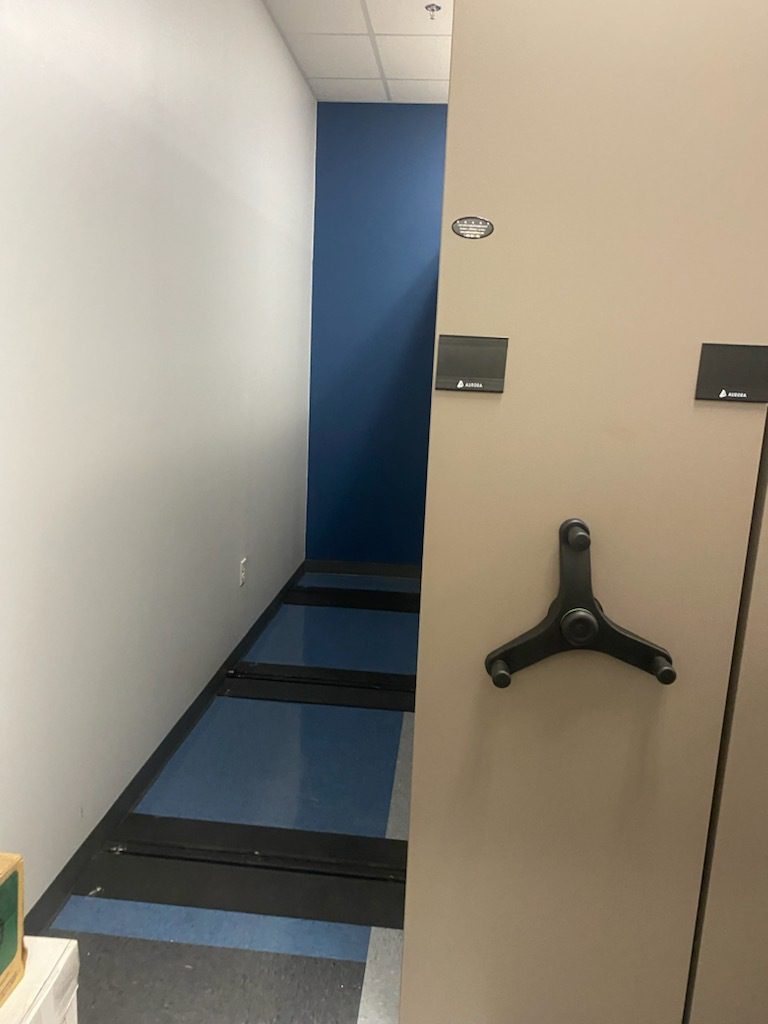
 Rail and carriagesSteel rail is set level and in plane on the slab or in a built-up deck. Carriages ride the rail on wheels and carry the shelving. This is the part of the system that dictates floor preparation, ramping and the finished floor level.
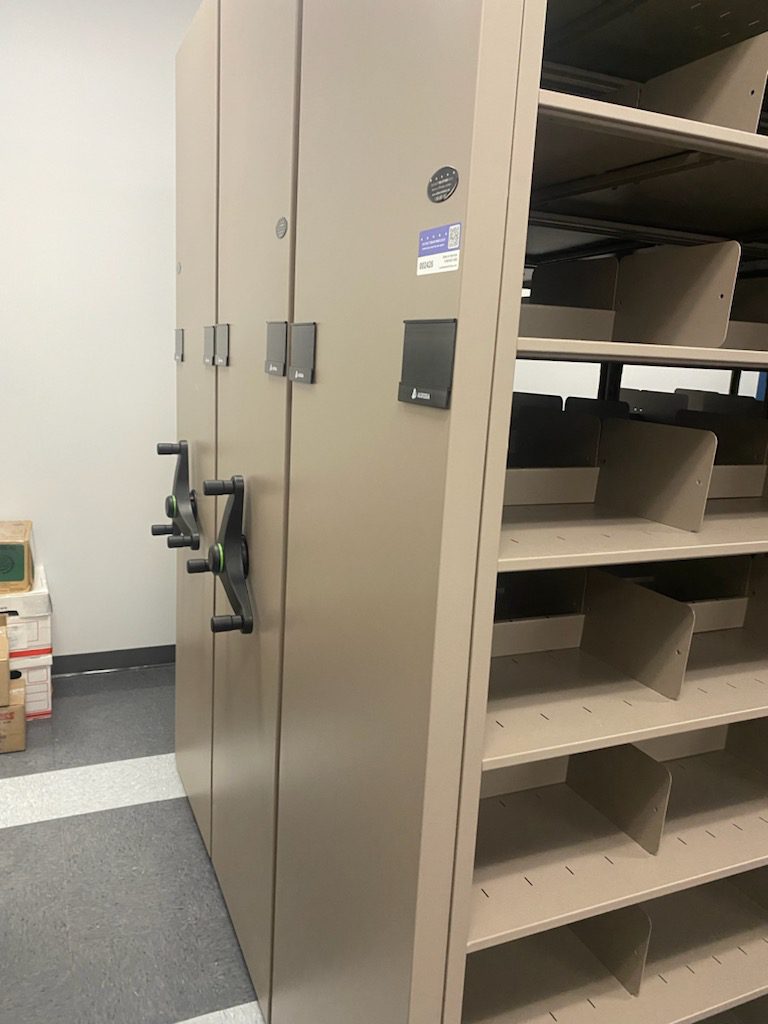 Drive and controlsMechanical-assist handles gear the carriage so a loaded range moves with modest effort; electric systems use an end-panel control instead. Drive choice follows range length, load and who has to operate the system.
 Shelving and dividersShelves, dividers, back stops, file supports and reference shelves are selected for the collection — letter or legal filing, boxes, books, weapons, evidence or bulky items.
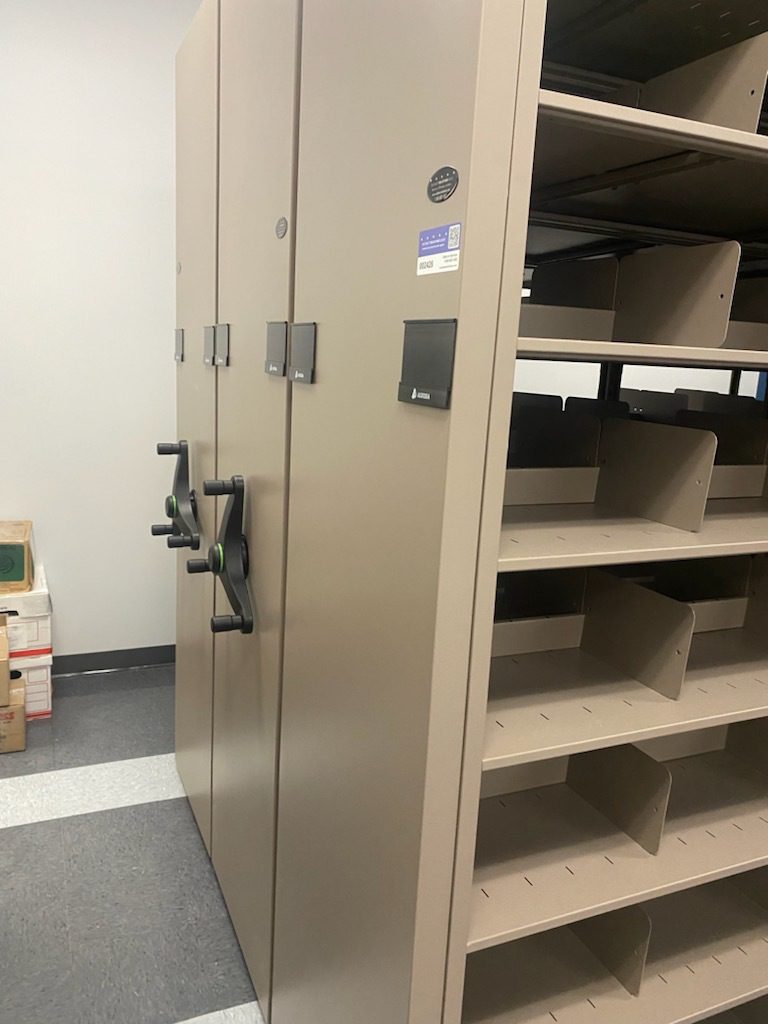
 End panels and finishesEnd panels close the system visually, carry the handles or controls, and are where colour, laminate or wood finishes and signage are applied. In public rooms this is the part everybody actually sees.
Manual, mechanical-assist and electric drives
Manual systems are pushed by hand. They suit short, lightly loaded ranges — small file rooms, supply storage, a single bank of ranges in a back office.
Mechanical assist is the three-spoke handle you see on most records and evidence installations. A gear reduction lets one person move a fully loaded range smoothly and stop it precisely. It is mechanical, it does not need power, and it keeps working during an outage — which is why it remains the default choice for archives and evidence rooms.
Electric mobile systems replace the handle with a control on the end panel. Aurora documents an electric mobile line in the brochure we host below. Electric is normally considered when ranges are long or heavily loaded, when the same aisle is opened dozens of times a day, or when operating effort has to be minimised for the people using the room.
There is no universally correct answer. Rather than guess, tell us the range length, what is going on the shelves and who operates the room, and we will recommend a drive and explain why. Any specific effort, speed or duty figures come from Aurora’s published documentation for the configuration you actually buy.
Aurora shelving lines that ride on the carriages
The carriage is a platform. What sits on it is chosen for the collection, and Aurora’s lines are documented in the brochures and specification files hosted on this site.
 Quik-Lok four-post shelvingAurora’s four-post shelving line, used for letter and legal filing, boxes, binders and general storage. Openings, shelf depths, dividers and back stops are configured per range.
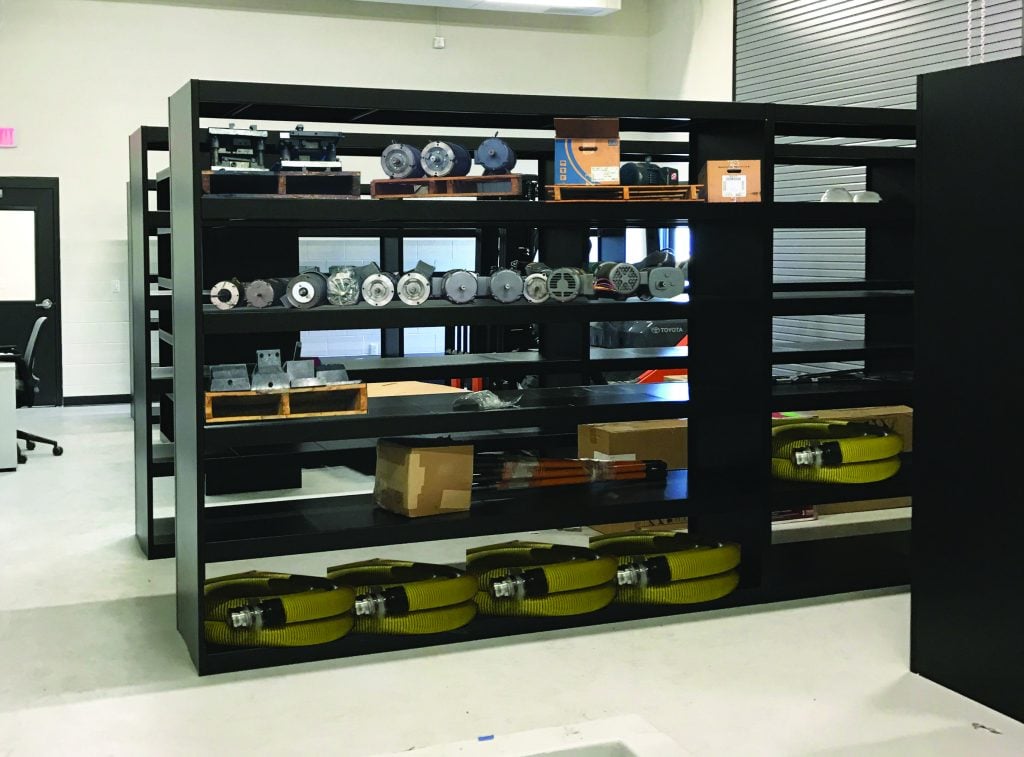 Wide-Lok wide-span shelvingLonger shelf spans for bulky, awkward or palletless items that will not fit a standard filing shelf — parts, kits, cases and equipment.
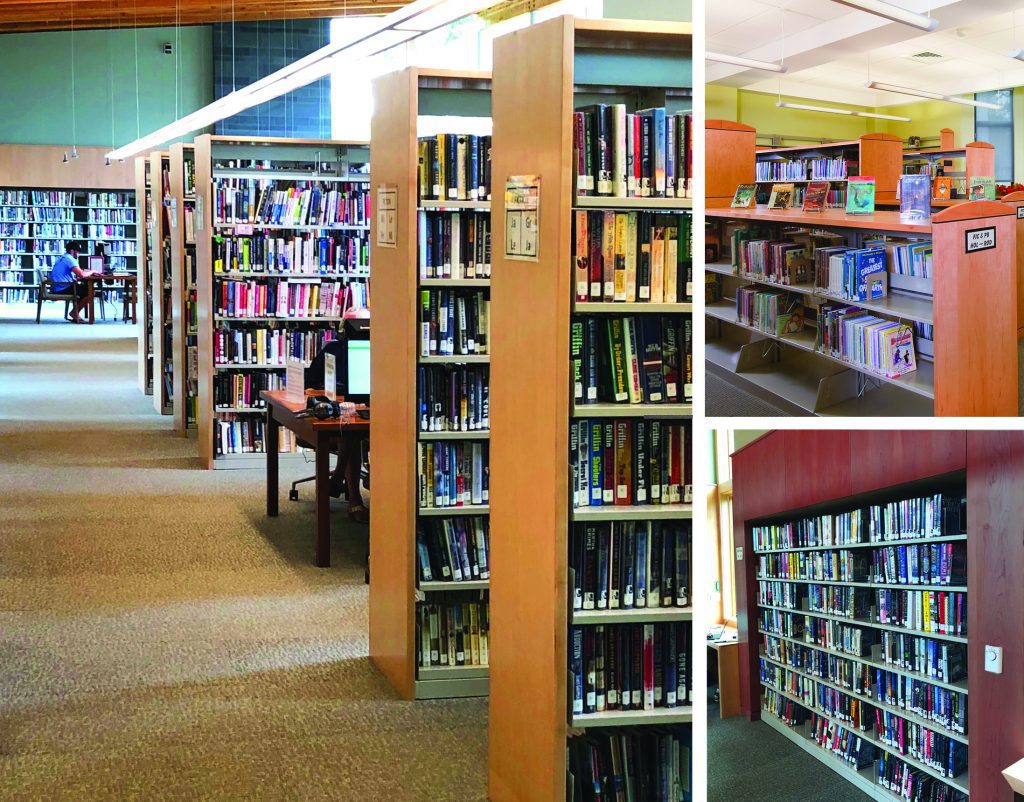 Library shelving (MJ System 30 and cantilever)Cantilever and case-style library shelving with the finishes and end panel treatments public spaces expect. Aurora publishes CSI specification documents for these lines.
Aurora also builds Times-2 rotary units and the InterActivwall system. They are separate products rather than mobile carriages, but they often share a project with a mobile system.
Where Aurora mobile shelving is used
Evidence and property rooms. Evidence storage grows without permission and is audited. Mobile shelving buys shelf space inside a secured room without moving the room, and end panel locking options let ranges be closed when nobody is working in them.
Records and archives. Letter and legal filing, boxes, deeds and long-retention paper. Mechanical assist and clear range labelling matter more here than raw speed.
Libraries and education. Compressing stacks releases floor area for study, collaboration and staff space, which is usually the actual project goal. Finishes and end panels carry the room.
Laboratories and healthcare. Sample retention, charts and regulated documents in leased space where growing the footprint is not an option.
Museums and collections. Object storage with the shelf types, drawers and protection an accessioned collection requires.
Industrial and parts storage. Wide-span shelving on carriages for kits, service parts and cases in a room that has already run out of aisles.
Related pages: mobile shelving for medical records, archive shelving for law firms, evidence storage, and the non-branded high-density shelving overview.
Planning the room before anything is ordered
Mobile shelving is a construction-adjacent product. The layout decisions below are made once, early, and they are expensive to revisit after rail is on the floor.
How a project runs
Survey and layout
You send a dimensioned plan and describe the collection. We lay the room out, count shelf capacity for each option, and flag the floor and code questions we can see.
Specification
Drive type, shelving line, shelf depths, dividers, finishes, end panels and locking are fixed in writing. Architects can build Aurora’s CSI documents into the project manual.
Site preparation
Slab survey, rail layout, and the deck or recess detail. This is coordinated with the general contractor before delivery, not after.
Installation and handover
Rail, carriages, shelving and end panels are installed and the system is adjusted and demonstrated. Aurora’s installation documentation is provided for your records.
Scheduling, crew size and lead time depend on the size of the system and the state of the site, so they are confirmed in writing on your quotation rather than promised here. Ask us early if a construction milestone drives the date.
Aurora mobile shelving resources
All of these files are hosted by Material Handling USA and are the Aurora documents we work from.
- Aurora Mobile Shelving flyer (PDF) — overview of the mobile system.
- Aurora Electric Mobile Shelving brochure (PDF) — the powered line.
- Aurora Mobile Shelving installation instructions (PDF) — how the system goes together.
- Aurora shelving specifications (PDF) — specification data for the shelving lines.
- Aurora CSI library shelving specifications (PDF) — editable CSI-format text for architects.
- Full Aurora brochure library and Aurora shelving specifications page.
Buying on the GSA schedule?
Aurora mobile shelving is also available to federal buyers under Aurora’s GSA Multiple Award Schedule contract. That ordering path has its own page: Aurora mobile shelving GSA contract 47QSMA21D08R9, with related shelving items on GSA Aurora shelving. This page stays focused on the product itself.
More Aurora: Aurora Storage Products brand hub · Aurora shelving · all mobile shelving systems.
Honest notes before you buy
Do not buy capacity you cannot reach. A denser room is only better if staff can still work in it. Count how many people use the room at once; two people needing two open aisles changes the layout.
Measure the collection, not the shelving. Linear inches of files, boxes on hand and annual growth give a real answer. Range counts derived from a guess produce a system that is wrong on day one.
Settle the floor early. Rail level, ramp allowance and the finished floor material are the things that delay these projects. Raise them in design, not on the delivery date.
Keep the drawing. The layout, finish schedule and shelf configuration make future additions straightforward. Filed away, they save a re-survey.
Ask for the parts of the answer we cannot know. Loads, ratings, code compliance and delivery dates are confirmed against Aurora documentation and your project conditions in writing. Anything you see stated as a universal number on a website — ours included — deserves that check.
Aurora mobile shelving FAQ
What is Aurora mobile shelving?
How much space does a mobile system actually save?
What drive options does Aurora offer?
Does the floor have to be perfect?
Can Aurora mobile shelving be moved or reconfigured later?
What shelving can ride on the carriages?
How do you keep users safe between moving ranges?
Is this the same as buying from the GSA contract?
Do you help with layout drawings and specifications?
What should I have ready before asking for a quote?
Related planning resources: low-profile mobile shelving planning.
Get an Aurora mobile shelving layout
Send us a floor plan and what you need to store. We will lay the room out, size the system and quote it — no obligation.