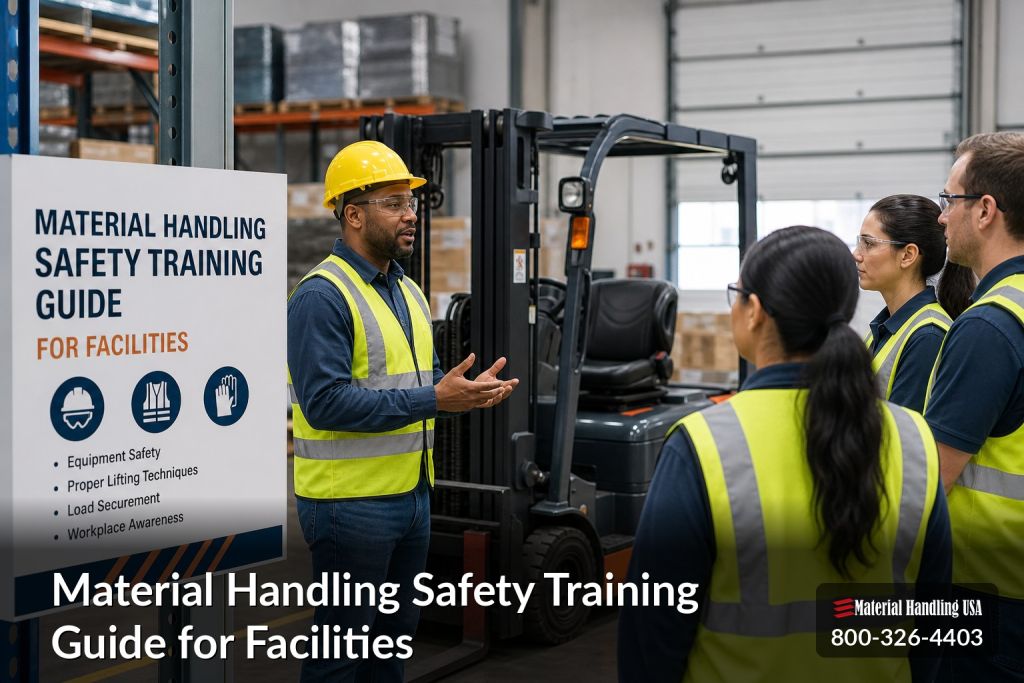
You've got the signs already. A lift team starts avoiding certain racks, a lab supervisor keeps redoing the same refresher notes, and a secure storage area logs near misses that never quite become formal incidents. That's usually what material handling safety training looks like before anyone puts structure around it, a lot of motion, a lot of assumptions, and not enough consistency.
The risk is not abstract. The CDC's NIOSH engineering-controls database links lifting to 37% to 49% of low-back-pain cases, with pushing, pulling, carrying, twisting, and bending also showing up as major contributors (CDC NIOSH engineering controls database). OSHA materials also note 410,000 workplace accidents that resulted in back injuries in 2000, and back injuries made up more than 20% of all occupational illnesses in those materials (CDC NIOSH engineering controls database). If your facility handles pallets, carts, cages, bins, or lab materials, the training gap shows up fast, and it usually shows up in the back, shoulders, and missed time.
A good program doesn't just teach people how to lift. It teaches them how to judge load, move safely around equipment, spot congestion, and stop a bad task before it turns into an injury. For anyone comparing a simple checklist to a more complete facility plan, a useful starting point is the Material Handling USA material handling overview, because training works best when it matches the equipment and layout people use.
If a worker gets hurt and needs time off, the recovery path can get complicated quickly, which is why managers often keep a practical reference like Mattiacci Law's guide to temporary total disability close at hand. That kind of context matters because the cost of a poor manual handling program is never just the incident itself. It's the lost time, the schedule disruption, and the scramble to cover the same task with fewer hands.
Introduction to Training Needs
A warehouse supervisor once described the problem the way a lab manager might. “We train everybody on day one, then the work changes, and the training doesn't.” That is how gaps form. The old lesson still sits in a binder or LMS record, but the task, aisle layout, cart height, storage method, or equipment mix has already changed.
That gap shows up in injury records. Occupational Health & Safety reported that material handlers in manufacturing and retail accounted for nearly 40% of the 295,180 reported sprain and strain injuries in 2019, and it also noted that more than 111,000 back injuries occur each year with an average recovery time of 57 days per injury (OH&S material handling injuries report). For a facility manager, that points to a routine operating problem, not an occasional bad day. It is the kind of exposure that shows up in shipping lanes, storage rooms, lab benches, and secure areas where people move loads under time pressure.
Who needs the training
Facility managers, operations directors, project planners, and procurement teams all touch this issue, even if they are not the ones lifting the load. A narrow view treats material handling training as a forklift topic only. OSHA's forklift guidance requires employees to be trained before using material handling equipment and to demonstrate competence, but the day-to-day risk also reaches pedestrians, spotters, maintenance staff, and supervisors working near moving loads (OSHA materials handling guidance).
Practical rule: if a person can be struck, pinned, strained, or distracted near the flow of materials, they need role-based training.
That broader view matters in mixed environments. A warehouse may need a lesson plan built around pallet movement, dock traffic, and congestion points. A lab may need tighter controls on handoffs, cart positioning, and protected storage. Secure storage areas add another layer, since access control can slow movement and tempt shortcuts. For teams comparing a simple checklist with a more complete facility plan, the Material Handling USA material handling overview is a useful reference because the training should match the equipment and layout people use.
If a worker gets hurt and needs time off, the recovery path can get complicated quickly, which is why managers often keep a practical reference like Mattiacci Law's guide to temporary total disability close at hand. That context matters. A weak manual handling program does not just create one incident, it creates lost time, schedule disruption, and a scramble to cover the same task with fewer hands.
Planning Considerations and Prerequisites
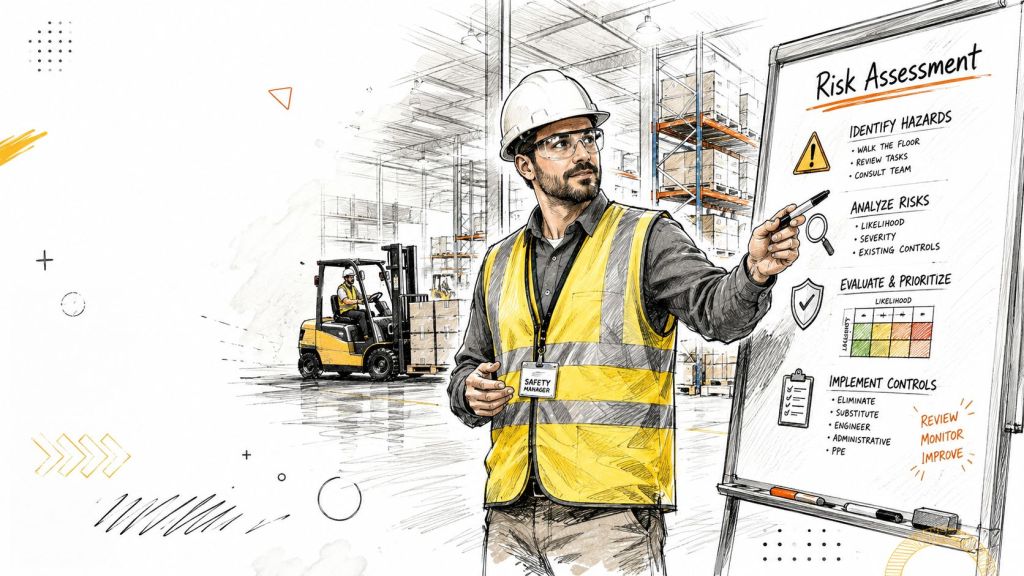
Strong programs start before any lesson is written. Leadership has to back the work, line supervisors have to support it, and the people who know the floor have to help define the risk. If the training team only talks to HR or only talks to safety, the final program usually misses the tasks that hurt people most.
The first pass should be a real walk-through of the facility. Look at narrow aisles, high-load tasks, awkward transfer points, and any area where people and equipment cross paths. OSHA materials stress clear load limits, safe storage, and keeping work areas free of hazards, which means the layout itself is part of the training plan, not just the backdrop (OSHA material handling training materials).
What to gather before writing content
Start with injury logs, near-miss notes, and the tasks that keep recurring on shift reports. Then sort the work by environment, warehouse, lab, secure storage, or mixed-use space, because each one has different hazards and different error patterns. A lab may need tighter rules around benchtop transfers, while a warehouse may need more time spent on aisle discipline and load stability.
Training gets easier when the floor is mapped first. A weak map leads to generic lessons, and generic lessons get ignored.
For teams that also manage material flow systems or storage equipment, the lifting and material transport equipment page is a useful reference point when deciding what the training has to cover. The equipment list should drive the curriculum, not the other way around.
Step-by-Step Program Creation
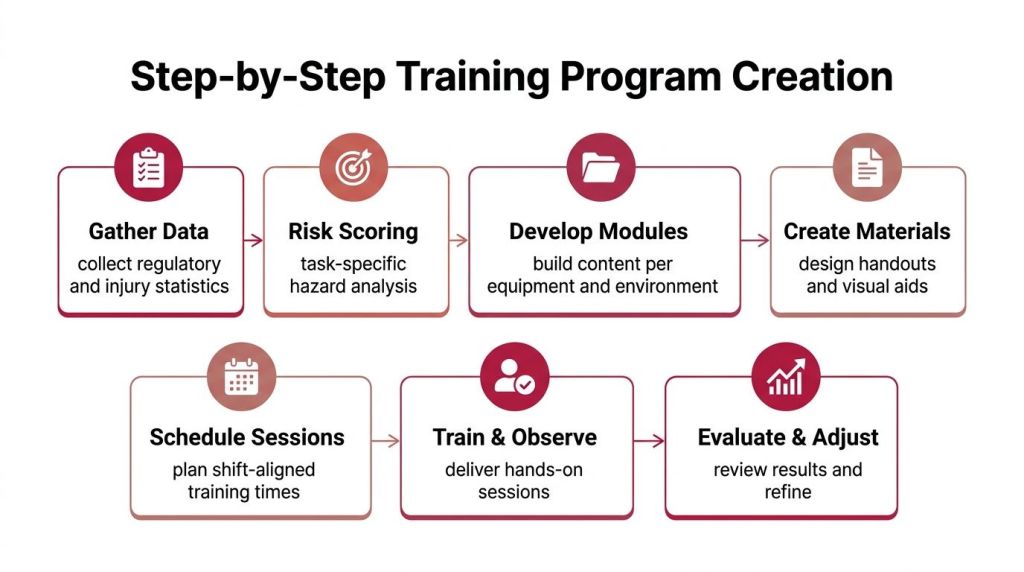
A usable program starts with the work people do, then turns that reality into training, practice, and records. The best programs are built in layers, first the data, then the task risk, then role-specific lessons, then hands-on checks, and finally review. That order keeps the content tied to real hazards instead of a slide deck that looks complete but changes nothing on the floor.
Step 1, gather data
Pull injury logs, incident reports, near-miss notes, and the facility rules that already exist. Add the tasks that keep showing up in day-to-day work, because repeat problems usually point to repeat exposures. The goal is to build a list of the work people do, not the work managers wish they did.
Before writing a single lesson, walk the floor and compare the paperwork with the actual setup. Narrow aisles, high-load tasks, awkward transfer points, and crossings between people and equipment often explain why a task keeps showing up in reports. OSHA materials on material handling stress clear load limits, safe storage, and clutter-free work areas, so the layout belongs in the training plan, not just in the background (OSHA material handling training materials).
Step 2, score the tasks
Some tasks carry more strain, more pinch points, or more struck-by exposure than others, and the training time should match that reality. Heavy lifts, pushed loads, blind corners, and crowded handoff points usually need the most attention and the most hands-on practice. A short classroom reminder is not enough when the task itself carries a high strain or struck-by risk.
This is also where a facility-specific reference helps. A warehouse floorplan safety guide can help managers see how aisles, storage zones, and travel paths affect the lessons that need to be built into the program.
Step 3, build modules by role and environment
The content should change by equipment and by space. Forklift operators need different lessons than pallet jack users. Lab staff need different handling rules than warehouse pickers. Secure storage teams may need emphasis on controlled access, careful movement, and protecting the load while it moves.
That is where customizable lesson plans pay off. A warehouse needs more time on aisle discipline and load stability. A lab needs tighter rules around benchtop transfers and shared surfaces. Secure storage needs clear controls for movement, custody, and what to do when access must stay limited. One generic outline will miss those differences.
Step 4, choose the delivery method
Use the format that fits the task. Classroom time works for policy, hazard recognition, and site rules. Hands-on drills work for load balance, walking paths, and aisle behavior. E-learning helps with repeatable knowledge checks, but it should not replace floor practice when the task involves movement, space, or judgment.
Blend the methods around the actual job. A new hire can review the basics online, then demonstrate the lift, carry, or transfer under observation. A seasoned worker may only need a short refresher plus a task check. That keeps the program practical instead of bloated.
Step 5, set assessment and refresher timing
A training program should prove competence, not just attendance. Workers must show they understand the task and can perform it correctly after training, and refresher timing should follow actual changes in the workplace, the materials, or the way the job is done. That approach fits real operations because change is normal, not exceptional.
Keep the trigger list simple enough that supervisors can use it without guessing. A new package size, a different rack layout, a revised route through the facility, or a pattern of unsafe practices should all prompt a review. If the lesson stays static while the job changes, the gap shows up in the field.
Step 6, add recordkeeping tools
Use a standard form for names, modules, scores, dates, and the next review deadline. Keep it simple enough that supervisors will use it. A corporate LMS can help, but a paper binder still needs to work when the network is down or when a shift supervisor wants a quick audit trail.
| Training Record Checklist | ||||
|---|---|---|---|---|
| Date | Module | Trainee | Score | Next Review |
Good recordkeeping also supports specialized environments. If your team handles medical gases, fold in oxygen safety compliance from MedEq Fitness alongside the material handling entries so the same supervisor can track both the hazard controls and the training history without juggling separate systems.
Step 7, pilot and refine
Run the lesson with a small group first. Ask what was unclear, what felt unrealistic, and which task examples missed the mark. Then revise the lesson, the checklist, and the refresher trigger before rolling it out more widely.
This is also where record templates earn their keep. A warehouse may need a simple sign-off sheet with equipment-specific notes. A lab may need space for control verification and waste transfer steps. A secure storage room may need a tighter chain-of-custody log. The point is not paperwork for its own sake, it is a record that matches how the site operates.
Safety Compliance and Recordkeeping
A training program only holds up if the records hold up with it. If attendance is split across a spreadsheet, a binder, and a supervisor's memory, the system turns brittle fast. Audits become harder, retraining slips through the cracks after a process change, and no one can quickly show who was trained on what.
Build one source of truth
Keep one central record for each trainee, each module, the score or completion status, the training date, and the next review date. When equipment changes, storage methods change, or workflow changes, the record should show what retraining happened and when. That matters because training is not a one-time event, it is part of day-to-day control.
A simple audit rhythm works well. Review the records after new-hire onboarding, after equipment changes, and after any incident or near miss tied to behavior. That keeps the program aligned with retraining triggers for changed conditions and unsafe practices, as outlined in the WSU materials handling program.
For facilities planning around racking, traffic lanes, dock flow, and storage layout, the OSHA compliant warehouse design page is a practical reference. Floorplan decisions shape the training plan, because the lesson has to match the actual path people walk, push, lift, and inspect.
One more practical point. If the organization already tracks another regulated safety area, such as oxygen safety compliance from MedEq Fitness, keep the same recordkeeping discipline. The format can be adapted, but the goal stays the same, clear logs that support inspection readiness and consistent retraining across different safety programs.
Common Mistakes to Avoid
A training program usually starts to fail when it treats every job the same. A lift technique refresher may be useful, but it does little for the primary risks that show up in warehouses, labs, and secure storage areas, where pedestrian movement, maintenance access, and mixed equipment traffic all create different exposures.
OSHA guidance on forklift safety centers on operators, so facilities need to fill the gap for people who work around the equipment, not just on it (OSHA forklift guidance). In practice, that means the lesson plan has to cover the people who spot, guide, clean, stock, inspect, and pass through the same area, with examples that fit each workspace.
Mistakes and better fixes
- Generic lift-only sessions: build task-specific modules for forklifts, carts, pallets, bins, and bench transfers, and adapt them for the work area instead of handing out the same outline everywhere.
- Ignoring non-operator staff: include pedestrians, maintenance workers, and supervisors in the same hazard map, with examples that match their daily routes and access points.
- One-time training only: set refresher triggers for new equipment, layout changes, storage changes, and unsafe behavior, then record what was retrained and why.
- No real-world practice: use floor drills, route walks, and handoff practice, not just slides, so people can rehearse the paths and decisions they face.
Another common mistake is weak recordkeeping. The training may happen, but the form is incomplete, stored in the wrong folder, or never updated when the workflow changes. That creates audit problems and hides patterns that should trigger retraining, which is why many facilities use lesson plans and log templates made for warehouses, labs, and secure storage instead of relying on a generic form set.
If the program cannot show who was trained, on what, and when, the facility is guessing. Clear logs protect the operation, support inspection readiness, and make it easier to adjust the training plan when tasks change.
Cost Timeline and Professional Services
The lowest quote rarely means the lowest total cost. An internal team may avoid vendor fees, but it still spends staff time on lesson planning, formatting, recordkeeping, follow-up, and updates when the workflow changes. A professional service shifts much of that work off your desk and usually gives you a cleaner starting point for layouts, templates, and role-specific materials.
A controlled ergonomic intervention study found that structured training combined with redesign can bring risk into an acceptable range, so many facilities treat safety training as part of a larger improvement effort rather than a stand-alone class. The same logic applies to budget planning. If the program changes the task, the space, or the equipment flow, it has a stronger chance of returning value for the time invested.
For a useful budgeting benchmark outside this industry, Haulier.AI's budget guide for ADR courses shows how training cost discussions become clearer when direct delivery costs are separated from the hidden cost of internal labor. The same approach helps here, whether the team builds the curriculum in-house or buys a packaged service.
Professional support also helps when you need lesson plans and recordkeeping templates that fit specific environments. Warehouses, labs, and secure storage all create different access rules, handoff steps, and supervision needs, so a single generic outline usually misses something important. A consultant who understands those differences can format the material so supervisors know what to teach, what to document, and what to review later.
Choose in-house when
Use in-house development if you already have a safety lead, a stable operation, and a small number of repeatable tasks. It works best when the workflow stays steady and the training can remain simple. You also need enough internal capacity to maintain the lesson plan, update the logs, and keep the records consistent when duties change.
Choose professional support when
Choose professional support if your facility has multiple environments, changing layouts, or equipment that needs custom handling rules. A partner can build the program faster and reduce the trial-and-error that often slows internal teams. That matters when the rollout has to match a project schedule, an audit deadline, or a new storage layout that cannot wait for a long internal draft cycle.
Conclusion with Next Steps
A strong material handling safety training program is built on real tasks, clear roles, and repeatable records. The best programs don't stop at lift technique, they cover pedestrians, equipment awareness, layout, refreshers, and the moments when work changes faster than the old lesson can keep up. That's how facilities reduce injury exposure, tighten compliance, and avoid the delays that come from reacting after the first incident.
Start with the floor, not the slide deck. Map the tasks, score the risks, write role-based modules, and set up a recordkeeping system that shows who trained, when, and why they need a review. Then check the program against new equipment, new layouts, and any area where people and machines share space.
For facilities that want help turning that plan into a practical layout and product fit, Request a Quote, Call (800) 326-4403, or Contact Us for free layouts and no-obligation quotes. Earlier planning usually means faster installs, cleaner coordination, and fewer missed details when the training has to match the actual work.
Material Handling USA can help you pair training needs with the right storage, transport, and layout decisions, so the program fits the facility instead of fighting it. If you're ready to compare options, get a free quote, or talk through a custom layout, visit Material Handling USA and start the conversation with a team that understands warehouses, labs, and secure storage.