Pallet Rack / Lightweight Pallet Rack

Lightweight Pallet Rack: A Buyer’s Guide to Hand-Stack Racking

Boltless light-duty racking for cartons, totes, tires and files — real beam capacities, decking choices, anchoring rules and an honest look at when long-span shelving is the better buy. Designed, supplied and installed from Salt Lake City.

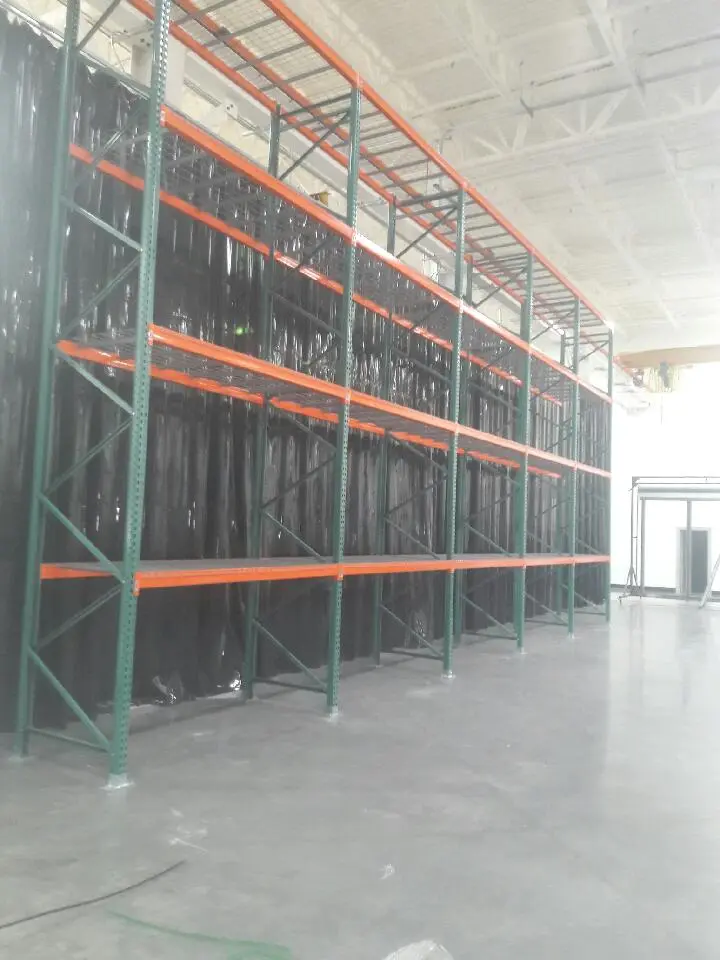
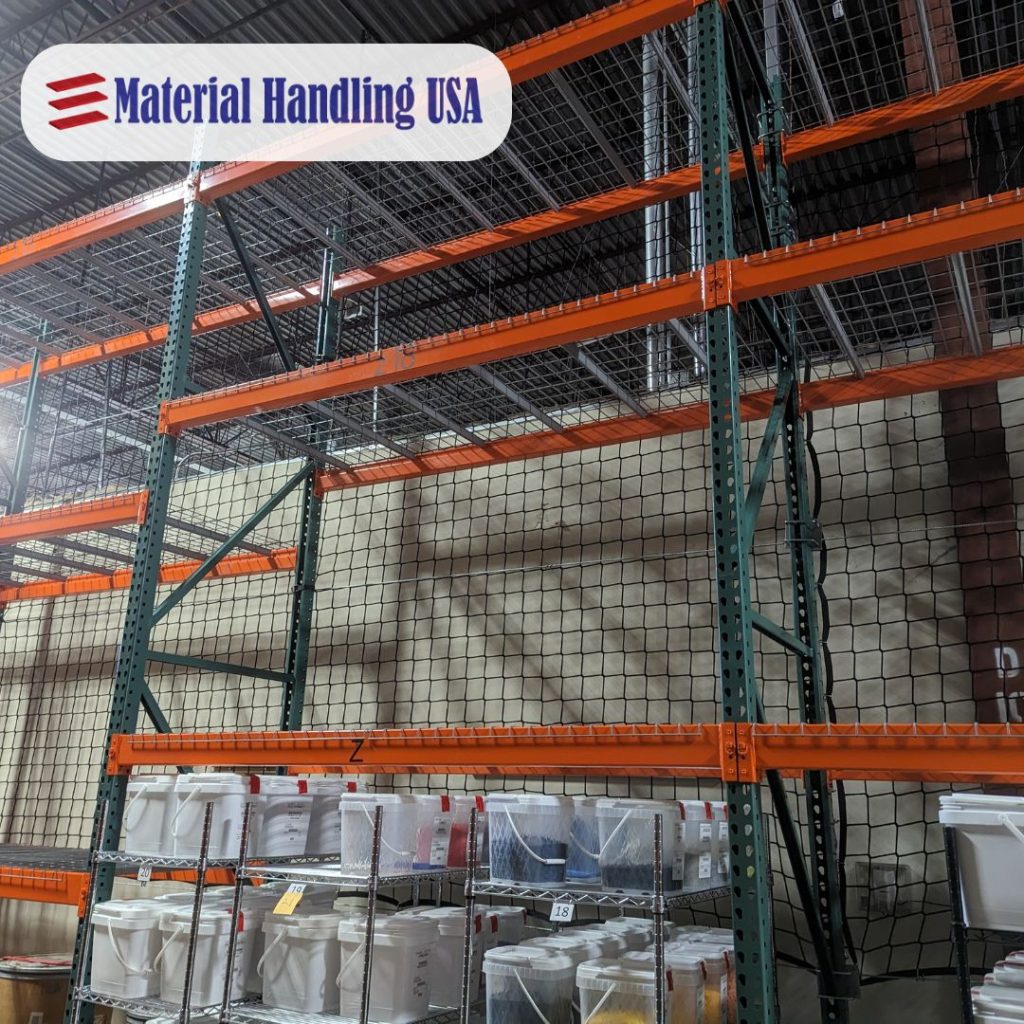
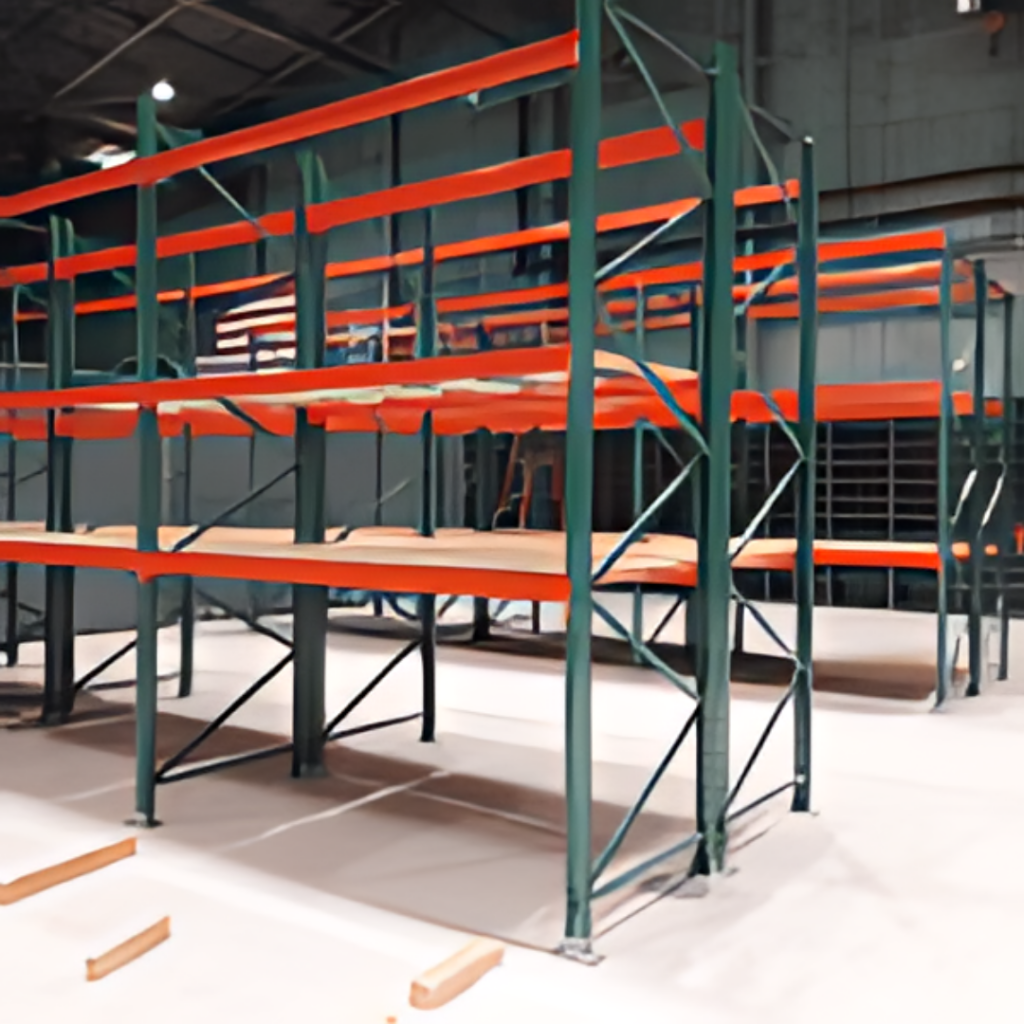
Light-duty pallet rack with green uprights, orange beams and wire decking in a storeroom

1-1/2″

Beam adjustment increment

1,000–2,000 lb

Typical light-duty level capacity

36″–120″

Stock upright heights

50 in²

Minimum load plaque per ANSI MH16.1

What “Lightweight Pallet Rack” Actually Means

Light-duty rack bay with four wire-decked beam levels at hand-stacking height
Light-duty bay with four wire-decked beam levels sized for hand stacking

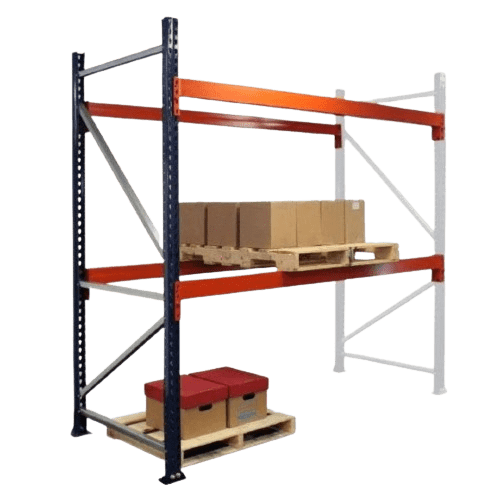
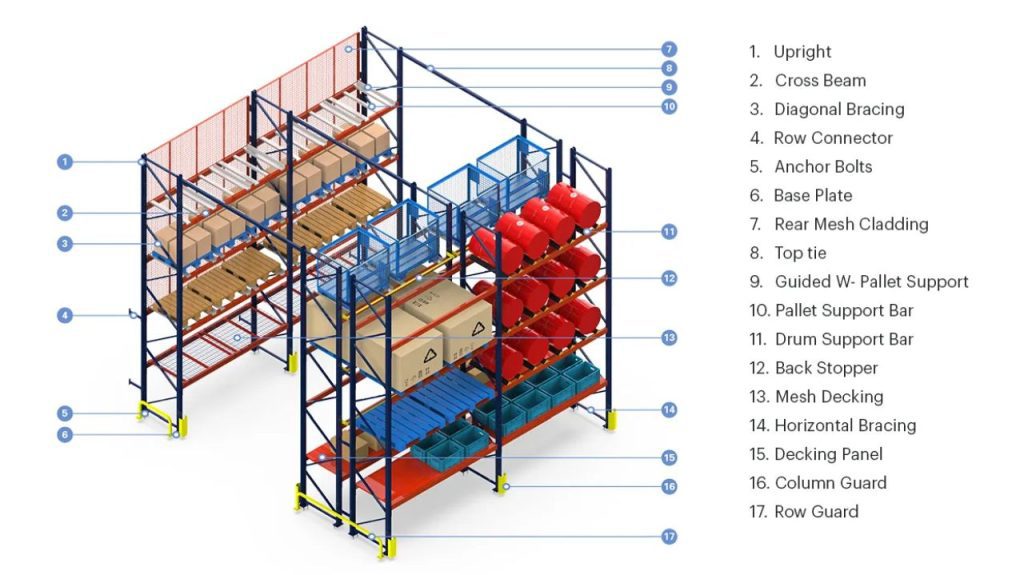
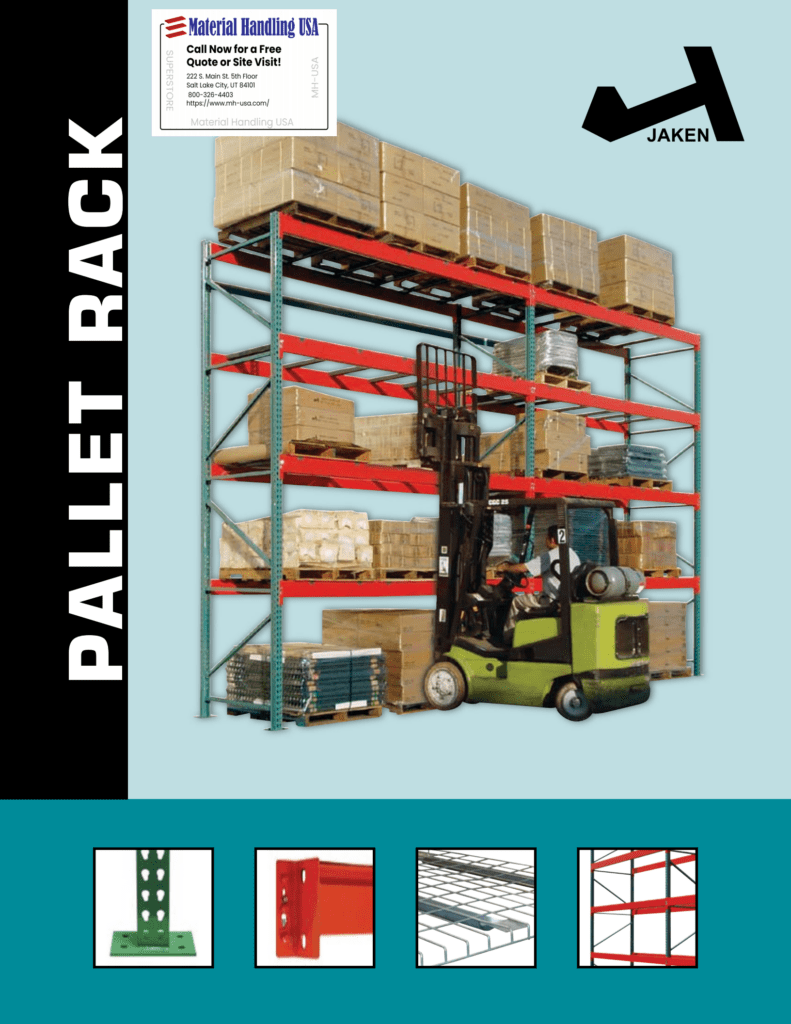
Lightweight pallet rack — light-duty racking, hand-stack rack, bulk storage rack — is built like pallet rack and used like shelving. You get the same three parts: roll-formed upright frames, beams that lock into the columns without hardware, and decking that turns each beam level into a usable shelf. What changes is the steel gauge, the span and the assumption about how product arrives: by hand, by cart or by pallet jack, not on the forks of a lift truck.

That single assumption drives every specification decision on this page. Because nothing heavy is being driven into the frame, the columns can be lighter and the bays shorter. Because people are loading each level by hand, beam spacing matters far more than raw capacity — which is why light-duty lines adjust in 1-1/2″ steps instead of the 2″ to 4″ steps you see on selective rack sized around pallets.

It also sets the honest limit. A light-duty bay is not a cheap substitute for pallet rack. The moment a forklift is placing unit loads in the bay, you need engineered selective pallet rack with anchored base plates and a proper design basis. We would rather tell you that up front than sell you a rack you will bend in a month.

  • Loaded by hand, cart or pallet jack — never by forklift into the bay
  • Boltless connectors with a built-in safety clip; assembly with a rubber mallet
  • Beam levels adjustable in 1-1/2″ increments to match carton heights
  • Wire mesh or solid decking on every level that holds anything smaller than the beam gap
  • Add-on bays share an upright, so a run grows one frame and two beam pairs at a time

The Components — and What Each One Decides

Six parts make up almost every light-duty system. Getting any one of them wrong is how a rack ends up rated for less than the owner thinks it is.

Roll-formed rack upright frame with punched connection holes and welded bracingUpright FramesTwo roll-formed columns joined by welded or bolted bracing. The frame sets the depth (commonly 18″, 24″, 36″ or 48″ on light-duty units) and the height (36″ to 120″ in the Jaken FastRak line). Depth should match the load, not the shelf you wish you had — overhanging cartons are the most common cause of dropped product on hand-stack rack.
Step beam teardrop connector locked into a roll-formed rack upright columnBeams & ConnectorsLight-duty beams use a miniature teardrop or hook-and-slot connector that drops into the column and locks with a built-in safety clip. FastRak beams come in 2″ and 3″ heights and 24″, 36″, 48″, 72″ and 96″ lengths, adjustable in 1-1/2″ increments. Full selective rack steps up to 2-1/2″–6-1/2″ step beams with 4″ adjustability.
Welded wire mesh deck panel with waterfall front edge and two support channelsWire Mesh DeckingWelded mesh panels with a waterfall front edge and two to four steel support channels underneath. The channels — not the mesh — carry the load, which is why a 42″ × 46″ deck is published anywhere from about 1,800 lb with two channels to 3,500 lb with four. Open mesh keeps sprinkler water and light moving through the rack.
Particle board deck panel used as a solid shelf surface on light-duty rack beamsParticle Board & Steel DeckingSolid decking for small, loose or spill-prone items that would fall through mesh. On FastRak, particle board requires separate safety supports that sit in the beam notches to keep the surface level and carry the rated load; without them the board is doing structural work it was never rated for. Steel deck panels are available where wash-down or fire code rules out wood.
Row spacers and leveling shims joining back-to-back rack uprights on a concrete slabRow Spacers, Shims & FootplatesBack-to-back rows are tied together with row spacers so both frames act as one; shims level the bases on an out-of-flat slab. Jaken FastRak offers optional deluxe footplates that bolt into the upright and take a concrete wedge anchor — the right call for taller units, seismic regions and anything within reach of a pallet jack.
Clear label holders clipped to the front edge of a steel shelf beam for bay locationsLabels & Load PlaquesAdhesive or magnetic label holders (3″ × 5″ on FastRak) keep locations barcoded when you reslot. Separately, ANSI MH16.1 §4.5 requires posted load plaques of at least 50 in² showing the maximum permissible unit load and/or maximum load per level — we supply them with every system we install.

Lay your bays out before you buy

Our free Pallet Rack Designer lets you set frame depth, height, beam length and levels, see the run in plan, and send the configuration straight to our team for pricing. For boltless shelving runs, use the Jaken Shelving Designer instead.

Open the Pallet Rack Designer Request a Pallet Rack Quote Call (800) 326-4403

Real Capacities, From the Manufacturer’s Own Tables

“Holds up to 1,500 lb” is marketing. Capacity is a property of a specific beam at a specific length, and of a specific frame at a specific beam spacing. Below are published figures from the Jaken FastRak brochure we host, so you can see how fast the number moves with span.

Jaken FastRak beam capacities (evenly distributed load per beam pair)

Beam size Model Capacity Safety supports needed with board decking
2″ × 48″ 215-CB20048 1,400 lb 2
2″ × 72″ 215-CB20072 1,200 lb 3
2″ × 96″ 215-CB20096 1,000 lb 4
3″ × 24″ 215-CBL30024 2,000 lb 0
3″ × 36″ 215-CBL30036 2,000 lb 0
3″ × 48″ 215-CB30048 2,000 lb 2
3″ × 72″ 215-CB30072 1,800 lb 3
3″ × 96″ 215-CB30096 1,600 lb 4

Two details buyers miss

First, the same 3″ beam drops from 2,000 lb at 48″ to 1,600 lb at 96″ — span costs capacity, every time. Second, the safety supports in the last column are required when you deck with particle board and are sold separately; the rated capacity assumes they are installed.

Frame and system options, light duty through selective rack

Frame capacity is always quoted at a stated beam spacing. Widen the vertical spacing and the column is doing more work between braced points, so the published figure no longer applies.

System Construction Frame depths Heights Published capacity basis Beam adjustment
FastRak light-duty upright Knock-down roll-formed 18″, 24″, 36″, 48″ 36″–120″ 7,000 lb per upright at 36″ maximum beam spacing 1-1/2″
Jaken regular-duty pallet rack 16-gauge, 3″ × 3″ column 24″–48″ To 24′+ 16,100 lb per upright (configuration dependent) 2″
Jaken heavy-duty pallet rack 14-gauge, 3″ × 3″ column 24″–48″ To 24′+ 23,300 lb per upright (configuration dependent) 2″
Ridg-U-Rak slotted / teardrop Roll-formed 3″ × 2-1/4″, 3″ × 3″ or 4″ × 3″ column, 100% welded 24″–48″+ Engineered to the building Published by frame configuration in the factory capacity tables 4″
Forklift working an aisle of engineered selective pallet rack in a warehouse
Engineered selective pallet rack worked by forklift — where hand-stack racking stops

The Ridg-U-Rak line is worth knowing even on a light-duty project, because it is where you go when the project outgrows hand stacking. Their slotted and teardrop selective rack uses roll-formed columns with 180° return flanges, 100% welded uprights, large base plates with offset anchor holes, and 4″ vertical beam adjustment, in 3″ × 2-1/4″, 3″ × 3″ and 4″ × 3″ column sizes with 2-1/2″ through 6-1/2″ step beams.

Ridg-U-Rak publishes frame and beam capacity tables by profile and spacing rather than a single headline number, which is exactly the right way to read any rack capacity. When we quote a system, the capacity we put in writing comes from those tables for your configuration — never from a category page.

Decking: The Cheapest Way to Ruin a Good Rack

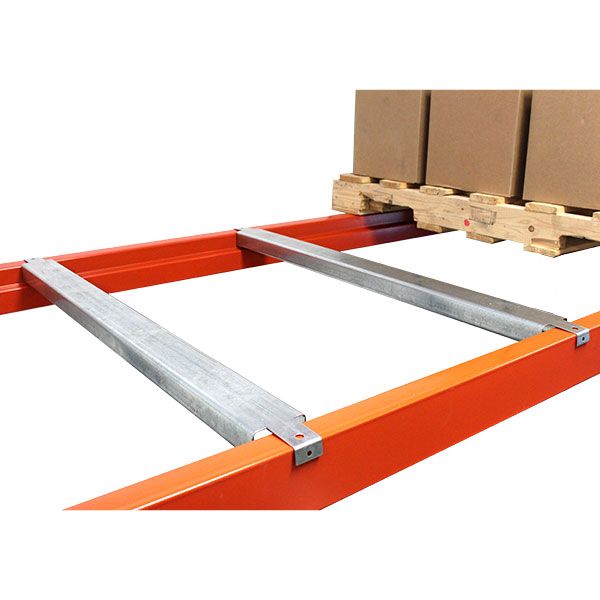
Underside of a wire mesh deck showing the steel support channels that carry the load
Support channels under a wire mesh deck — the parts that carry the load

Beams carry load; decking carries the item. On hand-stack systems the deck is what people touch every day, and it is the part most often value-engineered into a problem.

Wire mesh is the default. The waterfall front edge hooks over the beam so there is no lip to catch a carton, and the open grid lets sprinkler water, light and air through the rack — which is why fire protection engineers prefer it over solid shelves in racked storage. Capacity comes from the support channels welded under the mesh, not the wire itself: published ratings for a common 42″ × 46″ deck range from roughly 1,800 lb with two channels to 3,500 lb with four. Count channels before you compare prices.

Solid decking earns its place with small, loose or spill-prone goods that would fall through mesh, and in retail backrooms where a flat surface just works better. Particle board is the economical option and needs its safety supports; steel deck panels cost more but survive wash-down and abuse. See our pallet rack wire decking page for sizes, channel counts and capacities.

Decking Best for Watch out for
Wire mesh, waterfall edge Cartons, totes, tires, mixed inventory, sprinklered storage Small parts falling through the grid; verify channel count for the capacity you need
Wire mesh, flush / inside-waterfall Bays where the deck must sit inside the beam line Less forgiving of beam-length tolerance than a standard waterfall deck
Particle board Small loose items, retail backstock, budget-driven projects Safety supports are mandatory; moisture and repeated wetting destroy board
Steel deck panels Wash-down areas, oily parts, heavy abuse Higher cost; heavier to handle
Bare beams (no deck) Palletized or crated loads only Never leave a hand-stack level undecked — that is how product ends up on the floor
Steel shelving bay decked with solid board levels carrying cartons and bins
Shelving bay decked solid so small items cannot fall through

Board or mesh — decide by what falls through

The practical test takes five seconds: if the smallest item you store could pass through a 2″ × 4″ grid, deck solid. If not, deck mesh and keep the fire-code and visibility advantages. Mixed runs are fine — mesh the carton levels, board the small-parts levels, and label both.

Light-Duty Rack vs. Pallet Rack vs. Long-Span Shelving

Most of the money lost on a storage project is lost here, choosing the wrong family before anyone talks about brands. Two comparisons settle it.

Light-duty (hand-stack) rack vs. selective pallet rack

Consideration Light-duty / hand-stack rack Selective pallet rack
How it is loaded By hand, cart or pallet jack — one carton or tote at a time By forklift, one unit load at a time
Typical level capacity Roughly 1,000–2,000 lb per beam pair on a light-duty line such as FastRak, by beam size Several thousand pounds per beam level, set by beam profile and span
Beam adjustment 1-1/2″ increments — tight levels around carton heights 2″–4″ increments — sized around pallet loads
Assembly Boltless: connectors drop in, safety clips lock, two people and a mallet Bolted or hook-and-slot with anchoring, row spacers and often a permit and installation crew
Anchoring Optional footplates and anchors; required as height and seismic demand rise Always anchored; base plates and anchors are part of the engineered design
Right when Hand-picked cartons, totes, bins, tires, files, retail backstock Palletized freight, forklift aisles, high bays, dense storage
Wrong when Anything a forklift will reach into — light frames are not rated for impact or for pallet loads Small hand-picked inventory — you pay for capacity you never use and waste vertical space

When long-span shelving beats rack outright

System Load per level Levels in the same height Best fit
Light-duty (hand-stack) rack 1,000–2,000 lb per level 2–4 decked levels, 6′–10′ tall Mixed carton and tote inventory that occasionally sees a pallet jack
Long-span / boltless shelving Commonly 500–1,500 lb per level, by span and decking 4–6 levels in the same height Uniform boxes, records, retail backstock — maximum levels per bay
Closed-back four-post steel shelving A few hundred pounds per shelf 5–8 shelves, 87″ typical Small loose parts, tools, supplies, anything that needs a back and side panels
Selective pallet rack Thousands of pounds per level 3–5 pallet levels, engineered height Palletized freight and forklift traffic — see our selective rack pages
Freestanding boltless shelving unit with three wide board-decked levels
Boltless shelving unit with wide board-decked levels for uniform cartons

The rule of thumb we use on site visits: if the load per level is light and uniform, buy levels; if it is heavy or variable, buy capacity. A records room storing 1 ft³ cartons is a levels problem — six shelf levels of boltless long-span shelving in a 96″ bay stores far more than three rack levels ever will, for less money.

Flip it around and the answer flips too. A shop storing crates, castings, tires and the odd pallet needs the beam capacity and the impact tolerance of light-duty rack, even though nothing in the building weighs a ton. And if a forklift is in the aisle at all, the conversation moves to engineered pallet rack, anchoring and permits.

Not sure which family fits your inventory?

Send us a SKU list or a few photos of what you are storing today and we will tell you which system stores it for the lowest cost per carton — including when that answer is shelving rather than rack.

Request a Quote Try the Jaken Shelving Designer Call (800) 326-4403

Where Light-Duty Racking Earns Its Keep

These are the applications we install most often in Utah, Nevada, Idaho, Colorado and Arizona — and the detail that matters in each.

Dealership parts department with hand-stacked steel shelving and bin storageParts Rooms & DealershipsBoxed components, fluids and slow-moving SKUs on decked levels, with bin shelving for the small parts. Adjustable 1-1/2″ beam spacing lets you tighten levels around carton heights instead of wasting a foot of air above every box.
Tires hand-stacked on light-duty rack with red beams in an automotive service areaTire & Bulky Goods StorageTires, cases, drums of packaged goods and other awkward items stack cleanly on open beam levels when the deck is sized for them. Keep the heaviest items on the bottom two levels so an employee never lifts above the shoulder.
Blue parts bins on decked shelf levels in a hand-pick kitting and assembly areaKitting & Light AssemblyDecked levels at 30″–60″ put bins, totes and kits in the golden zone. Pair with a workbench run so kits are built where they are picked instead of carried across the building.
Aisle of bulk storage shelving with wood decking holding loose parts and hose fittingsBulk Storage & Maintenance StoresLong, open bays for hose, fittings, castings and spares that are too heavy for wire shelving and too small to justify a pallet position. This is the classic bulk-shelving application.
Rows of boltless long-span shelving with wood decking in a Utah warehouseRecords, Archive & Case FilesBoxes are light and uniform, so the driver is levels per bay, not pounds per level. Long-span boltless shelving usually beats rack here because you can put five or six levels in the same height a rack gives you three.
Freestanding boltless rivet shelving unit with five decked levels of stored itemsRetail Backrooms & StockroomsSingle freestanding units and short runs that staff reconfigure themselves. Boltless rivet units assemble with a rubber mallet, take wire or board decking, and move when the store resets.

Safety, Anchoring and What the Standards Require

Rack upright with a bay location label and posted capacity information at floor level
Posted bay location and capacity information at the end of a rack run

Load plaques and rack drawings are not optional paperwork

RMI’s American National Standard ANSI MH16.1 — the specification for the design, testing and utilization of industrial steel storage racks — calls for load plaques of at least 50 in² posted on or near the system, stating the maximum permissible unit load (product plus pallet or container) and/or the maximum uniformly distributed load per level. RMI also expects load application and rack configuration (LARC) drawings to be furnished with the installation and retained by the owner. OSHA has no rack-specific standard of its own; it looks to ANSI MH16.1 and to the manufacturer’s instructions, so those documents are what an inspector or your insurer will ask to see.

The practical consequence for a light-duty system: keep the plaque current. If you move beams and change level spacing, the rated capacity changed too, and the sign on the end frame is now wrong.

Rack upright base plate anchored to a concrete warehouse floor with wedge anchors
Rack base plate anchored to a concrete slab with wedge anchors

Anchoring, height and seismic

Light-duty units are often sold as free-standing, and in a low bay with a wide footprint that is reasonable. It stops being reasonable as height climbs, as the footprint narrows, as anything motorized works the aisle, or as the seismic design category rises — and the Wasatch Front is not a forgiving place to guess. Jaken offers optional deluxe footplates that bolt into the FastRak upright and accept a concrete wedge anchor; anchoring per the manufacturer’s instructions is the defensible position. In leased buildings that prohibit drilling, we look at lower heights, deeper frames, wall ties or ballast instead of simply skipping the anchors.

Utah jurisdictions also permit storage racks over certain heights. We handle that submittal work — see pallet rack seismic compliance.

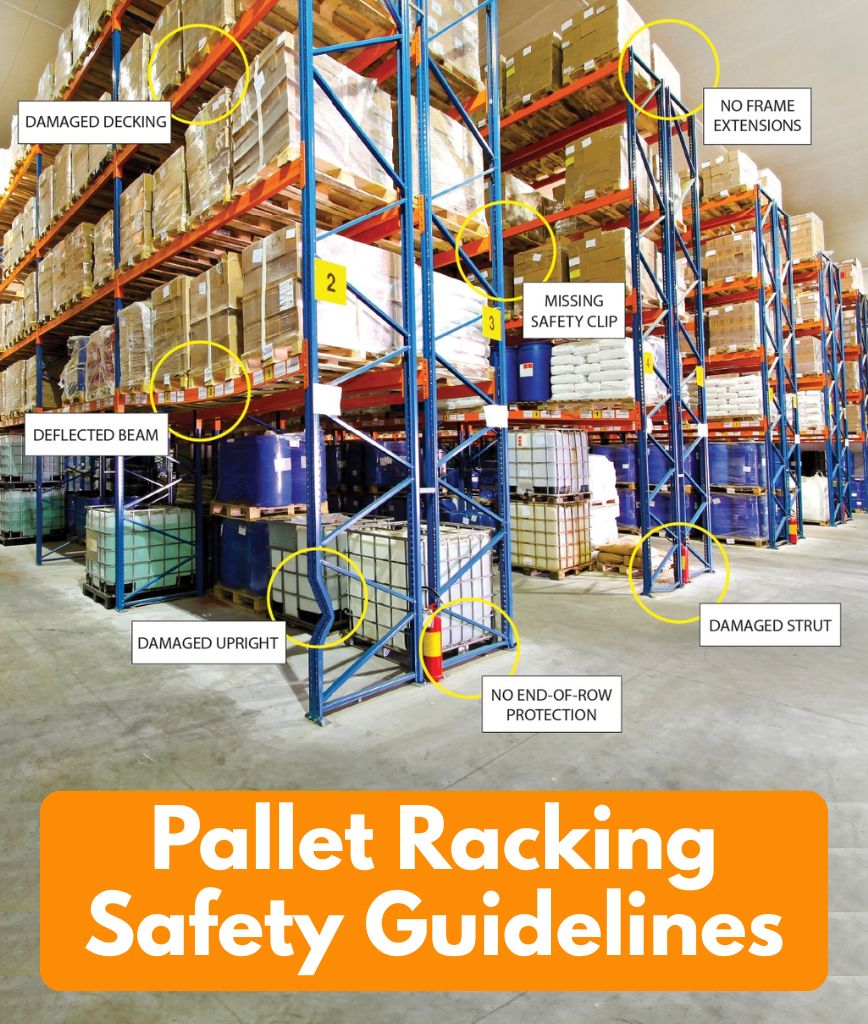
Inspection and damage

Safety inspector checking rack uprights and beam connections with a checklist
Inspector checking beam connections and upright condition against a checklist

Hand-stack rack fails differently than pallet rack. You rarely see a forklift strike; you see overloaded levels, missing safety clips, beams reset by an employee without checking capacity, and decking that has been walked on. Put a quarterly walk on the calendar and look for the four things that actually matter: clips in place on every beam, no bowed or deflected beams, no twisted or dented columns, and every level decked as designed.

Replace damaged components rather than straightening them — roll-formed steel does not return to its rated strength once it has yielded. Because these systems are boltless, a bent beam is usually a ten-minute swap. Our warehouse racking safety guide covers the full inspection routine.

  • Safety clip installed on every beam connector, every level
  • No beam deflection you can see from the end of the aisle when the level is loaded
  • No dented, twisted or out-of-plumb columns; nothing straightened and reused
  • Every level decked as designed, with board decking sitting on its safety supports
  • Heaviest product on the lowest levels; nothing stored above shoulder height by hand
  • Load plaque posted, current, and matching the beam spacing actually in place

How to Specify a System That Fits the First Time

Bring these eight answers to any rack conversation — with us or anyone else — and the quote you get back will be right.

  • Heaviest single item and the heaviest full level you will ever load — not the average
  • Carton or tote footprint, so frame depth is at least as deep as the load
  • Clear ceiling height, sprinkler height and lighting height
  • Whether a pallet jack, order picker or forklift will ever come within reach of the bay
  • Floor condition: slab flatness, thickness and whether anchoring is allowed in a leased space
  • Seismic design category for the site, and any local permitting requirement for storage racks
  • Decking type by contents: wire mesh for sprinkler flow and visibility, solid board for small items
  • Aisle width for the equipment and the people who will actually work the aisle
1

Measure and count

Bay footprint, clear height, sprinkler and light height, aisle width, and the real quantity of cartons or totes you need to store — today and at your next peak.

2

Pick the family

Levels or capacity? That answer chooses light-duty rack, long-span boltless shelving, closed steel shelving or engineered pallet rack before any brand is named.

3

Size beams and decking

Set beam length from the bay module and beam height from the published capacity at that span, then deck by what falls through.

4

Design the run

Starter and add-on bays, row spacers, anchoring, protection where traffic passes, and labels so the layout survives its first reslot.

5

Install and document

Level and anchor per the manufacturer’s instructions, post the load plaque, hand over the configuration drawings, and set the inspection interval.

Talk to someone who installs these every week

We have been designing and installing racking and shelving out of Salt Lake City for over 30 years. Send dimensions and a description of what you store, and we will come back with a layout, a capacity basis and an installed price.

Request a Pallet Rack Quote Open the Pallet Rack Designer Call (800) 326-4403

Lightweight Pallet Rack FAQs

What is a lightweight pallet rack?
It is a boltless, roll-formed racking system built for goods that are loaded by hand or with a pallet jack rather than a forklift. It uses the same architecture as pallet rack — upright frames, beams that lock into the columns, and decking — in lighter gauges and shorter spans. The Jaken FastRak line is a good reference point: knock-down uprights 18″–48″ deep and 36″–120″ tall, 2″ and 3″ beams from 24″ to 96″ long, adjustable every 1-1/2″, with wire mesh or particle board decking.
How much weight can a lightweight rack level actually hold?
It depends on the beam, not on the phrase “light duty”. Published Jaken FastRak beam capacities run from 1,000 lb for a 2″ × 96″ beam up to 2,000 lb for 3″ beams at 24″–48″, all as evenly distributed loads. Capacity per upright is quoted at 7,000 lb based on 36″ maximum beam spacing — increase the vertical spacing and that number changes. We confirm the exact rating for your configuration with the factory before quoting, and we never publish a capacity we cannot trace to the manufacturer.
Do I need wire decking, or can I load straight onto the beams?
If the item is smaller than the gap between beams, it needs decking. Wire mesh is the default because it lets sprinkler water and light through and lets you see the stock; solid particle board or steel is better for small, loose or leak-prone goods. On FastRak, particle board requires separate safety supports in the beam notches — those supports are what make the rated capacity real, so do not leave them out of the order.
When should I buy long-span shelving instead of rack?
When the load per level is light and uniform and what you actually need is more levels. Records cartons, retail backstock and e-commerce totes usually fit five or six shelving levels in the same height that gives you three rack levels, at a lower cost per stored carton. Choose light-duty rack instead when levels are heavier, item sizes vary, or a pallet jack will set a full pallet down somewhere in the run.
Does a lightweight rack have to be anchored to the floor?
Anchor it whenever the height-to-depth ratio, the seismic design category or the surrounding traffic makes tipping credible — and follow the manufacturer’s instructions, which is what OSHA will hold you to. FastRak offers optional deluxe footplates that bolt into the upright and take a concrete wedge anchor. In leased buildings where drilling is restricted we look at reduced height, deeper frames, wall ties or ballast instead of simply skipping the anchors.
Do light-duty racks need load plaques and rack drawings?
Load plaques yes: ANSI MH16.1 §4.5 calls for plaques of at least 50 in² posted on or near the system, showing the maximum permissible unit load and/or the maximum load per level. RMI also expects load application and rack configuration (LARC) drawings to be furnished with a rack installation and kept by the owner, and OSHA leans on ANSI MH16.1 when it evaluates rack safety. We provide both with the systems we install.
Can I reconfigure or add to the system later?
Yes — that is the main reason to buy boltless. Beams lift out after the safety clip is released and reset in 1-1/2″ increments, and add-on bays share an upright with the bay next to them. Two cautions: re-check the level capacity after you change beam spacing, and update the load plaque and drawings, because a reconfigured rack is a different rack.
What about mixing light-duty rack and real pallet rack in one building?
That is normal and usually correct: hand-pick SKUs on light-duty rack or boltless shelving along the pick line, palletized reserve stock on selective rack in the forklift aisles. What is not correct is putting pallet loads on light-duty frames because the bay happened to be empty. If reserve pallets are creeping into your hand-stack run, that is a layout problem — and it is what our design team fixes for free with a quote.

Get a Light-Duty Racking Layout and Price

Tell us what you store, how it arrives and how much height you have. We will size the frames, beams and decking to published capacities, lay out the run, and quote it installed — and we will say so if long-span shelving is the better buy.

Ready to configure your pallet rack system?

Use our guided BuildQuote tool to choose the right configuration, review your parts and submit it for checkout or a formal quote.

Build & Price Your Pallet Rack

Headquartered in Salt Lake City, UT • Serving customers nationwide
Local service areas: Salt Lake City • Provo • Ogden • Park City • St. George • Logan • Lehi • Orem