Most warehouses don't have an inventory problem, they have an accuracy problem. CAPS Research, summarized by the Institute for Supply Management, found an average inventory accuracy rate of 83%, and only 69% of companies track the KPI at all, which means many teams are managing a core operating metric without really measuring it ISM inventory accuracy benchmark. In practice, that gap shows up as phantom stock, preventable reorders, missed picks, and time wasted hunting for product that the system says is there.
A facility can look busy and still be leaking money through bad records. A major Harvard Business School retail study found 65% of nearly 370,000 inventory records across 37 stores were inaccurate, and RGIS UK later reported that about 60% of SKU records were wrong at any point in time, with corrections producing about 4% to 8% sales growth for participating retailers Harvard Business School inventory research. That's why inventory accuracy deserves executive attention, not just a year-end audit.
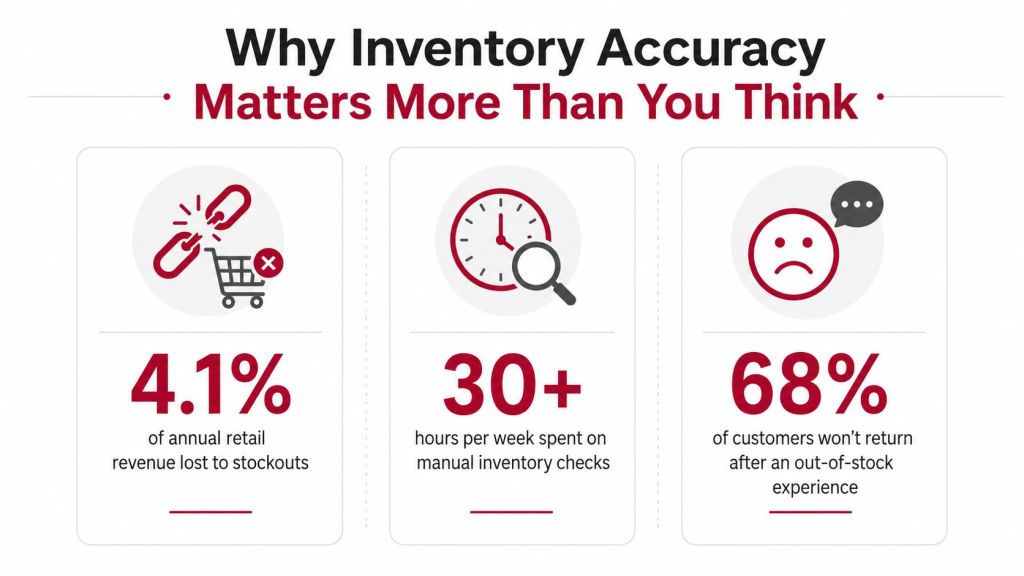
Why Inventory Accuracy Matters More Than You Think
The fastest way to understand inventory accuracy is to stop treating it like bookkeeping. It's an operating control that touches purchasing, labor, customer service, and space planning. When the record is wrong, teams order what they already have, promise what they can't ship, and waste time checking locations that should have been correct from the start.
The old assumption is that inventory errors sit in the background. They don't. They turn into stockouts, duplicate buys, rushed transfers, and frustrated workers who stop trusting the system.
Practical rule: if the record and the floor disagree often, the warehouse pays for it twice, once in labor and again in missed fulfillment.
That's why inventory accuracy has been a persistent issue for years, not a new software problem. Older studies had already found average accuracy levels as low as 65%, and the 2024 ISM summary still showed an average of 83% with the lowest-performing companies at 67% ISM inventory accuracy benchmark. If you manage a site with returns, high pick volume, or mixed storage methods, those weak points usually show up fast.
A useful outside lens comes from retail loss prevention. GM Group Services' discussion of loss prevention for shopping centres reinforces a point warehouse operators already know, loss is not always dramatic theft, it's often a chain of small process misses that create big gaps over time. That's the same pattern most inventory teams see in receiving, staging, and putaway.
How automated inventory control changes the cost picture is worth reading alongside this topic because the business case usually starts with fewer errors and ends with better throughput. Accuracy is the lever. Everything else follows.
How to Measure Inventory Accuracy Correctly
The basic formula is simple, but simple can be misleading. The standard calculation is usually written as (Counted Items / Items on Record) x 100, which gives you a headline percentage. The problem is that overages and shortages can offset each other, so the final number can look healthier than the operation really is NetSuite inventory accuracy guidance.
Use the right metric for the question
A single warehouse-wide percentage does not show where the errors live. A tighter audit should separate line-level match rate, quantity variance rate, value accuracy, location accuracy, and lot or serial integrity. That matters because a facility can pass a count on paper while still losing value through expensive SKUs that are mislocated or tied to the wrong lot or serial record Umbrex inventory accuracy framework.
| Inventory Accuracy Metrics Comparison | Formula | What It Reveals | Best Use Case |
|---|---|---|---|
| Line-level match rate | Counted line matches record | Whether the SKU is present in the right place | Cycle counts and receiving audits |
| Quantity variance rate | ( (Sigma |Book Qty – Physical Qty| / Sigma Physical Qty) times 100 ) | How far the counts drift in units | Spotting recurring count errors |
| Value accuracy | ( [1 – (Sigma |Book Value – Physical Value| / Sigma Physical Value)] times 100 ) | Whether expensive stock is misvalued | Finance review and high-value SKUs |
| Location accuracy | Record location matches physical location | Whether product can be found where the system says it is | Warehouses with many move events |
| Lot or serial integrity | Lot or serial matches the record | Traceability and compliance quality | Regulated, serialized, or batch-controlled inventory |
A warehouse with strong line counts can still fail at the points that matter most. Returns areas, receiving docks, and high-traffic pick faces often carry the highest error concentration, so the right metric depends on which risk zone you are trying to control.
Count from synchronized snapshots
The cleanest counts use ERP and WMS snapshots taken at the same timestamp as the physical count. If the systems are out of sync, the variance may reflect timing, not reality. Master data also needs to be normalized first, because mismatched units of measure, location codes, or SKU records can create false exceptions. That is the kind of data alignment problem Vendtel WebSync is built to address between counting events and system records.
The software matters, but the process matters more. If the count comes from inconsistent data, no dashboard can repair the result. Count rules, timing discipline, and clean item masters have to hold up in the same workflow.
Setting Realistic Accuracy Targets by SKU Class
Chasing 100% inventory accuracy sounds tidy, but it usually sets the wrong expectation for operations. The better target is control where errors hurt the business most. That often means exact location control, fast exception handling, and tighter checks around returns, transfers, and secure storage, as noted in NewStore inventory accuracy guidance.
What Is a Good Inventory Accuracy Rate?
There is no single inventory accuracy rate that fits every operation, but the ranges most operators use as a guide are consistent. Many sites treat 95% to 98% as a solid, world-class result and reserve 99% or higher for best-in-class operations with tight controls and frequent cycle counts. A facility sitting closer to the industry average near 83% is not failing, but it usually means real money is leaking through phantom stock and unplanned reorders. The right target for your site depends on SKU velocity, order accuracy requirements, and how much a single miss costs in labor or a lost sale.
Match the target to the item, not just the facility
A high-velocity A item needs a tighter tolerance than a slow-moving C item. That is a practical standard, not a soft one. A single miss on a high-value or fast-moving SKU can interrupt service faster than several small errors in low-priority stock.
| SKU class | Typical operational risk | Target mindset |
|---|---|---|
| Class A | High velocity, high service risk | Tight tolerance, fast escalation |
| Class B | Moderate movement and moderate impact | Balanced tolerance and regular review |
| Class C | Low movement, lower immediate impact | Broader tolerance, still monitored |
The point is to stop spending time and labor on the wrong layer of the inventory profile. Benchmarks in the same space often treat 95% to 98% as world-class and 99%+ as best-in-class, which shows that target setting is usually tied to business context rather than a single universal number.
Operational takeaway: use stricter tolerance bands for A items, then widen the band only where the business impact truly drops.
Fast movers create more touches, so they deserve more attention and better slotting discipline. A practical guide on how to do inventory management can help teams align count effort with velocity, and save time picking fast movers reinforces the same point from the picking side.
Where Inaccuracy Actually Hides in Your Warehouse
The worst inventory problems rarely spread evenly. They cluster where people touch product most often, which is why receiving, returns, putaway, and shared storage zones usually deserve the first look. A clean cycle count on a quiet aisle can hide serious drift in a high-traffic work cell.
I've seen this pattern repeat in distribution centers and back rooms. A receiving team books product before the actual cartons are checked, then putaway lands stock in the nearest open slot instead of the assigned one, and returns get staged in a corner until someone has time to reconcile them. By the time the system is updated, the physical flow has already moved on.
Track accuracy by transaction path
The better question isn't “How accurate is the warehouse?” It's “Which transaction path keeps breaking?” That means separating receiving-to-location, returns-to-restock, pick-to-adjustment, and transfer activity instead of relying on a single blended rate.
A practical guide to how to do inventory management can be useful here because it reinforces the same operational truth, control starts at the transaction level. If your process allows a mismatch to enter at receiving, every later count becomes a cleanup exercise.
The strongest diagnostic move is to inspect the places where product changes hands. Shared storage, open bin areas, and high-turn racks usually need more oversight than long-term reserve locations. That's also why many facilities discover that their biggest “inventory problem” is really a process design problem, not a count problem.
Retail Inventory Accuracy: What Changes on the Sales Floor
Retail inventory accuracy has to account for two records instead of one, the point-of-sale system and the backroom or warehouse record. A sale can register at the register before the backroom count is adjusted, and a return can sit in a corner for days before it is scanned back into stock. Add omnichannel fulfillment, where the same unit can be promised to a website order and a walk-in customer at the same time, and small timing gaps turn into real service failures.
Where retail counts break down first
Backroom and stockroom areas usually carry the highest error concentration because they see the most hand-offs, receiving, staging, markdowns, and returns, often in a small footprint with limited labeling. A clearly zoned backroom with labeled sections makes it much easier to confirm that a system location and a physical location actually match.
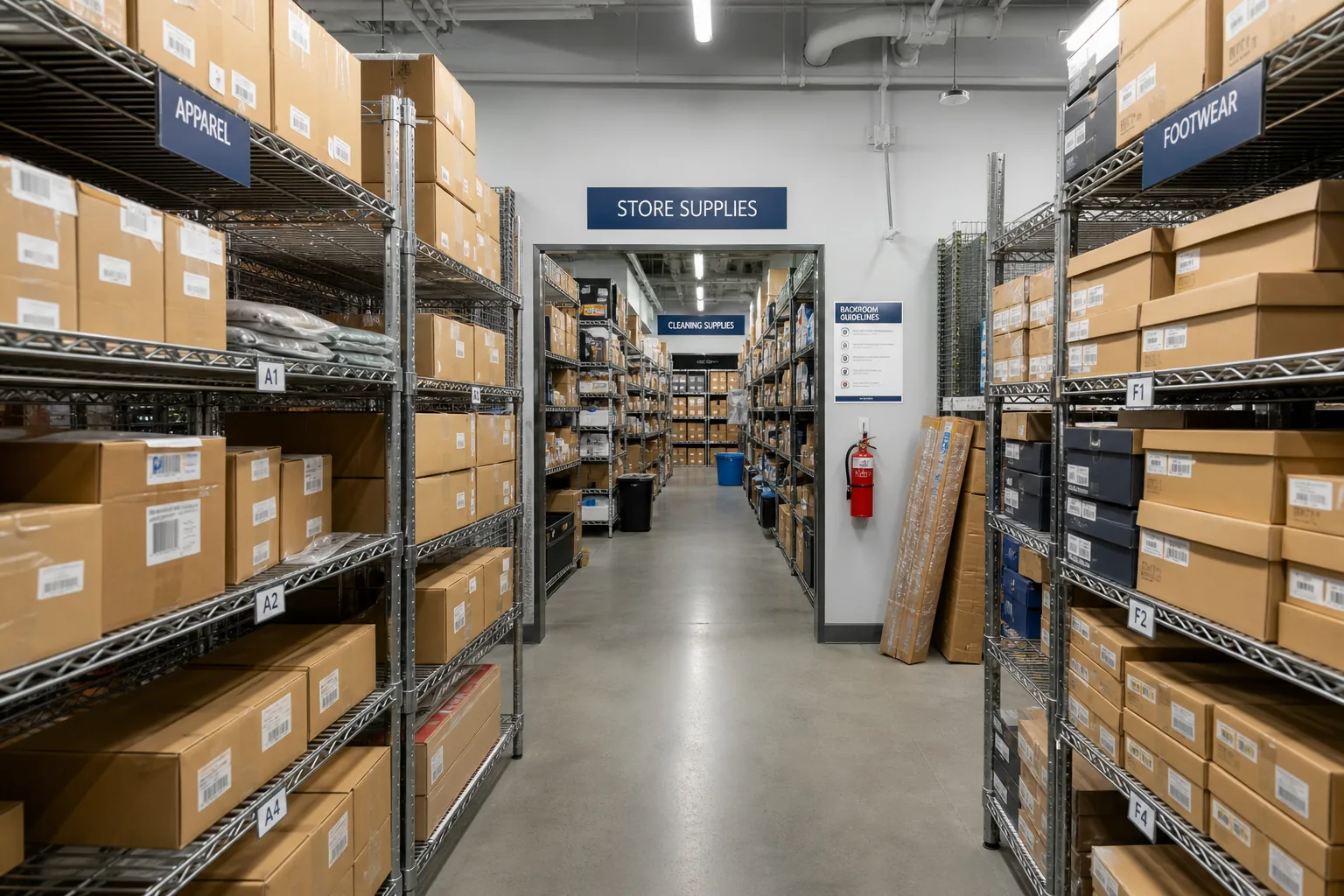
The practical fix mirrors the warehouse playbook above: count by zone, reconcile returns fast instead of letting them stack up, and keep the backroom layout legible enough that a new associate can find a location without asking. Retailers with high SKU counts and frequent markdowns benefit the most from tighter zone discipline because those are the areas where records drift fastest.
Inventory Accuracy Systems for Logistics and Distribution Operations
A 3PL or multi-client distribution site has an extra layer of risk that a single-owner warehouse does not, several customers’ inventory sharing the same building, sometimes the same racks. An inventory accuracy system in this setting needs to keep each client’s stock separately trackable, not just accurate in total. That usually means license plate or tote-level tracking, strict zone or rack assignment by client, and a WMS that flags a mismatch before product ships to the wrong order.
What logistics sites should prioritize
Cross-dock and high-turn freight leaves little time to catch a count error before product moves again, so the priority shifts from year-end audits to catching mistakes at the transaction, not after the fact. Pocket or bin storage systems that assign a fixed, labeled position per SKU or per client reduce the chance that two customers’ products get mixed in transit.

Material Handling USA’s Storeganizer pocket storage configurator lets you lay out fixed, labeled positions for high-SKU-count logistics and distribution operations before you commit to a footprint.
Your Implementation Playbook for Better Accuracy
The quickest gains usually come from boring discipline, not big transformation projects. Start with cycle counts that follow risk, not convenience. Count high-velocity and high-value locations more often, then move outward to slower zones once the error pattern is under control.
Build a daily control loop
- Baseline the record. Clean up SKU masters, units of measure, and location naming before you count.
- Count by zone. Break the floor into receiving, reserve, pick faces, returns, and staging.
- Escalate exceptions fast. Anything unexplained gets reviewed before the next transaction wave.
- Close the loop. Adjust the record, then look for the process that caused the miss.
Two-step review for manual adjustments is worth the effort. A second set of eyes catches a lot of “fixes” that would have buried the root cause. That's especially true in sites where supervisors are also handling labor planning and dock flow.
Technology should support the process, not replace it. Barcode readers are the first upgrade many teams use because they tighten transaction capture. RFID helps where fast reads or hard-to-reach items matter more, while mobile devices help staff scan in place instead of walking data back to a terminal. How to manage lab inventory is a good reference for the same principle in a controlled environment, where location discipline and adjustment control are just as important.
Practical rule: if a tool makes it easier to scan, verify, and resolve exceptions at the point of work, it usually helps accuracy. If it only creates more screens, it probably doesn't.
Make accountability visible
Dashboards should track accuracy by zone and by transaction type, not only as one floorwide number. Staff training matters too, especially on scan discipline, location confirmation, and what to do when physical stock doesn't match the system. If people don't know whether to stop, adjust, or escalate, they'll improvise.
A direct conversation about how to manage lab inventory often reveals the same control needs warehouse teams face, clear rules, clean storage, and consistent review. That's why change management is part of implementation, not an afterthought.

Choosing the Right Technology and Storage Solutions
The right tools depend on the error pattern. If the problem is poor identification, labeling and scanning matter most. If the issue is location drift, the storage layout itself may be the bigger fix. If the floor is cluttered and hard to audit, even good software won't save the record.
Compare the options by the problem they solve
Basic tools can work well when the process is already disciplined. Advanced tools earn their keep when stock moves fast, locations are shared, or multiple people touch the same inventory path. Storeganizer automated pick-to-light storage system is one option Material Handling USA offers for buyers looking at storage and pick precision, while other facilities lean on simple barcode labels and standard shelving because the root problem is still layout, not software.
| Area | Basic approach | Advanced approach |
|---|---|---|
| Identification | Barcoded labels | RFID tags |
| Capture device | Basic scanner | Mobile computer |
| Storage | Standard shelving | Modular bin systems |
The other side of the decision is physical organization. Shelving that forces product into clear locations makes count work easier. Security cages help protect controlled stock. Mobile shelving can improve density, but only if the aisle and access plan still supports fast location confirmation. The point is to reduce ambiguous storage, because ambiguous storage creates ambiguous counts.
Inventory Accuracy Tools: Matching the Fix to the Failure Point
An inventory accuracy tool only pays off if it targets the actual failure point. Use this quick check before buying anything new.
| Symptom | Likely root cause | Tool or fix that helps |
|---|---|---|
| Right item, wrong count | Inconsistent counting or receiving process | Barcode scanning at receiving and putaway |
| Item exists but can’t be found | Location drift or ambiguous storage | Defined bin locations, labeling, pocket or bin storage systems |
| Fast movers keep coming up short | Shared access or high-traffic pick faces | Pick-to-light or put-to-light storage with tighter access control |
| Counts look fine but service still slips | Wrong metric being tracked | Track location accuracy and value accuracy, not just line count |

For sites deciding between a layout fix and a technology fix, a warehouse layout and design review is often the faster win because it removes ambiguous storage before you spend on scanners or software.
Need a second opinion on which fix applies to your site? Call Material Handling USA at (800) 326-4403 for a free inventory accuracy and storage layout review.
Buy for the root cause
Do not overspend on RFID if the core issue is bad putaway discipline. Do not install more software if staff still have to guess where stock belongs. Match the tool to the failure point, then make sure the layout supports the workflow.
That logic is where inventory accuracy becomes a facilities decision, not just an IT one. Material Handling USA can support that kind of planning with storage systems, labeling products, and layout consultation tied to the actual space and workflow.
Measuring ROI and Planning for Long-Term Success
ROI is easier to see when you connect accuracy to the costs it touches. Better counts can reduce stockouts, cut the time spent searching for items, lower correction work, and improve the quality of fulfillment decisions. The financial gain doesn't always show up as one big savings line. It usually appears as less waste across several departments.
Look at the whole operating picture
The cleanest business case includes labor, space, customer service, and replenishment. If a better process saves time during receiving and counting, avoids duplicate buys, and keeps service promises more reliable, the project has more than one path to payback. That's why facilities that start sooner usually get the advantage of better planning timelines and fewer compounding errors.
Long-term success depends on cadence. Keep the same metrics visible after the initial rollout, review exception trends, and tighten counts where the misses cluster. If the record starts slipping, go back to the process before you blame the people.
A rollout timeline also matters. Teams that wait too long often face more disruption because the backlog of bad data keeps growing. Moving sooner usually means cleaner installs, cleaner counts, and fewer surprises during peak periods.
For facilities that want a practical next step, a consultative layout review is often the most efficient start. It helps connect counting discipline, storage design, and technology selection before money goes into the wrong fix.
Inventory Accuracy: Frequently Asked Questions
What is a good inventory accuracy rate?
Most operators treat 95% to 98% as a solid, world-class inventory accuracy rate and 99% or higher as best-in-class. The right number for your site depends on SKU velocity and how much a single error costs in labor or a missed order.
What is the formula for inventory accuracy?
The standard formula is (Counted Items / Items on Record) x 100. It gives a quick headline percentage, but overages and shortages can cancel each other out, so most operations also track line-level match rate, quantity variance, and location accuracy separately.
What are the most useful inventory accuracy metrics to track?
Line-level match rate, quantity variance rate, value accuracy, location accuracy, and lot or serial integrity each reveal a different kind of problem. A single blended percentage can hide a serious issue in one of these areas, so track them separately when you can.
What tools actually improve inventory accuracy?
The right tool depends on the failure point. Barcode scanning fixes inconsistent data capture, defined bin locations and labeling fix location drift, and pick-to-light or put-to-light storage fixes errors in high-traffic pick faces. Buying advanced technology before fixing a layout or process problem usually wastes the investment.
What is the right inventory accuracy solution for a growing operation?
Start with a layout and process review to remove ambiguous storage, then add barcode or pick-to-light technology where volume and SKU count justify it. A phased approach, starting with the highest-risk zones, usually costs less and disrupts operations less than a full system swap.
How is retail inventory accuracy different from warehouse inventory accuracy?
Retail has to keep the point-of-sale record and the backroom or warehouse record in sync, and omnichannel fulfillment can promise the same unit to two different orders if the timing is off. Backroom zoning and fast return reconciliation matter more in retail than in a pure warehouse setting.
What inventory accuracy best practices matter most for logistics and 3PL sites?
Track accuracy separately by client and by zone, not as one blended number, assign fixed and labeled positions per SKU, and catch mismatches at the transaction rather than waiting for a periodic audit. Cross-dock and high-turn freight leave little time to correct an error after product has already moved.
How often should a warehouse run cycle counts to keep inventory accuracy on target?
Count high-velocity and high-value locations most often, then move outward to slower-moving zones once the error pattern is under control. Counting by risk instead of on a fixed calendar schedule finds problems faster and uses less labor.
Material Handling USA helps facilities improve inventory control with storage systems, labeling products, and layout support built around real workflows. If you're planning a warehouse upgrade or want to tighten record accuracy in a stockroom, visit Material Handling USA to review options, request a quote, or ask for a free layout and design consultation. Call (800) 326-4403 or email Sales@MH-USA.com to talk through your space and compare solutions.