A vertical carousel and a vertical lift module both bring stored goods to an operator, but they move inventory in different ways. A carousel rotates a connected loop of carriers. A vertical lift module, often called a VLM, stores trays in fixed locations and retrieves one tray at a time. This guide explains how those designs affect fit, capacity planning, workflow, software, site needs, and total project scope.
Vertical Carousel vs Vertical Lift Module at a Glance
| Decision factor | Vertical carousel | Vertical lift module |
|---|---|---|
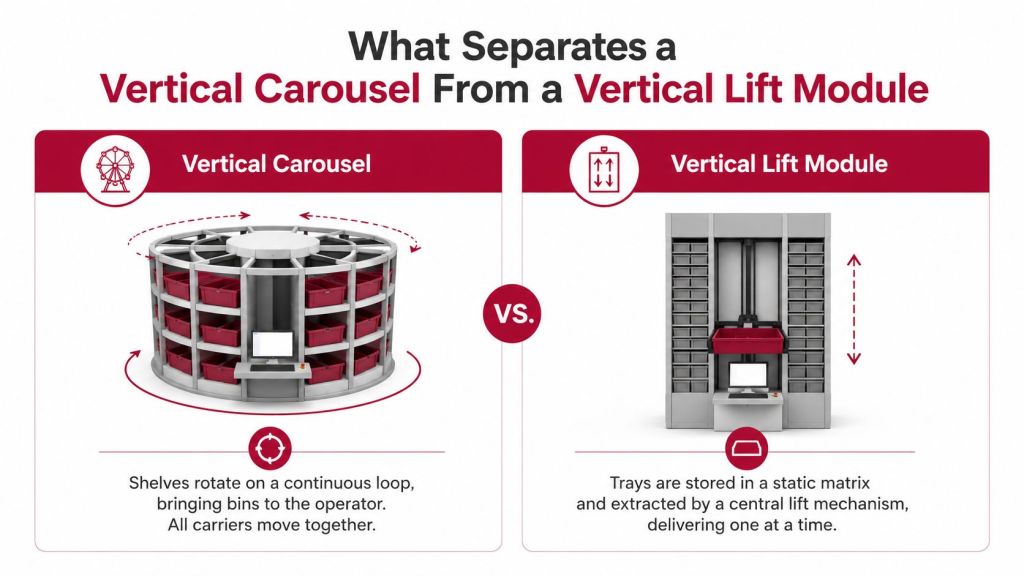
| How it moves | All carriers travel together in a vertical loop | An extractor retrieves a selected tray from a storage matrix |
| Inventory fit | Stable items with consistent sizes and assigned carrier locations | Mixed item sizes, changing inventory, tooling, parts, and kitting stock |
| Load planning | Carrier loading and balance must be planned across the moving loop | Each tray has a defined load limit and storage position |
| Use of height | Carrier spacing is fixed by the selected system layout | Tray positions can often be assigned based on stored item height |
| Workflow fit | Repeatable access patterns and stable parts rooms | Mixed order picking, kitting, and workflows that may change |
| Key risk to check | Inventory outgrows fixed carrier dimensions or balance plan | Added controls and integration do not support a real process need |
How the Two Storage Systems Work
Vertical carousel operation
A vertical carousel works like a Ferris wheel for inventory. Shelves or carriers attach to a continuous chain. The system rotates the loop until the requested carrier reaches the access opening. Since every carrier is part of the same loop, loading and balance affect system design.
Vertical lift module operation
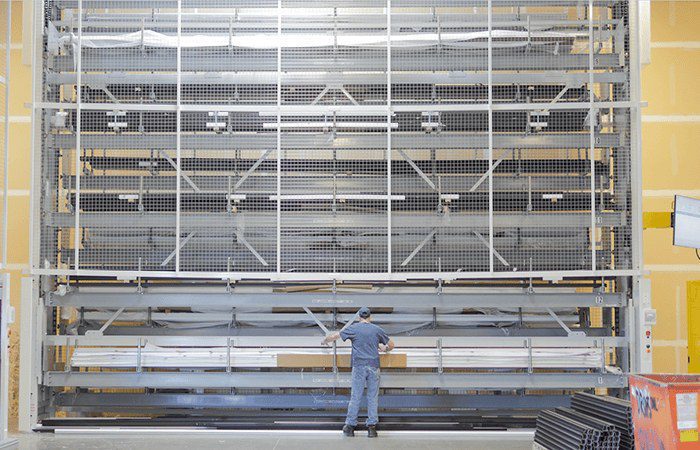
A VLM stores trays on both sides of a central lift path. An extractor travels to the selected tray, removes it, and presents it at an access opening. The other trays remain in place. Tray locations may be assigned to use the available height more closely when stored items vary in height.
For product details, compare our vertical carousel storage solutions with our vertical lift modules. A separate vertical lift module market history provides broader market background.
Do Not Choose by a Single Published Specification
Published limits vary by model, tray or carrier size, machine height, controls, and installation conditions. A high maximum load on a data sheet does not show whether the machine fits your actual inventory. It also does not prove that it will reach the required pick rate.
For example, a load comparison from one manufacturer can help explain the design difference. Review the VLM and vertical carousel load comparison, but confirm every limit against the exact system proposed for your site. The same caution applies to throughput figures in its published comparison. Travel distance, order profile, batch size, operator pace, software prompts, and replenishment work can change real output.
Ask each bidder to state the proposed machine height, overall width and depth, access opening, tray or carrier dimensions, usable load, total system load, electrical needs, and service clearances. Require those values on the approved drawing rather than relying on a general brochure.
How to Size a Vertical Carousel or VLM
A useful design starts with item data and workflow data. Ceiling height and SKU count alone are not enough.
- Measure every item group. Record the length, width, height, unit weight, container weight, and quantity that must be stored. Flag the largest, tallest, and heaviest items.
- Profile inventory activity. Separate fast movers, slow movers, reserve stock, kits, and parts that are often picked together. Record average and peak picks by shift.
- Measure the site. Verify clear height, columns, lights, ducts, sprinklers, electrical service, floor conditions, and the equipment delivery route.
- Map the work. Show where picking, replenishment, packing, maintenance, and production handoffs occur. Include operators per shift and any shared workstations.
- Define system connections. List the WMS or ERP, barcode rules, scanners, printers, pick lights, conveyors, and production equipment that may exchange data.
- Plan for change. Test the concept against expected growth in SKUs, item size, inventory depth, peak work, and staffing.

Planning tip: Use the free Automated Vertical Storage Designer to organize your layout and send the concept to Material Handling USA for review. For help now, call (800) 326-4403.
Include facility and installation details
The usable equipment height is not always the highest roof point. Beams, sprinkler clearances, lighting, ducts, sloped roofs, and local requirements can reduce the available envelope. The installation route matters too. Check doors, docks, aisles, turns, overhead openings, and staging space before the equipment ships.
Floor conditions, anchoring, seismic design, permits, fire protection, and electrical work may require review by qualified trades or local authorities. A proposal should identify who owns each task. It should also state what is included, excluded, or carried as an allowance.

Which System Fits Your Operation Best
Choose a vertical carousel when
- Item sizes and assigned storage locations are stable.
- The carrier dimensions fit the inventory without wasting major space.
- The loading plan can keep the moving loop within approved balance and load limits.
- Operators follow repeatable parts room, maintenance, or batch access routines.
- The available building height matches a carousel configuration.
Consider a vertical lift module when
- Item heights and weights vary across the stored inventory.
- Tooling, parts, packaged goods, or kits need separate tray locations.
- Inventory profiles are likely to change.
- The workflow needs software guidance, scanning, or links to business systems.
- The building can use a taller machine and has a suitable installation route.
Some operations can use both. A carousel may support stable small parts while a VLM stores heavier tooling or variable height stock. A hybrid plan only makes sense when each zone has clear inventory rules and the software directs operators to the right storage point.
Market research, including Mordor Intelligence's VLM market analysis, may show broad adoption trends. Those forecasts should not drive a specific equipment choice. Your item data, work pattern, building, and support plan matter more. For a general process view, this resource on ridurre costi magazzino guidato discusses warehouse management and cost control.
Compare Total Project Scope, Not Just Equipment Price
Do not compare quotes by the hardware total alone. Two proposals can look similar while assigning software, freight, site work, or training to different parties.
| Scope item | Questions to ask |
|---|---|
| Equipment | What trays, carriers, dividers, access openings, guards, and controls are included? |
| Freight and rigging | Who unloads, stages, moves, and sets the equipment? |
| Site work | Who handles floor preparation, anchoring, electrical work, sprinklers, and permits? |
| Software | Is the system standalone, or does it connect to a WMS, ERP, scanners, or picking aids? |
| Commissioning | What testing, item setup, operator training, and acceptance steps are included? |
| Service | What preventive maintenance, response process, spare parts, and remote support are available? |
| Schedule | Which dates are estimates, and what approvals or site work can change them? |
Lead time depends on the approved configuration, controls, fabrication, component supply, engineering, site readiness, and installation plan. Do not assume a fixed schedule before the supplier validates the scope. Review our guide to vertical storage cost and pricing factors before comparing proposals.
Common Vertical Storage Buying Mistakes

- Planning around average inventory only. Peak stock, reserve quantities, packaging, and future item changes can consume space that looked available.
- Using SKU count as the main sizing input. Two facilities with the same SKU count may need very different space because item size, weight, and quantity vary.
- Accepting brochure throughput as a guarantee. Real output depends on the full pick and replenishment process.
- Treating software as an afterthought. Item records, slotting rules, scanning, permissions, and system handoffs must be tested.
- Skipping the delivery route review. A machine can fit its final location but still be difficult to move through the building.
- Leaving service space out of the layout. Operators and technicians need safe access around the equipment.
Questions to Ask Before Requesting a Quote
- Which inventory is included, and which items should stay outside the machine?
- What item data was used to select tray or carrier dimensions?
- How were peak picking and replenishment activity tested?
- What building measurements and overhead clearances have been verified?
- Which software, scanning, and network tasks are included?
- Who handles freight, rigging, electrical work, permits, fire protection, and training?
- What service access and preventive maintenance does the system require?
- Which assumptions could change the price or schedule after approval?
Frequently Asked Questions
What is the main difference between a vertical carousel and a VLM?
A vertical carousel moves all connected carriers in a loop. A VLM uses an extractor to retrieve one selected tray from fixed storage locations.
Is a VLM always better for heavy items?
No. Both system types are available in different configurations. Item weight, container weight, load distribution, tray or carrier dimensions, and the exact approved equipment limits must all be checked.
Which system uses changing item heights better?
A VLM can often assign trays to storage positions based on the height of the loaded tray. A carousel uses a fixed carrier arrangement, so item height must fit that layout.
Which system is faster?
Neither type is always faster. Output depends on machine travel, item locations, order profile, batch rules, operator work, software, and replenishment activity. Test the proposed workflow instead of comparing one brochure number.
Can a vertical carousel or VLM connect to a WMS or ERP?
Many systems can exchange data with business or warehouse software, but the scope varies. Define item records, transactions, scanners, permissions, error handling, testing, and support before approval.
What measurements are needed for a quote?
Provide item dimensions and weights, stored quantities, pick activity, clear building height, floor area, overhead obstructions, electrical service, access route, and workflow details.
How should buyers compare project costs?
Compare equipment, accessories, software, freight, rigging, site work, permits, installation, commissioning, training, and service. Mark every exclusion and allowance.
Get a Validated Vertical Storage Plan
Start with the workload, not the machine name. Stable inventory and repeatable access may favor a carousel. Mixed item sizes, changing tray needs, and more complex picking may favor a VLM. The final choice should follow verified item data, site measurements, workflow review, and a complete project scope.
Use the Automated Vertical Storage Designer to create a starting concept. Then ask Material Handling USA to review the layout, equipment fit, and installation needs. Call (800) 326-4403, email Sales@MH-USA.com, or request a vertical storage consultation.