
Fence Post and Pipe Cantilever Rack: Merchants Metals, Murray, UT
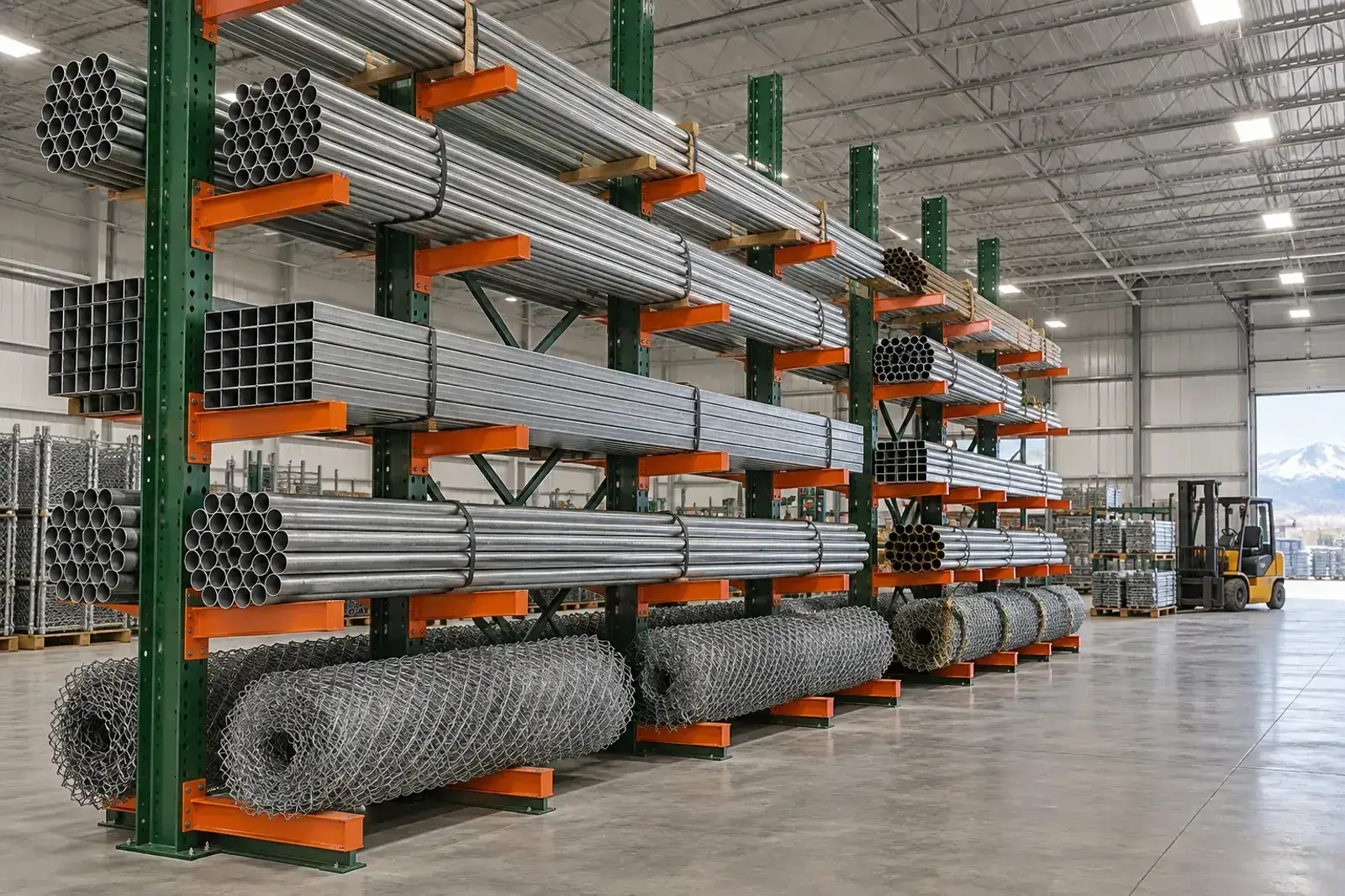
How a Salt Lake City area fence-products branch replaced floor-stacked galvanized posts, pipe and chain link rolls with two structural cantilever rack rows on 16-ft columns and 5-ft arms.
Murray, UT
Project location
2025
Supplied
Structural
Rack type
16 ft / 5 ft
Columns / arms
The Project: A Fence-Products Branch Storing Posts, Pipe and Fabric on the Floor
Merchants Metals distributes fence and perimeter security products, and its Salt Lake City area branch in Murray, Utah carries the long, heavy inventory that comes with that business: galvanized line and terminal posts, round pipe, square tube, top rail and rolls of chain link fabric. In February 2025 the branch manager asked Material Handling USA for a quote on heavy duty cantilever pipe racks. Jessica Ferguson, Director of Sales, worked the request and quoted two complete structural cantilever configurations the same day.
The two options differed in one variable: column height. Option A used 16-ft (192-inch) columns; option B used 12-ft (144-inch) columns. Everything else stayed the same: 60-inch bases, 60-inch arms at 4.75 inches tall, and 48-inch bracing, so the branch could weigh the cost of height against the storage it would gain. In April the branch approved option A and doubled the quantity, taking two full rack rows instead of one, and confirmed that its own people would handle installation. The order shipped from the manufacturer in May 2025.
The component set referenced throughout this case study is covered in our cantilever rack systems overview.

| Project detail | As supplied |
|---|---|
| Client | Merchants Metals, Salt Lake City area branch (Murray, UT) |
| Application | Galvanized fence posts, pipe, square tube, top rail and chain link rolls |
| Rack type | Structural bolt-together cantilever rack |
| Columns | 192-inch (16-ft) columns, painted green |
| Bases | 60-inch bases with anchor hardware |
| Arms | 60-inch arms, 4.75 inches tall, four per column, painted orange |
| Bracing | 48-inch X-brace sets and 48-inch horizontal braces |
| Scope | Material supplied by Material Handling USA; customer-installed |
Why Cantilever Rack Suits Fence and Pipe Inventory
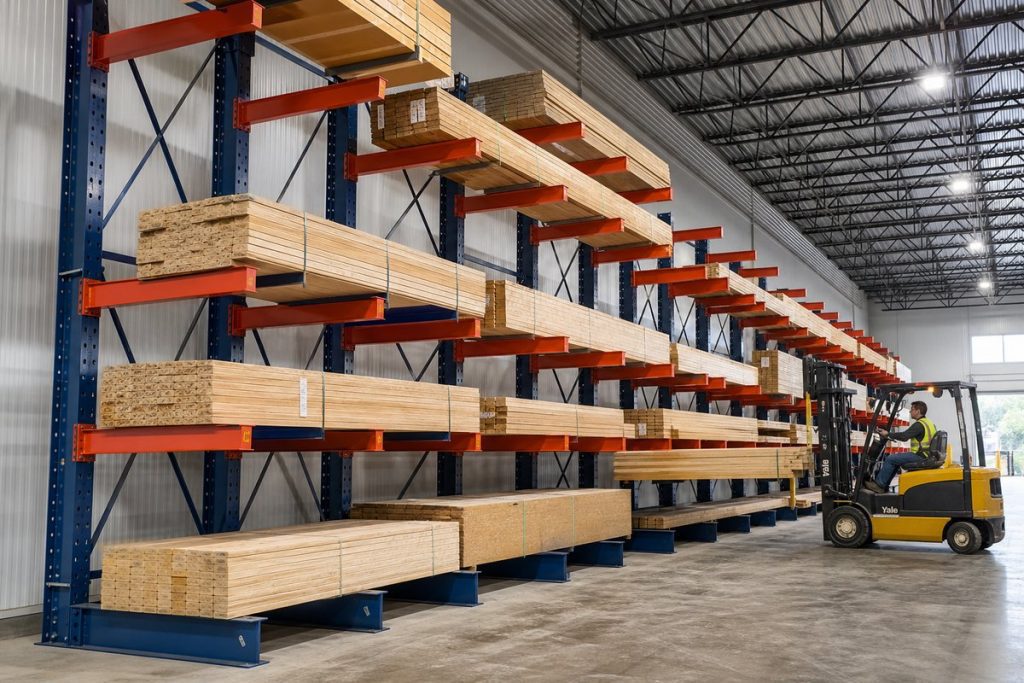
Fence inventory is the textbook case for cantilever rack. Posts and pipe arrive in banded bundles that are long, round and heavy. Chain link fabric arrives in rolls that will not stack squarely on anything. None of it fits a pallet footprint, and almost none of it can be safely floor-stacked more than a few bundles high.
Floor stacking long galvanized material creates three specific problems. Bundles at the bottom of a stack are unreachable until everything above them moves, so a branch ends up pulling from whatever is on top instead of what the counter ticket calls for. Round stock spreads and rolls, which is both a housekeeping and an injury issue. And a stack consumes floor area that cannot be used for anything else, in a building where floor area is the scarce resource.
Cantilever rack removes the front column that makes selective pallet rack awkward for long loads. A row of columns carries arms that project outward, leaving the entire face of the rack open, so a forklift can set a bundle of 21-ft top rail anywhere along the arms without squaring it into a bay opening. Length stops being a constraint, and the branch gains vertical storage for material that previously had nowhere to go but the slab.
Structural Cantilever Rack vs Roll-Formed: Why This Branch Needed Structural
Cantilever rack is built two ways, and the difference matters more here than on most projects. Roll-formed cantilever uses cold-formed sections with punched slots; arms usually drop into the column and lock with a pin or wedge. It is lighter, less expensive, and entirely adequate for light and medium duty material. Structural cantilever uses hot-rolled structural shapes, and arms and bracing bolt through the column.
This project was quoted and supplied as structural, bolted rack. For a fence branch the reasoning is straightforward. Galvanized pipe and post bundles are dense, so the load per arm is high relative to the space the material occupies. Bundles are handled with a forklift several times a day, and steel bundles do not forgive a glancing blow the way a lumber bundle does. A bolted structural connection stays tight under that kind of repeated impact, and an arm cannot be lifted out of its slot by a fork tine because there is no slot, only bolts.
The trade is weight and price. Structural rack costs more per foot and takes more labor to erect. When the stored material is dense metal handled daily, that is usually the cheaper answer over the life of the rack, because the failure modes of the lighter option are exactly the ones a metal distributor will meet.

| Structural cantilever | Roll-formed cantilever | |
|---|---|---|
| Sections | Hot-rolled structural shapes | Cold-formed, punched sections |
| Arm connection | Bolted through the column | Usually drop-in with pin or wedge |
| Impact tolerance | High; bolted joints stay tight | Lower; slots and wedges can deform |
| Reconfiguring levels | Deliberate work (unbolt, re-bolt) | Fast, tool-light changes |
| Typical fit | Dense metal, pipe, bar, plate, daily handling | Lumber, trim, panel, lighter mixed goods |
| Used here | Yes, for galvanized posts, pipe and tube | Not specified for this branch |
Column Height, Arm Length and Bracing: The Four Numbers on the Quote
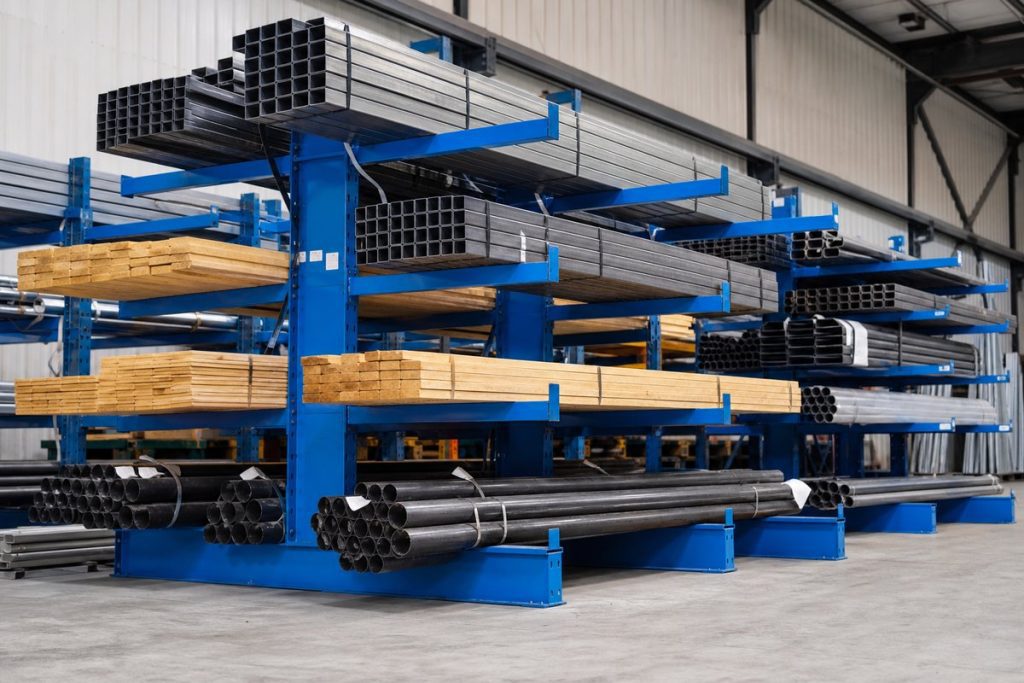
Column height. The quote put 16-ft and 12-ft columns side by side because that is the honest way to present the decision. Taller columns add arm levels and therefore stored footage without taking another square foot of floor, but only if two things are true: the building has the clear height, and the lift truck can actually place a heavy bundle at the top level. A 16-ft column with four arm levels is useless if the forklift tops out at ten feet. This branch had the height and the equipment, and chose the taller column.
Arm length. The arms on this project are 60 inches long and 4.75 inches tall. Arm length should be set by the material, not by a wish for depth: usable depth is arm length minus the clearance the load needs at the column, and rated capacity falls as arm length grows because the load acts farther out. Five feet is a practical depth for banded post and pipe bundles, which are long rather than wide, and it keeps the aisle from having to grow.
Arm count per column. Four arms per column on this order. Vertical arm spacing is driven by the tallest bundle in each level plus lift clearance, and by where the weight should sit, with the heaviest material on the lowest arms, always.
Bracing and column spacing. The X-brace sets and horizontal braces on this order are 48 inches, which sets the spacing between columns along the row. Column spacing is not only a stability question; it decides whether material sags. A bundle that spans too far between arms will deflect well below the rack’s rated load, which is why flexible or unbanded stock wants closer columns, and why brace lengths and column spacing have to be quoted as one decision.
| Design input | What it controls | How to decide it |
|---|---|---|
| Column height | Number of arm levels and total stored footage | Building clear height and the real lift reach of your forklift. |
| Arm length | Usable depth and arm capacity | Widest bundle plus clearance; extra depth costs capacity. |
| Arm vertical spacing | Opening height per level | Tallest bundle in that level plus lift clearance. |
| Column spacing | Sag and row stability | Closer for flexible stock; matched to brace lengths. |
| Base length | Resistance to overturning | Longer bases for tall columns and deep arms. |
| Bracing | Row stability along its length | X-brace sets and horizontals sized to actual column spacing. |
Published capacities always belong to one specific combination of arm length, arm spacing and column, so a rating can never be carried across from one configuration to another. The design, testing and utilization of industrial steel cantilevered storage racks is covered by ANSI MH16.3.
Single-Sided or Double-Sided: How to Choose for a Branch Warehouse
A single-sided cantilever column carries arms on one face, with the base extending under the load side. A double-sided column carries arms on both faces off one column and one base. The choice is decided by where the row can stand, not by preference.
Against a wall, a fence line or a yard boundary, single-sided rack is the only sensible option: arms on the back face of a double-sided column would be unreachable, so you would be buying steel that can never be loaded. Standing free in the middle of a building with an aisle on each side, double-sided rack stores far more per dollar of steel and per square foot of floor, because one column and one base do two jobs.
For a branch warehouse like this one the practical question is aisle count. Two double-sided rows need three aisles to be fully usable; two single-sided rows against opposite walls need one. Working that out before quoting is what keeps a rack purchase from quietly consuming the drive lane the forklift needs to load a truck.

| Single-sided | Double-sided | |
|---|---|---|
| Best placement | Against a wall, fence or yard boundary | Free-standing with an aisle on both faces |
| Steel per stored foot | Higher | Lower, because one column serves two faces |
| Base loading | Asymmetric; base length and anchors matter more | More balanced |
| Aisles needed | One aisle per row | One aisle per face |
| Typical use | Perimeter runs in a tight branch warehouse | Interior rows and wide buildings |
Round Stock: Arm Incline, Pipe Stops and Keeping Pipe Where You Put It
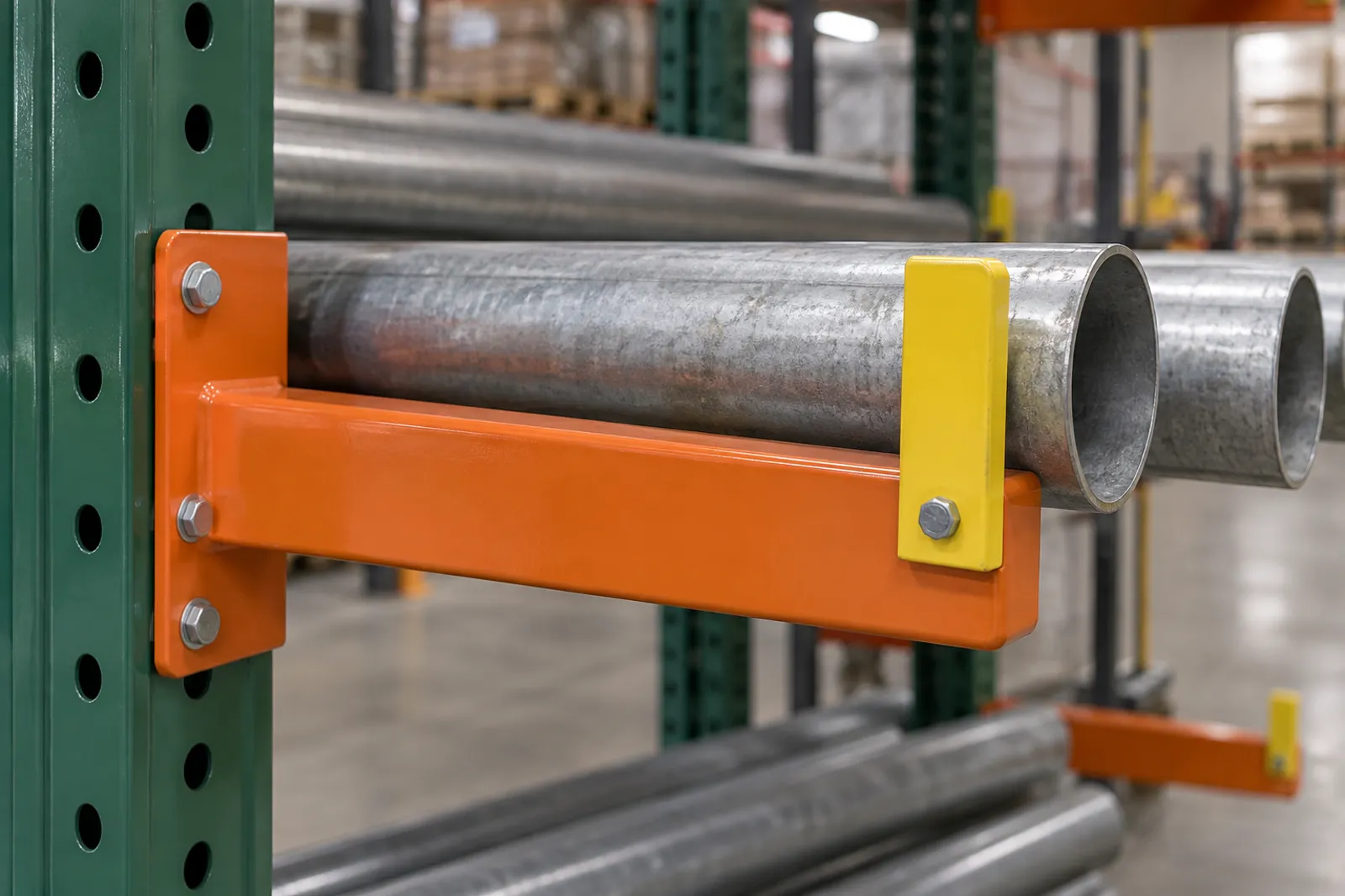
Round material behaves differently from lumber or panel stock on a cantilever arm, and it is the detail most often missed when a rack is specified. Pipe, post and top rail will roll. A bundle that is banded when it arrives stops being a bundle the moment the bands are cut at the counter, and loose round stock finds the front edge of the arm.
Three things control it. First, arm incline: cantilever arms are normally installed with a slight rise toward the column so gravity works against roll-off. Second, arm stops or pipe stops, which bolt to the outer end of the arm and give the material a positive stop instead of relying on friction. Third, pick discipline: loose round stock belongs on lower arms where a person can reach and restrain it, not at the top of a 16-ft row.
This branch worked through exactly that sequence in practice. Months after the rack went in, the branch manager came back to Material Handling USA asking about pipe stops and pipe stop holders for the cantilever arms. That is a good outcome, not a design miss: the rack was right, and the accessory that matched how the branch actually picks loose pipe became obvious once the material was up on arms. Pipe stops are inexpensive, they bolt on, and they can be added to an existing row.
Customer-Installed Structural Rack: Sequence, Anchoring and Safety
The branch told us plainly that it would take care of installation, and that is a reasonable call for a metals distributor with forklifts and crews who assemble product every day. It does shift the burden forward: when nobody from the supplier is on site, the order itself has to be complete and the configuration has to be settled before it ships. Notice how much of the quoting conversation on this project was about brace lengths, arm count and base length rather than price.
The sequence that avoids rework on a structural cantilever row is the same every time. Mark and square the full run before setting a single anchor. Set and anchor the first two columns, then check plumb. Install bracing as you go rather than saving it for the end, because an unbraced row is not a partly finished rack, it is an unsafe one. Torque the arm bolts level by level. Load from the bottom up, heaviest material on the lowest arms.
Anchoring deserves its own thought. Cantilever bases resist the overturning moment of a loaded arm, and they can only do that if the anchors suit the slab: thickness, strength and edge distance all matter, and a base set too close to a control joint or a slab edge will not develop the capacity the drawing assumes. Once loaded, the row needs a real inspection habit covering bolts, base plates, column plumb and impact damage. General requirements for secure material storage are set out in OSHA 29 CFR 1910.176.
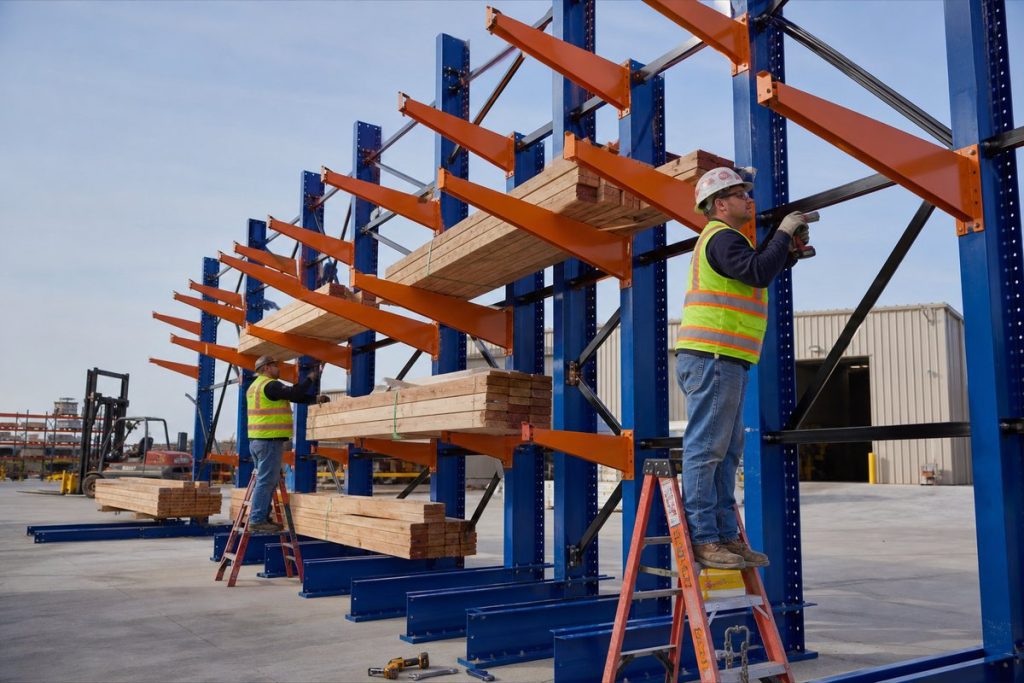
Square the run
Mark the full row and check squareness before any anchor is set.
Anchor and plumb
Anchors matched to the slab; check plumb on the first columns.
Brace as you go
X-bracing and horizontals installed with the row, not afterward.
Arms, then load
Torque arms level, load heaviest material lowest, work upward.
What This Project Shows
Three things stand out about the Merchants Metals branch project. The quote presented a real choice on the one variable that mattered, column height, instead of a single take-it-or-leave-it configuration. The rack was structural because the material is dense metal handled by forklift every day, not because structural sounds stronger. And the follow-on question about pipe stops shows the normal life of a cantilever row: get the columns, arms and bracing right first, then add the accessories that match how your people actually pick.
If you distribute fence products, pipe, tube or any other long metal stock in Utah, the planning conversation is short and specific: what you store, how long it is, how heavy the bundles are, how high your building and your forklift reach, and where the rows can stand.
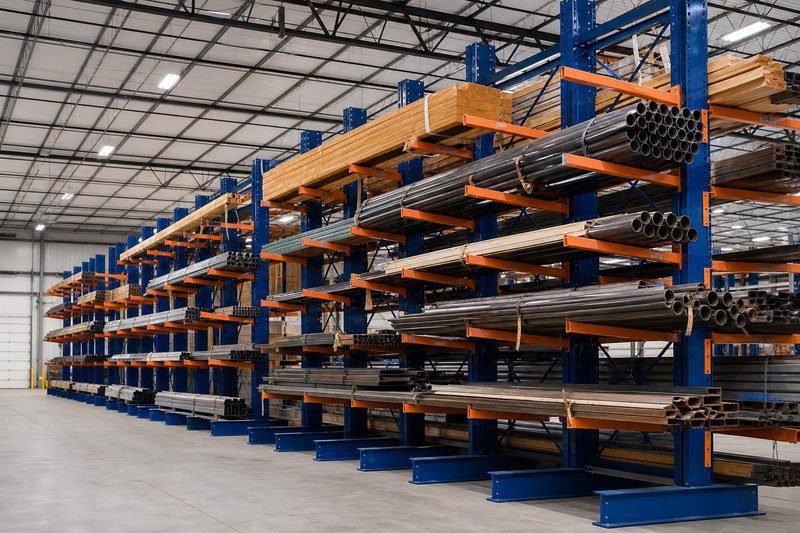 Cantilever Rack SystemsComponents, configurations and applications for long-material storage.
 Cantilever Rack in Salt Lake CityLocal cantilever rack supply and service along the Wasatch Front.
 Pallet Rack SystemsWhen palletized loads belong on selective, drive-in or push-back rack instead.
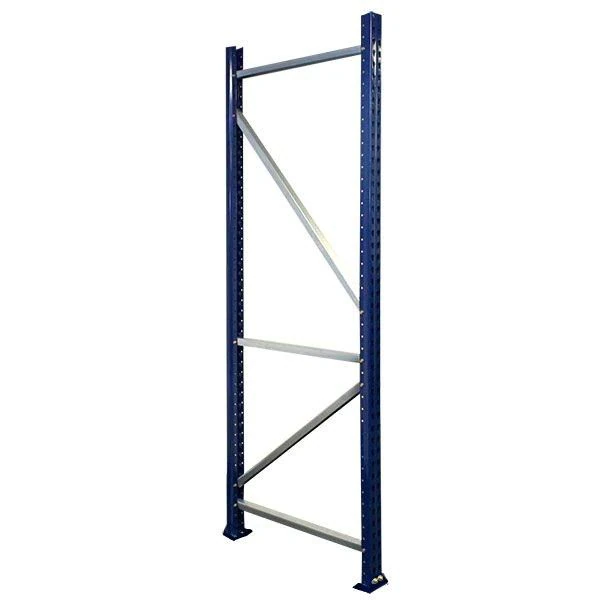
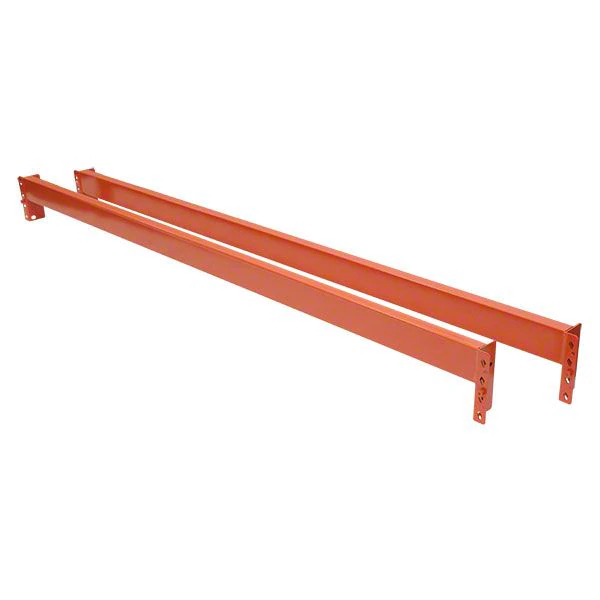
Shop Rack Components Online
Buy select items directly from our online store, or request a quote for volume, custom sizes and freight-rated orders.

Cantilever Rack FAQs
Is structural or roll-formed cantilever rack better for pipe and fence posts?
How tall should cantilever columns be?
How do I stop pipe from rolling off cantilever arms?
How far apart should cantilever columns be?
Can I install structural cantilever rack with my own crew?
Do cantilever bases have to be anchored?
Can cantilever rack store chain link fence rolls as well as posts?
Storing Pipe, Posts or Long Metal Stock?
Tell us what you store, how long and heavy the bundles are, and how high your building and forklift reach. We will size columns, arms, bracing and anchors and quote the complete package.