
Mobile Filing Systems › Datum MobileTrak5
Datum MobileTrak5 Mobile Filing Systems
Lateral files, file bars and shelf filing mounted on Datum MobileTrak carriages: model detail, rail and ramp options, aisle locking, powered safety features and the filing arithmetic we use to size a file room.

288 in
maximum documented MobileTrak3 carriage length
612 in
maximum documented MobileTrak550 carriage length
4
documented rail types: non-grouted, grouted, recessed, seismic
1968
year Datum began manufacturing storage products
Why a filing conversion is not the same project as a shelving conversion

Most high-density projects are described in square feet. Filing projects are not: they are measured in filing inches, and that unit changes every decision. A filing inch is simply one inch of horizontal shelf or drawer run occupied by upright files. It is a definitional unit, which is why it is so useful — a 42-inch-wide shelf level provides 42 filing inches, whether the files sitting in it are thick or thin.
The consequence is that filing rooms live or die on shelf pitch rather than shelf depth. Letter-size files are shallower than most industrial shelving assumes, so a carriage designed for cartons wastes depth in a file room. Conversely, filing is dense and heavy: a fully loaded run of files puts far more weight per foot on a carriage than a run of half-empty archive boxes, which pushes the drive selection toward mechanical or powered assist sooner than people expect.
Datum’s MobileTrak platform handles this by treating the carriage as a chassis and the filing hardware as the payload. Datum documents MobileTrak as able to accommodate any Datum shelving solution, explicitly including lateral files alongside 4Post, Stak-N-Lok, VuStak, ThinStak and weapon cabinets, and notes that systems can be customised. In practice that means the same rails and drive can carry lateral file frames in one bay and shelf filing in the next.
This page is model-specific on purpose
If you are still comparing lateral file carriages, file-bar systems and shelf filing in general, start with the generic mobile filing systems page. This page covers the Datum MobileTrak product line specifically, and the wider Datum range lives on the Datum brand page.
The MobileTrak models we specify for filing
Datum publishes the MobileTrak family as variations on one idea: carriages on rails with a movable aisle. What separates the models is profile, carriage size and how the movement is generated. The figures below are the manufacturer’s own documented maximums, not project capacities.
| Model | Movement | Documented carriage size limits | Where it fits a file room |
|---|---|---|---|
| MobileTrak3 | Manual or mechanical carriages | Lengths up to 288 in; depth up to 44 in | Low-profile design documented as working around low ceilings, sprinkler systems and other obstructions — the usual answer for converted office space and basements |
| MobileTrak550 | Manual, mechanical or powered | Lengths up to 612 in; depths up to 60 in | Heavy-duty, mechanically assisted design documented for more and heavier storage, with four rail choices including seismic; suits long banks of dense filing |
| MobileTrak Powered | One-touch electric controls | Configured per project | Where users should not be pushing loaded carriages at all, or where access speed and controlled aisle entry matter |
Two options cut across the models and are worth naming early because they change the layout. Dual Drive is documented as available, which matters on long carriages where a single drive point would be a long way from one end. Syncro Drive is also documented as available, and is the feature to ask about when several carriages should move together predictably. Datum additionally documents mechanical safety sweeps as available on MobileTrak550.
About the MobileTrak5 name
The MobileTrak5 brochure we hold from Datum is the collateral that documents this high-density family, and it details the MobileTrak3, MobileTrak550 and MobileTrak Powered systems described above. We quote the specific model designation Datum confirms for your configuration on the order, rather than treating the series name as a part number.
Filing arithmetic: working out what your room can hold
Here is the calculation we actually run, written out so you can check ours or run your own before anyone quotes. Every step is arithmetic or measurement. None of it is a manufacturer rating, and it deliberately stops where engineering begins.
1. Count today’s filing inches. For shelf filing, multiply the usable width of one shelf level by the number of levels per section, then by the number of sections. For lateral cabinets, multiply the usable drawer width by the number of drawers. Add them together. That single number is your baseline, and it is almost always different from what the records team believes it is.
2. Add retention growth. Filing volume is driven by your retention schedule, not by office headcount. Take the annual intake in filing inches, subtract the annual destruction under the schedule, and project forward over the life you want from the room. If the schedule is not being enforced, fix that before buying storage — it is the cheapest capacity you will ever find.
Why filing inches beat square feet
Filing inches are comparable between rooms and between systems; square feet are not. Two rooms of identical area can differ by a third in filing capacity purely on shelf pitch and aisle count. Insisting on filing inches at every stage is the easiest way to stop a records project drifting.
3. Model the carriage layout. Along the travel direction, the bank consumes the summed depth of the carriages, plus each aisle you keep open, plus rail run-out and the ramp at the access end. Across the travel direction, carriage length is limited by the model (Datum documents up to 288 inches for MobileTrak3 and up to 612 inches for MobileTrak550) and by the room itself.
4. Subtract the real-world losses. Sprinkler clearance, lighting, the reach height of your shortest user, columns, a door that swings into the bank, and any aisle you must keep permanently open for simultaneous users. Each of these removes filing inches from the theoretical maximum, and pretending otherwise is how file rooms end up 10 percent short on day one.
| Input | Unit | Why it decides the design |
|---|---|---|
| Current filing volume | Filing inches | Baseline capacity the new room must at least match |
| Annual net growth | Filing inches per year | Sets how many spare carriage levels to design in |
| File size mix | Letter, legal, oversize | Sets shelf pitch and carriage depth |
| Simultaneous users | People | Each permanently open aisle costs a carriage of capacity |
| Clear height and obstructions | Inches | Sets shelf levels; often the reason MobileTrak3’s low profile is chosen |
| Loaded weight | Pounds per square foot | Reviewed by a qualified engineer, especially above grade |
What we will not put in writing without a design
Capacity, shelf loading, floor loading, lead time, pricing and compliance outcomes. Those come from Datum’s engineering against your measured drawing and from your own engineer where the structure is involved. Datum’s brochure states the design allows you to fit more than double the storage of traditional stationary shelving; we treat that as the manufacturer’s positioning, not as a promise for your room.
Send us your filing inches
If you can tell us your current filing volume, your file sizes and the room dimensions, we can model the carriage layout and show the resulting capacity with the assumptions listed.
Request a QuoteGeneric mobile filing optionsCall (800) 326-4403
Rails, ramps and what the floor has to do
Datum documents four rail types, and the choice is usually settled by the building rather than by preference.
| Rail type | Documented description | Typical reason to choose it |
|---|---|---|
| Non-grouted | Can be anchored to the floor, or sit on the floor where anchoring is not practical | Leased space, post-tension slabs, or rooms where the floor must not be drilled |
| Grouted | Secured to the floor | Permanent installations where a solid, levelled bed is wanted |
| Recessed | Securely anchored within the floor, which Datum notes eliminates the need for a secondary floor | New build or refit where a flush finish matters and the slab can be prepared |
| Seismic | Seismic carriages include anti-tip brackets at each wheel location for carriage stability, helping keep the carriage from being dislodged from the rail | Projects where the local code and engineer call for it |

Datum also documents that all tracks have the ability to add anti-tip brackets at any time, which is a genuinely useful piece of future-proofing: it means a decision you defer today is not a decision you lose.
Ramps deserve their own paragraph because they consume room. Datum documents ramps in standard and ADA depths, in steel or wood, and notes that stainless steel transition strips are provided with all wood ramps on the MobileTrak550. An ADA-depth ramp is longer than a standard one, so if accessible approach is required — and in most public and institutional file rooms it is — that length has to come out of the carriage run at layout stage, not be discovered at installation.
The last floor question is load. A dense filing bank concentrates weight in a way static filing spread across the room does not. Above grade, on a mezzanine, or over an unknown slab, that has to be checked by a qualified structural engineer. We provide the loaded weight of the proposed system so the check can be made against a real number.
Handles, aisle locks and day-to-day operation
The hardware a user touches every day matters more to the success of a file room than any headline specification. Datum documents three handle options and a set of mechanical features that together define how the room behaves.
- Three handle options: a handle with red aisle indicator, a lockable crank handle, and a manual pull handle
- Push-button aisle locks that prevent carriage movement while the aisle is in use
- A locking crank handle that provides security for the system
- Carriage and rails documented as providing smooth movement when opening and closing aisles
- An enclosed drive mechanism with an external adjustable chain tensioner, so adjustments can be made without removing the end panel
That last item sounds minor and is not. Chain tension is the most common maintenance touch point on a mechanically assisted system. If tensioning requires dismantling an end panel, it gets deferred, and deferred tension adjustment is how carriages start to feel heavy. An external adjuster turns a service call into a five-minute task.
The red aisle indicator handle is worth specifying in any shared file room. It gives an at-a-glance signal that an aisle is occupied, which combined with the push-button aisle lock is the practical answer to the most common concern people raise about mobile filing: that someone will close an aisle while a colleague is inside it. Hardware helps, but it does not replace training and a written aisle rule, and we cover both at handover.
MobileTrak Powered: one-touch access and the safety stack
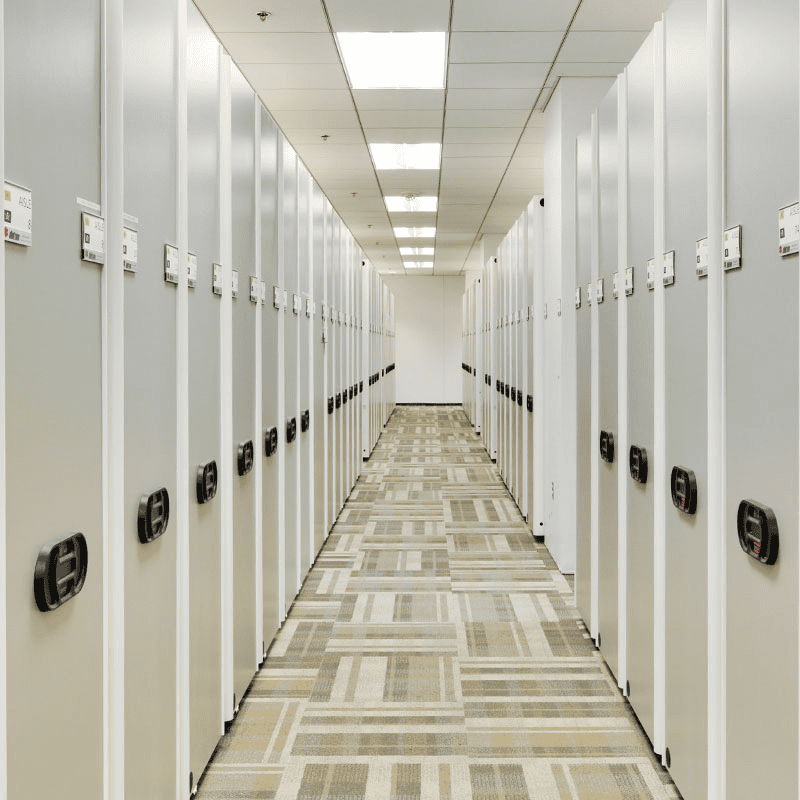
Powered movement is the right answer in three situations: the carriages are long or heavy enough that manual effort becomes an ergonomics problem, the users are the public or occasional staff rather than trained records clerks, or the room is busy enough that seconds per retrieval add up. Datum documents MobileTrak Powered as a complete system with simple one-touch controls to access storage aisles.
The standard safety features Datum documents are infrared floor sweep, manual override and distance sensors. The optional list is where most of the project-specific decisions sit: aisle entry sensors, aisle lighting, advanced safety systems, power lock and fire park. Fire park in particular is worth discussing with your fire protection consultant, because how the carriages sit during an alarm affects sprinkler coverage inside the bank.
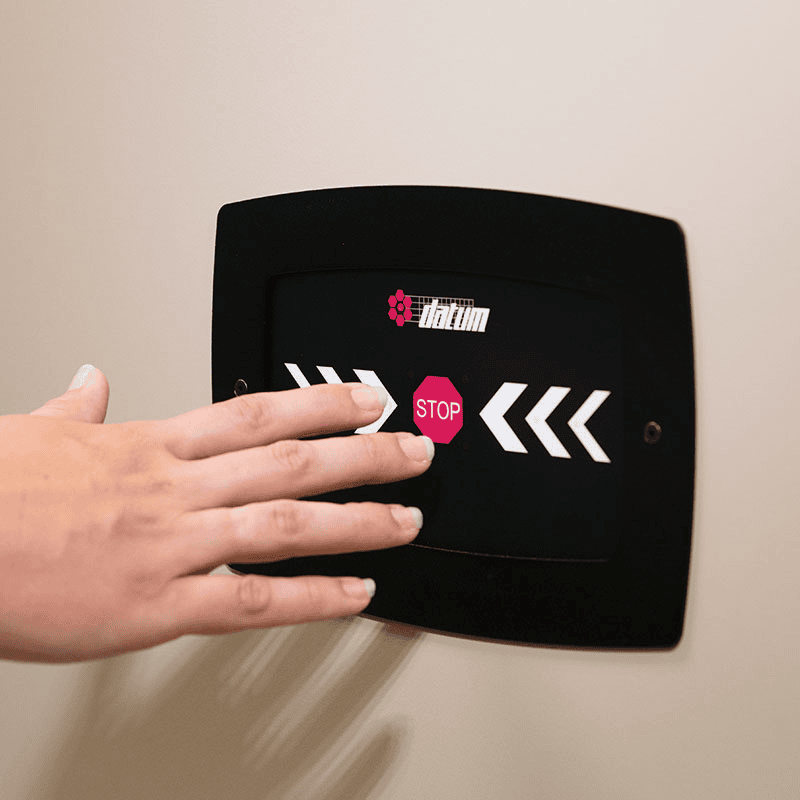
The control interface is deliberately simple: directional arrows to open an aisle and a stop button. That simplicity is a safety feature in itself, because a control that needs explaining is a control that gets used wrongly. Manual override is documented as standard, which is the answer to the obvious question about what happens when power is lost.
Powered systems also change the installation. Power has to be routed to the bank, controls commissioned, and sensors tested loaded as well as empty. That is scoped explicitly in our quotes rather than assumed, and it is why we ask about the electrical supply on the first call.
End panels, finishes and making the room look intentional
In a records room nobody sees, end panels are functional. In a law office, a clinic corridor or a university department, they are the whole visual impression of the project. Datum documents that all MobileTrak systems are available with a selection of end panel configurations, ranging from a simple drive box cover through one-piece, two-piece, three-piece and four-piece end panels, and that end panels can be made from melamine, laminate or steel. A powder coat finish is documented for the system.
- Drive box cover only, where the bank is in a back-of-house room and budget goes into capacity instead
- One-piece panels for a clean, flat face in a public-facing space
- Two, three and four-piece panels where panel scale needs to match surrounding joinery
- Melamine or laminate to coordinate with existing casework; steel where durability outranks appearance
- Perforated steel where the stored material benefits from air movement
One practical note on specifying finishes: match them to something physical in the room, not to a swatch on a screen. We get finish samples in front of the people signing off, because a laminate that looks close in a PDF can look wrong beside real casework, and end panels are not the part of the system you want to re-order.
The file rooms this system is usually built for
Datum lists archives and museums, athletics, computer labs, government, healthcare and medical, libraries, manufacturing and industrial, offices and corporate, police and military, and schools and universities as target environments for its high-density storage. For filing specifically, four of those come up again and again in our projects.
| Room type | What drives the design | Related page |
|---|---|---|
| Legal and professional records | Long retention, legal-size files, and a strong preference for a finished appearance in client-visible space | Archive shelving for law firms |
| Healthcare records | Chart-style filing, controlled access, and rooms that are usually the wrong shape and already too small | Mobile shelving for medical records |
| Government and institutional records | Retention schedules, accessible approach requirements, and contract purchasing paths | Datum GSA contract details |
| Mixed records and evidence rooms | Filing alongside cabinets or weapon storage on the same rail system, with locking taken seriously | Datum weapons storage |

Two of these deserve a warning. First, healthcare and legal file rooms are frequently the leftover space in the building — low ceilings, columns in awkward places, and a door that opens the wrong way. This is precisely where MobileTrak3’s documented low profile earns its place, because it is designed to work around low ceilings, sprinkler systems and other obstructions.
Second, mixed rooms need the locking conversation early. Datum documents push-button aisle locks and a locking crank handle, and power lock as an option on the powered system, but the right combination depends on your access policy. If files and controlled items share a room, expect to discuss whether they should share a bank at all.
If your requirement is rotary rather than carriage-based filing, we cover that separately on the Datum rotary file page, because the retrieval pattern and the space arithmetic are genuinely different.
How a MobileTrak filing project runs
Define
Filing volume in filing inches, file sizes, retention schedule, users and access policy. Datum’s own process describes defining storage needs first, and it is first for a reason.
Design
Room survey, carriage layout, model and drive selection, rail and ramp approach, end panel and finish selection, and the documentation your engineer or landlord needs.
Install
Rails set and levelled, carriages assembled, filing hardware fitted, movement tested loaded, and powered safety devices commissioned where fitted.
Operate
User handover on aisle locks and indicators, a written inspection routine, and a documented path for adding carriages as filing grows.
The step most often shortened is the survey, and it is the one we refuse to shorten. Rail layout depends on the room as built, not the room as drawn. We have yet to survey a file room where the drawing and the tape measure agreed completely.
The step most often forgotten is the last one. Filing rooms are living systems: intake continues, destruction happens on a schedule, and departments reorganise. A design that leaves no spare levels and no path to add a carriage is a design that will be full within a year of handover. We plan the expansion path at design stage and write it down.
Datum MobileTrak filing questions
What is a Datum MobileTrak5 mobile filing system?
How are the carriages moved?
Which MobileTrak model suits a file room?
Can our existing lateral files go on the carriages?
How much filing capacity will we gain?
What rail options are available?
Is a MobileTrak system suitable in a seismic area?
What safety features does the powered version have?
Can the file room be locked down?
Who makes MobileTrak and what warranty applies?
Related: the generic mobile filing systems page for non-brand-specific comparison, the Datum brand page for the wider product range, and the mobile shelving hub for how movable-aisle storage compares with the alternatives.
Size your file room with real numbers
Send your filing inches, file sizes and room dimensions. We will return a MobileTrak layout, a model and drive recommendation, and the assumptions behind both in writing.