
Wire Decks or Solid Shelves on Mobile Shelving Carriages
Open wire, solid steel or divided record shelves change how a high-density room breathes, cleans, lights and gets protected. Here is how to pick the deck before the carriages are ordered.

Deck first
It drives finish, fire and cleaning decisions
50%
Openness threshold that separates open from solid shelving in NFPA 13 storage rules
UDL
Published shelf ratings assume a uniformly distributed load
Mixed
One system can carry more than one deck type
The shelf deck is a bigger decision than it looks
Most conversations about high-density storage start with the carriages, the rail and the drive. The shelf that actually holds the inventory tends to get chosen last, from a dropdown, on the day the order is placed. That is backwards. On a track-mounted mobile shelving system the carriages simply move shelving around; what the shelving is made of decides how the room performs every day after handover.
A deck determines whether air moves through the stored goods or around them, whether sprinkler water can reach what is on the shelf below, whether a mop and a light can get where they need to, whether small items stay put or fall through, whether a label sits flat, and how the shelf is cleaned when something spills. Those are operating characteristics, not accessories, and they are difficult to change once several hundred shelves are installed and loaded.
This page compares the deck options that get carried on mobile carriages — open wire, solid steel, divided record shelves and wire with bins — and explains the criteria that should decide between them. For shelf sizing itself, see the companion guide to shelf depth and level spacing.
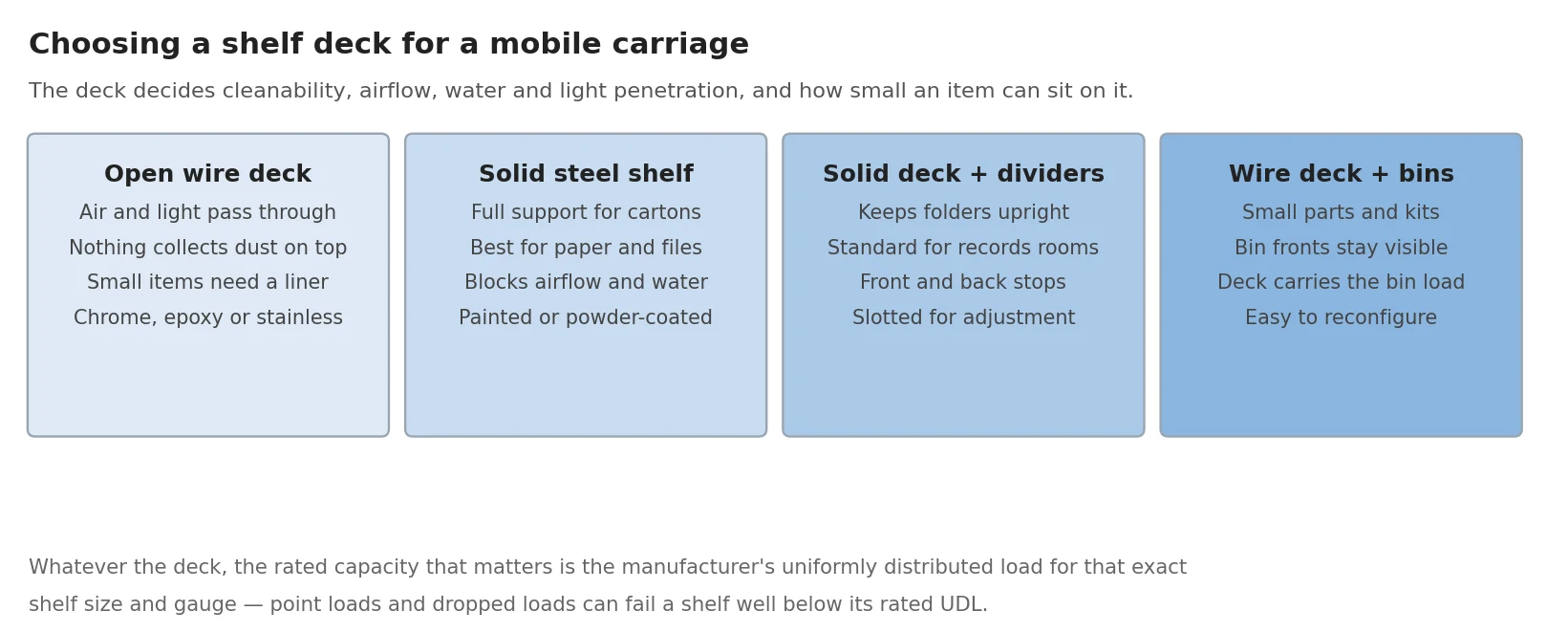
The four decks you will actually be offered
Manufacturers use different trade names, but the families behave predictably.
| Deck | How it behaves | Typical use on a mobile system | Watch out for |
|---|---|---|---|
| Open wire deck | Welded wire mesh with an open surface; air, light and water pass through | Supply rooms, kits, bins, bulky items, damp or wash-down areas | Small or soft items need liners or bins; wire pattern can mark soft goods |
| Solid steel shelf | Flat closed deck, usually painted or powder-coated steel | Cartons, binders, boxed collections, anything that needs a flat bearing surface | Blocks airflow and sprinkler water; needs dusting on top surfaces |
| Solid shelf with dividers | Flat deck plus vertical dividers and end stops | File rooms and archives where folders must stay upright and in order | Divider spacing has to match the file size, not the other way round |
| Wire deck plus bins | Open deck carrying plastic bins or totes as the real storage unit | Small parts, consumables, kitted items, anything picked by hand | The bin, not the shelf, becomes the size limit; plan bin footprints first |

Nominal deck size is not usable deck size
Every deck loses some of its nominal dimension to the frame, the wire flange or the divider hardware. That loss is small per shelf and large per room: a fraction of an inch across hundreds of shelf feet is the difference between a plan that fits and one that does not. When you compare quotes, compare the usable clear opening between uprights and the clear height between levels, not the catalogue shelf size.
The same discipline applies to bins. A bin that fits the deck on paper but overhangs the front edge will foul the adjacent carriage face when the system closes, and that is discovered on installation day.
Air, water and light: what an open deck actually changes
The single functional difference between an open and a closed deck is that things pass through the open one. Three of those things matter enough to drive the decision.
Air
A closed system of solid shelves creates still pockets. In a room where humidity, temperature or odour control matter — a collections store, a damp basement records room, a refrigerated supply area — open decks let the room’s air handling actually reach the stored material. Federal facility standards for records storage make the same point from the fire and preservation side: where compact mobile shelving is used in a records storage facility, it must be designed to permit proper air circulation and fire protection. That is a design obligation on the shelving arrangement, not a footnote.
Water
Sprinkler water falls from above. Solid shelves catch it; open decks let it continue to the levels below. That is why the deck belongs in the fire protection conversation, discussed in the next section and in the guide to sprinkler, lighting and HVAC coordination above the ranges.
Light
Aisle lighting on a mobile system illuminates a narrow moving canyon. Open decks let some of that light reach the lower levels of a deep range; solid decks put every level in its own shadow. Where staff read spine labels or handwritten box labels, the deck choice is quietly a legibility choice.
Where an open deck is the wrong answer
Open wire is not automatically better. Loose paper, small hardware, textiles and anything with soft corners all behave worse on wire. Archive folders in particular need a flat surface and dividers, which is why record rooms overwhelmingly use solid divided shelves even when the same building uses wire everywhere else.
Fire protection treats open and solid shelving differently
Sprinkler design for storage is governed by NFPA 13, and one of the questions the standard asks is whether the shelving is open or solid. Shelves of wire mesh, slats or similar materials that are more than 50 percent open, with flue spaces maintained, are treated as open. Solid shelf areas up to 20 square feet are likewise treated as open racks. Beyond that, larger solid shelf areas can require in-rack sprinklers — at intermediate levels no more than six feet apart vertically for mid-sized solid shelf areas, and below every level once the solid shelf area is larger still.
Two practical consequences follow. First, a deck decision made casually can change the sprinkler scope of a project, and sprinkler scope is expensive to change late. Second, when a mobile system compacts, the picture the fire protection engineer analysed changes: ranges that were separated are now touching. Give the engineer the compacted condition, the deck type, the commodity and the storage height, and let them apply the standard.
Nothing on this page is a fire protection design and nothing here approves a layout. It is the vocabulary you need so the right question gets asked early.

Finish selection: match the environment, not the catalogue photo
Finish is where deck decisions are most often made on appearance and most often regretted. The useful rule is to specify the finish against the wettest, most corrosive condition the room will ever see, not the condition on the day of the site visit.
| Environment | Common deck finish | Why |
|---|---|---|
| Dry interior storage, offices, records | Chrome-plated wire or painted / powder-coated steel | Lowest cost, easy to keep clean, no corrosion exposure |
| Humid rooms, coolers, occasional wash-down | Epoxy or polymer-coated wire | Coating resists moisture that would blister paint or pit plating |
| Corrosive, sanitising chemicals, food handling | Stainless steel | Withstands repeated chemical cleaning without degrading |
| Food handling areas of any kind | Shelving certified to the NSF/ANSI food equipment standard | That standard covers materials, design, cleanability and corrosion resistance for food equipment, and inspectors ask for it |
Finish and deck also interact with the rest of the system. A stainless deck on a painted carriage in a wash-down room solves half the problem; the carriage, the end panels and the fasteners live in the same environment. When you write the specification, describe the environment once and let every component be selected against it — the approach set out in the specification and submittal checklist.
Not sure which deck belongs in your room?
Send us the room conditions, what you store and how it is handled. We will come back with a deck and finish recommendation and a layout that fits the space.
Load ratings: read them the way the manufacturer tested them
Published shelf capacities look like simple numbers and are not. Shelving capacities in this industry are derived under the recognised industrial steel shelving standard, whose current edition explicitly covers bin shelving placed on mobile carriages as well as free-standing shelving. Those ratings share three assumptions that buyers routinely miss.
- The load is uniformly distributed. The rating describes weight spread evenly over the whole deck. Concentrating the same weight on a small area, or dropping it, can fail a shelf well below its rated capacity.
- The rating belongs to a specific shelf. Size, gauge and support arrangement each change the number. A capacity quoted for a 36 by 18 inch shelf says nothing about a 48 by 24 inch shelf in the same family.
- The shelf is only one link. Above the shelf is the upright, below it the carriage, and below that the floor. The lowest rating in that chain is the real limit, which is why loaded systems are checked against the floor load capacity of the slab.
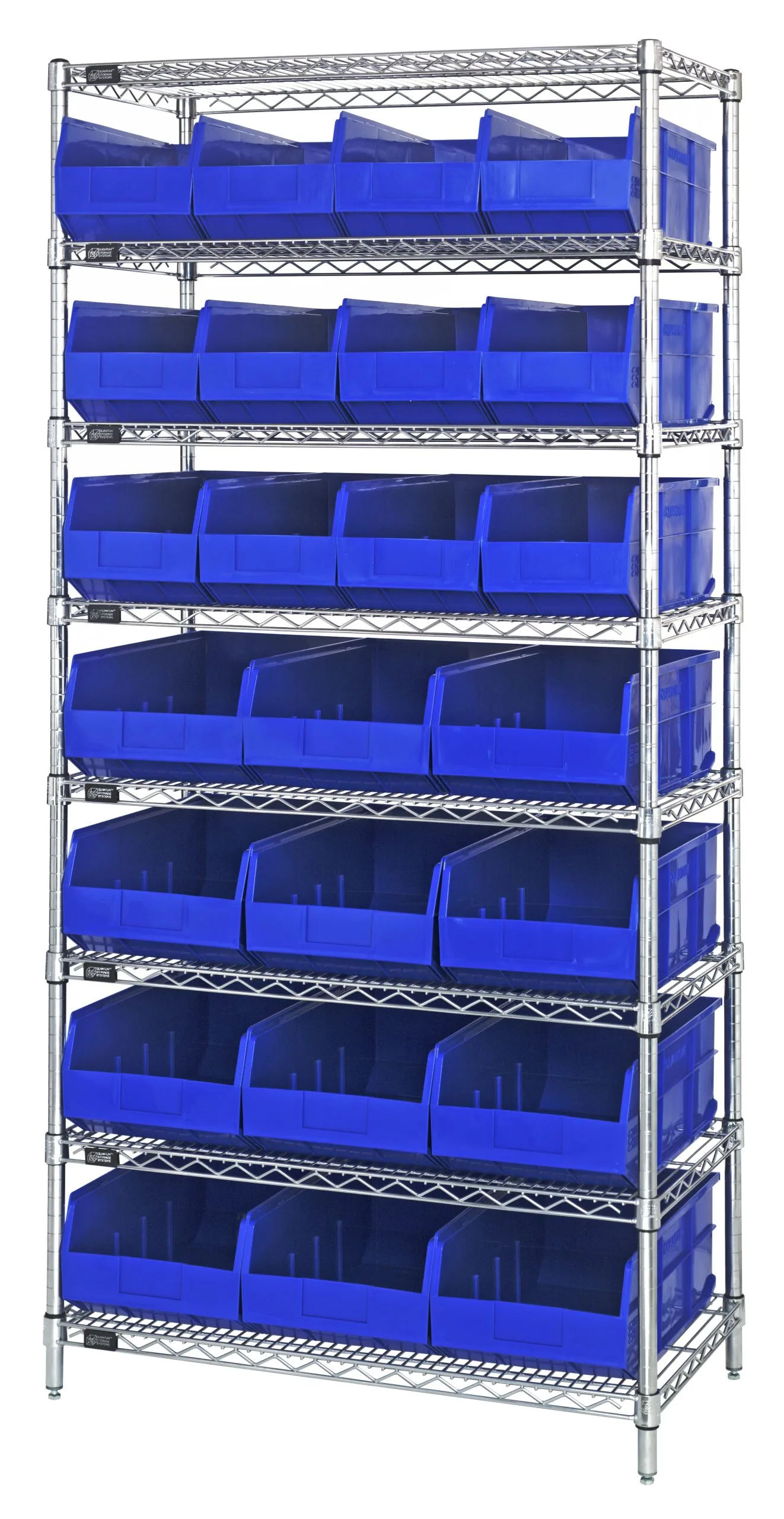
Total loaded weight is a carriage question too
Deck choice changes the tare weight of the system slightly and the payload substantially. A range of wire decks loaded with bins of fasteners can be far heavier than the same range of solid shelves holding folders. When you compare deck options, price the loaded weight per carriage as well as the shelf itself, because the loaded weight is what decides the carriage rating, the drive effort and, on mechanical-assist and powered systems, the drive selection.
Cleaning, inspection and the service life of a deck
Decks age differently. Open wire never accumulates dust on a flat top surface, but the wires themselves collect grime in a greasy or dusty environment and are awkward to wipe. Solid decks wipe in seconds and collect dust on every unused surface. Neither is maintenance-free, and the honest comparison is about which kind of cleaning your housekeeping routine actually performs.
Two failure modes are worth designing out at the deck stage:
- Overhang. Anything that projects past the front edge of a deck will eventually be crushed when the aisle closes. Divided record shelves with front stops, or bins sized to the deck, prevent this by design.
- Debris on the rail. Items that fall through an open deck land on the floor and then on the rail, which is the most common cause of rough travel. This is one of the checks in the preventive maintenance schedule for a mobile system.
Decks are also the part of the system most likely to be reconfigured. Levels get moved as contents change, and a system that is easy to re-space stays useful longer than one that is not. Ask, at quotation stage, how a level is adjusted and whether it can be done without unloading the adjacent range.

Choosing by room type
The fastest way to a defensible answer is to describe the room honestly and let the deck follow.
If your requirement is straightforward static shelving rather than a moving system, the general wire shelving and shelving pages cover those product families directly.
Frequently asked questions
Can wire shelving be mounted on mobile carriages?
Is wire or solid shelving better for a records room?
Does an open wire deck change the sprinkler design?
What finish should wire decks have?
How much weight can a shelf hold?
Can we mix deck types in one system?
Shop Wire Shelving Online
Free-standing wire shelving units ship from our online store. High-density mobile systems are engineered and installed to your room — request a quote for those.


Get a deck and layout recommendation for your room
Tell us what you store, how it is handled and what the room conditions are. We will specify the shelving, the decks and the finish, and lay out the system to fit.