
Home › Storeganizer › Case Studies › H.Essers
H.Essers — recovering pallet space and tidying up an operation
A logistics provider that set out to waste less space and pick more efficiently, and ended up with a stock room that is also easier to keep clean and easier to staff.

Pallet space
unlocked
Faster
order picking
Ergonomic
working height
Minimal
staff learning curve
The situation
| Project profile | |
|---|---|
| Industry | Logistics and distribution |
| Application | Supplementary stock room, mixed small-SKU storage |
| System | Storeganizer high-density textile pocket columns in existing pallet rack |
| Source | Results as reported by the operation and its Storeganizer manufacturer, KTP conTeyor |
H.Essers is a European logistics provider whose objectives going into this project were unusually plainly stated: waste less space, improve order picking, and end up with an operation that looks and stays tidier. The third objective sounds cosmetic and is not — in a shared or regulated warehouse, tidiness is a proxy for whether stock can be counted, found and audited.
The underlying constraint was the familiar one. Small items were consuming locations and floor that the business needed for pallets, and the picking process was paying for the sprawl.
What was installed
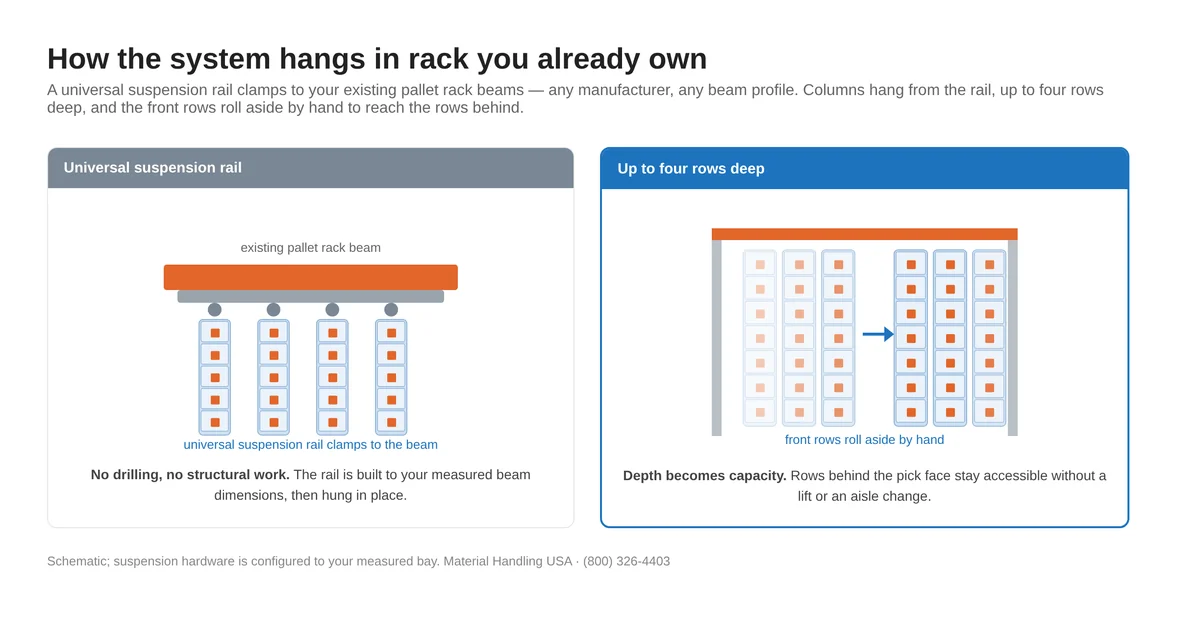
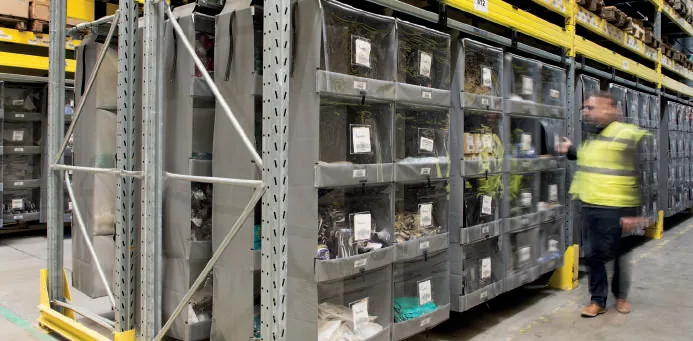
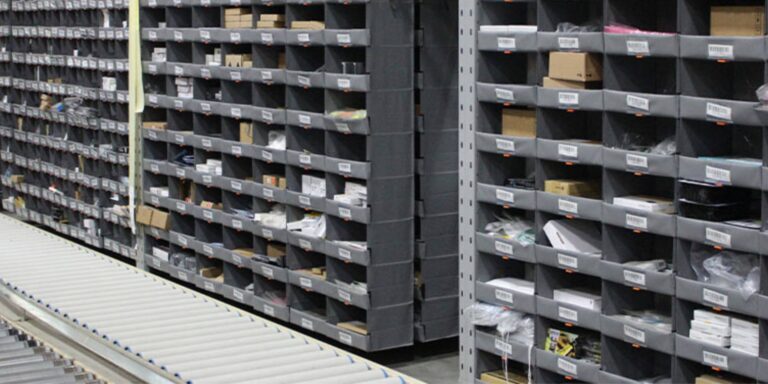
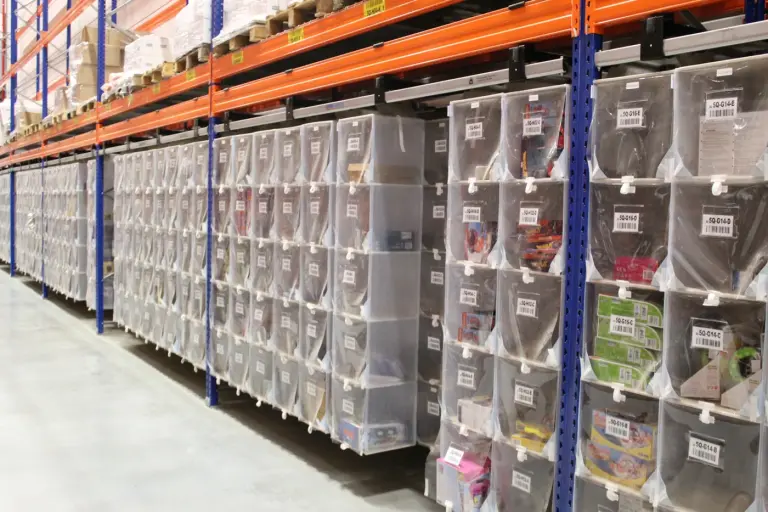
Storeganizer pocket columns were introduced to create supplementary stock room capacity inside the existing building. Alongside the columns, the project standardised packaging into uniform units and adopted a more compact storage approach — the two changes reinforce each other, because uniform packaging is what lets a pocket size be chosen confidently.
Order pickers reach products directly from the pocket face at working height. Nothing was drilled or built; the columns hang from existing rack beams, which is why this kind of project can be done in an operating warehouse.
Reported results
| Measure | Before | After |
|---|---|---|
| Pallet space | Consumed by small-item storage | Additional pallet space unlocked |
| Order picking | Baseline | Faster and more practical processes |
| Working conditions | Reaching into shelving and bins | Ergonomic benefits at the pocket face |
| Housekeeping | Mixed packaging, untidy zones | Orderly and consistently hygienic |
| Training | — | No steep learning curve for staff |
“I had no clue that such an efficient system to create supplementary stock room existed, offering a fitting degree of flexibility as well.”
There are no published percentages for this installation, so we are not going to publish any. The reported outcomes are qualitative: pallet space released, picking faster, conditions better, housekeeping improved, and no significant retraining required.
That last point is the one most often left out of storage business cases. A system that needs a week of training, a service contract and a software integration carries costs long after the invoice. Pocket columns have no moving parts, no power and nothing to learn beyond reading a label — which is a large part of why the transition did not disrupt the operation.
What this means for a US operation
Every warehouse is different, and a result reported elsewhere is evidence rather than a forecast. These are the transferable parts:
- Releasing pallet space is often the real return. Moving small items out of pallet positions gives the positions back to pallets.
- Standardise packaging alongside the storage. Uniform units make pocket sizing straightforward and density predictable.
- Count the training and maintenance cost. A maintenance-free system with no learning curve keeps delivering after the project closes.
The measured averages behind these cases — around 40% more usable space, 42% less travel time and 26% better picking efficiency — come from independent research at the University of Leuven, Belgium (2013), comparing Storeganizer with conventional rack and shelf. To see what the same arithmetic produces in your own bay, use the Storeganizer Designer or ask us to run the numbers with you.
Why this inventory profile suits pocket columns
The transferable part of any case study is the profile, not the logo. These are the characteristics that made this operation a good candidate — and they are the ones worth checking against your own inventory before you consider a conversion.
How a conversion like this runs
Four steps, and none of them involve construction. The sequence matters: the slotting analysis comes before the measurement, and the count comes before the order.
Profile the SKUs
We look at item size, stock depth and order frequency for the zone in question — the three properties that decide whether a pocket is the right home for a part.
Measure the bays
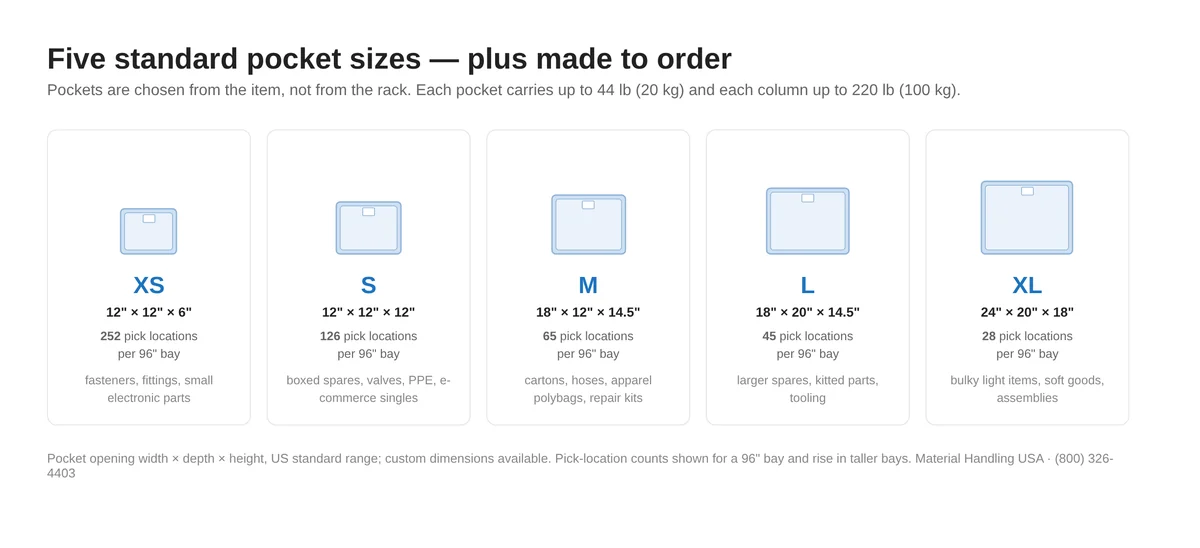
Inside width, inside depth, clear height and beam profile. The suspension rail is then manufactured to those dimensions.
Configure and count
Pocket sizes are selected per SKU group and the location count is calculated before anything is ordered.
Install and slot
Columns hang from existing beams in an operating warehouse — no drilling, no anchoring, no permit drawing — then stock is slotted in.
We handle all four in the United States, including the install. Because the system is maintenance free — no motors, no controls, no annual service contract — there is nothing scheduled after handover.
Questions about this project
What did H.Essers set out to achieve?
What were the reported outcomes?
Are there percentage figures for this project?
Why does packaging standardisation matter?
Related reading
 Spare parts and MRO storageGive every spare its own labelled pocket – up to 396 per pallet rack bay. Cut search time, duplicate purchasing and…
 Pallet rack space optimizationRecover the wasted cube in your small-item rack bays. Storeganizer converts half-empty shelving into up to 396 pick…
 Warehouse optimization servicesLearn how to optimize warehouse operations with tailored storage solutions. Discover effective strategies, key…
 All Storeganizer case studies and measured results8,611 sq ft consolidated into 1,335. Picking from 25-30 to 60-80 lines per hour. 4,000 SKUs in 16 bays. Attributed…
 Storeganizer high-density pocket storage overviewStoreganizer turns unused pallet rack into hundreds of small-parts pick faces – 40% more usable space, 42% less…
Could your rack do this?
Tell us the bay dimensions and the SKUs giving you trouble. We will come back with a configuration, a location count and an honest view of whether a conversion is worth it.