
Laboratory / Snorkel Arm Ventilation Systems
Advanced Laboratory Snorkel Arm Ventilation System
Nederman FX2 BenchTop extraction arms in 2″, 3″ and 4″ diameters — Original, CHEM and ESD/EX models with 360° joints, ceiling, wall, bench and drop-ceiling mounting, and combi, dome or metal capture hoods. Specified, supplied and installed by Material Handling USA.

3
Arm models: Original, CHEM, ESD/EX
2″–4″
Arm diameters
30–265
CFM per arm
360°
Rotation on the two outer joints
Capture the Fume Where It Starts
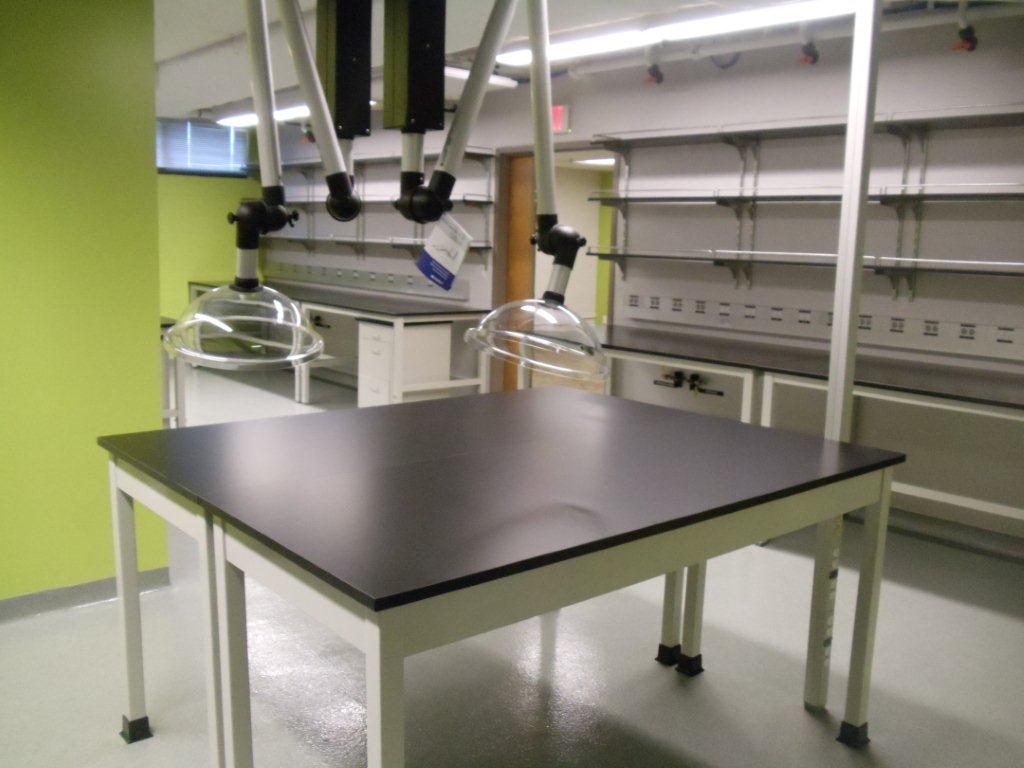
A laboratory snorkel arm — also called an exhaust snorkel, extraction arm or fume arm — is an articulated duct you position directly over the operation making the contaminant. Because the hood sits inches from the source, it removes smoke, fumes, gases, vapors and fine dust before any of it reaches the breathing zone, and it does that on a small fraction of the exhaust air a fume hood needs.
That is the whole argument for arms. On most lab projects we see, the fume hoods are already installed, the exhaust fan is already sized, and the problem is the six or eight bench operations that never fit inside a hood: a hot plate, a stereo microscope, a soldering station, a balance weighing powder, a 3D printer, a staining tray. Adding hoods for those means new exhaust and new make-up air. Adding arms usually means a branch duct and 65–140 CFM each.
Material Handling USA supplies Nederman FX2 BenchTop arms — the Original, CHEM and ESD/EX models — along with the hoods, brackets, extension profiles, dampers, fans and controls that make them a working system. We stock the common configurations, quote the accessories with the arm instead of after it, and install throughout the Mountain West from Salt Lake City.
Three Arm Models — Pick by Environment, Not by Price
All three share the same aluminum construction, 360° outer joints and mounting accessories. What changes is what the joints, connectors and profiles are made of, which is exactly what determines how long the arm survives in your room.
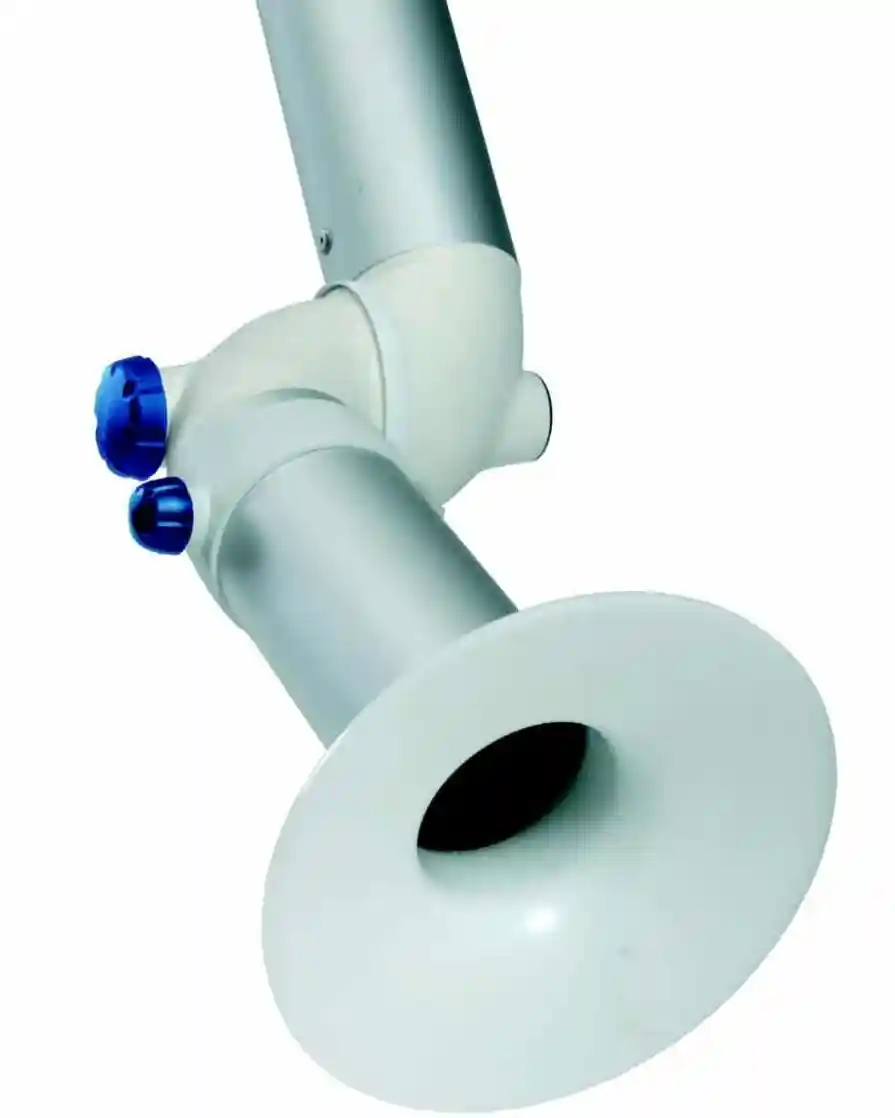 FX2 Original — General Lab & Shop WorkThe all-round arm for general fumes, vapors and dust where there is little risk of electrostatic discharge or attack by aggressive chemicals. Anodized aluminum tubes, PP friction joints, EPDM rubber duct connector and a molded mini hood. Available in 2″, 3″ and 4″ (50, 75 and 100 mm) diameters. This is the model most schools, general chemistry labs and light-industrial benches end up with.
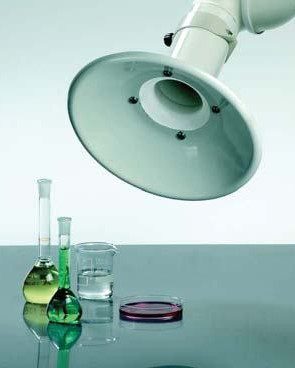 FX2 CHEM — Corrosive & Aggressive FumesProfiles in double anodized aluminum for fume extraction in corrosive environments — acid digestion, solvent handling, staining and histology benches, plating and etch work. Offered in 3″ and 4″ (75 and 100 mm) diameters only. Pair it with a CHEM-rated combi, dome or metal hood so every wetted surface in the capture path is corrosion resistant.
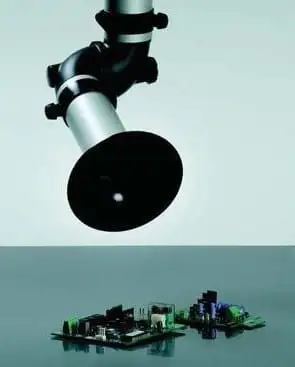 FX2 ESD/EX — Electronics & Classified AreasConductive PP joints, a conductive EPDM duct connector and a conductive mini hood dissipate static so the arm can be used at ESD-protected workstations. Nederman recommends the ESD/EX arm for certain applications in potentially explosive atmospheres — zones 1, 2, 21 and 22. Available in 2″, 3″ and 4″ diameters.
Not sure which arm your bench needs?
Tell us what happens at the bench — solvent, acid, powder, solder, heat — and we will specify the model, diameter, arm length and hood, then quote the mounting accessories with it so nothing shows up missing on install day.
Diameter, Airflow and Arm Length
Two numbers drive the selection: the diameter, which sets the airflow range the arm is designed around, and the arm length, which sets how far the hood reaches from its mounting point.
| Arm | Diameter | Airflow range | Models available | Typical use |
|---|---|---|---|---|
| FX2 50 | 2″ (50 mm) | 30–65 CFM (50–110 m³/h) | Original, ESD/EX | Soldering, small powder handling, single-point capture |
| FX2 75 | 3″ (75 mm) | 65–140 CFM (110–240 m³/h) | Original, ESD/EX, CHEM | The general-purpose lab bench arm — most common choice |
| FX2 100 | 4″ (100 mm) | 120–265 CFM (200–450 m³/h) | Original, ESD/EX, CHEM | Larger sources, higher heat, wider capture hoods |
Arm Lengths and Working Radius
Working radius is measured from the mounting point to the hood with the arm extended. A cut2fit extension profile is added separately to set the mounting height, so reach and drop are specified independently.
| Arm length | Max. working radius | What it suits | Example model |
|---|---|---|---|
| L700 | Approx. 2′4″ | Short reach — single fixed operation at the bench | FX2 50 ESD/EX (e.g. 70601244) |
| L1100 | 42.9″ (1,090 mm) | One workstation, arm parked back against the wall or bench | FX2 75 Original Up-Low 70602344 |
| L1500 | 57.1″ (1,450 mm) | Reaches across a deeper bench or two adjacent positions | FX2 75 Original Up-Low 70602744 |
Sizing rule of thumb
Put the hood within roughly one hood diameter of the source and the arm does its job at the low end of its airflow range. Every inch you move it away costs airflow — and a bigger fan. If an operator cannot easily reposition the hood, they will stop using it, which is why arm length and mounting height matter as much as CFM.
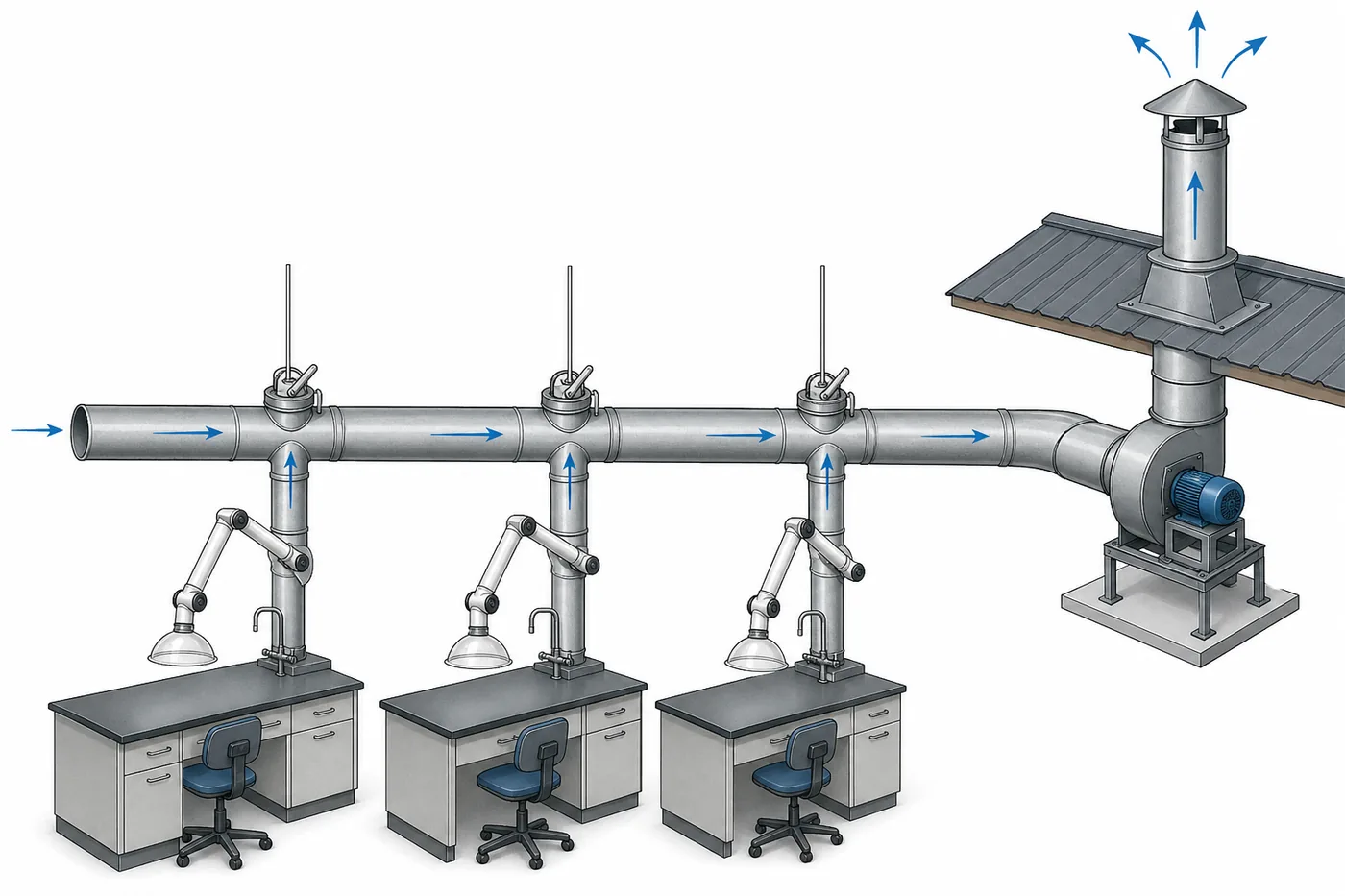
Balancing a Multi-Arm Run
Every arm is supplied with a manual damper. On a run of four or six arms on one fan, that damper is how the last arm on the branch ends up pulling the same air as the first. Skipping the balance step is the single most common reason a new installation “does not work” even though every component is correct.
Because the FX2 airflow path was developed with computerized flow simulation, the arms need less static pressure than older designs, so a smaller fan usually covers the same number of stations — less energy and less noise in the room.
Capture Hoods
The hood is what actually captures the contaminant, and swapping it is the cheapest way to fix a marginal installation. All three extended hoods fit the 50, 75 and 100 mm arms.
 Combi HoodA transparent PET-G hood that captures contaminants at low energy and low airflow, and can be fitted to any FX2 arm. Part 70500144 for Original arms, 70500344 for CHEM arms. The right choice when you want a wide capture area right over a small bench operation without cranking up the fan.
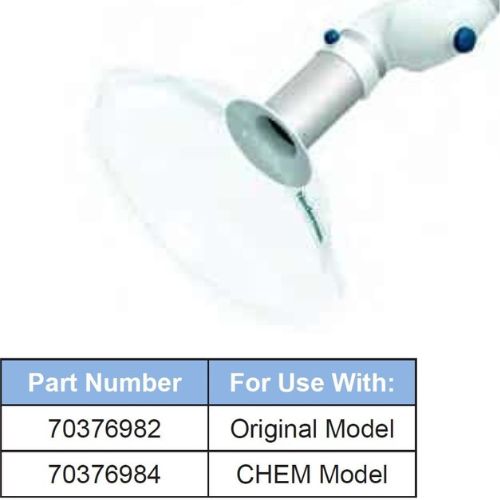 Dome HoodThe transparent dome hood is the most commonly specified option: excellent visibility of the work, easy to move, and well suited to high-dispersion contaminants that rise off the bench. Part 70376982 for Original arms, 70376984 for CHEM arms.
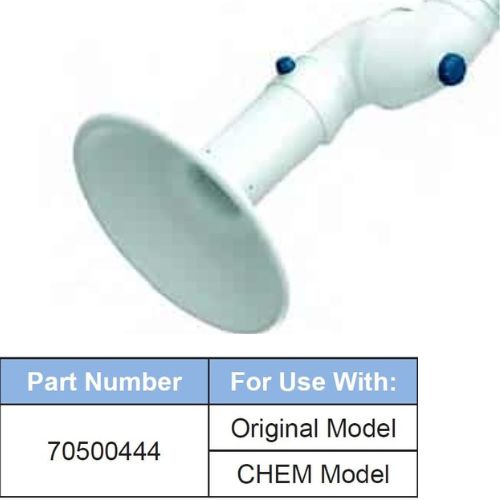 Metal HoodPowder-coated aluminum hood for aggressive fumes, higher fume temperatures and abrasive dust, with good corrosion resistance and no risk of crazing or cracking a clear plastic shell. Part 70500444 fits both Original and CHEM arms.
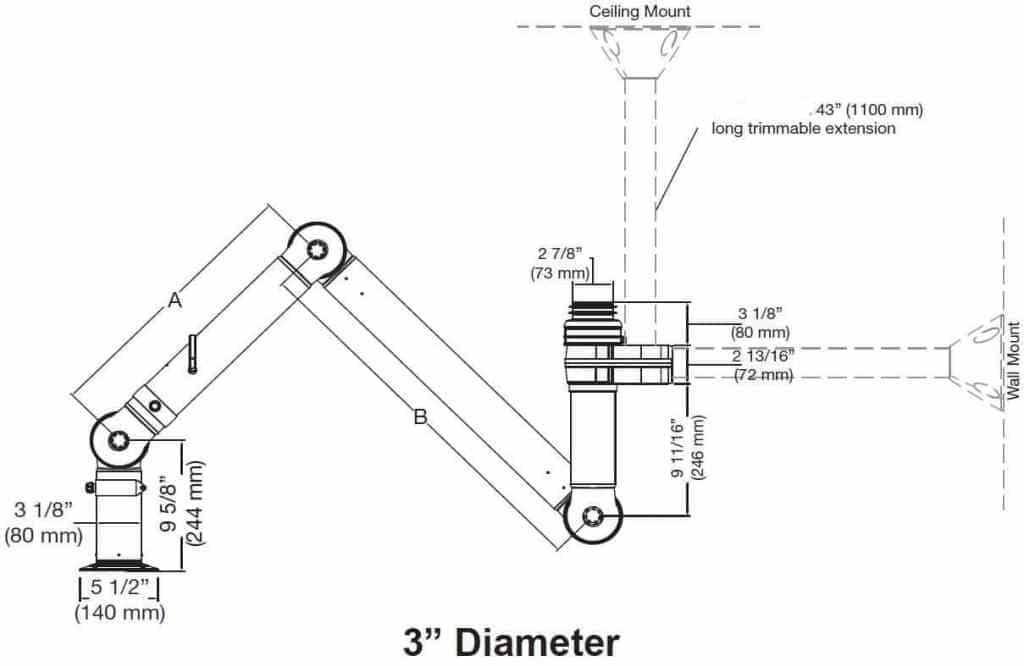 Mini Hood (Supplied With Every Arm)Every FX2 arm ships with a molded mini bell-mouth hood, so an arm works out of the box when you can get the inlet within a few inches of the source. Extended capture hoods are added only when the source sits farther away or spreads across the bench.
- Transparent hoods when the operator needs to see through the capture zone
- Metal hood for aggressive fumes, high temperatures and abrasive dust
- CHEM-rated hood part numbers whenever the arm is a CHEM arm
- Stainless mesh guard where dropped items could be pulled into the duct — teaching labs above all
- Mini hood alone is enough when the inlet can sit within a few inches of the source
Mounting Options for Any Lab Configuration
Arms are ordered in one of four connection configurations. Choosing the right one at order time is what keeps the duct out of the operator’s way and off the bench.
| Configuration | Duct connection | Mounts to | Why you would choose it |
|---|---|---|---|
| Up-Low | Duct connection up | Ceiling, wall, shelf edge | The standard lab install: arm hangs below, duct runs up into the ceiling or along the wall |
| Up-PLUS | Duct connection up, extended swivel | Ceiling or wall with the PLUS cover plate | Higher mounting point and a cleaner ceiling penetration |
| Down-Low | Duct connection down | Bench edge, floor, any horizontal surface | Bench-bracket mount where there is no ceiling structure to use |
| Down-Through | Duct connection down through the worktop | Through the bench | Lightest configuration; duct is hidden under the bench and out of the way |

Drop Ceilings and Tall Ceilings
Most laboratory retrofits have a suspended grid ceiling and no exposed structure to hang from. The fix is the cut2fit extension profile: an aluminum extrusion supplied in L1100 and L2200 lengths that is cut to length on site, coupled to the classic bracket, and dropped through the grid. A ceiling cover plate then closes the opening around the profile and the duct so the penetration looks finished.
On a high open ceiling, the same profile lets you bring the arm down to a usable height instead of mounting the whole assembly out of reach. For benches against a wall with no ceiling access at all, the wall brackets and the Up-PLUS configuration give you the same result off the wall.
Bench-mounted arms use either the bench bracket kit at the worktop edge (Down-Low) or a Down-Through arm that drops the duct straight through the top and runs it under the bench — the lightest and tidiest option when the bench is being built or replaced anyway.
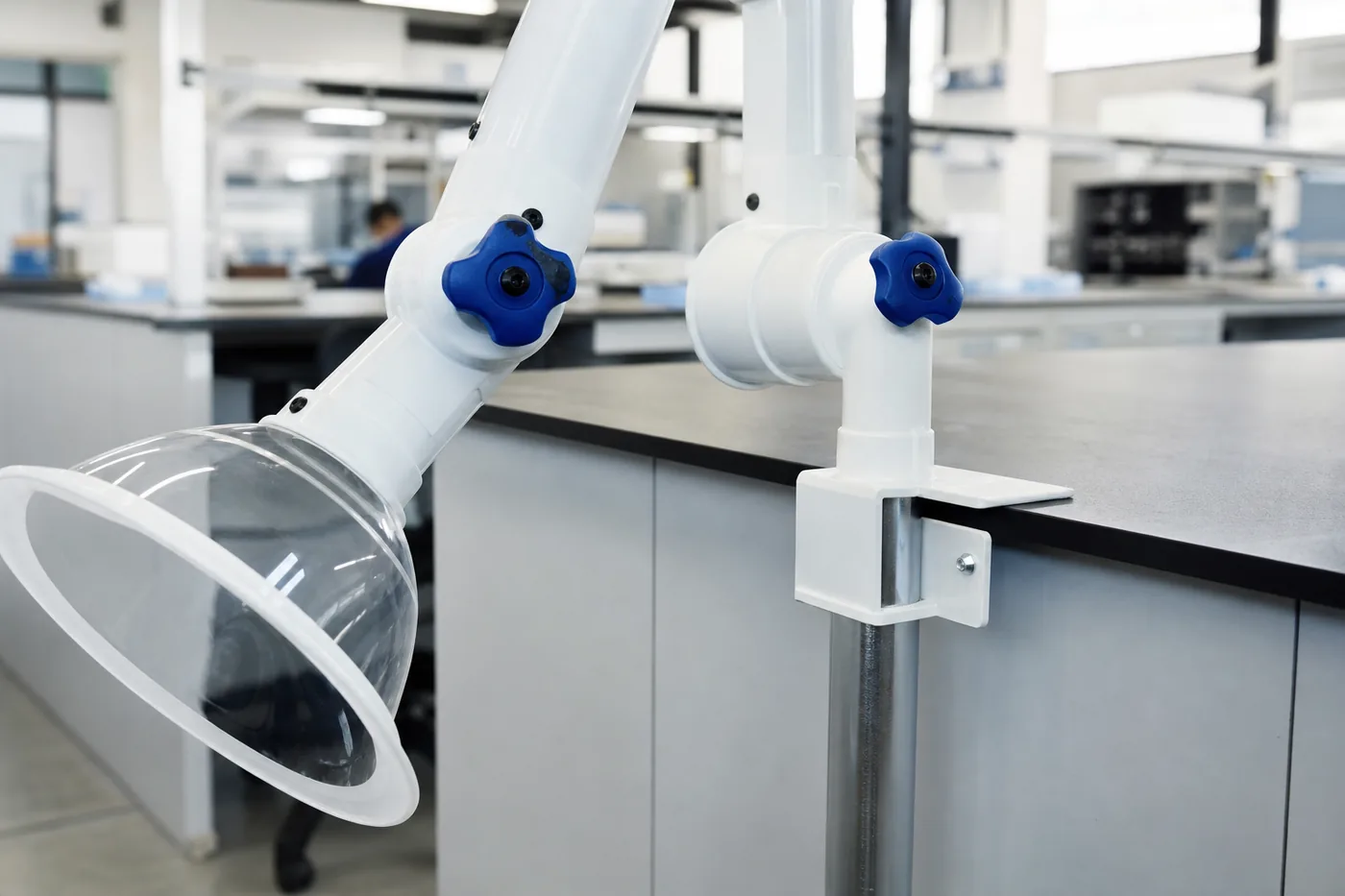
Bench-Edge and Through-Bench Installs
Bench mounting keeps the arm entirely within the workstation, which matters on islands and in rooms where the ceiling belongs to the mechanical contractor. The trade-off is that the duct has to be run in the bench cabinet or along the floor, so it is a decision to make before casework is installed rather than after.
Send us your ceiling and bench photos
Ceiling type, ceiling height and bench depth decide the mounting configuration and the extension length. Photos plus a rough floor plan are enough for us to quote the arms, brackets and extensions correctly the first time.
Snorkel Arm Specifications
Published Nederman FX2 BenchTop data. Exact figures vary by diameter, length and configuration — we confirm the specific model on every quote.
| Item | Specification |
|---|---|
| Arm construction | Tubes in anodized aluminum with three adjustable composite friction joints |
| Maneuverability | The two outermost joints rotate and swivel through 360°; the hood locks in place with the friction devices in the joints |
| Joints / connectors | Original: PP joints, EPDM rubber duct connector, PP mini hood. ESD/EX: conductive PP joints, conductive EPDM connector, conductive mini hood. CHEM: double anodized aluminum profiles |
| Maximum fume temperature | 158°F (70°C) |
| Noise level | 58 dB(A) at 140 CFM (FX2 75 Original); 60 dB(A) at 65 CFM (FX2 50 ESD/EX) |
| Weight | Approx. 2.6–10.4 lbs depending on diameter, length and mounting configuration |
| Damper | Manual damper supplied with the arm for balancing airflow branch by branch |
| Installation | Indoor; ceiling, wall, shelf, floor, bench edge or through the bench |
| Certifications | CE on all models; ESD and EX certification on the ESD/EX arms |
Common Mounting Accessories
These are the parts that are most often left off a competing quote and then show up as a change order. We list them explicitly.
| Accessory | Part number | What it does |
|---|---|---|
| FX-Classic bracket — D50/75/100 | 70501244 | Used with the cut2fit extension to mount an arm to a ceiling, wall, floor or other horizontal surface |
| FX-Cut2fit extension — L1100 | 70501344 | Aluminum profile cut to any length on site — the answer for tall and drop ceilings |
| FX-Cut2fit extension — L2200 | 70374600 | Longer profile for high-bay and tall lab ceilings |
| FX-Ceiling cover plate | 70502644 | Covers the false/dropped-ceiling opening made by the extension profile and ducting |
| FX2-Ceiling cover plate-PLUS | 70377045 | Cover plate for the Up-PLUS mounting configuration |
| FX2-Bench bracket kit — D50/75/100 | 70501444 | Complete kit for mounting an arm to the edge of a bench |
| FX-Bracket kit — D50/75/100-L190 | 70501144 | Short bracket kit for wall or ceiling mounting |
| FX2-Wall BRKT kit — Flat-L190-White | 70377043 | Flat white wall bracket for a finished look |
Shop Online at MaterialHandling-USA.com
Arms, hoods and lab ventilation accessories are also available with published pricing on our online store, and each product page carries the full Nederman leaflet.
Where Lab Snorkel Arms Earn Their Keep
Six applications account for most of the arms we ship. In every one of them, the alternative was either an oversized fume hood or nothing at all.
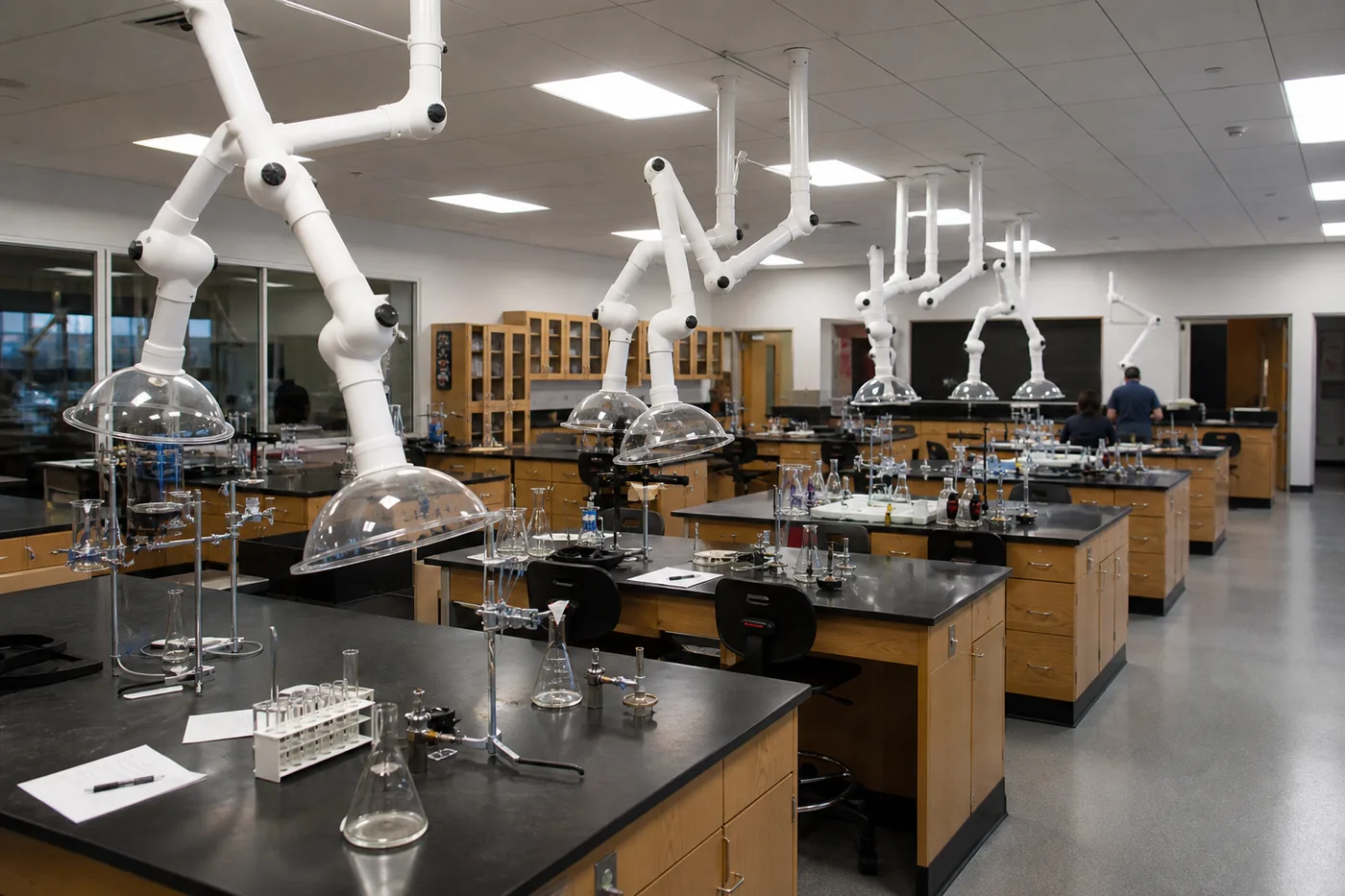 Schools, Colleges & Teaching LabsThe highest-volume application we quote. Arms are dropped from the ceiling on a trimmable extension over each student bench, so a whole class can work with solvents, burners or 3D printers without needing a fume hood per station. Stainless mesh guards keep dropped items out of the duct — a real concern with teenagers in the room.
 Pharmacy & CompoundingPowder handling, weighing and reconstitution generate fine airborne dust that a room exhaust never catches. A 2″ or 3″ arm placed just above the operation captures it at the source at 30–140 CFM, which is a fraction of the exhaust a hood consumes.
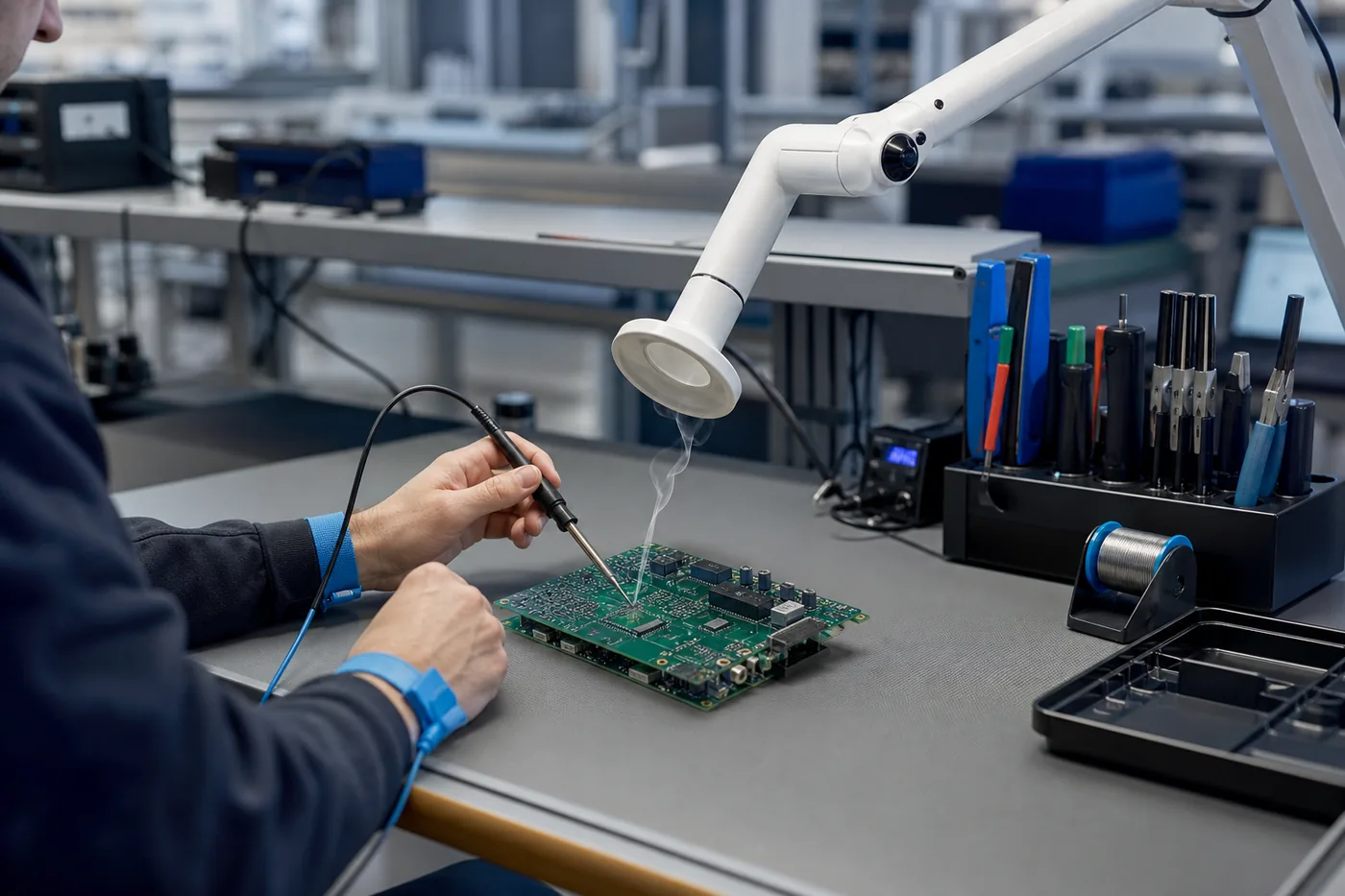 Electronics, Soldering & 3D PrintingSolder flux fume, adhesive vapor and additive-manufacturing emissions are point sources. The ESD/EX arm dissipates static at the bench so it can sit inside an ESD-protected area, and the slim profile keeps sightlines to the work clear.
 Clinical, IVF & Research LabsStaining, fixatives, xylene and formalin work benefit from local capture instead of pushing the whole room through a hood. See our page on lab snorkels for IVF applications for how this plays out in a sensitive clinical environment.
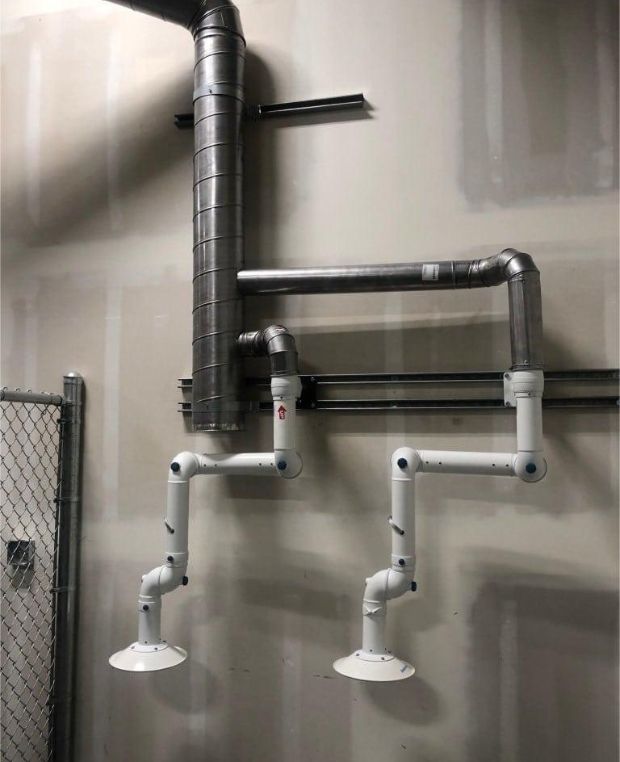 Chemistry & QC LaboratoriesWall-mounted CHEM arms tied into spiral duct, positioned over hot plates, rotary evaporators and sample-prep stations that live outside the fume hood. Corrosion-resistant profiles and hoods matter here because the capture path sees the fume before it is diluted.
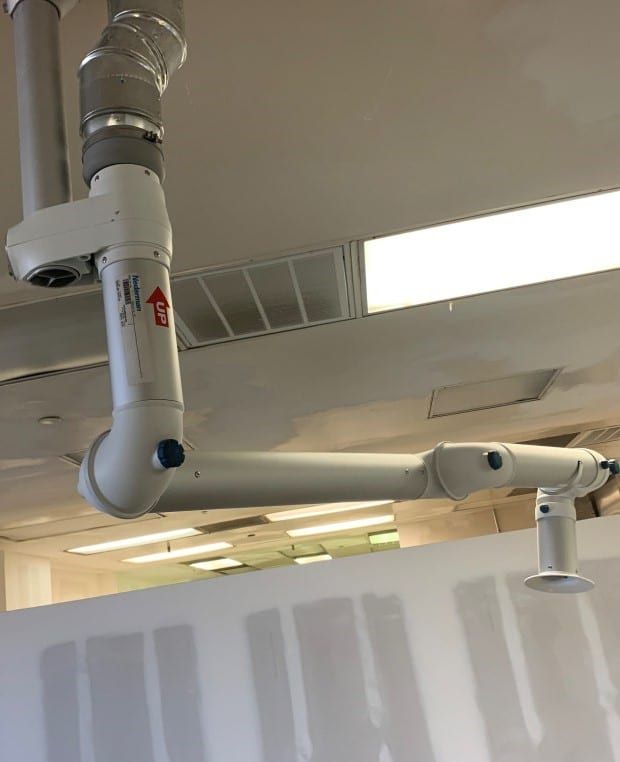 Drop-Ceiling RetrofitsExisting labs rarely have exposed structure to hang from. The cut2fit extension profile is trimmed to length on site, dropped through the ceiling grid, and finished with a ceiling cover plate so the penetration looks intentional instead of improvised.
How a Snorkel Arm Project Runs
Tell us the operations
List what happens at each bench — solvent, powder, solder, heat, acid — and roughly how often. That decides model, diameter and hood, not the catalog price.
Measure the space
Bench depth, ceiling height, ceiling type (exposed structure or grid), and whether an exhaust riser already serves the room.
We configure and quote
Arm model, diameter, arm length, connection type, hood, brackets and extension profile — plus fan, duct and controls if you want the whole scope in one number.
Install and balance
Arms are mounted, ducted and the manual dampers are balanced branch by branch so the last arm on the run pulls as well as the first.
What the Arms Do Not Include
Being direct about scope saves everyone a change order. An arm is supplied with its mounting bracket, a leak-proof rubber duct connector, a manual damper and a mini hood. It does not include the branch or main duct, the exhaust fan or filter unit, fan controls, the roof curb or discharge stack, or the electrical work. Those are either in your mechanical contractor’s scope or quoted by us as a separate line — tell us how the project is bid and we will format the quote to match.

Codes, Standards and Honest Limits
Local exhaust ventilation for laboratories is governed by your authority having jurisdiction and by the consensus standard your engineer of record designs to — in US labs that is normally ANSI/AIHA/ASSP Z9.5, alongside OSHA’s laboratory standard at 29 CFR 1910.1450 and NFPA 45 for fire protection in labs handling chemicals. Equipment selection supports compliance; it does not create it.
So we will say plainly what an arm is and is not. It is an excellent local-capture device for a point source an operator can position the hood over. It is not containment, it has no sash, and it has no face velocity to certify. If the hazard requires containment, the answer is a fume hood, and we would rather quote you the right thing than the cheaper thing.
Maintenance
Arms are mechanical and they do wear. Once a quarter, check the friction joints for drift, confirm the hood still stays where it is put, look at the duct connector for cracks or chemical attack, and clean any mesh guard. Once a year, verify airflow at each hood with the dampers as balanced — a slowly clogged filter or a closed damper somewhere on the run is the usual cause of a complaint that “the arms stopped working.”
Recent Laboratory Snorkel Arm Projects
A sample of the exhaust snorkel work we have shipped and installed:
- Chemical laboratory, corrosion-resistant arms: a chemical lab needed chemical-resistant arms on short notice. Two CHEM arms were wall mounted and tied into new spiral duct above the sample-prep bench so the station could be used without waiting on a hood.
- School laboratory, summer shutdown: a contractor asked how fast lab exhaust snorkels could ship for a school. Stock arm configurations and cut-to-length extension profiles are exactly what makes that kind of schedule possible.
- Pharmaceutical laboratory, bench capture: weighing and reconstitution steps were moved off overloaded fume hoods and onto arms, freeing hood capacity for the work that genuinely needed containment.
- Clinical laboratory, staining bench: arms placed over fixative and staining trays so solvent vapor is captured at the tray instead of migrating through the room.
Laboratory Snorkel Arm FAQs
What diameters do laboratory snorkel arms come in?
How far does a snorkel arm reach?
What are the mounting options for a lab snorkel arm?
Does a snorkel arm include a fan, ductwork or the HVAC connection?
Can a snorkel arm replace a fume hood?
How much exhaust air does a snorkel arm use compared to a fume hood?
Which arm do I need for corrosive fumes?
Are these arms safe to use in a classified or ESD area?
How loud is a snorkel arm installation?
Can arms be added to a lab that is already built?
Related Lab Ventilation Products & Resources
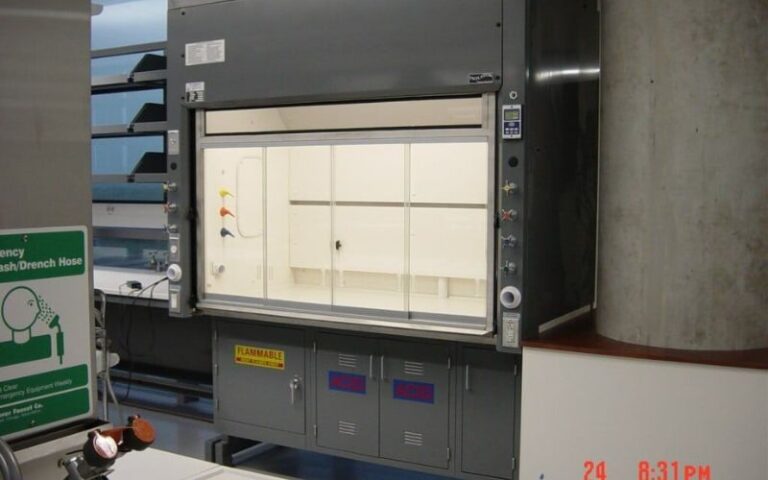 Fume Extraction Systems for LaboratoriesHow arms, hoods, fans and filtration fit together into one lab exhaust system.
 Laboratory Fume HoodsBench-mounted and walk-in hoods for work that needs containment rather than local capture.
 Movex ESD Snorkels & Extraction ArmsAn alternative arm family for ESD benches, aseptic filling and food-grade work.
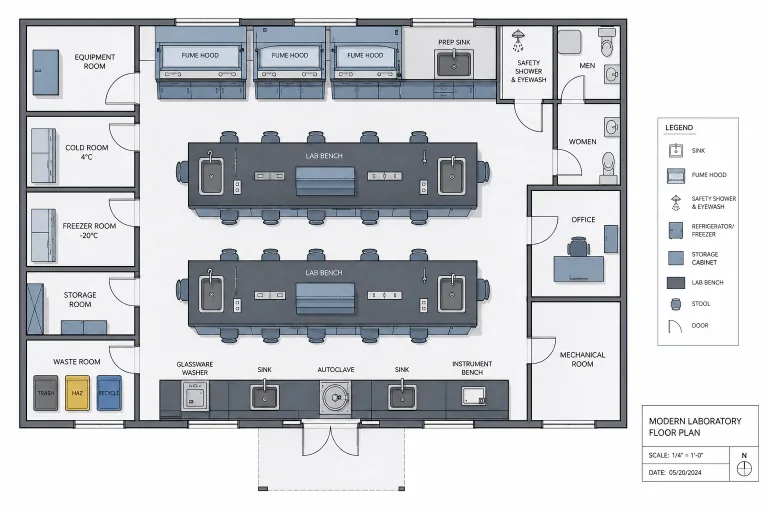 Lab Layout ConfiguratorLay out benches, hoods and extraction points yourself and send the plan to our team.
 Laboratory BenchtopsEpoxy, phenolic and stainless work surfaces — the bench your arms mount to.
Get a Quote on Laboratory Snorkel Arms
Tell us what happens at each bench, your ceiling type and your bench depth. We will come back with the arm model, diameter, length, hood and mounting accessories — and the installed price. Call (800) 326-4403 or request a quote online.