
Off-Site Records Storage or an On-Site High-Density Room?
Storing boxes off-site is a recurring cost that never ends; a high-density room is a one-time cost that consumes floor area. Here is how to compare them with your own numbers instead of a sales claim.

1.2 cu ft
Volume of the standard letter/legal records carton
Per cu ft
How off-site storage is normally priced
Retrieval
The cost line most comparisons forget
Exit terms
Check before you plan a return
Two different kinds of cost, not two prices
Almost every organization that stores paper eventually holds this argument. One side points at an
invoice for off-site storage that has quietly grown every year. The other points at the floor area a
records room would consume, and at a capital request nobody wants to write. Both are describing real
costs, but they are different kinds of cost, and comparing them as if they were the same number
is why the decision so often stalls.
Off-site storage is a recurring operating cost, usually priced per cubic foot per month, with separate
charges attached to activity: retrieval, delivery, refile, permanent removal, and sometimes destruction.
It scales smoothly, it needs no capital approval, and it never ends. An on-site room built around
high-density mobile shelving is a capital cost with a long life, and after it is paid
for the marginal cost of another box is close to zero — until the room is full, at which point the
next box is very expensive indeed.
Neither option is automatically right. What follows is a method for making the comparison with your own
volume, your own retrieval rate and your own building, so the answer is defensible rather than
rhetorical.
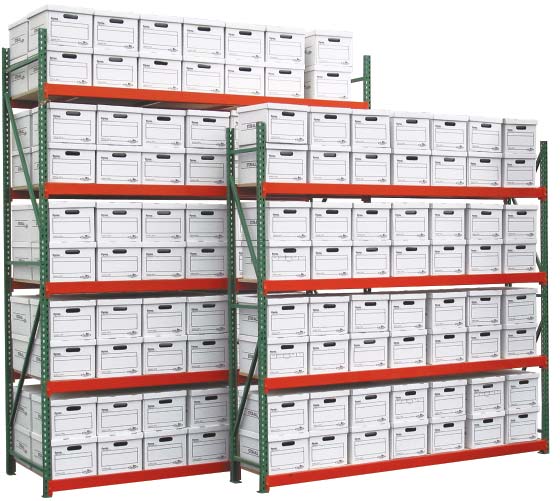
Step one: convert everything to cubic feet
Off-site storage is priced in cubic feet, shelving is bought in linear feet of shelf, and internal
debates are usually held in boxes and filing cabinets. Convert all of it to one unit before comparing
anything.
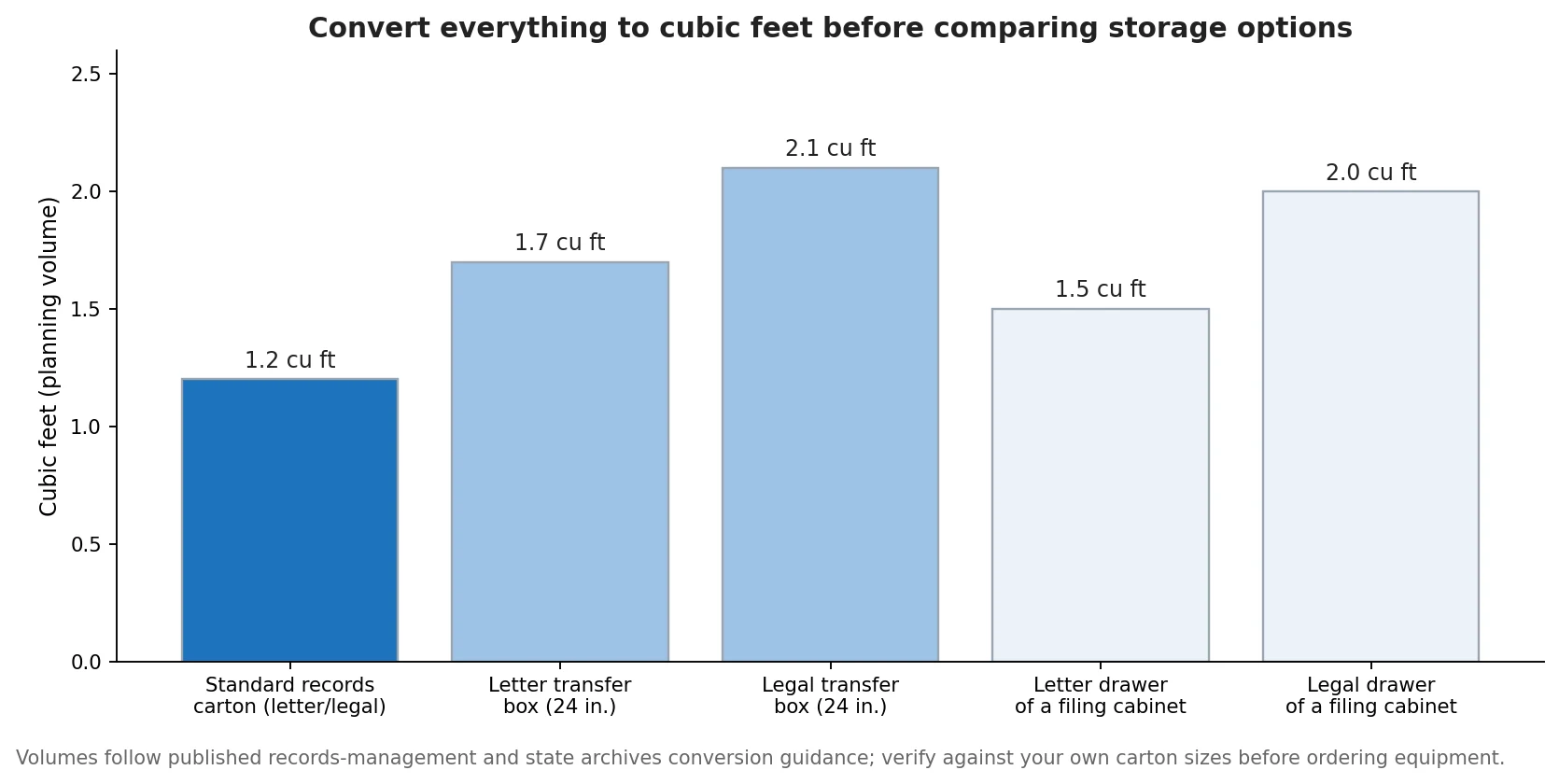
Published records-management and state archives conversion guidance gives the standard figures. A
records center box measuring roughly 15 by 12 by 10 inches is treated as one cubic foot; the same
letter/legal carton is commonly billed at 1.2 cubic feet in the commercial records industry because of
its external dimensions when full. A 24-inch letter transfer box runs about 1.7 cubic feet and its legal
equivalent about 2.1. On the office side, a letter-size filing cabinet drawer is about 1.5 cubic feet and
a legal drawer about 2. Shelf files convert at roughly 0.8 cubic feet per linear foot for letter size and
about 1 cubic foot per linear foot for legal.
Watch the billing definition
Commercial records centers do not all define a carton the same way, and some bill oversized boxes at a rounded-up volume. Before you use an invoice as the baseline for a capital comparison, confirm what volume you are actually being charged for, and whether the total includes activity fees or storage alone.
Step two: be precise about what differs
Once the volume is common, the differences that matter are operational rather than dimensional.
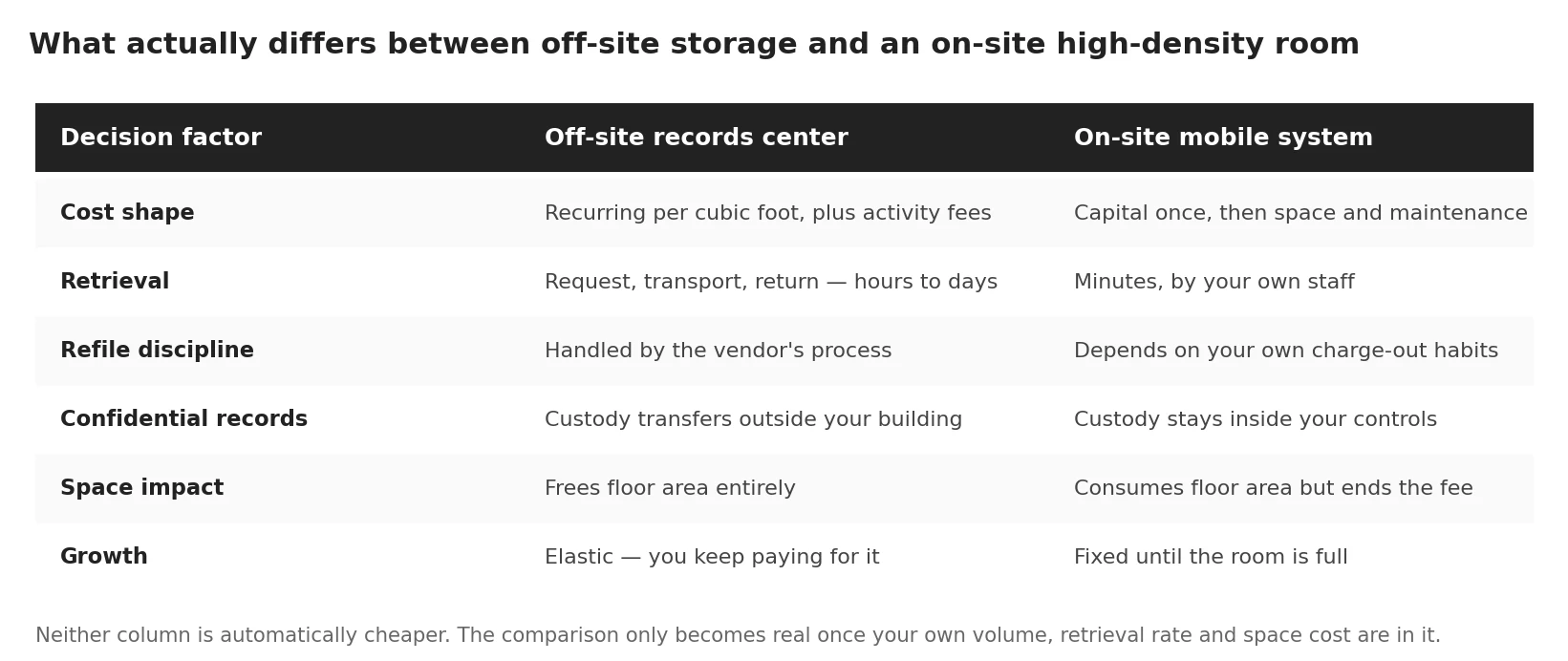
Two of those rows deserve expanding, because they are where most comparisons go wrong.
Retrieval. Off-site storage is cheap to hold and expensive to touch. If your
organization retrieves a handful of files a year, that trade is excellent. If departments request boxes
weekly — and legal, HR, finance and clinical functions usually do — the activity charges plus
the delay start to dominate. Count actual retrievals over twelve months before assuming your own rate; it
is almost always higher than people estimate.
Custody. For confidential material, moving boxes off-site moves custody outside your
own controls and adds a transport leg to every request. That is manageable with a competent vendor and a
written agreement, but it is a governance decision, not a storage decision. Where records are sensitive,
the ability to keep everything behind your own access controls often matters more than
the monthly rate.
Step three: build the comparison honestly
A defensible comparison has five inputs on each side and one shared assumption: how long you intend to
keep the records. Retention length is what turns a monthly fee into a real number.
| Input | Off-site side | On-site side |
|---|---|---|
| Volume | Billed cubic feet today, plus projected growth | Same volume, converted into shelf levels and range lengths |
| Recurring cost | Storage fee per cubic foot over the retention horizon | Maintenance, plus the value of the floor area consumed |
| Activity cost | Retrieval, delivery, refile and permanent-removal charges | Staff time to walk to the room and refile properly |
| One-time cost | Intake and any transfer charges | Equipment, floor preparation, installation and phasing |
| Risk | Vendor dependency, transport, access delay | Room fills; building constraints limit expansion |
Three practical cautions. First, do not compare a fully loaded capital estimate against a
storage fee that excludes activity charges — get the whole invoice history. Second, do not credit
the on-site option with space you do not actually have; if the room needs building, that is a
construction project, and the comparison changes. Third, include the purge. Most collections contain
material that is already eligible for disposition, and destroying it is cheaper than storing it anywhere.
Our cost and budget drivers page breaks down what actually moves the capital number on
the on-site side, from storage height to floor work to drive type.
A worked example of the method (with your numbers, not ours)
The arithmetic is simple once the inputs are real. Work through it in this order and keep every figure
sourced to something you can show a finance reviewer.
Count the volume
Billed cubic feet from the current invoice, plus anything still held internally converted at the standard rates. Note how much of it is already past retention.
Count the activity
Twelve months of retrieval, delivery, refile and permanent-removal charges. This is the line that decides most comparisons and the one people guess at.
Set the horizon
The years the surviving records must be kept under the retention schedule. Monthly fees only become a comparable number once they are multiplied by that horizon.
Price the room
Equipment sized to the surviving volume, plus floor preparation, installation and phasing — then add the value of the floor area it occupies.
Compare, then sensitivity-test
Re-run it with a 20% higher growth rate and with a 20% larger purge. If the answer flips, the decision is being driven by an assumption rather than by the data.
The purge is the highest-return step in the whole exercise
Volume is the multiplier on every line in the comparison — storage fees, equipment size, floor loading and room area all scale with it. Disposing of records that are already eligible reduces every one of those at once, and it is the only step that costs almost nothing to start.
If you decide to bring boxes back
Repatriating a collection is a project in its own right, and the order matters more than the schedule.
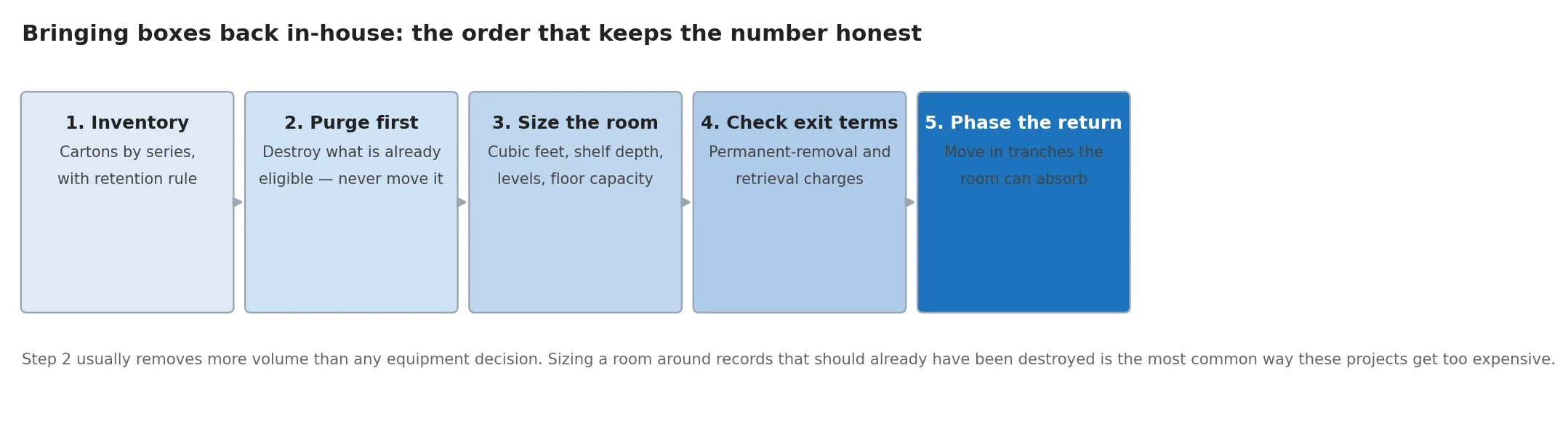
- Inventory by series, not by box count. You need to know what is in the cartons and which retention rule applies before you can decide what comes back.
- Purge before you move. Anything eligible for destruction should be dispositioned where it sits — never pay to transport and then store it.
- Read the exit terms. Permanent-removal or withdrawal charges are common and are usually billed per carton. They can be a material part of the project cost and belong in the business case from the start.
- Size the room to the surviving volume. Convert to cubic feet, then to shelf levels at a realistic fill rate. Planning to 100% fill leaves nowhere to file next year.
- Phase the return. Bring material back in tranches the room and the staff can absorb, with indexing done as it lands rather than afterwards.
Indexing is the hidden cost
Boxes come back with the vendor’s location labels, which are meaningless in your building. Budget the labour to re-index into your own scheme as the material arrives — retrofitting an index onto a full room later costs several times more.
What the on-site room actually has to support
An on-site high-density room is only cheaper if the building can carry it without construction. Four
questions decide that, and all four should be answered before a capital number is quoted.
Detail on each: floor load requirements,
sprinkler, lighting and HVAC coordination, shelf depth and level spacing,
and, for a room that is already occupied, retrofitting into an existing building. The
installation process page covers what site readiness looks like once the decision is
made. Where the collection is genuinely static and the room is generous, plain
records storage shelving may be the better answer — density is only worth paying
for when floor area is scarce.
When off-site storage is still the right answer
It often is, and a supplier who tells you otherwise is selling rather than advising. Off-site storage
tends to win when the collection is genuinely dormant and rarely retrieved; when the retention horizon is
short enough that the fees never accumulate into a capital equivalent; when your building has no floor
capacity, no room, or a lease shorter than the equipment life; when the volume is volatile and you need
elasticity; or when a specialist environment — vault storage, disaster recovery separation,
climate control you cannot replicate — is part of what you are buying.
The most common good outcome is a split. High-activity and confidential series come back on-site into a
high-density room sized for them; dormant long-retention material stays where it is, at a rate negotiated
against a smaller, better-understood volume. That decision needs the cubic-foot math and the retrieval
count, which is where this page started.
For a public-sector example of the on-site path, see our
state agency records storage project. When you are ready to specify equipment, the
specification and submittal checklist covers what belongs in the package.
Frequently asked questions
How do I compare an off-site invoice with a mobile shelving quote?
What volume is a standard records box?
Will everything fit if we bring it back?
Are there charges for removing boxes from off-site storage?
Can a mobile system go into an existing office floor?
Is a split between on-site and off-site sensible?
Want the comparison run against your own numbers?
Send us your box count, retrieval volume and room dimensions, and we will return a layout, a capacity figure and an equipment estimate you can put beside your storage invoice.