
Home › Metro Carts
Metro Carts: Utility, Transport, Medical and ESD
The whole Metro cart family — utility, transport, pan racks, dunnage, medical, ESD and heated — specified for the load, the route and the cleaning process.
1929
InterMetro founded
30,000+
Metro products
8
Cart families covered
1997
MH-USA serving the West
One Cart Platform, A Dozen Different Jobs
Almost every building that stores things also moves them, and the last hundred feet happens on a cart. A Metro cart has to fit the aisle, clear the door, survive the cleaning process and still be worth pushing five years from now.
Metro is the brand of InterMetro Industries, founded in 1929 and headquartered in Wilkes-Barre, Pennsylvania. Metro created the original Super Erecta wire shelving system and builds more than 30,000 products. The cart catalog is unusually broad — utility, transport, pan racks, dunnage, clinical, static-safe and heated cabinets — and because those families share posts, shelves, casters and accessories, a facility can standardize hardware instead of stocking spares for six unrelated products.
This page maps that family: what each is for, what changes between models, and where the mistakes happen. Shopping across manufacturers instead? Start with our general utility carts category page instead.
The Metro Cart Families at a Glance
Eight families cover nearly everything Metro moves on wheels. Three have their own detailed page; the rest are covered in full below.
 Wire Utility CartsSuper Erecta wire decks on tubular posts — two or three shelves, flat or lipped, in chrome, epoxy or stainless.
 Polymer Utility CartsmyCart, MetroMax i and MetroMax Q molded shelves that will not rust and take a full washdown.
 Transport & Exchange CartsEnclosed or covered carts for moving supplies between departments and buildings.
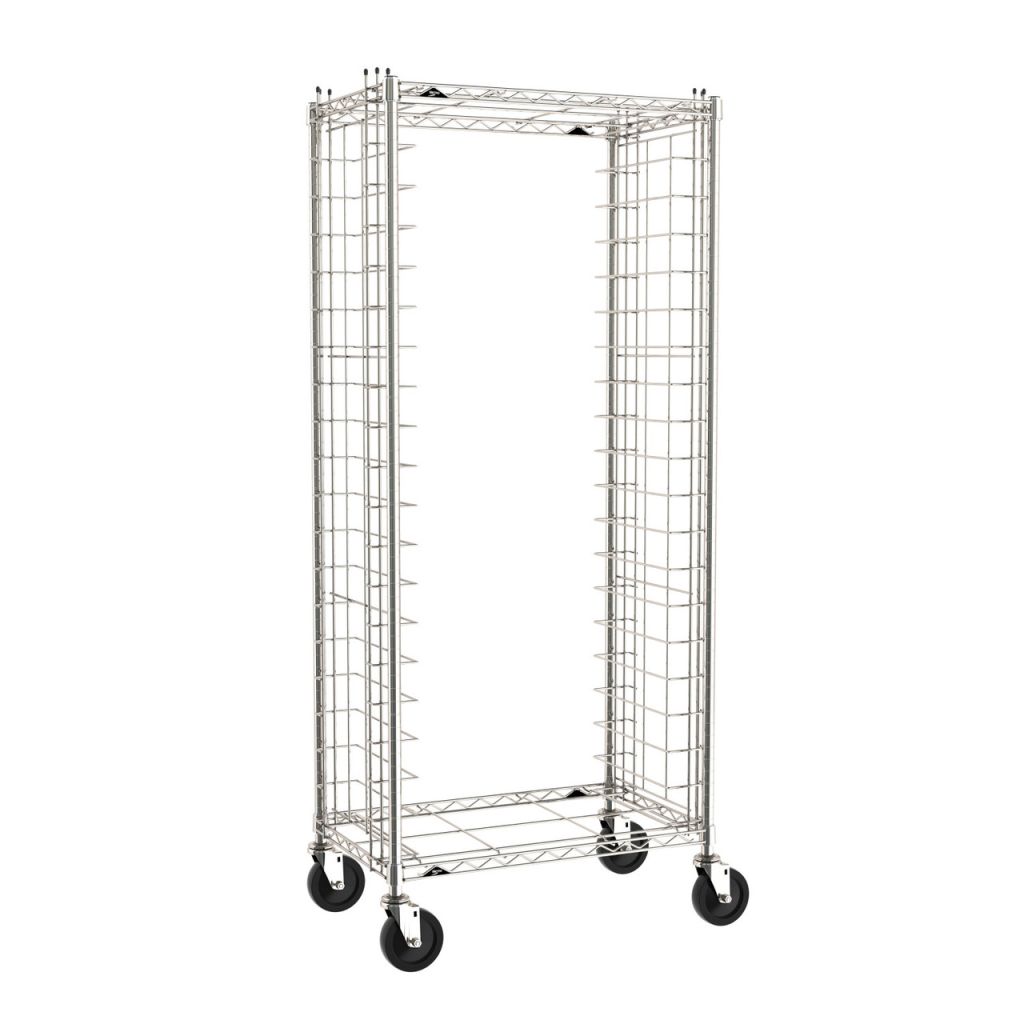 Pan Racks & Bun Pan CartsEnd-load and side-load sheet pan racks, roll-in racks, tray racks and knock-down models.
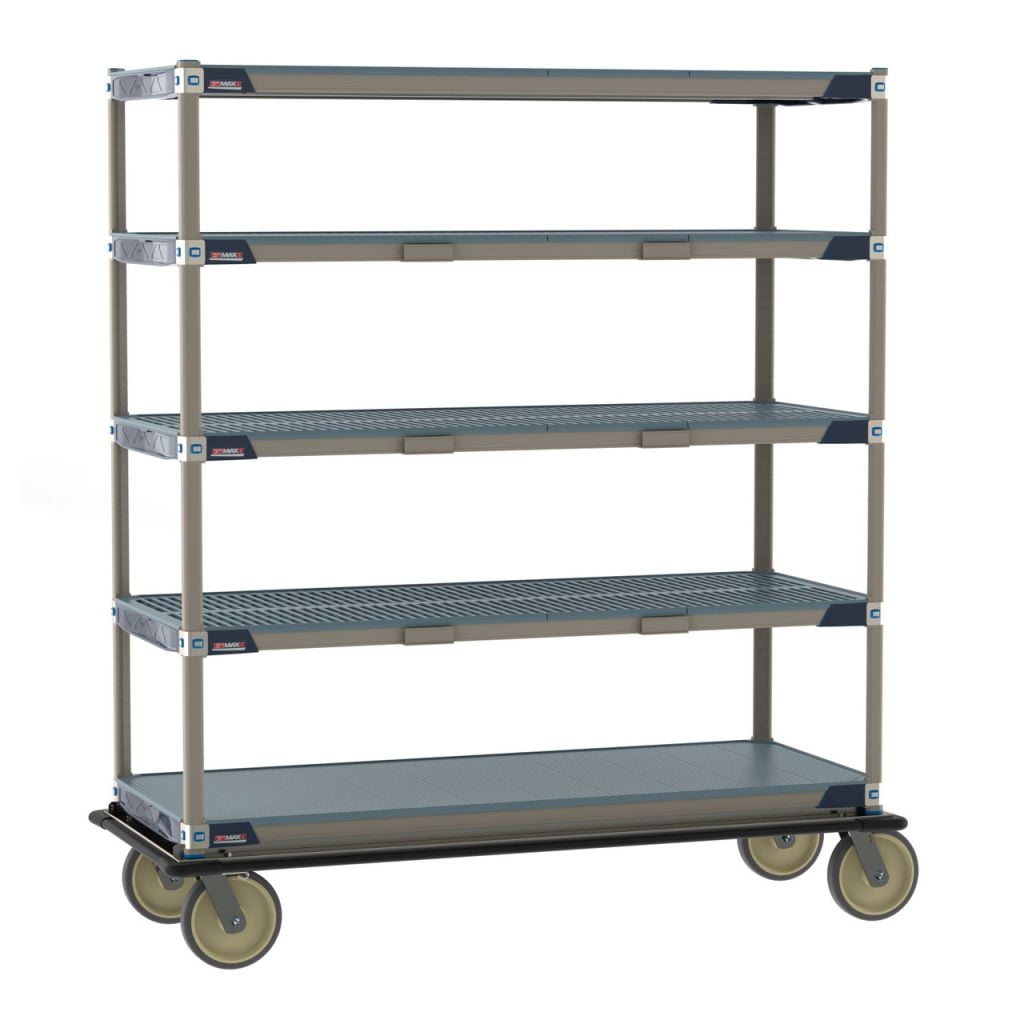
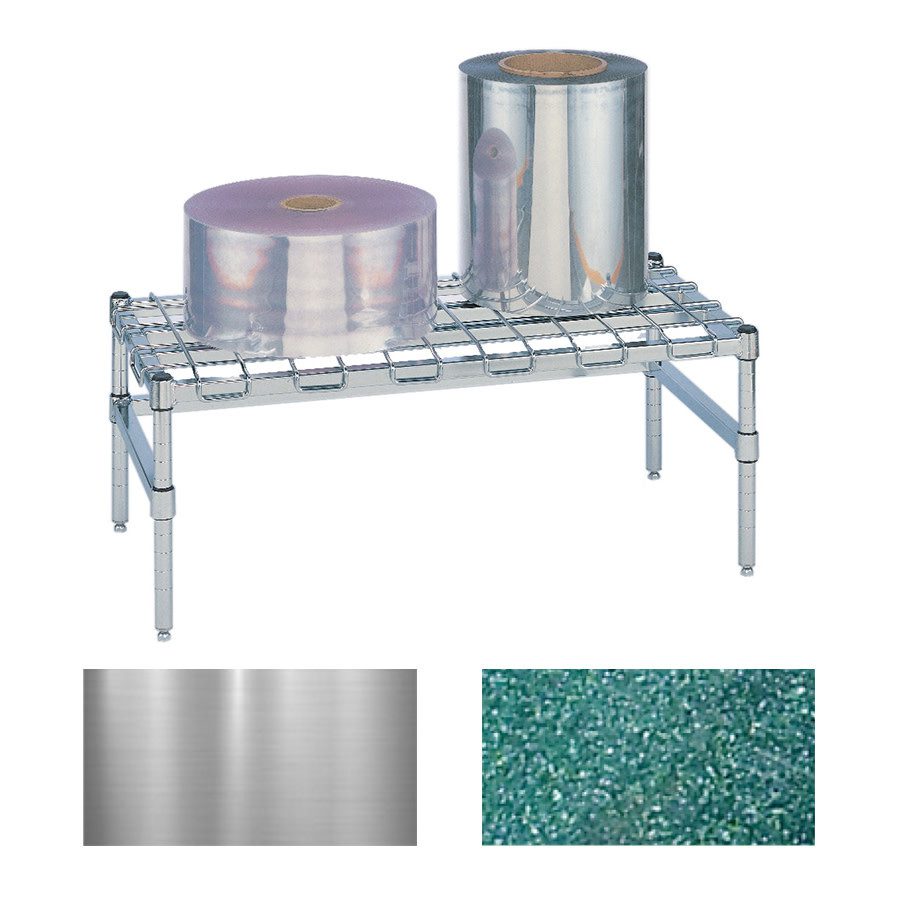 Dunnage Racks & Supply CartsOff-floor bulk storage, mobile dunnage, par level carts and picking carts.
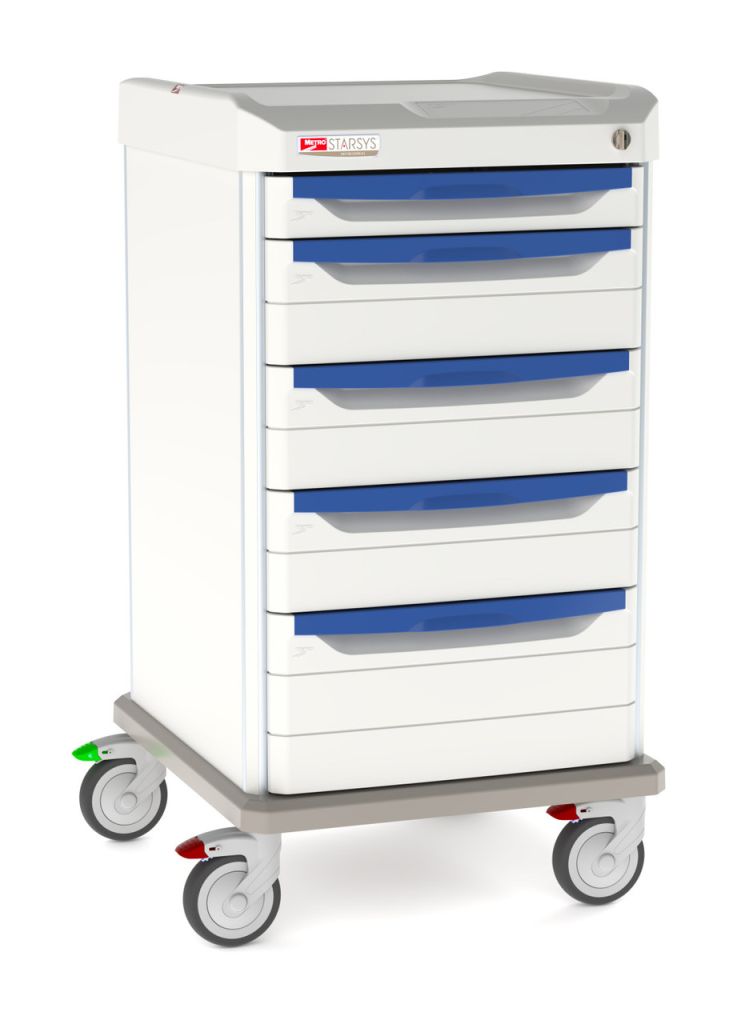 Medical & Clinical CartsFlexline, Starsys and Nimbl procedure, supply and isolation carts with locking drawers.
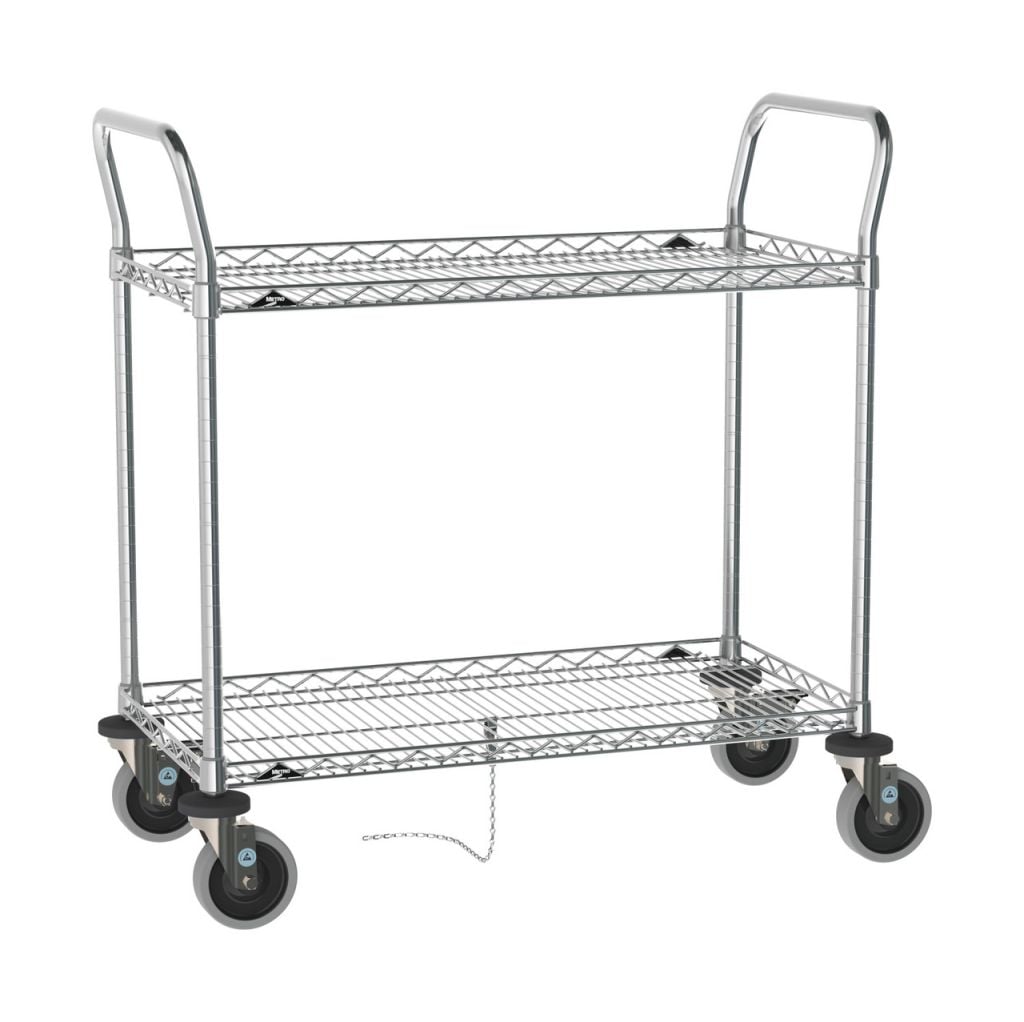 ESD / Static-Safe CartsStatic-dissipative carts and tray transport for electronics assembly and SMT handling.
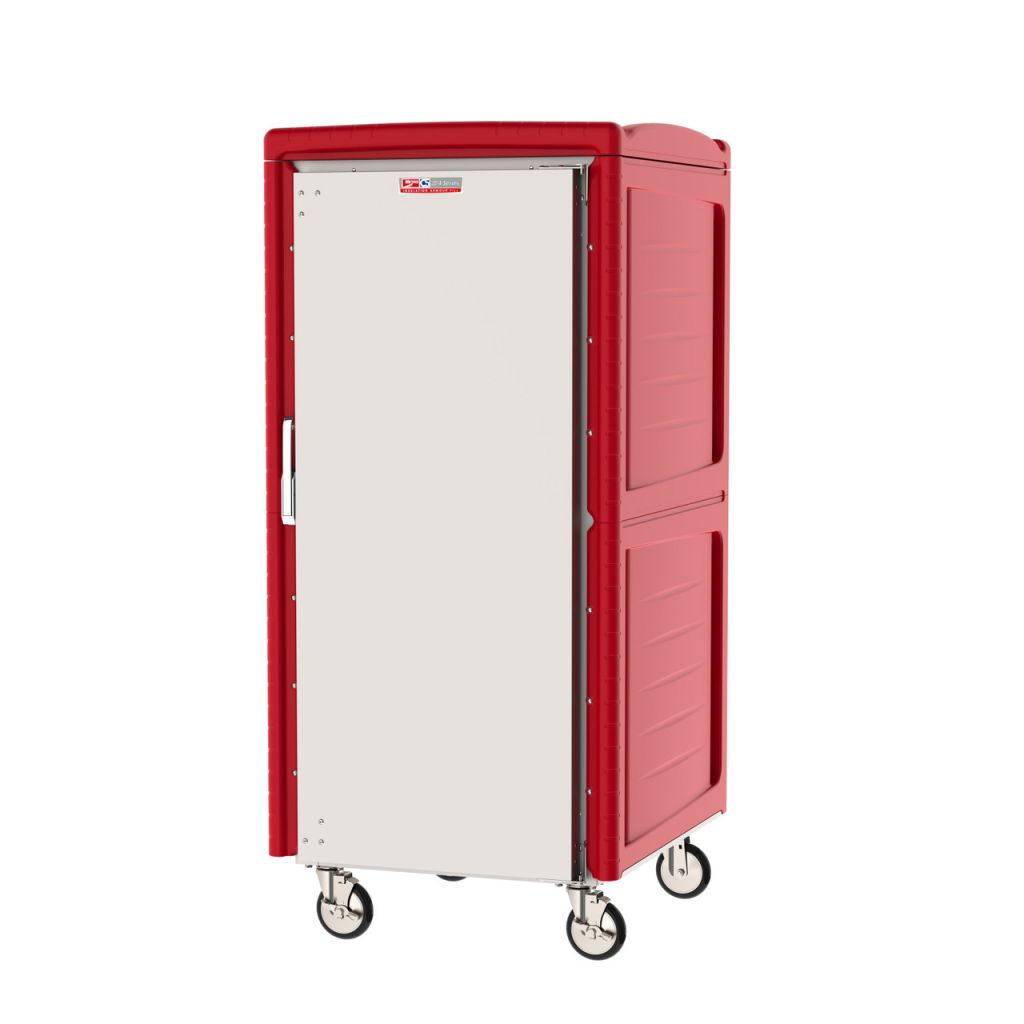 Heated & Insulated TransportC5 heated and non-powered transport cabinets and Mightylite insulated carriers.
Metro Utility Carts: Wire, Polymer and Stainless
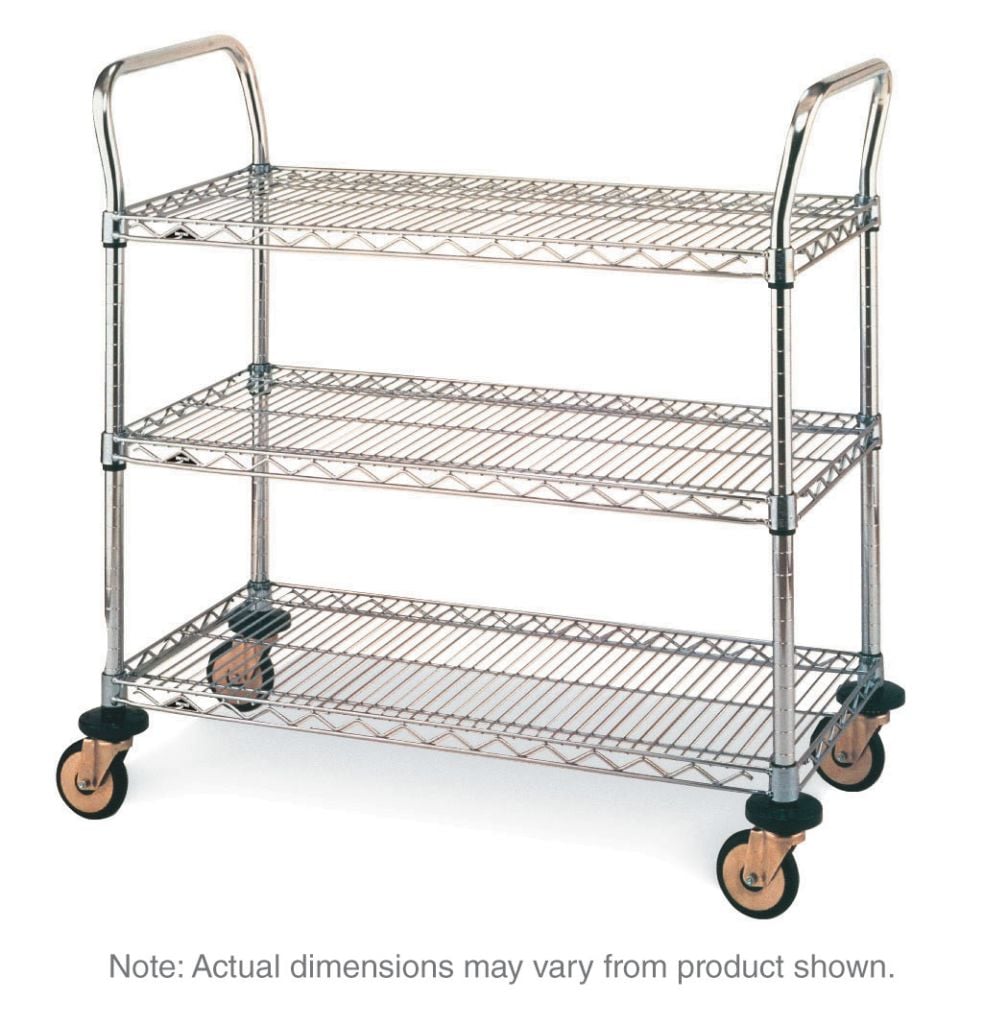
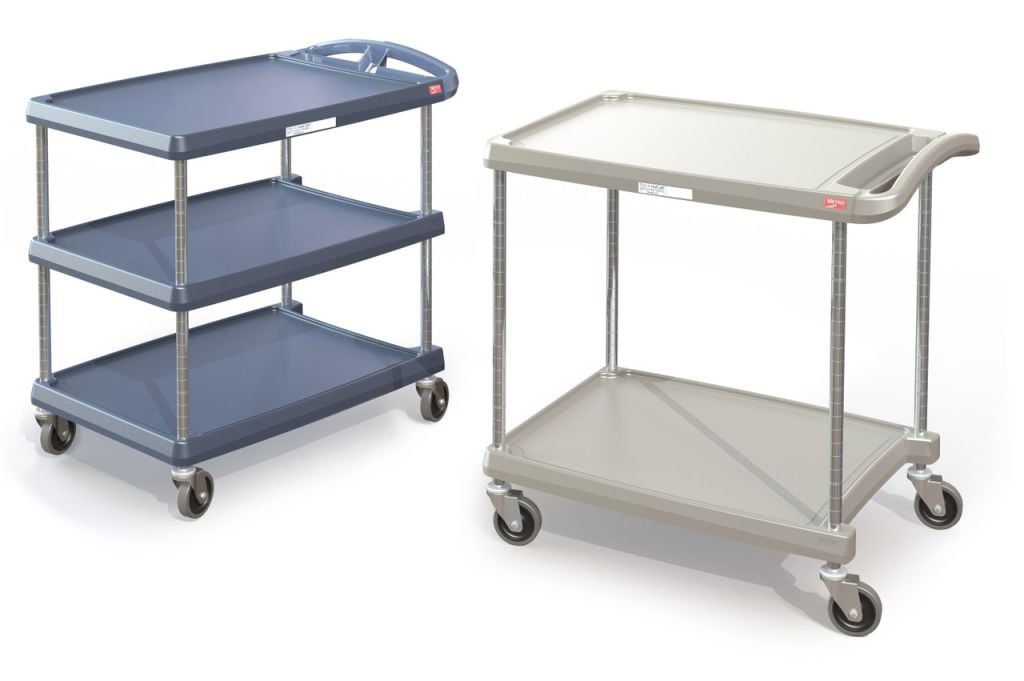
The Metro utility cart is the workhorse of the family and what most people picture when they say “Metro cart.” Two or three shelves on four posts and casters — that simplicity is why material choice matters; nothing hides a bad one.
Wire carts use Super Erecta shelves on tubular posts. The open deck passes air, light and sprinkler coverage and gives the highest capacity per dollar. Chrome suits dry stockrooms, epoxy humid rooms and coolers, stainless labs and sterile processing.
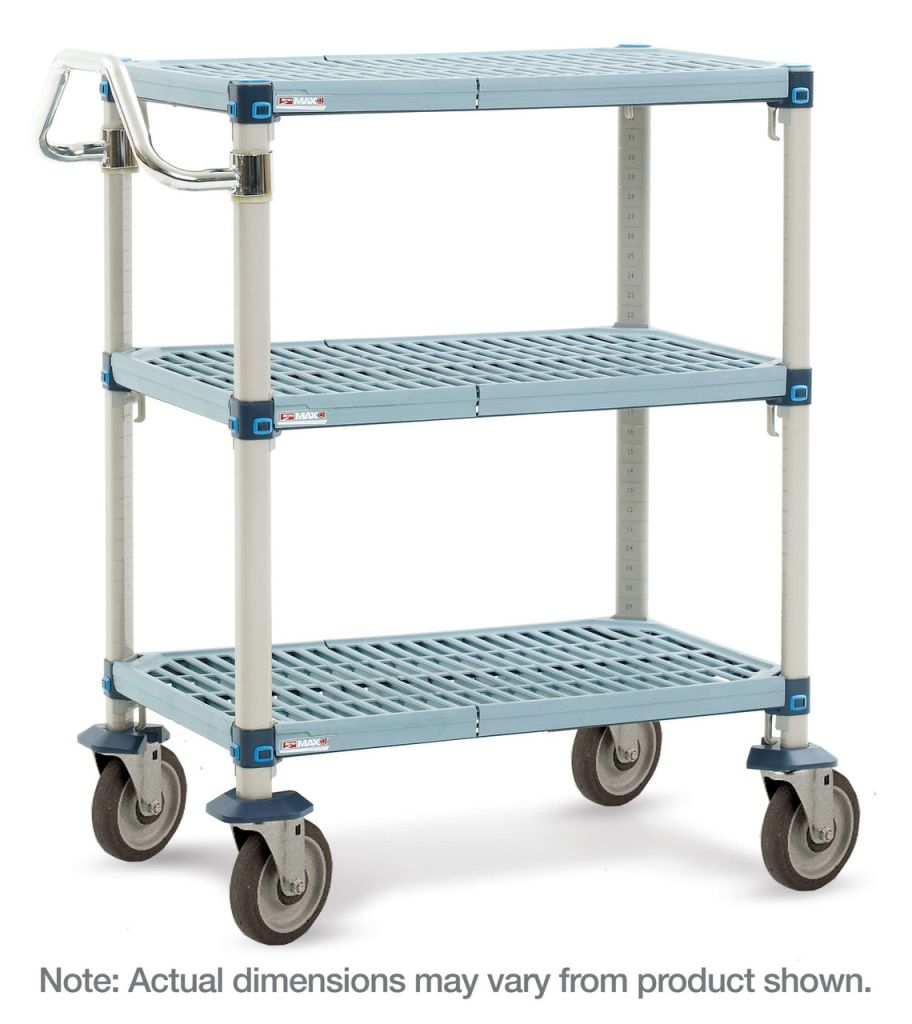
Polymer carts — myCart Series, MetroMax i and MetroMax Q — use molded shelves that cannot rust. Open-grid shelves drain fast after a washdown, the usual answer for wet rooms and coolers, and MetroMax Q adds removable shelf mats that clean separately from the frame.
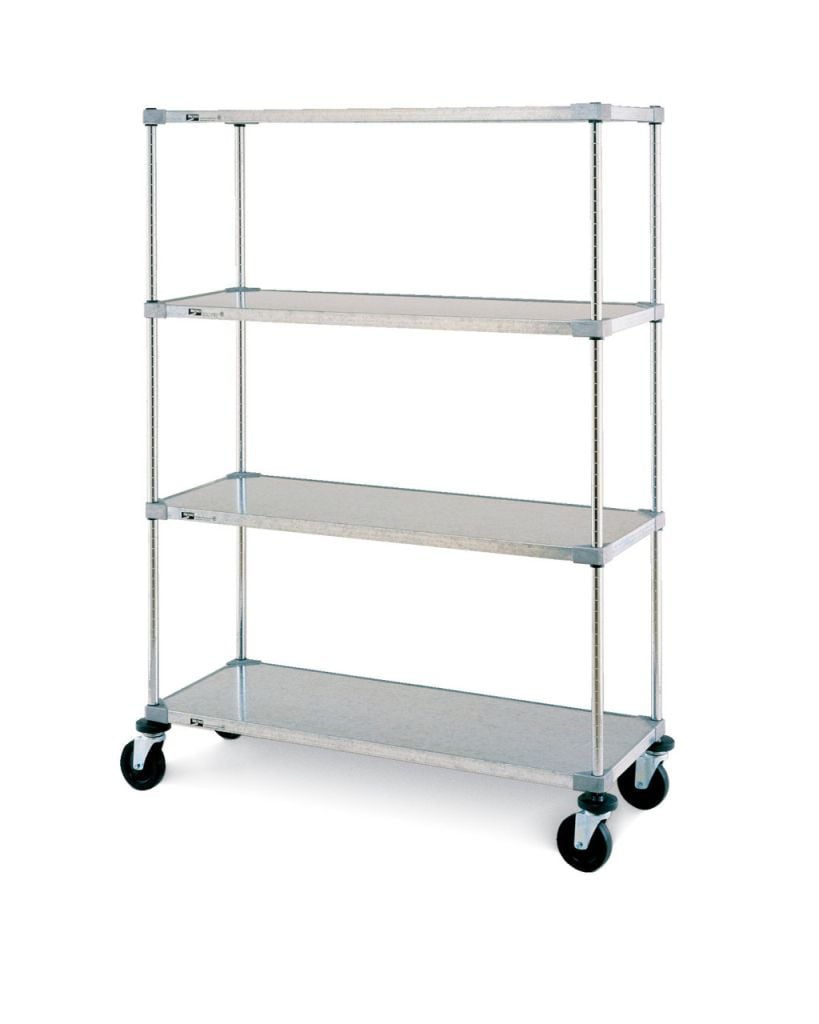
Flat versus lipped shelves is the decision most buyers skip. A flat deck loads faster and takes oversized boxes; a lipped deck keeps bottles, instruments and loose parts from walking off at a threshold, and pays for itself the first dropped item it saves.
Deep ledge carts turn each shelf into a shallow tub — common in housekeeping, specimen transport and sterile supply. The trade is clearance: they hold shorter items than a flat cart of the same height.
Solid decks give a continuous surface for small parts and liquids and keep drips off the level below, but they hold spills and block airflow — a top-shelf choice more often than a whole-cart choice.
| Deck | What it is | Best for | Watch out for |
|---|---|---|---|
| Chrome wire | Plated Super Erecta wire shelves on tubular posts | Dry stockrooms, offices, back-of-house transport | Corrodes in wet or humid rooms |
| Epoxy-coated wire | Wire shelves with a baked epoxy coating | Humid rooms, coolers, kitchens, general foodservice transport | Coating chips under impact; touch-up matters in busy aisles |
| Stainless wire | Stainless shelves and posts | Cart wash, autoclave, labs, sterile processing | Highest cost — match every component to the process |
| Open-grid polymer | Molded MetroMax i / Q shelves with an open grid | Full washdown, wet storage, drying rooms, coolers | Small loose items need a mat, bin or solid insert |
| Lipped / deep ledge | Raised edge on all four sides | Bottles, instruments, tools, loose items | Costs vertical clearance per shelf |
Two shelves or three?
A two-shelf cart gives one tall clear opening for bulky loads; a three-shelf cart gives more deck area but shortens every level. Measure the tallest item that rides the cart daily, add two inches of knuckle clearance, and let that set the answer.
Transport and Exchange Carts

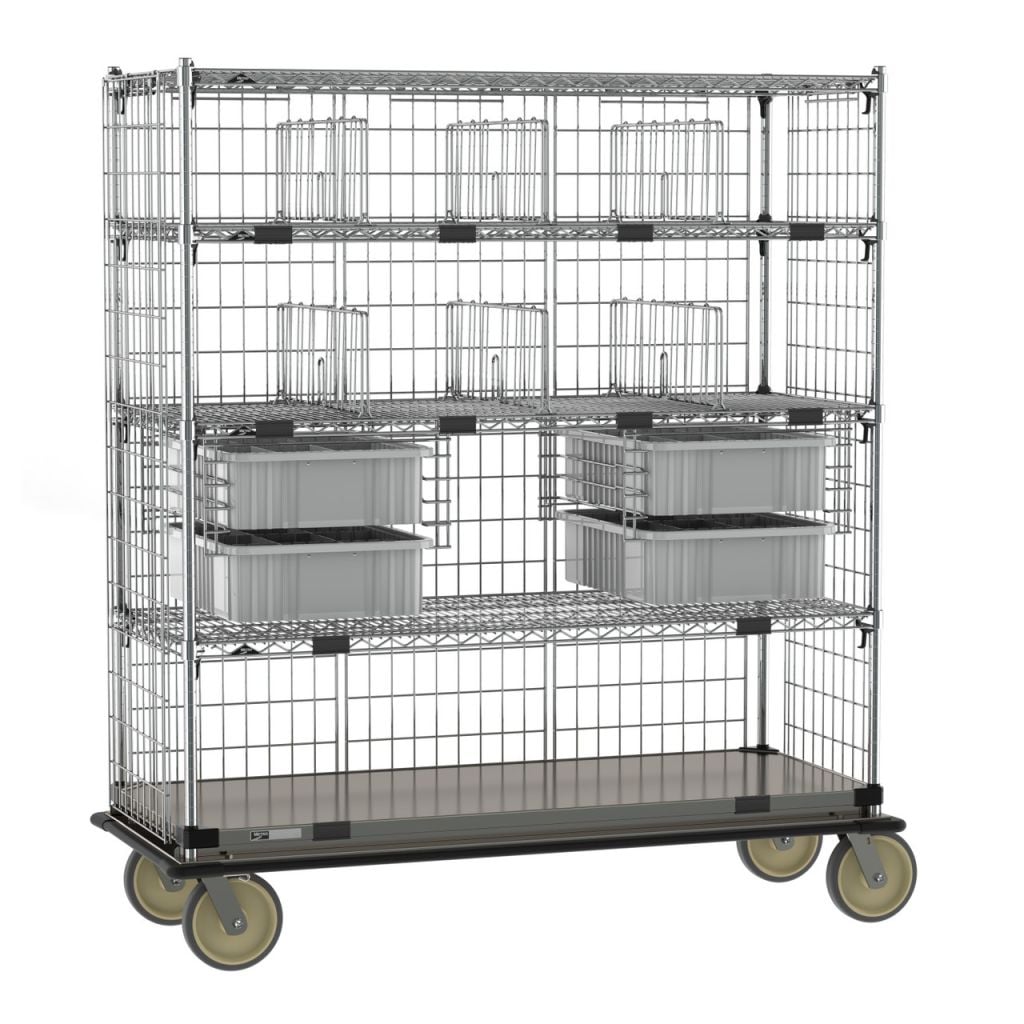
A Metro transport cart is a utility cart that has grown a skin: covers, doors or full enclosures on a Super Adjustable Super Erecta or MetroMax frame, so a loaded cart can leave a clean or secure area, cross a corridor or dock, and arrive dust-free and accounted for.
“Exchange” describes how they are used: a full cart rolls in and an empty one rolls out instead of restocking at the point of use. Sterile processing exchanges case carts with the OR; commissaries exchange loaded carts with satellite sites. Each exchange removes a double handling step.
Deluxe versions add heavier enclosures, hinged or roll-up doors and locking provisions; vinyl covers are the light alternative when you only need dust protection. Either way check added width — two inches per side can make a cart too wide for a door it used to clear.
- Enclosed transport carts — panels or doors on a Super Erecta or MetroMax frame for dust protection and security.
- Case carts — open or enclosed stainless carts sized for instrument sets.

Two practical notes: an enclosed cart is heavier before you load it, so the caster spec moves up a size, and doors need swing room where the cart is parked.
Pan Racks and Bun Pan Carts
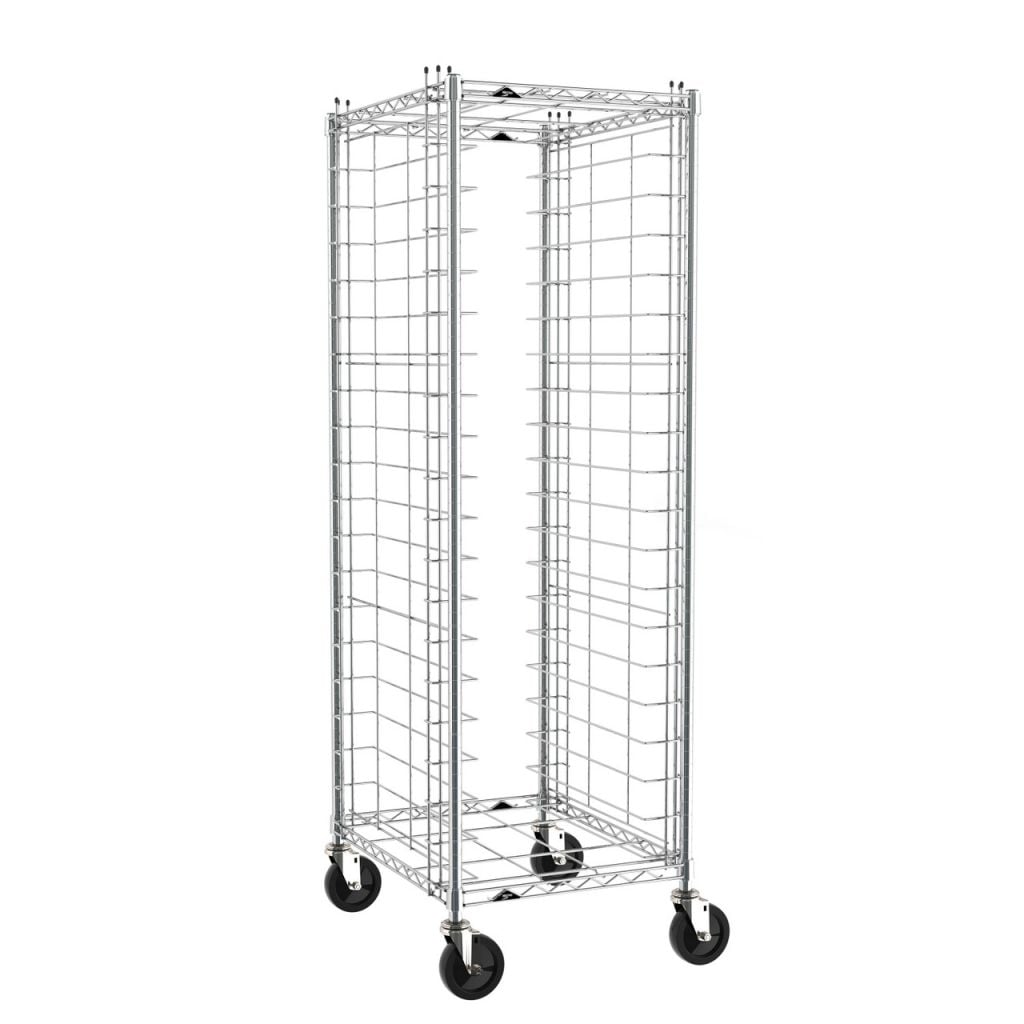
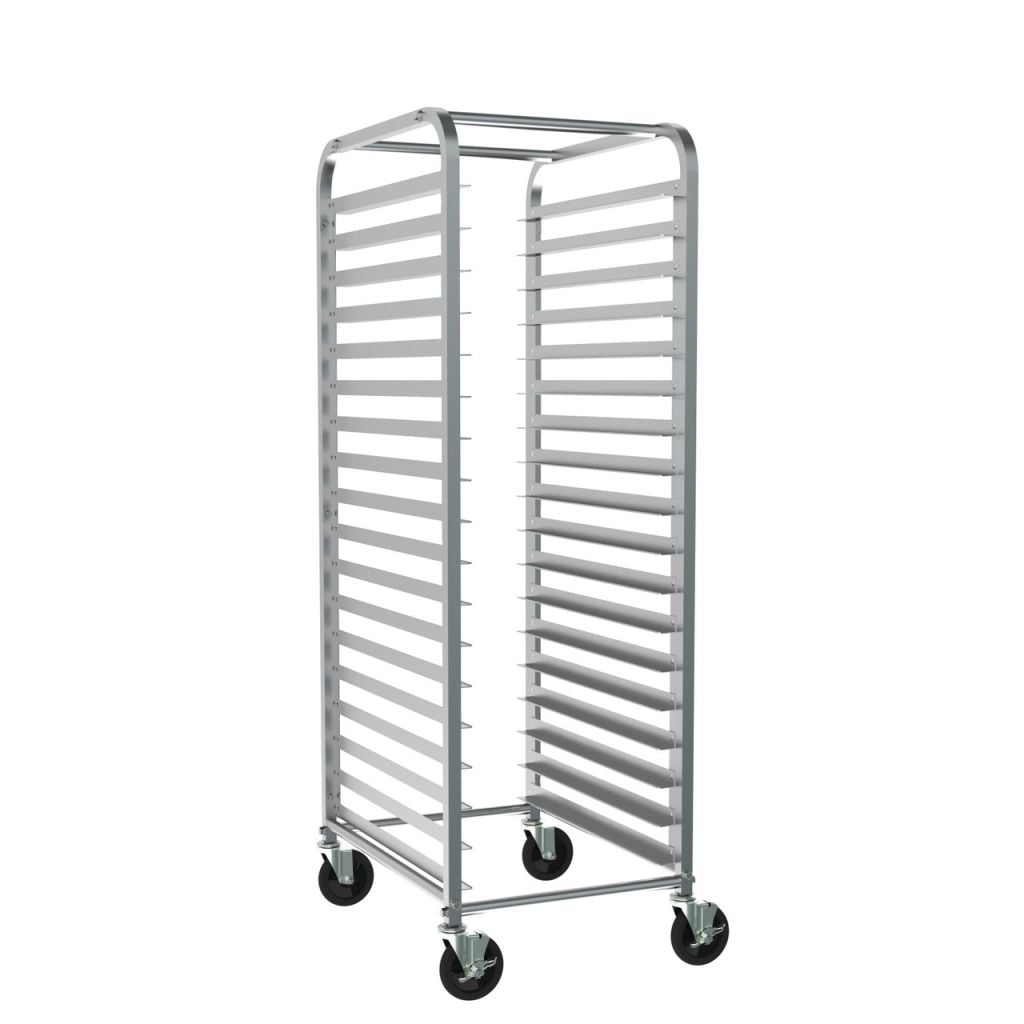
A Metro pan rack is a cart built around a pan pitch rather than a shelf: slides run up both sides of the frame and sheet pans, steam table pans or trays slide in. One rack in a two-foot footprint replaces a run of table space in a bakery, kitchen or tray line.
The first decision is end-load versus side-load. End-load racks take pans through the narrow end and suit wall lineups, ovens and roll-in refrigerators; side-load racks take pans through the long side, which is faster at a bench. If the rack goes into equipment, the equipment picks for you.
The second is slide pitch. A tighter pitch fits more pans but will not clear proofed dough, a domed cake or a covered pan. Pitch around your tallest routine product, or staff will skip every other slide.
| Rack type | Loads from | Typical use | Specify around |
|---|---|---|---|
| End-load pan rack | Narrow end | Wall lineups, ovens, roll-in refrigeration | Equipment opening width and rack depth |
| Side-load pan rack | Long side | Bench-side transfer | Aisle width beside the bench |
| Roll-in refrigerator rack | End | Racks living inside a roll-in cabinet | Exact cabinet interior dimensions |
| Knock-down pan rack | End or side | Seasonal and catering fleets | Assembly labor and rigidity |
| Oval tray rack | End | Banquet and room service tray handling | Tray size and count per service |
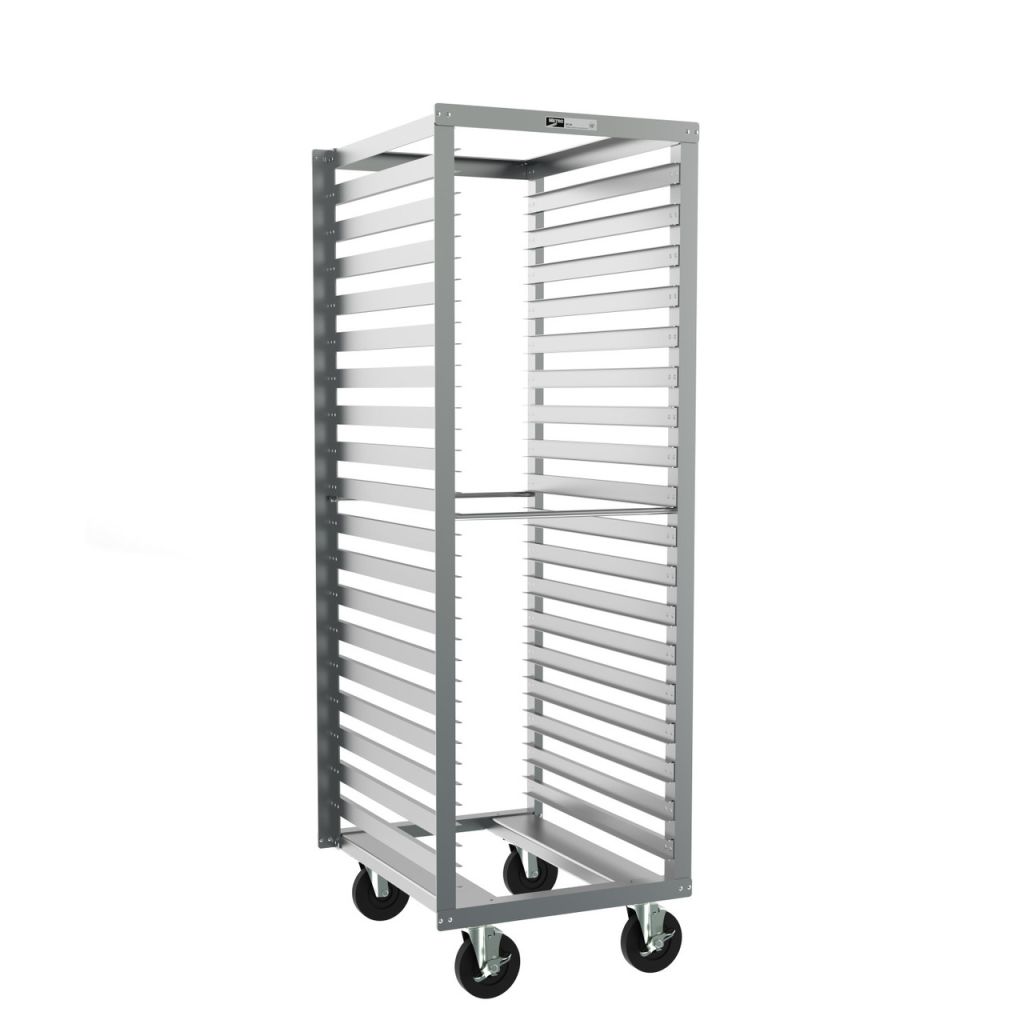
Roll-in racks are sized to a specific cabinet, and half an inch of error means the rack does not fit or the door will not shut. Get the cabinet model before ordering.
Knock-down racks ship flat and freight cheaply — budget assembly labor and re-torque hardware after the first month. Finish follows the shelving rules: aluminum for light weight, epoxy wire for humid rooms, stainless for aggressive wash chemistry.
Dunnage Racks and Supply Carts
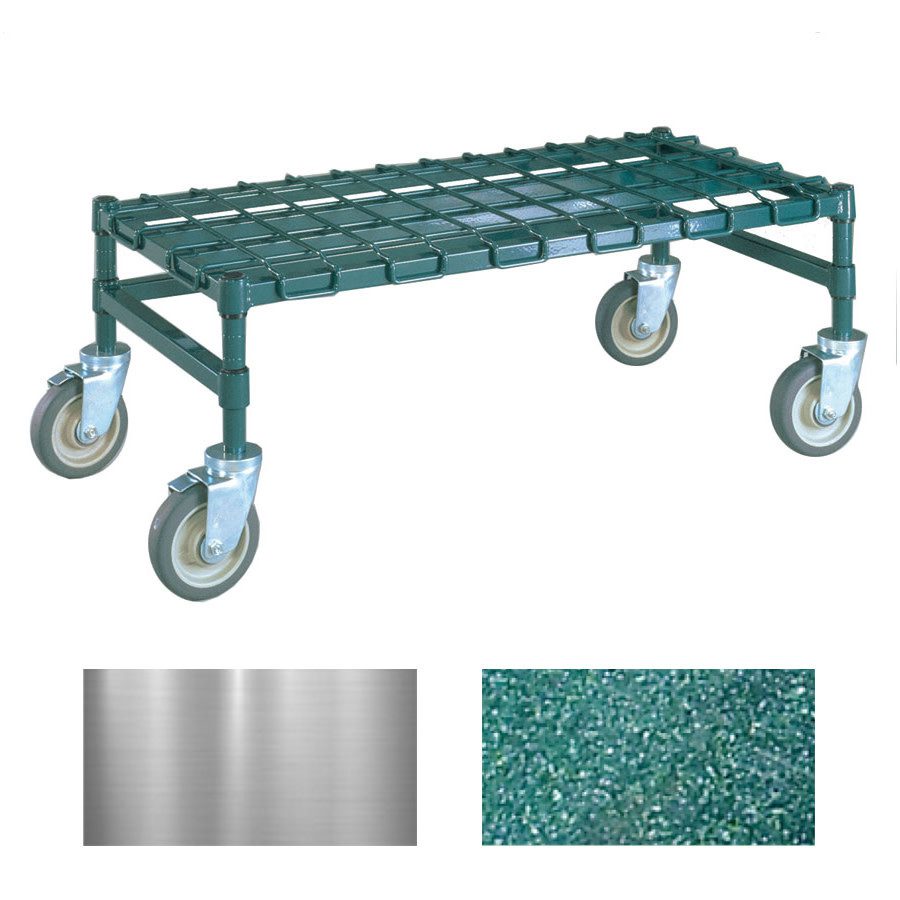
Dunnage racks keep bulk product off the floor: flour sacks, cases, drums and anything too heavy to lift onto a shelf. Health codes generally require product off the floor, and dunnage is the cheapest way to do it while keeping the floor cleanable.
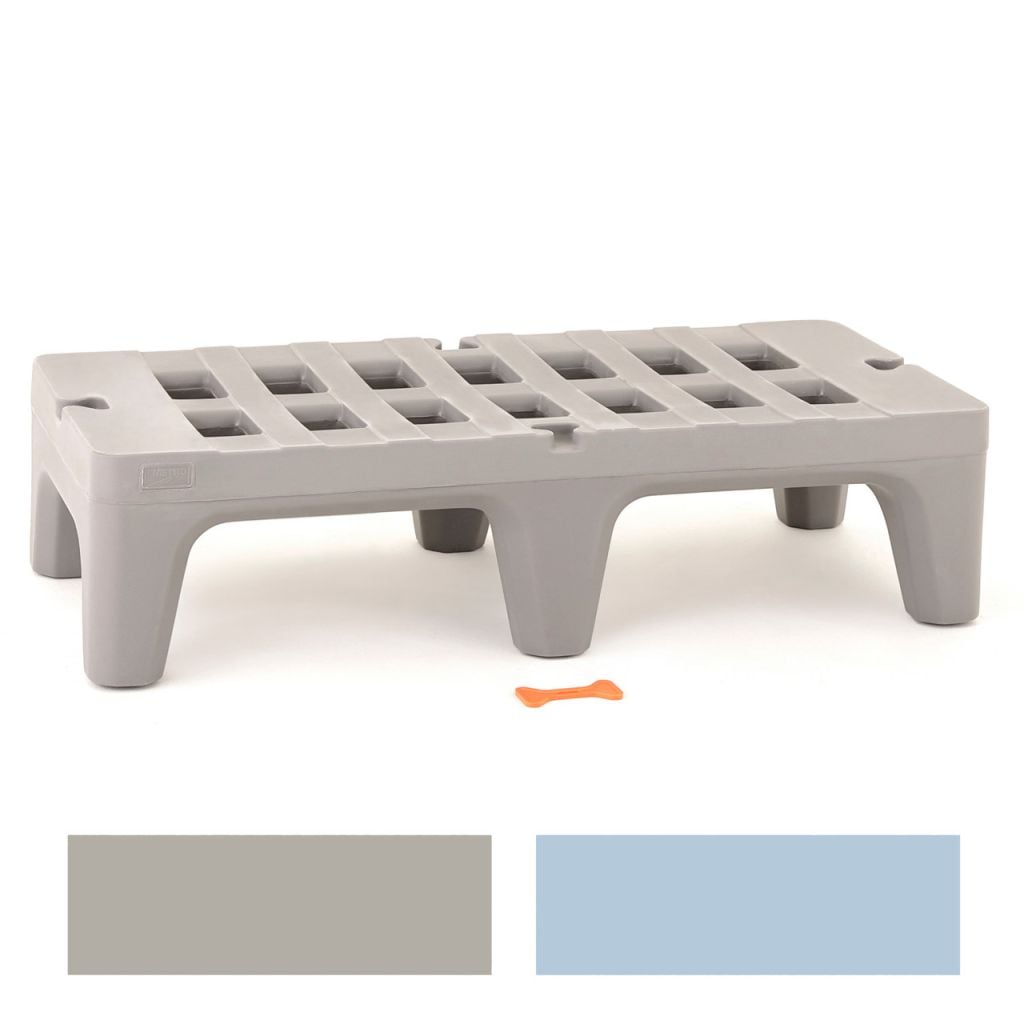
Metro offers heavy-duty dunnage racks and standard-duty platforms in chrome, Metroseal epoxy and stainless, plus a bow-tie profile that spreads load over a wider footprint. Mobile versions add casters for walk-ins where the stack moves for cleaning.
Capacity here is a real number: dunnage loads are dense, dropped rather than placed, and rarely even.
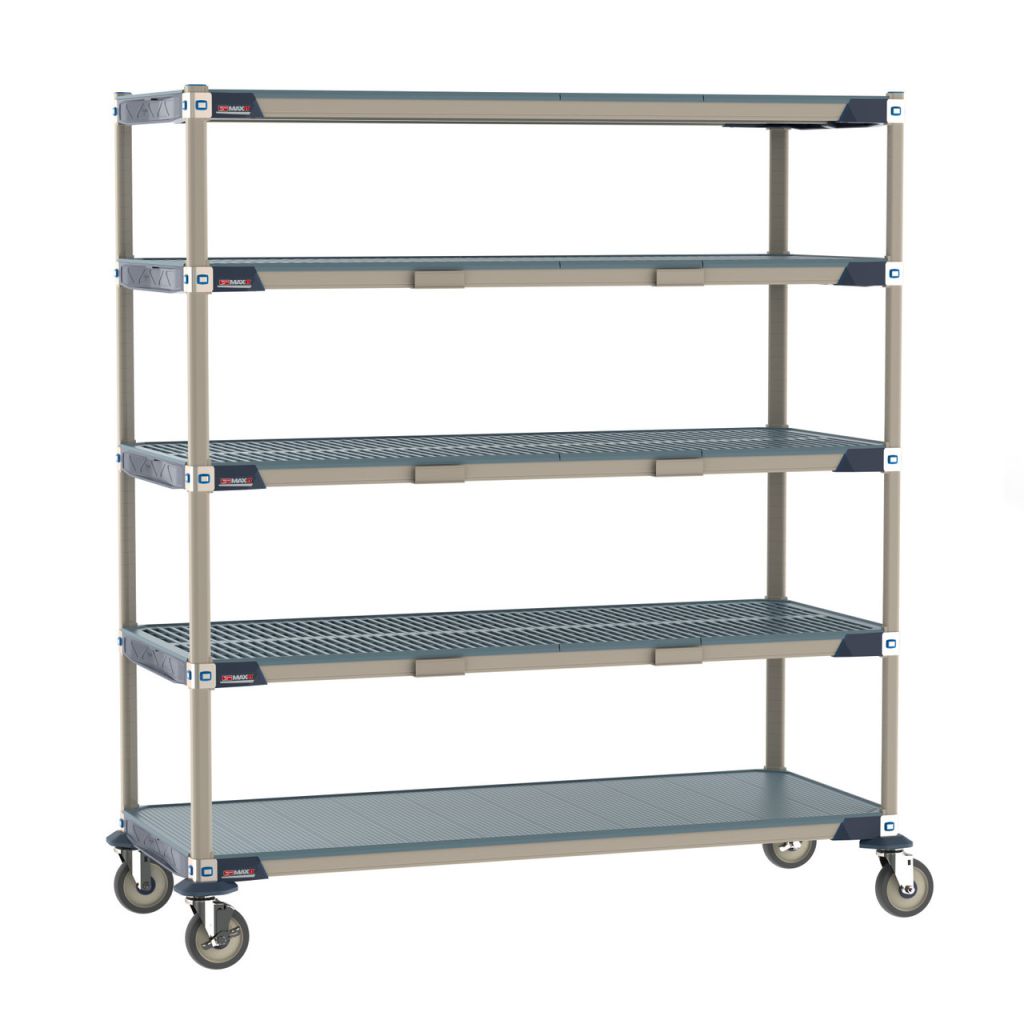
Supply carts sit between utility carts and shelving. Par level carts add bins, dividers and labels so a stockroom restocks to a set quantity without counting from scratch. Picking carts add a work surface, tote positions and a scanner mount so one pass down an aisle builds several orders.
Both are ordinary Metro frames with the accessory package doing the work, so an existing cart can be converted with dividers, bins, ledges and labels. The tell is repetition: if someone walks the same route twice a shift, structure on the cart beats a bigger cart.
Not sure which Metro cart family fits?
Send us the load, the route, the doorways it must clear and how it gets cleaned. We will spec the frame, deck, casters and accessories and quote it with freight.
Medical and Clinical Carts
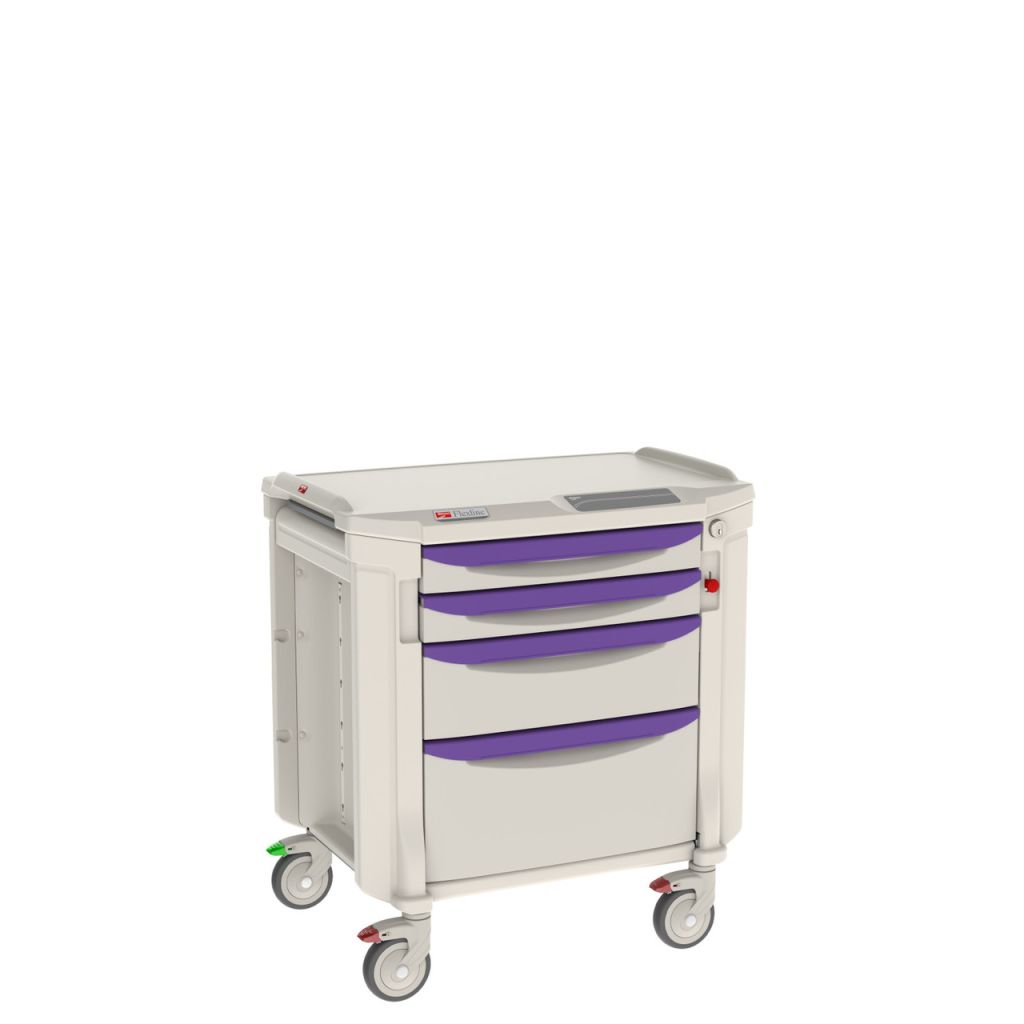
Metro’s clinical carts are a different animal: molded or laminate bodies, drawer modules instead of shelves, and locking hardware from a simple key to keyless touchpads and cart management software. Flexline covers general use, procedure, phlebotomy and isolation carts. Starsys adds a modular drawer-and-door system for biomedical, IV and specialty storage. Nimbl includes mobile workstations for point-of-care charting and endoscopy carts.
What you actually specify is the drawer stack — how many drawers, at what heights, with which dividers — plus security level, accessory rails, and whether the cart carries a monitor, keyboard tray or sharps container.
We have a dedicated page for these lines with drawer, security and accessory guidance: Metro healthcare storage and clinical carts.

ESD and Static-Safe Carts
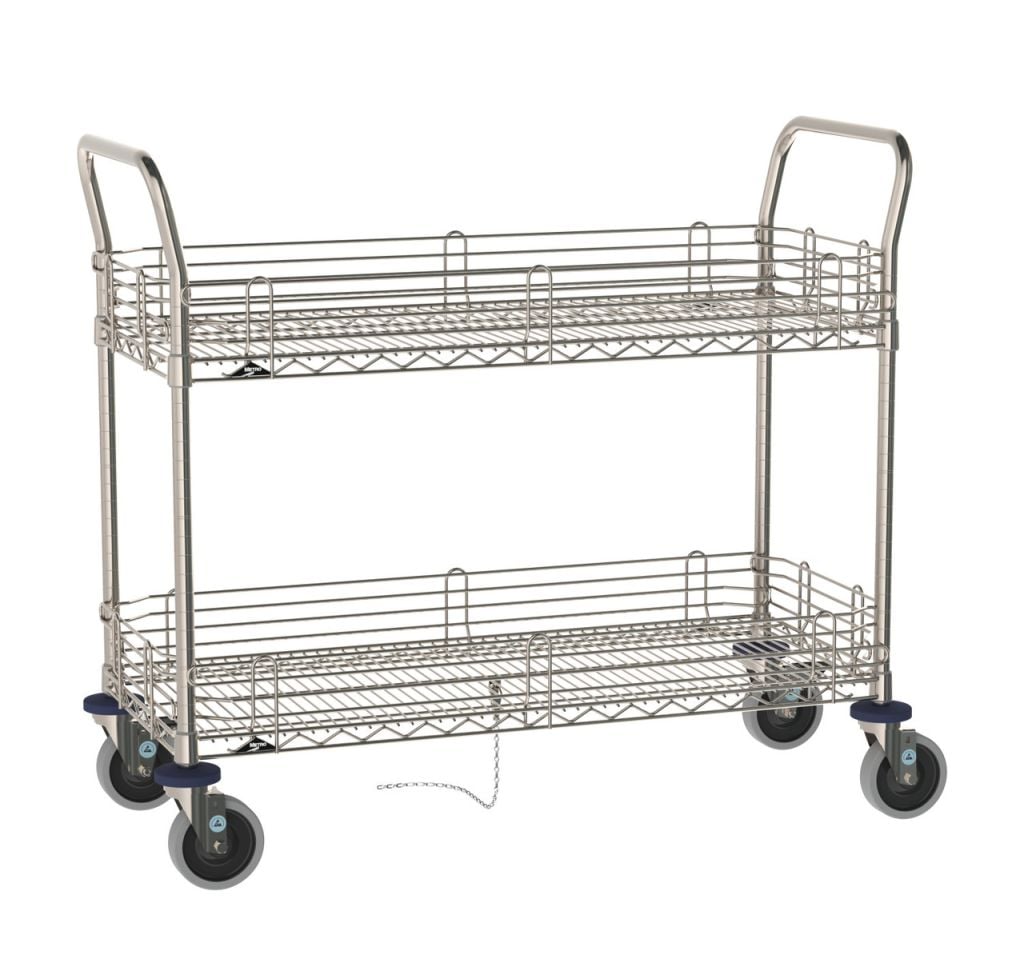
Electronics assembly, repair depots and SMT lines cannot move boards on an ordinary cart. Static-safe carts use dissipative materials and a grounding path so charge bleeds away in a controlled way instead of jumping into a component. The ESD-safe range includes two- and three-shelf utility carts, drop-mat carts, SMT reel storage carts and tray transport carts sized for ESD-safe electronics trays.
The cart is only one link. Grounding is a system — cart, mats, wrist straps, flooring and workstation — verified periodically. A dissipative cart with a broken ground path is just a cart.
Full detail on the static-safe range lives here: Metro ESD shelving and carts.
Heated and Insulated Transport
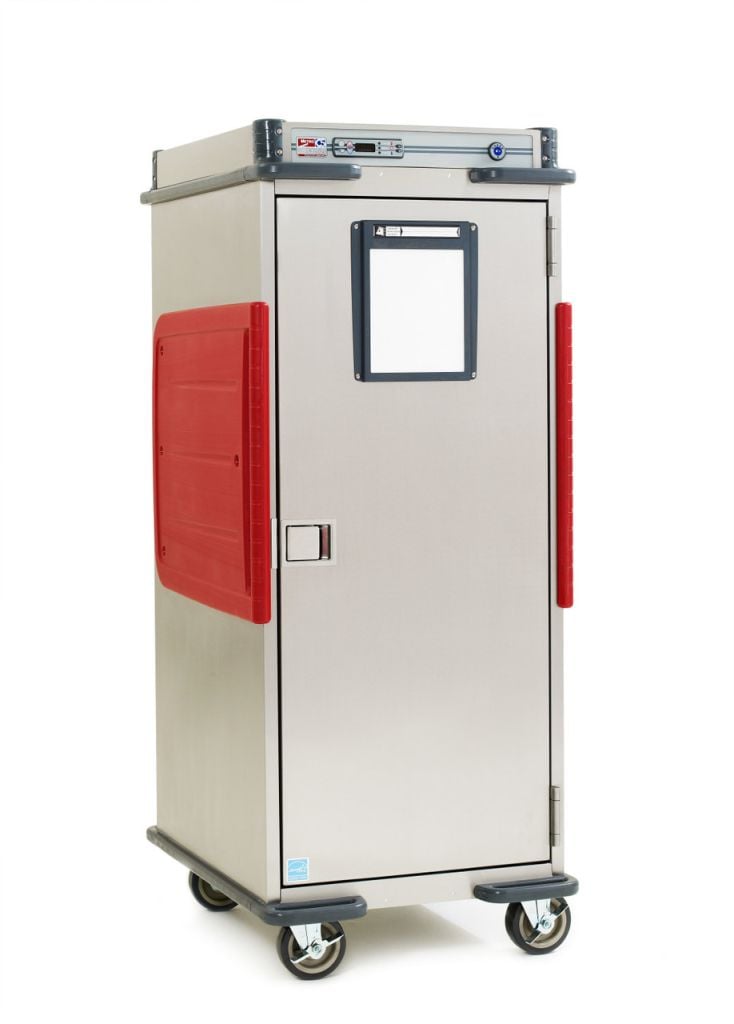
When the cargo is hot food, the cart becomes an appliance. Metro’s C5 series covers heated transport cabinets, non-powered insulated transport cabinets and proofing cabinets in full, five-sixths and half heights, single and dual cavity. Mightylite insulated carriers are the lighter, non-powered option for catering, room service and off-site events, and HotBlox insulated transport cabinets sit between the two.
Specification hinges on how long the food must hold, whether power exists at the destination, and how many pans a service needs. A powered cabinet holds indefinitely but needs an outlet; a non-powered cabinet is lighter but is a countdown clock from the moment the door closes.
Details, cavity sizes and holding guidance are on our dedicated page: Metro heated holding and transport cabinets.
How to Spec a Metro Cart
Whatever family you land on, the same questions decide whether the cart works. Answer them in order — each narrows the next.
| Spec item | What to decide | How it goes wrong |
|---|---|---|
| Load rating | Total weight per shelf and per cart, including the accessories | Published ratings assume even loads, a level floor and slow movement. Concentrated loads and thresholds eat the margin fast. |
| Shelf count & spacing | Levels, and clear height between them | Spacing set from a catalog photo instead of the tallest daily item; staff use half the levels. |
| Caster type & size | Swivel/rigid mix, wheel material, diameter, stem or plate mount | Three-inch wheels on a route with expansion joints, or hard wheels on a floor that marks. |
| Push handle | Fixed handle, ergonomic handle, or open frame | No handle on a long-route cart; operators push on the shelf edge and bend the deck. |
| Accessories | Bins, dividers, ledges, wastebaskets, labels | Rails specified too late, so nothing mounts without drilling. |
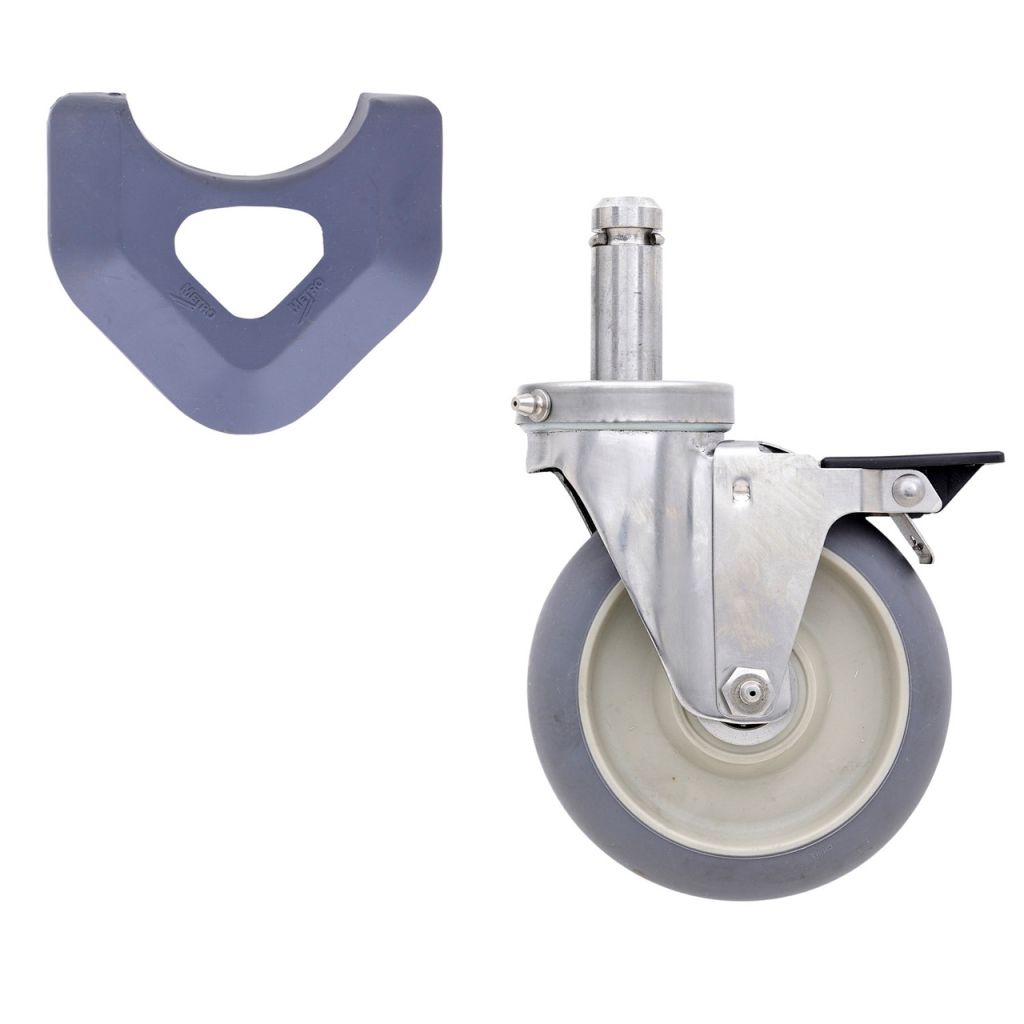
Casters deserve the most attention: they fail first and they decide how the cart feels. Three-inch wheels suit smooth tile in one room, five-inch is the stockroom default, six- or eight-inch makes long hauls across joints and dock plates a one-person job. Softer treads are quieter; harder treads roll easier under load.
Check mount style on replacement orders: stem casters thread into a tubular post, plate casters bolt to a flat plate, and they are not interchangeable. Specify brakes by intent — total-lock for a work surface or sloped floor, wheel brakes for a cart that only stops briefly.
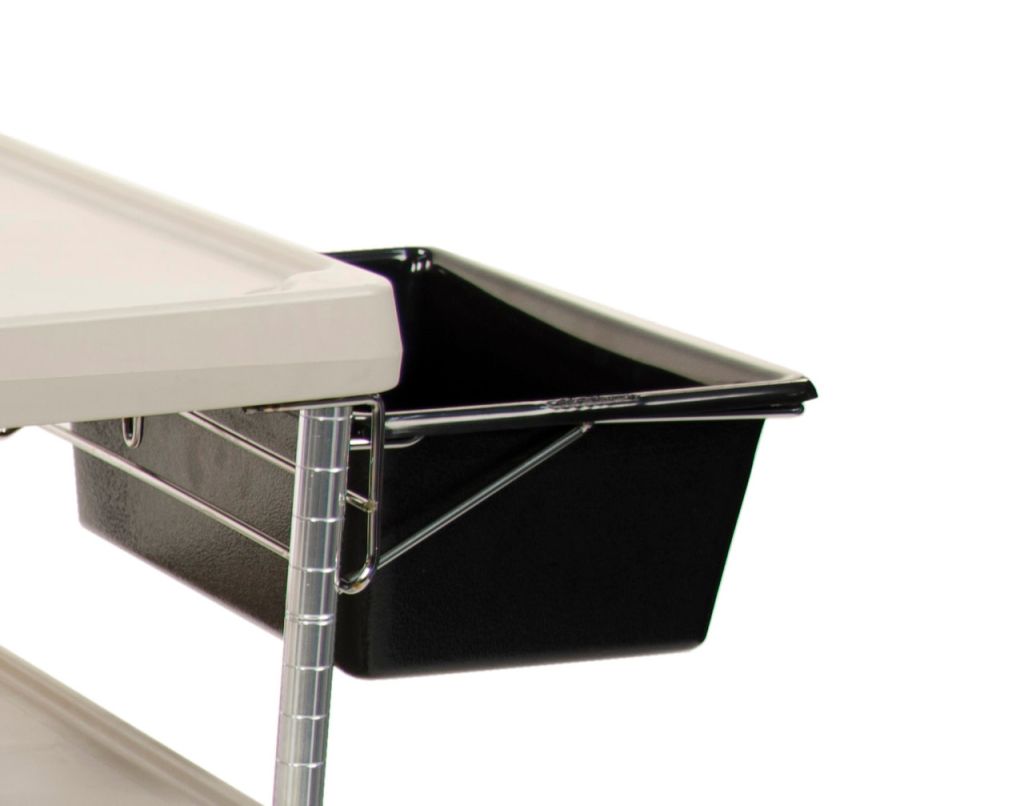
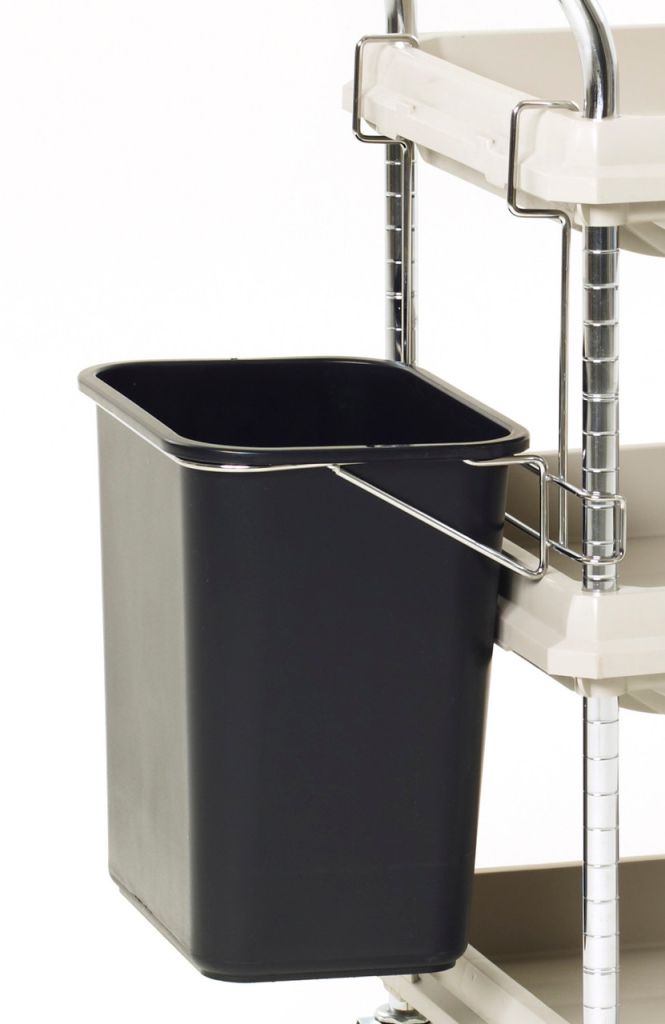
Accessories are where a generic cart becomes the right cart: bins and holders, wastebasket holders, ledges and dividers that create fixed locations, label holders and wire supply baskets.
Specify the accessory package with the cart, not later: most Metro accessories mount to a post, rail or shelf edge, and the frame configuration decides what will fit.
Settle the overall envelope before ordering: measure the narrowest clear opening on the real route, not the nominal door size, then check the elevator car.
Cleaning and Wash-Down Practice

Carts get cleaned far more often than shelving, and cleaning is what kills them. Before picking a finish, write down the real process — chemical, concentration, temperature, method and frequency.
Wipe-down routines let you use chrome or epoxy wire almost anywhere indoors. Hose or spray washdown pushes you toward polymer and stainless, with open-grid polymer drying fastest. Cart washers and autoclaves are the aggressive end; Metro offers stainless swaged post components for those applications.
Casters are the weak point: standard bearings pack with detergent residue and bind, and the operator compensates by shoving harder until something bends. If the cart gets washed, the casters have to be rated for it.
Metro offers Microban product protection on selected lines; we can tell you which components carry it and make no health claims about it. Sanitation and safety listings are model-specific, so send model numbers and we will confirm listing status in writing.
When a Cart Beats Fixed Shelving
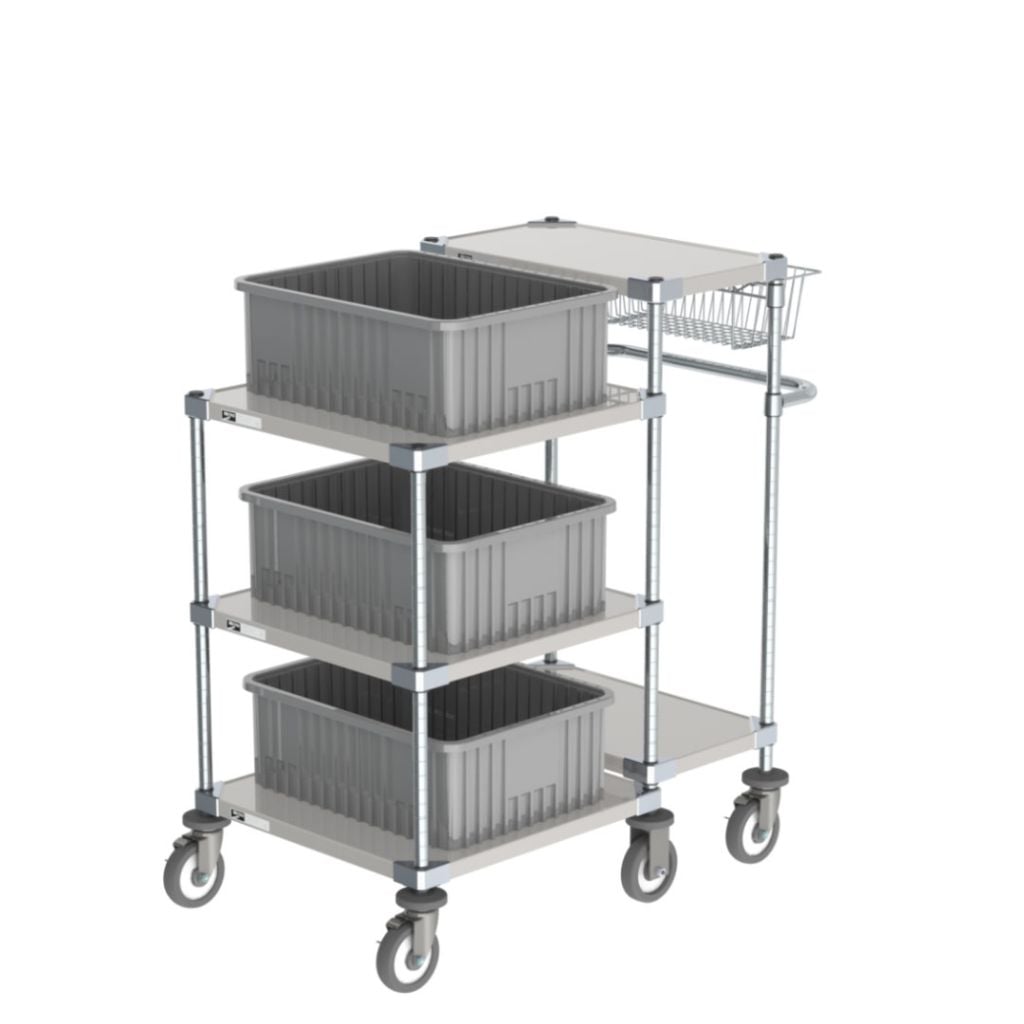
Carts always cost more per cubic foot than static shelving — casters, handles and heavier frames are not free, and a cart needs aisle space a wall shelf does not. The case for a cart is never storage; it is handling.
The break-even is repetition: every time an item is picked, set down, moved and set down again you pay handling twice. If that repeats several times a shift, a cart pays for itself. If stock is put away once and picked once, fixed wire shelving is the cheaper and denser answer.
Most facilities end up with both: shelving for reserve stock, carts for staging, exchange and the last hundred feet.
| Situation | Better answer | Why |
|---|---|---|
| Reserve stock, put away once | Fixed shelving | Lowest cost per cubic foot |
| Department-to-department supply | Transport / exchange cart | Full-for-empty swap instead of point-of-use picking |
| Bulk product off the floor | Dunnage rack | Off-floor storage; mobile versions roll out for cleaning |
| Hot food to another building | Heated or insulated cabinet | Holds temperature through the trip |
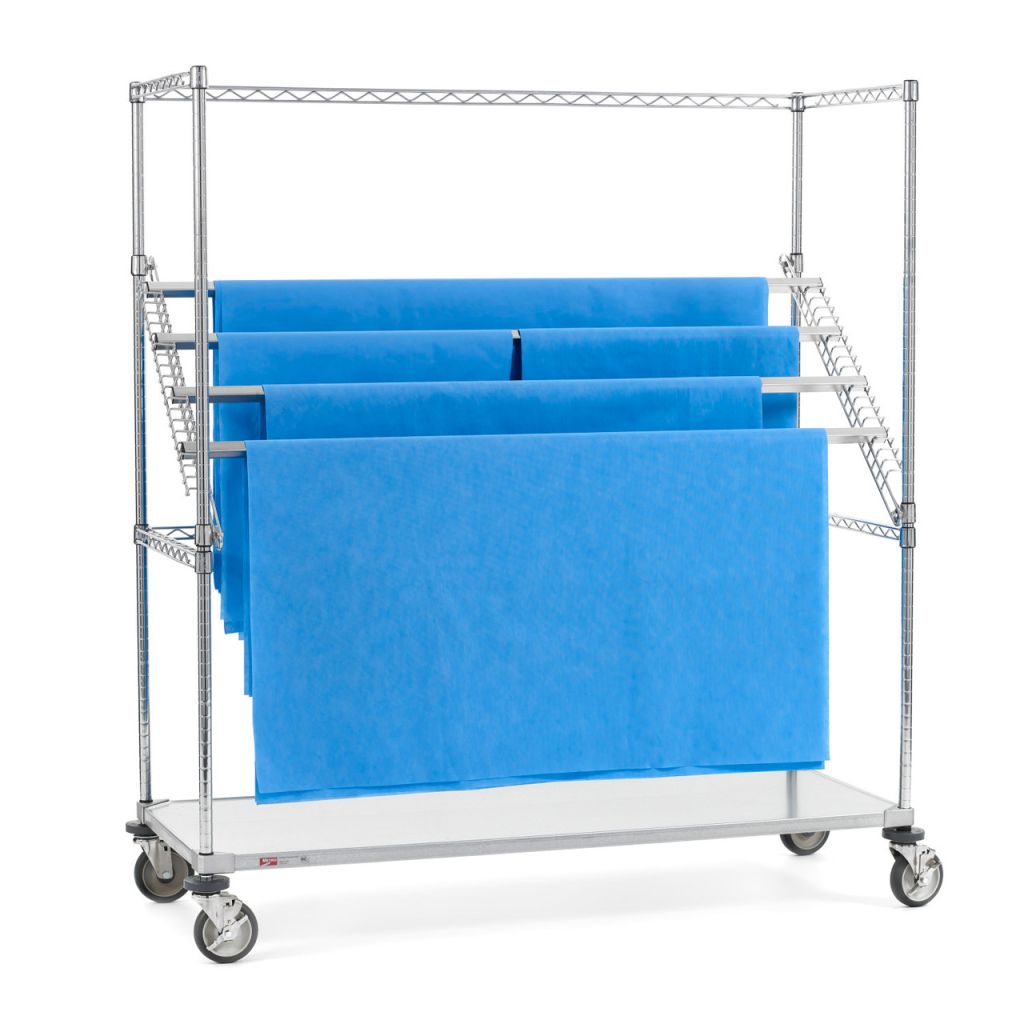
Shop Metro Carts Online
Buy select items directly from our online store, or request a quote for volume, custom sizes and freight-rated orders.

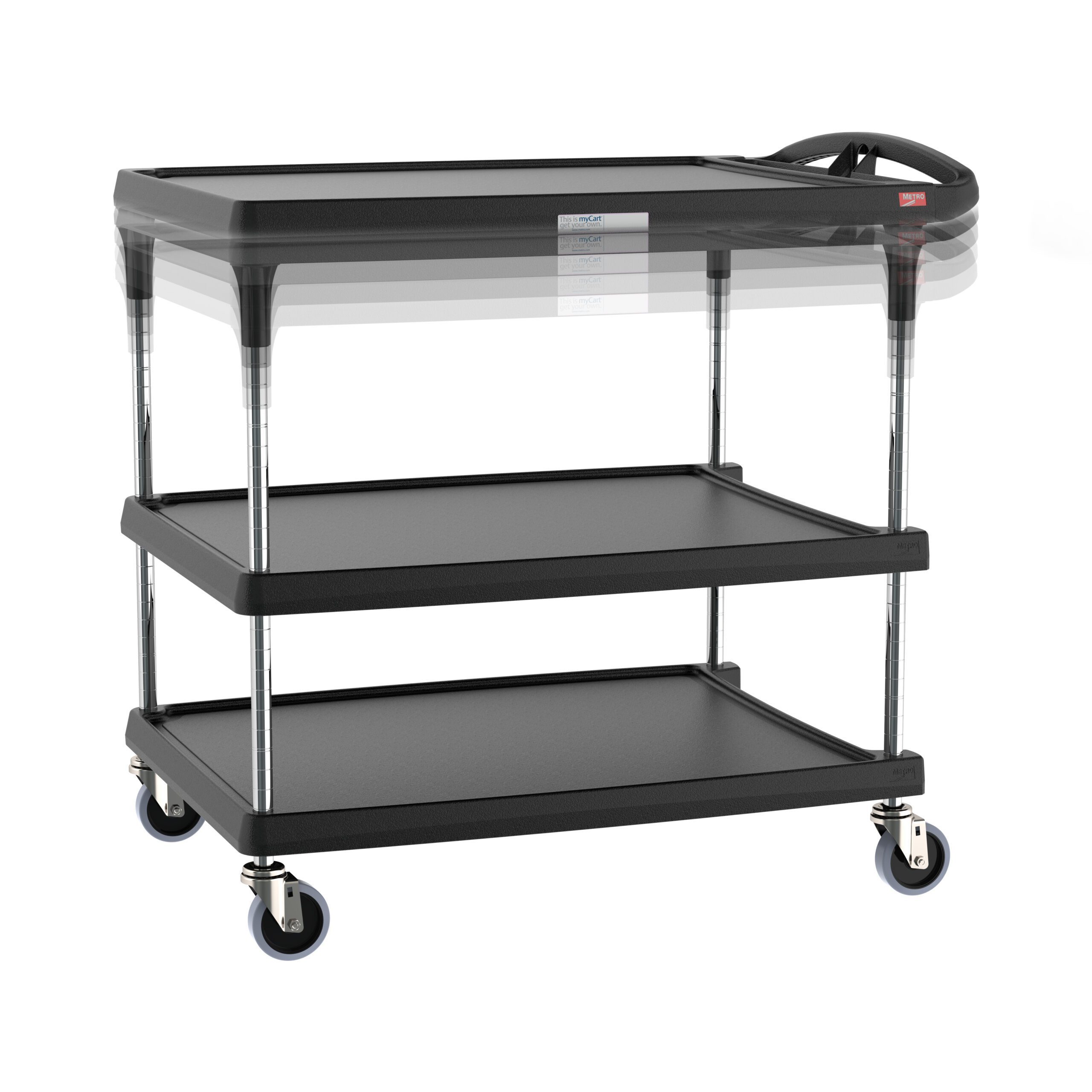
Metro Cart FAQs
What kinds of carts does Metro make?
What is the difference between a Metro wire cart and a Metro polymer cart?
Should I buy a two-shelf or three-shelf utility cart?
How do I size casters for a Metro cart?
Can Metro carts be washed down or run through a cart washer?
Does MH-USA stock Metro carts and ship outside Utah?
Get a Metro Cart Quote
Tell us what moves, how far, through which doors and how it gets cleaned. We will spec the cart, deck, casters and accessories and ship anywhere in the country.