
Quick Lube and Express Service Bay Storage
Filters, bulk oil, fluids and shop consumables have to sit within a few steps of a moving lane without blocking it. How to lay out storage for a quick-lube or express service bay so a technician never leaves the bay for a filter.

60 gal
Federal cabinet limit for Category 1–3 flammable liquids per approved storage cabinet
120 gal
Cabinet limit for Category 4 flammable liquids, per the same rule
“Used Oil”
The exact marking federal used-oil rules require on containers and tanks
0 steps
The design goal: no walk out of the bay for a routine filter or quart
The express lane fails at the storage, not at the wrench
A quick-lube or express service operation is a throughput business. The work itself — drain, filter, refill, check, top off, inspect — is short and highly repeatable, so the minutes that decide bay capacity are almost never spent turning a wrench. They are spent walking: to the filter shelf that is around a corner, to the wiper blade rack in the parts room, to the bulk oil area to find out whether the drum is empty, to a counter to ask someone else where the cabin filter went.
That makes storage design the single highest-leverage change in an express operation. A lane that stores its own consumables at the point of use runs on a different clock from one that shares a general parts room, and the difference shows up in cars per bay per day rather than in any single task time.
The constraint is that an express bay is also the most crowded floor in the building. There is a vehicle, a lift or a pit, a drain, hoses, a technician moving around the car and, in a drive-through layout, a second vehicle waiting. Storage has to be dense, wall-mounted or narrow, and it cannot creep into the vehicle path. This page covers how to plan that, and it sits inside our wider automotive storage solutions work for dealership and independent service operations.
Start with the short list a lane actually consumes
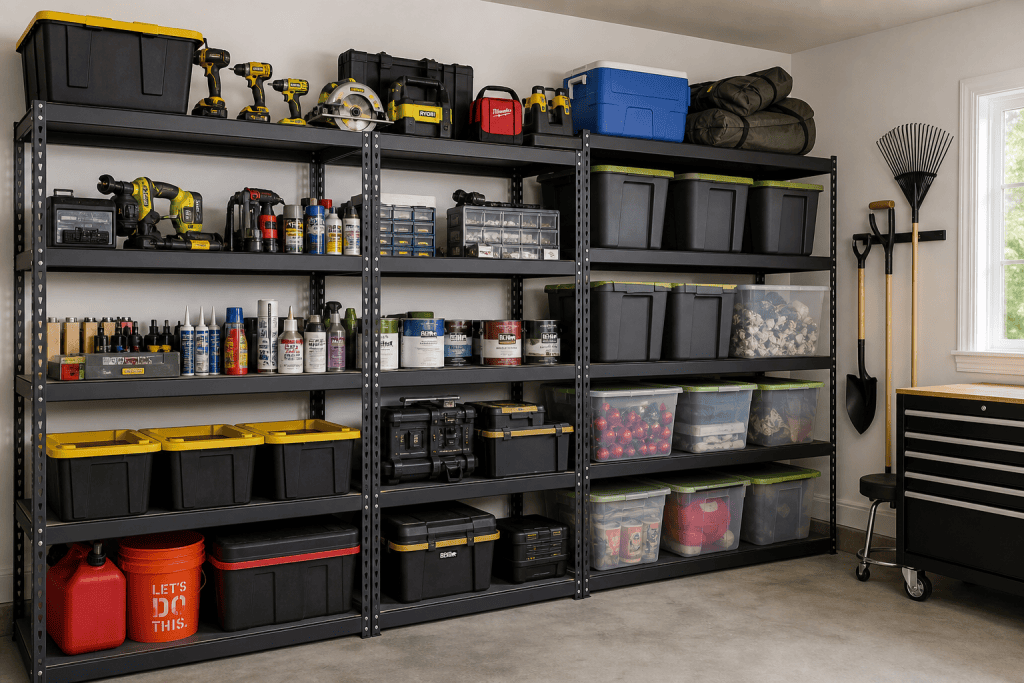
An express lane does not need the parts department in miniature. It needs a deliberately short list of high-frequency items, stocked deep, replenished on a schedule, and located so the technician never turns their back on the vehicle for long. Everything else stays in the main parts room and is delivered.
| Item group | Typical express-lane behavior | Storage that suits it |
|---|---|---|
| Oil filters and cartridge elements | Highest-frequency item; a small number of part numbers cover most of the car park, with a long tail behind them. | Labeled shelf bins or divided shelving at the bay, sized so the top movers get a full bin and the tail is delivered from the parts room. |
| Air and cabin air filters | Bulky, light, easily crushed, and heavily upsold at the lane. | Open shelving above waist height with divided openings; carton depth drives shelf depth, not weight. |
| Bulk and packaged motor oil | Dispensed by reel in mature operations, cased or bottled in smaller ones; heavy and a spill risk. | Contained drum or tank area with secondary containment, or floor-level shelving for cases with nothing stored above head height. |
| Other fluids — coolant, ATF, washer, brake fluid | Varied packaging, mixed hazard classes, some incompatible with each other. | Segregated shelving by fluid type with containment beneath; flammable classes go in rated cabinets, not open shelves. |
| Wipers, bulbs, drain plugs, gaskets, air fresheners | Small, cheap, high-shrink, and central to the express upsell. | Small-parts bins or a shallow drawer cabinet at the bay; each item gets a location and a par level. |
| Shop consumables — gloves, rags, absorbent, funnels | Consumed constantly and rarely counted until they run out. | One controlled supply point per lane group with a par level and a scheduled refill, not a pile on a bench. |
Stock the lane by demand, not by catalog
The list above is a shape, not a stocking guide. Build the actual lane list from your own repair-order history: rank filter part numbers by usage over the last several months, stock the ones that cover the bulk of your volume at the bay, and leave the tail in the parts room where it can be picked and delivered. Re-run that ranking each time the local car park shifts.
Laying out storage around a moving lane
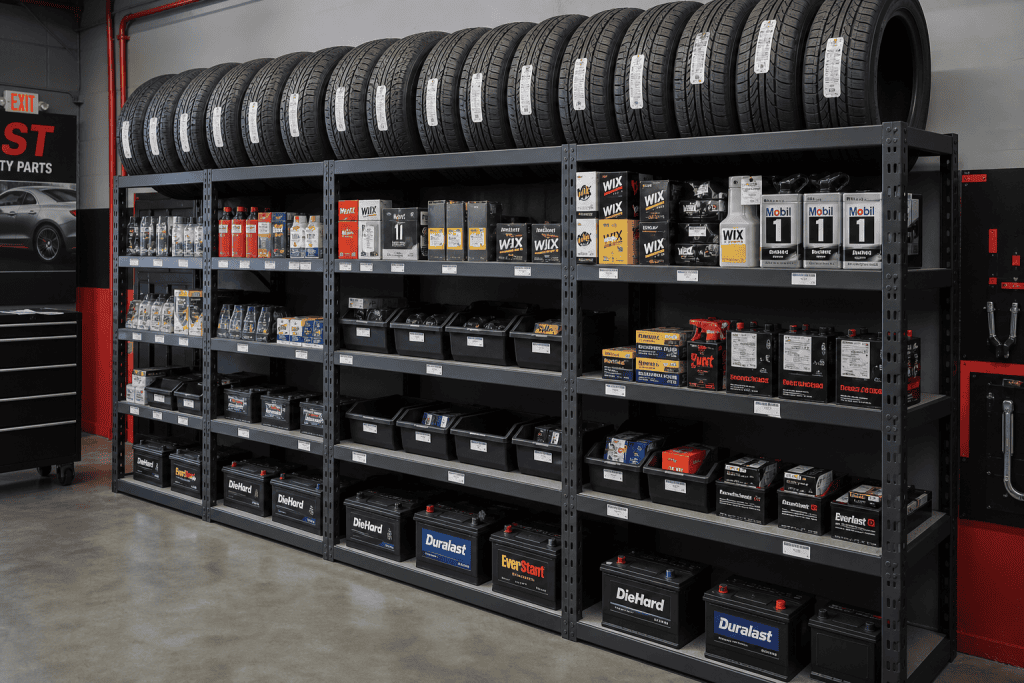
Express bays are usually built as drive-through lanes or as tight two-post arrangements with very little side clearance. Storage has to be planned as part of the vehicle path, not fitted around it afterwards.
- Everything wall-side and vertical. The usable storage in an express bay is the wall band between roughly knee and shoulder height, plus whatever is above the door line. Shallow shelving and cabinets hold far more useful stock there than a deep unit that eats floor.
- Nothing in the swing path. Door swings, hose reels, drain arms and lift arms all need clearance. Storage that has to be moved to work on a car will end up in the aisle instead.
- Keep aisles and exits clear by design. Federal rules require permanent aisles and passageways to be kept clear and in good repair, with no obstruction that could create a hazard, and exit routes must remain unobstructed. In practice, the cases of oil stacked “temporarily” beside a lane are the most common violation in a busy express operation — which means the real fix is a designed location that holds a full replenishment quantity.
- Stack for stability. Storage must be stacked, blocked or otherwise secured so it is stable and cannot slide or collapse. Cased oil and coolant on a bare floor is heavy, slick when it leaks, and stacks badly above waist height.
- Leave a replenishment path. The cart, pallet jack or hand truck that refills the lane needs a route that does not cross the customer vehicle path. Plan it on the same drawing as the storage.
Where the lane sits inside a larger service department, the bay storage should mirror the tooling plan — see our service department tool storage guidance — and the tail inventory should stay in parts room shelving with a delivery routine, rather than migrating out to the floor.
Bulk oil, fluids and the rules that shape the room
Fluid storage is where an express operation’s storage plan stops being a convenience question. A few federal requirements set hard boundaries on how much you can keep, in what, and where.
 Secondary containment under bulk containersDrums and totes of oil and fluids are normally staged on containment pallets or in bunded areas so a leak is captured rather than reaching a floor drain. Size the containment for the largest container in the area and keep the deck clear enough to inspect.
 Totes need a dispensing plan, not just a standA bulk tote saves handling only if it is on a stand that allows clean dispensing and inspection. Plan the fill route, the dispense point and the containment together, and keep the tote out of traffic and away from lift arms.
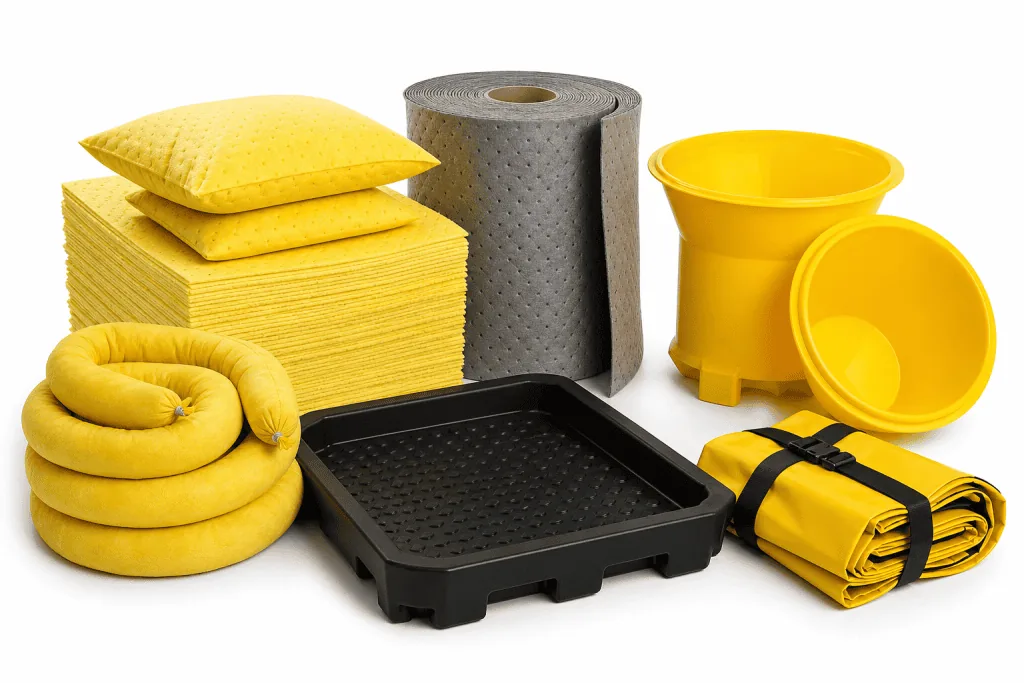 Absorbent and drip control at the point of useEvery fluid storage position should have absorbent and a drip tray within reach. It is the difference between a wipe-up and a floor drain incident, and it keeps the lane surface safe underfoot.
 Controlled consumables issueGloves, blades, adapters and specialty items disappear fastest in high-traffic express areas. A controlled issue point — a locked cabinet, a supply point or a vending unit — converts an unmeasured cost into a tracked one.
What the federal rules actually say

These are the provisions most often relevant when planning fluid and consumable storage in an express service area. They are quoted here as planning constraints; your local fire code, state programs and authority having jurisdiction may be stricter, and your own compliance program governs.
- Flammable liquid cabinets. Federal rules limit an approved storage cabinet to no more than 60 gallons of Category 1, 2 or 3 flammable liquids, or 120 gallons of Category 4 liquids. Cabinets must be labeled “Flammable — Keep Fire Away,” and metal cabinets are specified down to the detail: at least No. 18 gauge sheet metal, double walled with a 1½-inch air space, a three-point lock, and a door sill raised at least two inches above the cabinet bottom.
- Quantities outside cabinets. The same rules cap what may be held outside a cabinet or inside storage room in a fire area — including 25 gallons of Category 1 flammable liquids in containers, and 120 gallons of Category 2, 3 or 4 liquids in containers. Storage plans that ignore this end up non-compliant the day the shop buys in bulk.
- Used oil. Federal used-oil rules require generators to keep used oil in containers and tanks that are in good condition and not leaking, and to label or mark them clearly with the words “Used Oil.” That applies to the drain container in the bay as much as the tank outside.
- Hazard communication. Containers of hazardous chemicals must be labeled, and safety data sheets must be readily accessible to employees in the work area. Storage design should include where those sheets live and how a technician reaches them without leaving the lane.
- Housekeeping and stability. Aisles and passageways clear; storage stable and secure against sliding or collapse; floors kept in a clean and, so far as possible, dry condition.
Nothing on this page is a compliance determination. It is the planning input we use when we lay out a lane so the resulting storage does not put you at odds with the rules you already have to meet.
Planning an express lane or quick-lube build-out?
Send us the bay layout and your top consumable list. We will lay out bay-side shelving, cabinets, bins, fluid storage and the replenishment route as one package, and quote it against your drawing.
Request a Bay Storage Layout See all automotive storage solutions Call (800) 326-4403
Replenishment is the other half of the design
Set a par level for every bay-side location
Each bin, shelf opening and cabinet position gets a minimum and a maximum quantity that reflects a full replenishment cycle plus a buffer. Without a par level, a location is just a place things happen to be.
Label the location, not the product
Locations are permanent, products are not. A labeled position that outlives a part number change is what lets a new technician find a filter on day one and lets anyone replenish the lane.
Replenish on a schedule, from the parts room
A daily or shift-based top-up run beats a technician walking to the parts room mid-job. It also converts many small interruptions into one planned trip.
Deliver the tail, do not store it
Slow-moving filters and odd applications stay in the parts room. Where volume justifies it, they are staged for the day’s booked work rather than stocked at the lane.
Count what leaves the lane
Consumables with no issue record become invisible cost. A controlled issue point or a simple scan at the bay puts them back on the books.
Re-rank the lane list quarterly
Fleet mix, filter supersessions and service intervals shift. The stocking list should be reviewed against actual usage rather than left to age in place.
The storage systems that fit an express operation
Shop Delivery and Storage Supplies Online
These are related shipping supplies and material-handling products—not automotive storage systems. Confirm product fit and current availability on the product page.

Quick lube and express bay storage FAQs
What should be stored in a quick-lube bay and what should stay in the parts room?
How much motor oil and fluid can we keep inside the shop?
What are the storage requirements for used oil?
Do express bays need secondary containment?
How do we stop consumables from disappearing?
What is the best shelving for oil filters?
Can bay-side storage be added without a construction project?
Can you lay out a whole quick-lube build-out?
Design the lane around the storage, not the other way round
Material Handling USA plans, supplies and installs shelving, bins, drawer cabinets, rated cabinets, carts, fluid storage and containment for quick-lube, express service and full-service automotive operations nationwide.