
Storage for Independent Repair Shops and Body Shops
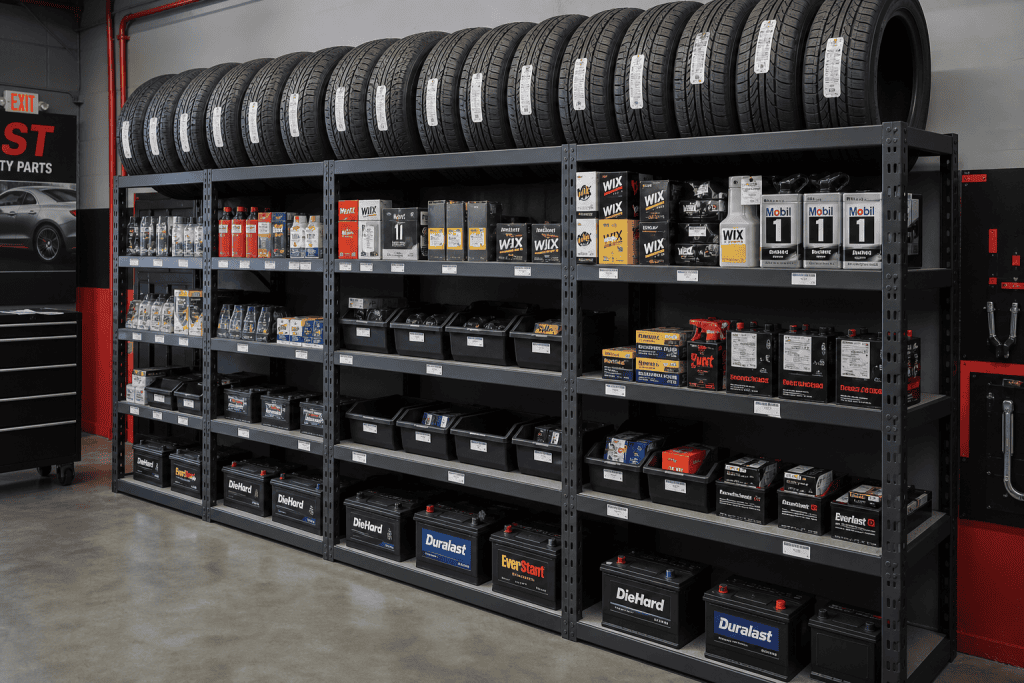
Shelving, bins and supply storage for shops without a parts department: how to organize a back room that holds special-order parts, shop consumables, wheels and chemicals in a few hundred square feet.
60 gal
OSHA cabinet limit for Category 1-3 flammable liquids
4
Zones every shop back room needs
1
Labeled location per stocked item
0
Parts that should live on the shop floor
An independent shop is not a small dealership
Most advice about automotive storage is written for a franchised dealership parts department: thousands of stocked part numbers, a dedicated parts staff, a DMS with bin locations, and a room designed for the purpose. An independent repair shop or body shop runs on a different model. It stocks very little, orders most parts for a specific vehicle in the bay right now, buys consumables in bulk, and stores it all in whatever space is left over after the lifts, the compressor and the alignment rack.
That changes the storage problem completely. The dealership’s challenge is density and inventory accuracy across a huge catalog. The independent’s challenge is staging and identification: knowing which of the seven boxes on the shelf belongs to the car on lift three, keeping consumables in one place so nobody runs a $120-an-hour technician to the parts store for a $4 clip, and storing chemicals in a way that will not embarrass you during an inspection.
The equipment answers are simpler and cheaper than a dealership build-out, which is the good news. What follows is a practical plan for shops with one back room, drawn from the same automotive storage systems we install in larger facilities, sized for a shop that has to solve it once and get back to work.
Four zones that fix most shop back rooms
Before buying shelving, divide the room. Almost every functioning shop back room has these four zones, even if nobody drew them on paper.
The single highest-return change in most shops is the first one. When special-order parts land on a general shelf, someone re-identifies them at install time, and eventually a part gets fitted to the wrong car or ordered twice. A run of shelving with one labeled position per active repair order — RO number on the label, nothing else in the space — costs a few hundred dollars and removes an entire category of mistake.

Choosing shelving for a shop back room
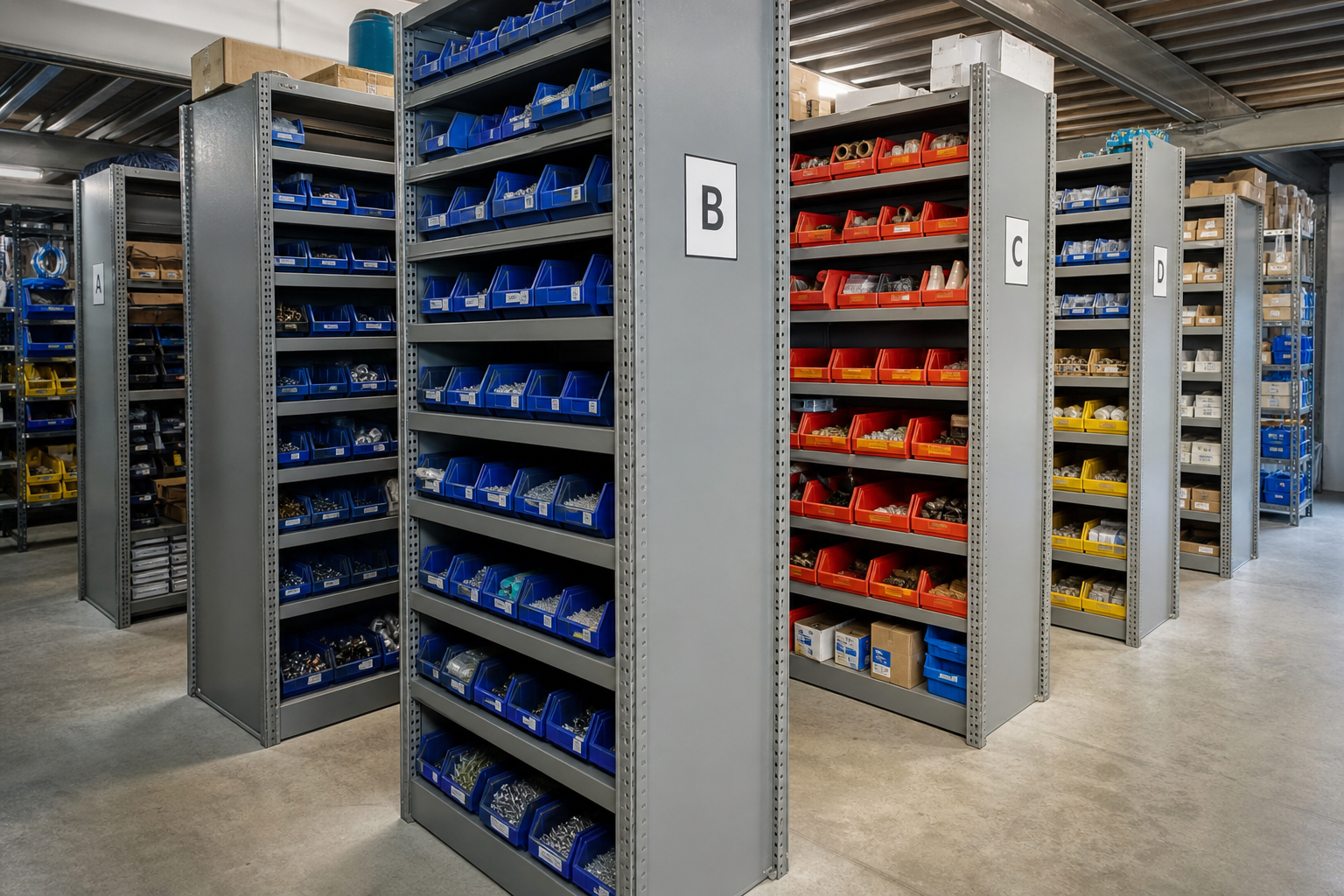
Three systems cover nearly everything an independent shop stores, and the choice is mostly about what you put on them.
Boltless (rivet) shelving is the default. It assembles without fasteners, adjusts on roughly one-inch increments, carries respectable loads on particleboard or wire decks, and costs less per linear foot than anything else that will survive a shop environment. Wire decks are worth the small premium where sprinklers are present or where you want light to reach the lower levels.
Closed steel shelving with back and side panels suits smaller boxed parts and keeps items from being pushed through the back of the unit. It looks more finished in a customer-visible area and is the usual choice for a proper parts room shelving layout.
Pallet rack only enters the conversation when you receive on pallets, store bulk oil, or need to stack heavy assemblies — and then usually as a single run along one wall. If you are hand-picking everything, rack is the wrong tool; see our pallet rack systems if pallets are genuinely part of your flow.
Whatever you pick, buy the depth that matches your parts, not the deepest available. Most shop back rooms are better served by 12- to 18-inch-deep shelving with more levels than by deep shelving where the back half becomes storage for things nobody remembers.

Consumables: bins, min/max and where the money leaks
Consumable storage looks trivial and is not. Clips, fasteners, abrasives, connectors, tape and sealants are individually cheap and collectively expensive, and a technician hunting for them is billing nothing. Two rules fix most of it.
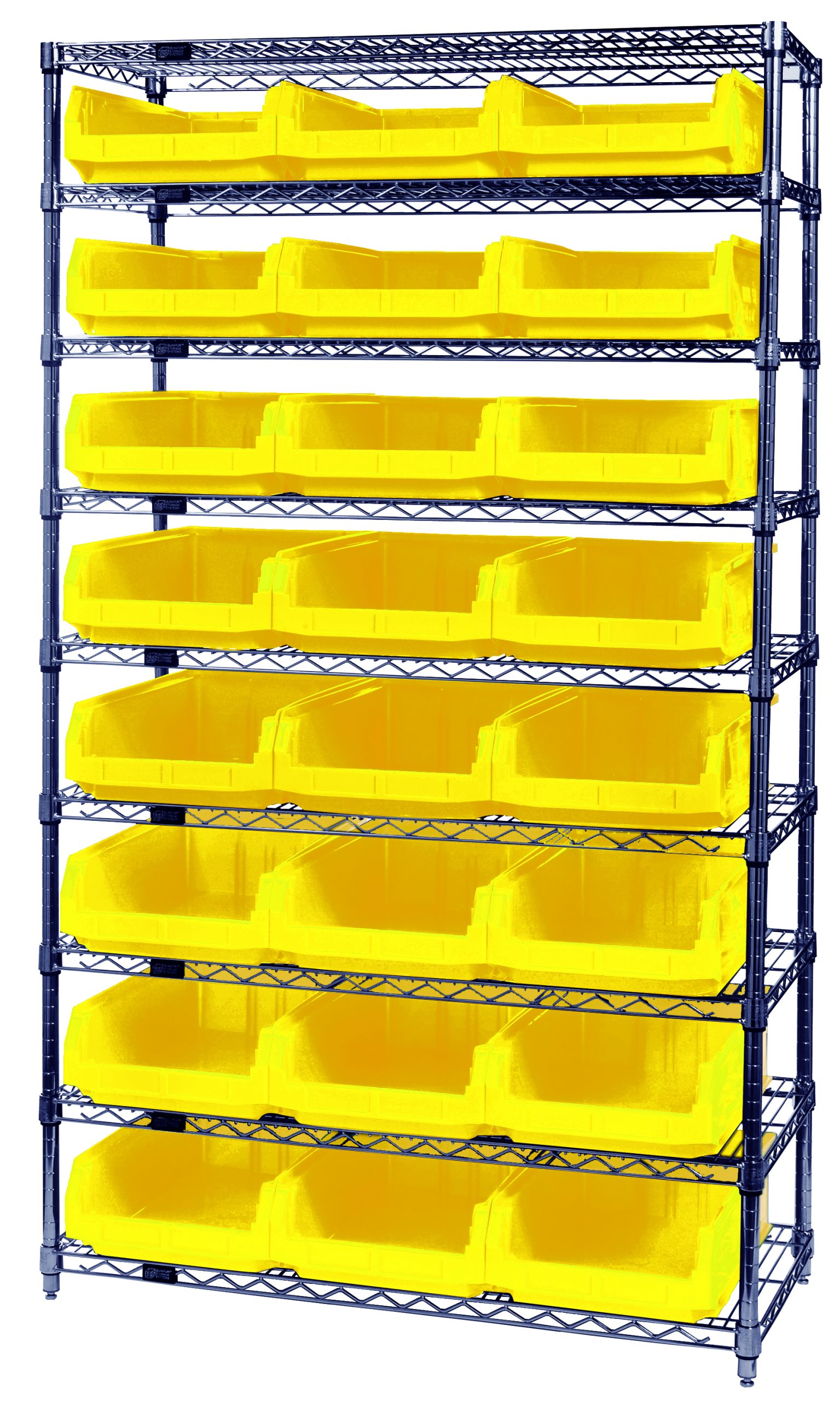
Give every consumable one visible home. Bin shelving or bin cabinets at the point of use, labeled on the bin front, sized so a full box of the item fits in the bin. If it does not have a home, it will be bought again next month.
Set a visible minimum. A line on the bin, a second smaller bin behind the first, or a simple reorder tag — anything that makes “we are nearly out” visible to the first person who notices rather than the last. Shops that adopt a two-bin habit stop making emergency runs almost immediately.
Consumables also make the strongest case for storing at the bay rather than centrally. If a technician uses an item on most jobs, it belongs within arm’s reach of the stall in a workstation or on a rolling tool cart, with the back room holding the bulk. Central storage of a daily item is a tax paid in walking.
Fluids, chemicals and waste: what the rules actually say
Body shops and repair shops store flammable liquids, paint materials, aerosols, new and used oil, and coolant. Storage for those is regulated, and the requirements are more specific than most shop owners expect. None of the following is a compliance determination for your facility — your state and local authority having jurisdiction may go further — but these are the federal baselines worth designing around.
- Flammable liquid cabinets. OSHA’s flammable liquids standard, 29 CFR 1910.106, limits a storage cabinet to not more than 60 gallons of Category 1, 2 or 3 flammable liquids, or 120 gallons of Category 4 liquids, and requires cabinets designed and constructed to limit the internal temperature to not more than 325°F in a standardized 10-minute fire test, with joints and seams remaining tight and the door remaining securely closed.
- Used oil containers. EPA’s used oil rules at 40 CFR 279.22 require containers and aboveground tanks at generator facilities to be in good condition — no severe rusting, structural defects or deterioration — not leaking, and labeled or marked clearly with the words “Used Oil.” Fill pipes to underground tanks carry the same labeling requirement.
- General storage stability. 29 CFR 1910.176 requires that stored material not create a hazard, that items stored in tiers be stacked, blocked, interlocked and limited in height so they are stable and secure against sliding or collapse, that aisles be kept clear, in good repair and marked, and that storage areas be kept free of accumulations that create tripping, fire, explosion or pest hazards.
- Hazardous waste accumulation. Waste paint, solvents, used antifreeze and contaminated rags are managed under hazardous waste rules with container condition, labeling, dating and accumulation-time requirements that vary by generator category and by state. Confirm your category and limits with your state environmental agency before you design the storage area.

What that means for the layout
Put the flammable cabinet where it is reachable from the mixing or dispensing point but not in an egress path. Keep new fluids and waste fluids visibly separate — different zone, different labeling, ideally different side of the room — because the failure mode is somebody topping off a car from a waste drum or pouring good oil into a waste container. Store cased fluids low: a case of quarts is heavy, and it is the classic overhead-shelf injury in a shop.
Give waste containers a defined footprint marked on the floor, with room for the pickup vendor to get a drum dolly in. If the containers migrate, the labeling and dating discipline goes with them.
Wheels, tires and bulky panels
Two categories break shelving in shops: customer wheels and tires, and body panels.
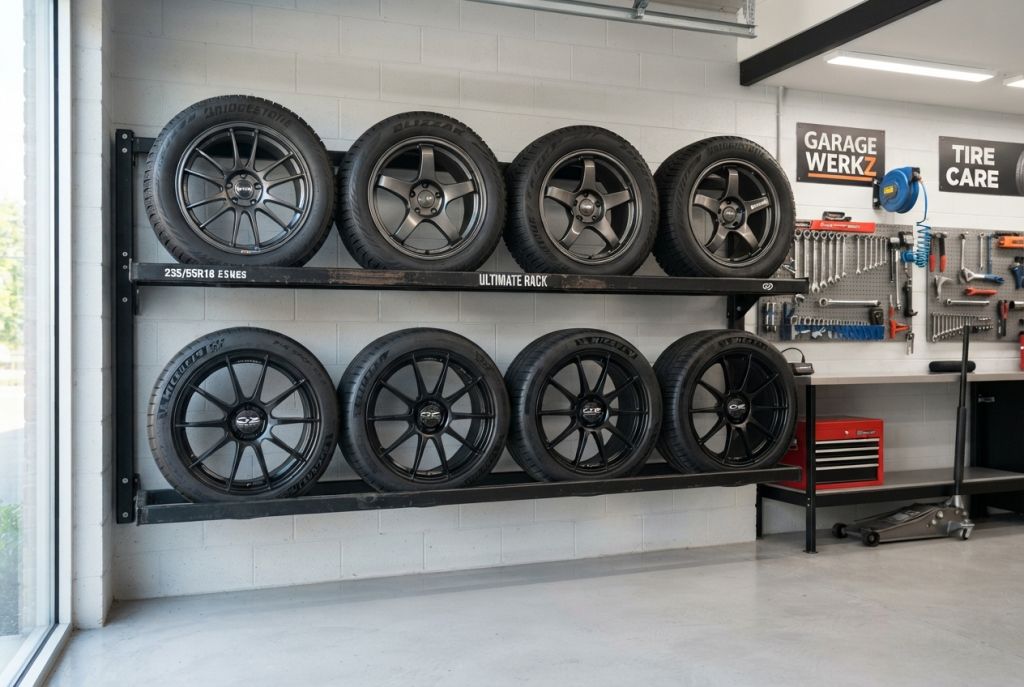
Wheels and tires stored on general shelving destroy the shelf economics — they are heavy, round and consume enormous cubic space. Purpose-built tire racks or wall-mounted wheel racks keep them off the parts shelving and off the floor, and make the seasonal changeover pile manageable. Where tire storage is a real business line rather than an occasional inconvenience, our tire storage systems page covers the higher-density options.
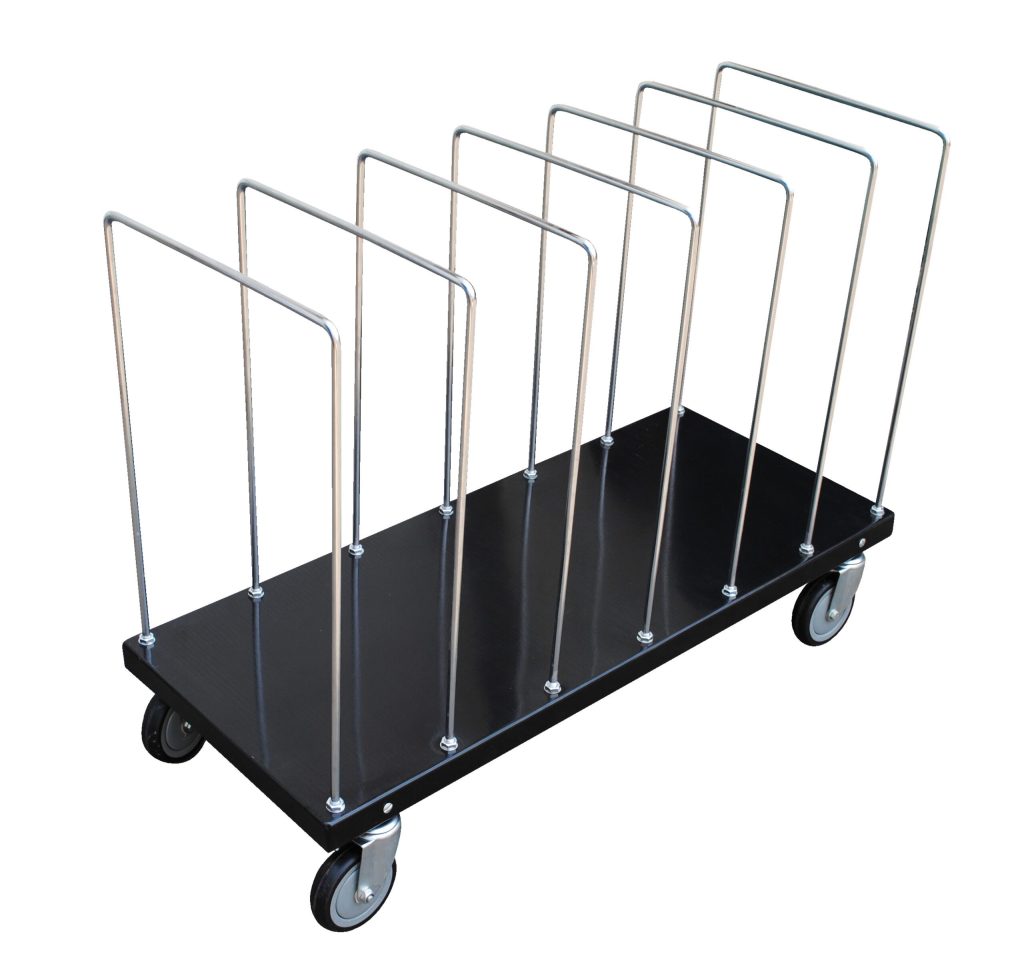
Body panels, bumper covers and glass need vertical or cantilevered storage, not shelves. A bumper cover on a shelf takes the space of a dozen boxed parts and gets damaged anyway. Body shops that solve this well store covers vertically in padded racks near the paint prep area, with a labeled position per repair order — the same job-staging logic as the parts shelf.
Both categories argue for keeping general shelving shallow and dedicating a separate, purpose-built run to the awkward items. Trying to make one shelving system do everything is what produces a back room where nothing fits properly.
A one-day plan for reorganizing a shop back room
Most independent shops cannot close for a week to fix storage. This sequence fits a slow Friday and a Saturday morning.
Empty and sort
Pull everything out. Sort into: stocked items, job-specific parts, consumables, cores/returns, and obsolete. Be ruthless with the last category — parts for cars you no longer service are costing you space every day.
Measure the room and the parts
Wall lengths, ceiling height, door swings, and the depth of the deepest thing you actually stock. Shelving depth and level count come from this, not from a catalog.
Assign the four zones
Mark them on a sketch: staging, fast movers, consumables, returns and waste. Put staging where the technicians walk, not where the space happened to be free.
Install shelving and label first
Sections lettered, levels numbered, labels on before anything is put away. A location that is not labeled is not a location.
Load by frequency
Fast movers at waist to chest height; heavy and cased items low; rare items high. Leave one empty section, deliberately, for growth and for the parts that arrive tomorrow.
Set consumable minimums
Mark a minimum line on every consumable bin and name one person who orders when a line shows. This is what keeps the reorganization from decaying in six weeks.
Want a layout for your shop before you buy shelving?
Send dimensions, a couple of photos and what you stock, and our team will lay out the shelving, bins and fluid storage for your room — and tell you the cheapest way to get there.

When a shop outgrows shelving
A few signals mean the back room has stopped being a shelving problem:
- Parts are staged in the bays because there is no room in the back. That is lost bay capacity, which is far more expensive than storage.
- You stock enough to need real inventory control — at that point bin locations, counts and a system of record start mattering the way they do in a dealership parts department.
- The ceiling is empty above eight feet. Taller shelving with pick steps, or a small mezzanine, is usually cheaper per square foot of gained storage than leasing more building.
- Consumable spend keeps climbing without a matching increase in car count, which points to shrink and duplicate ordering rather than usage.
Those are the same thresholds that lead multi-bay shops toward MRO and consumables storage systems and toward the denser storage used in dealership parts rooms. There is no rule that says an independent shop has to build like a dealership — but the transition is worth planning before the back room forces it.
Shop Related Automotive Parts-Room Products
These catalog products support parts organization and handling; they are not a custom-designed automotive storage system. Confirm specifications and project suitability before ordering.
Repair shop and body shop storage questions
What shelving is best for an auto repair shop?
How should a body shop store paint and chemicals?
How do we stop losing special-order parts?
Where should customer wheels and tires be stored?
How much storage space does a small shop need?
Is a mezzanine worth it for a repair shop?
Get it laid out once
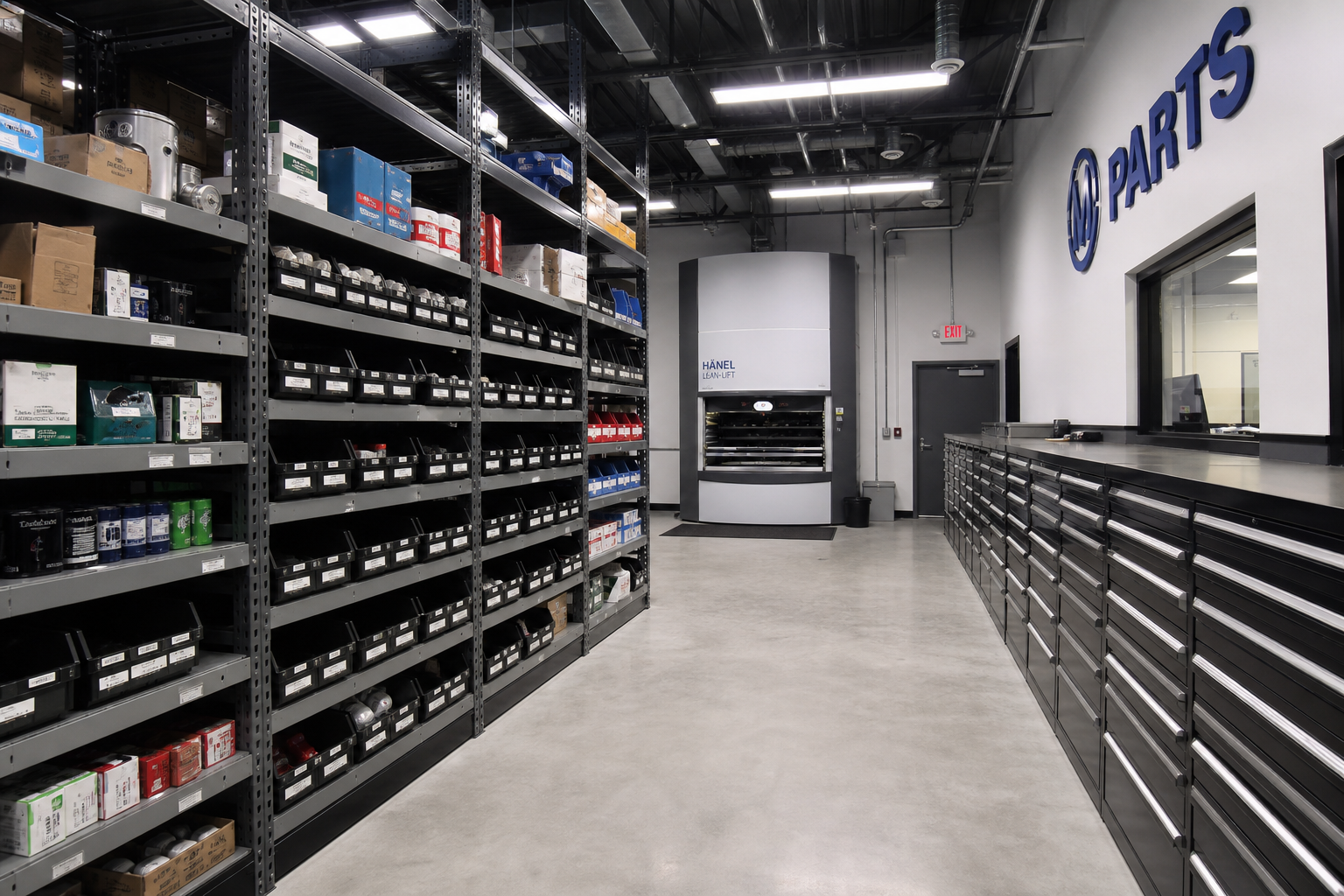
MH-USA has planned automotive storage since 1997, for shops from two bays to full distribution centers. For an independent shop the engagement is usually short: dimensions, a photo or two, a list of what you stock, and a layout with shelving, bins and fluid storage priced out. No design fee, and no attempt to sell a dealership-scale system to a five-bay shop.
Where a decision depends on your building — anchoring, seismic requirements, sprinkler clearances, mezzanines or code-driven chemical storage — we will tell you plainly that it needs an engineer or your authority having jurisdiction rather than guessing on your behalf.
Organize your shop’s parts and supply storage
Send us your back room dimensions and what you stock — we will send back a layout and a quote.