
Body Shop Paint Mixing Room Storage
How to store toners, clears, hardeners, reducers and refinish consumables in a collision shop mix room — shelving that fits the cans, the code questions that decide the room, and a layout that keeps color work fast and inventory from expiring.

The mix room is a regulated room
Fire code treats mixing rooms as a defined, limited-size space with containment and ventilation
Cabinets have quantity limits
Federal rules cap how much flammable liquid a storage cabinet may hold and how many cabinets sit in one fire area
Inventory expires
Toners and activated products have shelf lives — storage order is what stops write-offs
Consumables are the hidden pile
Masking, abrasives, cups and clips outgrow the mix room before the paint does
Why the mix room outgrows itself
Almost every collision shop starts with a mix room sized for the paint line it had when the room was built.
Then the shop adds a second line, an OEM certification, waterborne basecoat alongside solvent clears, a bigger
range of toners, and a wall of consumables that has nowhere else to live. The room that was tidy at
installation is now a place where a technician moves three cans to reach a fourth, where a hardener is bought
twice because nobody saw the one behind the reducers, and where a spill would not be contained by anything.
Body shop paint storage is a slightly different problem from general parts storage. The inventory is
liquid, flammable in most cases, dated, sensitive to temperature, and handled dozens of times a day at a bench
where speed matters. Storage decisions therefore have to satisfy three masters at once: the fire code and OSHA,
the paint manufacturer’s own handling and storage instructions, and the painter who needs to find a toner in
seconds.
This page covers the storage side of the mix room in detail. It sits inside our broader
automotive parts storage systems guidance, and pairs with our
repair and body shop storage page, which covers the rest of the back-of-house.
What the rules actually say about mixing rooms and paint storage
Adopted codes and editions vary by jurisdiction, so treat the table below as the list of questions to ask
your fire marshal and building department — not as a determination for your building.
| Source | What it addresses | Why it changes the storage plan |
|---|---|---|
| NFPA 33, Standard for Spray Application Using Flammable or Combustible Materials | Defines the mixing room used with spray application operations, including a limit on mixing room floor area (commonly cited as not exceeding 150 square feet), construction, spill containment and ventilation requirements. | The room’s size is capped, so the answer to "we need more room" is usually denser and better-organized storage inside the same footprint plus compliant storage elsewhere — not a bigger mix room. |
| OSHA 29 CFR 1910.107, Spray finishing using flammable and combustible materials | Covers spray booths, ventilation, electrical classification, and the storage and handling of flammable and combustible liquids in connection with spray finishing operations. | Determines what may be kept in the spray area versus the mix room versus a separate storage room, and what the electrical and ventilation environment around your storage has to be. |
| OSHA 29 CFR 1910.106(d)(3), Flammable liquids — storage cabinets | Limits quantity per storage cabinet: not more than 60 gallons of Category 1, 2 or 3 flammable liquids, or 120 gallons of Category 4 liquids, and not more than three such cabinets in a single fire area (with an exception for certain separated areas in industrial occupancies). Also sets cabinet construction and labeling requirements. | This is the number that decides how many cabinets you need and where they can go. Buying one more cabinet is not always compliant; sometimes the answer is an inside storage room. |
| OSHA 29 CFR 1910.106(e)(6)(ii), transfer of Category 1 liquids | Requires bonding or grounding of containers when Category 1 flammable liquids are transferred from one container to another. | Applies at the mixing bench and anywhere solvent is decanted — the bench design, not just the shelving, is part of compliance. |
| OSHA 29 CFR 1910.1200, Hazard Communication | Requires labeling of containers, accessible safety data sheets and employee training on the chemicals in the workplace. | Secondary containers and mixed material need labeling, and the SDS library has to be reachable from where the material is stored and used. |
| EPA 40 CFR 63 Subpart HHHHHH (the area source "6H" rule) | Applies to paint stripping and miscellaneous surface coating at area sources, including motor vehicle refinishing, with requirements such as enclosed spray gun cleaning and trained, certified painters. | Gun cleaning equipment and its waste containers need a planned, contained home — frequently taken out of the mix room’s usable storage wall by default. |
| EPA 40 CFR 273, Universal Waste | Includes hazardous waste aerosol cans as a universal waste category with accumulation and container requirements. | Waste aerosols need their own labeled, closed container and a storage spot, which competes for the same floor as everything else. |
| Paint manufacturer technical data sheets | Each product line publishes its own storage temperature range, shelf life, agitation requirements and compatibility guidance. | The TDS — not a general rule of thumb — sets the temperature band your mix room has to hold and how long stock may sit. |
Planning guidance, not a code determination
Occupancy classification, control areas, maximum allowable quantities, sprinkler design and ventilation are engineering and code questions specific to your building. Use this page to prepare the conversation with your fire marshal, insurer and paint supplier — then design the room around their answers.
Choosing shelving that fits refinish inventory

Mix room storage fails for a boring reason: shelf openings that do not match the container sizes. Refinish
inventory arrives as pints, quarts, gallons and five-litre or five-gallon pails, plus aerosols, and each of
those wants a different opening height. When every shelf is set at one spacing, half the room is wasted air
and the other half is a can wedged sideways.
- Set spacing by container, not by habit. Measure the tallest can in each family, add
clearance for lifting, and set shelf levels in bands: quarts and pints on close-spaced upper levels, gallons
mid-height, pails low. - Put weight low. Pails and cases belong at or below waist height. This is a handling and a
stability decision: OSHA 1910.176(b) requires stored material to be stacked and secured so it is stable and
secure against sliding or collapse. - Keep the picking face shallow. Deep shelves bury toners. For can storage, a shallower shelf
with more levels beats a deep shelf every time — you want one can deep wherever possible. - Front lips and dividers. Cans walk when a shelf is bumped. Lipped shelves, dividers or a
retaining bar keep them on the shelf and keep families separated. - Choose a finish that survives solvent. Powder-coated or coated steel wipes clean; bare
particle board decking absorbs whatever gets spilled on it. - Plan for scale-side staging. The bench needs a small, deliberate parking spot for the cans
in the current mix, or they end up on the floor.
For the shelving families themselves, our parts room shelving and
Borroughs automotive shelving pages cover the steel systems that suit a collision shop, and
bin shelving covers the small-parts side.
Cabinets, rooms and where the flammables actually go
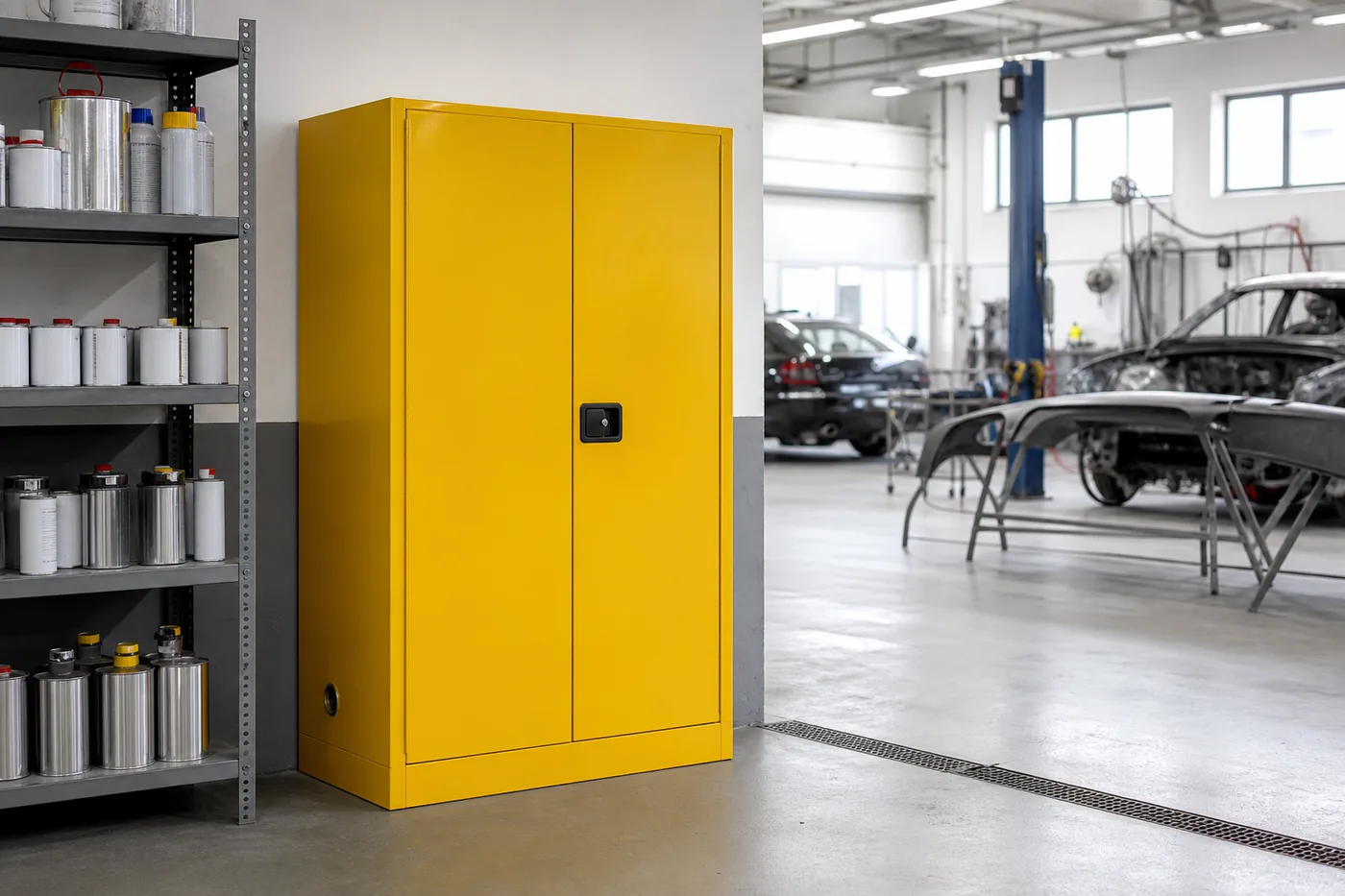
The most common mix room mistake is treating a safety cabinet as unlimited storage. It is not: it is a
defined quantity in a defined fire area, and once the shop passes that quantity the correct answer changes from
"another cabinet" to "a designed storage room."
Store the paint carousel question early
Shops with very large toner ranges sometimes move can storage into vertical equipment to reclaim floor area. If that is on the table, raise it before the room is laid out, because it changes clearances, ventilation and electrical planning. Our vertical storage for paint and coatings page covers that option.
A layout that matches how a color job actually runs
Watch a painter build a formula and the storage plan writes itself: the same forty to sixty containers get
touched constantly, a long tail gets touched monthly, and the consumables get touched by everyone in the
shop, not just the painter.
Zone by touch frequency, not by product family
Keep the working toner range and the current clear, hardener and reducer within one step of the scale. Alphabetical or supplier order looks tidy and costs steps all day.
Give the bench a clear working surface
Nothing lives permanently on the mixing bench except the scale and the equipment that has to be there. Everything else has a labeled home within reach.
Separate slow-moving and specialty stock
Low-turn toners, tinted specialty products and OEM-specific materials can sit on the higher or further shelving. They still need to be visible; they do not need to be closest.
Move consumables out of the mix room
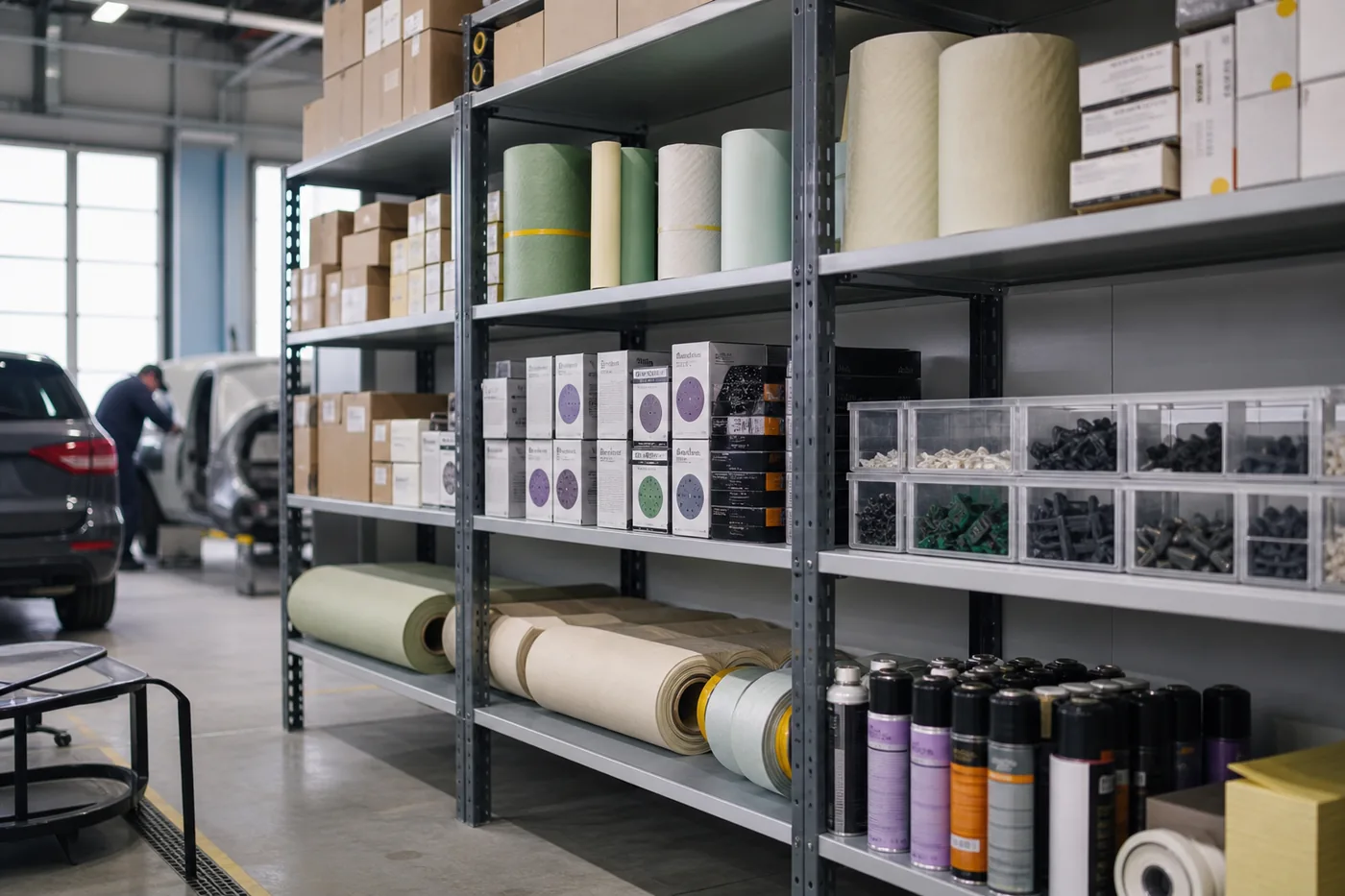
Masking paper, film, abrasives, mixing cups, sticks, filters, tape and gloves outgrow the mix room fast. Put them on boltless shelving in an adjacent supply area with min/max levels, and the mix room stays a paint room.
Label the location, not just the product
A location label on the shelf edge means anyone can put stock away correctly. Without it, put-away accuracy depends on one person’s memory.
Rotate dated stock on receipt, every time
New material goes behind, not in front. Rotation done at the receiving step is the entire shelf-life control system; a quarterly cleanup is not.
Review the room quarterly against the actual formula mix
Color popularity shifts, product lines change, and the front-row range should be re-picked with the paint rep rather than left as it was on install day.
Want the mix room and supply area laid out before you buy shelving?
MH-USA lays out collision shop paint storage, mix rooms and back-of-house supply areas across Utah, Idaho, Nevada and the Mountain West, and supplies the shelving, cabinets, benches and bins to match.
Shelf life, temperature and the write-offs nobody budgets for
Refinish inventory is money with an expiry date. The write-offs are rarely dramatic; they are a hardener
found behind a reducer, a toner that gelled after a cold weekend, a partially used clear that nobody trusted.
Storage is the control.
- Hold the temperature band the product data sheets require. Mix rooms on an exterior wall
in the Intermountain West swing hard between a July afternoon and a January morning. Waterborne materials in
particular have a freezing risk. Our parts room climate, humidity and corrosion page covers
how to think about a conditioned storage space. - Date on receipt. Received date plus manufacturer date makes rotation obvious to everyone,
not just the person who ordered it. - Front-face and rotate. A shelf that is faced daily reveals the gaps and the overstock
without a report. - Set min/max on consumables. Masking, cups, filters and abrasives are the categories that
get both stocked out and over-ordered in the same month. - Keep opened material in one place. A defined shelf for opened, still-usable material stops
part-cans from being buried behind sealed stock and re-ordered. - Deal with dead stock deliberately. Discontinued and superseded material takes prime shelf
space for years. Our obsolete parts, returns and core storage page covers the same discipline
on the parts side.
Shop Flammable Liquid Storage Cabinets Online
Listed flammable liquid storage cabinets (60- and 30-gallon) and replacement shelves for paint, solvent and refinish materials. Buy online, or ask us to size the cabinet count to your fire area.



How big can a body shop paint mixing room be?
How much paint can I keep in a flammable storage cabinet?
What shelving works best for paint cans in a mix room?
Where should body shop consumables be stored?
Does the mix room need to be temperature controlled?
How do we stop paint inventory from expiring on the shelf?
What has to be labeled in a paint storage area?
Can we store paint in the spray booth or the shop floor instead?
Design the mix room around the inventory you actually carry
Send us your toner range, container mix, consumable list and the room dimensions. MH-USA will lay out compliant, workable paint and consumable storage for your collision shop and quote the shelving, cabinets and benches to match.