
Home › Storeganizer › Case Studies › Chalhoub Group
Chalhoub Group — from 8,611 sq ft of mezzanine shelving to 1,335 sq ft of pocket columns
A luxury-goods distribution operation more than doubled its pick rate and cut the floor area holding the same inventory by roughly 85%.

46
bays, three rows deep
828
pick modules
60–80
pick lines per hour
~30%
operational efficiency gain
The situation
| Project profile | |
|---|---|
| Industry | Luxury goods retail distribution |
| Application | High-SKU-count beauty, fragrance and fashion distribution |
| System | Storeganizer high-density textile pocket columns in existing pallet rack |
| Source | Results as reported by the operation and its Storeganizer manufacturer, KTP conTeyor |
Chalhoub Group distributes luxury beauty, fragrance and fashion products across the Middle East from roughly 860,000 square feet spread over 12 sites. Its small-item inventory sat on static mezzanine shelving occupying about 8,611 square feet — a floor of shelving that pickers walked, level by level, to assemble orders of small, high-value items.
Static shelving on a mezzanine is a reasonable answer to a small-parts problem right up to the point where SKU count grows. Then it becomes two problems at once: the shelving is consuming an expensive floor, and the pick route across it is getting longer every time a product line is added.
What was installed
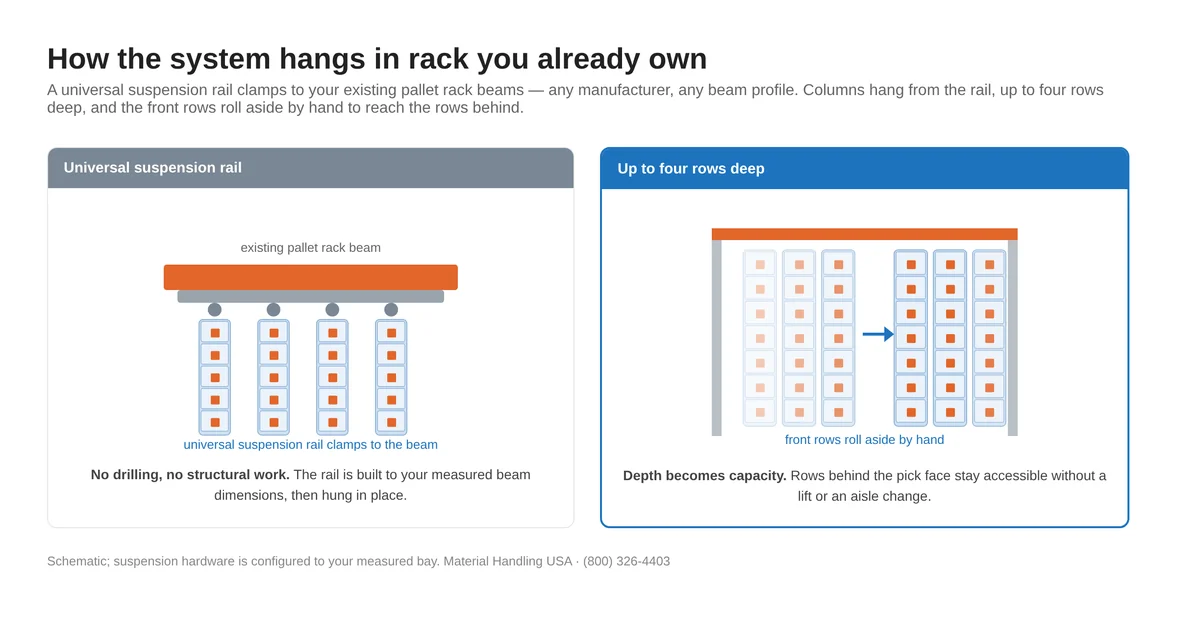
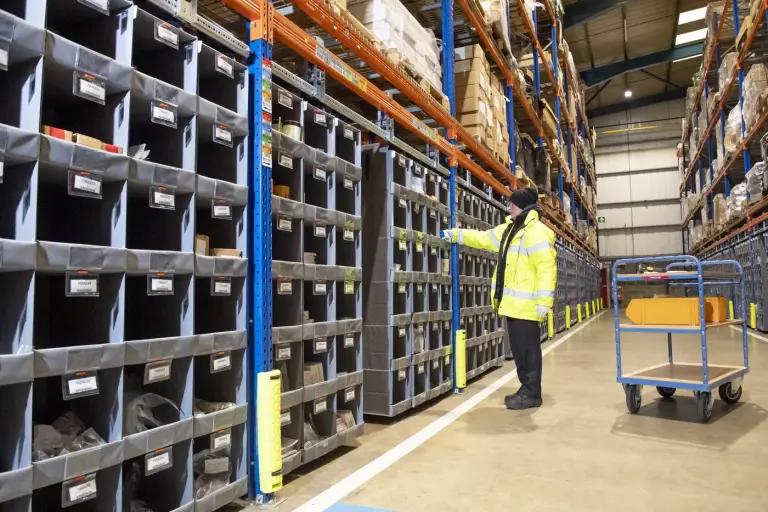
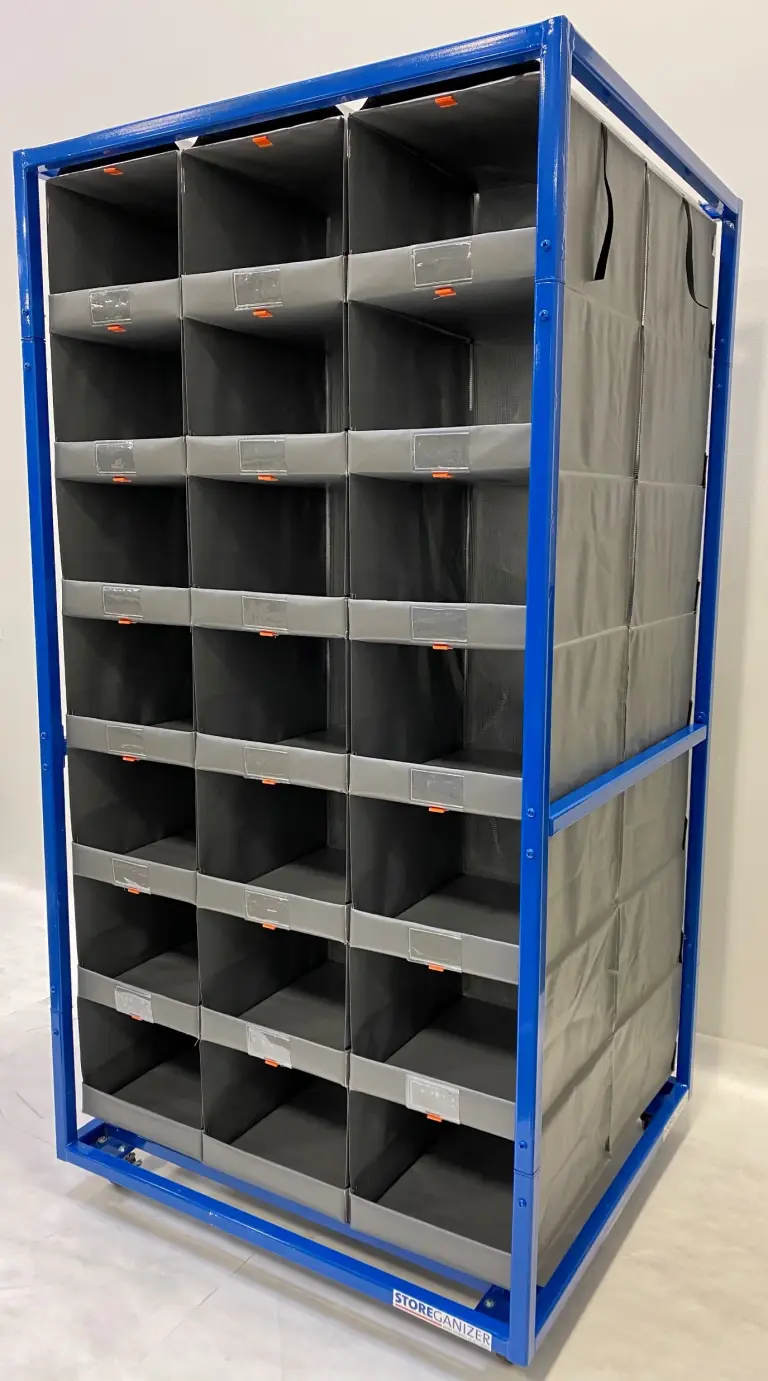
The mezzanine shelving was replaced with 46 Storeganizer bays, three rows deep and six columns high — 828 pick modules. Each SKU received its own pocket, and the front rows roll aside by hand so the rows behind stay reachable from the same standing position.
The relevant change is not that the inventory got smaller. It is that the walking did. Concentrating 828 pick modules into 46 bays means the same order lines are gathered from a pick face measured in feet rather than a mezzanine measured in thousands of square feet.
Reported results
| Measure | Before | After |
|---|---|---|
| Floor area holding the inventory | 8,611 sq ft of static mezzanine shelving | 1,335 sq ft of pocket columns |
| Pick rate | 25–30 lines per hour | 60–80 lines per hour |
| Operational efficiency | Baseline | Up approximately 30% |
| Staffing in the zone | Baseline | Two fewer full-time staff needed |
| Mispicks | Several SKUs sharing shelf locations | Fewer, with one SKU per pocket |
“With static shelving we could do 25-30 picklines per hour, with Storeganizer we can do now 60-80 picklines per hour.”
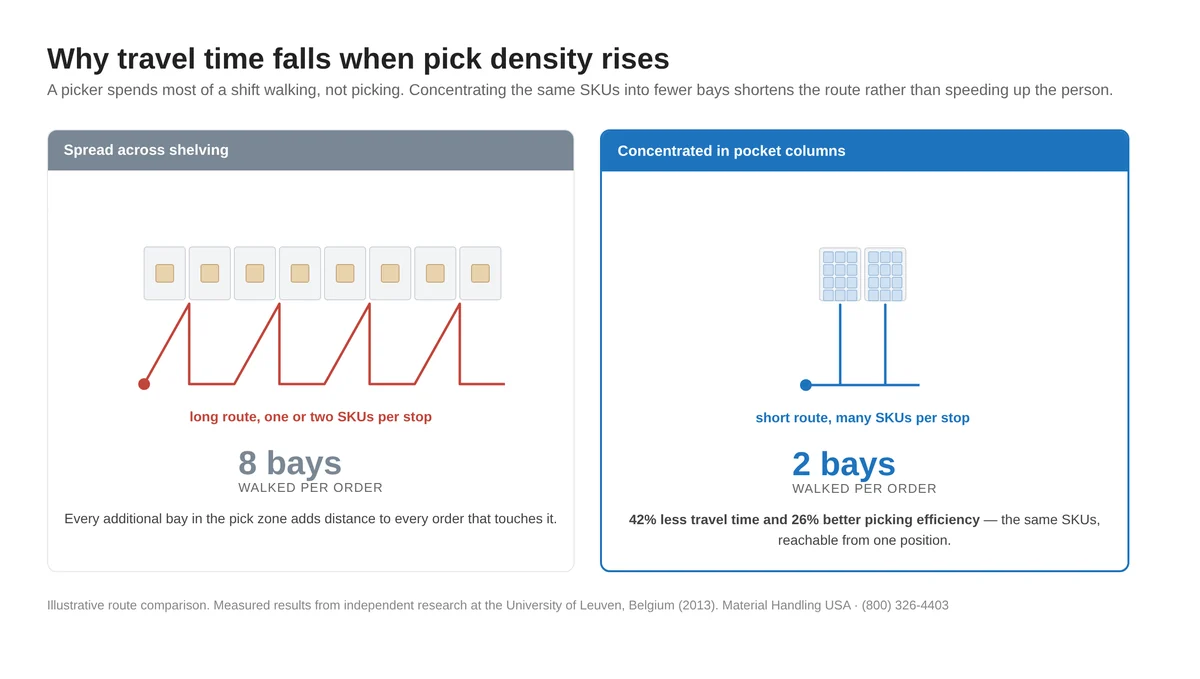
Doubling a pick rate does not come from pickers moving faster. It comes from removing the walking between picks — which is why the floor-area figure and the pick-rate figure in this case are the same fact reported two different ways.
The two fewer full-time staff is worth reading carefully. In most operations that capacity gets redeployed rather than removed, because the constraint was never the people; it was how far they had to walk to reach the next line.

What this means for a US operation
Every warehouse is different, and a result reported elsewhere is evidence rather than a forecast. These are the transferable parts:
- Static shelving on expensive floor is the clearest conversion case there is. If small items are occupying a mezzanine, both the space and the travel are being paid for twice.
- Three rows deep is normal, not aggressive. Depth becomes capacity when the front rows move by hand.
- One SKU per pocket is the accuracy mechanism. It shows up in every case where look-alike items previously shared a location.
The measured averages behind these cases — around 40% more usable space, 42% less travel time and 26% better picking efficiency — come from independent research at the University of Leuven, Belgium (2013), comparing Storeganizer with conventional rack and shelf. To see what the same arithmetic produces in your own bay, use the Storeganizer Configurator or ask us to run the numbers with you.
Why this inventory profile suits pocket columns
The transferable part of any case study is the profile, not the logo. These are the characteristics that made this operation a good candidate — and they are the ones worth checking against your own inventory before you consider a conversion.
How a conversion like this runs
Four steps, and none of them involve construction. The sequence matters: the slotting analysis comes before the measurement, and the count comes before the order.
Profile the SKUs
We look at item size, stock depth and order frequency for the zone in question — the three properties that decide whether a pocket is the right home for a part.
Measure the bays
Inside width, inside depth, clear height and beam profile. The suspension rail is then manufactured to those dimensions.
Configure and count
Pocket sizes are selected per SKU group and the location count is calculated before anything is ordered.
Install and slot
Columns hang from existing beams in an operating warehouse — no drilling, no anchoring, no permit drawing — then stock is slotted in.
We handle all four in the United States, including the install. Because the system is maintenance free — no motors, no controls, no annual service contract — there is nothing scheduled after handover.
Questions about this project
How much floor space did Chalhoub save?
How much did picking productivity improve?
How deep and high was the installation?
Does replacing mezzanine shelving mean removing the mezzanine?
Related reading
 Improving order-picking efficiencyTravel is the biggest consumer of a picker’s shift. See how a denser pick face cut travel 42% and lifted picking…
 Retail backroom and BOPIS storageDense, labelled backroom storage plus the mobile Picking Hive for BOPIS, curbside staging and returns. Standard US…
 Warehouse mezzaninesShop industrial mezzanine from Material Handling USA. In-stock options, professional installation, and nationwide…
 All Storeganizer case studies and measured results8,611 sq ft consolidated into 1,335. Picking from 25-30 to 60-80 lines per hour. 4,000 SKUs in 16 bays. Attributed…
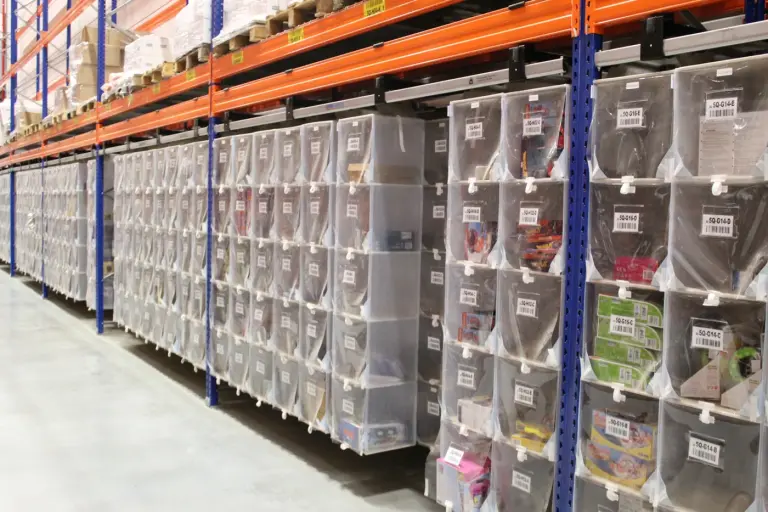 Storeganizer high-density pocket storage overviewStoreganizer turns unused pallet rack into hundreds of small-parts pick faces – 40% more usable space, 42% less…
Could your rack do this?
Tell us the bay dimensions and the SKUs giving you trouble. We will come back with a configuration, a location count and an honest view of whether a conversion is worth it.