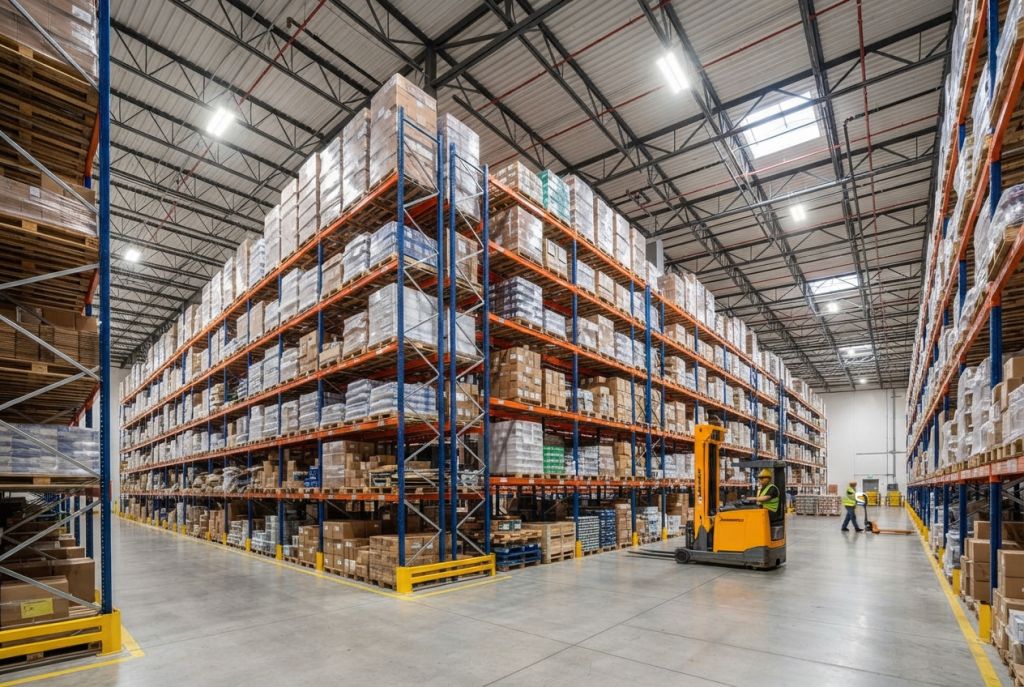
A pallet rack upright is a vertical frame assembly forming one side of a rack bay. Its columns and bracing work with the beams, connectors, base plates and anchors to support the designed loading. Selecting uprights requires more than a height and a familiar hole pattern. This guide explains the component information, load details and professional review needed to choose or replace frames and plan their installation.
What Is a Pallet Rack Upright and Why It Matters
Think of your pallet racking like a skyscraper. The horizontal beams are the floors, and your inventory is everything inside. The pallet rack uprights are the massive foundational columns holding it all together. If those core supports are weak, incorrectly chosen, or damaged, the entire structure is at risk. That same principle applies to your warehouse storage.
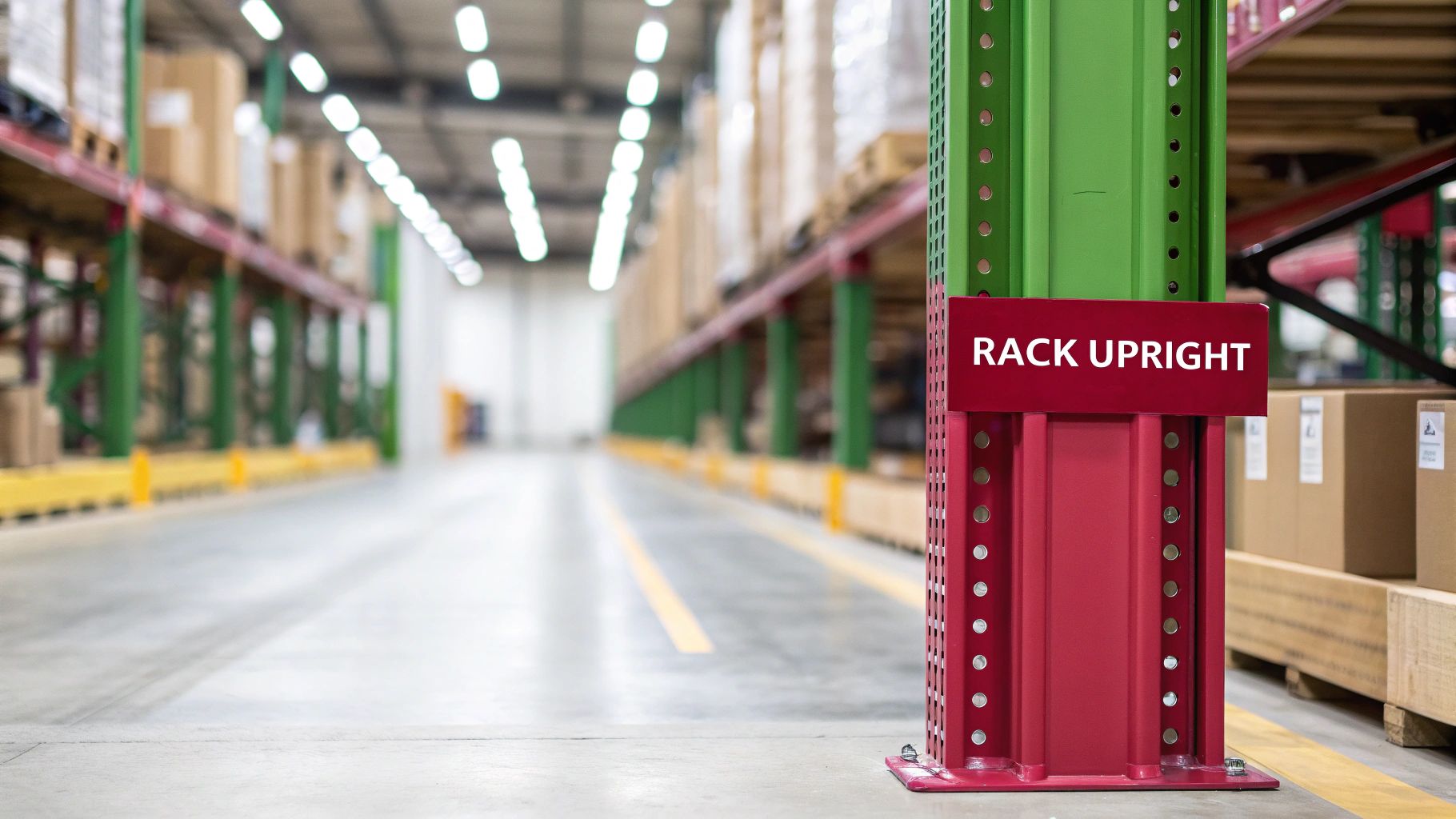
For any facility manager, getting familiar with the basic anatomy of an upright frame is essential. These frames aren’t just simple posts; they are complex, engineered assemblies designed for maximum strength and stability. Understanding how these components work together is the first step toward making smart decisions about your system’s design and long-term safety.
The Core Components of an Upright Frame
An upright frame comprises two columns connected by bracing, with base plates at the floor. Depending on the exact product, its connections may be bolted or welded and the assembly may be supplied complete or require specified assembly work. Confirm the order unit and assembly scope; neither every frame nor every replacement component is a factory-welded unit.
Here’s a quick breakdown of what makes up a standard upright frame.
| Component | Function |
|---|---|
| Columns | These are the two vertical steel posts forming the front and back of the frame. They feature the connection points or holes for attaching horizontal beams. |
| Bracing | Horizontal and diagonal members connect the columns in the manufacturer’s specified pattern. Connection details may be bolted or welded. Do not relocate, remove or substitute bracing without an approved design. |
| Footplates | Base plates transfer column forces to the supporting floor and provide locations for the specified anchors. Plate dimensions, connections and anchorage are design details to verify for the actual rack and slab. |
These components form a designed assembly, not a collection of interchangeable parts. Confirm assembly, installation and loading requirements for the exact product. To see how frames fit into the wider project, explore our guide to pallet rack and pallet rack systems.
Upright Profiles and Steel Gauge Explained
The word “profile” means the column’s cross-sectional shape. Roll-formed columns are formed from sheet steel, while structural columns use hot-rolled sections. Profiles and hole patterns vary by product family. They help identify a component, but neither a familiar shape nor matching hole spacing proves compatibility with another system.
Steel thickness is one of several design inputs. Material grade, column shape, bracing, connections, beam elevations and loading also matter. Do not infer capacity from gauge alone or assume a heavier-looking frame can replace another frame. Use documentation that identifies the exact components and configuration.

When comparing quotes, ask for the exact frame identity, material and construction details, beam elevations and loading assumptions. A manufacturer’s capacity table is useful only when its stated configuration and conditions apply. Missing or changed information requires review rather than an estimate from a similar-looking frame.
Why the Right Upright Is Non-Negotiable
Picking the right pallet rack upright is about more than just holding pallets, it’s a foundational piece of operational safety and efficiency. The wrong choice can lead to catastrophic system failure, destroyed inventory, and most importantly, a hazardous work environment for your team.
A properly specified upright is one part of a complete rack design. Its suitability depends on the loads, connections, floor conditions, installation and approved configuration, not the frame alone.
Upright height and depth affect the layout, but aisle widths and clearances also depend on the forklift, loads, building and applicable requirements. Start with accurate measurements and operating needs. We can help prepare a preliminary layout and quote, with engineering and approval responsibilities identified separately.
Choosing Between Roll Formed and Structural Uprights
When you’re designing a pallet rack system, one of the first big decisions you’ll have to make is whether to go with roll formed or structural steel uprights. The way these two types are manufactured creates significant differences in performance, cost, and ideal applications. This decision is fundamental, it shapes your system’s durability, flexibility, and overall value for years to come.
Roll-formed upright systems provide several frame and connection options. Some use teardrop beam connections, but adjustability is not permission to relocate levels at will. Confirm which beam elevations and load combinations are approved for the exact system before planning a change.
Structural uprights use hot-rolled steel sections and may be considered for demanding applications. The appropriate choice still depends on the engineered configuration, loads, traffic and site. Structural steel is not impact-proof, and its appearance does not establish a safe residual capacity after damage.
The Versatility of Roll Formed Uprights
Compare roll-formed options for the actual pallet loads, layout and handling operation. The frame’s dimensions and shipping weight alone do not establish suitability or total installed cost. Ask the supplier to identify the product family, included components, assembly requirements and scope of the quote.
Moving or adding beam levels can change the loads on the rack. Consult the Load Application and Rack Configuration (LARC) drawings and have a licensed professional engineer review proposed beam elevations and loads before reconfiguration. Adding another level can overload the original system even when the beams are spaced closer together.
All rack types need appropriate operating clearances, handling practices and inspection. A published capacity applies to its specified conditions; it is not permission to use a damaged frame. Report impacts and changed conditions for evaluation rather than relying on a construction-type comparison.
Market trends do not determine whether a particular upright fits your project. Concentrate on the exact frame, approved loading, support geometry and complete quote scope when comparing alternatives.
Evaluating Structural Uprights
Structural rack may be considered where loads and operating conditions warrant it, but it is not the only suitable choice for every high-traffic facility. Review the environment, product loads, handling equipment and protection measures with the rack design professional. After an impact, isolate the affected area and obtain an evaluation rather than assuming a substantial steel section remains usable.
Construction type is only one input to rack selection. The complete system must be designed for its loading, connections, anchorage and operating conditions.
Selective, drive-in and push-back layouts have different operating arrangements and design requirements. Do not assume they share the same frame specification or truck access. Compare the actual engineered system and installation scope rather than using a generic claim about structural rack to choose a layout.
Comparing Roll Formed vs. Structural Steel
To nail down the right choice, it helps to see them side-by-side. Your decision should be based on your daily operations, your budget, and the reality of your warehouse environment.
| Feature Comparison | Roll Formed Upright | Structural Upright |
|---|---|---|
| Manufacturing Process | Cold rolled steel | Hot rolled C-channel steel |
| Damage assessment | Inspect and obtain qualified evaluation after damage | Inspect and obtain qualified evaluation after damage |
| Initial Cost | Compare the complete quoted scope | Compare the complete quoted scope |
| Adjustability | Only the manufacturer-approved configurations | Only the manufacturer-approved configurations |
| Selection basis | Exact loads, access, environment and design | Exact loads, access, environment and design |
Compare complete systems rather than choosing on price or steel thickness alone. The right option must address the loads, handling operation, site and approved configuration.
Bolted vs. Welded Upright Frame Connections
Upright frames may use bolted or welded bracing connections. Verify the exact product documentation and supplied assembly rather than assuming all roll-formed frames arrive welded. The specified bracing arrangement is part of the frame design, not an installer-selected option.
Bolted construction does not authorize an installer to move braces or alter their pattern for a local code requirement. A damaged brace may be replaced only under the manufacturer’s or qualified rack design professional’s approved procedure for that system. Any proposed change to bracing, connections or structural members requires review before work begins.

Both welded and bolted frames require inspection: welds can crack and fasteners or connections can be damaged. Check fasteners, welds and alignment using the manufacturer’s specified requirements; do not apply a generic torque value or field repair. Our pallet rack specifications guide can help organize questions, but original component documentation is needed to identify your frame.
Need help deciding which pallet rack upright is right for you? Our experts can provide a free, no-obligation layout and quote. Contact Us or call (800) 326-4403 to get started.
How to Accurately Determine Upright Load Capacity
An upright load rating applies to a defined configuration and set of conditions. Gather the original LARC drawings, manufacturer documentation and loading information before treating a label or catalog figure as the capacity of an existing rack. If the configuration has changed or its identity is uncertain, have a qualified rack design professional review it.
The floor-to-first-beam distance, other beam elevations and the loads at each level are important design inputs. They must be evaluated together with the frame, beam, connector and anchorage details. There is no single frame-wide rating that applies to every arrangement.
Do not calculate a revised capacity by assuming that closer beam spacing automatically makes the rack stronger. Additional levels can introduce more total load, while changes in elevations can affect the frame’s behavior. The proposed configuration needs review against the actual design.
Record the existing and proposed beam elevations and loading separately. Have a licensed professional engineer review any reconfiguration and provide the required revised documentation before moving levels or adding capacity.
Gathering Your Data for an Accurate Calculation
To find the true capacity of your system, you have to look beyond the upright itself and collect key data about your entire operation. This process makes sure your final design is grounded in real-world needs, not guesswork.
Before you can look at a manufacturer’s capacity chart or talk to a design expert, you’ll need this information handy:
- Maximum Pallet Weight: What is the absolute heaviest load you will ever place on a single pallet?
- Load Dimensions: You’ll need the height, width, and depth of a typical loaded pallet.
- Beam specifications: Record the manufacturer, model, dimensions, connector and locking hardware, not just length and face height.
- Beam elevations and loads: Record floor-to-first-beam height, every level elevation, loading per level and total loading per bay.
Use these details to support a review, not to approve a capacity yourself. Our guide to pallet rack specifications explains useful information to collect. Include pallet construction and load-contact details because equal weights can load beams and decking differently.
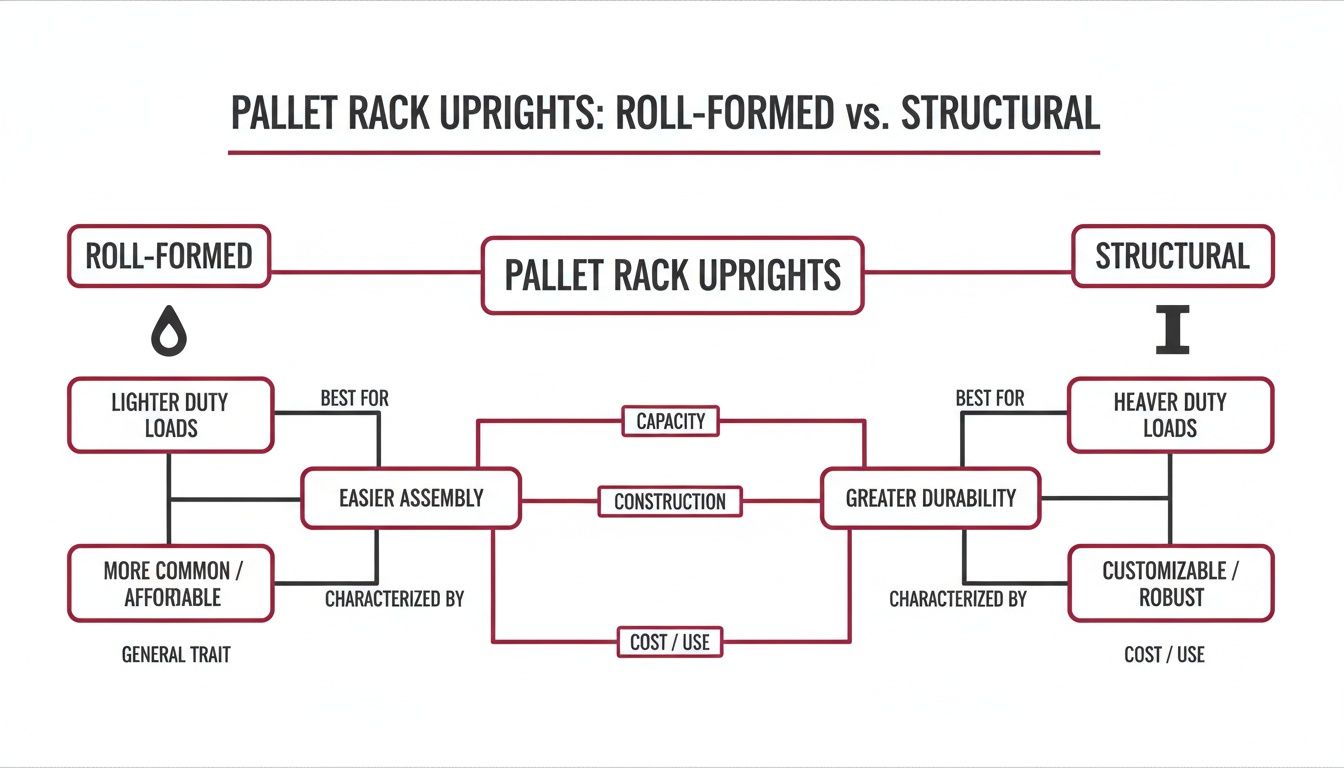
The usable rating depends on the exact components and loading configuration, not a visual comparison between roll-formed and structural frames.
Using Manufacturer Capacity Charts
Use the manufacturer’s documentation for the exact frame and configuration. Check the units, loading assumptions, beam elevations and any stated limitations. If the documentation is unavailable or does not cover the proposed arrangement, ask the original supplier and have a qualified rack design professional determine what review is needed.
Do not interchange capacity charts across manufacturers or product families. Even within one brand, revisions, steel grade, bracing and connector details can differ. A chart does not by itself establish that the building, slab, anchorage or local approval requirements are satisfied.
Don’t Guess, Get an Expert on Your Side
Calculating upright capacity involves many variables, and a small mistake can have massive consequences. The safest and most reliable way to design your racking system is to partner with experts who do this every day.
We can help collect the product and project information needed for a quote and coordinate the appropriate review. Confirm who will provide the engineering calculations, drawings and approval documents required for your rack and site. Request a Quote with the available configuration and loading details.
Getting the Right Fit: Upright Dimensions and System Compatibility
Think of choosing a pallet rack upright like getting a custom suit made, the fit is everything. If you get the dimensions wrong, you’re not just looking at an awkward setup; you’re creating serious safety risks, wasting valuable storage space, and inviting compliance headaches. Nailing the key measurements, height and depth, is the first step toward a system that works for you, not against you.
Rack geometry must be coordinated with the forklift, loads, building obstructions and required fire-protection and operating clearances. Measurements support that review; they do not by themselves establish compliance. Confirm the applicable requirements with the project’s design professionals and responsible authority.
Measuring Upright Height and Depth Correctly
The two most critical dimensions of any upright frame are its height and depth. They seem simple, but measuring them with your specific operation in mind is what makes all the difference.
- Upright height: Record the required overall frame height and loaded-pallet elevations. Coordinate them with the forklift reach, building obstructions and the project’s required sprinkler and fire-protection clearances. Do not use a single generic clearance number.
- Upright depth: Record the dimension and its measurement endpoints. Have the intended pallet orientation, bottom construction and beam contact reviewed before choosing frame depth or overhang.
Do not use a fixed subtraction from pallet depth as a universal sizing rule. The suitable frame and beam support geometry depends on the actual pallet and load. Document the proposed arrangement and confirm it with the manufacturer or qualified rack design professional.
Accurate measurements reduce quoting errors, but a dimension match is not a compatibility or design approval. Keep the measurements with the component identification and loading information.
The Critical Importance of Beam Compatibility
Verify the exact upright, beam, connector and locking hardware as a system. Identify the original design and intended replacement components before ordering. The fact that a beam engages a hole or appears to seat does not establish a suitable connection or load rating.
A teardrop hole pattern can help narrow identification research, but different products and revisions can have different connector requirements. Follow the exact manufacturer instructions and use the required locking hardware. Do not force a connection or treat apparent tool-free engagement as proof of fit.
The same-brand rule is not enough: product family, revision, construction and configuration must also match the approved design. Use an exact documented replacement or have a proposed alternative evaluated and approved by a qualified rack design professional before installation.
Your Pre-Purchase Checklist
Gather the following information to support identification, selection and a clear quote. Add available labels, original drawings and safely accessible connector photos. The checklist is a starting point for review, not a guarantee that a proposed replacement will fit.
| Upright Selection Checklist | Your Measurement/Requirement |
|---|---|
| Upright Height Needed | |
| Upright Depth Needed | |
| Exact frame and beam identities, connector and locking hardware | |
| Maximum Load Weight Per Pallet | |
| Beam elevations and loading per level and bay | |
| Original drawings, site and slab information |
Complete records make the quote and compatibility review more useful. Do not order an unknown replacement solely from dimensions, color or a photograph. Resolve the exact component and design requirements first.
Once the checklist is filled in, you can build and price your pallet rack upright configuration online using our guided configurator, or send the information to our team. A preliminary configuration or price is not an engineered approval.
Ready to find the perfect fit? Our experts are standing by to help. Request a Quote for a free layout and design, or give us a call at (800) 326-4403.
Racking Uprights vs. Commercial Shelving Uprights
Pallet rack uprights and commercial shelving uprights serve different storage systems. Pallet rack is specified for the intended palletized loads and handling equipment. Shelving may serve hand-loaded cartons, bins or records, but its capacity and loading method still depend on the particular product. Do not substitute shelving posts for rack columns because their dimensions look similar. Identify the loading method, item weights and access needs, then compare systems designed for that use.
When you are ready to price frames, our pallet rack uprights page covers stocked heights, depths and matching pallet rack beams, and the pallet rack systems guide shows how frames, beams and decking come together in a complete layout.
Best Practices for Installation and Maintenance
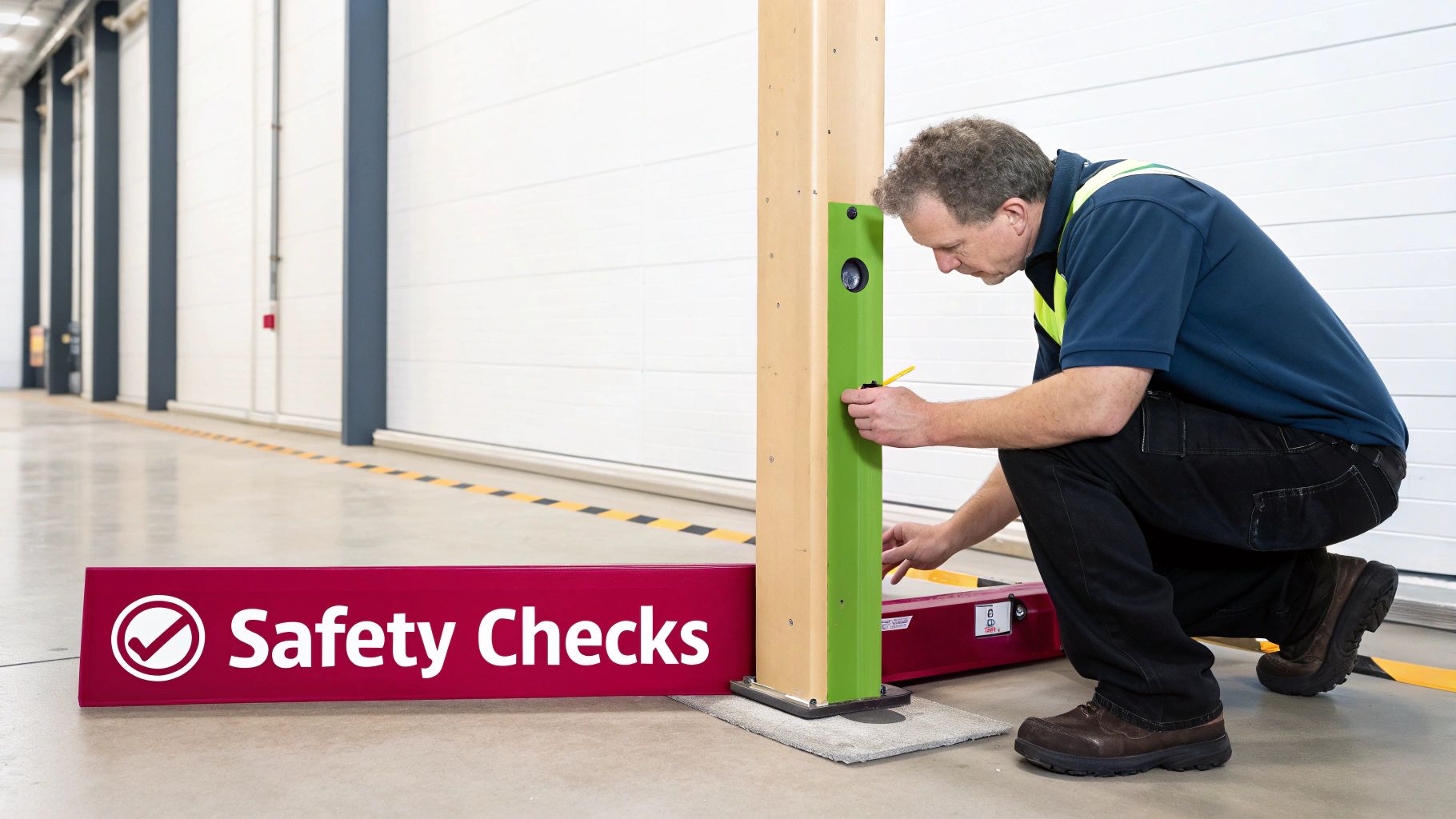
Installation and maintenance must follow the exact manufacturer instructions and approved project documents. This section identifies items to coordinate with qualified installers and the rack design professional; it is not a substitute for a complete installation procedure.
Confirm the approved drawings, component list, site conditions and responsible parties before work begins. Field deviations, missing parts or unexpected floor conditions need resolution through the project team rather than improvised substitutions.
Key Steps for a Safe Installation
Use qualified installers working from the approved documents. Before loading, complete the specified inspection, documentation and approval steps. Record deviations and resolve them with the responsible design professional.
Coordinate these installation requirements with the project team:
- Anchorage: Follow the specified anchor type, number, locations, embedment and installation procedure for the actual base plates and concrete. Not every unused base-plate hole requires an anchor. Refer unexpected cracks, joints, obstructions or floor conditions to the design team before changing the detail.
- Alignment: Have qualified installers check plumbness and alignment to the manufacturer’s and project’s specified tolerances. Do not substitute a visual impression or a generic “perfectly vertical” rule for those requirements.
- Beam connections: Use the exact specified connectors and locking hardware, installed and inspected according to the manufacturer’s instructions. Locks are not a guarantee against forklift impact or misuse.
- Base support: Use only the specified shim or support arrangement with the approved anchorage. An uneven floor is not permission to improvise shim stacks, grout or replacement anchors; obtain direction for conditions outside the approved detail.
Before loading or returning the rack to service, complete the required installation checks and resolve any departures from the approved design. A preliminary layout or this article cannot provide that approval.
Proactive Maintenance and Regular Inspections
Set an inspection program appropriate to the rack, use and conditions, following manufacturer guidance. Report impacts, newly observed damage or changed loading promptly. Do not treat minor-looking damage as harmless or assume normal operations can continue without evaluation.
A regular inspection routine is the most effective way to stay on top of this. For a deeper look at this topic, check out our guide on how to keep your warehouse racking safe. For standard upright sizes, profile and hole-pattern styles, and a full inspection checklist, see our warehouse racking uprights guide.
Beyond the uprights themselves, think about the bigger picture. We highly recommend optimizing safety and workflow with warehouse floor marking guidelines to create a safer, more efficient environment around your racking system.
Creating a simple checklist for your team can make these inspections fast and effective.
| Pallet Rack Inspection Planning Checklist | What to Look For | Status (OK/Needs Attention) |
|---|---|---|
| Upright Columns | Dents, twists, or creases from forklift impacts. | |
| Bracing | Bent, broken, or missing horizontal/diagonal braces. | |
| Footplates & Anchors | Loose or missing anchor bolts, corrosion at the base. | |
| Beams & Connectors | Damaged beam faces, missing safety clips. | |
| Overall Condition | Any signs of rust, overloading, or leaning. |
If damage is found, immediately isolate the affected area and have a storage rack design professional evaluate it. Follow that professional’s direction for unloading, repair or replacement and return to service. Do not enter an unsafe area or attempt repairs based on this checklist.
Need help organizing an existing-rack review or a new project? We can help with preliminary layouts and quotes and clarify the required professional review. Contact Us or call (800) 326-4403 to discuss the scope.
Let’s Build Your Racking System Together
Choosing the right pallet rack upright is a big decision, but it’s not one you have to make alone. You’ve learned what it takes to select the right type, capacity, and dimensions for a safe and efficient warehouse. Now, let us help you put that knowledge into action.
At Material Handling USA, we are more than just a supplier of quality products at competitive prices. We bring decades of hands-on expertise to the table, and we know that every warehouse has its own unique challenges and goals.
Your Expert Design Partner
Ask about our preliminary layout and quote services. We can help organize the product selection and project scope, while identifying responsibility for engineered design, permits and installation approvals. Confirm product availability, freight and delivery timing on the actual quote rather than relying on a general shipping promise.
When comparing rack proposals, focus on the exact components, configuration and included services rather than market-size forecasts. The Pallet Rack Systems hub connects the main rack options and planning resources.
Partnering with us means you’re not just buying steel; you’re investing in a complete solution built for the long haul. We’re committed to helping you build a better, more efficient warehouse from the ground up.
Let our team of specialists walk you through the options and design a system that fits your operation perfectly. We are ready to be your ideal partner for your next project.
Ready to start designing your perfect storage system? Request a Quote for a free layout, or give us a call at (800) 326-4403 to talk with a specialist today.
Technical references: RMI guidance on rack reconfiguration, damage assessment and repair, and specified base-plate anchorage. These references support the review process; the actual rack still requires its manufacturer’s documentation and project-specific direction.
Frequently Asked Questions
When it comes to pallet rack uprights, a few key questions always come up. Getting these right is crucial for safety, system longevity, and making a smart investment. Here are the straightforward answers you need from our team.
Can I Mix Uprights and Beams From Different Brands?
Do not assume compatibility from matching hole patterns, dimensions or appearance. Identify the exact frame, beam, connector and locking hardware and compare them with the original approved design.
The same brand name is not a guarantee either: product families and revisions can differ. Use exact documented components or have a proposed alternative evaluated and approved by a qualified rack design professional. Confirm warranty terms with the manufacturer rather than assuming guaranteed coverage or automatic cancellation.
What Is the Difference Between an Upright Frame and a Column?
People often use these terms interchangeably, but they’re not the same thing. Think of it like this:
- An upright column is one vertical steel member of the frame.
- An upright frame comprises two columns joined by bracing. Connections may be bolted or welded, depending on the product. Confirm whether the quote supplies a complete frame, individual parts or an assembly requiring specified work.
When Should I Replace a Damaged Upright Instead of Repairing It?
RMI’s guidance is to immediately isolate the affected area when damage is found and obtain a storage rack design professional’s evaluation. Unload, replace or repair as directed by that professional. Do not enter an unsafe area to investigate or assume that a small dent can be ignored.
Repair versus replacement depends on the actual damage, component identity, loading and configuration. An exact replacement or an engineered repair may be appropriate. A repair kit must suit the specific system; straightening or field welding is not a do-it-yourself remedy and requires the supervising rack design professional’s approved approach.
How Does My First Beam Level Affect Upright Capacity?
The first beam height and the other beam elevations are inputs to the rack design. Their effect must be evaluated together with the loads, frame construction, connectors and other system details. Moving a level or adding levels can change the conditions covered by the original rating.
Consult the original LARC drawings and manufacturer documentation, then have a licensed professional engineer review proposed elevation or loading changes. Do not estimate a new capacity from beam spacing alone.
What Does “Upright Profile” Mean on a Pallet Rack Spec Sheet?
The profile is the column’s cross-sectional shape. Record the profile, steel grade and thickness as identification inputs, but do not treat them as a complete load rating. Capacity and suitability depend on the exact frame construction, connections and approved loading configuration.
Is Bolted Pallet Racking Stronger Than Welded Racking?
Neither connection method alone establishes strength or suitability. Both require inspection under the manufacturer’s guidance. Bolted construction does not authorize field changes to bracing, and welded construction is not immune to damage. Replacement or alteration of a structural member requires the exact system’s approved procedure and professional review.
Ready to build a safer, more efficient storage system with the right components? The team at Material Handling USA is here to provide expert guidance and a free, no-obligation layout and design.
Who This Is For
Our pallet rack upright solutions are ideal for:
- Warehouse managers
- Facility planners
- Property managers
- Government coordinators
- Manufacturing managers
- Distribution operators
Online Store
Shop at MaterialHandling-USA.com
Need rack components or warehouse supplies? Browse the catalog and confirm current availability, freight and delivery terms.
Warehouse Equipment & Supplies
Pallets
Stretch Wrap & Shrink Film
Shipping Labels & Tags
Shop pallet rack & accessories →
Ready to configure your pallet rack system?
Use our guided configurator to prepare a preliminary configuration and request a formal quote or checkout review. Confirm engineering, compatibility and site requirements separately before installation.