
Home › Storeganizer › Electronics & White Goods
Electronics and White Goods Parts Storage — Storeganizer High-Density Pockets
High SKU counts, small units and shallow stock depth are exactly the profile pocket storage was built for. Convert existing rack into thousands of scannable component locations without adding floor space.

252
locations per 96″ bay (XS)
44 lb
per pocket
4 rows
deep per bay
0
software to integrate
Why electronics storage breaks conventional shelving
An electronics distributor, contract manufacturer or repair depot usually has the same storage problem in a different package: thousands of active part numbers, almost none of them needing much cube, and a shelf estate that ran out of distinct addresses long before it ran out of volume. The response is normally to share a shelf between several part numbers, which is where mispicks start.
The mismatch, stated plainly
- SKU count is high, unit volume is low. A shelf level sized for cartons wastes most of its cube on a bagged connector.
- Stock depth is shallow. Many part numbers are held two or three deep, so a full shelf level per SKU is indefensible.
- Shared locations cause errors. Two similar part numbers in one bin is the single most common cause of a wrong pick.
- Travel dominates the pick. When items are spread thin across bays, walking is most of the pick time, not handling.
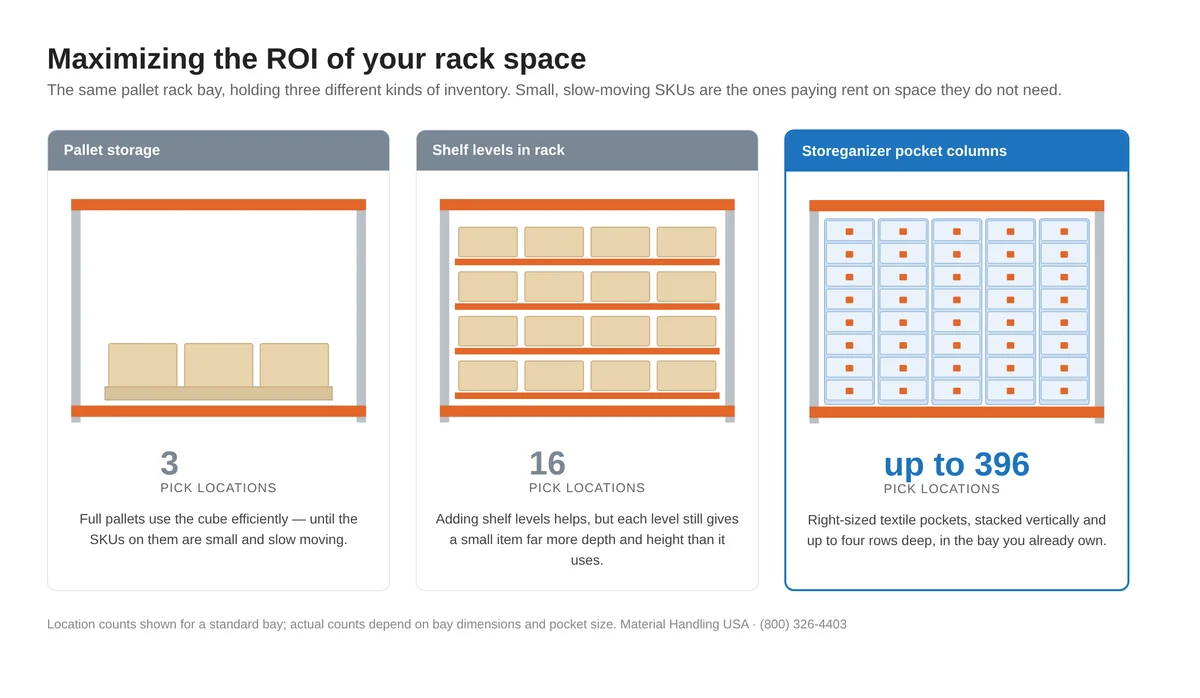
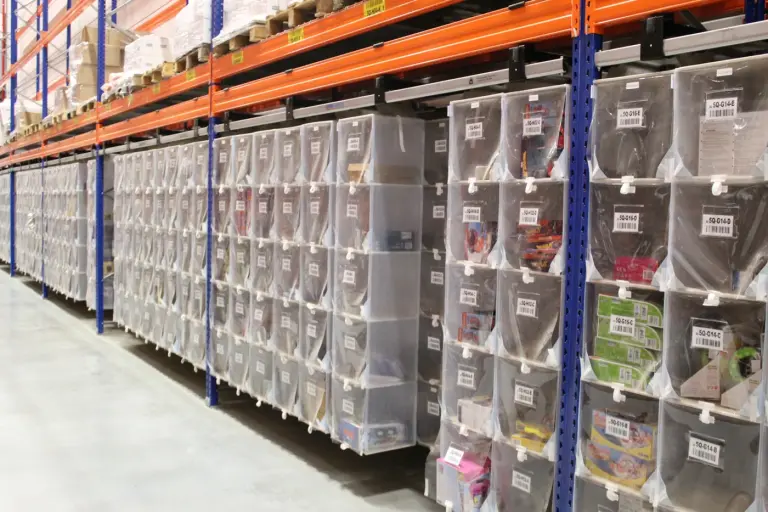
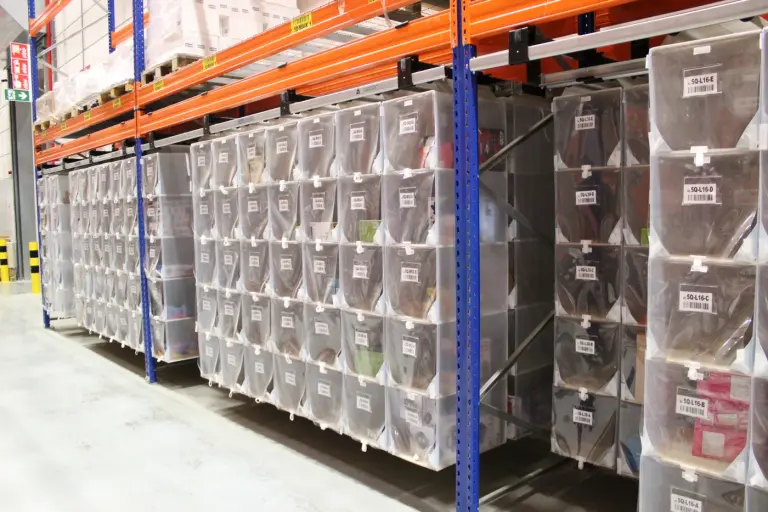
Hanging textile pocket columns in the rack you already own inverts that. Each pocket is one SKU, one label, one barcode, one address, and a single 96-inch bay can carry hundreds of them. For the underlying mechanism, see how Storeganizer works.
White goods and appliance spares
Appliance spare parts are one of the hardest inventories to slot well, because the range spans a fascia panel and an O-ring in the same catalogue. Mixed pocket sizes within a bay handle that spread without buying three different storage systems:
| Part group | Typical pocket | Why |
|---|---|---|
| Seals, clips, fasteners, sensors | XS 12×12×6″ | Tiny items, high line count — maximum addresses per bay is the objective. |
| PCBs, control modules, switches | S 12×12×12″ | Boxed electronics of consistent size; keeps the original ESD packaging intact. |
| Pumps, motors, valves, hoses | M 18×12×14.5″ | Bulkier assemblies that still sit well under the 44 lb pocket limit. |
| Drawer fronts, trays, small panels | L 18×20×14.5″ | Wide and light — the classic case for depth over height. |
| Housings, fascias, large covers | XL 24×20×18″ | Fewer locations, but keeps awkward plastics off the floor and undamaged. |
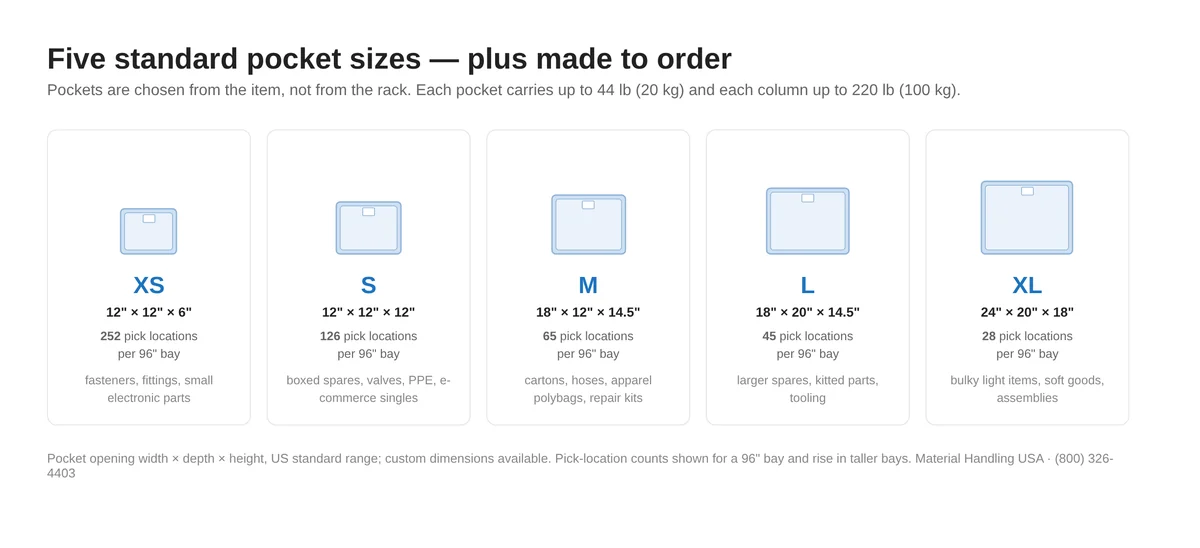
Because columns unhook and rehang by hand, a slotting decision made today is not permanent. As a model range is superseded and the spares profile shifts, the pocket mix moves with it — see SKU slotting and rack-space ROI.
Getting the pocket mix right first time
Profile the range by geometry
Sort the active part numbers by their largest dimension, not by product family. Storage cares about shape; catalogues do not.
Layer in stock depth
A part held three deep needs one pocket. A part held two hundred deep may still belong in a carton on a shelf.
Weight by pick frequency
Fast movers belong at the accessible front rows and at comfortable height. Slow movers can go deeper and higher.
Configure the bay
Enter real beam dimensions in the Designer and see the column count, pocket count and total locations before you commit.
Configure a bay in about two minutes
The Storeganizer Designer takes your beam width, depth and clear height and returns a preliminary configuration with total pick locations. No login, and nothing is submitted to us unless you choose to send it.
ESD, packaging and cleanliness — what we will and will not claim

Keep the parts in their own packaging
We do not market a static-dissipative textile, and we are not going to imply one. In ESD-sensitive operations the practical answer is that the component stays in its shielding bag, tube or tray and the pocket serves as the storage address — the same relationship the part already has with a cardboard bin.
Where that is not acceptable to your quality system, say so at the enquiry stage. There are inventories we will tell you to keep in ESD shelving, and it is cheaper for everyone to establish that before a quote than after an installation.
Front covers are available where dust ingress on open components is the concern, and dividers where two small part numbers must share one pocket under controlled conditions.
What it does to picking and accuracy
Two things change at once. Pick density per linear foot of aisle rises sharply, so a picker covers more lines in the same walk; and every part number gets its own labelled, barcoded address, which removes the shared-bin ambiguity behind most mispicks.
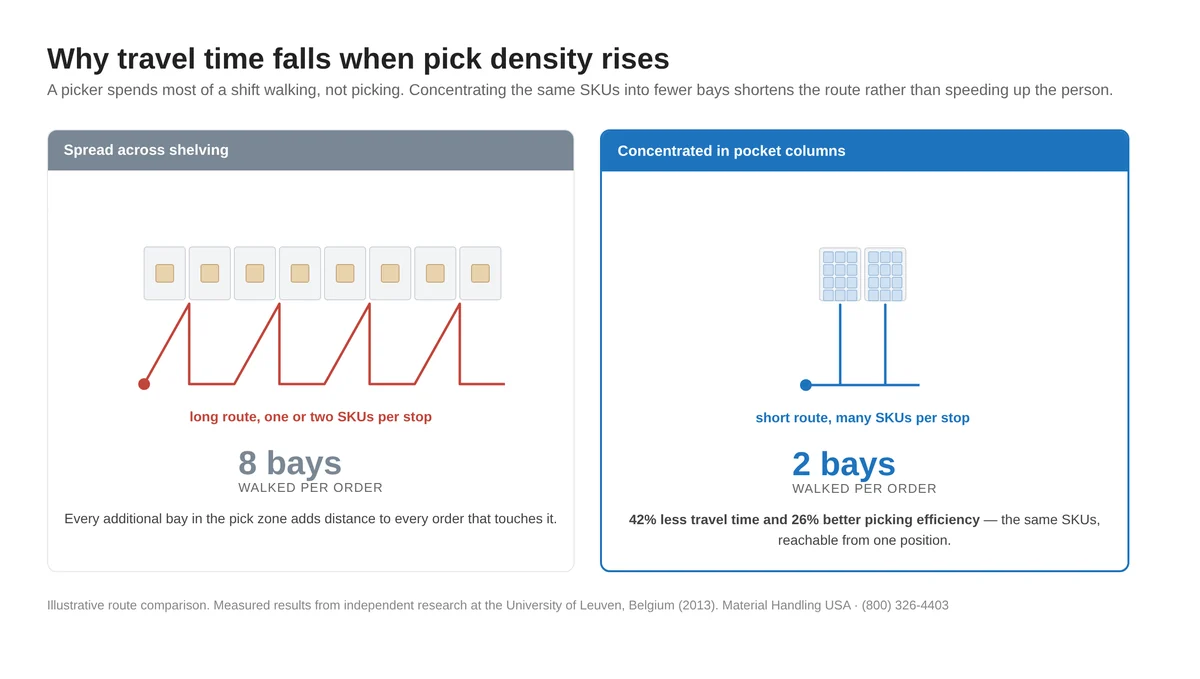
More on the mechanics: order picking efficiency. If you are weighing pockets against carousels, flow rack or a VLM, our alternatives comparison is deliberately even-handed about where automation wins.
Reference results from electronics and distribution operations
Reported by the operators concerned. We publish what was measured and attribute it, and we do not extrapolate it to your building:
| Operation | What they reported |
|---|---|
| Ingram Micro, Northampton (technology distribution) | Around 40% more SKUs handled per linear foot of picker travel — reported by David Cuddeford, Principal Engineer. |
| Gates (industrial components) | Approximately 90% space saving in the converted storage area. |
| DSV (contract logistics) | 19 medium-pocket bays; roughly 50% space saving and about 30% better picking efficiency. |
| CEVA Logistics, Daventry (3PL) | 26 bays across five pocket sizes in a 90,000 sq ft operation; improved picking KPI with reported 100% accuracy. |
Full write-ups, including the numbers behind them, are in our Storeganizer case studies.
Electronics and white goods storage — FAQs
Is Storeganizer suitable for electronic components?
Are the pockets ESD-safe or static-dissipative?
Can pockets hold white goods spare parts?
How many locations can we get from one bay?
Will barcodes and our WMS work with it?
What about long, thin parts like harnesses and extrusions?
Related reading
 Storeganizer high-density pocket storage overviewStoreganizer turns unused pallet rack into hundreds of small-parts pick faces – 40% more usable space, 42% less…
 How Storeganizer worksHow Storeganizer high-density pocket storage works: universal rack suspension, up to four rows deep, pocket sizes…
 Small parts and high-SKU-count storageTurn one pallet rack bay into up to 396 right-sized small-parts pick locations with Storeganizer textile pocket…
 Spare parts and MRO storageGive every spare its own labelled pocket – up to 396 per pallet rack bay. Cut search time, duplicate purchasing and…
 Pocket sizes and textile optionsAll five standard US pocket sizes with pick locations per bay, four textile grades with load and abrasion ratings…
 Storeganizer Designer — configure a bay onlineConfigure Storeganizer high-density pocket storage free online. Enter your pallet rack bay dimensions, choose a…
See what your component range looks like in pockets
Send bay dimensions and a SKU list. You will get a pocket mix, a location count and a straight answer on any parts that do not belong in pockets.