
Shelf Depth and Level Spacing for Records on Mobile Shelving
Before anyone counts ranges, someone has to decide how deep the shelves are, how many levels fit and how the cartons sit on them. Get this wrong and a brand-new high-density room stores less than the drawings promised.
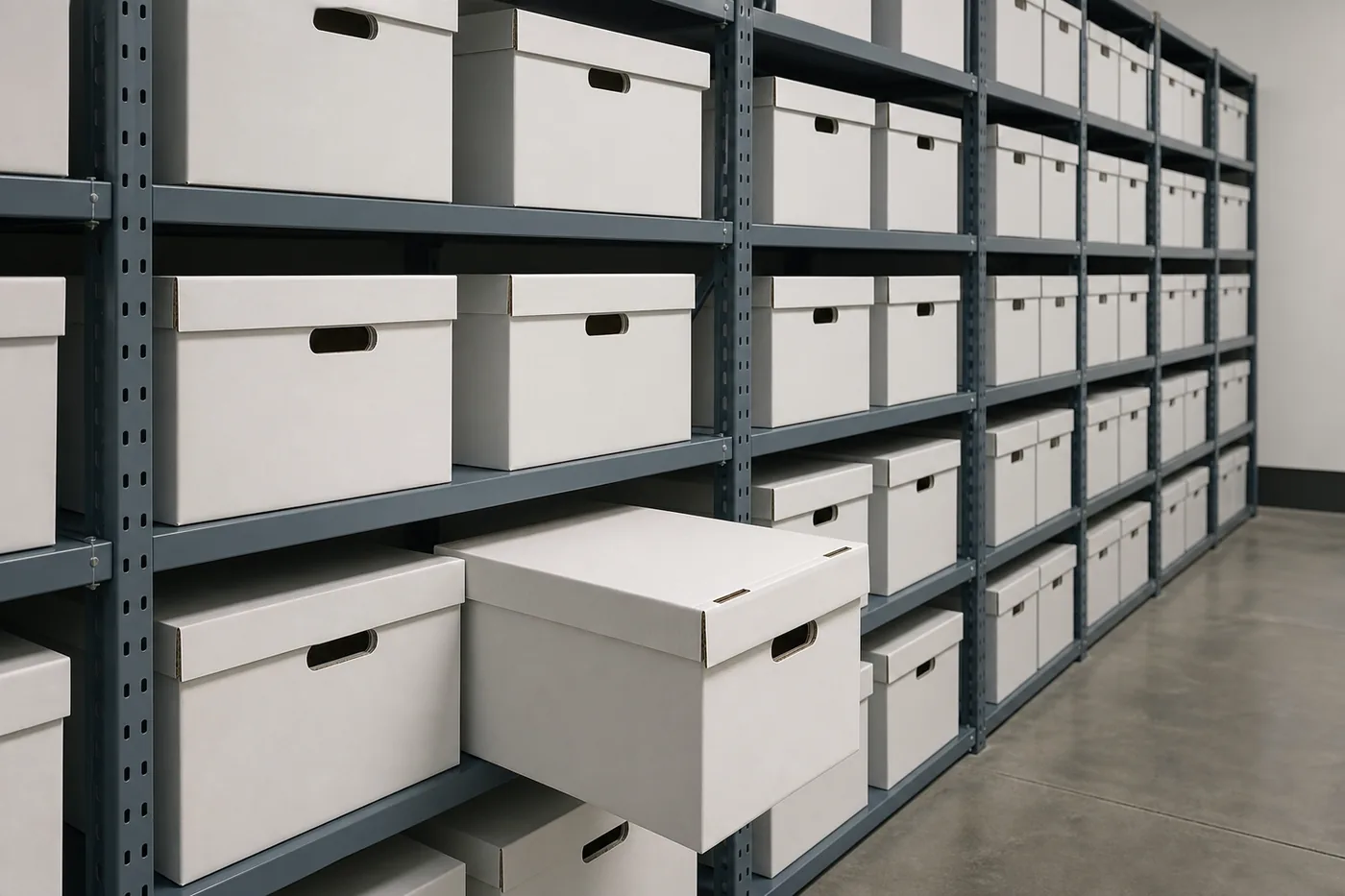
1 cu ft
What a standard records center carton holds
12 in.
Carton face that determines the practical shelf depth
18 in.
Minimum clearance below sprinkler deflectors under NFPA 13
15–48 in.
Unobstructed reach range in the 2010 ADA Standards
Capacity is decided at the shelf, not at the range
Every compact storage proposal ends in a number: linear feet, cubic feet, or cartons stored. That number is the product of four decisions that happen at the level of a single shelf — how deep it is, how wide it is, how much vertical clearance sits above it and how the material is oriented on it. Multiply a small mistake by six levels, eight sections and twelve ranges and a room can miss its target by thousands of cartons while every range on the drawing is exactly where it was supposed to be.
This page works from the item outward: the actual dimensions of the material, then shelf depth, then level spacing, then the constraints from above (sprinklers), below (floor capacity) and beside (reach and accessibility). It applies to high-density mobile shelving, but almost all of it is equally true for the static records storage shelving that mobile ranges are built from — the mobile carriage does not change how a box fits on a shelf.
Start with the real dimensions of what you store
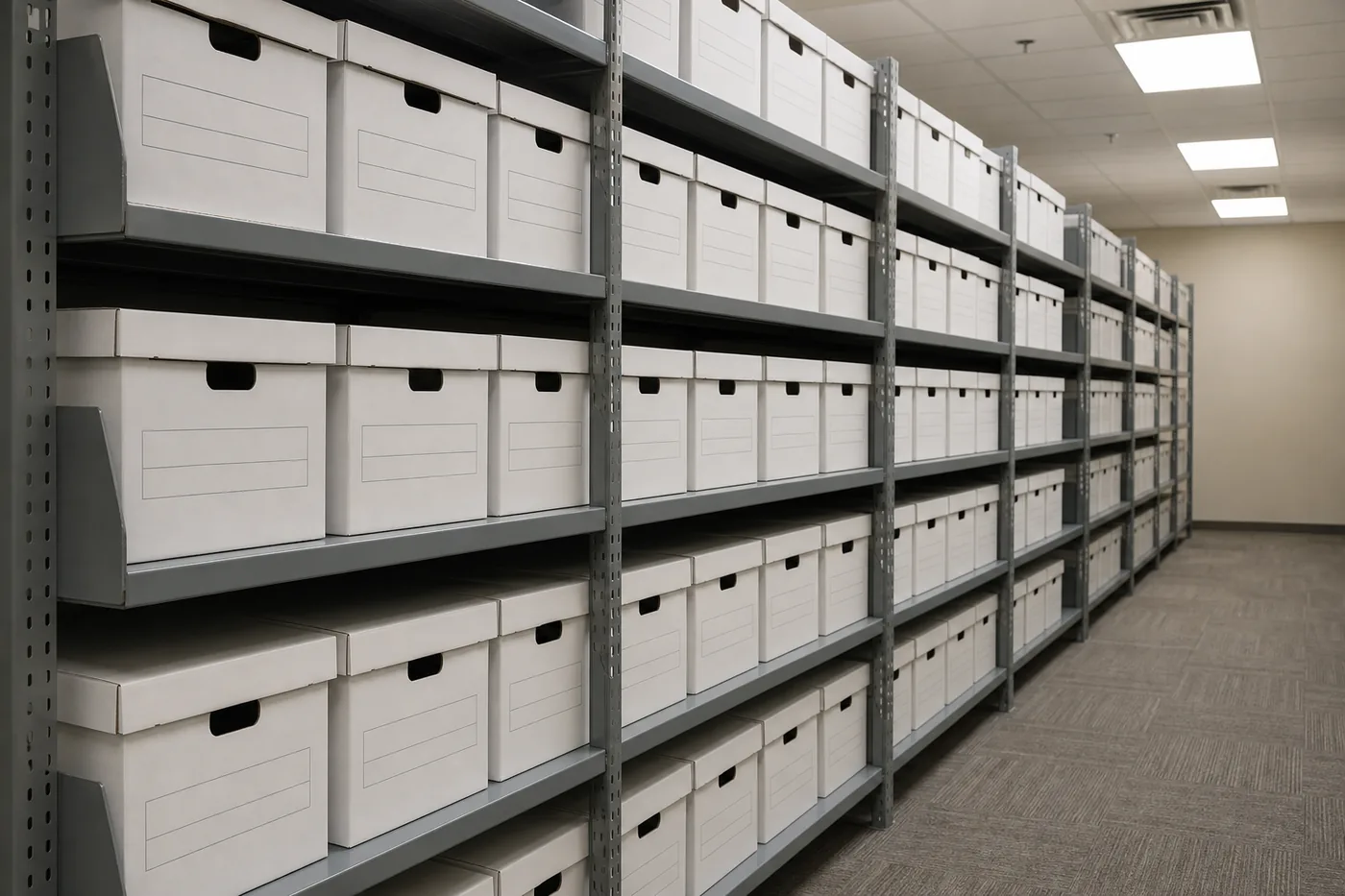
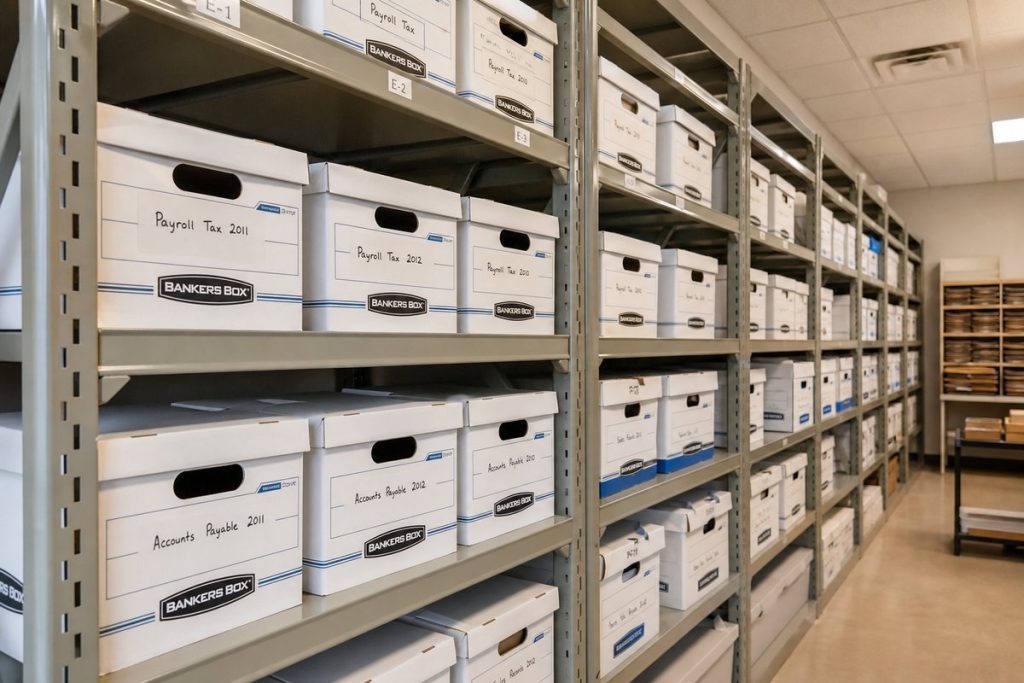
Nearly every records room is planned around one container, the standard records center carton, and its dimensions are published rather than assumed. The National Archives box specification defines the standard storage box with interior dimensions of roughly 14 15/16 by 12 by 10 inches, with exterior dimensions at the top of a closed box not to exceed 15 13/16 inches long, 12 3/4 inches wide and 10 13/16 inches high so the box fits on records center shelving. NARA’s own transfer guidance describes the standard box as 14 3/4 by 12 by 9 1/2 inches and treats one standard box as one cubic foot, and warns that boxes exceeding those dimensions will not fit their shelving.
Two practical consequences follow. First, a “one cubic foot box” is a physical object with a long face and a short face, and the shelf has to suit one of them. Second, the moment your collection includes anything else — letter and legal drawers, half-size boxes, x-ray boxes, binders, media, bound volumes, oversize flat material — you are planning for a mixed population, and the population, not the box, sets the shelving. Book collections behave differently again, because a volume is not a standard object: our page on mobile shelving for library book stacks works through the linear-foot capacity method libraries use instead.
Do this first: count what you actually have by container type before anyone quotes a system. NARA’s own conversion guidance is useful for the estimate: one letter-size file drawer holds about 1.5 cubic feet and one legal-size drawer about 2 cubic feet of records.
Shelf depth: which face goes out
Shelf depth is chosen against the carton, not against the room. The choice sets how many cartons sit on a shelf, whether anything overhangs into the aisle and how retrievable the material stays.
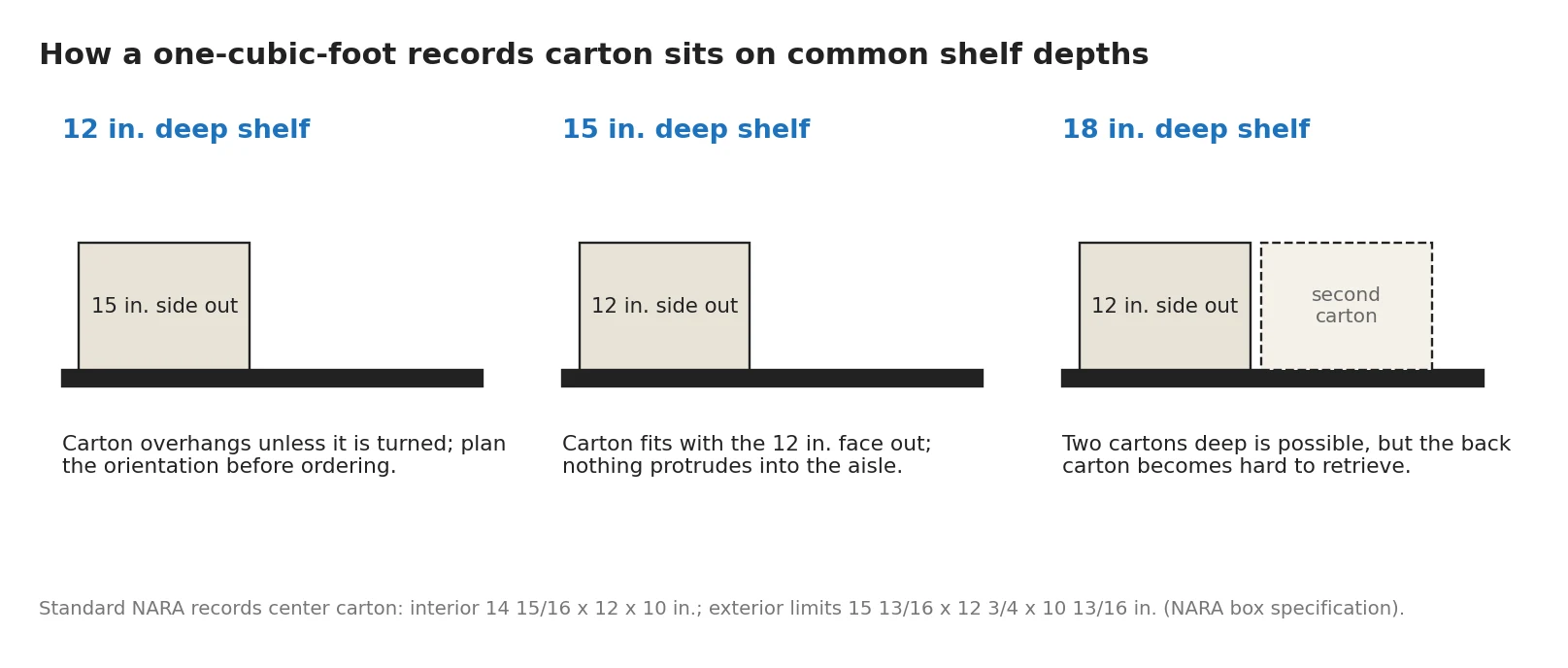
On a compact system the overhang question is more serious than on static shelving. Closing an aisle is a controlled collision between two ranges; anything protruding beyond the shelf face is what it collides with. Plan the orientation on paper, then require the shelf depth that supports it in the specification rather than discovering the problem at loading.
| Shelf depth | Typical use | Watch for |
|---|---|---|
| 12 in. nominal | Binders, letter files, small parts, book stacks and material stored on its narrow face. | A standard records carton placed with its long face out will overhang. Confirm orientation before ordering. |
| 15 in. nominal | The common records-room depth: one standard carton per position with the 12 in. face out. | Leaves little tolerance for oversize or bulging cartons; check the largest container in the population, not the average. |
| 18 in. and deeper | Two cartons deep, oversize containers, x-ray boxes, media, and mixed industrial material. | The back position is slow to reach and tends to become dead storage. Plan it for low-activity holdings only. |
| Double-faced ranges | Standard for freestanding ranges in the middle of a room. | Depth is per face; the range depth is roughly twice the shelf depth plus the upright. Draw it before you count ranges. |
Level spacing: the clear opening is what matters
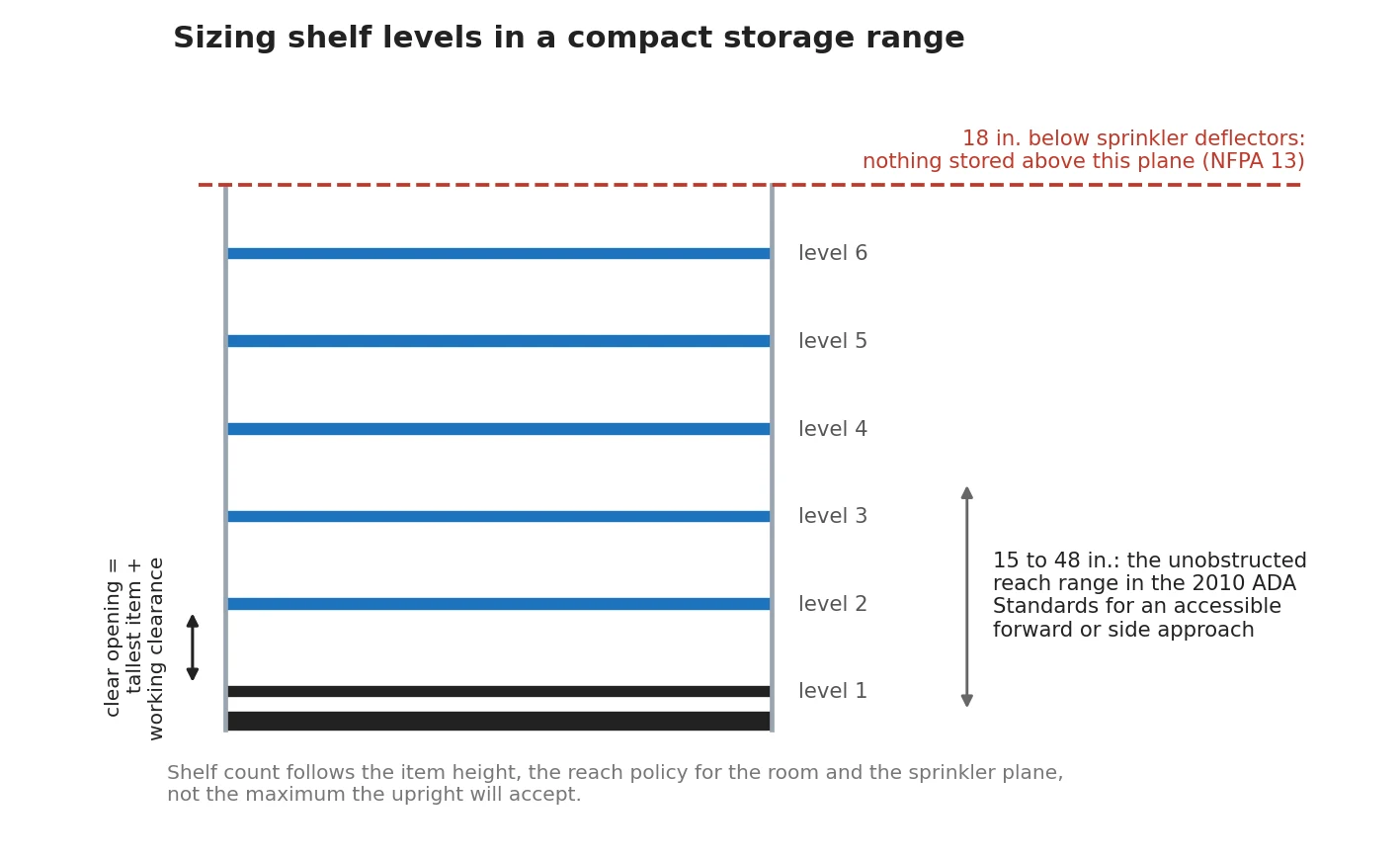
Shelving is sold by the number of levels, but what stores material is the clear opening between one shelf’s top surface and the underside of the shelf above it. Size it as the tallest item in that zone plus enough working clearance to slide the item in and out without lifting it over an obstruction.
For a standard records carton at roughly 10 3/4 inches of exterior height, a clear opening in the region of a foot works, and a room storing nothing but cartons can be planned tightly. Add binders, bound volumes, media boxes and equipment and the levels stop being uniform. That is normal and usually correct: a range with three tall zones and three short zones stores more of a mixed collection than six identical levels.
Adjustability is the hedge. Steel shelving with a close hole pattern in the upright lets you re-space levels later. On a compact system that is the difference between adapting to a changed collection and buying more shelving, so it is worth checking the adjustment increment before you buy.
The three ceilings on level count
You cannot simply keep adding levels until the upright runs out. Three separate limits arrive first.
Fire protection
NFPA 13 requires clearance between sprinkler deflectors and the top of storage — 18 in. as the general rule, and greater for certain sprinkler types. The top shelf lives below that plane.
Reach and access
The 2010 ADA Standards set the unobstructed reach range at 15 to 48 in. for an accessible approach; anything above that needs a policy and equipment.
Floor capacity
Every added level adds load. A licensed engineer confirms the loaded system against the building’s posted floor load limit.
Operation
Taller, heavier ranges take more effort to move, which pushes the drive-type decision toward mechanical assist or power.
The reach limit is the one most often ignored, and it is not only an accessibility question. A top shelf that requires a step stool slows every retrieval in the room and creates a fall exposure that a records room does not need. Our accessible aisle planning page covers reach and clear width in detail, and floor load requirements covers the load side.
Estimating capacity honestly
The arithmetic is simple; the discipline is in the deductions. Capacity is positions per shelf multiplied by levels per section, sections per range and ranges in the room — and then reduced for everything real that the spreadsheet forgot:
- Growth space. A room filled to 100 percent on day one is full on day one. Decide the target fill rate deliberately.
- Working space. Cartons need room to be pulled and returned; a shelf packed edge to edge is slow to use and gets damaged.
- Odd material. Oversize, flat, media and equipment items rarely fit the standard module and need their own zone.
- Static end ranges. Most systems have fixed ranges at one or both ends with different usable depth.
- Access zones. Reach limits mean the top and bottom levels are not equally usable for everything.
Any capacity figure quoted without those deductions is a maximum, not a plan. When comparing proposals, normalize them: same fill rate, same container population, same reach policy. Our cost and budget drivers page explains why two proposals for the same room can differ so much once these assumptions are made explicit.

Accessories that change what a shelf holds
Once depth and spacing are set, a handful of components decide whether the shelf actually works for your material: The deck itself is the first of them — our guide to choosing open wire decks or solid steel shelves on mobile carriages compares how each behaves for airflow, cleaning, fire protection and load.
Dividers. Vertical dividers keep files and folders upright on deeper shelves and stop the slump that makes a shelf unusable at three-quarters full. In file rooms they are not optional.
Back and side stops. On a mobile system, stops keep material from being pushed past the back of the shelf into the adjacent aisle when a range closes.
Deck type. Solid steel decks suit cartons and small items; wire or grid decks suit rooms where air movement or sprinkler performance below the shelf matters. Federal facility standards for records storage require compact mobile shelving to be designed to permit proper air circulation and fire protection, so deck choice is not purely a preference.
Labelling. Range, section, level and position labelling designed in from the start is what makes the capacity findable later. For collections with preservation requirements, see our museum and archival collections page, and put the whole package into the submittal checklist.

A short sizing sequence that works
Run these five steps before anyone draws ranges, and the layout that follows will hold what it claims:
- Inventory by container type. Count cartons, drawers, binders, media and oversize separately, with the largest dimension in each class.
- Choose orientation and shelf depth for the dominant container, and a separate zone for everything that does not fit it.
- Set clear openings from the tallest item in each zone plus working clearance, and confirm the shelving’s adjustment increment supports them.
- Cap the level count with the sprinkler plane, the reach policy and the floor capacity, in that order.
- Deduct for growth, working space, static end ranges and odd material before quoting a capacity to anyone who will remember the number.
This sequence also gives you a defensible basis of design to hand to a vendor, which is the fastest way to get comparable proposals instead of five different interpretations of the same room.
Frequently asked questions about shelf sizing for records storage
What size is a standard records storage box?
How deep should shelves be for records cartons?
How many record boxes fit on a shelf?
How much vertical space does a shelf level need?
How many shelf levels can a mobile shelving range have?
Should shelves be adjustable?
Are wire decks or solid decks better for records?
Can we mix shelf depths and spacings in one system?
Size the Shelves Before You Count the Ranges
Send us your container counts and room dimensions and we will work the depth, spacing and realistic capacity for a high-density system — before anyone quotes it.