
Borroughs Shelving › Record & Bulk Storage
Borroughs Record and Bulk Storage Shelving
Riveted, boltless steel shelving built for records centers, archives, and bulk storage rooms — sized and installed by MH-USA.

Static shelving built for the weight of paper and bulk inventory
Records centers, court archives, and back-of-house storage rooms carry a different load profile than a warehouse pallet. Bankers boxes, ledgers, and bulk paper files are heavy, dense, and packed shelf-to-shelf, and the shelving underneath them has to hold that load for decades without sagging, racking, or loosening. MH-USA sells and installs Borroughs Rivet-Span shelving for exactly this job: a riveted, boltless steel system engineered as static, high-density records and bulk storage — a distinct product line from the mobile/compact carriage systems we also install for records rooms (see our mobile shelving for records guidance if aisle space is tight enough to need moving carriages instead of fixed rows).
Rivet-Span is also the same structural platform behind our Borroughs automotive parts storage systems — the beams, posts, and decking are shared across bulk storage, record storage, and automotive bulky-parts configurations, just built out with different beam spacing and accessories for each use.
How a Rivet-Span record storage unit goes together
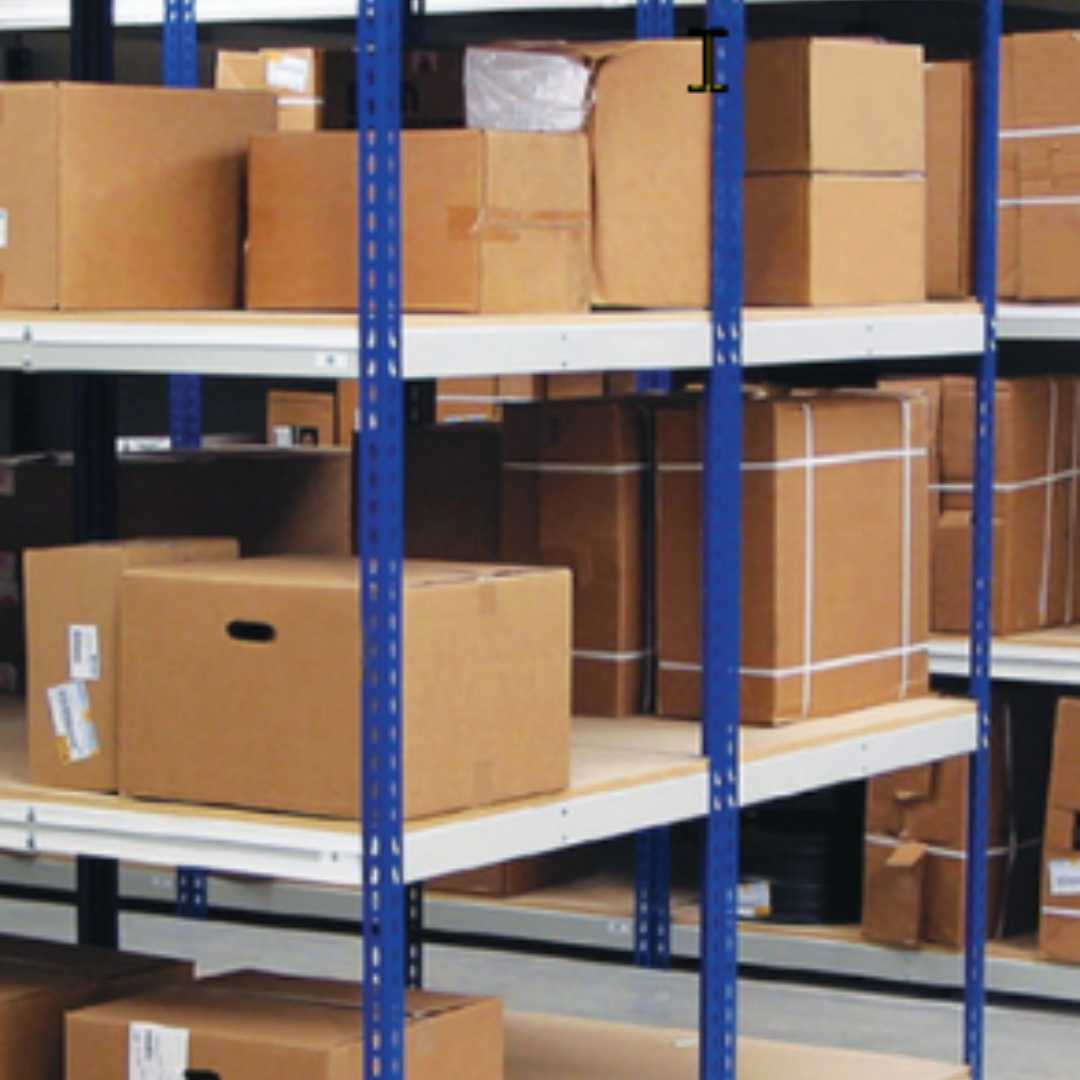
Manufacturer installation documentation (Borroughs Rivet-Span Installation Instructions, Document #32-50500-000A) describes a boltless, riveted-beam system: double-rivet angle or channel beams lock into slotted steel posts without bolts, using a mallet to fully seat the connection, then 5/8-inch particle board decking spans the beams to create each shelf level. Support ties and angle posts brace bulk storage bays that carry loose or oversized paper stock. Beam families are not universally interchangeable — the manufacturer’s documentation specifies which beam types can be intermixed on the same level (for example, single-rivet beams, double-rivet low-profile beams, and double-rivet Z-beams can share a level; double-rivet angle beams and double-rivet channel beams are a separate compatible group) so a mixed layout has to follow that pairing.
- Punched double-rivet angle and channel beams (PR/PH series) are made specifically to accept record storage support angles, per Borroughs documentation.
- Starter and adder units let a records row extend down an aisle without repeating full end framing on every bay.
- Beam levels and unit height are configurable — Borroughs’ own catalog units run from 3-level starters up through 7- and 8-beam-level bulk configurations.
- Foot plates anchor posts to the floor; wall ties and back-spacer ties stabilize rows against a wall or back-to-back run.
Planning a records room or archive storage layout
Every records or archive project starts the same way for us: we walk the room (or work from your floor plan), confirm ceiling height and any sprinkler clearance, and size bay widths and beam levels to the box or ledger sizes you’re actually storing rather than a generic shelf spacing. Aisle width, whether the run needs to be single- or double-entry, and floor load capacity for the building all factor into the final layout before we quote hardware.
Because Rivet-Span is boltless, reconfiguring a bay later — adding a level, widening an aisle, or extending a row — doesn’t require re-drilling or re-bolting framing; existing beams unclip and reseat at a new position.
Catalog configurations we can start from
Borroughs publishes pre-configured Rivet-Span record and bulk storage units that we use as a starting point before customizing to your room. A few examples from the current catalog:
| Configuration | Beam levels | Notes |
|---|---|---|
| 3-Level Record Storage Starter Unit | 3 | Entry-level starter bay for a new records row. |
| 4-Level Record Storage Starter Unit (BO-BPR4) | 4 | Punched double-rivet angle beam, sized for record storage support angles. |
| 5-Level Record Storage Unit (BO-B6948CH59) | 5 | 69" wide double-rivet channel beam configuration. |
| 3–8 Beam Level Bulk Storage Units | 3 to 8 | Double-rivet and channel-rivet bulk configurations for taller, heavier-duty rows. |
Starter units anchor the first bay of a row; adder units extend it without repeating end framing, which is how a records room typically grows from a pilot section to a full wall of shelving without buying full new end assemblies each time.
Where Rivet-Span record storage fits
 Records centers & archivesMunicipal, court, and corporate records rooms storing bankers boxes and ledgers on fixed steel shelving.
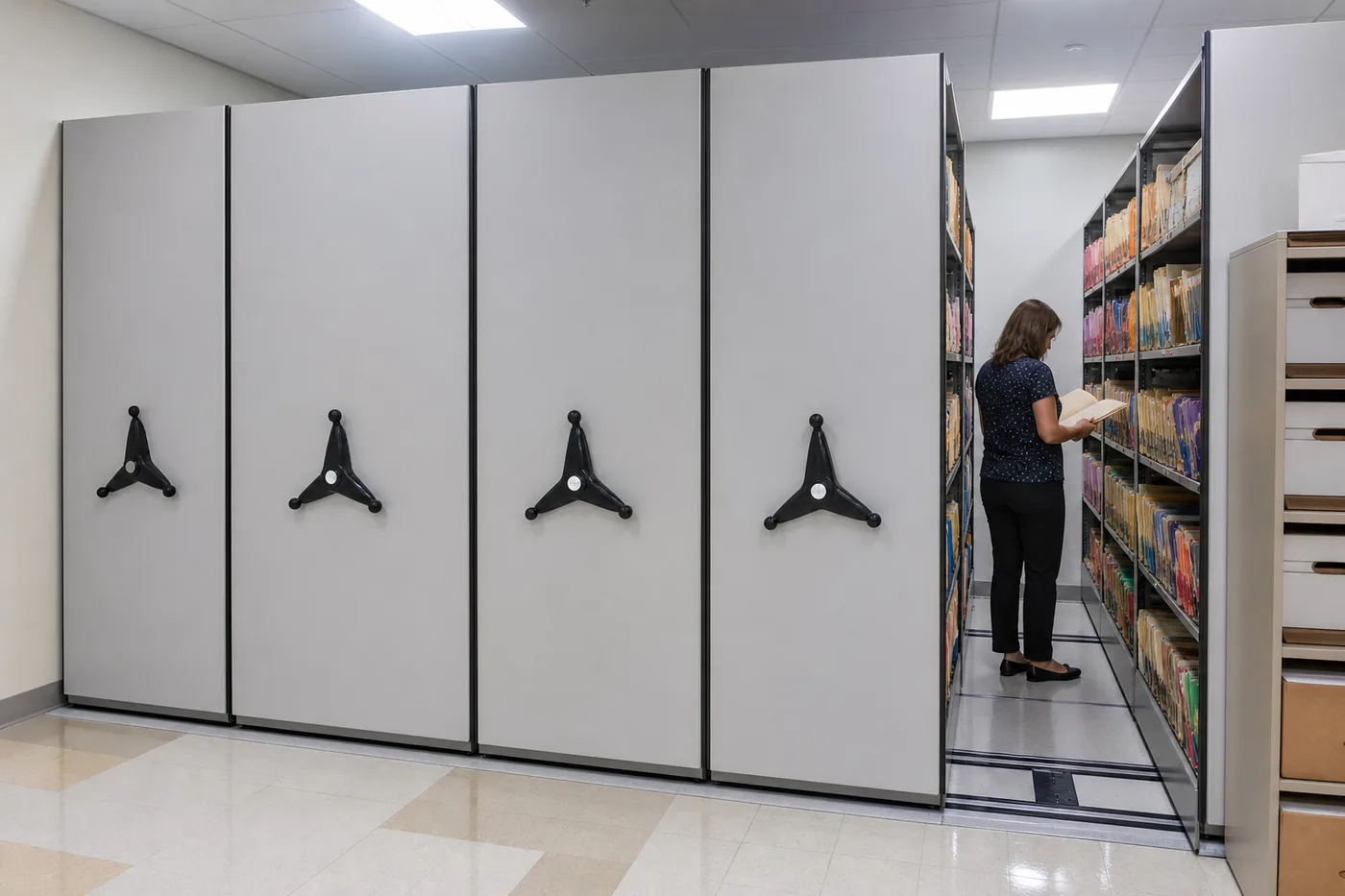 Back-office & institutional storageSchool districts, universities, and government offices consolidating paper files into a dedicated storage room.
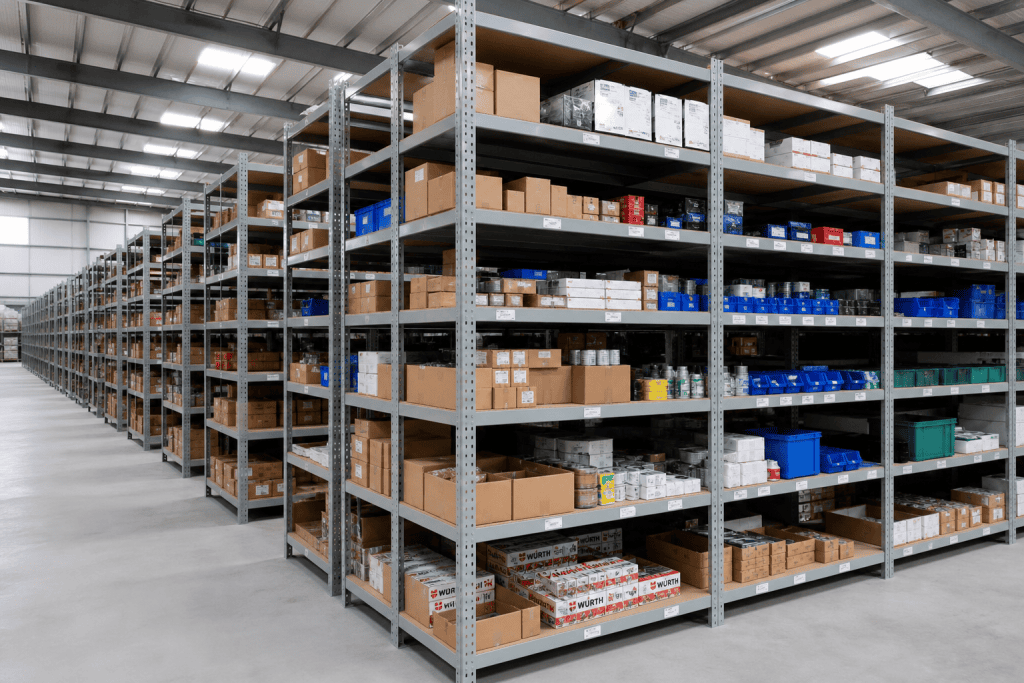 Bulk and loose-item storageWarehouses and distribution backrooms needing heavy-duty static shelving for bulk, loose, or oversized stock.
Not sure if static or mobile shelving is the right fit?
If floor space is tight, a mobile/compact carriage system can pack the same record volume into roughly half the aisle footprint. If space isn’t the constraint, static Rivet-Span shelving costs less per shelf and needs no track or mechanical assist.
How many record boxes fit? Published archive unit capacities
The only question that matters at the start of a records project is how many boxes a bay holds. Borroughs’ Rivet-Span literature publishes archive records units by catalog number with the box count for each, so the room can be sized from a box inventory instead of a guess. Most of the units below are 69″ wide; the single-rivet shelf units at the bottom of the table are 42″. Box counts are stated per unit.
| Catalog number | Size (W × D × H) | Beam levels | Boxes per unit | Loading pattern |
|---|---|---|---|---|
| B/A6915DR36 | 69″ × 15″ × 6′ | 3 | 30 × 1 cu ft | 5 across × 2 high × 1 deep |
| B/A6915DR59 | 69″ × 15″ × 9′ | 5 | 50 × 1 cu ft | 5 across × 2 high × 1 deep |
| B/A6930DH36 | 69″ × 30″ × 6′ | 3 | 60 × 1 cu ft | 5 across × 2 high × 2 deep |
| B/A6930DH59 | 69″ × 30″ × 9′ | 5 | 100 × 1 cu ft | 5 across × 2 high × 2 deep |
| B/A6948CH36 | 69″ × 48″ × 6′ | 3 | 90 × 1 cu ft | 5 across × 2 high × 3 deep |
| B/A6948CH59 | 69″ × 48″ × 9′ | 5 | 150 × 1 cu ft | 5 across × 2 high × 3 deep |
| B/A6924DR36 | 69″ × 24″ × 6′ | 3 | 30 × 1.5 cu ft | Sized to the 1.5 cu ft box |
| B/A6924DR59 | 69″ × 24″ × 9′ | 5 | 50 × 1.5 cu ft | Sized to the 1.5 cu ft box |
| B/A6915PR36 | 69″ × 15″ × 6′ | 3 | 30 × 1 cu ft | Record storage support angles, no decking required |
| B/A6930PH36 | 69″ × 30″ × 6′ | 3 | 60 × 1 cu ft | Record storage support angles, no decking required |
| B/A4215SR66 | 42″ × 15″ × 6′ | 6 | 18 × 1 cu ft | Single rivet shelf type, 3 across × 1 high × 1 deep |
| B/A4215SR88 | 42″ × 15″ × 8′ | 8 | 24 × 1 cu ft | Single rivet shelf type |
The boxes those counts are built around measure 12-7/8″W × 15-5/8″D × 10-1/2″H for 1 cu ft and 12-5/8″W × 24″D × 10-1/4″H for 1.5 cu ft. Measure a sample of your own cartons before ordering, because “banker’s box” is a nickname, not a standard. Borroughs’ notes are equally important: record storage boxes are not included, all units include metal framing only, and decking material must be ordered separately except on the record-storage-support-angle units, which are designed to carry boxes without decking.
A handful of four-level rows in the manufacturer’s archive table are internally inconsistent, so MH-USA confirms box counts for four-level configurations with Borroughs before publishing them on a quote rather than repeating a figure that does not reconcile.
Beam capacities: the table that drives the layout
Rivet-Span capacity is published as maximum uniformly distributed load per beam pair, by beam type and length, from Borroughs’ Rivet-Span catalog (Form #R-SPAN-RR-2-2016, © 2021).
| Beam length | Single rivet | DR low profile | Z beam (with Z tie) | DR angle (with support tie) | Channel (with tie) |
|---|---|---|---|---|---|
| 36″ | 350 | 450 | 1,400 | 1,400 | — |
| 42″ | 260 | 430 | 1,350 | 1,000 | — |
| 48″ | 240 | 400 | 1,300 (1,600) | 730 (1,700) | — |
| 60″ | — | — | 800 (950) | 680 (1,300) | 2,250 |
| 69″ | — | — | 600 (900) | 460 (1,100) | 1,900 |
| 72″ | — | — | 600 (900) | 450 (1,050) | 1,700 |
| 96″ | — | — | — | 240 (650) | 1,300 |
All values are maximum uniformly distributed pounds per beam pair. One support tie applies except at 96″, which uses two. Four qualifiers travel with every number and none of them are optional:
- Per beam pair, uniformly distributed — not per shelf and not for point loads.
- The longest pair of beams at a given level determines the capacity for the entire level.
- Steel only. The figures exclude the capacity of the decking, which is a separate limit.
- Capacities are for vertical loads where seismic forces are not a factor. Seismic design is the project engineer’s scope.
Posts have their own published limits, in pounds per post, by maximum beam spacing. Angle posts (1.57″ × 1.57″, 14 ga): 2,040 at 12″ spacing, 1,750 at 24″, 1,460 at 36″, 1,170 at 48″. Heavy-duty angle posts (1-7/8″ × 1-7/8″, 14 ga): 3,050 at 12″, 2,610 at 24″, 2,180 at 36″, 1,750 at 48″. Closer beam spacing buys post capacity, which is why records rooms with many short levels behave better structurally than a few tall ones.
Beam profiles, decking, and which combinations are legal
Rivet-Span uses high-strength shoulder rivets engaging double keyhole slots in the posts. Components are universal — no lefts or rights, no fronts or backs — and there are no nuts, bolts, clips, cross braces or sway braces, so a unit is accessible from any or all four sides and levels adjust on 1-1/2″ centers.
Beam families do not mix freely. Single rivet and double rivet low profile beams can share a level; double rivet angle and channel beams can share a level. The two groups cannot be intermixed and still support decking. Z beams carry decking on their own Z ties; confirm any level mixing Z beams with other profiles with Borroughs before ordering. Two more rules matter on records layouts: channel beams cannot sit directly at floor level because of their longer face — use angle beams with support ties for the floor-level beam — and where channel runs side-to-side, angle must run front-to-back. The 69″ punched double rivet angle (10097-009) and punched channel (10098-009) beams are the ones punched to accept the Record Storage Support Angle (10099-000 at 15″ and 10099-001 at 30″, 1-17/32″ high, 14 ga), which is how a no-decking archive unit carries boxes.
| Deck option | What it is | Where it fits a records room |
|---|---|---|
| 5/8″ particle board | Pre-cut sizes from 36″ × 12″ through 96″ × 48″ | Standard, lowest-cost deck for boxed paper |
| 18 ga galvanneal solid decking | R1-SDG series, 48″–96″ widths × 12″–48″ depths | Steel deck where cleanability or durability matters |
| Wire / plywood / OSB / structural wood | Permitted alternatives | Wire where sprinkler water penetration is a design consideration |
| No deck | Record storage support angles in punched beams | Box-only archive units; removes decking cost entirely |
Field-cut decking is cut to nominal size at +0″/−1/8″, and 3/16″ under nominal where single rivet or double rivet low profile beams support the deck.
Dimensional data for spec writers
Nominal is what you order; actual is what occupies the room. Rivet-Span nominal widths run 24, 30, 32, 36, 42, 48, 60, 69, 72, 84 and 96″; nominal depths 12, 15, 18, 24, 30, 32, 36, 42 and 48″; nominal heights 6′, 7′, 8′, 10′, 12′, 14′, 15′ and 16′.
| Measurement | Formula from the Rivet-Span catalog |
|---|---|
| Actual single-unit width or depth | Nominal plus 1/2″ |
| Actual height | Nominal ± 1/32″ |
| Back-to-back depth | Combined actual depths plus 7/32″ |
| Length of run | Sum of actual widths plus 7/32″ per adjoining unit |
| Horizontal clear opening, angle posts | Nominal width minus 2-5/8″ |
| Horizontal clear opening, heavy-duty angle posts | Nominal width minus 3-1/4″ |
| Vertical clear opening, DR angle beams | Beam spacing minus 3-1/4″ (based on 5/8″ decking) |
| Vertical clear opening, channel beams | Beam spacing minus 3-5/8″ (based on 5/8″ decking) |
That 7/32″ per adjoining unit is the growth factor that decides whether a 24-bay run clears the far wall. Check it before the wall is drawn, not after the trucks arrive.
Stability and anchoring requirements
Borroughs publishes beam-requirement rules that are part of the structural design, not a suggestion. Every unit needs a full perimeter of double rivet beams — two side-to-side and two front-to-back — at both top and bottom. Single rivet and DR low profile units up to 24″ deep need one intermediate front-to-back beam level at mid-height for 6’–8′ units, two for 9’–10′, and for 11’–16′ units, three intermediate levels — a full double rivet perimeter at mid-height, plus front-to-back single rivet beams in the upper and lower halves. Units 30″ deep and over need front-to-back single rivet beams at every intermediate level, with the mid-height full perimeter again on 11’–16′ units. Double rivet angle and channel units need front-to-back beams at every level. Tie plates go at the top and bottom of adjacent angle posts and no more than 48″ apart; they are not used with T posts.
The anchoring rule to design around: Borroughs recommends wall, floor or top tie anchoring for any unit whose height-to-depth ratio exceeds 4. A 9′ high unit at 15″ deep is a ratio of about 7.2 and is squarely in that territory; the same 9′ height at 48″ deep is 2.25 and is not. Aisle ties (30″–48″) stabilize units exceeding that ratio and are expressly not designed to support upper-level walkways. Foot plates (10103-000, 4″ × 2″, 14 ga) and 9″ wall ties are the other stock stability components.
Size your records room from a box count
Everything above turns into a layout in one pass. Send us the box inventory by size (1 cu ft, 1.5 cu ft, or measured cartons), the room dimensions, clear ceiling height and sprinkler elevation, aisle and cart requirements, and any retention growth you expect over the planning horizon.
We select an archive unit from the published catalog table above, divide your box count by boxes per unit to get bay count, build the run length using actual widths plus the 7/32″ per adjoining unit growth factor, check the level against the correct beam-pair capacity with all four qualifiers applied, check the height-to-depth ratio against the anchoring rule, and pick a deck option — or a no-deck record support angle unit — to suit the load and the budget.
Where bulk pallets, oversized cartons or mixed inventory share the room, model that side of the layout with our pallet rack designer and we will price the rivet shelving and rack together as one room. If floor area rather than height is the binding constraint, compare against a carriage system on our mobile shelving page. Other Borroughs lines are indexed on the Borroughs shelving hub.
All specification figures on this page come from Borroughs’ own Rivet-Span literature, including the Rivet-Span catalog (Form #R-SPAN-RR-2-2016, © 2021) and the Rivet-Span archive records unit tables. Beam capacities are maximum uniformly distributed loads per beam pair, steel only, excluding decking, for vertical loads where seismic forces are not a factor. MH-USA verifies current availability, catalog numbers and configuration with the manufacturer before quoting, and verifies the quoted configuration before order.
Borroughs record & bulk storage FAQ
Is Rivet-Span shelving bolted or welded together?
Can records shelving be reconfigured after it’s installed?
What’s the difference between this and mobile shelving for records?
Does Borroughs make a record-storage-specific beam?
Do you install Borroughs record storage shelving, or just sell the hardware?
Plan Your Records or Bulk Storage Room
Tell us your room dimensions and box or file count and we’ll put together a Rivet-Span layout and quote.