
Police and Fire Station Lockers: Duty, Turnout Gear and Crew Lockers
Officer duty lockers sized for uniforms, body armor and patrol bags, ventilated open-front turnout gear lockers for the apparatus bay, and personal lockers for crew quarters. Compare what each station area needs, shop steel lockers online, or send your station plan for a free layout and quote.
18–24″
Typical duty locker widths
Open Front
Turnout gear lockers
3-Point
Latching on heavy-duty gear lockers
Free Layout
Station locker planning
Shop Station Lockers by Tier
Current online prices for the lowest-priced one-wide locker in each style; wider 18″ and 24″ units, more colors and Lyon models are in each category. Duty, gear and turnout lockers are quoted per project. Some common sizes are in stock at select manufacturers, subject to confirmation.


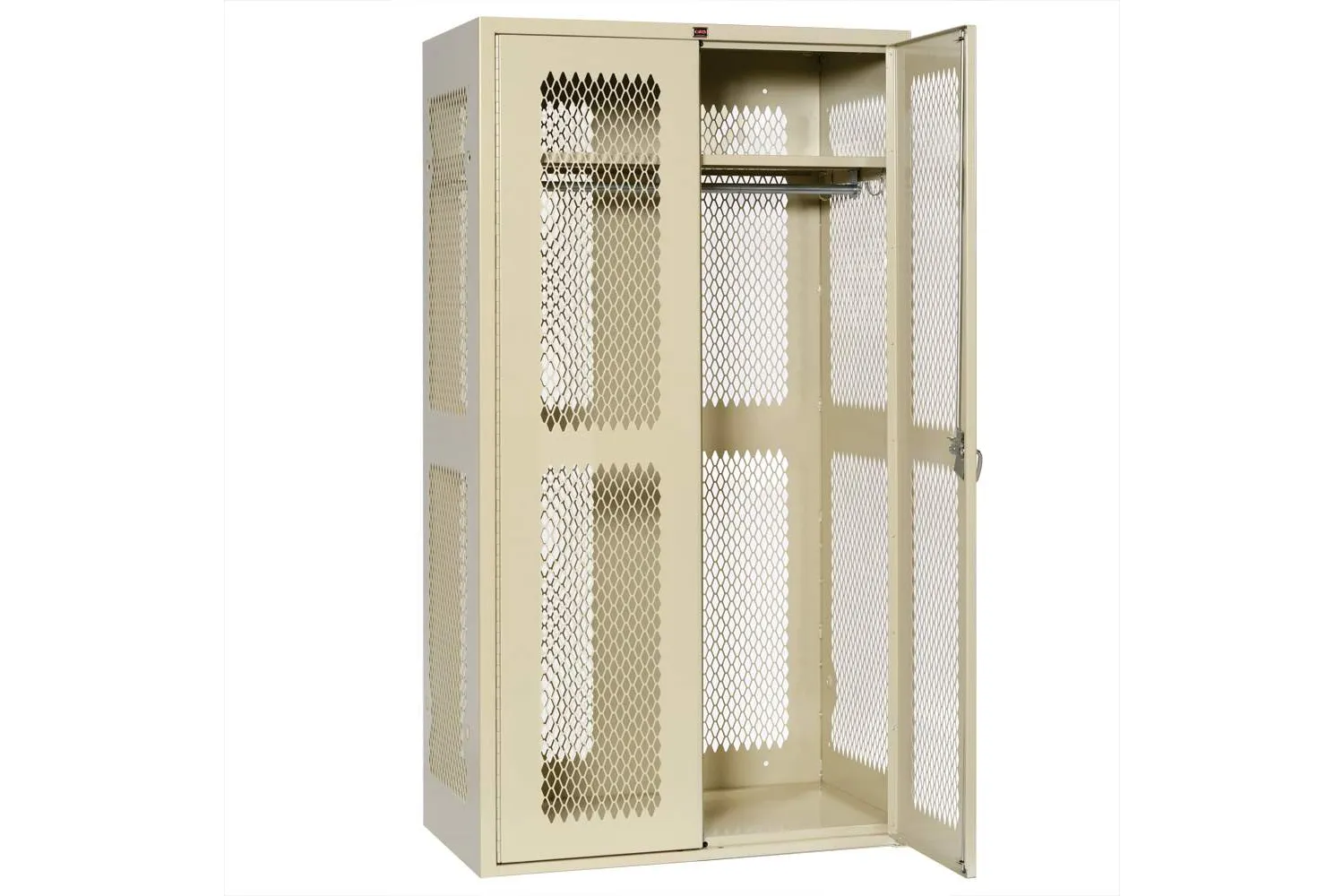
Need a ventilated gear locker? See the Lyon TA-50 gear locker in our store, or request a free station layout and quote.
Lockers for Police Stations and Fire Stations
Public safety staff carry more gear than almost any other employee group. A patrol officer comes off shift with a uniform, a duty belt, body armor, boots and a patrol bag; a firefighter has a full set of turnout gear plus the clothes they live in for a 24-hour shift. A standard 12″-wide office locker is too small for either, and the same locker does not belong in the apparatus bay and the bunk room.
This guide covers police station lockers (officer duty and uniform lockers), fire station lockers (turnout gear lockers and crew lockers), and how to split a station into the right zones. It is part of our employee lockers guide. For specialized law enforcement storage — tactical gear, evidence, weapons and inmate property — we route you to the dedicated pages below.

| What you need to store | Best locker type | Where to go |
|---|---|---|
| Officer uniforms, body armor, duty belt, personal items | Wide full-height duty locker | This page — police lockers |
| Firefighter turnout coat, pants, boots, helmet | Open-front ventilated turnout gear locker | This page — turnout gear |
| Crew clothes and personal items on shift | Single- or double-tier personal locker | This page — crew quarters |
| Rifles, duty bags, tactical vests, SWAT kit | Tactical gear locker | Dasco tactical gear lockers |
| Evidence handed in at end of shift | Pass-through or electronic evidence locker | Dasco e-locker system and our evidence storage guide |
| Military-style TA-50 field gear | TA-50 gear locker | Dasco TA-50 gear locker |
| Inmate property and detention storage | Detention-grade lockers | Jail lockers and inmate property lockers |
Police Station Lockers: Officer Duty and Uniform Lockers
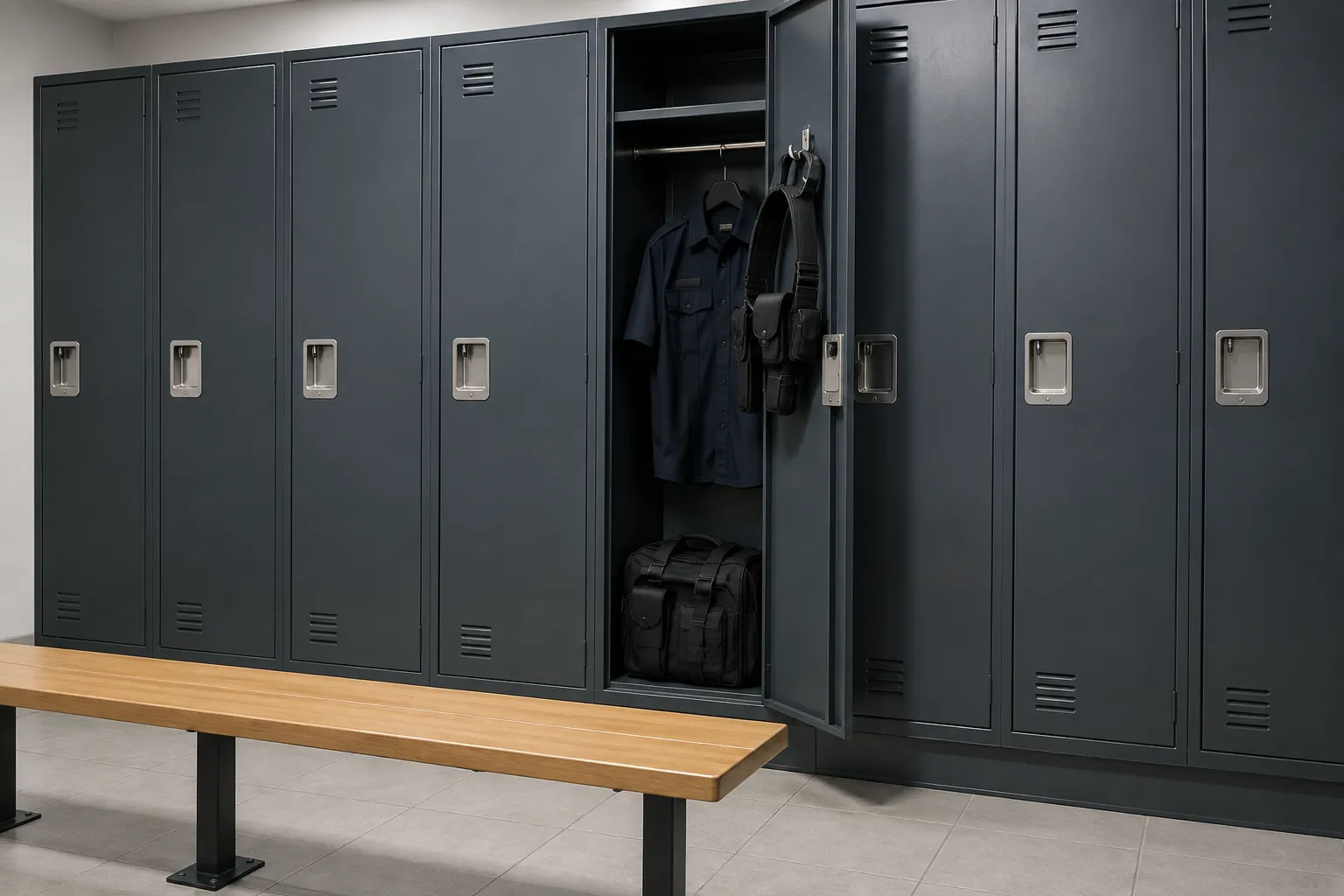
An officer’s locker holds the work uniform and everything that goes on it. Plan for a clean uniform on a hanger, a soft or hard body armor carrier, a duty belt with holster and pouches, boots, a jacket, a patrol or duty bag and personal items — often for officers on overlapping shifts who all change in the same room. That points to a full-height, single-tier locker that is wider and deeper than a standard employee locker.
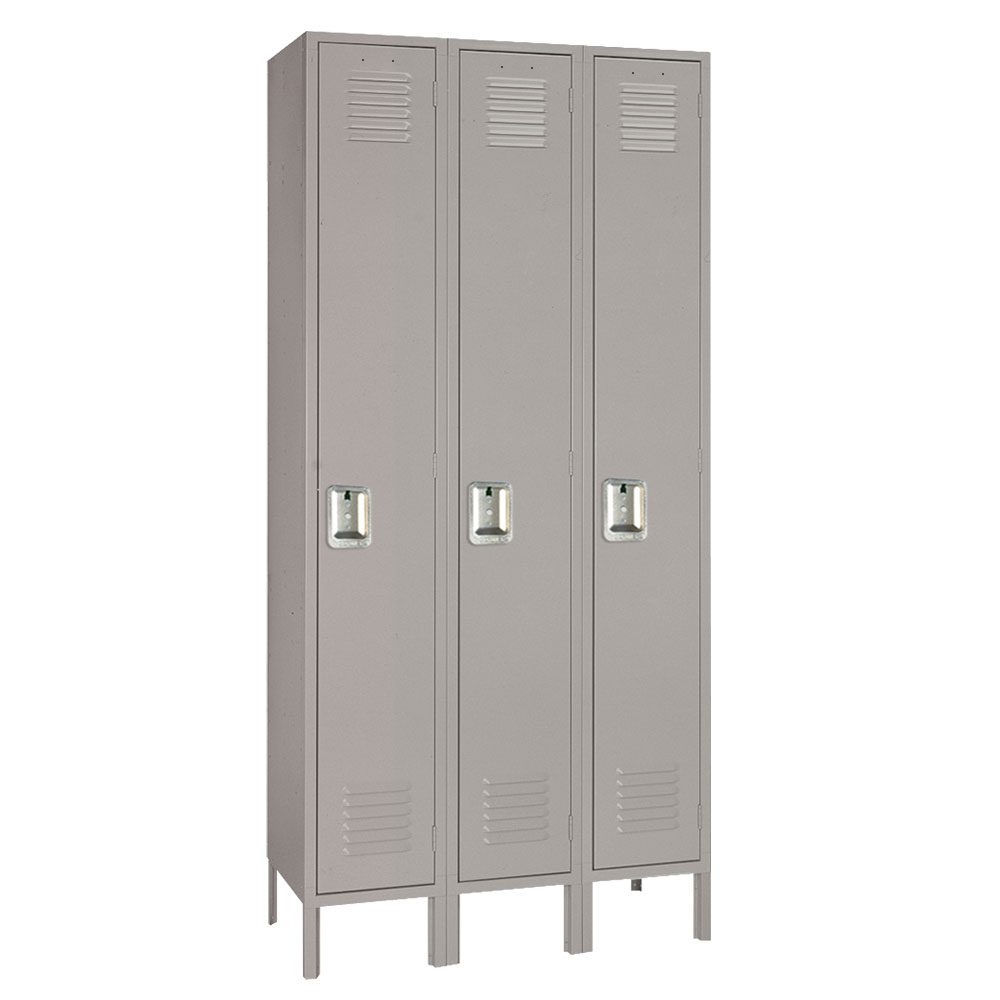
Width and depth. A 12″-wide locker will not take a hanging vest beside a uniform. Duty lockers built for law enforcement are typically 18″ or 24″ wide; Penco’s Patriot Duty locker, for example, is offered in 18 or 24-inch widths and 78 or 90-inch heights. In our online catalog, Lyon’s 18″ × 18″ × 78″ single-tier locker is the most common step up from a 12″ locker.
Interior. A coat rod with hooks for uniforms and the vest, a top shelf for a cover and gloves, and room on the floor for boots and a bag. Penco’s Duty locker adds a 16-gauge drawer base with at least 3.4 cubic feet of storage, an optional lockable security box, an optional side shelf and a back punched for electrical wiring so radios and lights can charge inside.
Bench seating. Penco’s Duty locker base is 33 or 36 inches deep and can accept individual or continuous hardwood bench seating, so officers sit to lace boots without a separate bench in the aisle.
- Ventilation — body armor and uniforms come off damp. Louvered or perforated doors keep air moving; solid doors with louvers keep contents out of sight.
- Security — a multi-point latch and a padlock hasp or built-in lock. Where department policy allows firearms in personal lockers, plan a lockable security box or a dedicated weapon locker and follow your agency’s storage policy.
- Power — radios, body-worn cameras and flashlights need charging. Lockers punched for wiring or a charging shelf save running cords across the room.
- Shift overlap — count every officer assigned to the station, including those on other shifts, since most departments assign one locker per officer.
Turnout Gear Lockers for Fire Stations
Turnout gear lockers (also called bunker gear lockers or firefighter gear lockers) are built for speed and air. They are usually open-front — no door to open on a call — with ventilated sides, a top shelf for the helmet and hood, hooks or a rod for the coat and pants, and floor space for boots. Penco’s Patriot line, for example, builds its Turnout lockers without doors; Hallowell’s turnout lockers list a fully framed all-welded body, expanded metal sides, an upper helmet shelf and an open front.
Why ventilation matters. NFPA 1851, the standard on care and maintenance of structural firefighting protective ensembles, calls for gear to be stored clean and dry, in a clean, dry, well-ventilated area, out of direct sunlight and where it will not be damaged by other equipment. Ultraviolet light degrades the outer shell, and damp gear in a closed box breeds odor and mildew.

Where to put them. Many stations keep turnout lockers in a dedicated gear room off the apparatus bay rather than along the bay wall, so diesel exhaust, sunlight through bay doors and contaminated gear stay away from living areas. Separating gear storage from crew quarters is part of the “hot zone / cold zone” approach many departments use to limit secondary contamination from fireground carcinogens.
Doors or no doors? Open-front lockers are fastest and dry best. Where gear rooms are shared with the public or volunteers’ gear needs securing, ventilated gear lockers with perforated doors — like the diamond-perforated TA-50-style gear locker — add a lock without losing airflow. Wall-mounted and mobile turnout racks are another option where floor space is tight.
NFPA 1851 storage points paraphrased from fire-service summaries of the standard; check the current edition and your department SOPs. Turnout locker features from Penco Patriot and Hallowell (List Industries) literature. Turnout lockers are quoted per project; we confirm sizes, finish and lead time with each quote.
Crew Quarters and Station Staff Lockers
Firefighters on 24-hour or 48-hour shifts need a personal locker on the clean side of the station for station uniforms, workout clothes, toiletries and personal items — separate from turnout gear. Police stations need the same for civilian staff, dispatchers and records personnel who do not carry duty gear.
Compare tiers in our single-tier, double-tier and box locker guides, or see standard sizes on our locker specifications page. Shared lockers that change hands by shift fit smart locker systems with PIN or badge access.
Duty Lockers vs. Gear Lockers vs. Turnout Lockers
| Standard single-tier | Duty locker | Gear locker | Turnout locker | |
|---|---|---|---|---|
| Typical user | Civilian staff, crew quarters | Police officers | Officers, firefighters, military | Firefighters |
| Front | Door with louvers | Door, often with drawer base | Perforated single or double doors | Open, no door |
| Common widths | 12, 15, 18″ | 18 or 24″ (Penco Patriot) | 18 to 48″ (Penco Patriot Gear) | Per manufacturer, often 20–24″ |
| Heights | 72″ body, 78″ with legs | 78 or 90″ (Penco Patriot) | 72 or 78″ (Penco Patriot Gear) | Per manufacturer |
| Ventilation | Door louvers | Louvers or perforations | Full perforation | Open front + vented sides |
| Security | Hasp or built-in lock | Multi-point latch, security box | Multi-point latch | None (secure the room) |
| Where it goes | Locker room | Officer locker room | Gear room, armory, locker room | Gear room off apparatus bay |
Duty and Gear dimensions from Penco Patriot literature; standard single-tier from Lyon and Tennsco listings in our catalog. Turnout locker sizes vary by manufacturer; we confirm on your quote.
Construction and Security for Public Safety Lockers
Station lockers are opened many times a shift, by people in a hurry, wearing gloves or carrying heavy bags. Heavier gauges and continuous hinges are worth the cost here.
- Gauge: Lyon’s TA-50 gear locker uses a unibody with a 16-gauge top, 14-gauge reinforced bottom, back and sides, and 14-gauge doors on full-length continuous hinges. Penco’s Patriot Duty locker has a 14-gauge welded shell.
- Latching: a three-point latch locks the door at top, middle and bottom — harder to pry than a single-point latch.
- Handles: recessed handles stay out of the aisle and resist damage; Penco uses its Ultra Cremone recessed handle on the Patriot line.
- Shelves: Lyon rates the TA-50 locker’s full-width 16-gauge shelf at 200 lb, enough for helmets, armor and boxed gear.
- Finish: powder-coat finishes in station colors; turnout lockers are often red.

For lockers in corridors or high-abuse areas, see our Dasco heavy-duty corridor lockers; for brand detail on Penco’s Patriot, Duty and Gear lockers, see our Penco lockers page.
Related Law Enforcement Storage

Personal lockers are only part of a station. Evidence handed in at the end of a shift should go through a pass-through or electronic evidence locker that logs who deposited what, so the chain of custody is never handled by an officer’s personal locker. Our evidence storage guide covers temporary lockers, property rooms and high-density shelving.
Rifles, tactical vests and SWAT kit belong in tactical gear lockers with rifle racks, drawers and bench seats, and detention facilities need jail lockers built for inmate-side abuse. We plan all of these together when a station is built or remodeled.
Planning Lockers for a New or Remodeled Station
Count and zone
List sworn officers, firefighters per shift, volunteers and civilian staff, and mark gear room, locker rooms and crew quarters on the plan.
Choose by zone
Duty lockers for officers, open turnout lockers in the gear room, and single- or double-tier personal lockers on the clean side.
Layout and quote
We return a layout with locker counts, sizes, benches, bases and accessible units, plus freight and optional installation.
Deliver and install
Freight to the station and optional installation, anchoring and bank assembly, scheduled around station operations.
Our locker room design service draws the room to scale, including aisles, benches and accessible lockers. Some common locker sizes are in stock at select manufacturers, subject to confirmation; duty, gear and turnout lockers are usually built to order, and we confirm lead time on every quote. Browse every locker category in our lockers directory or the Lyon locker catalog.
Police and Fire Station Locker FAQs
What size lockers do police officers need?
What is a turnout gear locker?
Why are turnout gear lockers open in front?
Should turnout gear be stored in the apparatus bay?
What is the difference between a duty locker and a gear locker?
Can officers store firearms in their lockers?
Do firefighters need separate personal lockers?
Do you have police and fire station lockers in stock?
Plan Lockers for Your Station
Send your station plan and headcount and we will recommend duty, turnout and crew lockers with a free layout and quote.