
Metal Service Center Racking: thyssenkrupp Materials
A metals service center stores the hardest things a warehouse can be asked to hold: dense, long, sharp-edged, unpalletized product that arrives by the bundle and leaves by the piece.

2022 & 2024
Years thyssenkrupp Materials worked with us on rack
Metals distribution
Service center: bar, tube, sheet, plate
Pallet rack
Product category we supplied
Weight-led design
Steel fills a bay long before it fills the volume
The project
thyssenkrupp Materials is a metals distributor and service center business. Material Handling USA supplied pallet rack for the company in 2022 and again in 2024. The client, those years and the product category supplied are the only project details we publish.
Metals distribution is the storage problem most warehouse design guides quietly skip. Almost every rule of thumb in general distribution — average pallet weights, cube utilisation, bay depth, pick faces at waist height — assumes product that is palletized, roughly cubic and light enough that the structure is rarely the limit. In a service center none of that holds. A single bundle of one-inch solid bar can outweigh a whole bay of consumer goods, and a twenty-foot length of tube does not fit any pallet position ever made.
What follows is how we plan pallet rack systems, cantilever racking and heavy-duty steel storage racks for a metals service center — the engineering questions that decide the layout, and what to insist on when specifying one.
Why steel breaks generic warehouse racking
Five characteristics of metal inventory drive the design, and each one has a direct structural consequence.
| Characteristic | What it means on the floor | Design consequence |
|---|---|---|
| Extreme density | A short bundle can weigh more than a full pallet of boxed goods | Capacity is set by weight per level and per frame, not by cube |
| Long lengths | Stock is bought and cut in 20 ft, 24 ft and longer lengths | Cantilever arms and column spacing, not pallet bays |
| Unpalletized handling | Bundles are slung, forked or craned, not always on a pallet | Load surfaces must suit banded bundles, not just pallet stringers |
| Sharp, hard product | Steel damages what it touches, including racking | Heavier gauge or structural components and serious impact protection |
| Mixed grades and sizes | Many sizes of the same shape, all of them look alike | Location addressing and labelling do more work than in most warehouses |
The first row is the one that catches people out. Sizing a bay from a “typical” pallet weight and then filling it with steel is how racking gets overloaded without ever looking full. A metals installation should be specified from the actual heaviest load per arm or per beam level, including the way that load is applied — a banded bundle concentrating load over two contact points is a different problem from a uniformly distributed pallet.
Capacity is a system property
Beam and arm ratings are only part of it. Frame capacity depends on the total load in the bay and on the vertical beam or arm spacing; add a level, or move one down, and the frame rating changes. Always design from the rack engineer’s load table for the configuration you are actually building.
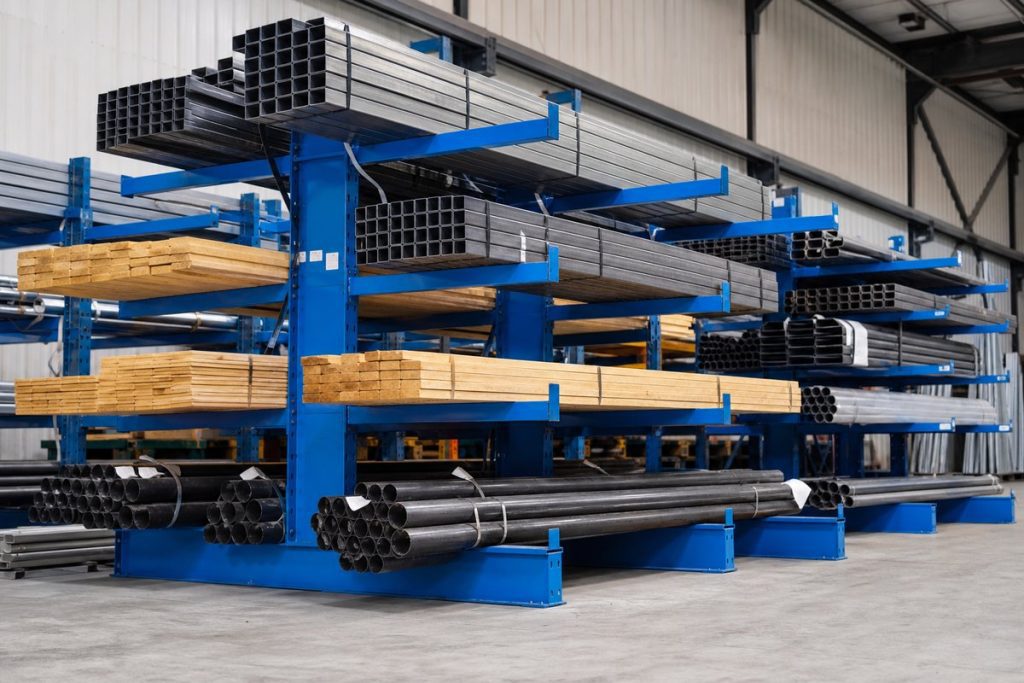
Long product: cantilever rack design
Bar, tube, angle, channel, extrusion and pipe belong on cantilever racking, not in pallet bays. The design starts with four inputs and everything else follows from them.
Load length and support points. Long stock needs enough arms under it to stop it sagging or tipping — usually column spacing chosen so no bundle is supported at fewer than three points. Column spacing is therefore a function of what you buy, not of what is convenient to install.
Weight per arm and per column. Arm capacity falls as arms get longer, and total column capacity is a separate limit from arm capacity. Both need checking against the heaviest bundle you actually stock, not the average.
Arm length and load depth. The arm should support the full bundle depth, with the load kept as close to the column as practical. Overhanging the arm tip is the fastest way to turn a rated arm into an unrated one.
Single or double sided. Double-sided cantilever down the middle of the floor doubles the storage on one base; single-sided against a wall costs floor area but is often the only practical arrangement where a crane bay or wall-mounted services intervene.
Our cantilever rack design guide works through the sizing inputs in detail, and the cantilever rack vs pallet rack comparison covers where each system is the right answer.
Storing long or heavy stock?
We size and install cantilever racking and heavy-duty structural rack for metals, pipe and extrusion.
Sheet, plate and coil: the flat-product problem
Flat product is a separate design exercise from long product, and it is where improvised storage is most common and most dangerous.
- Sheet and plate stored flat need a decked, rated surface and a way to get a lifting device under the top piece — not a stack on the floor that has to be pried apart.
- Stored on edge, sheet needs restraint. A vertical rack or A-frame arrangement has to prevent a sheet toppling when the one beside it is removed.
- Coil is a rolling hazard by nature: cradles, saddles or purpose-built coil storage, never a flat beam level.
- Bundle banding is not a structural element. Design as if the band may fail, because eventually one does.
- Keep the heaviest, densest product at the lowest levels — it lowers the centre of gravity of the whole system and shortens the drop if anything ever comes loose.
- Give the crane or forklift real approach room to every stored orientation; storage that can only be reached by an awkward manoeuvre gets damaged.
Where flat product is cut to order, the storage design has to serve the cutting cell, not just the warehouse. Staging positions beside a saw or plasma table — sized for the actual sheet footprint, decked, and close enough that a crane move is one lift — take more travel out of a service center day than any amount of density elsewhere.

Where pallet rack earns its place
A service center is not all long product. Fittings, fasteners, consumables, packaged and processed goods, customer-owned material awaiting collection and finished cut parts all sit better in pallet positions than on arms.
Selective pallet rack handles the mixed, addressable inventory — one hundred per cent access, easy to re-slot as the product mix moves. In a metals building it should usually be specified heavier than a general distribution equivalent, because it will be loaded heavier than anyone predicts.
Structural pallet rack — hot-rolled channel columns and bolted connections rather than roll-formed steel and drop-in beams — is worth its premium exactly where a service center operates: heavy loads, frequent handling, and forklift contact that would bend a lighter frame. It is also easier to repair in place.
Drive-in rack suits deep runs of a single item where lot identity does not matter within the lane, which in a metals building is usually processed or packaged product rather than raw stock.
Wire decking belongs on any level holding part loads, cut pieces, banded shorts or odd footprints — which in a service center is most of them.
Cranes, aisles and how the building actually works
Most metals buildings are crane buildings. That single fact changes rack layout more than any storage calculation.
Respect the crane envelope. Rack height is limited by the underside of the crane bridge and by the hook approach, not by the roof. Storage that fouls the crane path will be discovered the expensive way.
Decide what is craned and what is forked. Crane-served storage wants open tops and clear vertical access; forklift-served storage wants clear aisle approach and arm or beam elevations matched to the truck’s lift and free-lift capability. Mixing the two on the same run without deciding which governs produces storage that suits neither.
Size aisles for the load, not the truck. A truck carrying a twenty-four foot bundle needs turning and manoeuvring room that no aisle table accounts for. Cross aisles, end clearances and the approach to the saw or shear are where the real space is consumed.
Keep the traffic pattern one-way where you can. Long loads and two-way aisles are a poor combination, and the damage they cause lands on rack uprights.
Our guide to designing a pallet rack layout covers the general method; in a crane bay, run the crane and truck movements through the layout before the racking is ordered, not after.
Capacity, code, installation and inspection
Post the capacities, and mean them. Load plaques showing the rated capacity per level and per bay for the as-built configuration are both an OSHA-relevant safety control and the only practical defence against gradual overloading. In a metals building they should be posted where a forklift operator can read them from the seat.
Seismic design. Storage racks above a defined height are treated as non-building structures with seismic design requirements under the International Building Code as adopted locally, with rack design to ANSI MH16.1. For dense product this matters more, not less: seismic demand scales with the mass you are storing, so a metals installation generates far higher forces than the same steel holding boxed goods. Anchor type, size, embedment and count come from the rack engineer’s drawings for the actual slab.
Slab capacity is a real constraint. Base plate pressures from heavily loaded frames can exceed what a light slab was designed for. It is worth confirming slab thickness and condition before finalising frame layout, especially in an older building.
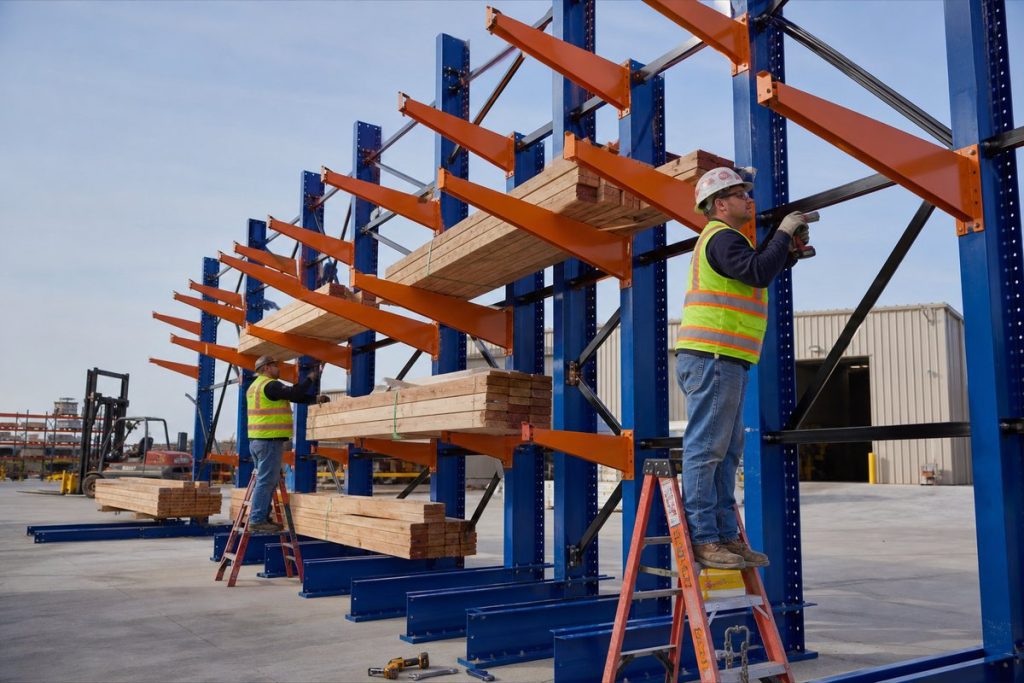
Installation and inspection. Plumb columns, verified beam engagement, correct anchor torque and a documented handover are what a professional rack installation delivers. After that, a documented inspection interval with an immediate unload-and-report rule for damage keeps the system in its designed condition, and rack repair restores engineered capacity where a column has been hit.
Protect the impact points. Column guards and end-of-row protection at aisle ends, door approaches and crane bay boundaries are the cheapest insurance in the building.
Metal service center racking FAQs
What kind of racking does a metal service center need?
How do you size cantilever rack for steel bar stock?
Is structural pallet rack worth the extra cost for metals storage?
Why can’t we just use standard pallet racking for steel?
Does storing heavy steel change the seismic requirements?
How should sheet and plate be stored?
How does an overhead crane affect rack layout?
Designing storage for a metals operation?
We design, supply and install cantilever, structural and selective racking across the Intermountain West, including Utah.
Racking Built for the Weight of Steel
Material Handling USA designs, supplies and installs cantilever and pallet rack for metals service centers, fabricators and industrial distributors across Utah and the Intermountain West.