
Equipment Security Cages for a Lawn Care and Pest Control Service Branch
How a Utah service company secured route equipment, spreaders and small engines inside a shared shop — and why the chemicals stayed out of the cage.
Utah
SolTerra Services, lawn fertilization, weed control and pest management
The problem
Route equipment, spreaders and small engines shared with an open shop
The answer
A wire enclosure for equipment, with regulated product stored separately
Local
Salt Lake City, Provo, Ogden, Park City, Lehi and Orem service coverage
A service branch is a warehouse with wheels
SolTerra Services runs lawn fertilization, weed control and pest management routes across the Wasatch Front. A branch like that looks nothing like a distribution center. There is a shop, a small storage area, a yard, and a fleet of route trucks that all leave inside the same hour every morning and come back covered in the day.
The assets are portable and desirable: backpack sprayers, spreaders, blowers and other small engines, hose reels, power equipment, batteries and the hand tools that go with them. They are also constantly in motion, which is exactly why they are hard to keep track of. Equipment does not usually leave in a dramatic break-in. It leaves one piece at a time, off a truck, off a bench, out of a bay that anyone walking through the shop can reach.
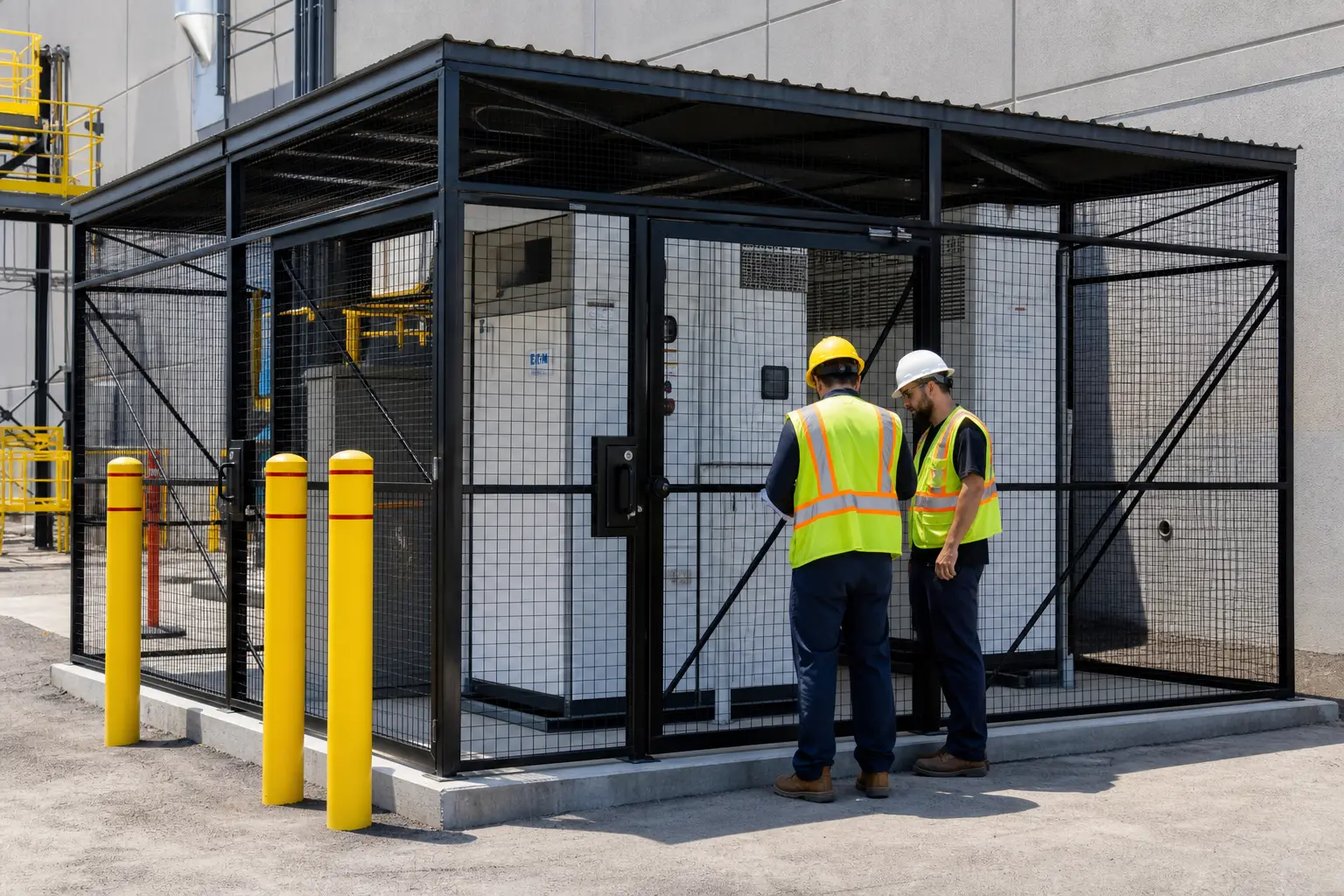
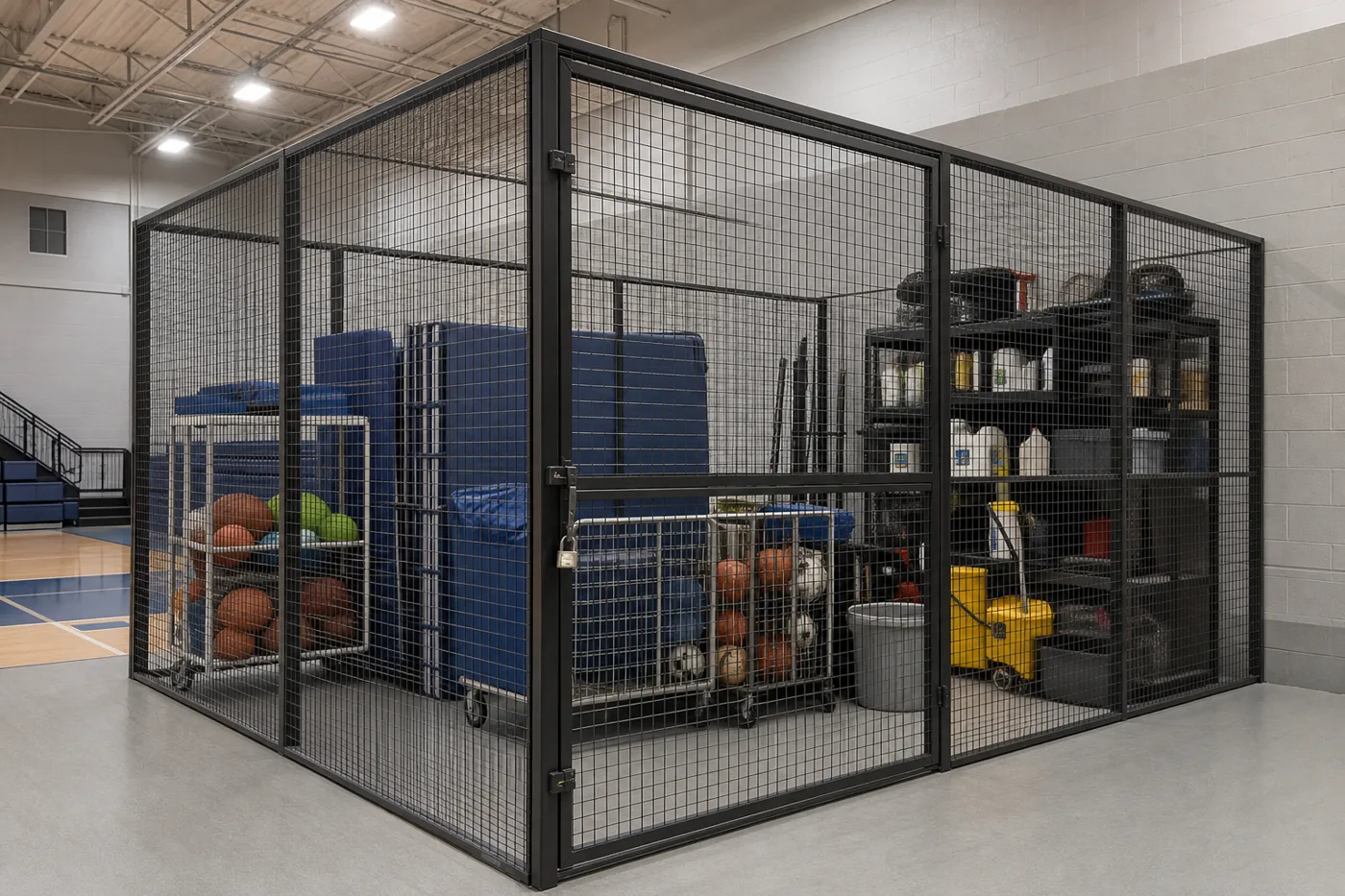
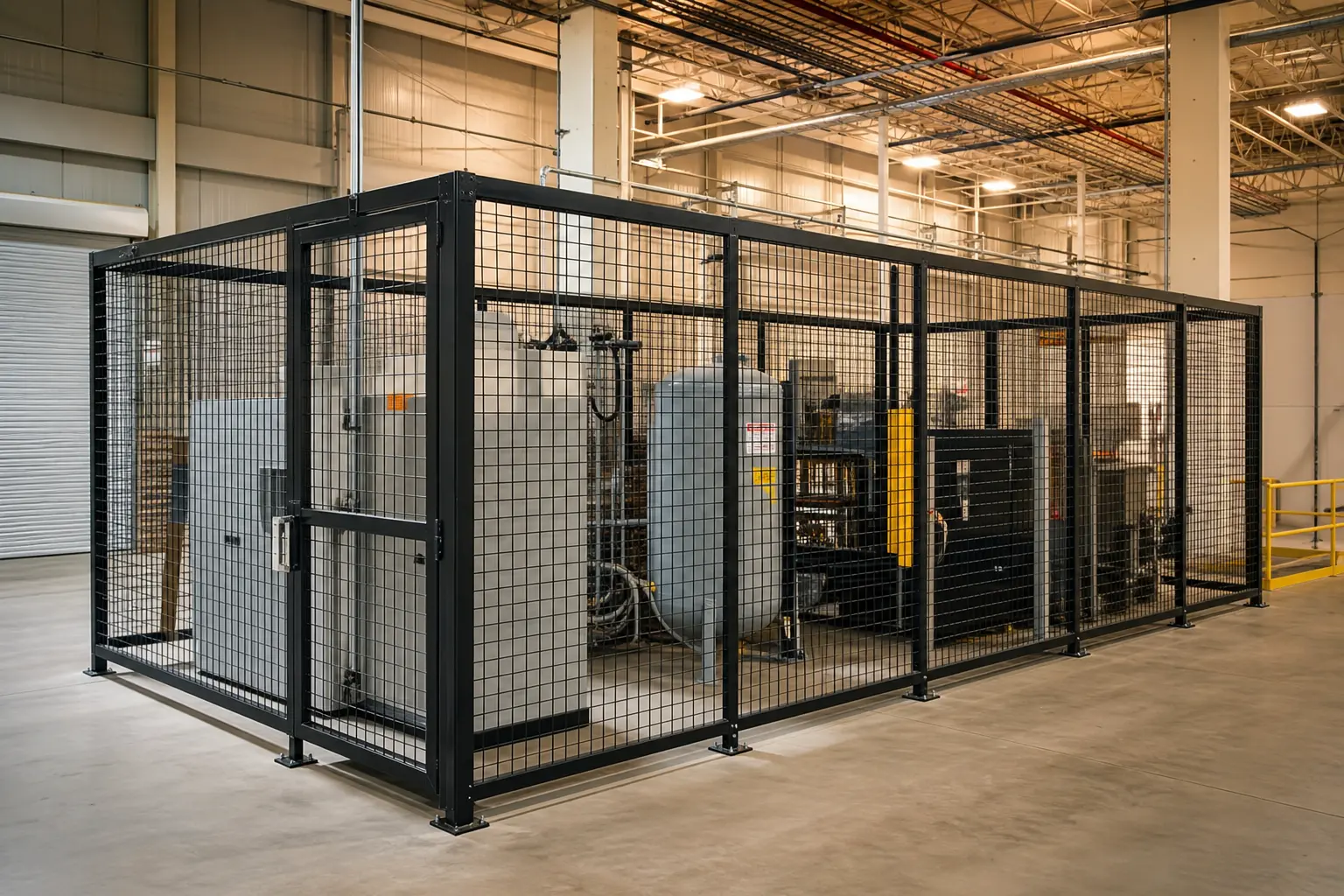
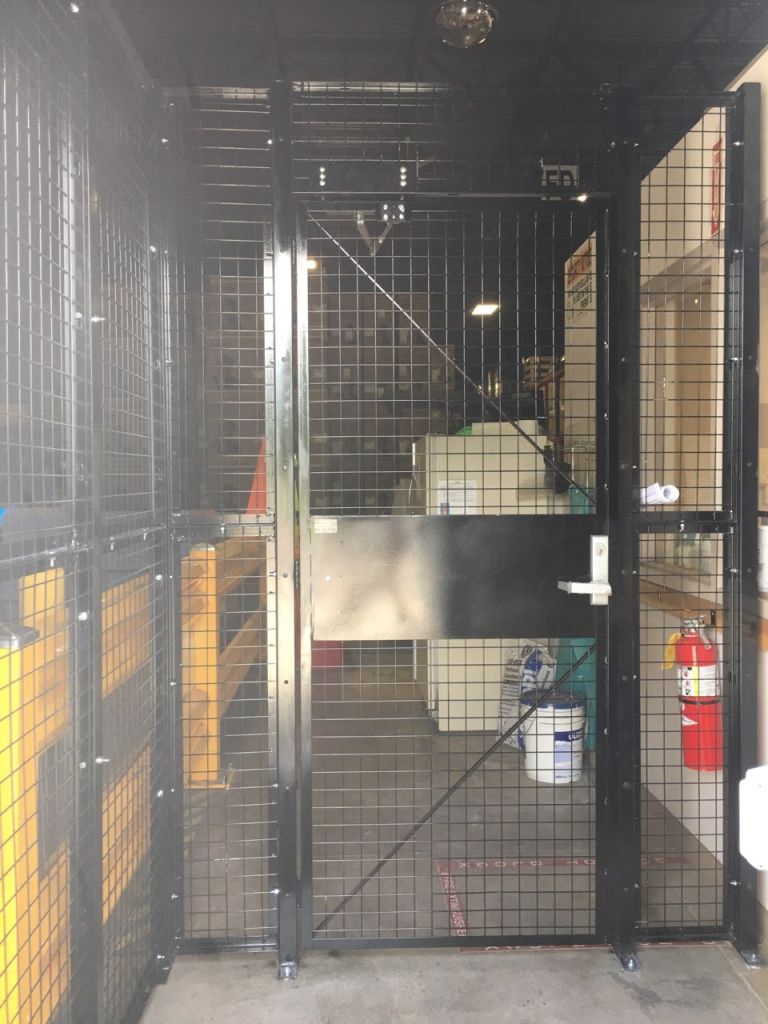
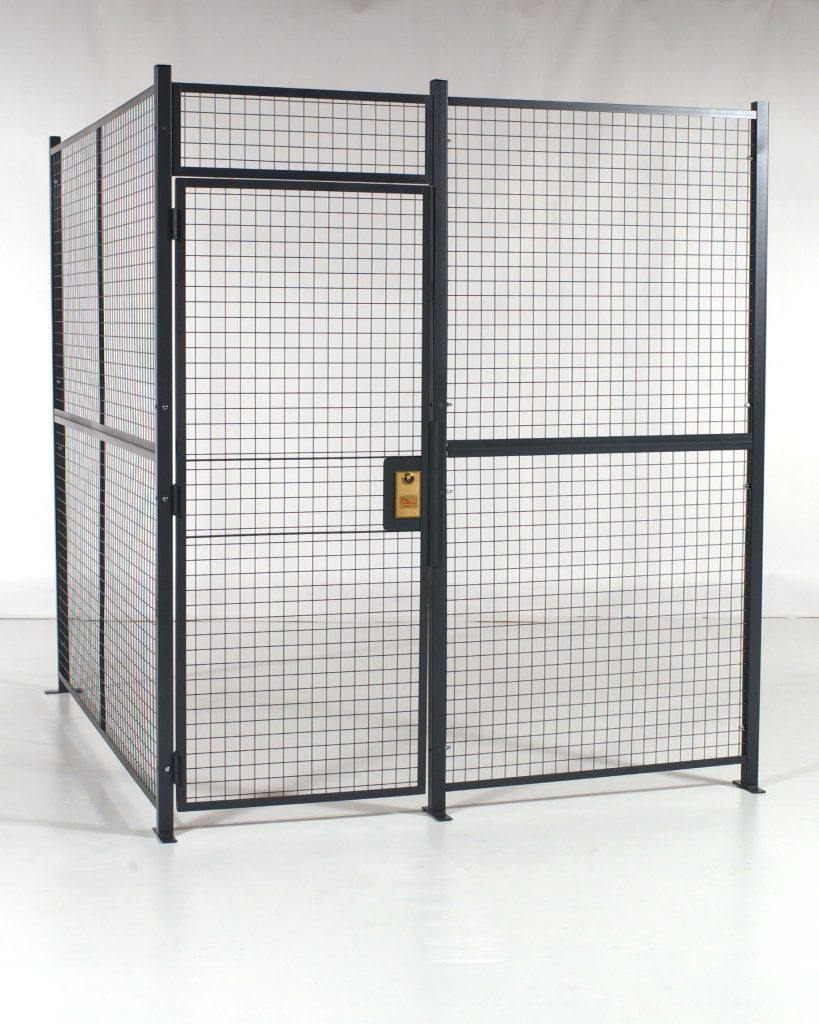
The answer we recommend for service branches is a defined equipment enclosure inside the building — the same welded wire construction used across our security cage and wire partition systems, sized for a shop rather than a warehouse. It keeps equipment visible and countable while limiting who can reach it, and it does not consume the floor space a solid-wall room would.
What belongs inside the enclosure
Start with the equipment that walks and the equipment that stops a route if it is missing.
Powered equipment. Backpack blowers, sprayers, trimmers, aerators and their batteries and chargers. Small engines are the single most commonly lost class of asset in a service branch.
Calibrated and metered gear. Spreaders, flow meters and application equipment that was set up deliberately and should not be adjusted by whoever grabs it.
Route kits and PPE. Respirators, cartridges, gloves and protective clothing belong somewhere clean, dry and controlled — and somewhere a supervisor can confirm they are actually stocked.
Inspection and monitoring devices. For the pest side of the business, monitoring equipment, cameras and detection tools are small, valuable and easy to misplace.
Seasonal equipment out of rotation. Anything that will not be touched for four months should be behind a door, not leaning against a wall.
What must not go in a wire cage
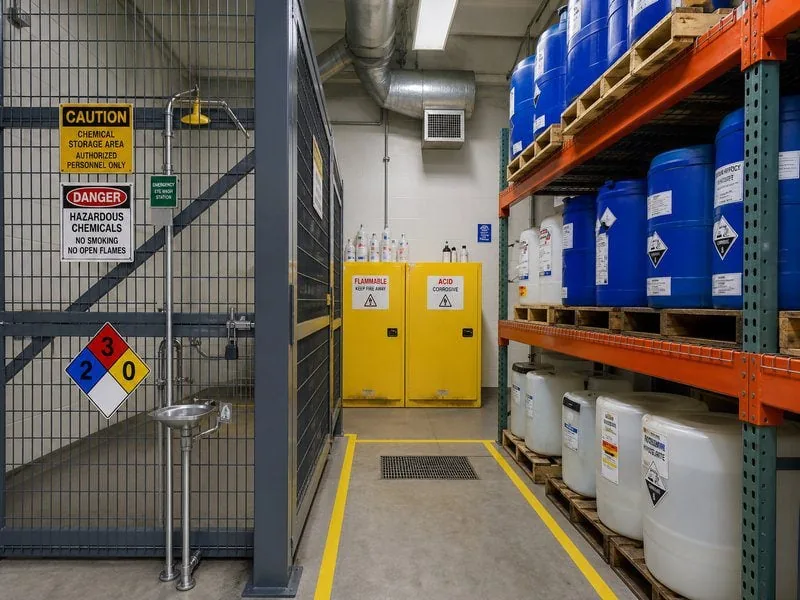
This matters more here than in almost any other application, so it is worth stating plainly: a wire mesh enclosure is an access-control barrier, not a chemical storage system. Mesh does not contain a spill, does not resist a corrosive, does not provide ventilation and does not meet the requirements that apply to regulated products.
Pesticides, herbicides, fungicides and fertilizers carry storage requirements that come from the product label, the U.S. EPA’s pesticide storage and disposal rules, state lead-agency licensing, and fire code provisions for hazardous materials. Depending on the product and the quantity, that can mean a dedicated room, secondary containment, mechanical ventilation, spill response equipment, separation from ignition sources, restricted-use recordkeeping and specific signage.
| Material | Right home | Why not a wire cage |
|---|---|---|
| Powered equipment, tools, PPE | Wire mesh equipment cage | Ideal — visible, ventilated, controlled |
| Packaged pesticide and fertilizer product | Dedicated, code-compliant chemical storage room | Containment, ventilation and label requirements |
| Restricted-use products | Locked storage per label and state rules | Legal storage and record obligations |
| Flammables and fuel cans | Listed flammable-liquid cabinet or approved room | Fire code, ignition separation |
| Empty, triple-rinsed containers | Marked outdoor holding area | Disposal handling, not security |
The clean way to design a service branch is to keep those two worlds physically apart: an equipment cage where staff and crews work, and a separate compliant chemical room with its own controls. If a supplier offers you a wire cage as chemical storage, that is a reason to ask more questions.
Designing for a business with seasons
Lawn and pest work swings hard through the year, and a fixed enclosure sized for July is either empty in January or too small in May.
Size for peak headcount, not peak inventory. The constraint at 6 a.m. in the busy season is people and carts moving through a door, not shelf space.
Build in a shoulder zone. A partitioned bay inside the enclosure that holds out-of-season equipment keeps the working area from silting up.
Plan an expansion run. Bolted framework means adding a bay later is a half-day job. Leave one straight wall clear so the enclosure can grow in one direction.
Watch temperature. Unheated shop space and batteries do not agree in a Utah winter. Battery storage often needs to be inside the conditioned part of the building, which may mean a second small enclosure rather than one big one.
Layout around route load-out
Everything in a service branch is decided by the morning. Twelve to twenty people load in the same window, and any control that slows that window will be defeated within a week.
Specifying the enclosure
Shop environments are harder on an enclosure than an office warehouse. What we look at:
Panel and frame. Welded or woven wire panels in a bolted steel frame. Add a kick plate or heavier bottom panel where carts and spreaders will hit the base.
Height. Partial height is fine in an open, supervised shop. Full height with a mesh ceiling is right when racking, a mezzanine or stacked material makes the top reachable.
Doors. A single hinged leaf for foot traffic; sliding where the aisle is tight; double leaf where equipment rolls through.
Hardware. Keyed hardware suits a small branch. A keypad or credentialed lock makes sense when crews start before a manager arrives or when you want a record of entry.
Finish. Powder-coated steel inside; galvanized or hot-dip finishes where the enclosure sees moisture, wash-down or outdoor weather.
Yard and outdoor enclosures
Service branches usually need something outside as well: trailers, hose reels, bulk equipment and seasonal machines that will not fit in the shop.
Outdoor enclosures change the specification. Finish has to survive weather, so galvanized or hot-dip components replace standard powder coat. Anchoring moves from an interior slab to a pad or footing that may need to be poured. Snow load and wind matter for anything with a roof, and in northern Utah snow removal around the enclosure has to be part of the plan rather than an afterthought.
Where the goal is protecting equipment left outdoors, our page on outdoor security cages for equipment protection covers finishes, anchoring and weather detailing in depth.
Egress, sprinklers and anchoring
Three checks apply to any enclosure built inside an occupied building.
Egress. The enclosure must not block a required exit path or trap anyone inside. Doors on egress routes need hardware that opens from the inside without a key, and required aisle widths have to be maintained. OSHA’s exit route rules in 29 CFR 1910.36 and 1910.37 set the floor; local building and fire code may go further.
Fire protection. Adding a mesh ceiling or dense storage changes sprinkler assumptions. NFPA 13 governs the design and the authority having jurisdiction approves it.
Anchoring. Posts anchor to the slab. Slab thickness, seismic design category and, in leased buildings, the landlord’s rules all shape the detail. Northern Utah sits in a seismically active region, so anchor specification is a question to answer on paper, not in the field.
Installation without losing a morning
A shop enclosure of this size is typically a one- to two-day installation. The disruptive part is anchoring, which is why it is normally scheduled after routes leave or on a weekend. Panels and doors go up quickly once the framework is set, and shelving, the charging bank and signage are fitted last with the branch team so labels match the way crews actually talk.
If the branch cannot lose any morning at all, the work splits: framework and door on day one after load-out, fit-out on day two during the quiet middle of the day.
Working with a Utah supplier
Material Handling USA is headquartered in Salt Lake City and installs across the Wasatch Front and the wider Mountain West.
Material Handling USA
222 S. Main St., 5th Floor
Salt Lake City, UT 84101
Phone: (801) 328-8788
Local service areas include Salt Lake City, Provo, Ogden, Park City, Lehi, Orem, Logan and St. George. Being local matters on projects like this for two reasons: someone can walk the shop before the layout is fixed, and a phased installation can be scheduled around a route calendar instead of a shipping window.
More on regional projects and coverage is on our Utah security cages page.
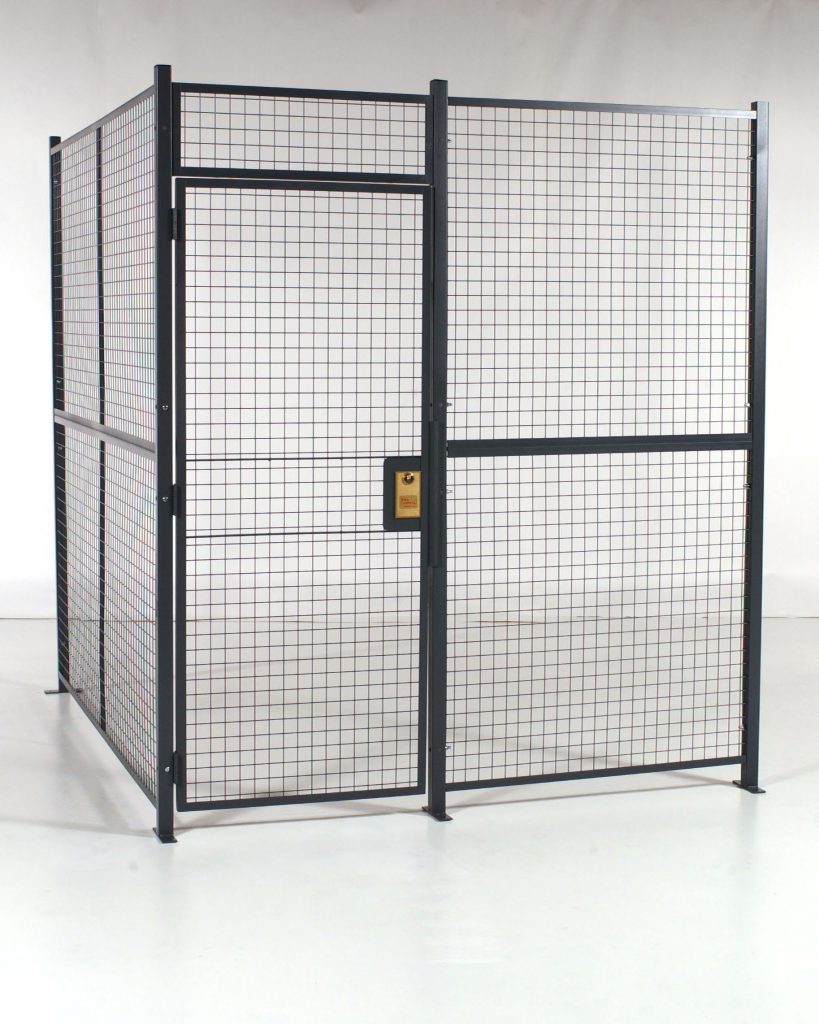
Shop Pre-Configured Wire Mesh Cage Kits Online
Standard-size welded wire cage kits, priced online, for smaller storage needs. Every kit still needs to be anchored to sound concrete — for tall, braced or engineered enclosures, request a quote with your building location and floor details.
Frequently asked questions
Can we store pesticides or fertilizer in a wire mesh cage?
What size enclosure does a service branch need?
Should the cage be full height?
Can we put an enclosure in the yard instead?
Will this work in leased shop space?
How do you handle battery storage and charging?
Looking for a project like yours? Browse more contractor and fleet security cage case studies, see all security cage case studies.
Talk to our Salt Lake City team
Send a shop sketch and your route count. We will size an equipment enclosure, flag anything that belongs in compliant chemical storage instead, and quote the work.