
Home › Storeganizer › Case Studies › ID Logistics
ID Logistics — aviation spare parts and the small-SKU storage problem
A contract logistics operation handling aviation spares, where the inventory is high in SKU count, low in volume per line, and unforgiving about being found quickly.

Aviation
spare parts
High
SKU count per bay
4 rows
deep in existing rack
1 SKU
per pocket
The situation
| Project profile | |
|---|---|
| Industry | Contract logistics / 3PL |
| Application | Aviation spare parts |
| System | Storeganizer high-density textile pocket columns in existing pallet rack |
| Source | Results as reported by the operation and its Storeganizer manufacturer, KTP conTeyor |
Aviation spares are one of the hardest inventory profiles in logistics. The SKU count is very high, the quantity held per line is often very low, the parts range from a washer to an assembly, and availability matters more than almost anywhere else — an aircraft waiting on a part is an expensive aircraft.
Conventional storage handles this badly in a specific way. Sizing locations for the largest part wastes space on every other line; sizing them for the average forces the outliers into bins they share with other SKUs. Either way the picker ends up searching, and searching is where both time and accuracy go.
What was installed
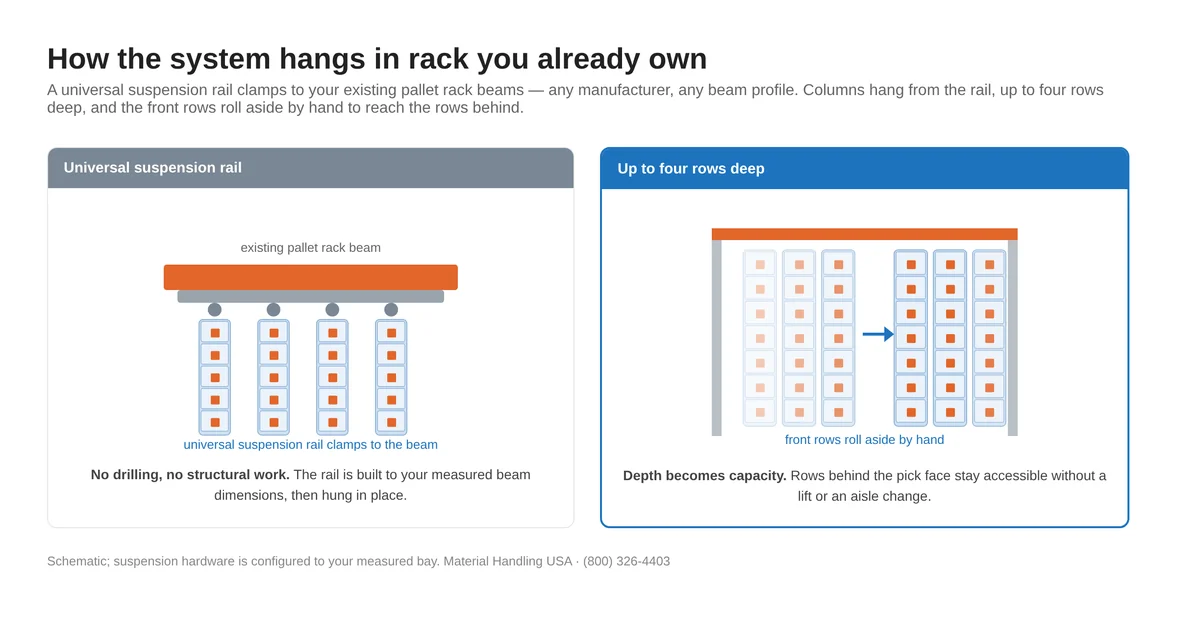
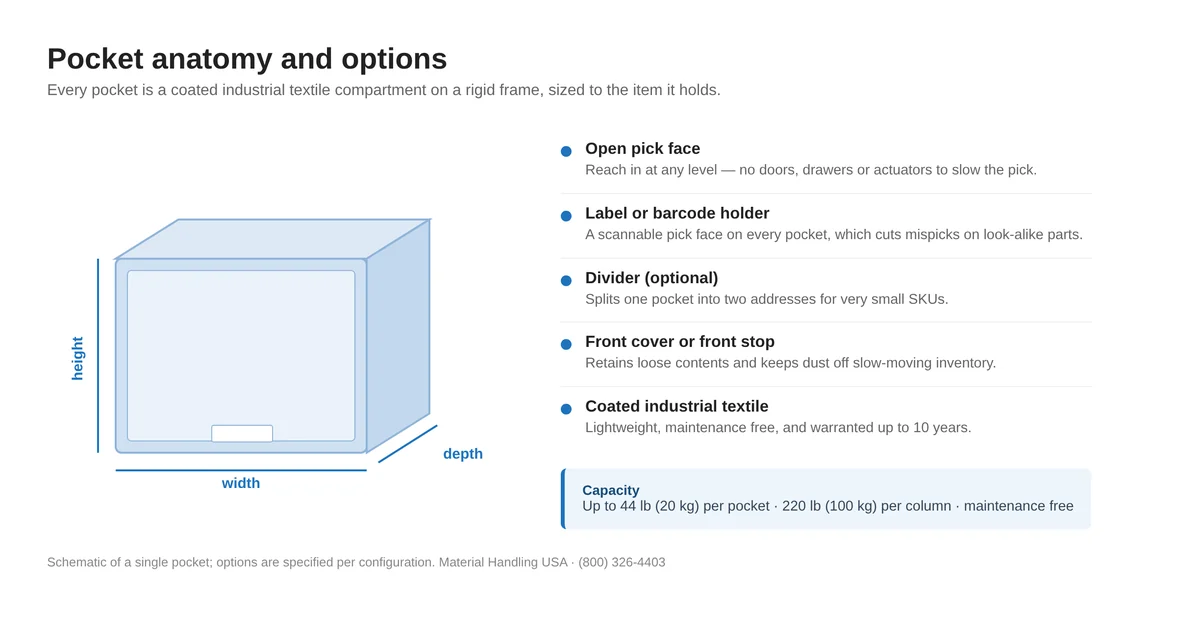
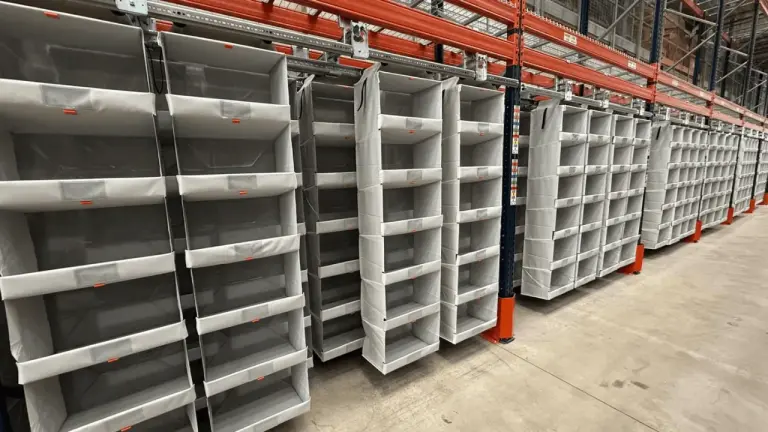
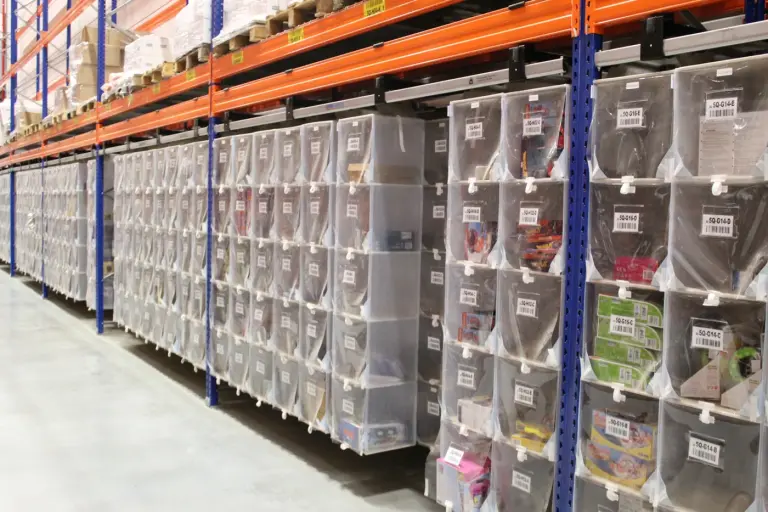
ID Logistics uses Storeganizer pocket columns for this inventory at its Paris operation. Each spare gets an individually sized, individually addressed pocket, hung in existing pallet rack up to four rows deep, with the front rows rolling aside by hand to reach the rows behind.
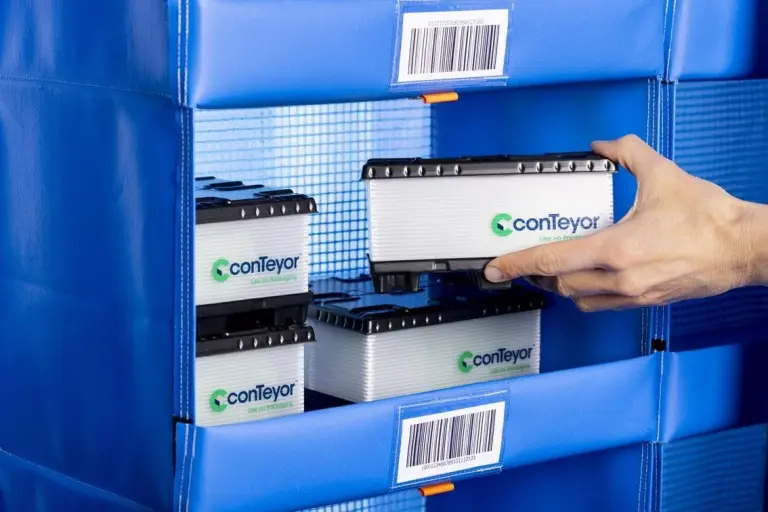
For a spares operation the addressing matters as much as the density. A labelled or barcoded pocket per part number means a scan-verified pick works exactly as it does on a rack beam, and stock levels are visible rather than inferred.
Reported results
| Measure | Before | After |
|---|---|---|
| Small-SKU storage optimisation | Conventional shelving and bins | Individually sized pockets, one SKU per address |
| Rack usage | Locations sized for the largest part | Up to four rows of columns in the same bay |
| Part visibility | Contents inferred from a bin | Open pocket, visible stock, labelled pick face |
“There is simply no other solution that is able to optimise small SKU storage to the same extent.”
We have quoted the assessment rather than inventing figures for it: the publicly reported detail for this installation is qualitative, and a case study that manufactures numbers is worth less than one that says what it knows.
What is measurable is why the profile fits. Aviation spares are the textbook case for pocket columns — high SKU count, low volume per line, wide size range, high cost of not finding the part. Every one of those characteristics is an argument for right-sized, individually addressed storage.

What this means for a US operation
Every warehouse is different, and a result reported elsewhere is evidence rather than a forecast. These are the transferable parts:
- High SKU count with low volume per line is the ideal profile. This is the inventory that suffers most in locations sized for cases.
- Wide size ranges need multiple pocket sizes, not a compromise size.
- Scan-verified picking works in pockets. Label and barcode holders are specified per pocket size.
The measured averages behind these cases — around 40% more usable space, 42% less travel time and 26% better picking efficiency — come from independent research at the University of Leuven, Belgium (2013), comparing Storeganizer with conventional rack and shelf. To see what the same arithmetic produces in your own bay, use the Storeganizer Configurator or ask us to run the numbers with you.
Why this inventory profile suits pocket columns
The transferable part of any case study is the profile, not the logo. These are the characteristics that made this operation a good candidate — and they are the ones worth checking against your own inventory before you consider a conversion.
How a conversion like this runs
Four steps, and none of them involve construction. The sequence matters: the slotting analysis comes before the measurement, and the count comes before the order.
Profile the SKUs
We look at item size, stock depth and order frequency for the zone in question — the three properties that decide whether a pocket is the right home for a part.
Measure the bays
Inside width, inside depth, clear height and beam profile. The suspension rail is then manufactured to those dimensions.
Configure and count
Pocket sizes are selected per SKU group and the location count is calculated before anything is ordered.
Install and slot
Columns hang from existing beams in an operating warehouse — no drilling, no anchoring, no permit drawing — then stock is slotted in.
We handle all four in the United States, including the install. Because the system is maintenance free — no motors, no controls, no annual service contract — there is nothing scheduled after handover.
Questions about this project
What does ID Logistics store in Storeganizer?
Are there published performance figures for this installation?
Why are aviation spares a good fit for pocket columns?
Can pocket columns handle heavy aviation components?
Related reading
 Storeganizer for aerospace and defense partsOne labelled, barcodable location per part number – up to 396 per pallet rack bay. Storeganizer pocket storage for…
 Spare parts and MRO storageGive every spare its own labelled pocket – up to 396 per pallet rack bay. Cut search time, duplicate purchasing and…
 SNC aerospace parts storage case studyHow Sierra Nevada Corporation replaced shelving with Storeganizer pocket storage inside existing 42-inch pallet rack…
 All Storeganizer case studies and measured results8,611 sq ft consolidated into 1,335. Picking from 25-30 to 60-80 lines per hour. 4,000 SKUs in 16 bays. Attributed…
Could your rack do this?
Tell us the bay dimensions and the SKUs giving you trouble. We will come back with a configuration, a location count and an honest view of whether a conversion is worth it.