
Home | Storeganizer | Pocket Sizes & Textile Options
Storeganizer Specifications: Pocket Sizes, Textile Grades and Rack Parameters
Every standard US pocket style with pick-location counts per bay, the four textile grades and what each is specified for, rack dimensions we need to quote, the options list, and Picking Hive specifications with reference numbers.

Standard pocket styles and pick locations per bay
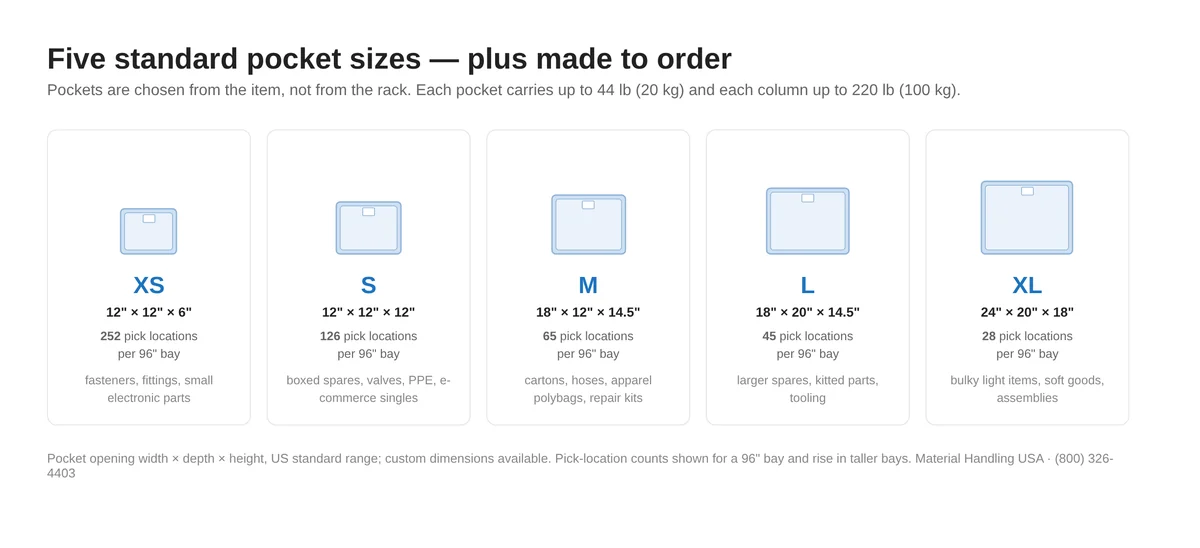
These are the standard US pocket styles MH-USA quotes from. Location counts assume a full four-row-deep configuration in a 42″ deep bay. Mixed pocket sizes within a single bay are standard and cost nothing extra.
| Pocket style | Opening (W x D x H) | 96″ bay | 108″ bay | 144″ bay | Typical contents |
|---|---|---|---|---|---|
| Extra Small | 12″ x 12″ x 6″ | 252 | 288 | 396 | Fasteners, washers, connectors, seals, sachets, sample kits |
| Small | 12″ x 12″ x 12″ | 126 | 144 | 198 | Boxed spares, fittings, valves, PPE, e-commerce singles |
| Medium | 18″ x 12″ x 14.5″ | 65 | 80 | 110 | Cartons, hoses, apparel polybags, repair kits |
| Large | 18″ x 20″ x 14.5″ | 45 | 55 | 75 | Bulkier cartons, moulded plastics, sub-assemblies |
| Extra Large | 24″ x 20″ x 18″ | 28 | 28 | 44 | Large cartons, bagged goods, light bulky returns |
Custom pocket dimensions
If none of the standard styles suits your parts, pockets are made to order. The manufacturer’s Quantisizer process measures the actual items and the available space, and pockets are tailored to both. This is worth doing when a single dominant SKU family drives the whole configuration.
Textile grades
The fabric specification determines both how much load a column carries and how much abrasion it tolerates before it wears. Tiger+ is the standard specification for most warehouses; heavier or sharp-edged parts and very high pick rates move up the range.
| Grade | Fabric weight | Load per column | Abrasion resistance | Specified for |
|---|---|---|---|---|
| Tiger | 3 oz | approx. 70 lb | 50,000 cycles | Light, low-turn inventory in clean environments |
| Tiger+ | — | approx. 100 lb | 150,000 cycles | The standard specification for most warehouses |
| Tiger++ | — | approx. 140 lb | 300,000 cycles | Heavier parts and high-touch pick faces |
| PC380 | 13 oz | approx. 165 lb | 500,000 cycles | Heavy, abrasive or sharp-edged parts, very high pick rates |
| NexTTex | approx. 30% lighter than PC-coated | Confirmed per build | High, with excellent UV resistance | 100% recyclable polypropylene membrane; stated 50% lower carbon footprint |
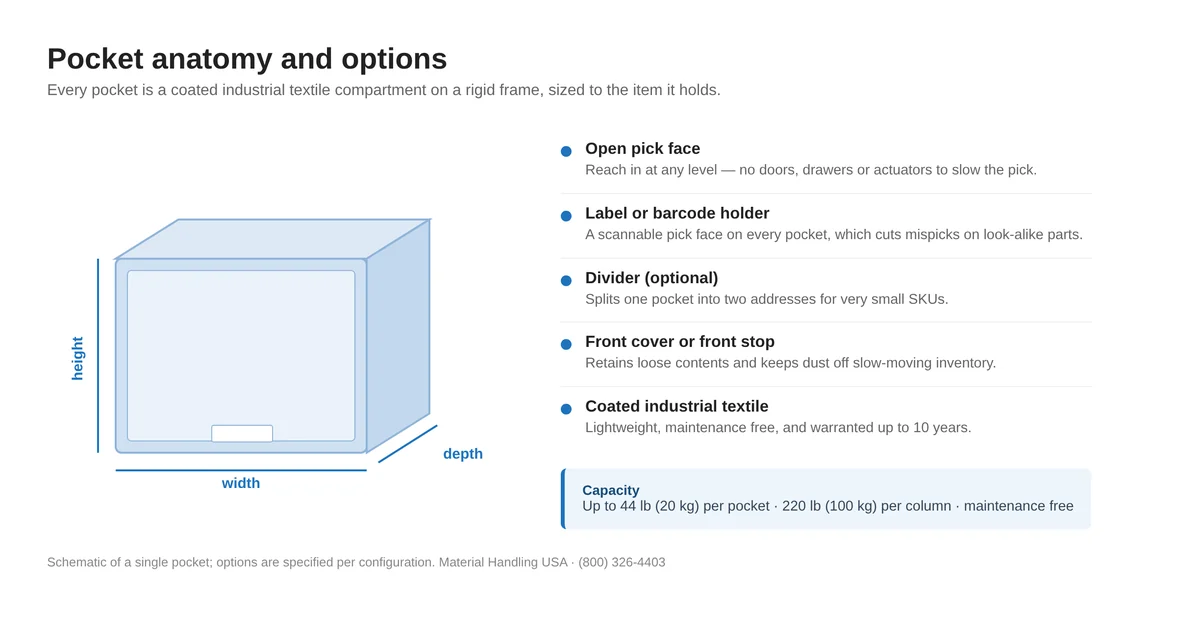
Manufacturer figures from the US textile range. The system is rated by the manufacturer at up to 220 lb (100 kg) per column with up to a 10-year rip-and-crack warranty. The rated load for your build is confirmed in writing on your quote before manufacture.
Rack parameters and compatibility
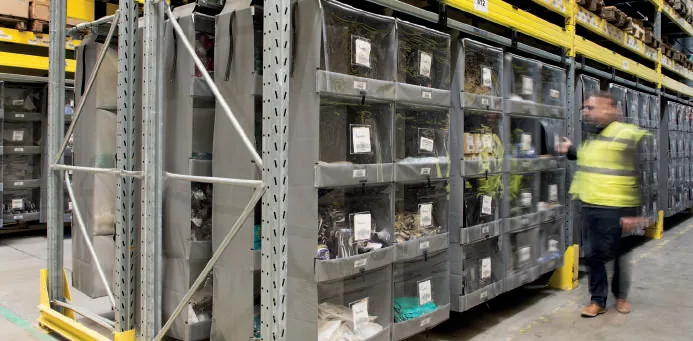
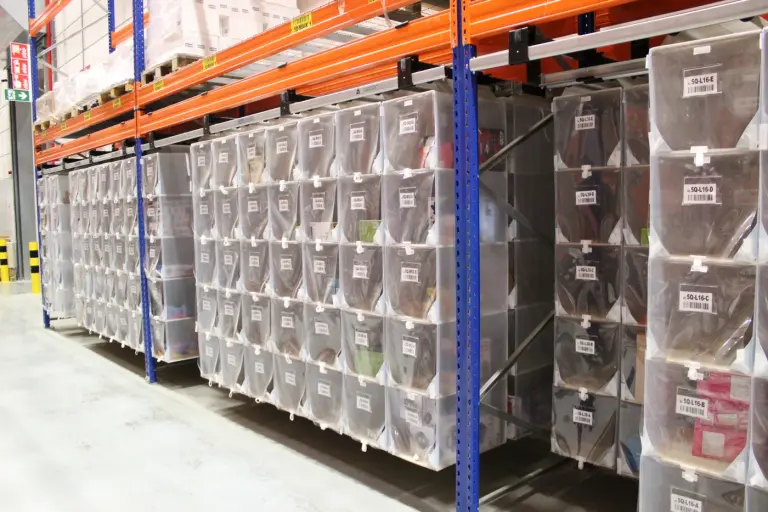
The top suspension bar is universal: columns hang from the beam of virtually any pallet rack regardless of manufacturer or beam profile, with no drilling, welding or rack modification. What we need to quote is five dimensions.
- Bay inner width — commonly 96″ or 144″ in US configurations
- Bay inner depth — commonly 42″, sometimes 48″
- Usable bay height — standard configurations at 96″, 108″ and 144″
- Beam height — typically around 4″
- Beam depth — typically around 2.5″
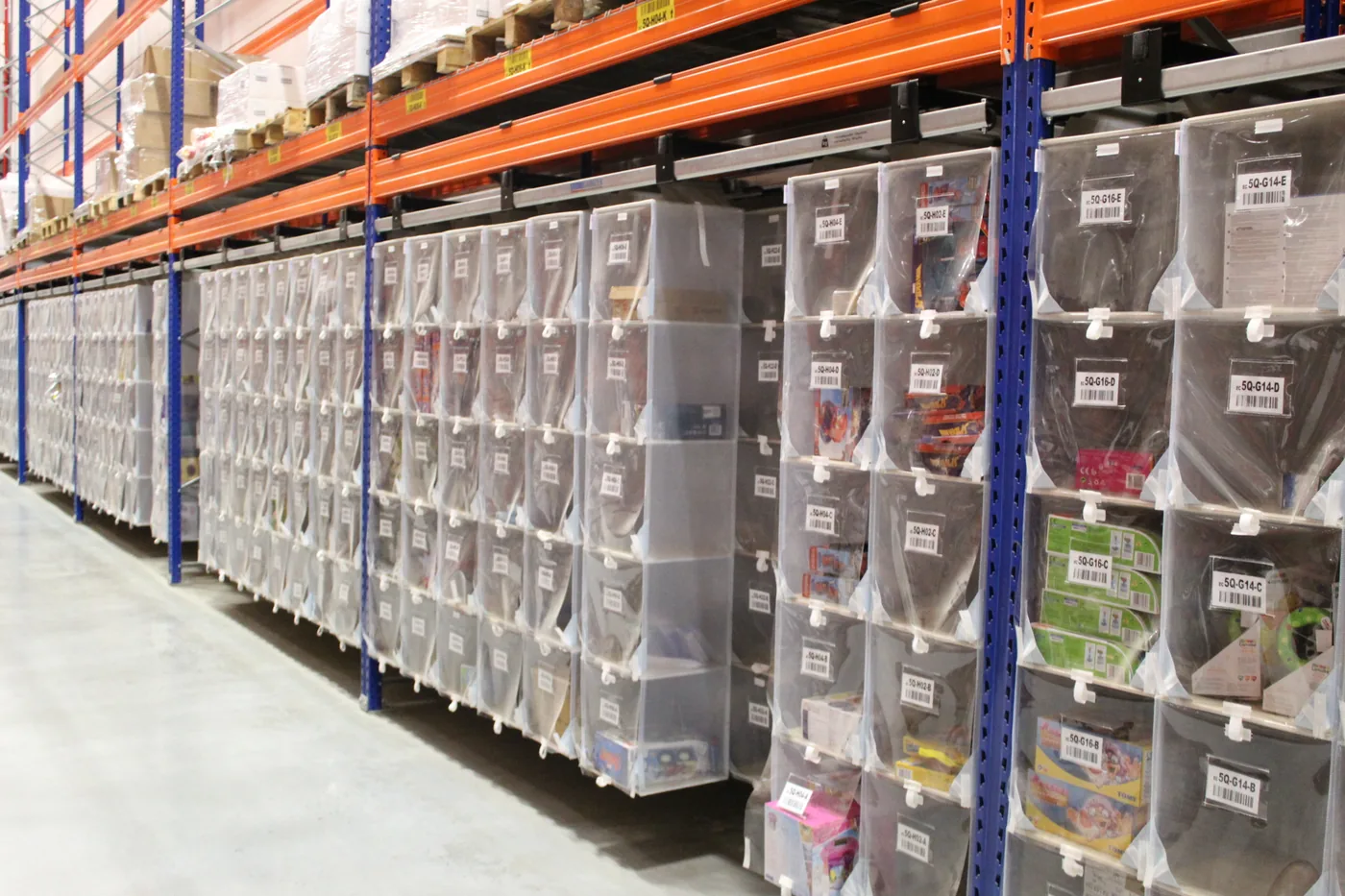
Pockets hang up to four rows deep front to back. The front columns are light enough to roll sideways by hand when loaded, so the rows behind stay accessible without a ladder or a lift. Nothing is anchored to the floor, so the entire installation is removable — which matters in a leased building.
Options and accessories
Picking Hive: mobile unit specifications
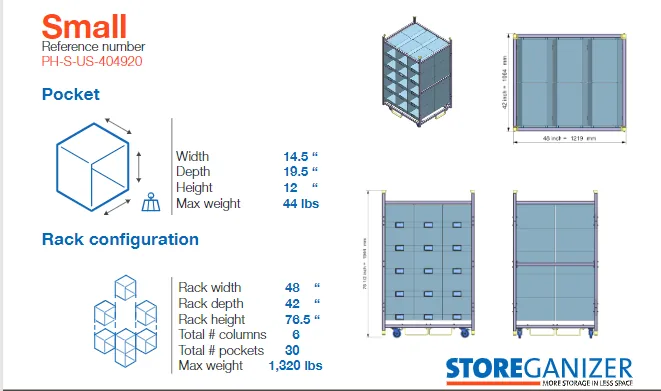
The Picking Hive is the same pocket system in a self-supporting mobile frame on a standard pallet footprint — no rack, no installation, set up by one person in minutes.
| Size | Reference number | Pocket (W x D x H) | Pocket max weight | Pockets | Frame (W x D x H) | Frame max weight |
|---|---|---|---|---|---|---|
| Extra Small | PH-XS-US-404154 | 14.5″ x 19.5″ x 6″ | 44 lb | 60 | 48″ x 42″ x 76.5″ | 1,320 lb |
| Small | PH-S-US-404920 | 14.5″ x 19.5″ x 12″ | 44 lb | 30 | 48″ x 42″ x 76.5″ | 1,320 lb |
| Medium | PH-M-US-404921 | 14.5″ x 19.5″ x 20″ | 44 lb | 18 | 48″ x 42″ x 76.5″ | 792 lb |

Configure your bays and get the bill of materials
The free Storeganizer Designer covers bay height, pocket style, bay count, textile grade and options, and returns the pick-location count, a 3D view and a bill of materials.
Explore the Storeganizer cluster
 Storeganizer hubWhat the system is, specs, options, process and results.
 Small-parts warehouse storageRight-sizing pick locations for fasteners, fittings and boxed components.
 3PL & e-commerce fulfilmentMore SKUs per square foot when the footprint cannot grow.
 Spare parts & MRO storageCritical spares findable in seconds without a parts-room expansion.
 Aerospace & defense partsTraceable, high-value small parts in a controlled parts room.
 Pallet rack space optimizationRecover the cube you already pay for before leasing more building.
 How Storeganizer worksThe suspension system, pocket columns, four rows deep, and installing into existing rack.
 Who makes StoreganizerconTeyor: founded 1988, ~€165m sales, 10 sites, and what to verify before buying.
 SKU slotting & rack ROIUsing SKU size, stock volume and order frequency to maximise rack-space return.
Frequently asked questions
What are the standard Storeganizer pocket sizes?
How many pockets are there per bay?
What is the load capacity?
What rack dimensions do you need from me?
What is NexTTex?
What warranty applies?
Related Storeganizer reading
Choosing a pocket size without guessing
Pocket size is the one specification decision that is genuinely difficult to reverse cheaply, because it determines how many locations a bay yields. Getting it right is a matter of measuring the right item rather than the average item.
A method that works
Take the largest item in the group
Not the typical one. A pocket sized to the average will not close around the outlier, and the outlier is the SKU that ends up back on a shelf.
Add handling clearance
An operator has to get a hand in and a part out without fighting the opening. Roughly an inch in each direction is usually enough.
Check the weight
Up to 44 lb (20 kg) per pocket and 220 lb (100 kg) per column. Dense small parts hit the weight limit long before they fill the volume.
Split the group if it spans sizes
Two pocket sizes in one bay is normal and usually better than one compromise size. Configurations mix sizes freely.
Where a divider beats a smaller pocket
For very small, low-volume SKUs, a divider inside a standard pocket creates two addresses without introducing another pocket size into the configuration. That keeps the bill of materials simple and leaves the option of removing the divider later if stock depth grows. Front stops do the same job for items that would otherwise roll or slide forward.
Textile grade follows handling, not weight
The textile grades differ in abrasion resistance rather than in capacity. Choose on how often a pocket is reached into and what the part does to the fabric on the way out: a pocket picked a hundred times a day with sharp-edged castings is a different specification from one holding polybagged apparel and picked weekly. Abrasion-cycle ratings for each grade are in the table above; our team confirms the grade against your pick rates before quoting, and every grade carries the same up-to-ten-year warranty.
If you would rather see the counts than read about them, the Storeganizer Designer returns pockets, columns and total pick locations for whatever bay dimensions and pocket size you enter.
Send us five dimensions and we will quote it
Bay inner width, depth and usable height, plus beam height and depth. Add a note on what you are storing and we will specify the pocket style and textile grade.