
Big Industrial Fans: Types, Sizes & How to Choose
From 36-inch drum fans and 30-inch pedestal and wall fans to 16 ft and 21 ft HVLS ceiling fans, compare big industrial fans by coverage, airflow, mounting, power and noise. We help you pick the right size for your building and quote it with freight.

24-42 in
Drum, pedestal, wall
16-21 ft
EverBreeze HVLS
120v-480v
Plug-in to 3-phase
Nationwide
Freight quoted
Shop Big Industrial Fans Online
Big drum, pedestal and beam-mount fans from Vestil, priced online. Every listing opens a product page with a pricing request, so we can confirm lead time and freight. HVLS ceiling fans are quoted per project.
Types of Big Industrial Fans
"Big industrial fans" covers two very different families. The first is portable and fixed high-velocity fans: drum (barrel) fans, pedestal fans and wall or beam-mount circulators with 24 to 48 inch blades. They throw a fast, focused stream of air at people, machines or a doorway. The second is high-volume, low-speed (HVLS) ceiling fans with blades 8 to 24 feet across that turn slowly and move a huge, gentle column of air over a whole zone of the building. Most large facilities end up using both.
Drum and barrel fans (24-48 in)
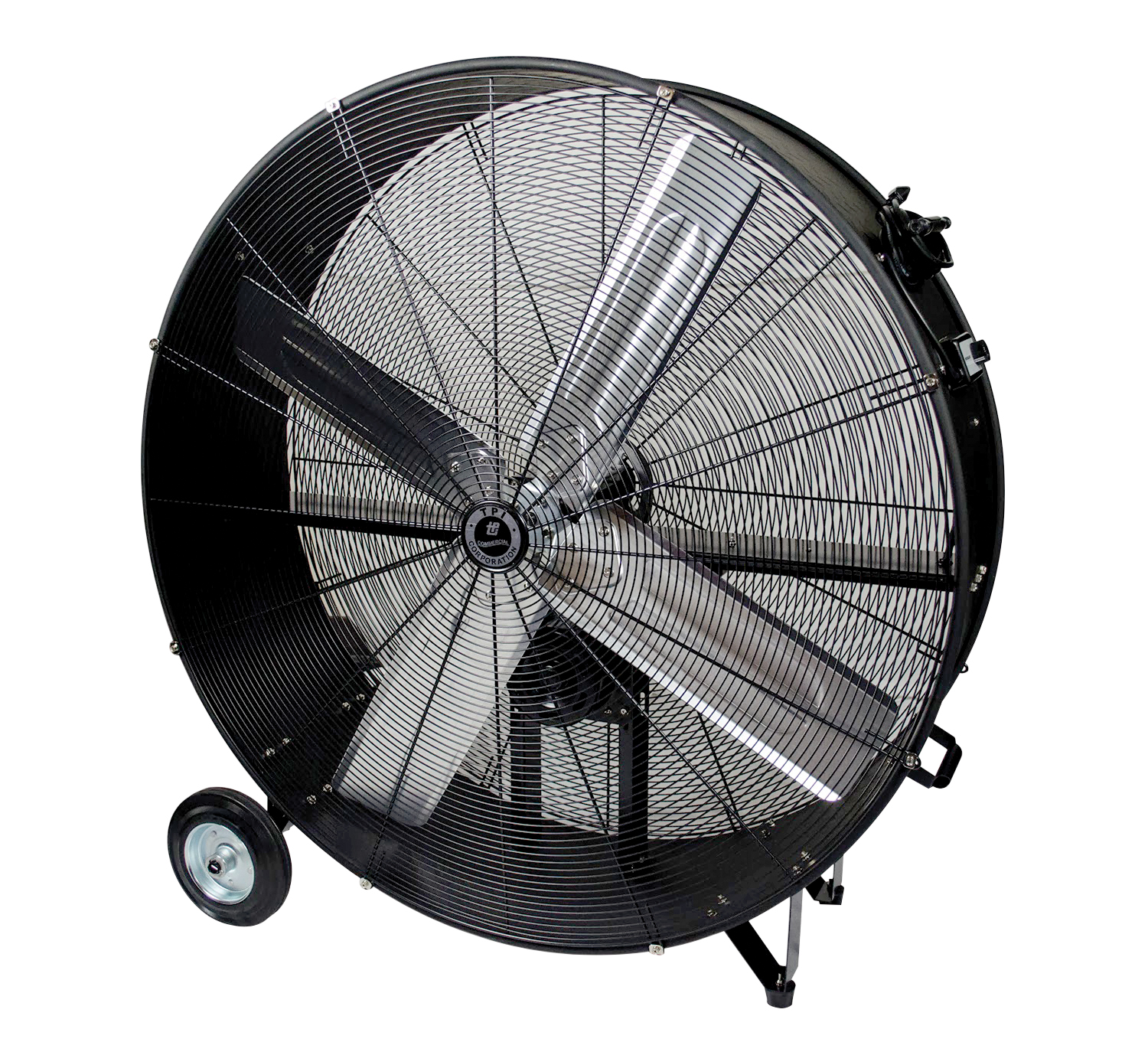
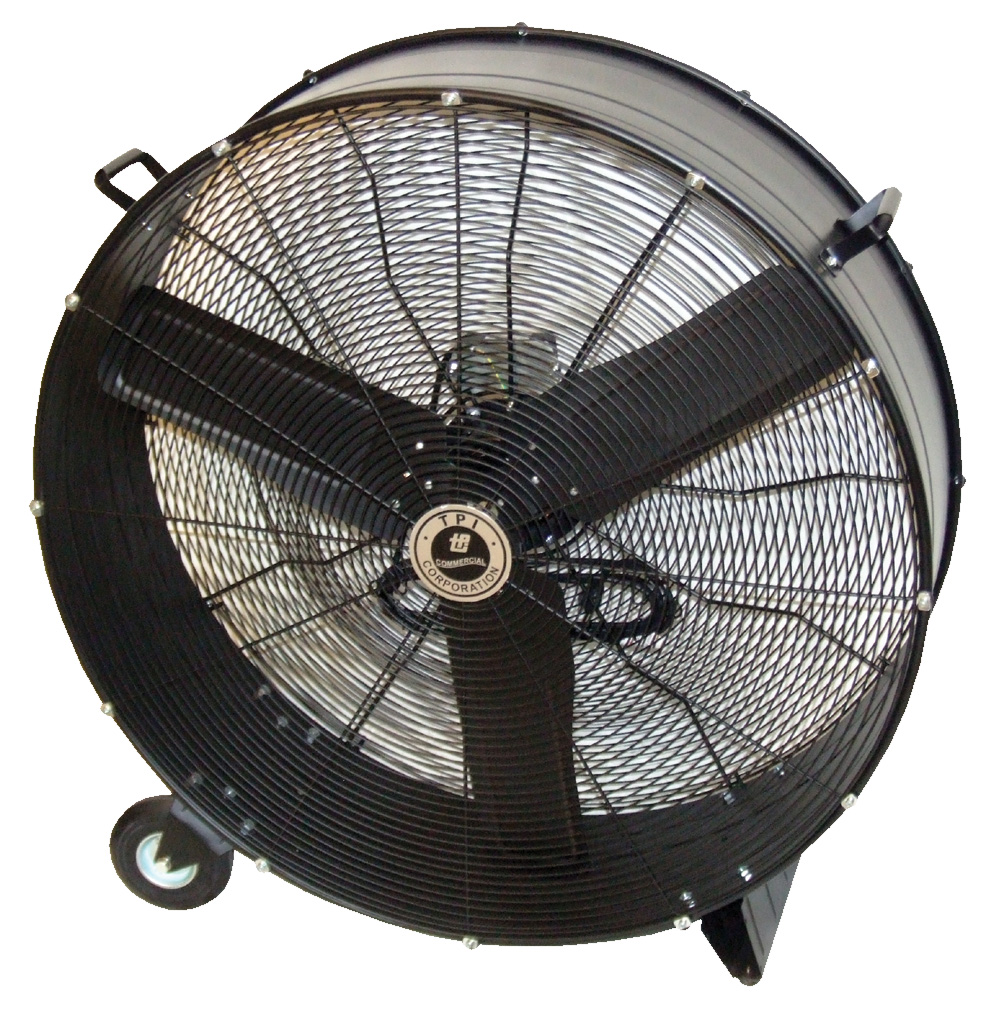
A drum fan is a large propeller inside a round steel housing on a wheeled stand or tilting cradle. It is the classic shop fan: roll it where the heat is, point it, plug it in. Belt-drive models push more air at lower motor speed; direct-drive models have fewer parts to maintain.
Best for: loading docks, service bays, temporary hot spots, drying wet floors and job sites. Watch for: noise on high speed, cords across walkways, and dust or paperwork blowing around.
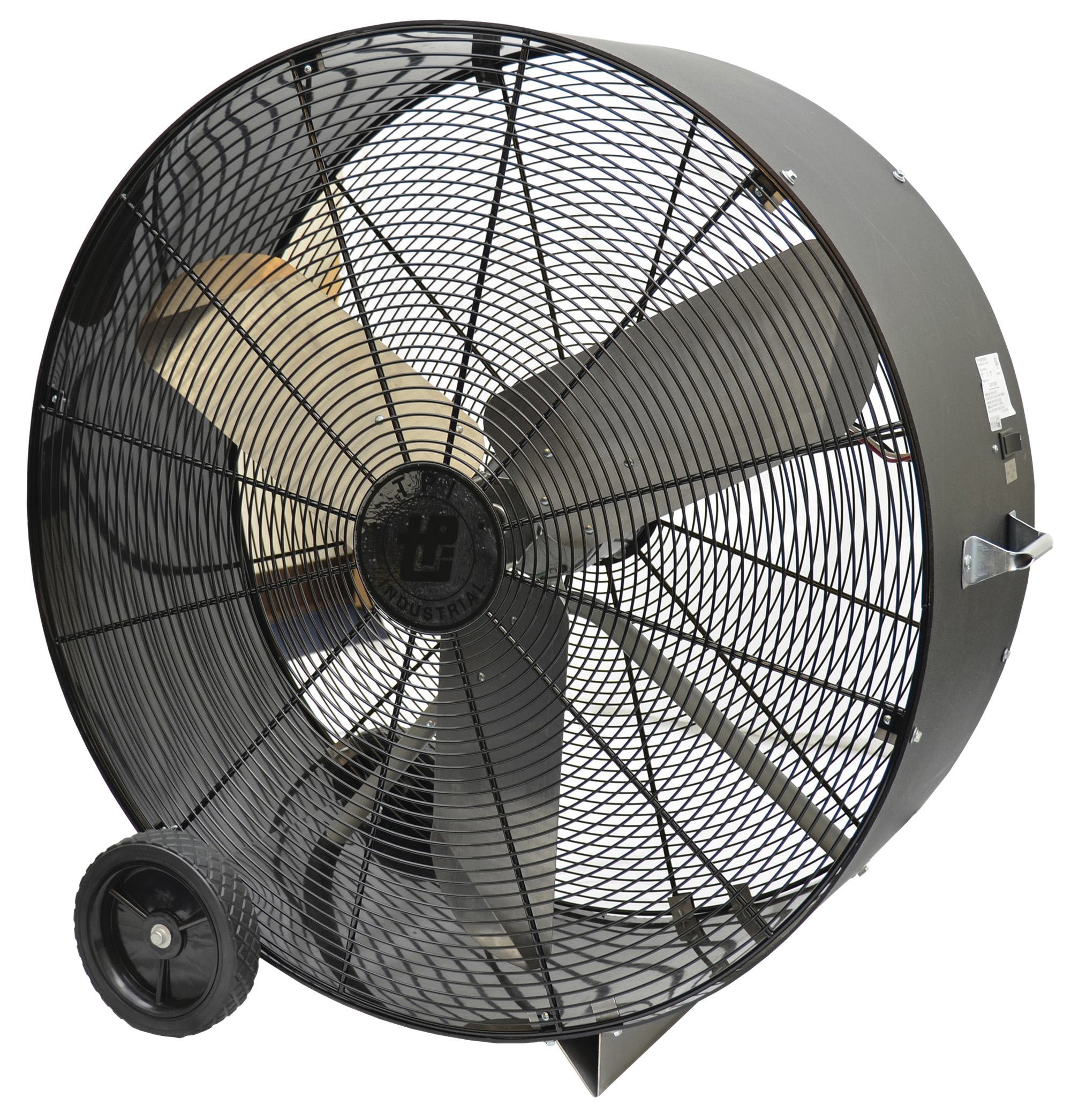
Vestil enclosed direct-drive drum blower, 36 in class.
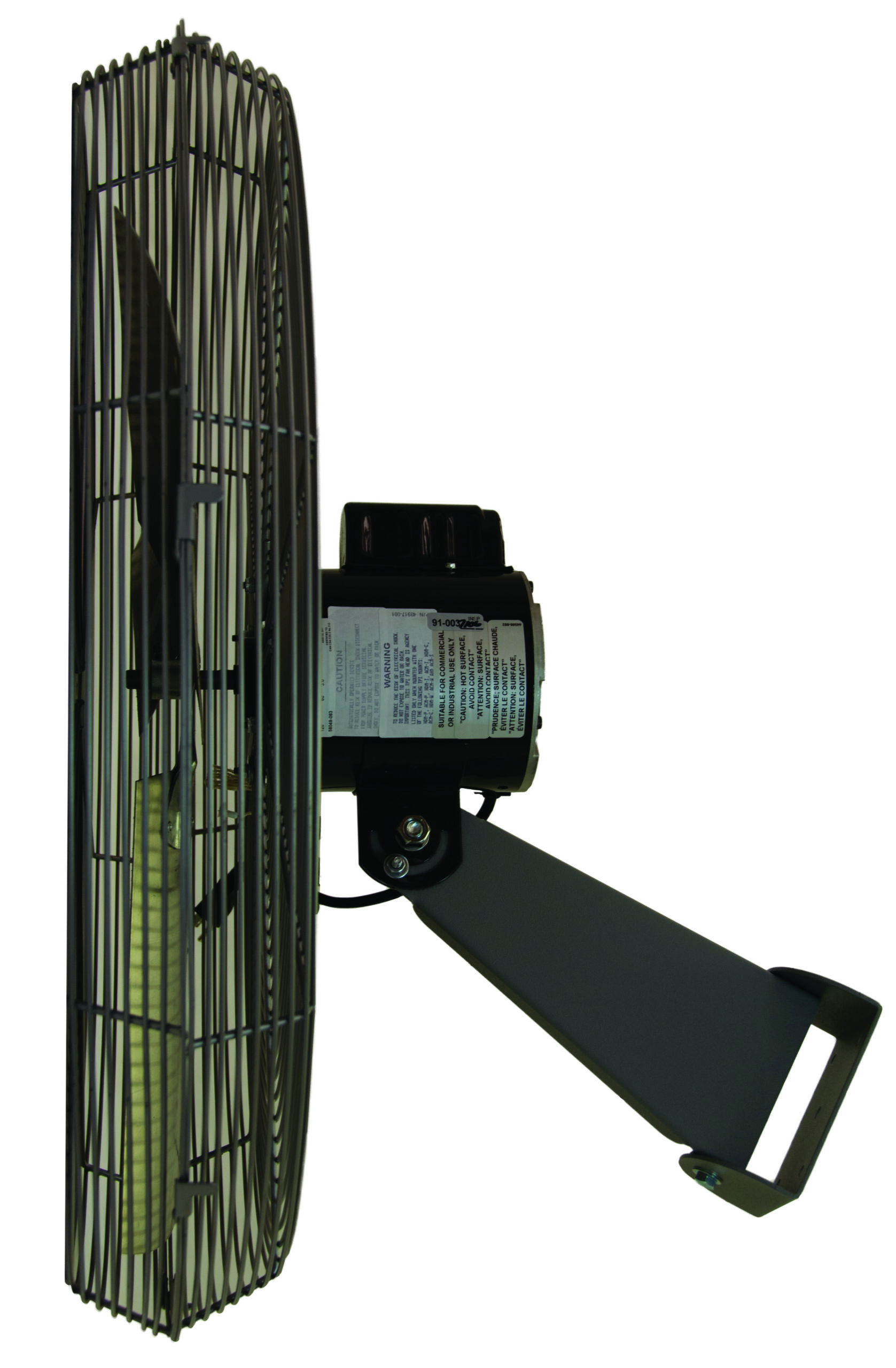
Wall, column and I-beam mount fans (24-30 in)
The same high-velocity fan head, mounted off the floor. Wall brackets bolt to masonry or girts, and I-beam brackets clamp to building steel, so the fan sits above people and forklifts and aims down at a work cell. Because there is no stand to trip over and nothing to move, they suit fixed workstations along walls and column lines.
Best for: assembly lines, weld booths, packing benches, machine operators. Watch for: a fixed throw direction and the need for a solid mounting point.
Vestil High Performance circular wall fan, 30 in.
Pedestal fans and high-speed ceiling-mount fans
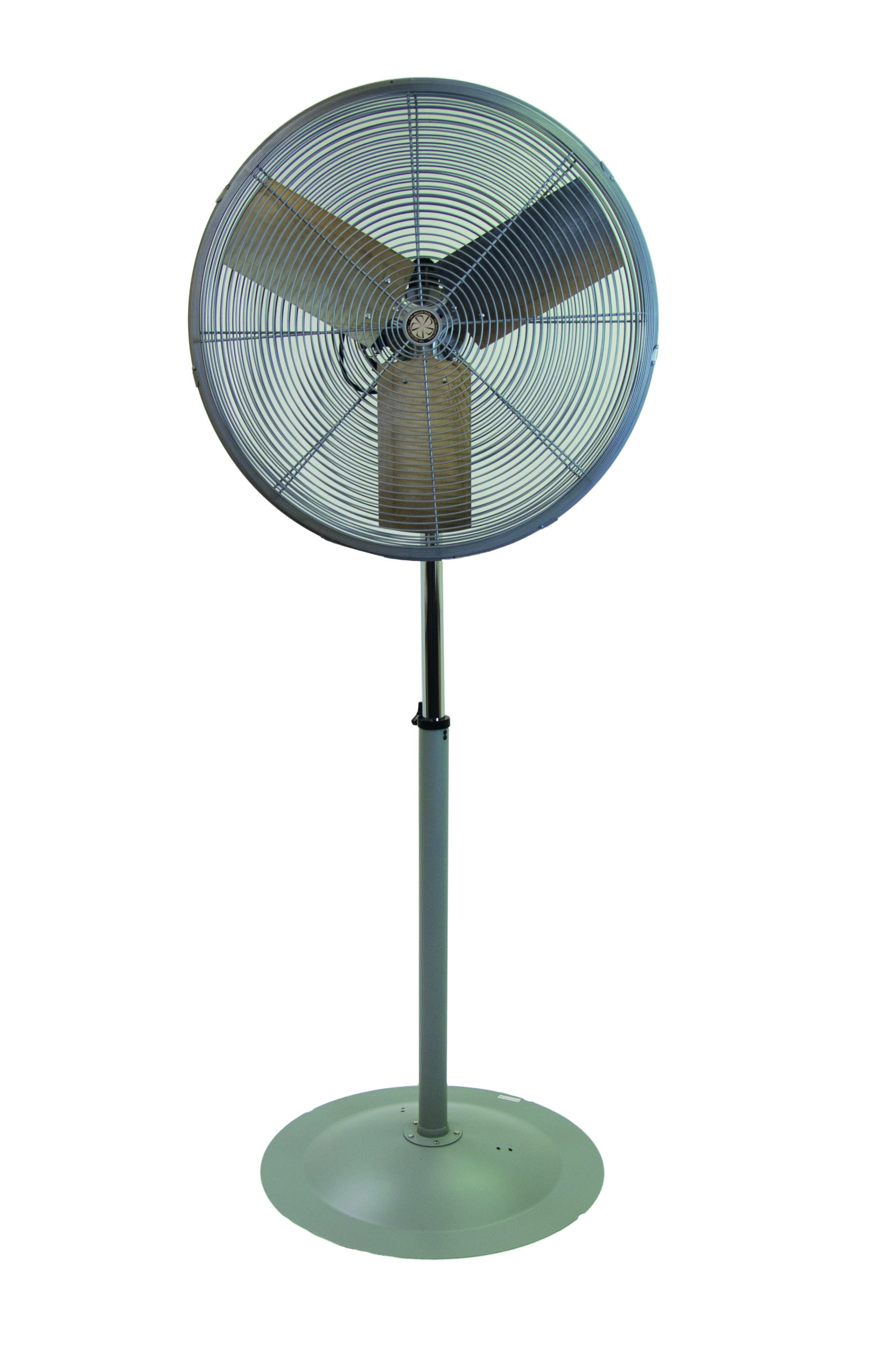
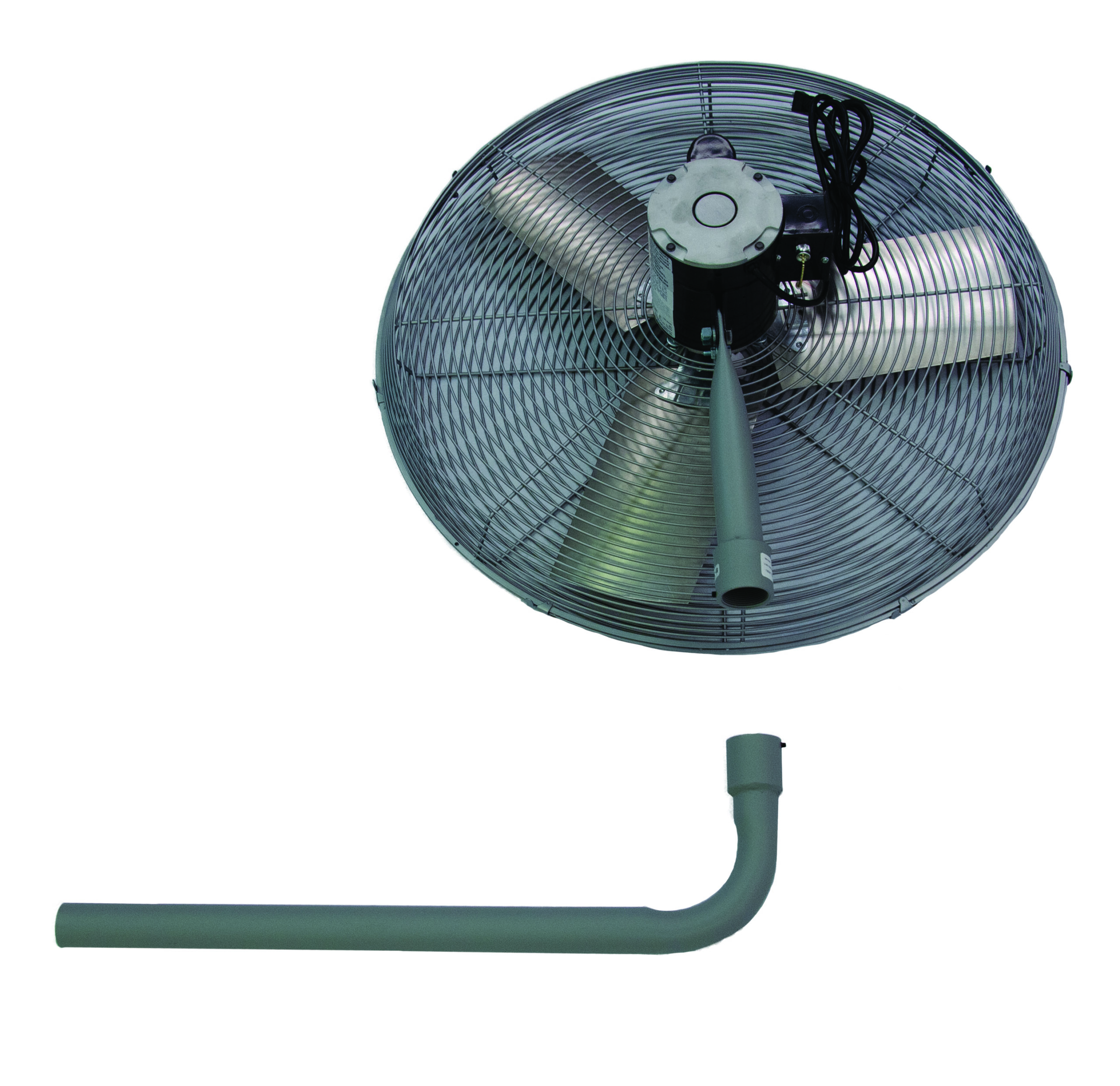
Pedestal fans put a 24 or 30 inch head on an adjustable post with a round base, so air reaches a standing worker’s upper body. Oscillating versions sweep a wider arc. High-speed ceiling-mount circulators hang a guarded 30 inch fan head from a down rod; they help in lower buildings but lose punch at the floor once ceilings pass about 20 feet.
HVLS fans are the biggest of all: 8 to 24 ft diameters, 1 to 2 HP motors and slow blade speeds. They are covered in detail below and on our HVLS fans hub.
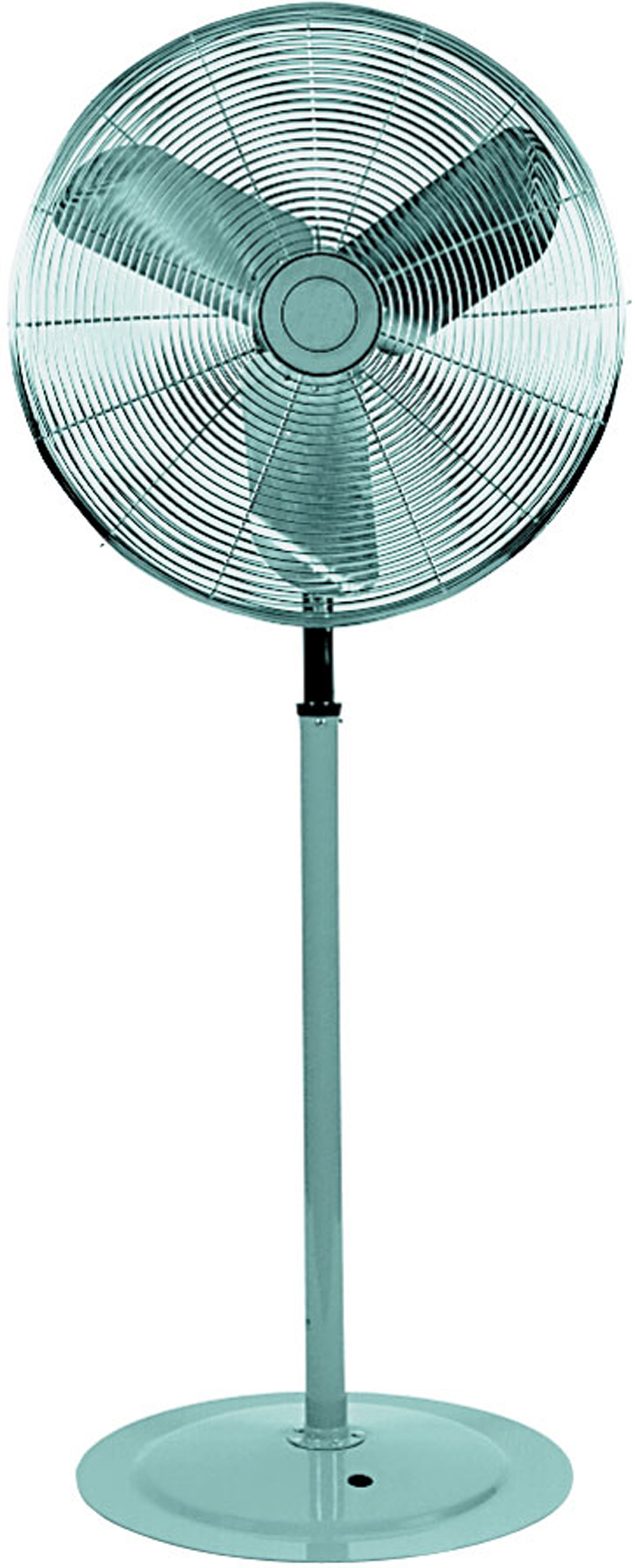
Vestil oscillating industrial pedestal fan, 30 in blade.
Big Industrial Fan Comparison: Coverage, CFM, Mounting, Power and Noise
Use this table to narrow the type before you look at models. Figures are typical market ranges for each class, not ratings for any single product; always check the specific fan’s data sheet.
| Fan type | Typical sizes | Coverage per fan | Typical airflow | Mounting | Power | Noise |
|---|---|---|---|---|---|---|
| Drum / barrel fan | 24-48 in | One bay, doorway or work zone; throw of roughly 50-150 ft | About 6,000-25,000 CFM | Floor, wheeled or tilting cradle | 120v plug-in, 1/4-1 HP; some 230v | Loud on high |
| Pedestal fan | 24-30 in | One to a few workstations | About 5,000-11,000 CFM | Floor stand, adjustable height | 120v plug-in, 1/4-1/2 HP | Moderate to loud |
| Wall / I-beam circulator | 24-30 in | A work cell or bench line | About 5,000-11,000 CFM | Wall bracket, column or I-beam clamp | 120v plug-in or hardwired | Moderate to loud |
| High-speed ceiling-mount fan | 24-30 in | A few hundred to ~1,500 sq ft below | About 5,000-10,000 CFM | Down rod from structure | 120v, often hardwired | Moderate |
| Shutter exhaust fan | 12-48 in | Air changes for a room, not a breeze | Varies widely by size | Wall opening with shutter | 120v-230v, hardwired | Moderate |
| HVLS ceiling fan | 8-24 ft | About 5,000-20,000+ sq ft open floor | Often 100,000+ CFM; TAB lists ~240,000 CFM | Steel beam, bar joist or wood truss kit | 1-2 HP; 208-480v, 1- or 3-phase, hardwired | Quiet |
CFM (cubic feet per minute) tells you how much air a fan moves. For comparing products fairly, look for airflow tested to AMCA 230, the Air Movement and Control Association’s test method for air circulating fans, and for UL or ETL safety listing.
How to Choose a Big Industrial Fan by Building Size and Ceiling Height
Start with two numbers: the floor area you want to cool and the clear height to the lowest roof structure. Then decide whether you need air on a few people or across the whole floor.
| Space | Clear height | Good starting point |
|---|---|---|
| Single work cell, bench or dock door | Any | One 24-30 in pedestal or wall fan, or a 36 in drum fan for a dock |
| Service shop or garage, 2,000-5,000 sq ft | 14-20 ft | Drum fans per bay, or one 8-12 ft HVLS fan over the center |
| Shop or small warehouse, 5,000-12,000 sq ft | 18-28 ft | One 16 ft HVLS fan (for example TAB EverBreeze 316), plus wall fans at fixed stations |
| Warehouse, plant or barn, 10,000-20,000 sq ft | 22-35 ft | One or two 21 ft HVLS fans (for example TAB EverBreeze 621) |
| Large DC or hangar, 20,000+ sq ft | 28 ft and up | Several 20-24 ft HVLS fans on a grid, spaced about 2.5-3 diameters apart |
Planning ranges only. Racking, walls, doors and equipment change real coverage, and we confirm fan count and spacing for your floor plan.
Worked examples
- 60 x 80 ft auto shop, 18 ft eave: one 16 ft HVLS fan over the center bays keeps the whole shop moving; a 36 in drum fan stays on hand for the bay doing the hottest work.
- 100 x 200 ft shipping warehouse, 30 ft clear: one or two 21 ft HVLS fans over the main aisle and staging lanes, plus drum fans at the busiest dock doors in summer.
- Fabrication line along one wall: a row of 30 in wall or I-beam fans every few stations, aimed down at operators, with no cords on the floor.
- School or club gym, 90 x 120 ft: one large HVLS fan over center court for quiet, even air instead of a ring of loud pedestal fans.
Rules of thumb
- Bigger and slower beats smaller and faster in tall buildings: one large HVLS fan usually outperforms many floor fans.
- Keep HVLS blades well above the tallest forklift mast, raised load or vehicle on a lift, and well below the roof deck.
- Tall racking breaks up airflow; aim fans at aisles and open work zones, not over rack tops.
- Point high-velocity fans along the path people work in, and keep them out of walkways and forklift lanes.
The Biggest Fans We Sell: TAB EverBreeze 16 ft and 21 ft HVLS Fans
When buyers search for giant industrial fans, they usually mean HVLS ceiling fans. As an authorized TAB Industries dealer, we supply both EverBreeze sizes:
- EverBreeze 316: 3 blades, 16 ft diameter, $4,500 per unit (TAB list price).
- EverBreeze 621: 6 blades, 21 ft diameter, $6,500 per unit (TAB list price).
TAB’s spec sheet lists a 2 HP, 45 RPM motor rated for continuous duty, roughly 240,000 CFM of airflow, mounting kits for pre-engineered steel, bar joists and wood trusses, and a pre-wired panel with a digital or thermostatic control included. Freight and installation are quoted separately.
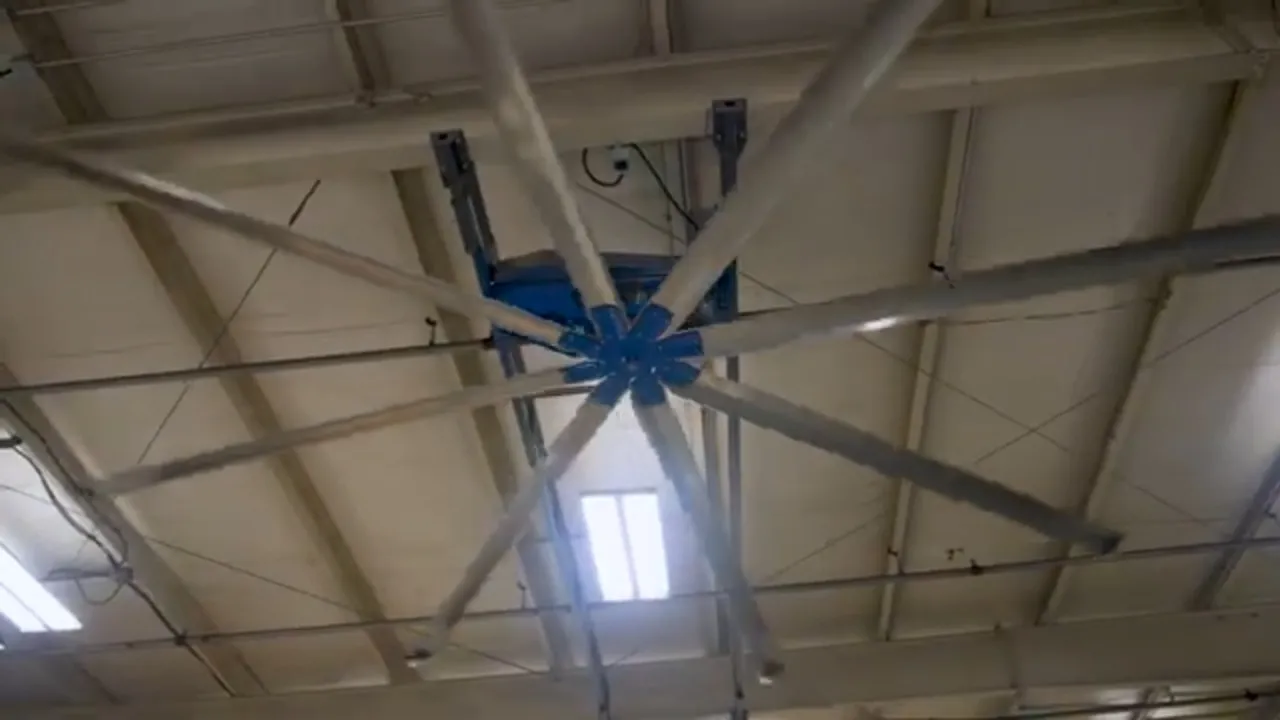
Photo: TAB Industries (EverBreeze product video).
For the full HVLS picture, including how destratification works in winter and how to space several fans across a building, see our HVLS fans guide. If your main question is cooling a warehouse with racking and docks, our warehouse fans page walks through that layout.
Is the biggest fan always the best?
No. A 21 ft fan needs about 25 ft or more of clear height and a structure that can carry it. In a 16 ft building or a small shop, a 16 ft HVLS fan, a few wall fans or a couple of drum fans may be the right answer. We size to the building, not to the biggest model.
Mounting and Structural Requirements
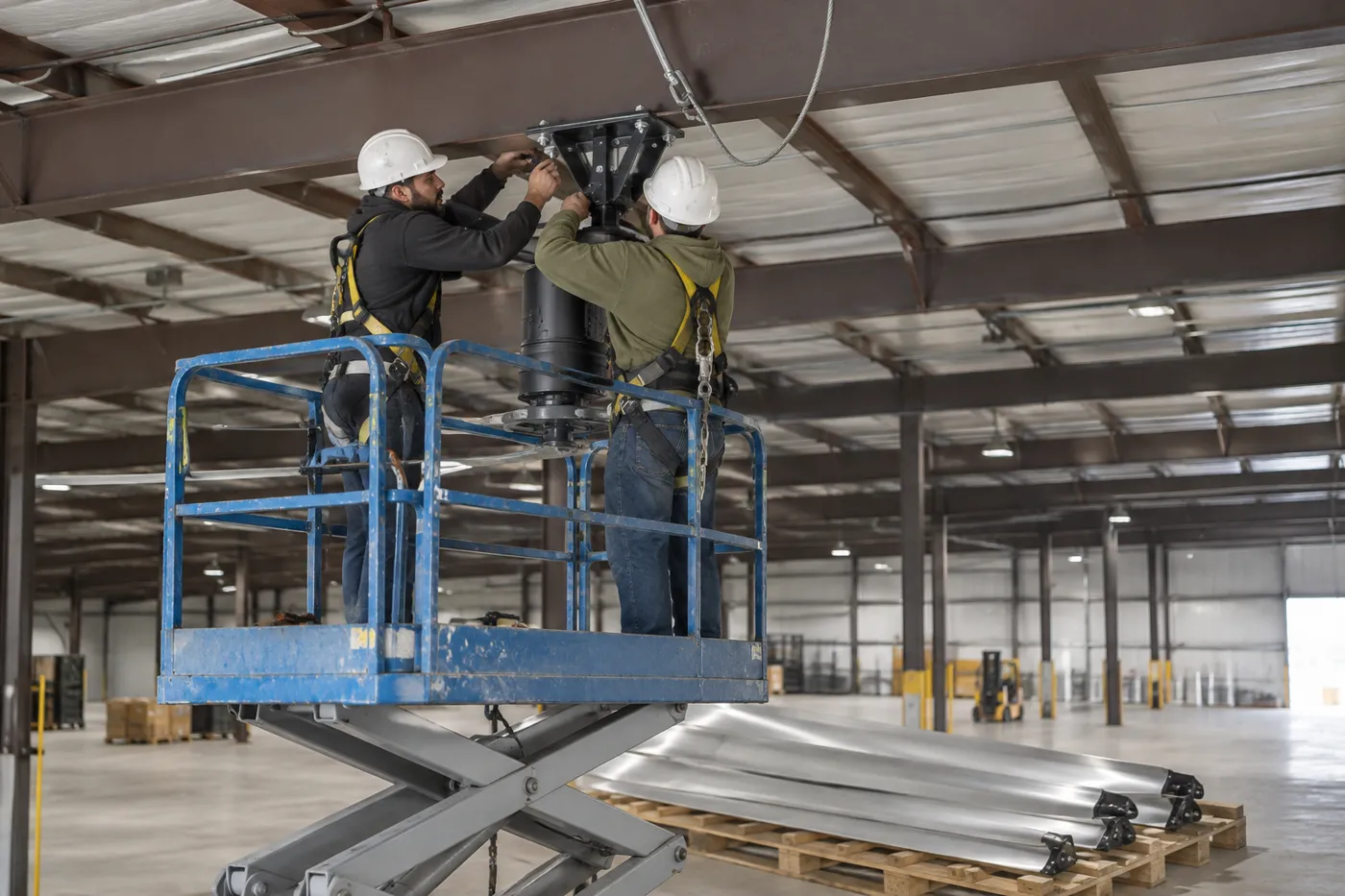
Floor fans need only a level floor and a safe cord path. Anything hung overhead needs a real mounting plan:
- HVLS fans hang from primary structure (beams, joists or trusses) with the maker’s kit, a secondary safety cable and, on most models, guy wires that stop sway. The structure must carry the fan’s weight and the torque it creates.
- Wall and I-beam fans need a bracket rated for the fan and fastened into solid masonry, steel or blocking, never into thin metal siding alone.
- Ceiling-mount circulators need a down rod from structure plus a safety restraint.
Representative HVLS installation scene.
Electrical Requirements by Fan Type
Power is often the deciding factor between a plug-in fan and a hardwired one. Check what you have at each location before you buy.
| Fan type | Typical supply | Connection | Notes |
|---|---|---|---|
| Drum and pedestal fans | 120v single phase | Cord and plug | Use a properly rated outlet; avoid daisy-chained extension cords across walkways. |
| Wall and I-beam circulators | 120v, some 230v | Cord and plug or hardwired | Hardwire fixed units where cords would hang in work areas. |
| Shutter exhaust fans | 120v-230v | Hardwired to a junction box | Needs make-up air from doors or louvers to work. |
| HVLS fans (TAB EverBreeze) | 240v single phase or 240v-480v three phase | Hardwired to a pre-wired panel | Dedicated branch circuit and disconnect per fan; licensed electrician; any fire-alarm interlock wired at install. |
HVLS fans ramp their blades up gradually and run at a low speed in winter, so the speed control is part of the package; TAB includes a digital or thermostatic control with each EverBreeze fan. In most buildings that means one dedicated circuit per fan is all the new wiring needed. Running a single 2 HP HVLS motor in place of a dozen 1/2 HP floor fans also takes a lot of plugs, cords and tripped breakers out of the picture.
Safety: Blade Guarding, Fire Sprinklers and Clearances
Blade guards (OSHA): OSHA’s general machine guarding rule, 29 CFR 1910.212(a)(5), requires fan blades to be guarded when their periphery is less than 7 feet above the floor or working level, with guard openings no larger than 1/2 inch. That is why drum, pedestal and wall fans ship with full wire guards, and why an HVLS fan’s blades must stay well above anyone working below.
Fire sprinklers (NFPA 13): the sprinkler standard has specific provisions for HVLS fans. In general terms, it addresses centering the fan between sprinklers, keeping vertical clearance between the fan and sprinkler deflectors, and shutting fans down when the sprinkler water-flow alarm activates, so the fan does not push the spray away from the fire.
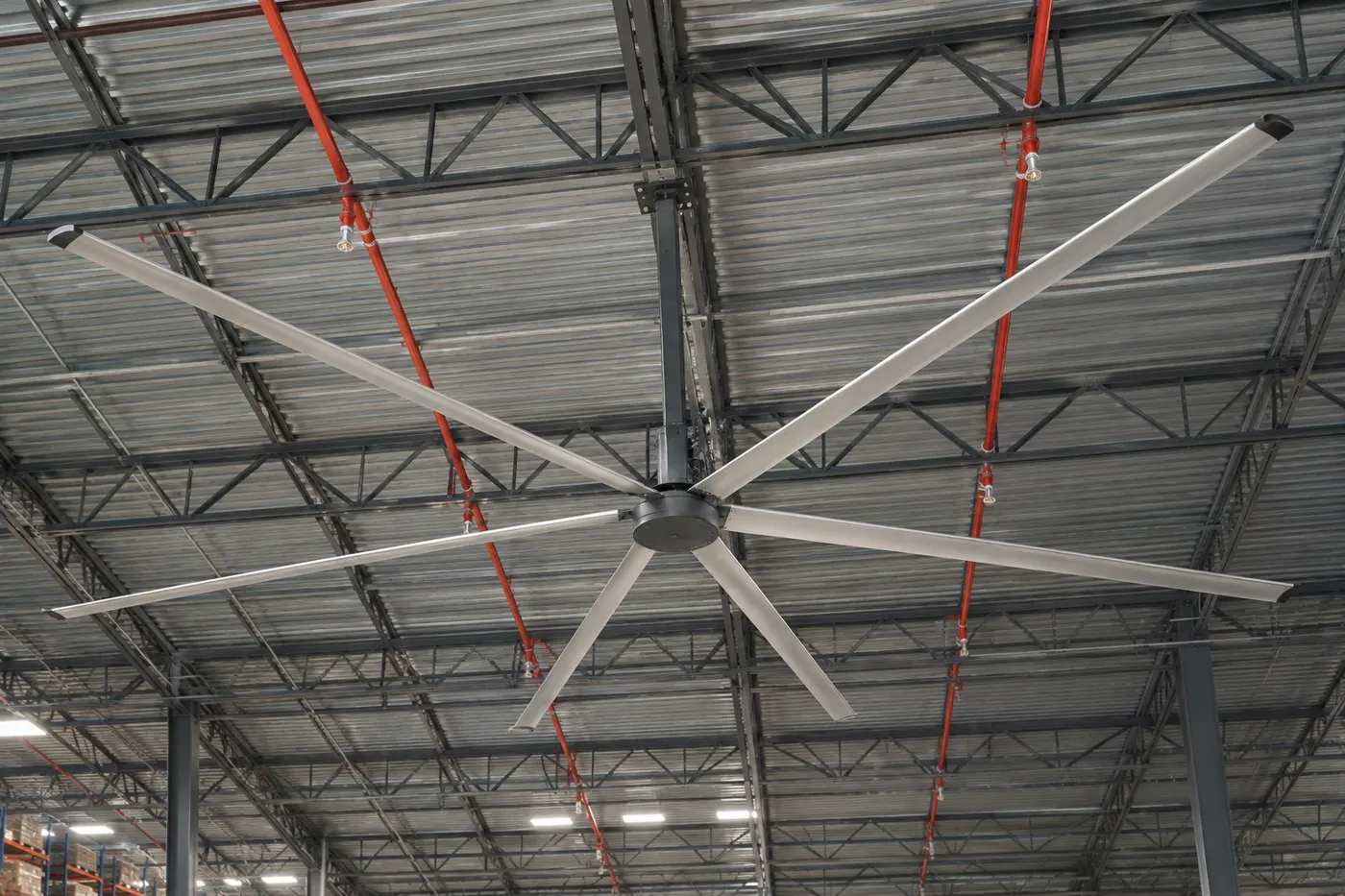
Representative scene: HVLS fan centered between sprinkler lines.
Confirm with your AHJ
Before an HVLS install, confirm fan location and any alarm interlock with your Authority Having Jurisdiction (usually the fire marshal or building department) and your sprinkler contractor. The exact rules depend on the NFPA 13 edition adopted locally and your storage. We provide fan dimensions and placement drawings for that review. This page is general guidance, not a code determination.
Everyday safety habits for portable fans
- Keep guards on and undamaged; replace a bent guard before using the fan again.
- Route cords out of forklift lanes and walkways, and never run them under mats or through doorways that close on them.
- Use fans with a listed motor in dusty or damp areas; Vestil notes its commercial blowers are for clean, dry spaces.
- Unplug before cleaning blades and guards, and check mounting hardware on wall and beam fans during routine inspections.
Applications: Big Fans by Facility Type
The right mix changes with the building. Here is how we usually think about it for the facilities we hear from most.
 Manufacturing and fabricationWall or I-beam fans at weld booths and machine stations, plus an HVLS fan over open assembly floor. Keep air off paint, powder coat and weld gas shielding.
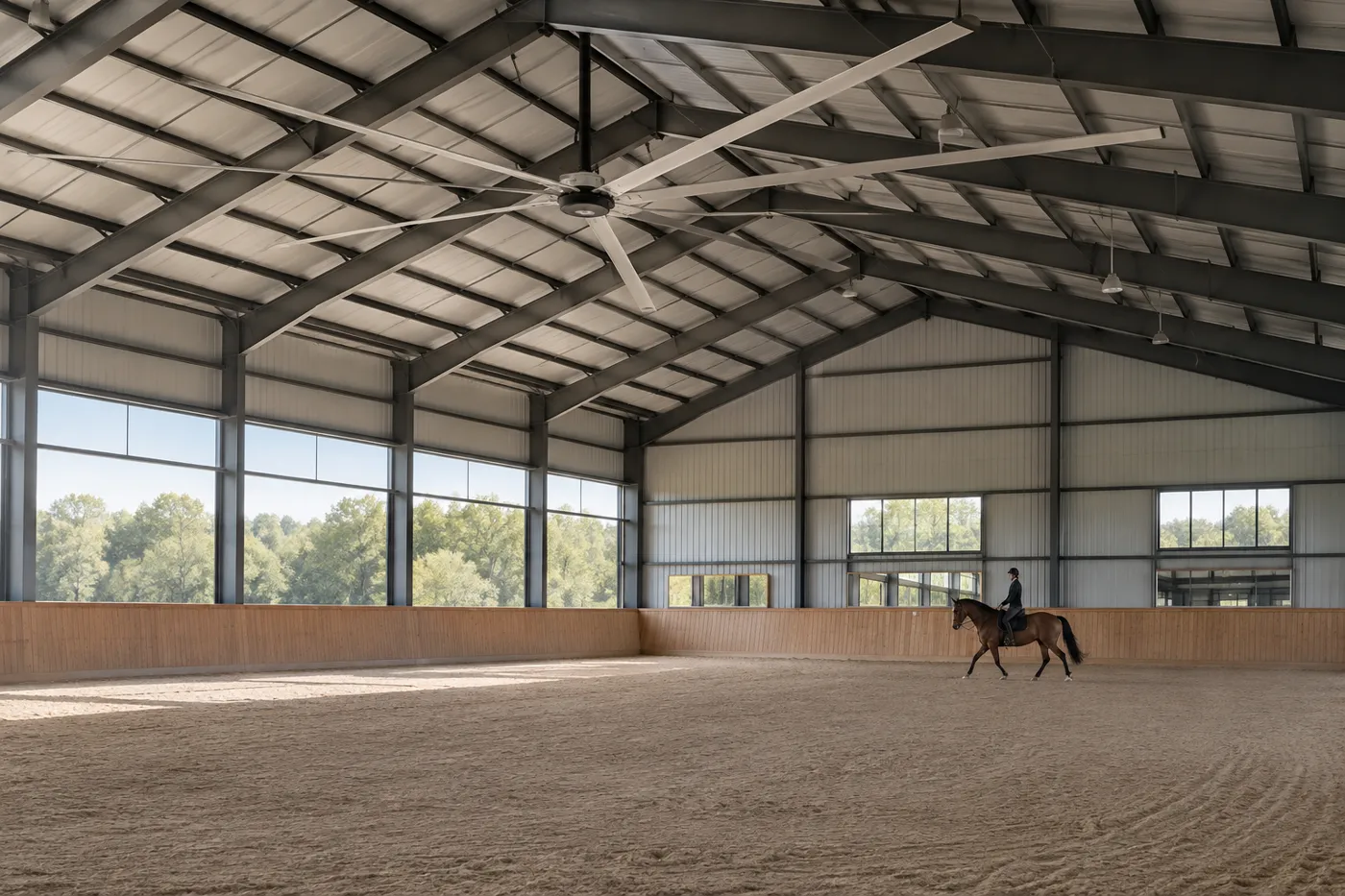 Ag barns and riding arenasBarn fans cut heat stress and dry bedding. HVLS fans mount to trusses over arenas and free-stall barns; keep blades high above animals and equipment.
 Gyms and fitness centersGym fans need to be quiet. One large HVLS fan over the court or training floor replaces noisy pedestal fans; keep clear of backstops and rigs.
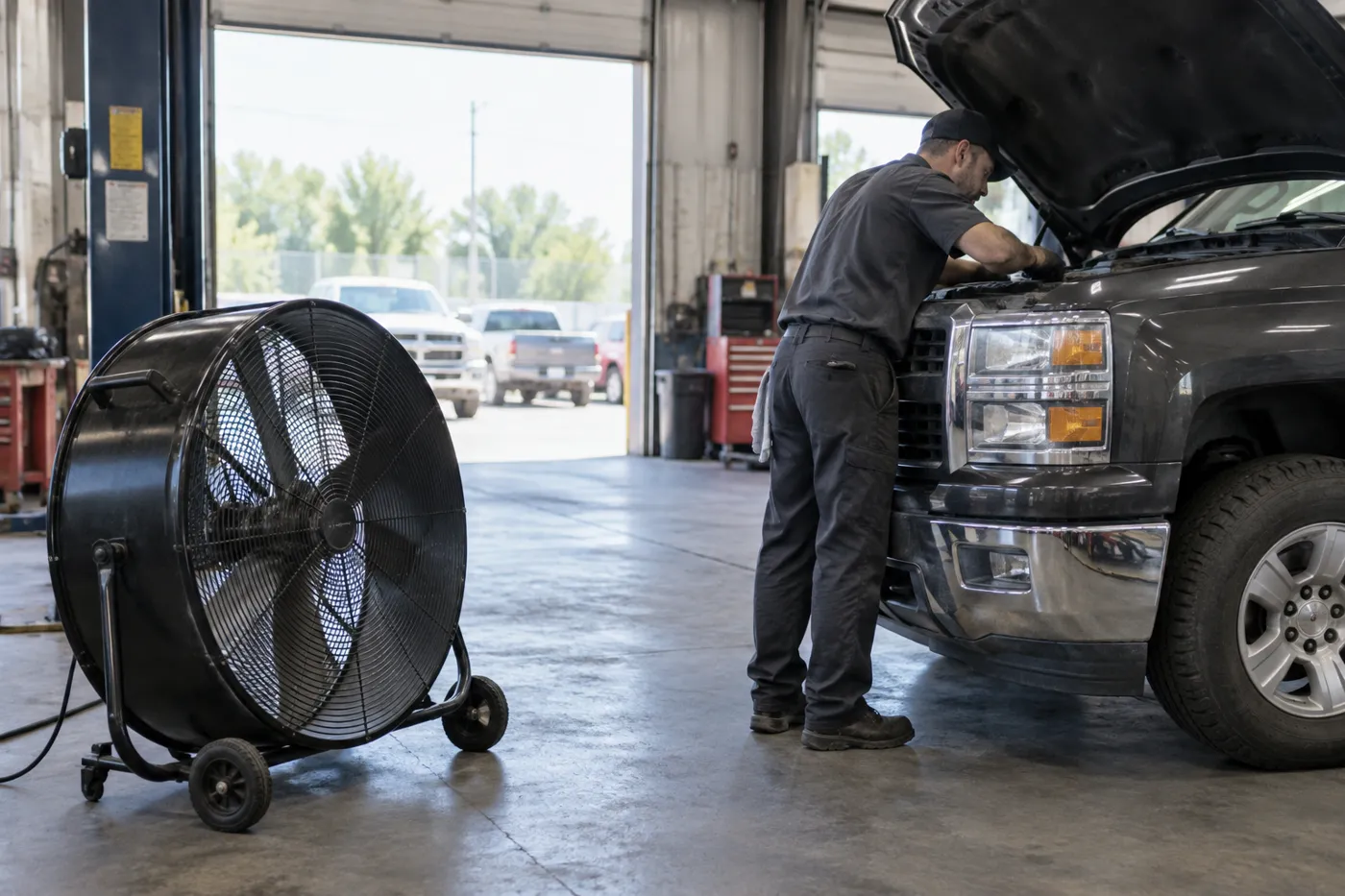 Auto and service shopsA drum fan per bay for hot jobs, or an HVLS fan above the highest raised vehicle on a lift to move exhaust and dry wet floors.
 Aircraft hangarsSeveral large HVLS fans on a grid, clear of tails and door tracks. Winter destratification holds heat that escapes each time the big door opens.
 Warehouses and loading docksDrum fans blow into hot trailers during unloading, while ceiling fans cover the staging lanes, and dock fans or exhaust fans handle the hottest doors.
Big Industrial Fan Buying Checklist
Send us these details and we will recommend fan types, sizes and placement with a freight-included quote.
- Building length, width and clear height to the lowest roof structure.
- Roof structure type (steel beam, bar joist or wood truss) and any cranes, lights or ducts in the way.
- Where people work: fixed stations, open floor, docks or bays.
- Available power at each location (120v outlets, or voltage and phase for hardwired fans).
- Sprinklers and who your fire marshal or AHJ is, if you are considering HVLS fans.
- Main goal: summer cooling, winter heat mixing, drying floors, or clearing fumes.
- Noise limits, for gyms, schools and spaces where people talk or train.
Common mistakes to avoid
- Buying more floor fans when the building really needs one ceiling fan.
- Picking an HVLS fan too big for the clear height, or too small for the floor area.
- Hanging fans over tall rack runs, where the airflow has nowhere to go.
- Leaving the sprinkler and alarm interlock conversation until after installation.
- Running cords for portable fans across forklift lanes and walkways.
Get a free quote
Tell us your building size, clear height and where people work. A project specialist will follow up with fan types, sizes, placement and pricing. Prefer to talk? Call (800) 326-4403.
Big Industrial Fan FAQs
What is the biggest industrial fan you can buy?
What is the difference between a big industrial fan and an HVLS fan?
How much area does a big industrial fan cover?
What size industrial fan do I need?
Do big industrial fans need special wiring?
Are big ceiling fans allowed in buildings with fire sprinklers?
Do industrial fans need blade guards?
What does AMCA certified mean for a fan?
Can I get a quote for big industrial fans with freight?
Need Help Choosing Big Industrial Fans?
Send a floor plan, clear height and a few photos for fan sizing, placement and a freight-included quote.