
Warehouse Fans & Warehouse Ceiling Fans
Cool your crews in summer, push trapped heat back down in winter and keep air moving through aisles, docks and pack stations. We help you choose, size and place HVLS ceiling fans, wall and pedestal circulators and exhaust fans for your warehouse, then quote them with freight.
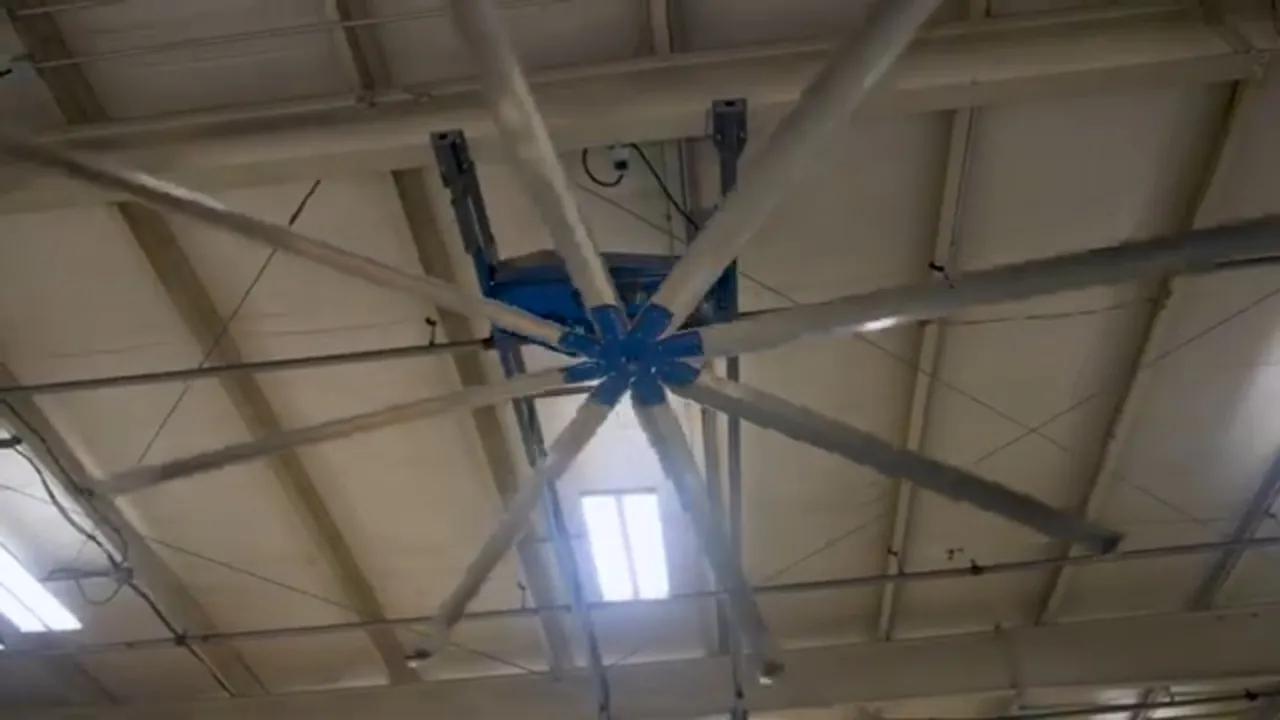
16-21 ft
TAB EverBreeze sizes
2 HP
45 RPM EverBreeze drive
Year-round
Summer cooling + winter destrat
Nationwide
Quoted with freight
Shop Warehouse Fans Online
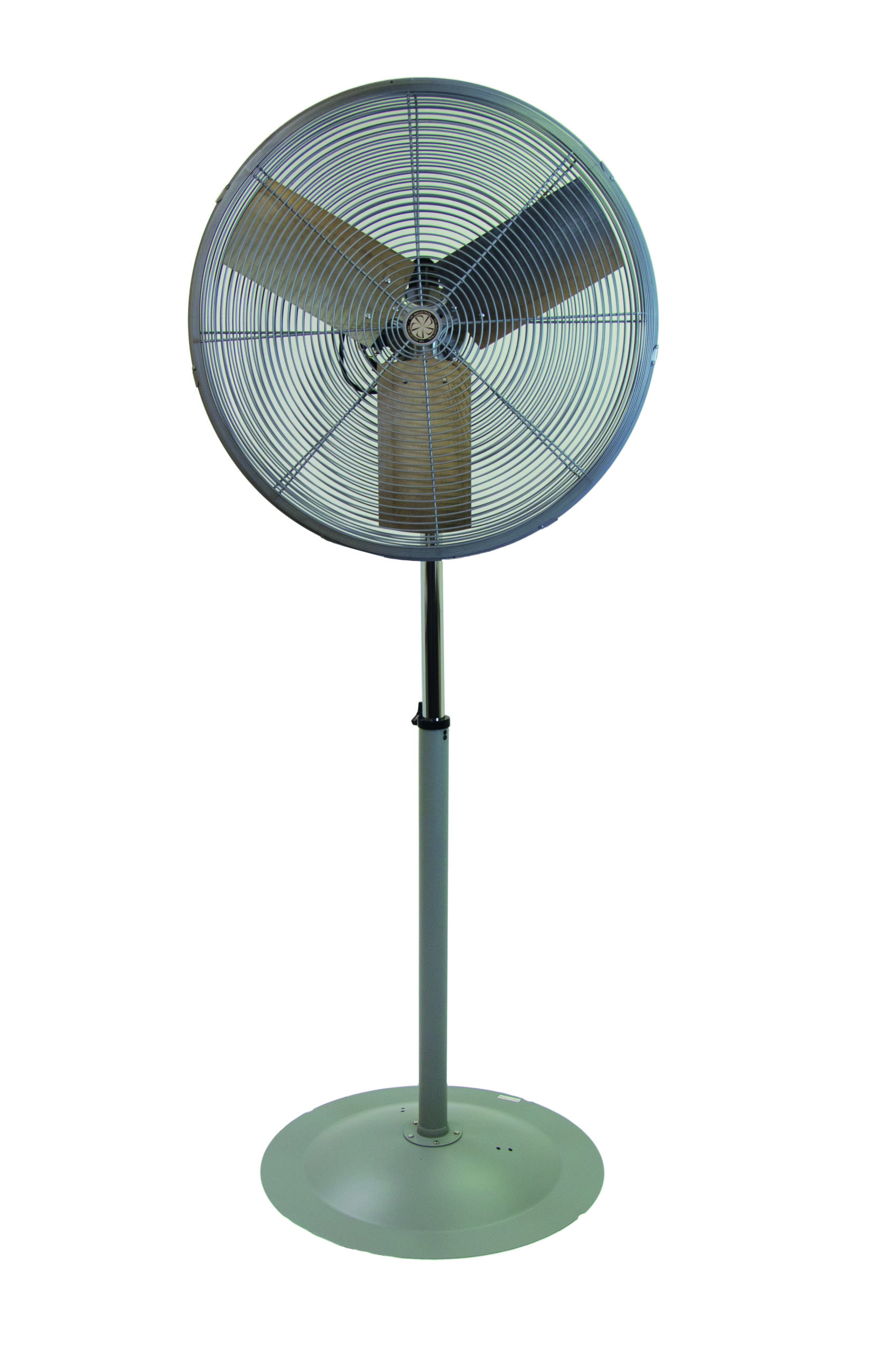
Pedestal, I-beam, portable and exhaust fans for pack stations, dock doors and work cells ship from our online store. TAB EverBreeze HVLS ceiling fans are quoted with freight; see sizing below.


Why Warehouses Need More Than a Few Floor Fans
A warehouse is a big box with a hot roof, a lot of open doors and very little air movement where people actually work. In summer, heat soaks through the roof deck and builds up between rack rows. In winter, the warm air your heaters make floats to the ceiling and stays there. Both problems come from the same thing: still air.
The right warehouse fans fix that by moving a large volume of air through the occupied zone. One well-placed HVLS fans layout can replace a whole fleet of drum fans, with no cords on the floor and nothing for a forklift to hit. Smaller wall, pedestal and exhaust fans then cover the spots a ceiling fan cannot reach, such as trailers, work cells and battery rooms.
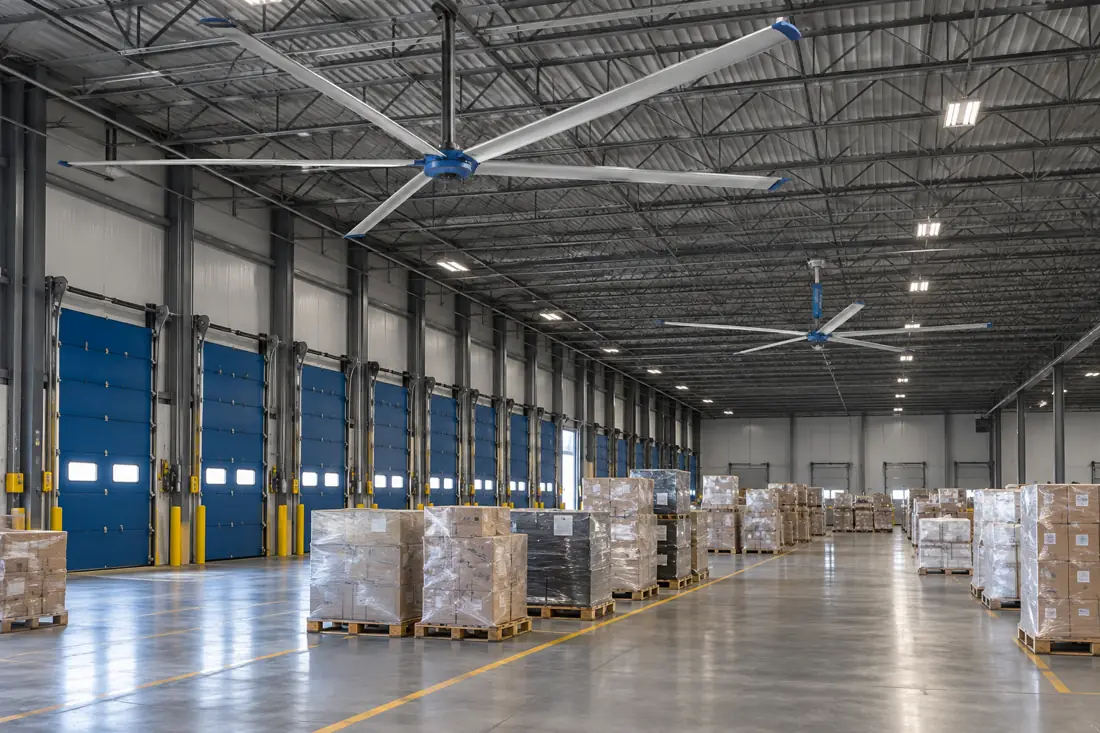
Representative warehouse illustration.
What still air costs a warehouse
Warehouse fans are not air conditioners. They do not lower the air temperature by themselves. What they do is make people feel cooler, mix the building’s air so heating and cooling work better, and help ventilation systems pull heat and fumes out. If you keep that in mind, choosing the right mix of fans becomes much simpler. If your main question is fan size and power rather than layout, our guide to big industrial fans compares the largest units side by side.
Types of Warehouse Fans Compared
Most well-run warehouses use more than one fan type. The table below shows what each one is good at and where it falls short, so you can match the fan to the zone instead of buying one type for everything.
| Fan type | Typical size | Best warehouse zones | Watch-outs |
|---|---|---|---|
| HVLS ceiling fan | 8-24 ft diameter | Main and cross aisles, staging, pick and pack, open bulk floor | Needs structure, clearance to racks, lights and sprinklers, and a fire-alarm shutdown |
| High-speed ceiling or I-beam fan | 24-30 in | Mezzanines, low bays, a single station or bench line | Air fades quickly below the fan in tall buildings |
| Wall or column circulator | 18-30 in | Pack stations, dock walls, maintenance benches | Fixed throw; noisy if aimed straight at people for hours |
| Pedestal or drum fan | 24-48 in | Dock doors, trailers, temporary work zones | Cords, trip hazards, blows dust and paper, many motors to maintain |
| Exhaust / shutter fan | 12-54 in | Removing hot air, fumes, humidity; battery charging rooms | Needs make-up air openings; it does not create a cooling breeze |
| Evaporative cooler | Portable or ducted | Dry climates, open docks, outdoor yards | Adds humidity; poor fit for humid regions and moisture-sensitive goods |
Ceiling-hung and I-beam circulators for low bays and mezzanines
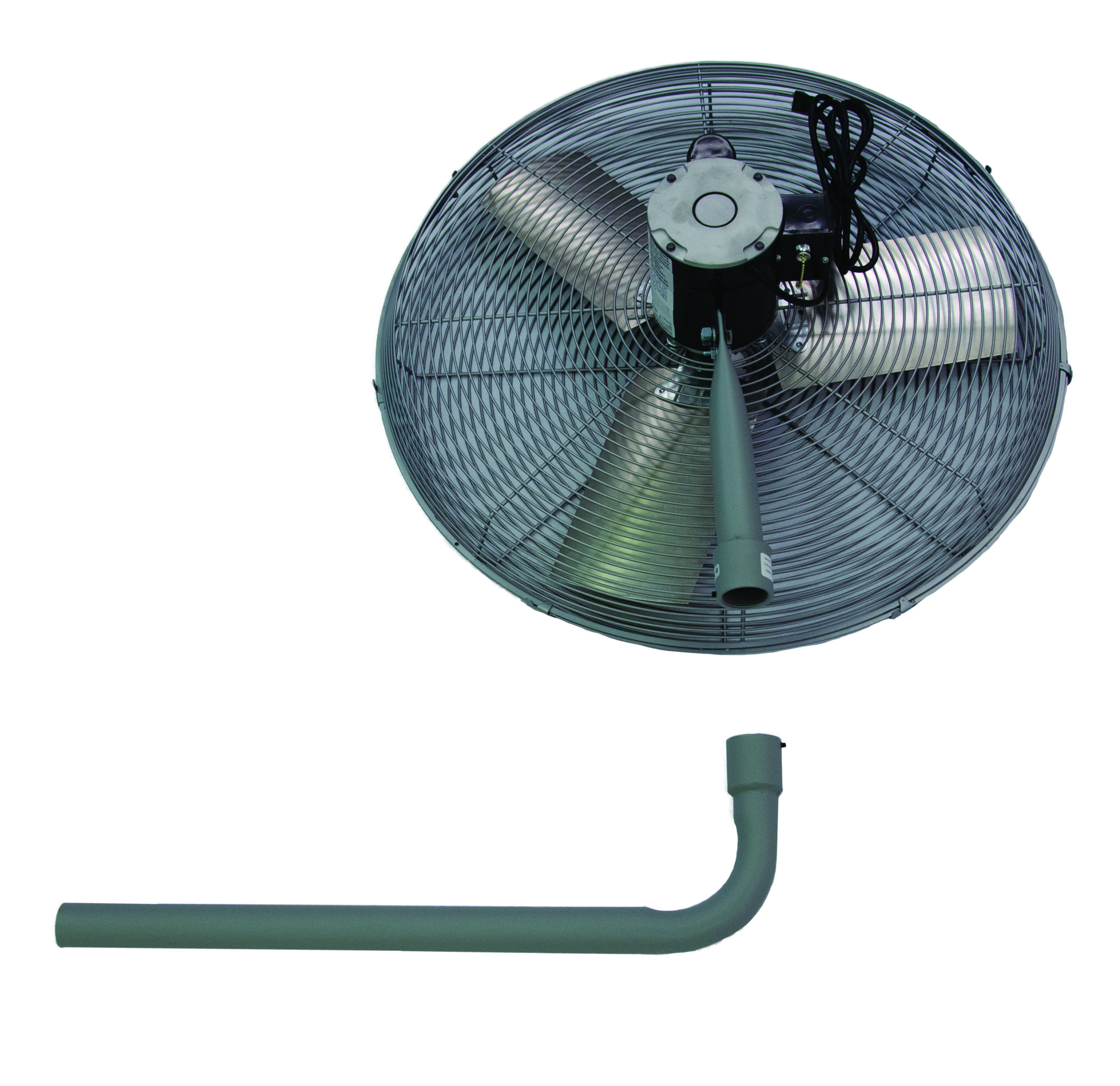
Where the clear height is too low for an HVLS fan, or under a mezzanine deck, a 24 to 30 inch high-performance circulator does the job. Ceiling-mount versions hang from the structure on a downrod; I-beam versions clamp to a steel column or beam and can be aimed down an aisle or across a bench line.
These fans move a strong, narrow stream of air, so plan one per workstation or one every 30 to 40 feet along a line, and aim them across people rather than straight at them. They plug into standard circuits, which makes them easy to add or move as your layout changes.

Wall-mount fans for pack stations and dock walls

Wall-mount and bracket fans keep the floor clear and put air exactly where a person stands for a whole shift: pack benches, label printers, returns processing, the shipping desk and the maintenance bench. An oscillating bracket spreads the breeze over two or three stations instead of one.
Mount them 8 to 10 feet up, angled down, on a wall, column or rack upright approved for the load, and keep the guard clear of forklift traffic. Pair them with an HVLS fan overhead and the wall fans only need to cover the hot spots the big fan misses.
How to Size Warehouse Ceiling Fans by Square Footage and Ceiling Height
Fan sizing starts with three numbers: floor area, clear height under the roof structure and how much of the floor is blocked by racking. Open floor lets a big fan’s air jet travel a long way; tall rack runs act like walls and shorten it. Use the tables below for planning, then let us confirm count and placement from your drawing.
Fan diameter by clear height
| Clear height (floor to underside of structure) | Typical HVLS diameter | Notes |
|---|---|---|
| Under 16 ft | Not usually HVLS; use ceiling, I-beam or wall circulators | Keep blades at least 10 ft above the floor |
| 16-24 ft | 12-16 ft (e.g. EverBreeze 316) | Common in older warehouses, shops and flex buildings |
| 24-32 ft | 16-21 ft (EverBreeze 316 or 621) | Typical modern warehouse; check top-of-rack and sprinkler heights |
| 32-40 ft+ | 20-24 ft (e.g. EverBreeze 621) | Tall distribution centers; larger fans push air further to the floor |
Quick fan-count estimates by building size
| Building | Clear height | Mostly open floor | Heavily racked (fans over aisles only) |
|---|---|---|---|
| 10,000 sq ft | 20-24 ft | 1 x 16 ft fan | 1-2 x 16 ft fans |
| 25,000 sq ft | 24-30 ft | 2 x 21 ft fans | 3-4 fans over main and cross aisles |
| 50,000 sq ft | 28-32 ft | 3-4 x 21 ft fans | 5-6 fans plus wall fans at pack and dock zones |
| 100,000 sq ft | 32-36 ft | 6-8 x 21 ft fans | 10-12 fans over cross aisles, staging and docks |
Planning estimates only, based on common industry coverage ranges for open floor. Mezzanines, walls, conveyors and dense racking change the count; we confirm from your layout.
Spacing rules of thumb
- Space HVLS fans roughly 2.5 to 3 diameters apart, center to center: about 40-50 ft for a 16 ft fan and 50-65 ft for a 21 ft fan.
- Keep fans at least one diameter away from walls so the air jet has room to turn and return.
- Mount blades low enough to reach the floor (often 20-30 ft) but above every forklift mast, raised load and lift.
- Use one controller per zone so docks, pack areas and storage can run at different speeds.
- Do not put two fans so close that their air jets collide; that creates a dead spot between them.
TAB EverBreeze models for warehouses
We are an authorized dealer for TAB Industries’ EverBreeze line, a straightforward HVLS fan built for warehouses and plants. Both models use a 2 HP, 45 RPM drive, a pre-wired electrical panel and an included digital or thermostatic control, per TAB’s published specifications.
| Model | Blades | Diameter | Good warehouse fit | TAB list price |
|---|---|---|---|---|
| EverBreeze 316 | 3 | 16 ft | Lower clear heights, smaller buildings, single zones, dock and pack areas | $4,500 per unit |
| EverBreeze 621 | 6 | 21 ft | Tall distribution buildings, wide cross aisles, large staging areas | $6,500 per unit |
Prices as published by TAB Industries per fan; freight, mounting kit extras, electrical work and installation are quoted separately. Top-of-page photo: TAB EverBreeze six-blade fan, Photo: TAB Industries.
Fan Layout Over Racking Aisles
Racking is the biggest difference between a warehouse and an open plant floor. A 28 ft rack run is a solid wall to moving air, so a fan placed over the middle of a rack block mostly cools the top of your pallets.
Put HVLS fans over the places where air can travel and people work: wide cross aisles, main travel aisles, staging lanes, pick modules and the end-of-aisle zone. The air jet runs along the open aisle and spills into the narrow aisles off it. In very narrow aisle (VNA) buildings, fans over the front and back cross aisles plus wall fans at the aisle ends usually work better than trying to cover every aisle from above.

Representative warehouse illustration.
Clearances to plan around racking
If you are also planning new pallet rack or reworking aisles, lay out fans at the same time. We design both, so rack rows, cross aisles, lights and fan drops can be coordinated in one drawing instead of fixed after install.
Dock Doors, Trailers and Staging Lanes

The shipping and receiving dock is usually the hottest and busiest part of a warehouse. Open doors let in hot, humid air, and a trailer that has been sitting in the sun can be far hotter inside than the building. People loading it by hand need airflow most.
A practical dock setup has three layers: an HVLS fan over the staging lane to keep the whole dock moving, a portable drum or pedestal fan at each active door aimed into the trailer, and wall fans at fixed check-in or labeling stations. Keep cords out of forklift paths and park portable fans out of the door opening when it is not in use.
Representative warehouse illustration.
Dock fan tips
- Place ceiling fans over staging lanes, not directly in line with door tracks or a leveler’s travel.
- In winter, run dock-area fans slowly or zone them off so they do not push warm air out of open doors.
- Pair fans with dock seals or shelters; fans cannot stop outside air from flowing in around a trailer.
- Keep fans and their cords clear of dock levelers, restraints and pedestrian walkways.
Dock seals, levelers and restraints are covered on our loading dock equipment page; we often quote fans and dock gear together.
Summer Cooling, Winter Destratification and ROI
Summer: the perceived cooling effect
Air moving across skin carries heat and sweat away faster, so people feel cooler at the same air temperature. ASHRAE Standard 55 recognizes elevated air speed as a way to keep people comfortable at warmer temperatures. At the gentle floor-level air speeds a large HVLS fan produces, workers commonly report feeling several degrees cooler, often in the 5-10°F range, depending on humidity, clothing and how hard they are working.
Winter: destratification
Warm air rises. In a tall warehouse the air near the roof can be 10-20°F warmer than the air at the floor, because temperature often climbs around half a degree to a degree per foot of height. Your thermostat sits at the floor, so heaters keep running while the heat they make collects under the roof. Running HVLS fans slowly in winter mixes that warm layer back down without creating a draft. The floor warms, the roof cools, and the heaters cycle less. Lower roof temperatures also reduce heat loss through the roof.
A simple ROI example
Every building is different, so treat this as a way to run your own numbers, not a promise.
| Item | Example assumption | Result |
|---|---|---|
| Building | 50,000 sq ft, 30 ft clear, heated | 4 x EverBreeze 621 |
| Fan cost | 4 x $6,500 list (before freight, install) | $26,000 equipment |
| Annual heating cost | $40,000 natural gas | – |
| Destrat heating saving | 10-20% (varies widely by building) | $4,000-$8,000 per year |
| Fan electricity | 4 fans x ~1.5 kW x 2,500 hrs x $0.12/kWh (full speed; winter runs slower) | Under $1,800 per year |
| Replaced floor fans | 15 drum fans at ~0.5 kW each, retired | Their power, cords and repairs go away |
Add in productivity: if cooler aisles save each of 40 workers even a few minutes of slowdown per hot day, the summer benefit can rival the winter heating savings. Ask your utility, too; some offer rebates or incentives for destratification fans or energy-efficient motors.
Running both seasons
In summer, run fans at higher speed for cooling. In winter, run them at low speed (often 20-40%) so they mix the air without making a breeze people feel. A thermostatic control can switch this automatically.
Warehouse Heat Stress and Worker Safety
Heat illness is a real risk in warehouses without air conditioning, especially on second-story mezzanines, in trailers and in the first hot weeks of the year before workers acclimatize. OSHA enforces heat hazards under its General Duty Clause, runs a National Emphasis Program on heat, and has proposed a federal heat injury and illness prevention rule that covers indoor work. Several states, including California, Oregon, Minnesota and Nevada, already have their own heat rules that reach indoor workplaces.
Air movement is one of the most practical engineering controls you have. It helps sweat evaporate, which is how the body sheds heat.

Representative warehouse illustration.
Build fans into a heat plan
- Measure heat index at pick zones, mezzanines and docks, not just at the office thermostat.
- Put airflow first where people stay put: pack benches, check-in desks, returns and trailer loading.
- Set up shaded or fan-cooled rest spots and water near work areas, not only in the break room.
- Phase in new and returning workers over the first week of hot weather (acclimatization).
- Train supervisors to spot early heat illness signs and know when to stop work.
- Remember the limit: above roughly 95°F air temperature with high humidity, moving air helps less; combine fans with cooling, ventilation and work-rest schedules.
For more ways to reduce fatigue on the floor, see our warehouse ergonomics guide.
Exhaust Fans and Ventilation: Getting Hot Air Out
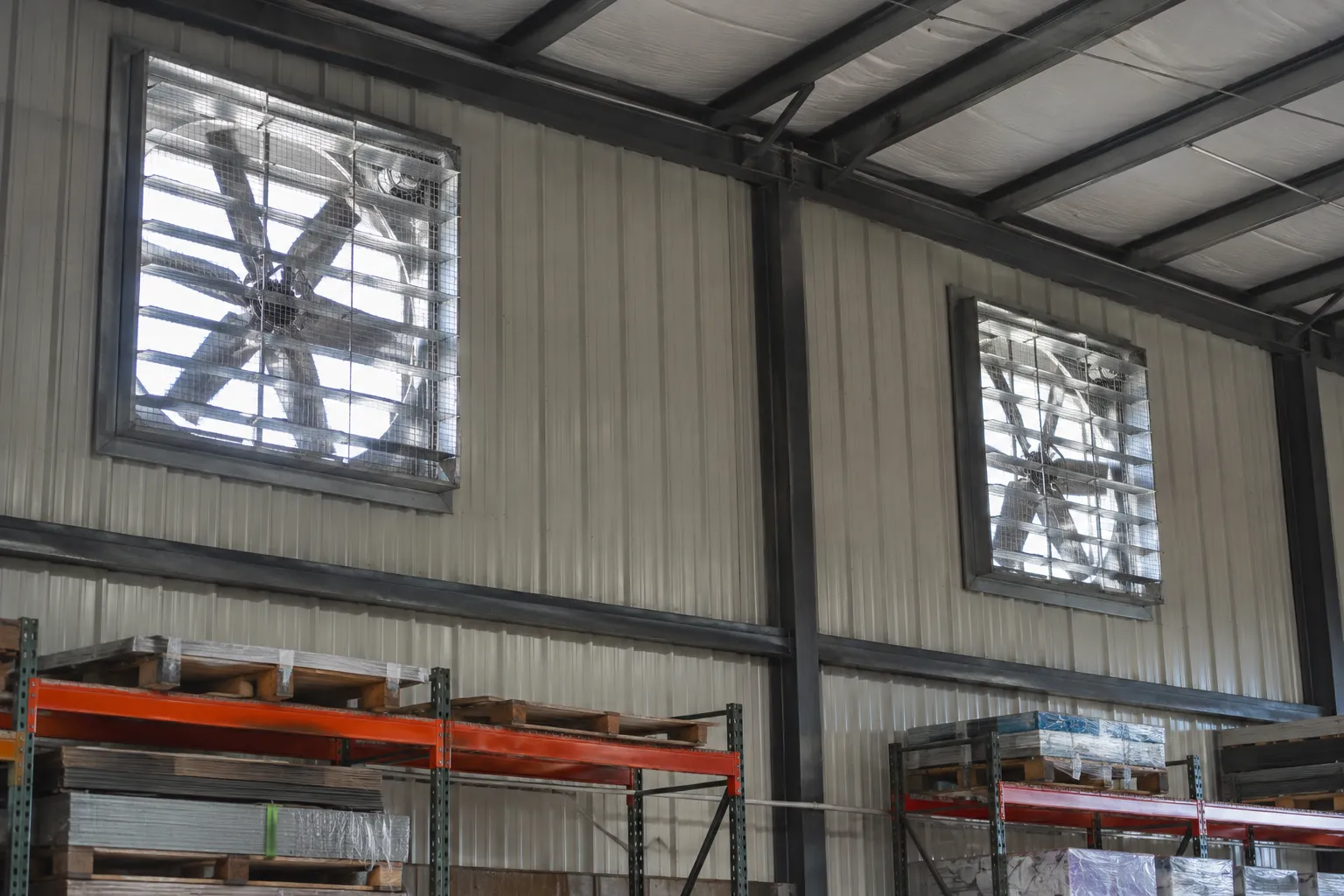
Circulation fans stir the air inside the building. Exhaust fans replace it. A pair of shutter-mounted exhaust fans high on a wall pulls the hottest air out from under the roof, while low openings or louvers on the opposite side let cooler outside air in. The shutters close when the fan stops to keep weather out.
Exhaust fans are the right tool for battery charging areas, propane forklift traffic, shrink-tunnels, mechanical rooms and any space where heat, fumes or humidity need to leave the building.
Representative warehouse illustration.
How much exhaust airflow do you need?
Ventilation is sized in air changes per hour (ACH). Required CFM = building volume x target ACH / 60. Example: a 100 ft x 200 ft area with a 24 ft clear height holds 480,000 cubic feet. At 4 air changes per hour that is 480,000 x 4 / 60 = 32,000 CFM of exhaust, split across several fans. Busier or hotter areas may need more. Battery charging rooms and areas with fuel-burning equipment have their own code requirements, so have those reviewed by your mechanical engineer.
Make-up air matters
An exhaust fan cannot remove more air than can get back in. Without enough inlet area, fans run starved, doors whistle and fumes can be pulled from places you do not want. Plan inlets as carefully as the fans.
NFPA 13 Sprinklers and Warehouse Ceiling Fans
Large ceiling fans can push sprinkler spray sideways and change how heat reaches sprinkler heads early in a fire. That is why NFPA 13, the sprinkler installation standard, includes specific provisions for HVLS fans in sprinklered buildings. In recent editions they generally include:
- A maximum HVLS fan diameter of 24 ft.
- Fans centered approximately between four adjacent sprinklers, so the fan does not sit directly under a head.
- At least 3 ft of vertical clearance between the fan and the sprinkler deflectors.
- All HVLS fans interlocked to shut down on a sprinkler waterflow signal through the fire alarm system (NFPA 72).
Requirements vary by the NFPA 13 edition your jurisdiction has adopted, by sprinkler type (ESFR, CMSA and in-rack systems can bring extra considerations) and by local amendments. Before anything is hung, send fan locations to your fire sprinkler contractor and the local authority having jurisdiction (AHJ), and have the fire alarm contractor plan the shutdown relay. We include a reflected ceiling plan with fan locations so this review goes quickly.
Do not skip the interlock
A fan that keeps running during a fire can delay sprinkler activation and disrupt water spray. Budget for the alarm relay and wiring as part of the fan project.
Applications: Warehouse Fans by Operation
E-commerce and parcel operations pack people closely around benches, conveyors and printers, often in the middle of a large open floor. That makes them ideal for an HVLS fan centered over the pack area, with wall fans only at the stations that still run warm.
Gentle overhead airflow is also kind to light items. Compared with drum fans blowing across a bench, it is far less likely to lift void fill, labels and paperwork.
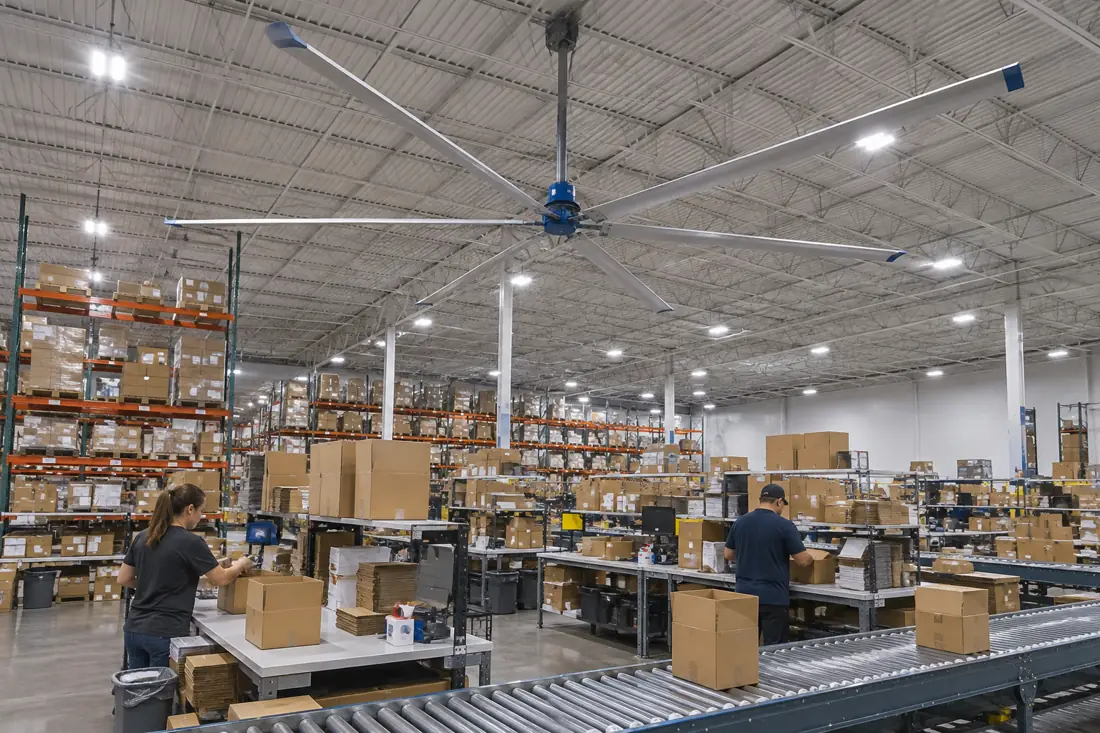
Representative warehouse illustration.
Cold storage and freezers need fans specifically rated for low temperatures and condensation, and should be coordinated with the refrigeration design. Ask us before planning fans in or near those rooms.
How We Plan a Warehouse Fan Project
Layout review
Floor plan, clear heights, rack heights, aisles, docks, lights, heaters and sprinkler layout.
Zone goals
Cooling, destrat, dock airflow, exhaust: decide what each zone needs.
Fan selection
HVLS diameter and count, plus wall, pedestal and exhaust fans for spot needs.
Code and structure
Structural check of mounting points; sprinkler, AHJ and alarm interlock review.
Power and controls
240v single phase or 240v-480v three phase circuits; zoned digital or thermostatic controls.
Install and commission
Lift, mount, safety cables, blades, electrical; set summer and winter speeds.
What to send for a fast quote
- Building length, width and clear height (or a floor plan / rack drawing).
- Roof structure type: steel beams, bar joists or wood trusses.
- Rack heights, aisle widths and the location of cross aisles, docks and pack areas.
- Whether the building is heated, air conditioned or neither.
- Available power (voltage and phase) and any known sprinkler type, such as ESFR.
- Your main goal: summer cooling, winter heating savings, dock comfort or ventilation.
Get a free quote
Tell us your warehouse size, clear height, rack layout and what you want the fans to do. A project specialist will follow up with fan sizing, placement and freight-included pricing. Prefer to talk? Call (800) 326-4403.
Warehouse Fan FAQs
What is the best fan for a warehouse?
How many fans do I need for my warehouse?
What size ceiling fan for a warehouse with a 30 ft ceiling?
Do warehouse ceiling fans actually lower the temperature?
Can HVLS fans be installed in a warehouse with ESFR sprinklers?
Should fans go over the racking or the aisles?
How much does it cost to run a warehouse fan?
What is the difference between a circulation fan and an exhaust fan?
How much do TAB EverBreeze warehouse fans cost?
Planning Fans for Your Warehouse?
Send us your floor plan and clear height. We will recommend fan types, sizes and placement and return a freight-included quote.