
Dock Seals & Dock Shelters
Close the gap between the trailer and the building to keep out weather, pests and dust and hold your inside temperature. Compare compression dock seals, seal/shelter combos and fabric dock shelters, size them to your door, bumpers and trailers, and order Vestil models online or get a free quote.

8–10 ft
Door widths and heights in our store
10–20 in
Vestil seal projections
18–36 in
Vestil shelter projections
5 in
Max recommended seal compression
Shop Dock Seals and Dock Shelters
A foam dock seal for 8 x 8 ft doors, a seal/shelter combo for 8 x 10 ft doors, a fabric shelter for doors up to 10 x 10 ft and a retractable shelter. Each card opens the product page with every projection and the current lead time.


What Dock Seals and Dock Shelters Do
When a trailer backs up to an open dock door, there is a gap around its sides and top. Heated or cooled air leaks out through it, and rain, snow, dust, insects and birds come in. Dock seals and dock shelters close that gap.
A dock seal is a set of foam pads covered in heavy vinyl, mounted on the wall around the door. The trailer backs into the pads and compresses them against its rear edges. A dock shelter is a frame that stands out from the wall with fabric curtains on the sides and top. The trailer backs into the opening and the curtains wipe against the outside of the trailer.
Both do the same job in different ways, and the right one depends on your door, your bumpers and the trailers you see each day, not just on the door size.
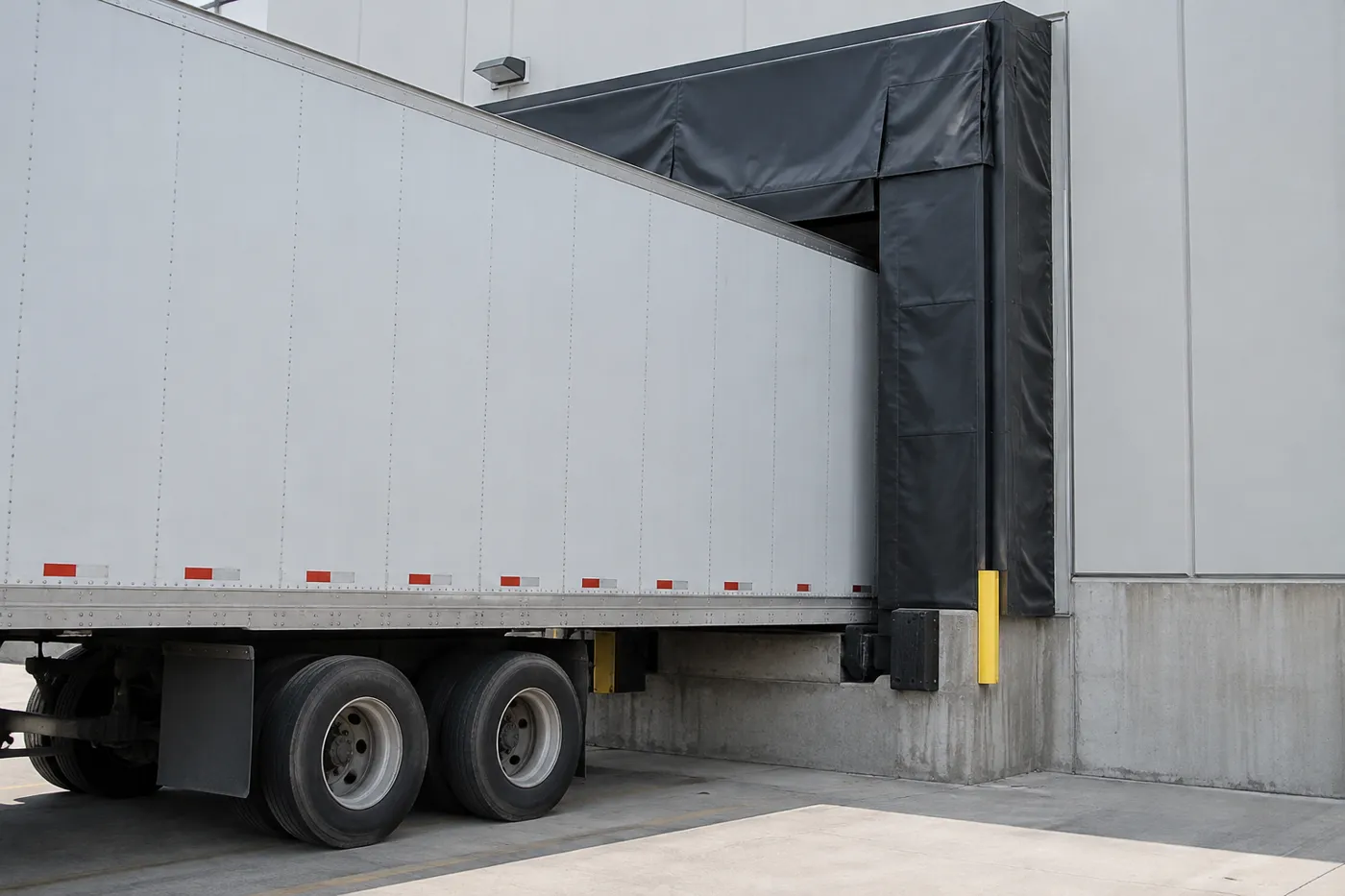
Dock Seal vs Dock Shelter
This is the main decision. Industry guides agree on the basic trade-off: seals seal tighter, shelters fit more trailers and leave the trailer opening clear.
| Dock seal (compression foam) | Dock shelter (curtains) | |
|---|---|---|
| How it seals | Trailer compresses foam pads against its rear edges | Curtains wipe the outside of the trailer sides and roof |
| Seal quality | Tightest seal | Looser; about 70% air flow efficiency, per Raymond West |
| Trailer mix | Best with consistent trailer sizes | Handles a wider range of heights and widths |
| Access to the trailer | Pads sit over the trailer edges; some of the opening is covered | Full width of the trailer opening stays clear |
| Typical door | 8 x 8 to 9 x 9 ft (head pad); 8 x 10 to 9 x 10 ft (curtain head) | Larger doors, up to 12 x 12 ft for rigid shelters |
| Projection past bumpers | 4–6 in past the bumper face | 12 in minimum past the bumper |
| Wall load | Compression pushes on the wall; Chalfant cites 35 to 90 lb per foot | Less force on the wall |
| Best for | Cold storage, food, climate-controlled docks, security | Mixed fleets, oversized doors, full-width loading |
Sources: Chalfant Dock Seal & Shelter Selection Guide, Pentalift Seals & Shelters catalog, Raymond West, Excel Solutions.

Choose a dock seal when most trailers are the same size, the door is 8 or 9 ft wide, and the goal is temperature control, such as a cooler, freezer or food dock. The tight fit also blocks light and makes it harder for anyone to slip in around the trailer.
Choose a dock shelter when the door is oversized, trailer heights vary (reefers, dry vans and straight trucks at one door), or forklifts need the full trailer width, for example to unload wide pallets right at the rear.
In between? A seal/shelter combo uses foam side pads with a fabric head curtain, so taller trailers still seal at the top.
Types of Dock Seals and Shelters
| Type | How it works | Good fit | In our store |
|---|---|---|---|
| Compression seal with head pad | Foam side pads plus a foam head pad | 8 x 8 to 9 x 9 ft doors, consistent trailers | Vestil D-150 (8 x 8 ft), D-350 (8 x 9 ft) |
| Seal/shelter combo (curtain seal) | Foam side pads with a fabric head curtain | 8 x 10 ft doors, mixed trailer heights | Vestil D-150/650 |
| Rigid dock shelter | Wood frame, fabric side and top curtains with fiberglass stays | Oversized doors, full trailer access | Vestil D-750 (doors to 10 x 10 ft) |
| Retractable shelter | Scissor frame folds back with the trailer | Docks where off-center backing damages fixed frames | Vestil D-520 |
| Soft-sided (foam frame) shelter | Foam frame flexes on off-center contact; curtains replace separately | High-impact docks | Quote |
| Inflatable seal or shelter | A blower inflates bags against the trailer after it is parked | Cold storage, walls not built for compression loads | Quote |
Dock seal and shelter models
 D-350 dock seal, 8 x 9 ft doorNylon-reinforced vinyl over foam on treated wood, a full-height air escape tunnel and a through-the-wall install kit. Projections 10 to 20 in.
 Draft blocker, 24 in projectionVinyl over a foam-filled core with an air vent so it springs back to shape. Blocks drafts between the seal and the dock leveler.
 Dock seal repair kitSix black vinyl patches with glue and instructions for Vestil dock seals and seal/shelter combinations.
How to Size a Dock Seal or Shelter: The Fit Survey
Seals and shelters are usually made to order and Vestil lists them as non-returnable, so measure before you buy. Vestil asks buyers to complete its survey sheet to confirm the size. These are the measurements that matter:
- Door width and height: the clear opening. This sets the model: 8 x 8, 8 x 9 or 8 x 10 ft for seals and combos, larger for shelters.
- Bumper projection: how far the face of the dock bumpers sits out from the wall. This sets the seal or shelter projection.
- Wall setback: any recess or offset between the wall and the door opening.
- Trailers served: the shortest and tallest trailer heights and widths, and any lift gates, rear bumpers, door hinges or gutters that stick out.
- Dock height and approach: Pentalift calls 48 to 50 in ideal with a level approach. Declined or inclined drives change where the trailer meets the wall.
- Wall construction and obstructions: what the seal mounts to, and any lights, canopies or downspouts around the door.
- Leveler type: pit leveler or edge-of-dock leveler, which changes the gap at the bottom corners.
Getting projection right
Projection is how far the seal or shelter stands out from the wall. Too little and the trailer never touches the pads; too much and the trailer crushes the foam and the pads wear out fast.
| Situation | Typical projection | Source |
|---|---|---|
| Seal: bumper projection + setback 4–6 in | 10 in seal | Wesco seal application guide |
| Seal: bumper projection + setback 14–16 in | 20 in seal | Wesco seal application guide |
| Seal pads in general | 4–6 in past the bumper face | Pentalift, Chalfant |
| Flush dock with an edge-of-dock leveler | 20 in Vestil seal | Vestil product data |
| Shelter | At least 12 in past the bumper | Chalfant |
| Maximum seal compression | 5 in | Vestil product data |
Vestil seals come in every inch from 10 to 20 in of projection, and D-750 shelters in 18, 24, 30 and 36 in. Send us your measurements and photos and we will confirm the projection before you order.
Sealing the Last Gaps and Making Repairs
Even a well-sized seal leaves gaps at the bottom corners and around the leveler. These parts close them:
- Dock seal draft blockers: weighted, foam-filled vinyl pads in 18, 24 and 36 in lengths that block drafts between the seal and the dock leveler.
- Dock leveler weather stripping: side strips and a rear foam insulator that close the leveler pit against drafts, pests and rodents.
- Dock seal repair kit: six black vinyl patches with glue for seals and combos.
Inspect the dock from inside with the trailer parked. Daylight around the trailer, puddles or ice inside the door, or torn and flattened pads all mean the seal is no longer doing its job.

Where Dock Seals and Shelters Are Used
Dock fans move air inside the dock but cannot stop outside air from flowing in around a trailer; see our warehouse fans guide. For levelers, bumpers, restraints and lights, see the full loading dock equipment guide.
Dock canopies are a different product
Searches for a dock canopy usually mean a boat dock or boat lift cover. At a truck dock, a canopy is a roof overhang above the doors. It keeps rain and snow off the dock apron but does not seal the gap around the trailer, so a dock with a canopy still needs a seal or shelter. If a canopy, light or downspout sits near the door, include it in your survey so the shelter header clears it.
Ordering Dock Seals and Shelters
Standard Vestil seals, combos and shelters ship from our online store; lead times are on each product page (about 5 working days for seals and combos and 10 for shelters, per Vestil) and confirmed with your quote. Inflatable, soft-sided and custom sizes are quoted.
Measure
Door size, bumper projection, wall setback, trailer range and two or three photos of the door.
Match the unit
Seal, combo or shelter, with the right projection and accessories.
Quote with freight
Units, draft blockers and freight on one quote.
Install
Seals include a through-the-wall install kit; ask us about installation help.
Get a free quote
Send the door size, bumper projection, number of doors and the trailers you receive. A project specialist will confirm the right seal or shelter and quote it with freight. Prefer to talk? Call (800) 326-4403.
Dock Seal and Shelter FAQs
What is the difference between a dock seal and a dock shelter?
Which is better for cold storage, a seal or a shelter?
How do I choose dock seal projection?
What size dock seal do I need for an 8 x 10 door?
Can a dock shelter fit an oversized door?
How long do dock seals last?
Can I return a dock seal?
Need Help Sizing a Dock Seal or Shelter?
Send your door size, bumper projection and trailer mix for a free recommendation and a freight-included quote.