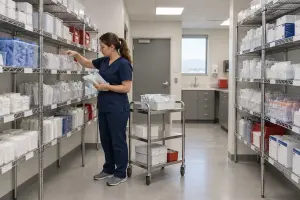
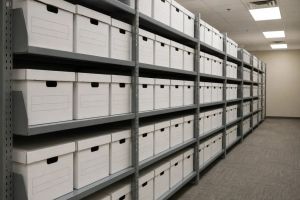
When a facility starts to feel tight, the first signs usually aren't dramatic. Pick paths get longer. Reserve stock creeps into active space. Operators spend more time searching, waiting, and rehandling. Then the bigger problems show up. Accuracy slips, labor gets stretched, and expansion starts looking more expensive than anyone wants.
That's where Automated Storage and Retrieval Systems come into the conversation. For many operations, AS/RS is no longer a specialty project. It's part of the mainstream planning discussion for warehouses, manufacturing plants, healthcare storage, government facilities, and high-control inventory environments.
Is Your Warehouse Out of Space and Time?
A crowded warehouse rarely has just one problem. Space pressure and time pressure usually hit together.
You may be dealing with slow-moving inventory taking up valuable floor space, while fast movers keep getting relocated to make room. Forklift traffic grows. Picking gets less predictable. Supervisors spend more time fixing layout problems than improving throughput.

That pressure helps explain why adoption has accelerated. The global AS/RS market was valued at USD 6.55 billion in 2023 and is forecast to reach USD 11.48 billion by 2030, with a projected 8.1% CAGR from 2024 to 2030, according to Next Move Strategy Consulting's AS/RS market report. That growth tells facility managers something important. AS/RS has moved from a niche automation tool to a standard planning option.
What managers are really trying to solve
Most buyers aren't looking for automation for its own sake. They're trying to solve a short list of practical issues:
- Space pressure: Existing shelving and rack layouts no longer support growth.
- Labor strain: Too much employee time goes into walking, searching, lifting, and rehandling.
- Control gaps: Inventory is harder to locate, track, and secure.
- Service demands: Shipping, replenishment, or line-side delivery needs are getting tighter.
Practical rule: If your operation is paying for storage problems with labor, lost time, or avoided growth, the storage method is already costing more than it appears on paper.
Automated storage and retrieval systems address those problems by combining high-density storage with controlled retrieval. Done well, they don't just add equipment. They change how work moves through the building.
How Automated Storage and Retrieval Systems Work
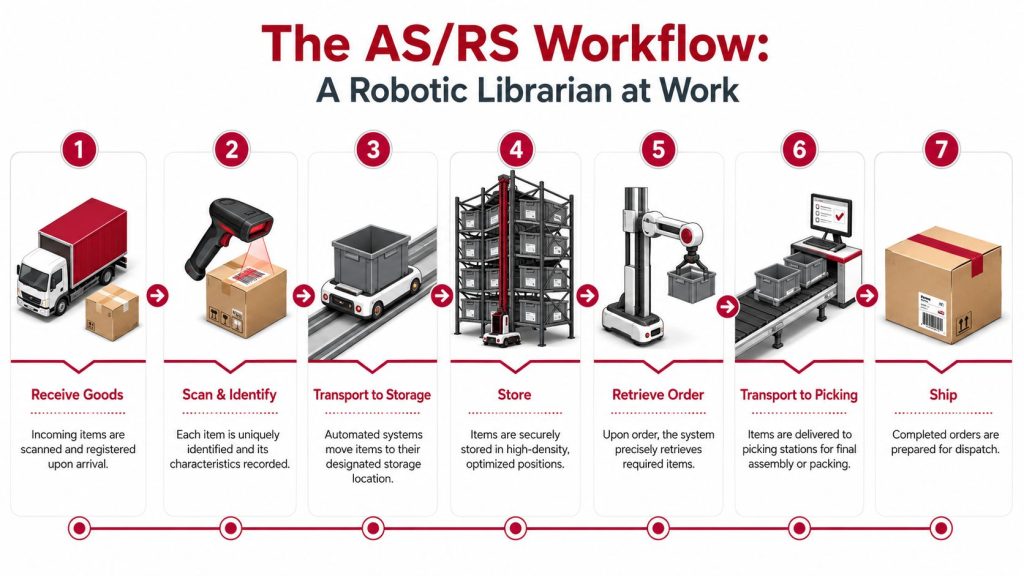
The simplest way to think about AS/RS is this. It works like a robotic librarian. The system knows where each item belongs, stores it in a controlled location, and brings it back when it's needed.
That sounds straightforward, but the performance depends on several moving parts working together.
The core parts of the system
An AS/RS setup usually includes storage structure, retrieval equipment, sensors, controls, and software. Depending on the design, the retrieval device may be a crane, shuttle, extractor, or carousel mechanism. Conveyors, lifts, or workstations may also be part of the flow.
The software layer matters just as much as the hardware. Modern deployments pair the machines with a WMS so the software can calculate optimal storage locations and direct movement in real time, as described by SSI SCHAEFER's overview of AS/RS integration. That's what turns the system from a machine that moves loads into an operational tool for throughput and inventory control.
A basic operating sequence
A typical workflow looks like this:
-
Receive and identify inventory
Items are scanned, measured, or confirmed against system records. -
Assign a storage location
The software selects a location based on dimensions, slotting rules, and retrieval logic. -
Move inventory into storage
The system transports the load to the assigned position. -
Retrieve on demand
When production, picking, or shipping needs the item, the system brings it to the access point. -
Confirm the transaction
The WMS or control system updates the record so inventory stays visible and traceable.
Why mechanical design still matters
Not every AS/RS discussion should stay at the software level. Some systems rely on lifting, pressure, or motion control components that benefit from a practical grasp of mechanical basics. For teams evaluating vertical movement or powered handling, this primer on understanding hydraulic principles is a useful background read.
For facilities comparing compact high-density options, it also helps to review examples of progressive drawers and carousels for space-efficient inventory storage. Those systems often fit operations that need faster access and tighter storage without jumping straight to a large crane-based installation.
If the item data is weak, location rules are inconsistent, or the WMS logic is poorly mapped, the machine may still move product quickly while the operation underperforms.
Exploring the Main Types of AS/RS
Not all automated storage and retrieval systems solve the same problem. The right choice depends on load size, SKU count, access pattern, and available space.
Unit-load AS/RS
Unit-load systems are built for full pallets or large unitized loads. They're common in distribution and manufacturing environments where pallet handling, buffer storage, or reserve inventory needs strong control.
These systems make sense when the operation needs dense pallet storage and repeatable movement. They are less attractive when the inventory mix changes constantly or when load dimensions vary too much.
Mini-load AS/RS
Mini-load systems handle totes, trays, cartons, and smaller containers. They fit operations with many SKUsand frequent retrieval activity, especially where order accuracy matters.
This is often the better choice for parts storage, component picking, and controlled small-item inventory. It gives better access precision than a pallet-focused system and usually supports goods-to-person workflows more effectively.
Vertical Lift Modules
Vertical Lift Modules store trays vertically inside an enclosed machine and deliver them to an ergonomic access opening. They are often a strong fit for maintenance parts, tools, medical supplies, records, and secure storage applications.
They're especially useful when floor space is limited but ceiling height is available. They also help when the operation wants better access control and cleaner organization for mixed inventory.
Carousels
Carousels bring stored items to the operator through rotating movement. Horizontal carousels tend to support faster access for parts and order picking. Vertical carousels often serve compact storage applications where vertical use is important.
Carousel systems can work well in stockrooms and controlled picking zones. They may be less flexible when SKU profiles shift significantly or when item dimensions vary more than the system layout allows.
Shuttle and bot systems
Shuttle-based and bot-based systems are designed for higher throughput and more dynamic movement. They're often chosen for operations that need rapid handling of totes, cartons, or mixed storage bins.
These systems can be very effective, but they also put more pressure on integration quality. If upstream feeding, conveyor logic, or workstations aren't balanced, the automation won't deliver its expected value.
For buyers comparing compact vertical solutions, this breakdown of vertical carousel vs vertical lift module is worth reviewing before locking in a concept.
AS/RS type comparison
| System Type | Typical Load | Storage Density | Throughput Rate | Best For |
|---|---|---|---|---|
| Unit-load AS/RS | Pallets and large unit loads | High | Moderate to high depending on layout | Distribution centers, pallet reserve storage, manufacturing buffers |
| Mini-load AS/RS | Totes, trays, cartons, small containers | High | High | Small parts, order fulfillment, component storage |
| Vertical Lift Module | Trays with mixed small to medium items | Very high in vertical space | Moderate | Parts rooms, tools, healthcare, secure inventory |
| Carousel | Bins, shelves, cartons, small items | High in compact footprints | Moderate to high depending on picking method | Stockrooms, repetitive picking, controlled item access |
| Shuttle or bot system | Totes, bins, cartons, selected pallets | High | High | Fast-moving fulfillment, high activity SKU environments |
The wrong AS/RS type can still be well built and still be the wrong answer. Matching the architecture to the order profile matters more than buying the newest concept.
Key Benefits Your Operation Can Expect
An AS/RS project earns its keep when it removes a specific constraint that is already hurting the operation. In most facilities, that constraint is not just storage. It is a combination of floor space pressure, labor inefficiency, inventory errors, and inconsistent material flow.

Better use of the building
Space is usually the first result operations teams notice. AS/RS stores product in tighter, more disciplined layouts and uses building height that static shelving and rack often waste.
That matters when expansion costs are high, aisles are crowded, or production and packing need more room than storage is currently allowing. In many projects, the primary return is not just fitting more inventory. It is reclaiming floor area for faster-value activities such as kitting, staging, inspection, or added workstations.
More controlled labor flow
Labor savings are real, but the better way to frame the benefit is labor reallocation. AS/RS cuts travel, search time, and repeated touches so the same team can handle more work with less fatigue and less variation by shift.
That does not remove the need for people. It changes where people add value. Operators spend more time picking, verifying, packing, or supporting production and less time walking aisles or hunting for exceptions.
Facilities that miss this point often overstate the labor case early and get disappointed later. The stronger business case usually combines labor efficiency with space recovery, accuracy improvement, and throughput stability.
Tighter inventory control
AS/RS improves inventory discipline because every move is directed and recorded. That supports cleaner location control, more reliable cycle counts, and better traceability for lots, serial numbers, or restricted items.
This benefit carries a lot of weight in manufacturing support, healthcare, labs, and secure storage environments. In those settings, knowing exactly what moved, when it moved, and who accessed it can matter as much as pick speed.
Safer, more predictable handling
Dense storage often creates unsafe habits. People climb, reach, stretch, improvise, and run more forklift traffic through tighter spaces than they should.
AS/RS reduces many of those exposures by bringing items to an ergonomic access point or automating the retrieval path. The safety gain is important on its own, but it also improves consistency. Fewer manual workarounds usually means fewer product touches, fewer handling errors, and less aisle congestion.
Benefits that matter most by facility type
The headline benefit depends on the operation:
- Warehouses: Higher density, shorter travel, and better slotting discipline
- Manufacturing: Reliable parts access, WIP buffering, and cleaner point-of-use support
- Healthcare and labs: Controlled access, organized storage, and stronger traceability
- Government and evidence rooms: Security, audit trails, and restricted retrieval
The main mistake I see is treating these benefits as automatic. They are not. AS/RS performs well when the design matches the order profile, inventory behavior, staffing model, and software environment. That is why the best results come from a joint evaluation with operations, engineering, IT, and an experienced integration partner before equipment is specified.
How to Select the Right AS/RS for Your Facility
A good buying process starts with questions, not models. Too many projects begin with a preferred machine and then force the operation to fit it.
The questions that shape the right choice
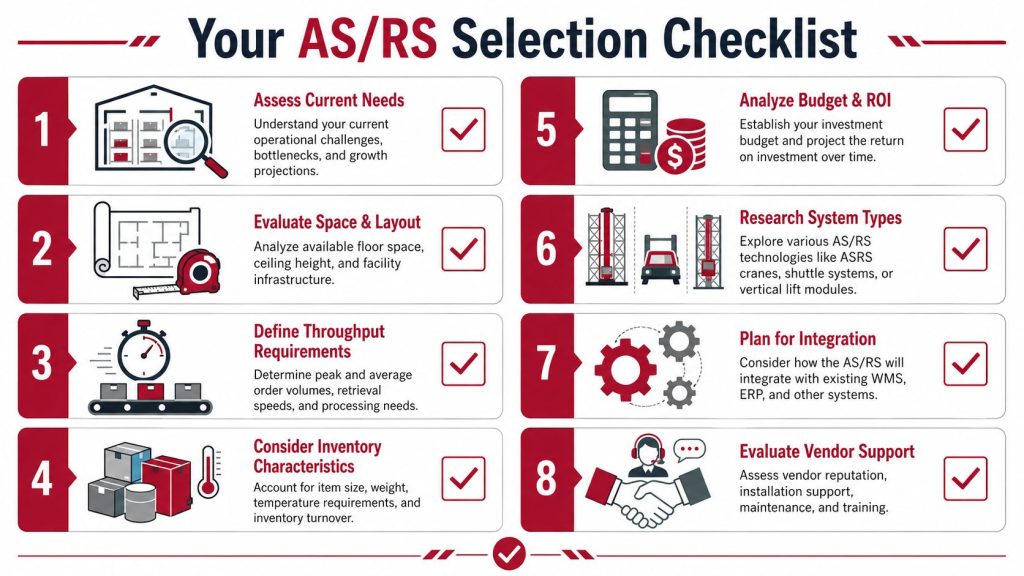
Use this checklist early in the process:
-
What are you storing
Item dimensions, weights, packaging style, and handling sensitivity decide whether you need trays, totes, pallets, or mixed-load support. -
How often do you need access
Throughput expectations matter. Fast access for a small number of active SKUs is a different design problem than deep storage for reserve stock. -
What does the building allow
Ceiling height, floor conditions, column spacing, fire protection, and access points all shape the solution. -
How stable is your operation
A relatively stable process is easier to automate. If your SKU mix, layout, or order profile changes constantly, a rigid design may become a problem. -
How will software connect
WMS, ERP, and control logic should be part of the evaluation from the start, not after equipment selection.
When AS/RS is a bad fit
Not every facility should automate storage. That's an important part of a responsible evaluation.
Industry guidance summarized by Control.com's review of AS/RS advantages and disadvantages notes tradeoffs including high initial investment and relative inflexibility. In practical terms, AS/RS may be a poor fit when SKUs, workflows, or facility layouts change frequently.
That doesn't mean automation is off the table. It means the design should match the volatility of the operation. In some cases, modular storage, dense shelving, or a phased approach works better than a large fixed system.
Look at total cost, not just purchase price
One of the most useful filters is total cost of ownership. Equipment price is only one piece of the decision.
Consider these cost drivers together:
| Cost Area | What to Review |
|---|---|
| Equipment | System type, capacity, controls, accessories |
| Installation | Site prep, delivery coordination, commissioning |
| Software | WMS connection, interfaces, testing, validation |
| Operations | Labor use, access time, inventory control impact |
| Long-term support | Maintenance planning, service access, parts strategy |
Buyers usually regret under-scoping integration and overestimating flexibility.
Planning Your AS/RS Implementation Project
An AS/RS project succeeds or fails long before go-live. The biggest mistakes usually happen in planning, not in installation.
Phase one starts with layout and data
The design phase should confirm item dimensions, storage rules, throughput assumptions, replenishment logic, operator access, and future growth needs. Missteps here frequently lead projects astray. Teams often underestimate the true storage envelope, forget service clearances, or base system sizing on incomplete SKU data.
A smart first step is reviewing broader smart warehouse automation design principles before approving equipment. That helps connect storage automation with traffic flow, workstations, shipping, and long-term scalability.
Integration deserves its own plan
Software integration is not a side task. It is a core workstream.
According to Swisslog's AS/RS systems overview, implementation risks often center on software integration and unrealistic throughput expectations. A mismatch between the WMS and the AS/RS control system can create bottlenecks that undermine performance.
Here's what usually needs special attention:
- Transaction logic: Define what triggers storage, retrieval, replenishment, and exception handling.
- Data quality: Clean item masters, dimensions, and location rules before testing.
- Exception paths: Plan for jams, rejects, shortages, and manual overrides.
- Performance realism: Test actual order profiles, not only ideal scenarios.
A system can pass a factory testandstill struggle on site if real order mix, labor handoff, or workstation pacing wasn't modeled honestly.
Commissioning and go-live
Go-live should be staged. Start with controlled SKU sets, trained operators, and clear fallback procedures. It's better to ramp with discipline than push volume too early and create avoidable downtime.
A practical implementation path often looks like this:
- Assessment and concept design
- Layout approval and engineering
- Site preparation
- Equipment installation
- Software testing
- Operator training
- Pilot go-live
- Measured ramp-up
The facilities that plan earlier usually keep better schedule options. As automation demand grows, waiting to start the design conversation can limit installation windows and stretch internal planning timelines.
Frequently Asked Questions about AS/RS
A good FAQ should answer the questions that affect budget approval, system fit, and long-term performance. These are the issues facility managers usually need to settle before they can move a project from interest to a workable plan.
What does an AS/RS usually cost?
Cost depends on the storage method, throughput target, software scope, and how much site work the building requires. A standalone vertical unit is a very different investment from a multi-aisle shuttle or crane-based system tied into conveyors, WMS, and pick stations.
The better question is total project cost and payback. Equipment price matters, but so do controls, integration, electrical work, guarding, fire protection, spare parts, training, and service coverage. I usually advise teams to compare options by labor reduction, space recovered, inventory accuracy, and risk reduction, not by purchase price alone.
Is AS/RS only for large distribution centers?
No. AS/RS is often a strong fit for mid-sized operations that have one painful constraint to fix: floor space, slow picking, inventory control, security, or labor availability.
That includes manufacturers, hospitals, parts rooms, e-commerce operations, government storage, and MRO environments. In many cases, a targeted installation solves the problem without forcing a full building redesign.
How hard is WMS integration?
It depends on how the system will be used on the floor. Basic integrations can be manageable. More complex projects require tight coordination between the WMS, equipment controls, ERP transactions, and operator workflows.
Integration difficulty usually rises when replenishment rules, lot control, serial tracking, and exception handling are not defined early. Many underperforming systems were sold as equipment projects when they were really software and process projects.
Can AS/RS improve security?
Yes. Controlled access, traceable transactions, and assigned storage locations make it easier to restrict who can touch inventory and to verify who moved it.
That matters for high-value parts, regulated items, tools, medical supplies, and evidence storage. Security gains are real, but only if user permissions, audit trails, and operating procedures are set up correctly.
What maintenance should buyers expect?
Every AS/RS needs planned maintenance. Motors, sensors, lifts, shuttles, controls, and software all require scheduled support.
The practical issue is not whether maintenance exists. It is whether your team can support the system without excessive downtime. Ask who stocks parts, what response times look like, what preventive service is required, and what happens if a key component fails during peak volume.
How do I know if my operation is too changeable for AS/RS?
Start with product behavior. If SKU dimensions, order patterns, slotting rules, and storage volumes change constantly, a highly fixed design can become expensive to modify later.
That does not mean automation is the wrong choice. It means the design needs flexibility. Modular systems, phased deployment, and carefully defined expansion points usually handle change better than a layout built only for today's volume. For teams evaluating automation in a broader operational context, this comprehensive guide for operations teams can help frame that decision.
Are all throughput claims realistic?
No. Vendor estimates are a starting point, not a guarantee.
Actual throughput depends on order mix, tote or pallet presentation, replenishment timing, operator interaction, batching logic, and how often the system has to deal with exceptions. The safest approach is to test proposed performance against your real SKU and order data before finalizing the design.
Transform Your Operations with the Right Partner
Automated storage and retrieval systems can solve real problems. They help facilities use space better, control inventory more tightly, and reduce wasted motion across storage and picking. But the system only pays off when the design fits the operation.
That's why selection and implementation should be collaborative. The right partner will look at SKU behavior, layout limits, integration requirements, service expectations, and future changes before recommending equipment. That approach reduces rework and helps the project reach go-live with fewer surprises.
For teams building a broader automation roadmap, this comprehensive guide for operations teams offers useful context on how storage automation fits into larger process improvement efforts.
Facilities that begin planning sooner usually have more flexibility in layout options, scheduling, and installation timing. They also avoid losing months to internal guesswork.
If you're evaluating Automated Storage and Retrieval Systems for your facility, Material Handling USA can help you move from concept to a workable plan. Contact the team for free layouts and designs with no obligation, competitive pricing, and free quotes. To discuss your project, Contact Us, Request a Quote, or Call (800) 326-4403. You can also email Sales@MH-USA.com for guidance on storage design, delivery planning, and installation coordination.
Related Resources
- high-density mobile storage — Compact shelving systems that complement automated storage workflows
- industrial mezzanines — Double your usable vertical space alongside ASRS installations
- pallet racking systems — Selective and drive-in racking for traditional and hybrid storage