
Industrial Lubricant Inventory Storage Case Study: Wayne, New Jersey
How a national lubricant brand’s warehouse compressed shelf-stable inventory of bottled and jugged oils, greases and fluids onto mobile carriages, freeing floor space without adding a foot to the building.
Customer
BP Lubricants USA
Location
1500 Valley Road, Wayne, NJ 07470
Product
High-density mechanical mobile shelving, 4 shelf levels, twin ramp
Application
Bottled and jugged lubricant inventory storage
About the project
BP Lubricants USA is the U.S. lubricants business behind the Castrol brand, and its Wayne, New Jersey site at 1500 Valley Road serves as the company’s U.S. headquarters and technology center for engine, driveline and industrial oils. A site like that keeps a working inventory of its own product line on hand: motor oil, transmission fluid, grease and industrial lubricants packaged in bottles, jugs and small containers, organized by product and pulled constantly for testing, sampling and distribution.
Material Handling USA supplied a high-density mobile shelving system quoted as high density mobile shelving to match the site’s drawing. The system uses four shelf levels per section and a twin ramp, which eliminates the need for a sub-floor. Freight, inside delivery and installation were included, with delivery and installation running about ten weeks from order.
Project scope at a glance
The situation
Lubricant inventory is heavy for its footprint and awkward to shelve efficiently. Bottles and jugs are shallow compared to their weight, so a static shelving layout built at a generic depth wastes space behind every row, and a static layout also needs a full aisle in front of every single run whether that aisle is being used or not.
At a technology and distribution site, that inventory also turns over constantly: product is pulled for lab testing, sample orders and outbound shipments, then restocked. The storage system has to keep every SKU easy to reach, not buried behind slower-moving stock, while still using the room efficiently enough to leave floor space for the rest of the operation.
Compressing the shelving onto mobile carriages solves both problems at once: shelves built to the true depth of a bottle or jug instead of a generic warehouse depth, and one shared aisle instead of one aisle per run.
What Material Handling USA supplied
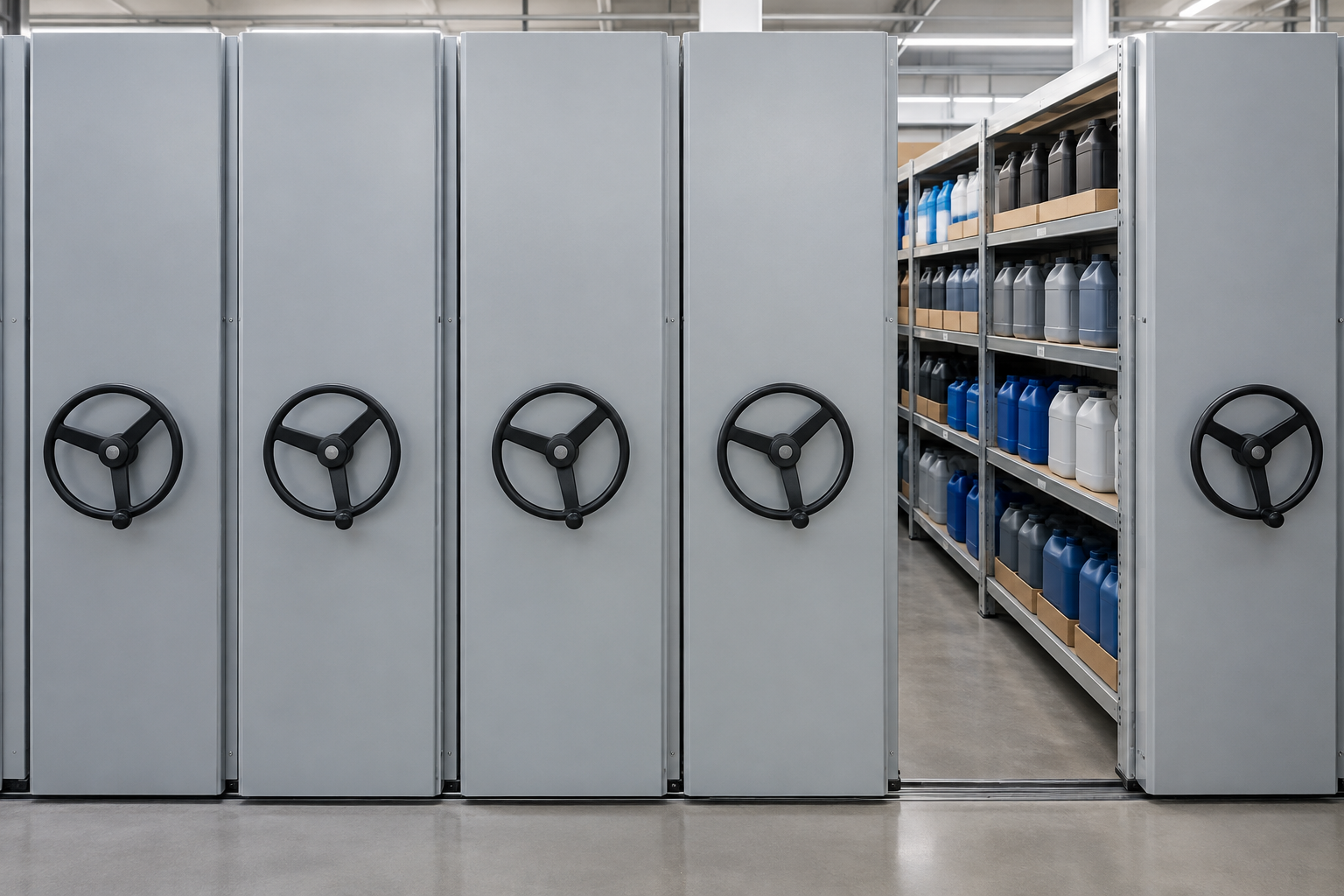
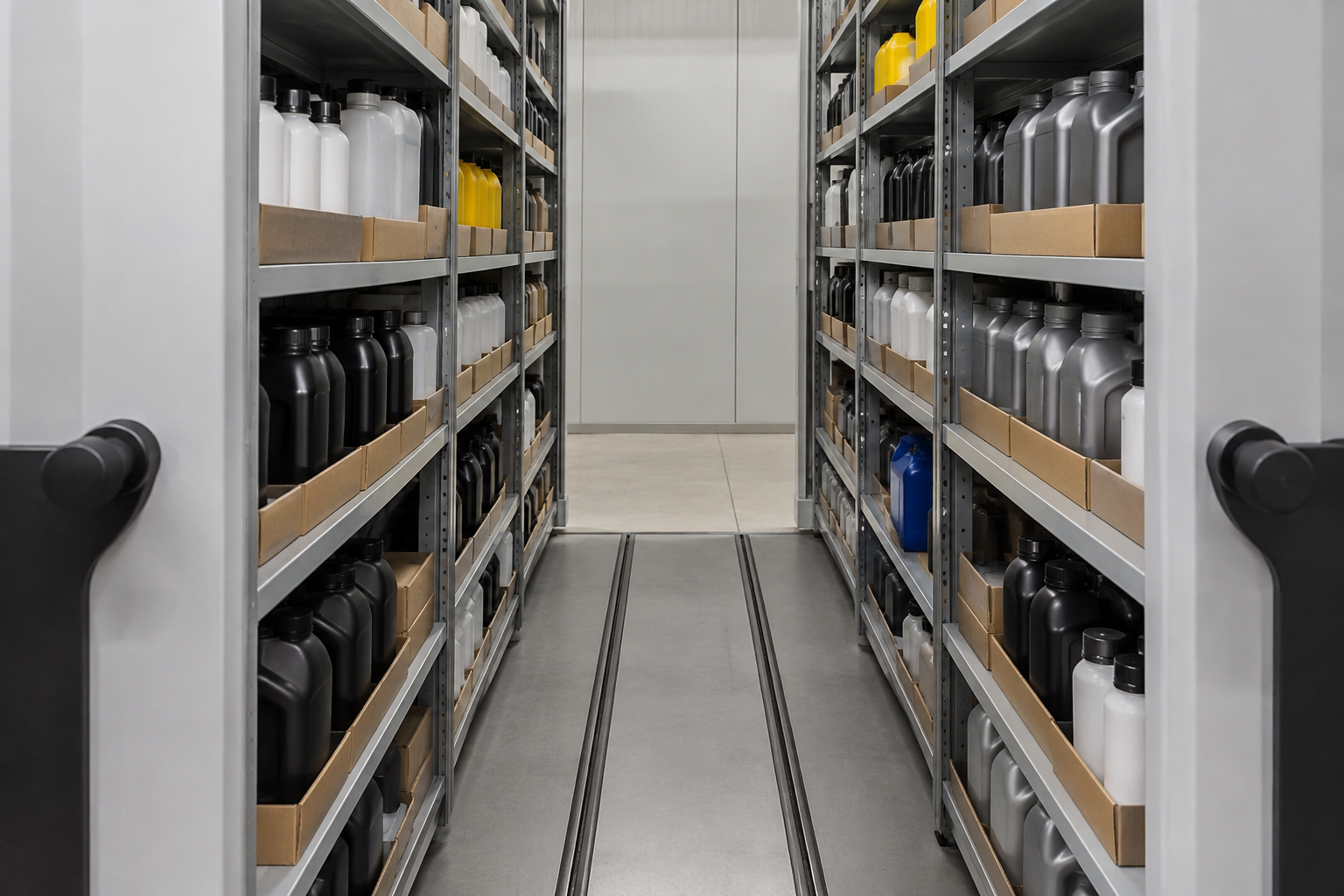
Material Handling USA supplied a high-density mechanical mobile shelving system built from the site’s own drawing. Carriages in two widths carry standard steel shelving set at shallow, closed-front depths sized for bottles and jugs rather than bulk cases, with four shelf levels per section.
Each carriage moves on a guide rail with anti-tip hardware and is opened with a 3-spoke handle sized for daily, all-shift use. A twin ramp configuration was specified instead of a sub-floor installation, which let the system go in on the existing warehouse floor without a recessed pour or extended downtime during construction.
Freight, inside delivery and installation were quoted and delivered as one project, with delivery and installation running about ten weeks from order to completion.
System layout
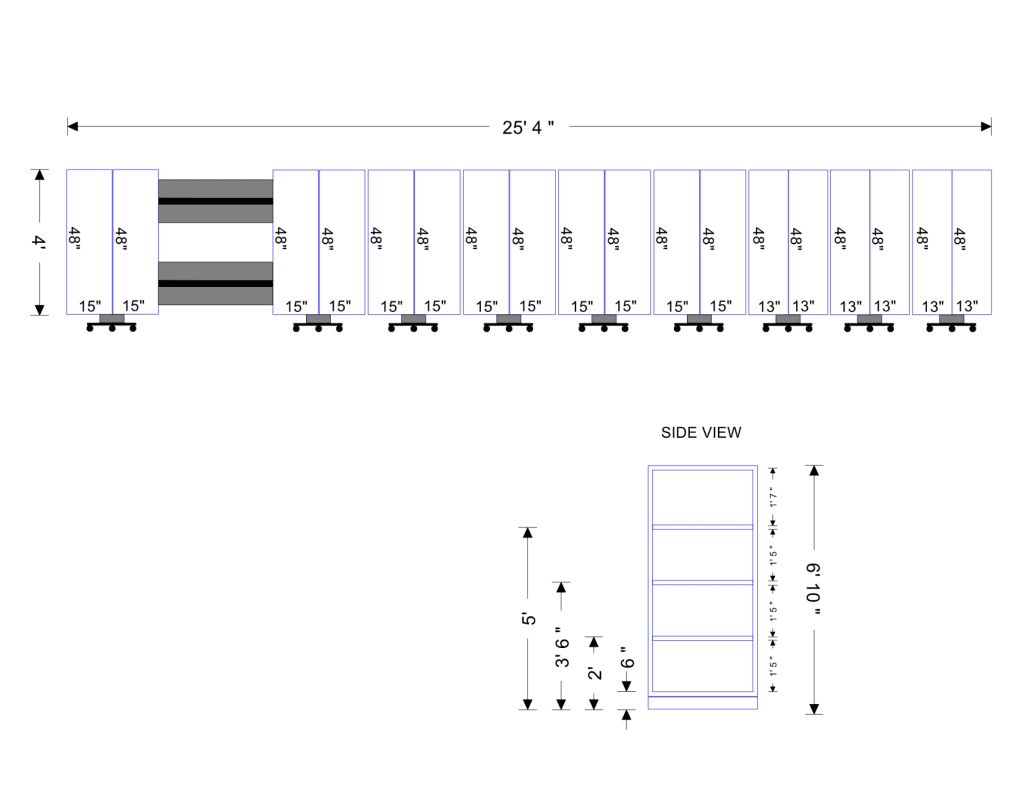
The layout drawing below shows the run configuration the system was built from: carriage widths, shelf bay spacing and the side elevation showing the four shelf levels. A lubricant inventory system is planned around the container, not the room — the shelf depth in this drawing is set to the product being stored, not a generic warehouse standard.
Planning the layout up front also settles where the fixed end of the run sits and how much clear space is left for a pallet jack or cart in front of the open aisle, which matters in a working distribution and testing operation.
What the warehouse gained
Static shelving vs. mobile shelving for lubricant inventory
| Static warehouse shelving | High-density mobile shelving (used here) | |
|---|---|---|
| Aisles | One permanent aisle per run | Runs share one aisle that moves |
| Shelf depth | Often a generic warehouse standard | Set to the container, shallow depths here |
| Capacity in the same room | Lower | Substantially higher |
| Floor prep | None | Track only; twin ramp avoided a sub-floor here |
| Best fit | Rooms with spare floor area | Sites that need more SKU capacity without expanding |
How a lubricant storage system gets specified
Start with the container. Bottles and jugs need shallow, closed-front shelving rather than a generic pallet-rack depth, and the shelf spacing should match the container height so a section does not waste vertical inches on air above every row. Four shelf levels suited this site’s product mix; a warehouse holding larger drums or cases would be planned differently.
Then plan the floor. A twin ramp lets a system install on an existing slab, while a sub-floor pour gives a perfectly flat deck at the cost of construction time. Which one makes sense depends on the building, the schedule and whether the floor can be taken out of service during installation.
Finally, plan for turnover. A lubricant inventory system usually needs to be pulled from constantly rather than archived, so the layout should group SKUs by pick frequency and leave enough clear space in front of the system for a pallet jack or cart to work without blocking the shared aisle.
Related pages: mobile shelving and pallet rack for bulk drum and case storage alongside a mobile shelving system.
Frequently asked questions
Does mobile shelving work for bottled and jugged inventory?
Why four shelf levels instead of more?
What is a twin ramp and why use one?
Is the system powered?
Can inventory still be picked quickly in a mobile system?
How long does a project like this take?
Does this work in a distribution and testing facility, not just a warehouse?
What if the warehouse also stores drums or bulk cases?
Managing packaged inventory that has outgrown static shelving?
Send us your container sizes and current shelving layout, and we will lay out a mobile shelving system sized to what you actually store.