
Home | Mobile Shelving | Utah | Provo & Orem
Mobile Shelving in Provo & Orem, Utah
Track-mounted high-density shelving for Utah County libraries, teaching collections, clinical records, county files and growing tech offices — designed, anchored and installed by a Utah-based team.
1
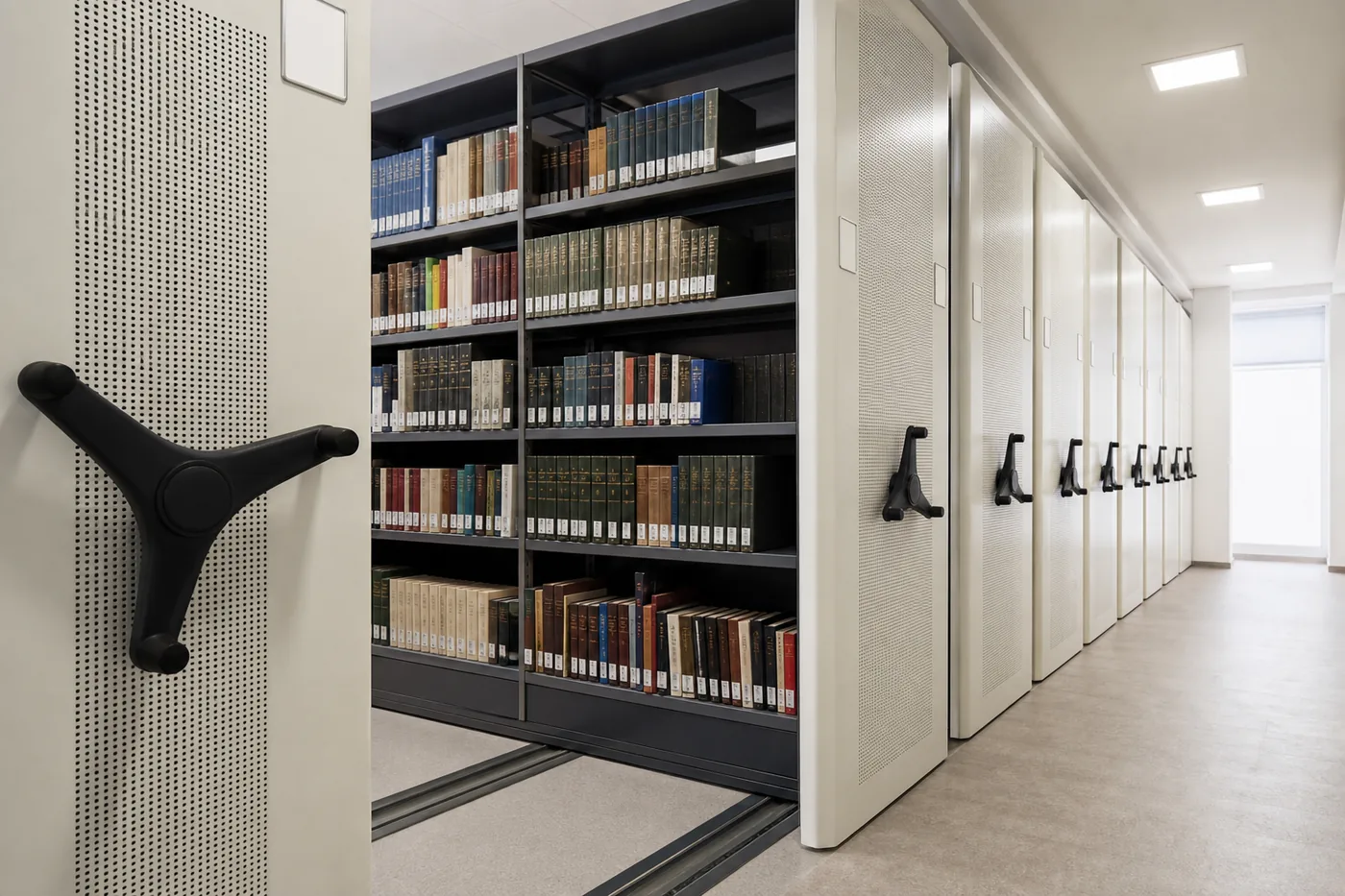
Moving aisle instead of many fixed aisles
3
Drive types: manual, mechanical-assist, powered
Utah
Local design, install and service
Free
Layout review of your room
Why Provo and Orem Rooms Run Out of Storage Before They Run Out of Building
Utah County is one of the densest concentrations of institutional paper, teaching material and long-retention records in the state. Provo is the county seat, so county administration, courts and recorder functions all keep files that have to stay retrievable for years. Brigham Young University sits in Provo and Utah Valley University sits immediately north in Orem, and campuses of that size generate collections that never shrink: bound periodicals, special collections, teaching specimens, athletics equipment, media, facilities drawings and student files. Utah Valley Hospital anchors a clinical district in central Provo with the supply rooms, imaging archives and business-office files that come with it. Around all of it, the technology corridor running along I-15 through Provo, Orem, Vineyard and Lehi keeps adding office and lab space where storage was never a design priority.
The result is a predictable pattern. The building is not full — the storage room is. Adding a room means giving up program space that a campus, clinic or startup would rather use for people. That is exactly the problem track-mounted mobile shelving was built to solve. Instead of leaving an open aisle between every shelving range, the ranges sit on carriages that roll along rails set into or onto the floor. The ranges stay closed until someone needs one, and a single aisle opens where it is needed. Aisle floor area that used to be walked on becomes storage.
Provo and Orem also have a wide spread of building ages. Older brick and concrete buildings near downtown Provo and around the university districts sit alongside newer tilt-up and steel-framed offices in Orem, Vineyard and along the Provo River corridor. Those two building types lead to very different mobile shelving decisions — especially about floor slab capacity, rail type and clear height — which is why we start every Utah County project with the building rather than with a product.
Campus and Clinical Rooms Have Their Own Constraints
Teaching and research spaces around Provo and Orem rarely offer a clean, empty rectangle. A collection room may share a wall with a lab, sit under exposed mechanical services, or be reached only through a corridor with a tight door swing. Those details change the system before anything is ordered:
- Room shape. Carriage length is set by the rail run, so a long, narrow room usually yields more added capacity than a square one of the same area.
- Access frequency. A special-collections room touched a few times a week can stay manual. A clinical or departmental file room touched all day is better on a mechanical-assist or powered drive.
- What is actually stored. Bound volumes, archive cartons, specimen jars and equipment cases all need different shelf depths and level spacing. That is a shelf depth and level spacing decision, not an afterthought.
- Who uses the room. If students, patients or the public reach the collection, accessible aisle planning has to be designed in from the start.
We document all of that in a site review before a layout is drawn, so the proposal reflects your room instead of a catalog page.

Laboratory and teaching collections stored on carriages: containers stay visible, and only one aisle is open at a time.
Choosing the Carriage Drive for a Utah County Facility
Drive selection is the decision that most affects how a Provo or Orem room feels to work in every day. It is driven by three things: how heavy the loaded ranges are, how often someone opens an aisle, and whether the room has power available where the system will sit.

How manual, mechanical-assist and powered drives compare on system size, operating effort, access frequency and building services.
Manual (direct push or pull) suits short, light runs — a departmental file room, a small collection alcove, a supply closet. The operator moves the load directly, so it stays comfortable only while the ranges are short and lightly loaded.
Mechanical-assist uses a geared handwheel or three-spoke handle so the operator turns a handle instead of pushing the mass. It is the most common choice for university, county and clinical rooms because it handles long, heavily loaded ranges without adding an electrical scope to the project.
Powered systems move carriages with a motor and a button or touch control. They are worth the added electrical work when the room is used constantly, when ranges are long and heavy, or when controls need to sit within an accessible reach range. Powered systems require a dedicated circuit and a final connection by a licensed electrician, so the electrical scope belongs in the budget from day one.
Compare the three in detail on our manual vs. mechanical-assist vs. powered mobile shelving guide before you write a specification.
Mobile Shelving Configurations We Design for Provo and Orem
Three configurations cover most Utah County rooms. The right one depends on load, access and the building services already in the space.
Where Mobile Shelving Fits in Provo and Orem Facilities
These are the room types in Utah County where converting fixed aisles to a single moving aisle usually pays off first.
Retrofitting an Existing Provo or Orem Building
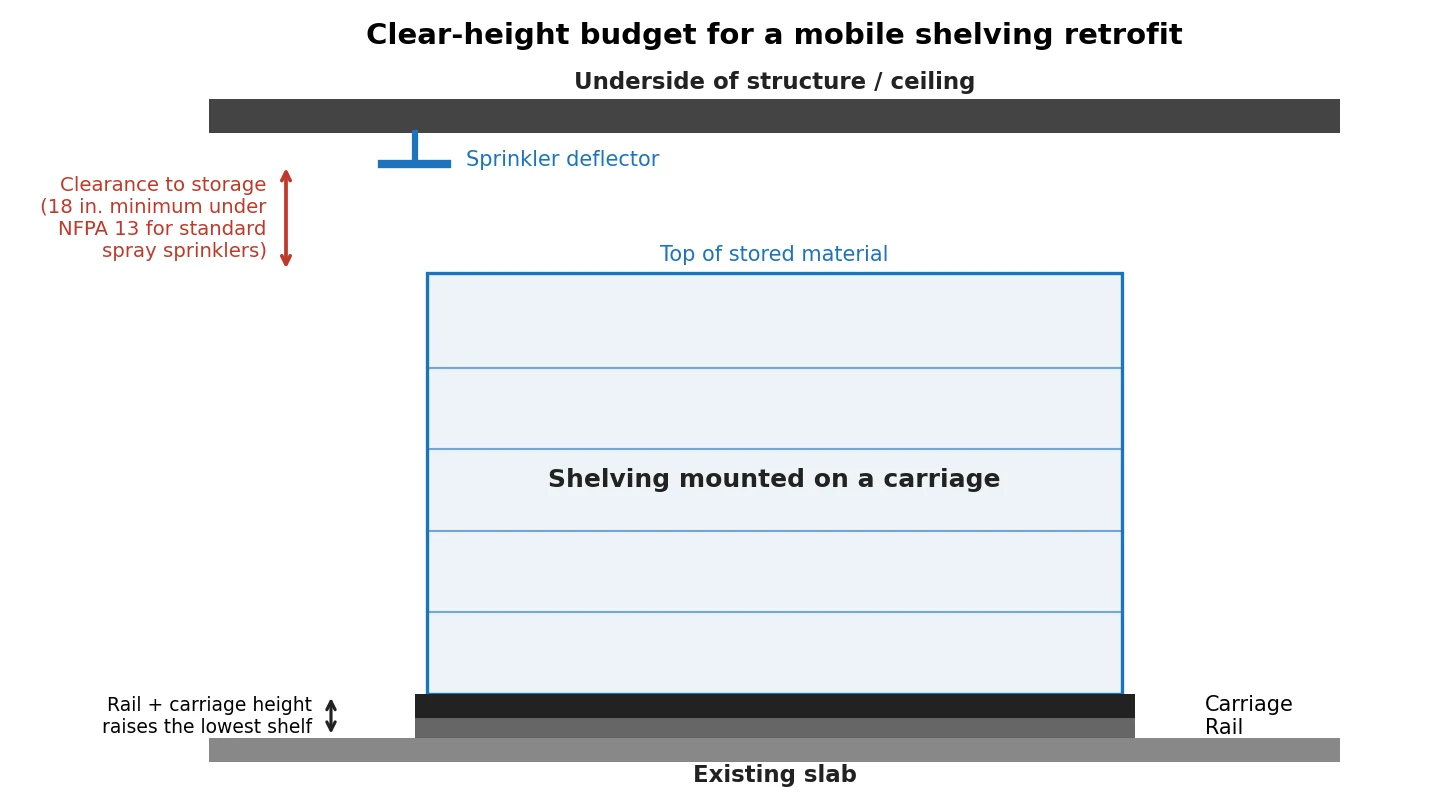
The clear-height budget for a retrofit: rail and carriage raise the lowest shelf, and clearance to the sprinkler deflector limits the top.
Most Utah County projects are retrofits, not new construction, and the two constraints that decide them are the floor and the ceiling.
The floor has to carry the loaded system. Mobile shelving concentrates what used to be spread across a room into fewer, heavier lines of load, and rails must be anchored to a structural floor rather than to a topping or an unbonded overlay. In an older building, or anywhere above grade, a licensed structural engineer should confirm the loaded system against the floor’s posted limit. Our floor load requirements guide explains what that review looks at.
The ceiling sets the top. Rail and carriage height raise the lowest shelf, and required clearance below sprinkler deflectors limits the top of stored material, so usable shelf levels are what remains between them. Lighting and sprinkler layouts also have to work with aisles that move; see sprinkler, lighting and HVAC coordination and retrofitting mobile shelving into an existing building.
How a Provo or Orem Project Runs
Every project follows the same sequence, from the first site review to the demonstration at handover.
Site review
We measure the room, check the slab and clear height, and record doors, services and access routes.
Capacity and layout
We convert what you store into linear feet and carriage runs, then draw the layout options.
Specification and submittal
Drive type, shelf depth, decks, end panels, safety devices and anchorage go into a documented submittal.
Install and demonstrate
Rails are set and levelled, carriages are squared, shelving is loaded, and your staff are trained on safe operation.
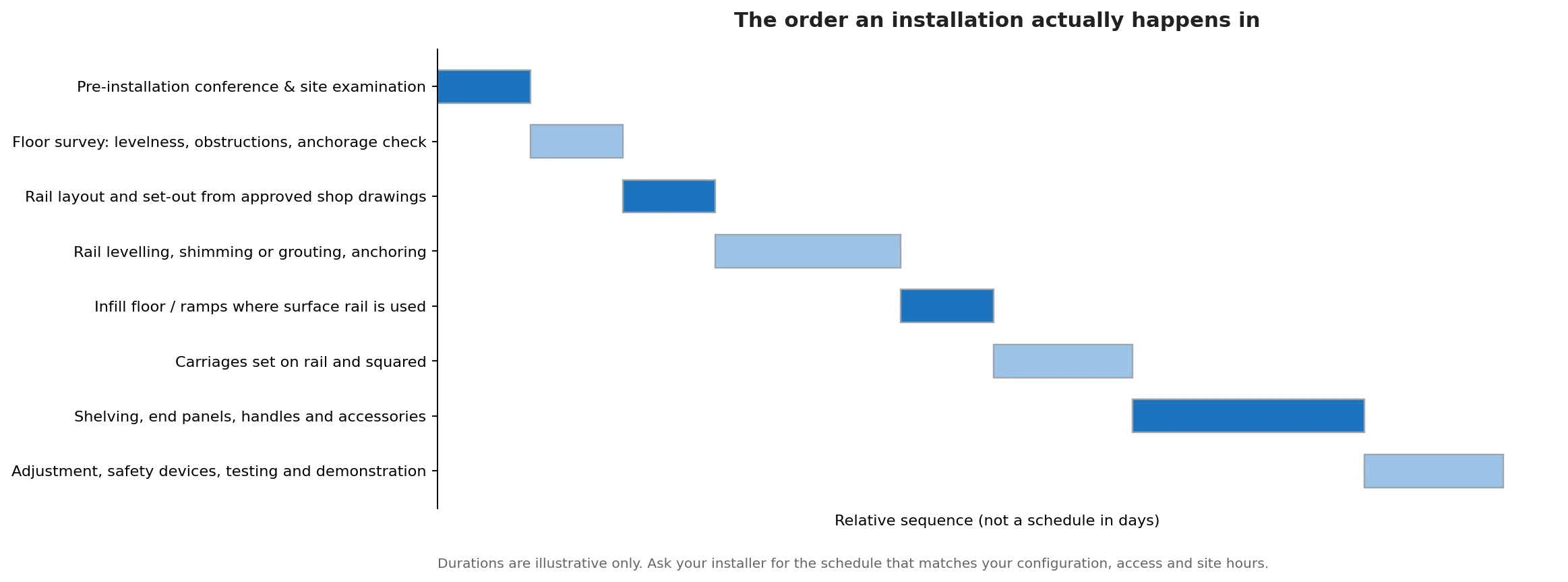
The order an installation actually happens in, from pre-installation conference to adjustment and demonstration.
Schedules on campus and in clinical buildings are usually set by the calendar, not by the shelving. Semester breaks, clinic downtime and county office hours all shape when rails can be set and when a room can be emptied. We plan the sequence around those windows, and we do not quote a duration until we have seen the room and the access route. Our installation process page walks through each step, and the cost and budget drivers page explains what actually moves the number on a proposal.
Published Mobile Shelving Projects You Can Review
These are published MH-USA mobile shelving projects. They are Utah and regional work, not projects in Provo or Orem — they show the room types and system decisions you can expect to discuss with us.
Serving Provo, Orem and Utah County
We design, supply and install mobile shelving throughout Utah County from our Salt Lake City office, including Provo, Orem, Vineyard, Lindon, Pleasant Grove, American Fork, Lehi, Springville, Spanish Fork, Payson and Saratoga Springs. Utah County work is handled by the same team that covers Salt Lake City and the rest of Utah, so the person who reviews your room is the person who follows the project through installation.
Call (801) 328-8788 to schedule a site review, or send your room dimensions and what you need to store and we will come back with a layout and a written proposal.
222 S. Main St, 5th Floor, Salt Lake City, UT 84101
Phone: (801) 328-8788
Email: Sales@MH-USA.com
Hours: Monday–Friday, 8:00am–5:00pm MT
Serving Provo & Orem from our Salt Lake City office.
Planning Guides for Your Provo & Orem Project
The technical decisions behind a Utah County system, explained in detail.
Related Boxes & Packaging Supplies
These are boxes and packaging supplies, not shelving, mobile carriages, or storage-system equipment. See each product page for current price and ordering details.




Mobile Shelving FAQ — Provo & Orem, Utah
How much storage will mobile shelving add to a Provo or Orem room?
Can mobile shelving go on an upper floor of a campus or office building?
Does a Utah system need seismic anchoring?
Which drive type is right for a university or clinical file room?
Can we reuse mobile shelving we already own?
Will the system work for a room that students or the public use?
Do you install in Provo and Orem, or just supply the shelving?
Plan a Mobile Shelving System for Your Provo or Orem Facility
Send us your room dimensions and what you need to store. We will review the space and come back with a layout and a written proposal.