
Home › Mobile Shelving › Golf Bag Storage, Logan Utah
Golf Bag Storage Mobile Shelving: Logan Country Club, Logan, Utah
How a Cache Valley country club replaced a crowded fixed-rack bag room with a high-density mobile shelving system that stores far more member bags in the same square footage, with one moving aisle and an ADA-compliant low-profile track.
Logan, Utah
Cache Valley country club
Golf bags
Member and rental bag storage
1 moving aisle
Instead of an aisle between every run
ADA track
3-piece low-profile aluminum rail

The bag room ran out of room before the membership did
Bag storage is one of the quiet operational headaches at a private club. Every member bag has to be stored somewhere indoors, staged quickly before a tee time, cleaned, and put back. The room set aside for that job is almost never expanded, but the bag count keeps climbing as the club sells memberships, adds junior programs, and grows its rental fleet.
Logan Country Club in Logan, Utah faced exactly that squeeze. The bag storage area was built around fixed racks with a walking aisle between every run. Those aisles are what make a fixed room work, and they are also what make it fill up. Roughly half the floor in a conventional bag room is permanently given over to air so a staff member can walk between two rows.
When a room like that fills, clubs usually reach for one of three bad options: stack bags on the floor, push overflow into a hallway or maintenance building, or start a capital project to build a bigger room. The fourth option is to stop paying for aisles you are not standing in, which is what high-density mobile shelving does.
What we installed at Logan Country Club
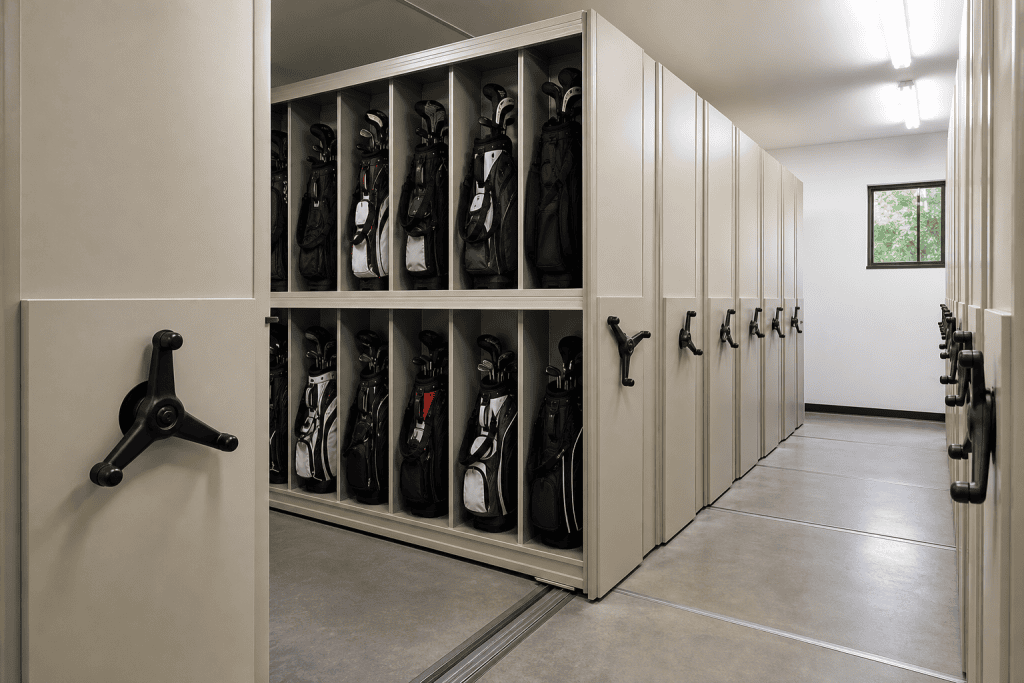
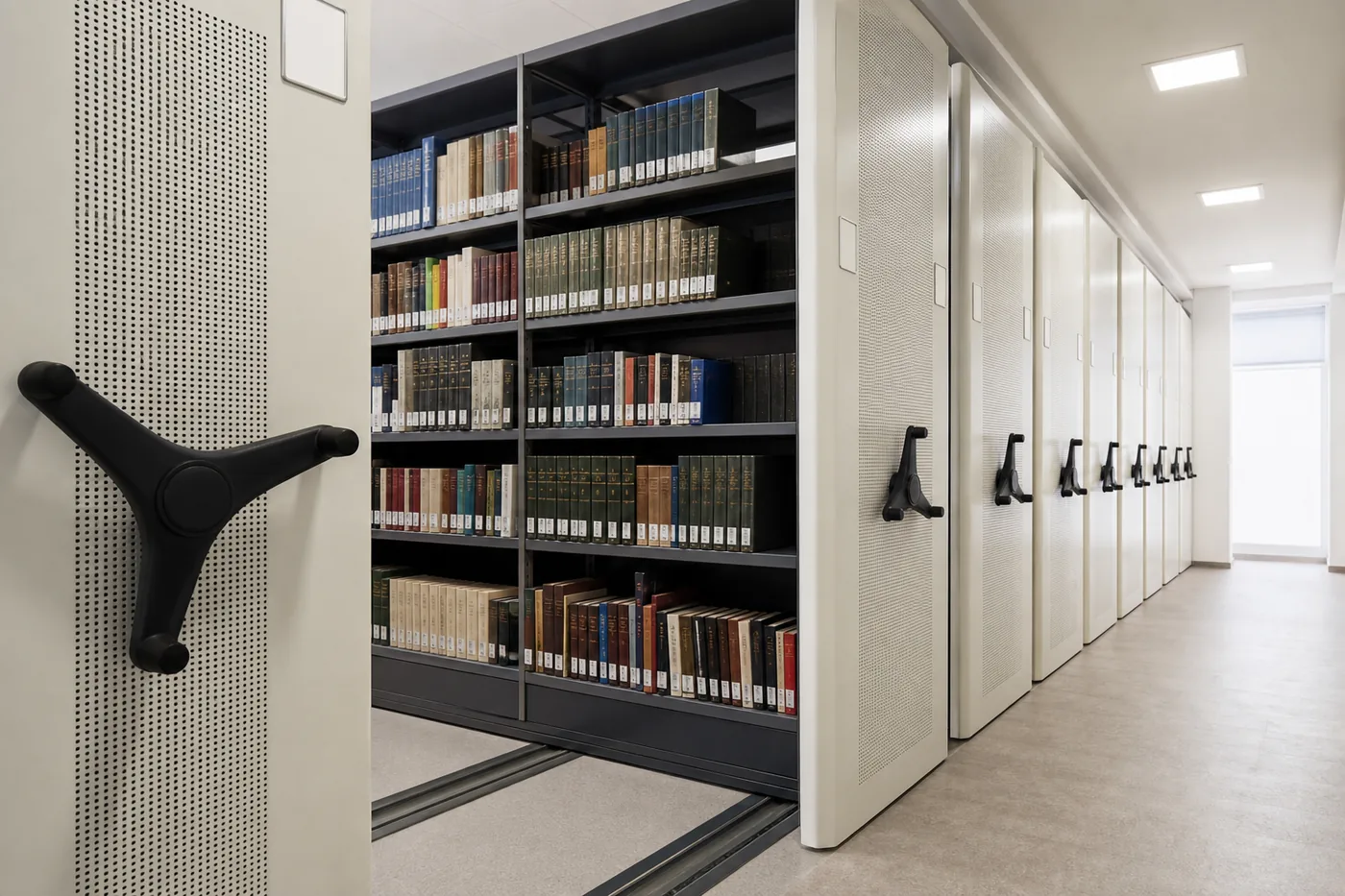
Material Handling USA designed and supplied a mechanical-assist high-density mobile shelving system configured specifically for golf bags, rather than a records system with bags forced into it. The core of the design is a set of four-post shelving units mounted on wheeled carriages that roll along a track set into the floor. Staff turn a handle at the end of a run and the carriages glide apart to open a single aisle exactly where the bag they need is stored.
| Component | What was specified | Why it matters for a bag room |
|---|---|---|
| Drive system | Mechanical-assist carriages with an ergonomic three-arm hand wheel and revolving handles | One staff member can move a fully loaded run of bags with light effort, all day, without a power connection. |
| Track | Three-piece low-profile aluminum track with integrated ramps, ADA compliant when installed level | A floorless rail that can be shimmed to an uneven clubhouse slab, with far less trip hazard than a single-piece rail. |
| Shelving | Four-post adjustable shelving on the carriages, fully adjustable in 1-1/2 inch increments, unslotted shelves | Openings can be re-set later as bag styles change, without buying new units. |
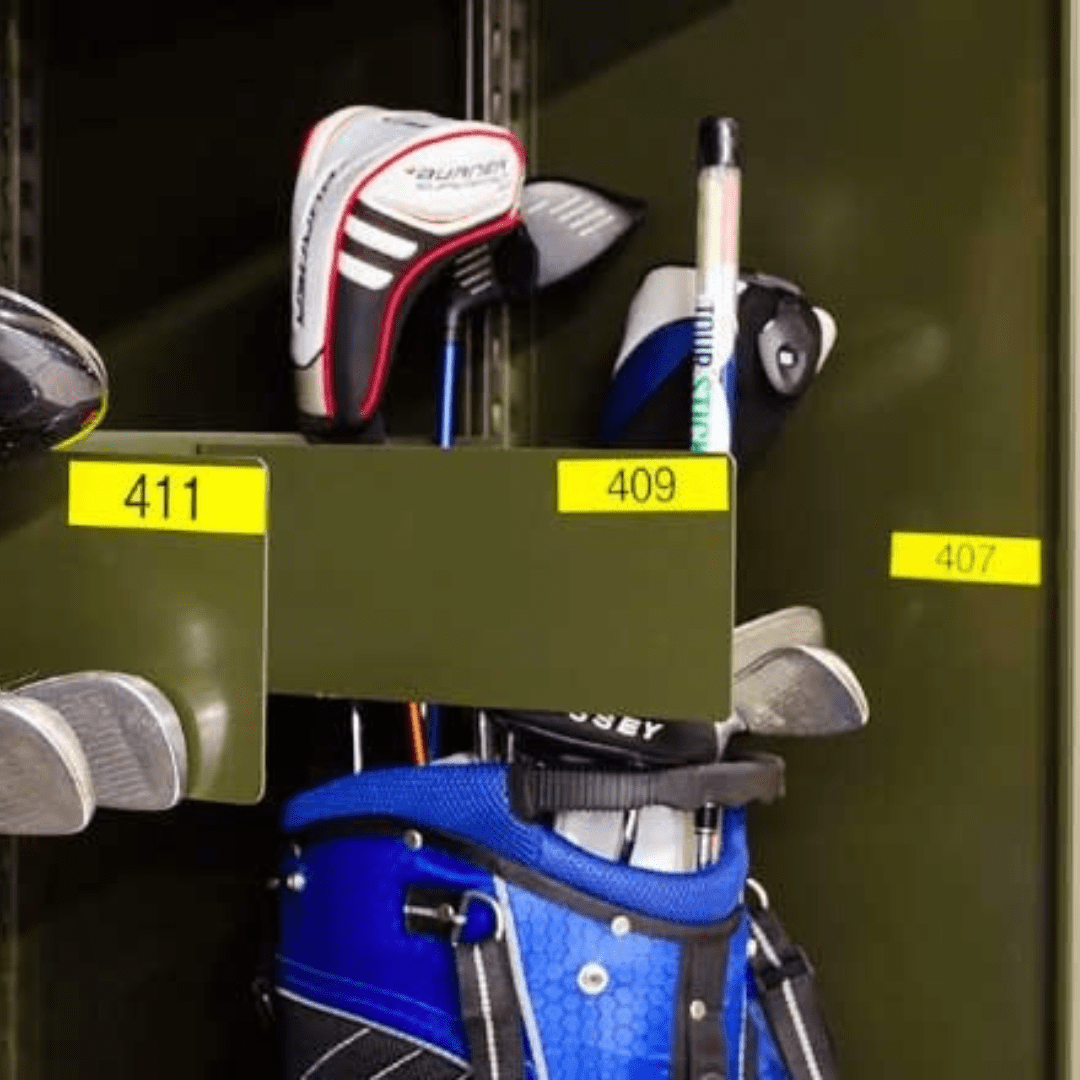
| Bag openings | Two shelf openings high with adjustable golf bag dividers | Each bag stands in its own compartment instead of leaning on its neighbor. |
| Backstops | Back stops at every shelf opening | Bags cannot be pushed through the back of a unit into the next carriage while a run is being closed. |
| Finish | Durable powder coat, standard color range | High resistance to abrasion, impact and scuffing in a room where bags are dragged in and out daily. |
| Static run | A run of static four-post shelving alongside the mobile system, deeper shelves, three openings high | Pull carts, shoes, range supplies and club accessories stay out of the bag openings. |
A note on capacity numbers
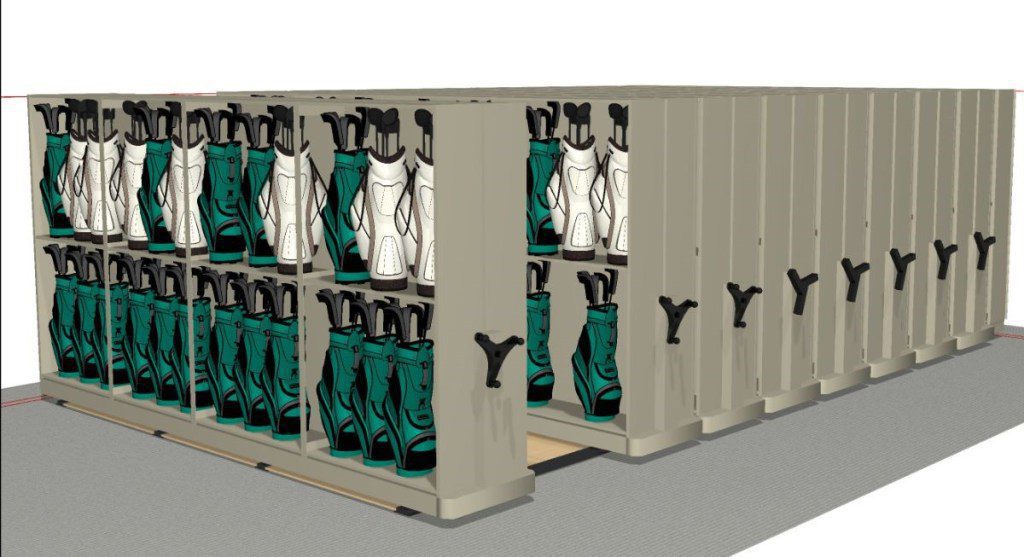
Bag capacity is a function of unit widths and opening heights, not a single catalog figure. On this style of system a 42 inch wide shelf accommodates three golf bags and a 48 inch wide shelf accommodates four, with two openings stacked vertically. A single 48 inch wide unit therefore holds eight bags in about the same floor space a fixed rack uses for four.
How the system works day to day
The whole system sits on a single set of rails. In the closed position the carriages are nested together and the room is almost entirely storage. When the bag attendant needs a bag, they walk to the run that holds it, turn the hand wheel, and the carriages roll apart to open one aisle. The rest of the room stays closed. After the bag is pulled, the aisle can be closed again or simply left open until the next request.
That single change is the reason the same floor area holds far more bags. It also changes the shape of the work. In a fixed room, staff walk the length of several aisles looking for a number. In a mobile room, runs are numbered and the aisle opens at the run, so retrieval becomes a short walk and one turn of a handle.
Mechanical assist matters here more than most buyers expect. A run of loaded golf bags is heavy, and a manual push-pull system gets tiring fast during a busy Saturday morning. The gear-reduction drive lets one person open a loaded aisle smoothly. For rooms with very heavy or very frequent movement, the same layout can be built with powered carriages instead.
Where the extra capacity actually comes from
The arithmetic is simple once you stop thinking about shelves and start thinking about aisles. A fixed room needs an open aisle between every pair of runs. A mobile room needs one. Every aisle you remove is converted directly into storage.

Two practical limits keep this from being unlimited. The first is the room itself: a very narrow or oddly shaped bag room may only support a short track, and a room with columns in the wrong place may need the system split into two banks. The second is service level. A club that pulls dozens of bags at once before a shotgun start may want two moving aisles rather than one, trading a little capacity for parallel access. Those trade-offs are decided during layout, not after installation.
Want the same math run on your bag room?
Send us the room dimensions and your current bag count. We will lay out a mobile system, show the capacity against your existing fixed racks, and quote it.
The details that make it a golf bag system
A mobile shelving carriage is a platform. What turns it into a bag room is the shelving configuration on top of it, and that is where most generic quotes fall short.
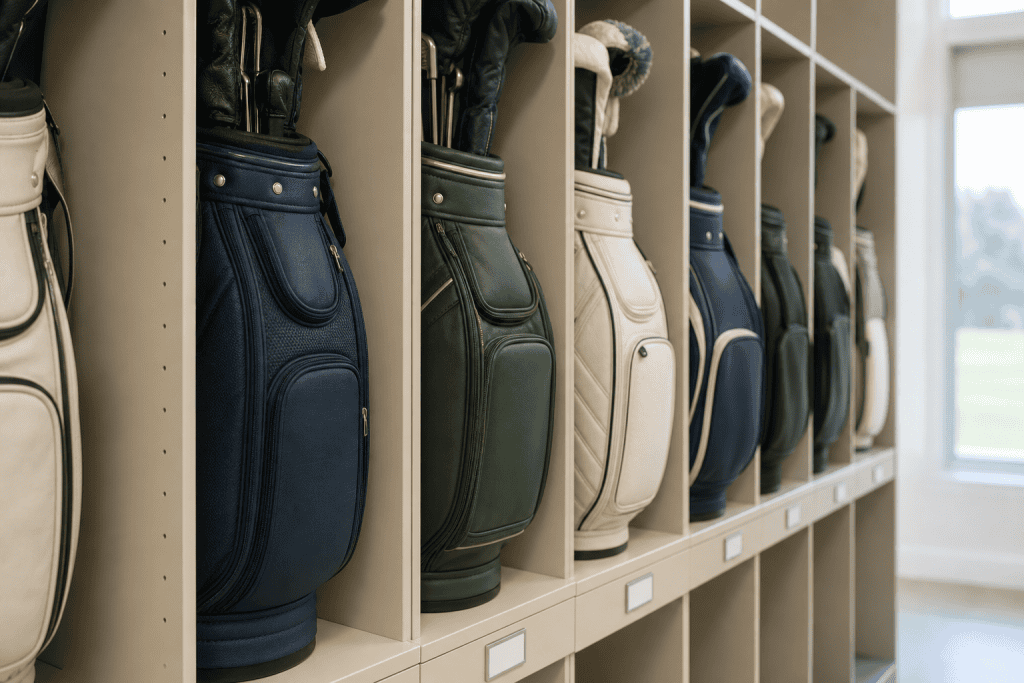
Adjustable dividers. Golf bags vary enormously. A tour-style staff bag and a lightweight carry bag do not want the same slot width. Adjustable dividers let the club set compartment widths per opening and change them later as the bag mix changes, instead of living with a fixed pigeonhole grid.
Two openings, not shelves. Bags stand upright with the club heads exposed, so the opening height has to clear the tallest driver head cover. Configuring the units as two tall openings rather than four ordinary shelves is what makes an upright bag work.
Back stops. With carriages that move, an unrestrained bag can be nudged out of the back of a unit. A back stop at every opening keeps bags inside their own carriage.
Numbering. Bag rooms live and die by a numbering scheme. Shelf-edge tags on each opening let the staff match a member number to a physical position, so a new seasonal employee can find a bag on their first shift.
Protecting the bags, not just storing them
A bag room is a customer-facing space even when members never see it. Damaged grips, scuffed leather and missing head covers become member complaints, so the storage method matters as much as the count.

Floor, track and installation in an existing clubhouse
Most clubs are not building a new bag room. They are putting a mobile system into a space that already exists, usually on a slab that was poured decades ago and is not perfectly flat. Three things decide whether that goes smoothly.
Slab condition and levelness. The three-piece aluminum track used on this project is a floorless rail, which means no structural deck has to be built under the system. It also accepts significantly more shimming than a one-piece rail, so a slab with normal settlement and slope can be brought into tolerance. Getting the rails level is what keeps a loaded carriage rolling with one hand.
Floor capacity. Concentrating storage concentrates weight. Golf bags are light compared with paper records, so bag rooms are rarely the hard case, but the load still has to be checked against the slab, especially on an upper floor or over a basement. Our guide to mobile shelving floor load requirements walks through how that check is done.
Anchorage. Utah is a seismic state and Cache County sits along the Wasatch fault system, so a tall floor-supported storage system is normally reviewed as a nonstructural component. See seismic anchoring and bracing for mobile shelving for how the requirement is generated and what a plan reviewer will ask for.
How the project ran
Measure the room and count the bags
We start with a dimensioned plan of the existing bag room, the door and column locations, the ceiling height, and an honest bag count including rentals and seasonal peaks.
Lay out the system
The layout sets the track direction, run lengths, unit widths, number of moving aisles and opening heights. This is where capacity is actually decided, so it is reviewed with the club before anything is ordered.
Approve the drawings
The club signs off on an elevation and plan set showing every run, opening and divider before fabrication. Nothing gets built off a verbal description.
Prepare the floor
The installers check the slab, set and shim the track to level, and confirm the ramps land cleanly at the room edges.
Install and load
Carriages, uprights, shelves, dividers and backstops go in as a system. The club then loads bags into a numbered scheme rather than wherever there is room.
Train the staff
Bag attendants learn the drive handles, the aisle locks and the numbering plan, because a high-density room only stays organized if the process is understood by seasonal staff.

Why mechanical assist over manual
Small mobile systems can be moved by hand. Once a run is long and loaded, hand-push systems start to require real effort, and effort in a service space turns into staff shortcuts. The mechanical-assist drive uses a gear reduction so a single attendant can open a loaded aisle with a light, steady turn of the hand wheel.
Two safety features come with it. Anti-tip devices along the track keep a carriage from rocking forward if a bag is pulled hard from a top opening, and aisle locks let a staff member hold an aisle open while they are standing in it. Both belong in a room where seasonal employees and sometimes members are moving through the space.
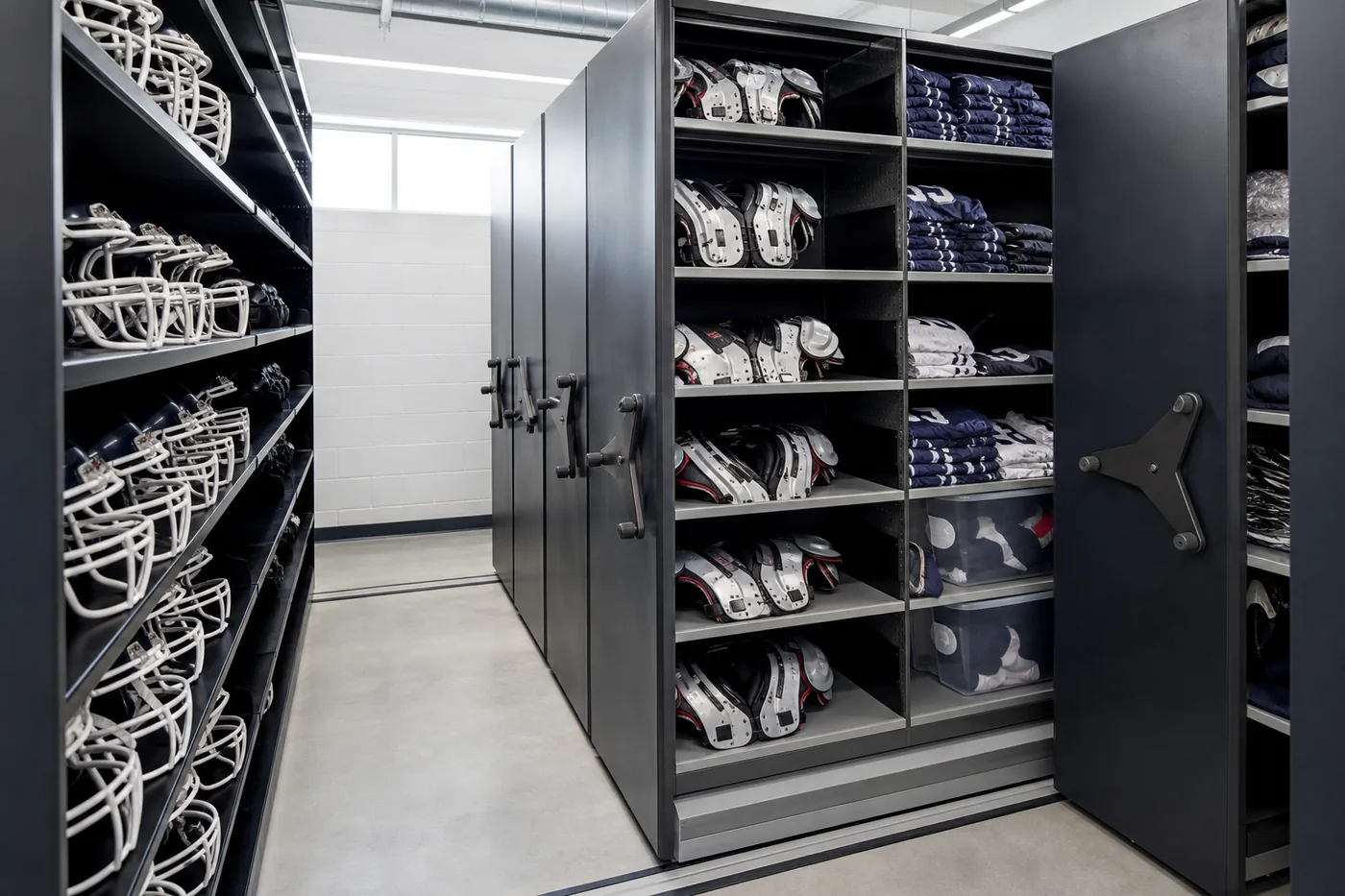
The same drive and track platform serves other high-density storage in a club: locker room towel and amenity storage, grounds and maintenance parts, event and banquet supplies, and athletic and team equipment storage where a club runs racquet or fitness programs.
What other Utah clubs can take from this project
Logan sits in Cache Valley, at the north end of the state, where the golf season is compressed by altitude and winter. That shapes the storage problem in a way clubs in warmer states do not deal with. Bags come in wet in spring and fall. There is a genuine off-season when a large share of the membership leaves clubs at the club rather than taking them home, so peak storage demand does not match peak play. And clubhouse expansion in a valley with a short building season is expensive.
Those conditions favor getting more out of the room you already have. The same reasoning applies at clubs along the Wasatch Front and beyond: Ogden, Layton, Bountiful, Salt Lake City, Park City, Provo, and down through St. George, along with municipal courses and resort properties that store rental fleets.
Material Handling USA is a Utah company. We design, supply and install storage systems across the state and the Mountain West, which means the layout, the delivery and the installation crew come from the same place rather than being coordinated across three vendors. Other completed projects are collected on our case study page, and the full product overview lives on the mobile shelving hub.
Related reading
 Golf Bag Storage Mobile ShelvingThe product overview for golf and country club bag storage, including configuration options.
 Mobile Shelving Floor Load RequirementsHow to check whether your slab or upper floor supports a high-density system.
 Seismic Anchoring and BracingHow earthquake requirements shape anchorage on a mobile shelving project in the Mountain West.
Frequently asked questions
How many golf bags can a mobile shelving system hold?
Do we need to renovate the floor or build a deck?
Is a mobile bag room accessible?
Can one person move a full aisle of loaded bags?
Will the shelves fit our mix of staff bags, carry bags and junior bags?
Do you install in northern Utah, or only along the Wasatch Front?
What else in a clubhouse can use the same system?
Planning a golf bag storage project in Utah?
Material Handling USA designs, supplies and installs high-density mobile shelving for country clubs, municipal courses and resorts across Utah and the Mountain West. Call (800) 326-4403 or request a quote.