
Mobile (Track-Mounted) Shelving for Cleanrooms and Controlled Environments
How ESD-safe hardware, low-particulate materials, and ISO classification compatibility change the way track-mounted mobile shelving is specified for cleanrooms, electronics assembly rooms and other controlled environments – as distinct from static shelving in the same space.
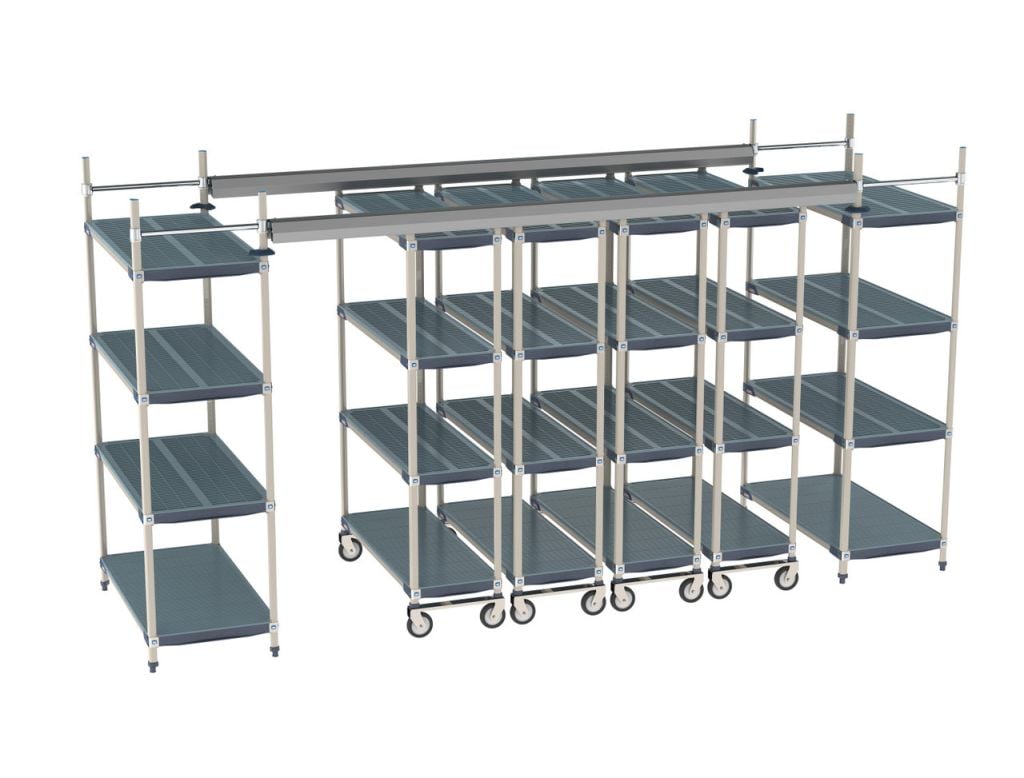
Common users
Electronics assembly, semiconductor, pharmaceutical and medical device cleanrooms
Material priority
Low-particulate, low-outgassing, wipeable – polymer, wire or stainless
Hardware priority
Sealed bearings, no exposed grease, ESD-safe casters/track where required
Drive type
Manual is the default – fewer sealed components to validate per classification
Mobile shelving is a different specification problem inside a controlled environment
Track-mounted mobile shelving gets specified for warehouses, records rooms and retail stockrooms without much thought to what the fixture itself sheds or outgasses. Inside a cleanroom, electronics assembly room, or other controlled environment, that changes: the shelving is now part of the room’s contamination control, not just its storage capacity, and every material and hardware choice is evaluated against the room’s classification.
This page covers what’s specific to putting mobile, track-mounted carriages into that kind of space – material and finish selection, ESD-safe hardware on the moving parts, and gowning/wipe-down upkeep. Static ESD shelving and Metro ESD carts and shelving already cover fixed-position electronics storage; this is the mobile counterpart, worth specifying when the room’s floor space is tight enough that reclaiming aisle space is worth the added mechanical complexity. For portable or modular cleanroom enclosures themselves rather than the shelving inside them, see the semiconductor cleanroom storage guide.
Material choices that affect particulate and outgassing
A cleanroom’s classification limits how much particulate and volatile outgassing any fixture in the room can contribute, and shelf material is the single biggest lever a shelving specification has over that number.
ESD-safe hardware on rail and carriage components
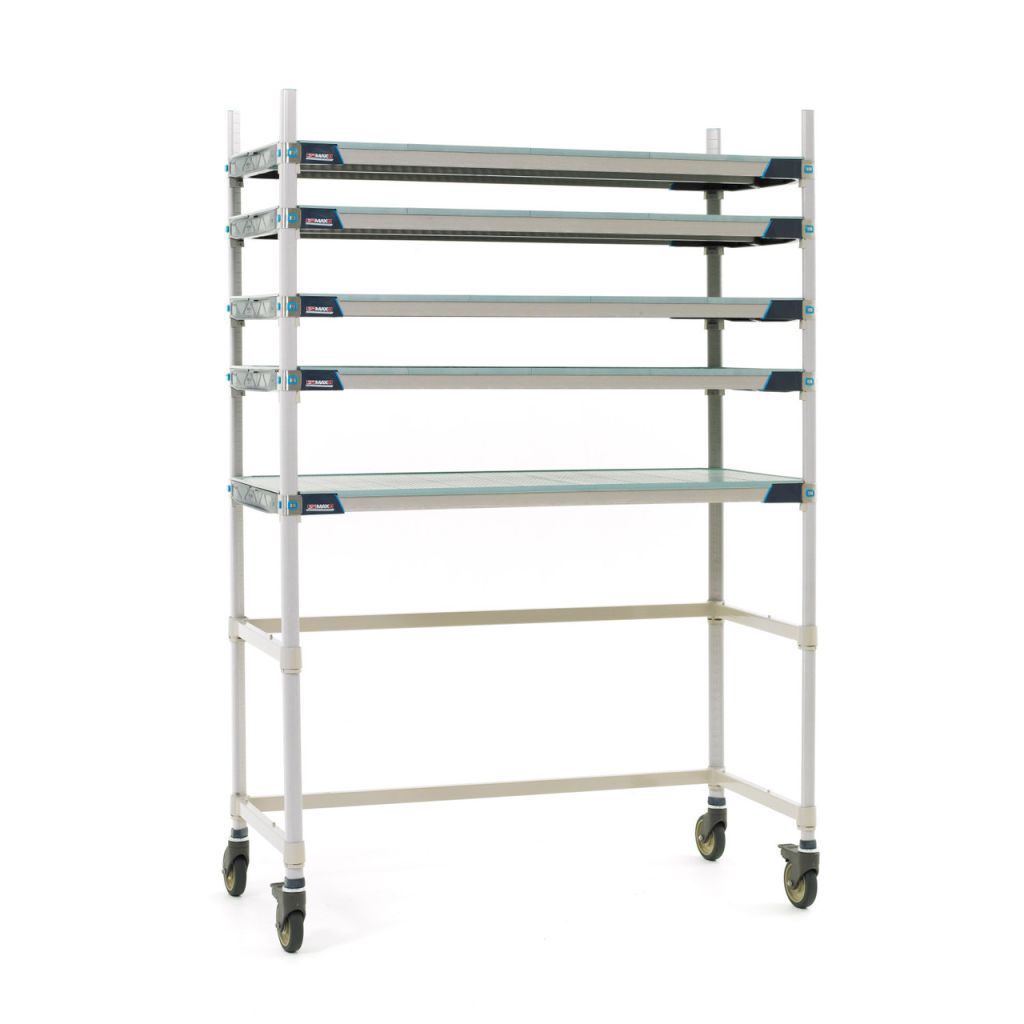
Electronics assembly rooms add a second requirement on top of particulate control: static-dissipative or conductive hardware so a moving carriage can’t build up and discharge static near sensitive components. On a mobile system that requirement extends past the shelf itself to the parts that actually move:
- Conductive or static-dissipative casters and stem casters, matched to the room’s grounded flooring, on any individually mobile unit.
- Grounding straps or drag chains on carriages that ride a fixed rail, so the moving structure stays bonded to the building ground rather than floating electrically.
- Static-dissipative shelf mats or trays for loose components, in addition to the shelving structure itself – see static ESD shelving for the shelf-level hardware this pairs with.
- Sealed bearings and enclosed track hardware with no exposed lubricant that could attract or shed particulate as the carriage travels.

Matching the system to ISO classification
ISO 14644-1 classifies cleanrooms by allowable particle count per cubic meter of air, from ISO 1 (the strictest) to ISO 9 (room air quality). The stricter the classification, the narrower the range of shelving materials, finishes and hardware that’s appropriate for that room:
| Room context | What that usually means for mobile shelving |
|---|---|
| Higher-classification cleanroom (semiconductor, tighter medical device rooms) | Low-particulate materials only – open-grid polymer, wire or stainless; sealed hardware; ESD-safe components on every moving part. |
| Moderate-classification room (general electronics assembly, some pharmaceutical areas) | Same material priorities, with more flexibility on finish color and end-panel options – see finish and material options. |
| ISO 8 or unclassified anteroom/gowning space | Standard mobile shelving materials are often acceptable; confirm against the specific facility’s documented requirements rather than assuming. |
| Mixed-use room with a cleanroom zone and an adjacent staging or receiving area | Different shelving specs by zone is normal – don’t assume one material choice has to cover the entire footprint. |
The room’s classification is set by the facility’s own qualification and monitoring program, not by a shelving vendor – confirm the documented class and any facility-specific material restrictions with your cleanroom engineer or quality group before finalizing a shelf material and finish.
Gowning and wipe-down maintenance
A mobile system adds one real step to the standard cleanroom wipe-down routine: the rail and the normally hidden face of each carriage end panel only get exposed when the system is opened to full travel, so a maintenance routine written for fixed shelving will miss them unless it’s updated.
- Open every carriage to full travel on a scheduled basis (not just when retrieving stock) so the rail, wheels and hidden end-panel faces get wiped down along with the shelves.
- Follow the room’s standard gowning protocol for anyone performing shelving maintenance – the shelving doesn’t change the room’s gowning requirements.
- Favor open-grid or wire shelf materials specifically because they wipe down and dry faster than solid decking, reducing the time a maintenance routine takes.
- Inspect casters and track hardware for lubricant migration or wear debris on the same schedule as the room’s general fixture inspection, not on a separate track.
Why a cleanroom mobile system costs more than a standard one
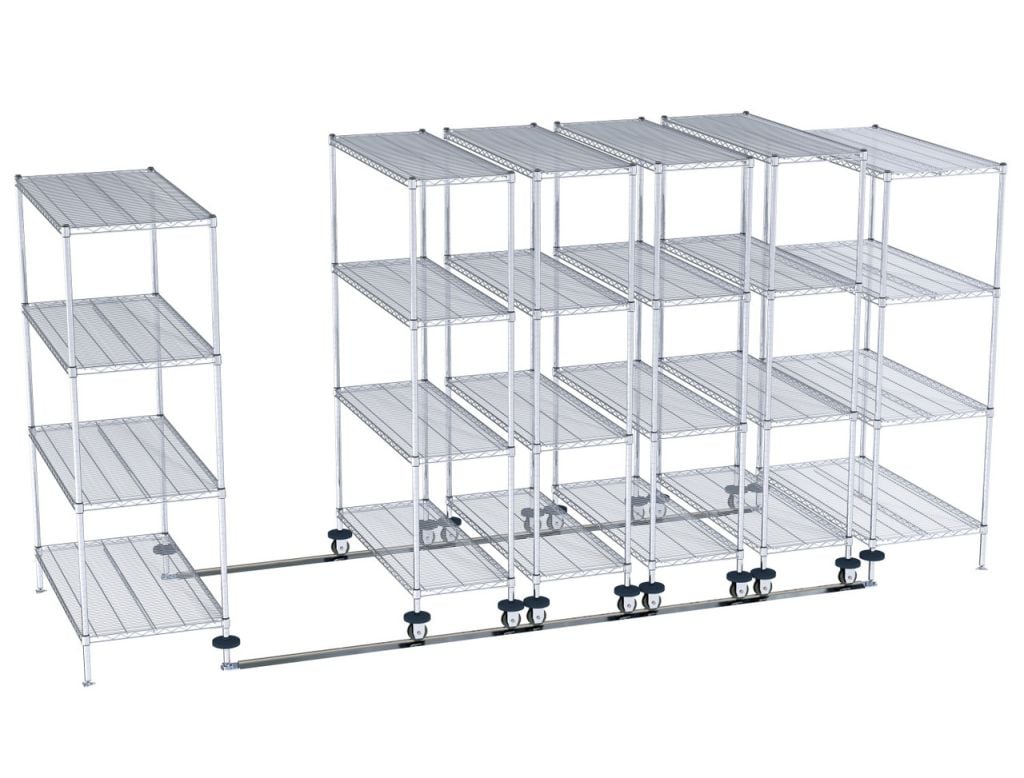
A track-mounted system built to controlled-environment requirements is not a standard mobile shelving system with a different label – the material upgrade (polymer, wire or stainless instead of painted steel or laminate), the sealed and grounded hardware on every moving part, and the added qualification/documentation step with the facility’s quality group all add real cost over a comparable warehouse-grade system of the same size. That premium is usually easiest to justify on the same basis as any mobile shelving investment: floor space inside a cleanroom is expensive to build and maintain, so reclaiming aisle space for more storage capacity or more usable process area tends to pay back faster inside a controlled environment than it does in an ordinary warehouse.
Because that premium is real, it’s worth confirming early whether the room actually needs the mobile, track-mounted version at all. A room with enough floor area to run fixed aisles comfortably may be better served by a straightforward static ESD shelving installation, saving the added mechanical complexity for the rooms where floor space is genuinely the constraint.
Decision checklist before specifying a cleanroom mobile system
- Room’s documented ISO classification (or unclassified/anteroom status), confirmed with the facility’s cleanroom engineer or quality group, not assumed.
- Shelf material and finish matched to that classification – open-grid polymer, wire or stainless as the default; painted steel or laminate only where the classification allows it.
- ESD requirement confirmed separately from the cleanroom classification – a room can need one, both, or neither.
- Grounding/static-dissipative hardware specified on every moving part, not just the shelf surfaces.
- Floor loading and rail-mounting method confirmed before the room’s floor finish is set – see the specification and submittal checklist.
- Wipe-down and gowning maintenance routine updated to include full-travel access to the rail and hidden end-panel faces.
For general drive-type, security and vendor-selection guidance that applies whether or not the room is a controlled environment, see manual vs. mechanical-assist vs. powered, security and controlled access, and choosing a mobile shelving company.
Shop ESD-Safe Storage Supplies Online
Buy select items directly from our online store, or request a quote for volume, custom sizes and freight-rated orders.




Frequently asked questions
Is mobile shelving allowed inside an ISO-classified cleanroom?
Does moving a carriage on a track create more particulate than a fixed shelving unit?
Should we choose ESD-safe mobile shelving, or is a static ESD rack enough?
How is a mobile shelving system cleaned or wiped down for a controlled environment?
Can an existing static ESD shelving room be converted to mobile shelving later?
What drive type is typical for a cleanroom mobile shelving system?
Tell us about your room’s classification and we’ll help match the shelving to it
Send us your ISO classification (or facility requirements), ESD needs and room dimensions and we’ll help specify a mobile or static system that fits.