
Rigging Hardware and Millwright Supply Storage Case Study: Warren, Michigan
How a heavy machinery rigging and moving company built three tall mobile shelving systems into one Warren, Michigan warehouse to organize rigging hardware, slings, tools and spare parts.
Customer
LMM (Lee Machinery Movers)
Location
23233 Schoenherr Road, Warren, MI 48089
Product
3 mobile shelving systems, tall mechanical carriages
Application
Rigging hardware, slings, millwright tools and spare parts storage
About the project
LMM, known through most of its history as Lee Machinery Movers, is a heavy machinery rigging, trucking and industrial moving company founded in Pontiac, Michigan in 1997. Its Warren, Michigan location at 23233 Schoenherr Road supports the equipment side of that work: rigging hardware such as shackles, hooks and lifting clamps, slings and straps, millwright tools and fasteners, electrical installation supplies, and spare parts and maintenance items for the company’s own machinery.
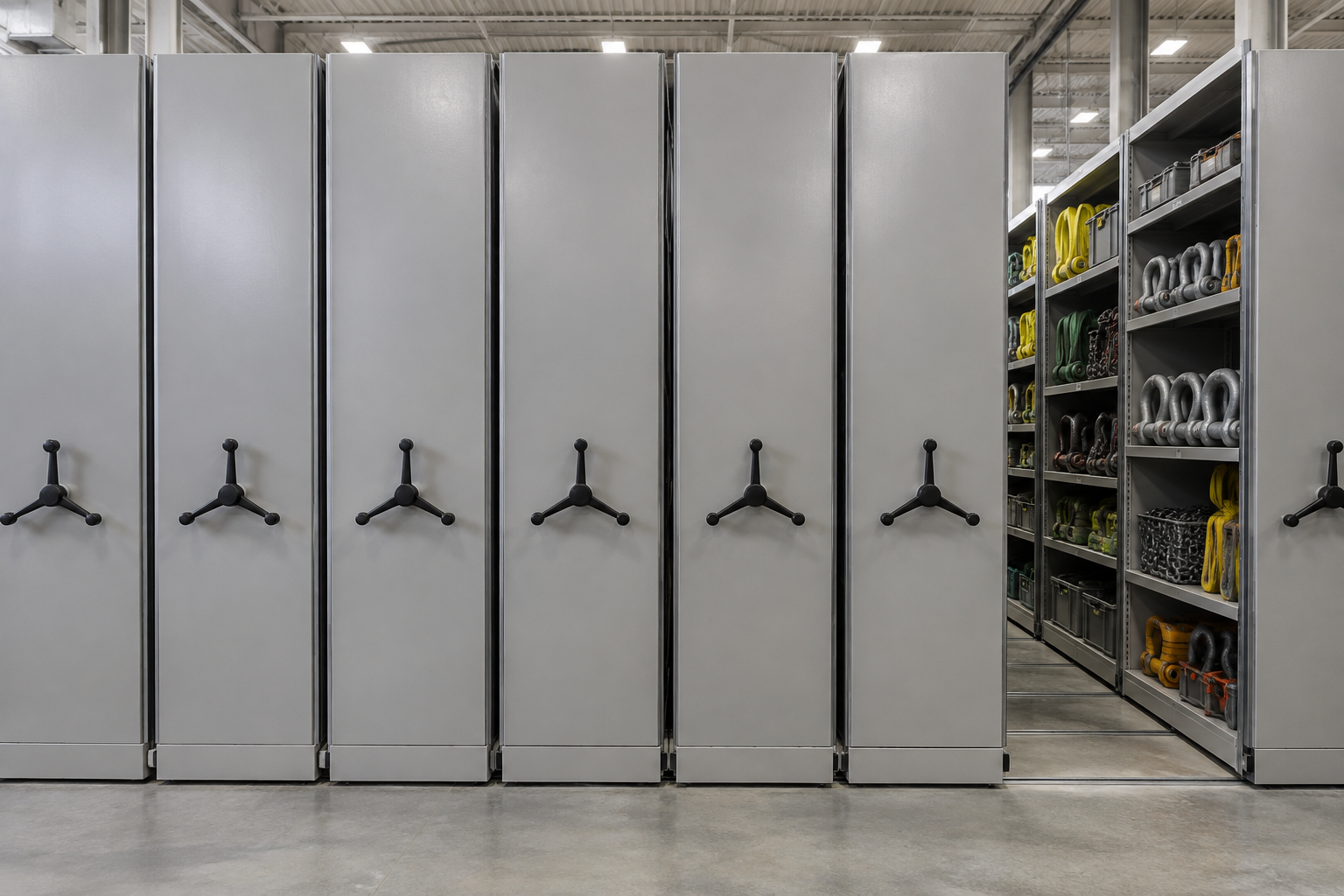
Material Handling USA supplied three mobile shelving systems to that warehouse, each built to the site’s own drawing, with tall mechanical carriages carrying deep steel shelving. The order shipped and installed within about six weeks of order.
Project scope at a glance
The situation
A rigging and machinery-moving company’s warehouse holds a wide range of equipment types in one room: chain and wire rope slings, shackles and clamps sized across a working range, millwright tools and fasteners, electrical supplies for equipment installs, and spare parts and maintenance items for the trucks and rigging gear itself. Every category has to stay organized and quickly reachable, because a rigging crew preparing for a job needs the right hardware fast.
Static shelving spreads that inventory across as many aisles as there are rows, which either limits how much can be stored in the room or forces overflow into whatever space is left. A tall warehouse ceiling is also wasted potential in a static layout unless the shelving is built to use that height, and a rigging warehouse’s inventory is heavy enough that the shelving and the carriage moving it both need to be built for real load, not just record boxes.
Mobile shelving addresses both: shared aisles recover floor area for more shelving, and building the carriages tall uses the ceiling height the room already has.

What Material Handling USA supplied
Material Handling USA supplied three complete mobile shelving systems for the Warren warehouse, each built from the site’s own drawing. The carriages are tall — built to a 16’6″ elevation — so each run makes full use of the warehouse’s ceiling height instead of stopping at a standard shelving height and leaving the space above empty.
Shelving on the carriages is set at a 48″ depth, sized for bulkier rigging hardware, coiled slings and boxed millwright and electrical supplies rather than small parts bins. Each carriage moves on anti-tip track with end stops and is opened with a TriStar handwheel, a style built for moving a heavily loaded tall carriage with controlled, even effort. Ramps bring the aisle floor level with the track so loaded carts and hand trucks move through cleanly.
Building three separate systems rather than one long run let each system be sized to its own section of the warehouse, so the room’s existing layout and support columns did not have to be worked around with a single oversized system.
System layout
The layout drawing below shows one of the three systems: carriage width, shelf bay spacing and the side elevation showing the tall 16’6″ carriage height. Each of the three systems in the warehouse was drawn separately so the layout matches the specific section of the room it occupies.
Drawing a tall carriage system up front also confirms that the ceiling height, any overhead obstructions and the floor loading all support building to that elevation before anything ships.

What the warehouse gained
Static shelving vs. mobile shelving for a rigging warehouse
| Static warehouse shelving | Tall mobile shelving (used here) | |
|---|---|---|
| Aisles | One permanent aisle per run | Runs share one aisle that moves |
| Use of ceiling height | Often limited to standard shelving height | Built to a tall 16’6″ elevation here |
| Capacity in the same room | Lower | Substantially higher |
| Shelf depth | Generic | Deep 48″ sections for bulkier hardware |
| Best fit for multi-category inventory | Works, but spreads inventory thin | Keeps categories dense and organized |
How a rigging equipment storage system gets specified
Start with what actually gets stored. Rigging hardware, slings, tools, electrical supplies and spare parts each have different shapes and weights, and the shelf depth and level spacing should follow that mix rather than a one-size warehouse standard. This project used a 48″ shelf depth because the inventory runs bulkier than small parts bins.
Next, measure the room’s ceiling height honestly. A tall mobile carriage only pays off if the building can support it — clear height, any overhead obstructions like sprinkler lines or lighting, and floor loading all factor into how tall a system can safely be built.
Then plan the layout in sections rather than one long run if the warehouse has columns, doors or uneven floor space. Three separate systems, each drawn to its own section of the room, is often a better fit than forcing a single oversized system to span the whole space.
Finally, size the carriage hardware to the load. Heavier inventory needs a handwheel and track built for real weight, not just paper boxes — TriStar handles and reinforced anti-tip track are suited to warehouses that store metal hardware and heavy tools rather than lightweight files.
Related pages: mobile shelving and cantilever rack for long rigging materials like pipe, bar stock or lumber that do not fit on shelving.
Frequently asked questions
Can mobile shelving be built tall enough to use a warehouse’s full ceiling height?
Is mobile shelving strong enough for heavy rigging hardware?
Why three separate systems instead of one large one?
What kinds of items are typically stored this way?
Is the system powered?
What are the ramps for?
How long does a project like this take?
Can mobile shelving be combined with other storage types in the same warehouse?
Storing rigging hardware, tools or spare parts in a warehouse that has run out of aisle space?
Send us your ceiling height and what you store, and we will lay out a mobile shelving system that uses the height and footprint you already have.