
Home / Mobile Shelving / GSA Contracts
Spacefile International Mobile Shelving GSA Contract GS-27F-0041X
A procurement and planning guide for federal buyers reviewing Spacefile high-density mobile shelving. Verify the current catalog, build the room-level scope, and route ordering questions through Material Handling USA.
GSA contract GS-27F-0041X: current record
GSA eLibrary lists Spacefile International under Multiple Award Schedule contract GS-27F-0041X. The record identifies the business classification as Other than small business and SAM Unique Entity Identifier K8MQEEZ6WPG6.
Spacefile’s published product program includes high-density mobile storage, compact shelving and related storage systems. The live GSA catalog controls which products and services are orderable.
Dates shown here are a research snapshot updated August 21, 2026. An ultimate end date is not a promise that every option will be exercised. Before quoting or accepting an order, MH-USA checks the live GSA record, current terms-and-conditions file and applicable catalog.
What this Spacefile International contract page covers
This page is intentionally narrower than our main mobile shelving page. It answers contract-specific questions about GS-27F-0041X; the main page explains how high-density mobile shelving works, how carriage movement differs, and how a system is planned for a room.
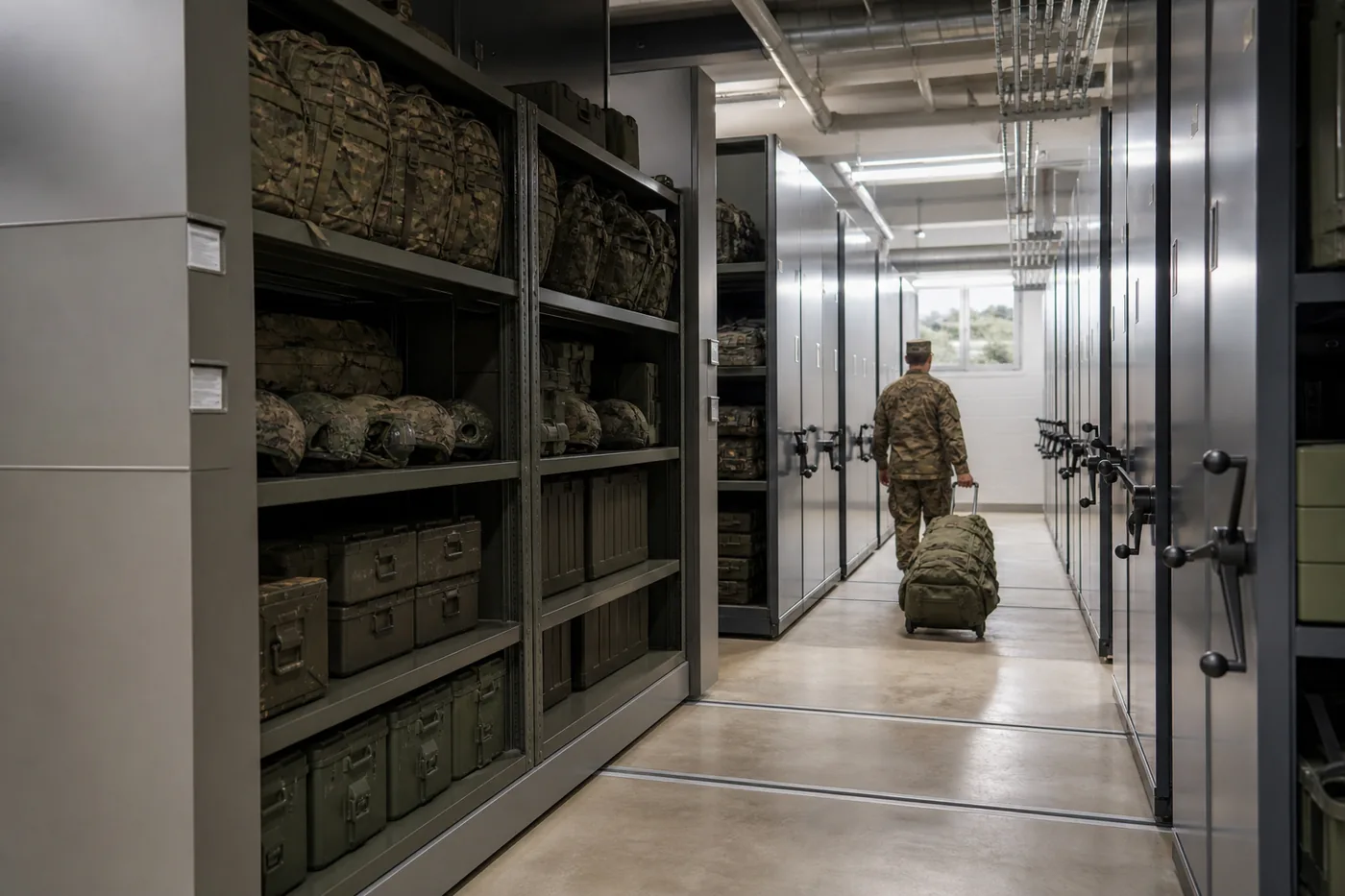
Potential applications include archives, libraries, museums, public safety, military storage, records and institutional collections. A project may use manual and mechanical-assist configurations, with other options only when present in the current contract catalog. Those descriptions are planning categories, not a statement that every configuration or accessory is currently awarded.
- The exact manufacturer name and contract number must match the purchase documentation.
- Only items and services shown in the current awarded catalog are treated as schedule items.
- Open-market components, freight, site work or installation must be identified and handled correctly.
- Room dimensions, floor conditions, fire protection, accessibility and agency criteria must be reviewed before final configuration.
- Final price, delivery and acceptance terms come from the current quote and order documentation.
Scope control matters: being a current MAS contractor does not make every product a GSA item. We verify the selected base, carriage, shelving, accessory and service line before the order is finalized.
How high-density mobile shelving changes the room
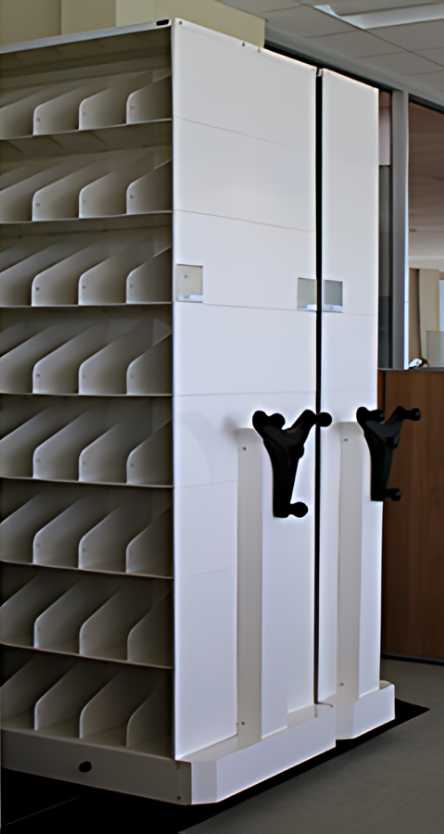
Conventional stationary shelving repeats an access aisle between most rows. A mobile system places shelving on movable carriages so the user opens an aisle where access is needed. The design question is not simply how many shelves fit. It is how the room, collection, workflow and safety requirements work together.
A useful concept begins with an inventory profile: media or item type, dimensions, quantity, weight, retrieval frequency, growth allowance and security needs. The team then studies carriage length, shelf depth, clear aisle width, end-panel controls, entry conditions and any fixed obstructions.
The final system can hold filing media, archival boxes, evidence, supplies, parts, museum collections or other materials, but the shelf type and load plan must match the stored item. MH-USA does not infer load ratings or approve a layout from a generic product description.
Room and project information to collect before a quote
Good procurement starts with a complete room brief. Send drawings when available, but field dimensions and current site photographs are also useful during early planning.
A preliminary plan is not an engineered approval. Final anchorage, loading, electrical work, permits, accessibility decisions and code review remain subject to the project professionals and authorities responsible for the facility.
Manual, mechanical-assist and powered movement
Movement method is selected after the team understands load, run length, use frequency, controls, user needs and the products actually listed on the contract. Manual systems are moved directly by the user and are generally considered for lighter or smaller applications. Mechanical-assist systems use a geared hand wheel or comparable drive to move heavier carriage runs with less effort. Powered systems use controls and motors and may add monitoring or safety functions.
| Movement type | Planning fit | Items to verify |
|---|---|---|
| Manual | Smaller, lighter systems with straightforward access patterns | Total moving load, handles, aisle locks and user effort |
| Mechanical assist | Longer or heavier carriage runs requiring geared movement | Drive ratio, carriage length, load distribution and controls |
| Powered | Frequent access or projects needing powered operation | Electrical scope, controls, safety features, service access and awarded catalog status |
For Spacefile International, the quoted configuration must be cross-checked against contract GS-27F-0041X. A movement type described in general literature should not be assumed to be schedule-priced.
Ordering workflow through Material Handling USA
Send the requirement
Share the agency, room, inventory, ship-to location, schedule requirement and target timing.
Develop the concept
MH-USA helps organize dimensions, storage media, movement method, accessories and service scope.
Verify the contract
We recheck GS-27F-0041X, the current catalog, eligible items, pricing basis and ordering instructions.
Finalize documentation
The quote separates contract items and any other required work so the ordering team can review the complete scope.
Start at MH-USA.com, email Sales@mh-usa.com, or call (800) 326-4403. Include “GSA mobile shelving” and the contract number in the subject line so the request can be routed correctly.
The order path depends on the final scope and the contracting officer’s requirements. MH-USA will not represent an item as contract-covered until that status has been checked in the current source documents.
Questions to resolve during contract review
- Is contract GS-27F-0041X active for the planned order date?
- Is each selected product, accessory and service visible in the current awarded catalog?
- Does the quote use the correct contract holder name, ordering address and payment instructions?
- Are freight, installation, site work and optional services included, excluded or separately identified?
- Are any open-market items clearly marked and permitted under the acquisition approach?
- Do delivery, inspection, warranty and acceptance terms match the agency’s requirement?
- Have room conditions and final dimensions been verified before release?
These checks protect both the purchasing activity and the project team. They also prevent an old PDF, superseded contract number or general manufacturer brochure from being mistaken for the live award.
How to read the contract record without overreaching
A GSA contractor-information page confirms the legal contract holder, contract number, business classification, entity identifier and the dates currently displayed by GSA. It is the right source for confirming that the contract record exists, but it is not a room design, a bill of materials or a blanket authorization for every product shown on a commercial website.
The next layer is the current terms-and-conditions and price-list material connected to the award. That documentation identifies the awarded categories, ordering terms and catalog basis. The product-level review then checks the actual model, component, accessory or service proposed for the project. All three layers should agree before a schedule order is represented as complete.
- Contract-level check: holder, number, status, dates and ordering identity.
- Catalog-level check: awarded categories, current price-list basis and applicable services.
- Line-item check: exact base, carriage, shelf, accessory, control and installation item.
- Project-level check: quantities, freight, receiving, site conditions, installation and acceptance.
This distinction is especially important for engineered-to-order storage. A mobile shelving installation combines manufactured components with a room-specific layout and may involve freight, labor, electrical coordination, floor or rail work, permits and closeout services. Some elements may be contract items while others require separate treatment. Clear documentation lets the ordering activity see what is included and prevents a broad marketing description from being mistaken for an awarded line item.
Keep a dated copy of the record and catalog used for the procurement file, together with the final quote and approved layout. If the configuration changes after review—different shelf media, added controls, revised quantities or a new installation condition—the changed scope should be checked again rather than assumed to inherit the earlier determination. That final recheck is a simple but important control.
The same discipline applies to schedule and delivery. Published lead times are not a project commitment, especially when a system requires drawings, approvals, custom finishes, special controls or coordinated installation. The final quote should identify the assumptions that affect release, manufacturing, shipping and installation. The agency should also confirm receiving hours, loading access, elevator or stair constraints, security procedures and the space available for staging. Resolving those details before award reduces avoidable changes after the equipment reaches the site. It also gives the installation team a clearer basis for coordination.
Frequently asked questions
Is Spacefile International GSA contract GS-27F-0041X current?
Does the contract cover every mobile shelving product?
Can MH-USA help plan the room before the order?
Can installation be included?
Where should an order inquiry be sent?
Where can I compare mobile shelving types?
Review Spacefile International Contract GS-27F-0041X With MH-USA
Send the room, inventory and acquisition requirement. We will organize the mobile shelving scope and verify current contract details before an order is accepted.