
Technical Fabric Roll Storage for Cutting & Converting
Choose the storage-to-production route for compatible dry rolls: retrieve and transfer, evaluated payout, or a separate process feed position.
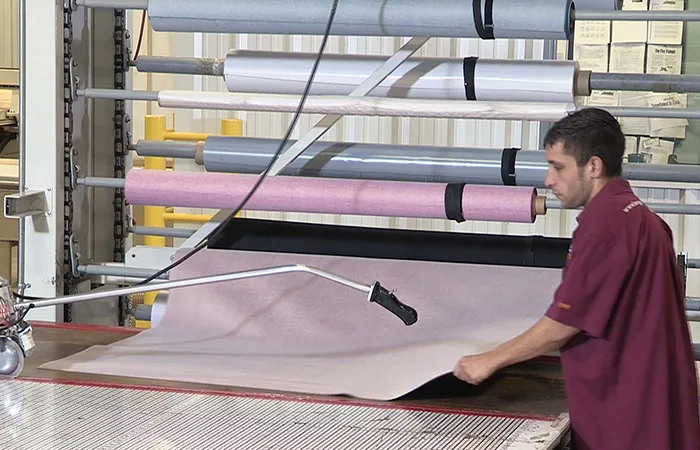
Plan a cutting-room handoff, not just a roll library
Technical fabric roll storage connects receiving, material identification, cutting and the return of usable remnants. A roll that fits in a machine can still be wrong for the next job if its identity is lost, its edge is marked, or its payout route creates uncontrolled handling. This guide is for industrial cutting and converting teams selecting that workflow across storage, transfer and feed stages.
The Vidir Textile Carousel page covers the machine and its roll-support options. Here we compare when stored-roll retrieval, payout from storage or a separate feed position makes sense. For the wider equipment range, return to our Vidir vertical storage solutions. This is not a fabric-retail display guide, a claim of an installed customer project, or a refrigerated-material storage recommendation.
Compare three routes from storage to production
| Route | When to investigate it | What must be resolved |
|---|---|---|
| Retrieve a roll, then transfer it | Jobs need the roll at a separate cutting or converting station. | Supported transfer, cart interface, identification and return location. |
| Payout from a stored position | A compatible material and accessory arrangement may suit a nearby work area. | Actual unwind path, tension, edge protection and operator access. |
| Keep a dedicated feed position | A production process needs its own unwind or handling arrangement. | Buffer stock, replenishment timing and the boundary between storage and process machinery. |
No route is automatically best. A large library with frequent material changes may have different priorities from a long production run. Count both outbound and return moves and include the time spent finding the correct lot. Evaluate a representative material and handling sequence before settling the layout.
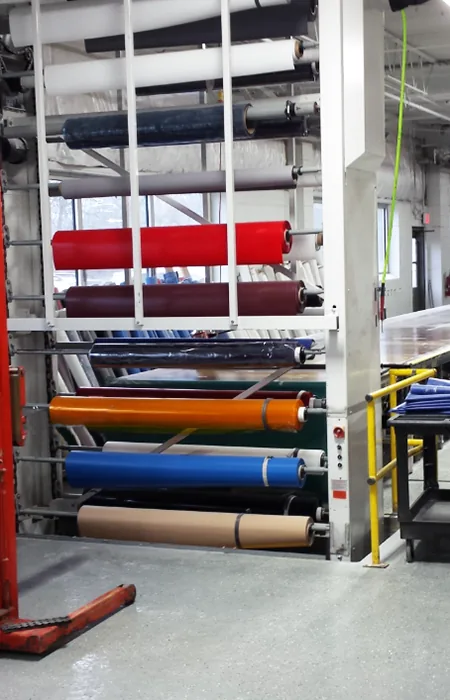
Separate material families by handling requirements
Filtration and nonwoven media
A proposed planning use for compatible dry rolls. Record compressibility, edge condition, wrapping and any material-specific handling restrictions supplied by the producer.
Awnings and marine canvas
A proposed industrial cutting workflow. Identify coated faces, required winding direction, shade or color identity and how the material reaches the cutting surface.
Dry reinforcement and other technical fabrics
Evaluate dry rolls individually. Document the permitted support and handling method. Refrigerated prepreg, temperature-sensitive resins and controlled-environment suitability are not established here.
Vidir’s current Textile Carousel page explicitly identifies woven, nonwoven, knitted, synthetic, netting and technical fabrics. That broad material-family statement does not verify every coating, reinforcement, film, core or finished-roll specification. Use your actual material data rather than transferring a successful setup from one family to another.
Create a roll record that survives every handoff
Give each roll an identity that follows it from receiving through storage, cutting and return. A useful planning record includes material code, supplier designation, lot or batch, roll width, outside diameter, core geometry, full and partial-roll weight, winding direction and remaining-length method. Where a material has expiry or conditioning requirements, ask the material owner to specify them; do not assume the storage machine enforces those rules.
Separate identity from status. “Available,” “reserved for job,” “in use,” “awaiting review” and “released for return” describe different decisions, even when the physical roll is in the same building. Assign a person or source system to each status change. A label alone cannot prevent someone from selecting a held roll unless the workflow tells the operator what to do.
- At receiving: compare the delivered label and packaging with the purchase and material records.
- Before retrieval: match the job requirement to the correct roll and approved status.
- At cutting: keep roll identity linked to the job while packaging is removed.
- At return: record the usable remainder, condition and the next storage location.
Review support, payout and protection separately
First establish how the core can be supported without damage. Then check the complete roll’s width, diameter, weight and geometry against the proposed carrier arrangement. Mixed roll widths and partial rolls may alter the configuration; do not choose a machine from a single maximum dimension.
Vidir lists tension-control collars, tapered cones and locking collars for the Textile Carousel. Discuss what each accessory does in the proposed arrangement and whether it is compatible with the actual core. These are storage and payout-planning inputs, not a guarantee of process-grade web control or a direct connection to any cutting line.
Surface protection is a separate review. Identify faces that cannot contact a work surface, edges vulnerable to marking, protective wrap that must remain in place and the approved method for securing a returned roll. Keep cleaning, conditioning and material acceptance instructions with the material owner rather than inventing them in a storage specification.
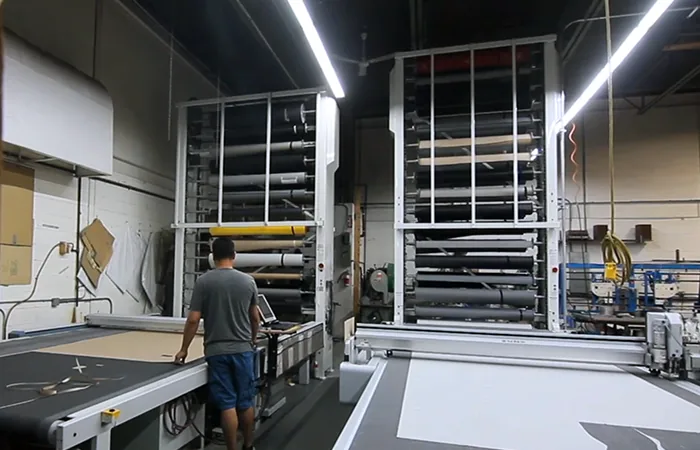
Test one complete job and one interrupted job
Receive and identify
Record the roll and keep the supplier identity connected to its storage location.
Reserve and retrieve
Match material and status to the job, then follow the approved transfer or payout route.
Cut and record
Maintain roll identity while consuming material; decide how the remainder is measured.
Inspect and return
Separate questionable material, protect usable returns and update the location and status.
Now interrupt that sequence. What if the job stops after the wrapping has been removed? Where does a partly used roll wait? Who may release a roll that was marked or dropped? How does the next shift distinguish a reserved roll from one available to all jobs? A workable answer may require a clearly defined hold area outside automated storage, not another machine feature.
Run the test with both a full roll and a light, partly used roll. Include the cart turning space and the space occupied by the cutting station. Do not reach through guards or improvise a lifting or transfer method to make a layout appear workable.
Keep different material forms on their own product paths
Print tooling is not textile inventory. Journal-supported cylinders and hollow printing sleeves belong on the Print Cylinder Carousel and Hollow Core Carousel paths. A hollow sleeve’s support method does not prove suitability for a raw fabric, film or paper roll.
Likewise, a Vidir vertical lift module may be evaluated for compatible boxed tools or other production supplies; it is not an assumed substitute for a supported fabric-roll carrier. Describe each inventory form and handoff so the proposal can separate storage zones instead of forcing dissimilar materials onto one system.
For a quote review, send a roll list with full and partial-roll measurements, material-handling requirements, a room plan showing the cutting area, photos of the current transfer and the proposed job-status rules. Ask for a clear boundary between machine supply, transfer equipment, process-line requirements and any software integration. That boundary keeps the project review practical and avoids confusing storage retrieval with the full converting process.
Get a storage project review
Send your item list, room dimensions, handling photos and the workflow you need to improve. We can review system fit and the details required for a project-specific quote.
Frequently asked questions
Does a Textile Carousel automatically feed any cutting machine?
Are nonwovens and technical fabrics within Vidir’s stated material families?
Can this guide be used for refrigerated prepreg?
Should partially used rolls go straight back into storage?
What distinguishes this guide from the Textile Carousel product page?
Shop packaging and shipping supplies
For routine packing and shipment preparation. These supplies are not Vidir systems or replacement parts.

Review your storage workflow
Share the inventory, layout and operating requirements so we can discuss a project-specific approach.