
Assembly Workstations & Production Line Furniture
Modular workbenches, ESD-safe stations, height-adjustable ergonomic cells, mobile carts and point-of-use parts presentation — specified around how your product actually gets built.
Talk with a specialist. Call (800) 326-4403 or email Sales@MH-USA.com
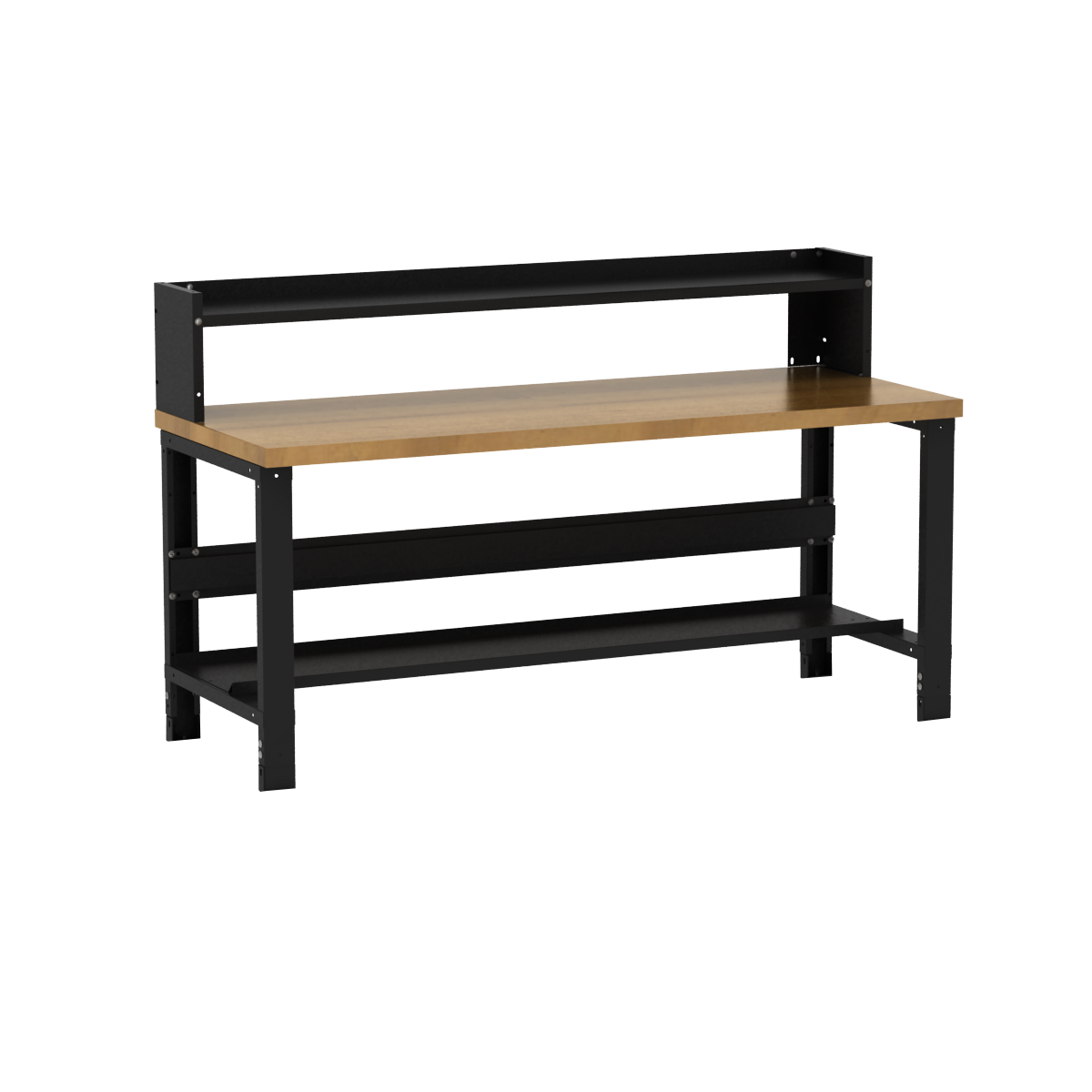
The Workstation Is Where Your Cycle Time Is Won or Lost

Most manufacturers we work with have already optimized the obvious things — purchasing, scheduling, machine uptime. What they have rarely touched is the two or three square metres where the product is actually assembled. An operator who walks eight steps to a shelf for a fastener, hunts through a mixed tote for the right variant, or reaches over a 30-inch-deep bench for a torque driver is burning cycle time on every single unit, every shift, for the life of the product.
Assembly workstations are the fixture that decides how much of that waste exists. A well-specified station puts every part, tool, fixture, document and utility the operator needs inside a comfortable reach envelope, at a working height matched to the task, under light that lets them see a defect before it moves downstream. That is not a comfort argument — it is a throughput, quality and scrap argument that shows up in the same numbers your plant manager already reports.
Material Handling USA specifies and supplies industrial assembly workstations, production benches and line-side furniture for manufacturers and equipment OEMs across Utah and the Mountain West from our Salt Lake City base. We work from your build sequence and takt time rather than from a catalog page, because a station that fits a five-minute wire-harness build is the wrong station for a 40-minute machine sub-assembly.
Start with the free Manufacturing Storage & Material Flow Review. We walk your plant layout and parts flow — where material lands, how it gets to the line, what the operator reaches for and how often — and come back with a workstation and point-of-use plan. It is a review of how your product moves, not a shelving quote. Call (800) 326-4403 or upload a floor plan for a free layout review.
Types of Assembly Workstations We Specify
Six configurations cover the large majority of production and assembly work. Most plants end up with two or three of them, standardized on one frame system so accessories interchange.
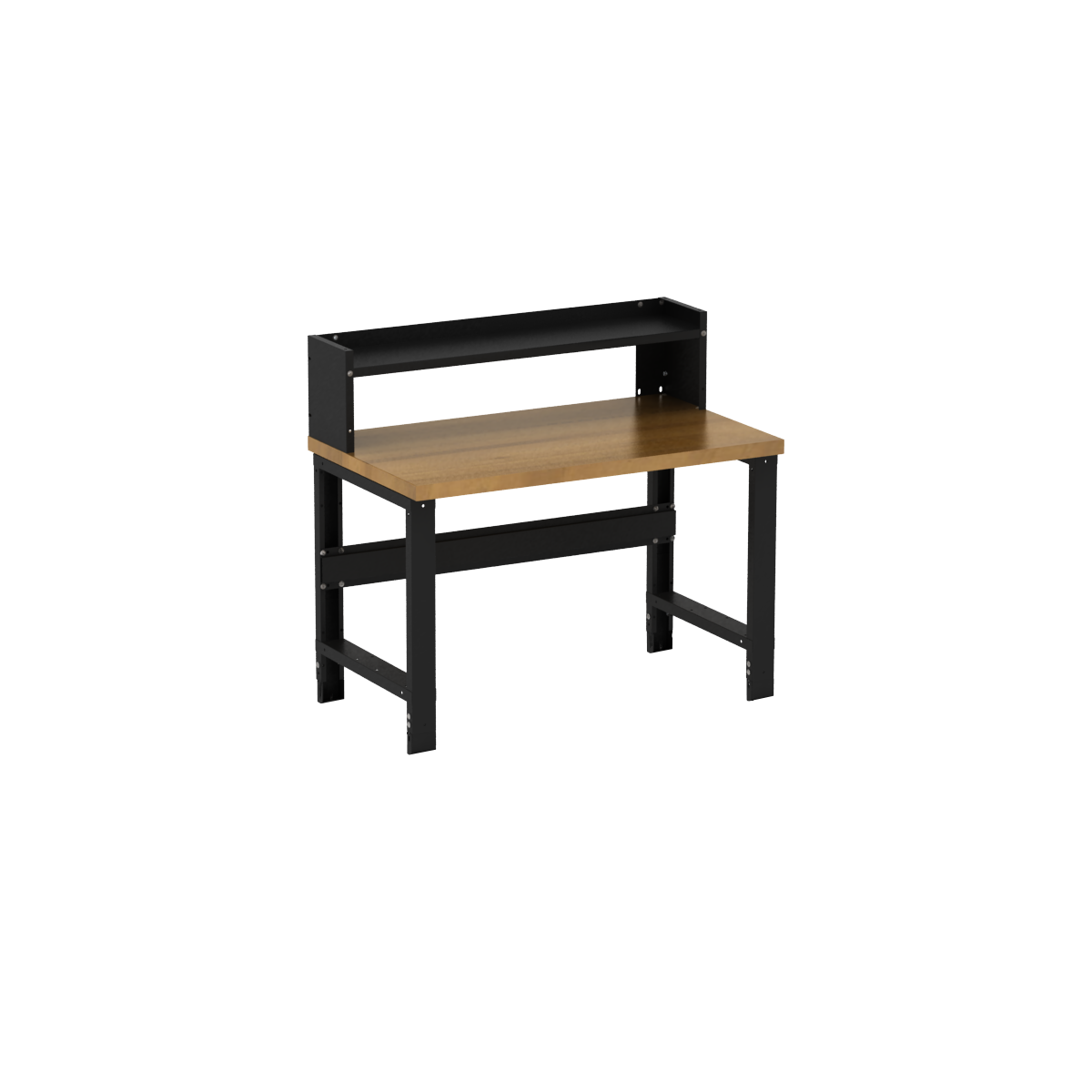
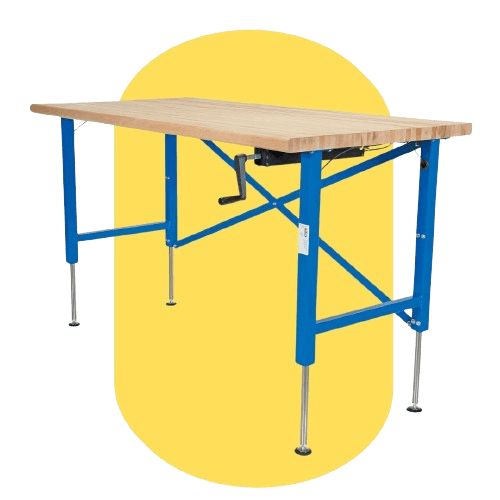
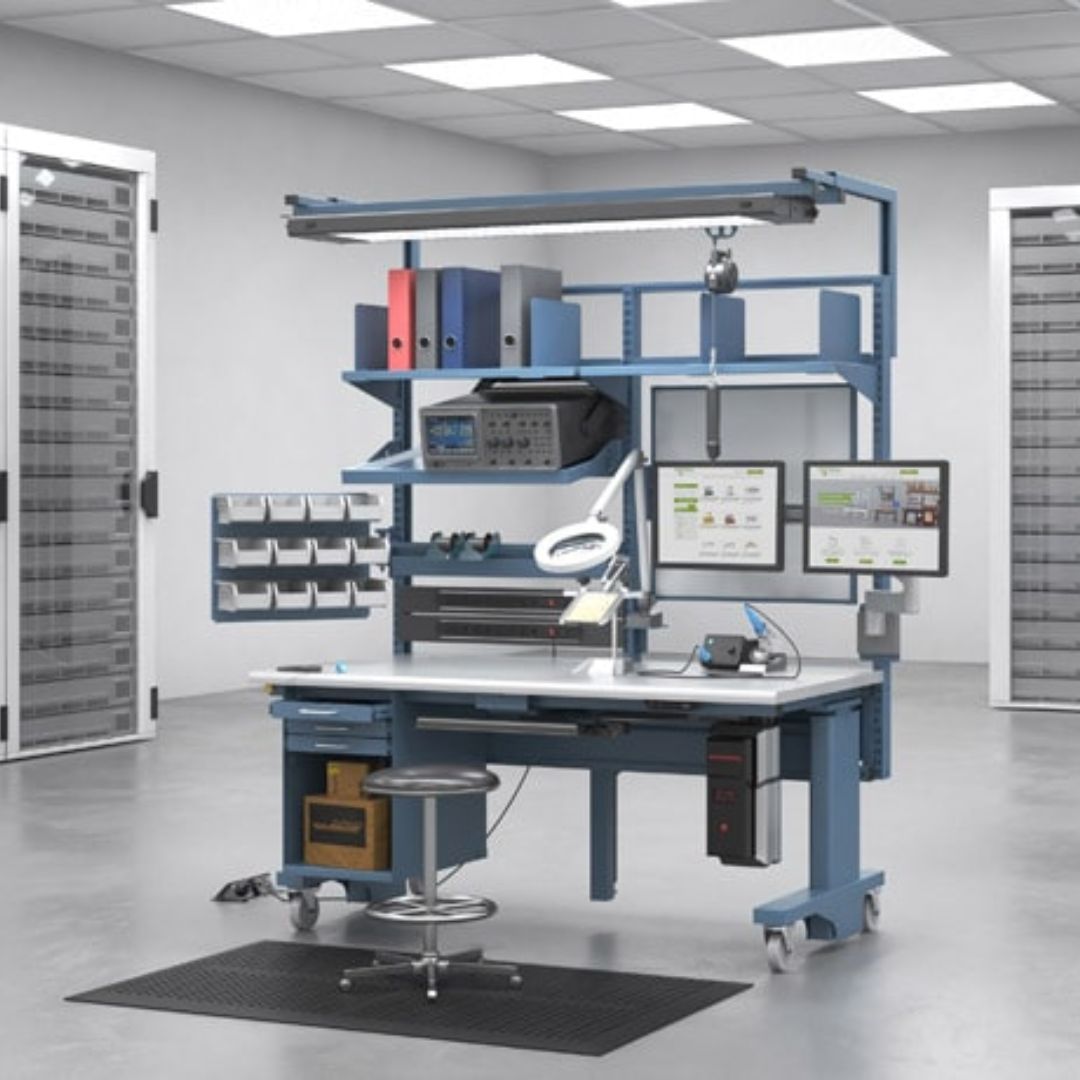
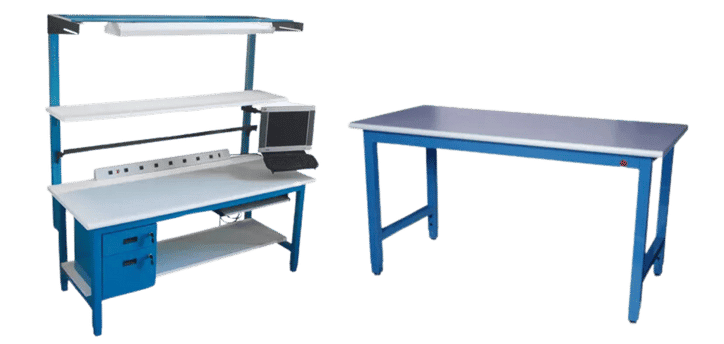
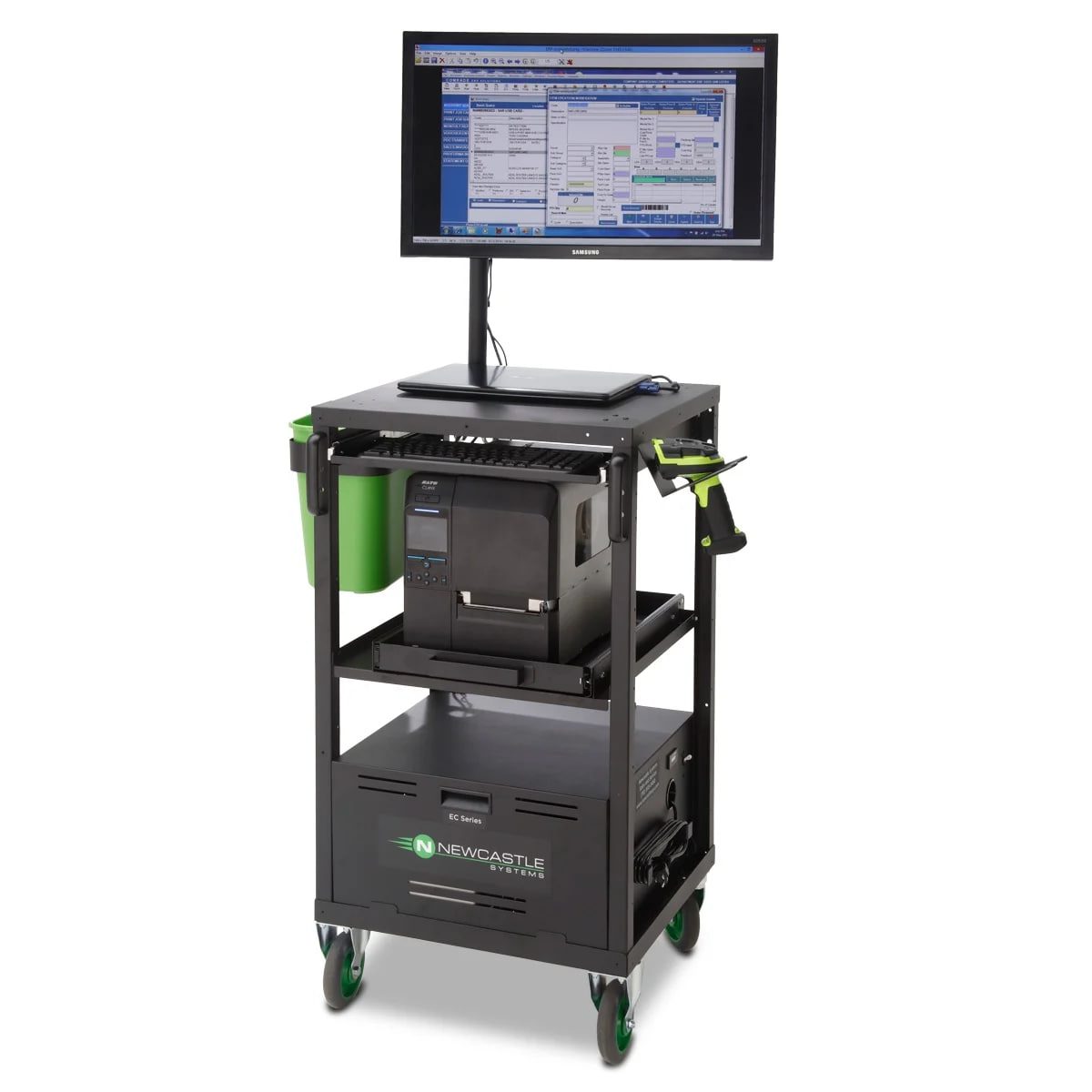

Point-of-Use Parts Storage at the Station
A bench with no parts strategy is just a table. The part of workstation design that pays back fastest is deciding what lives at the station, what lives near the station, and what should never come to the line at all.
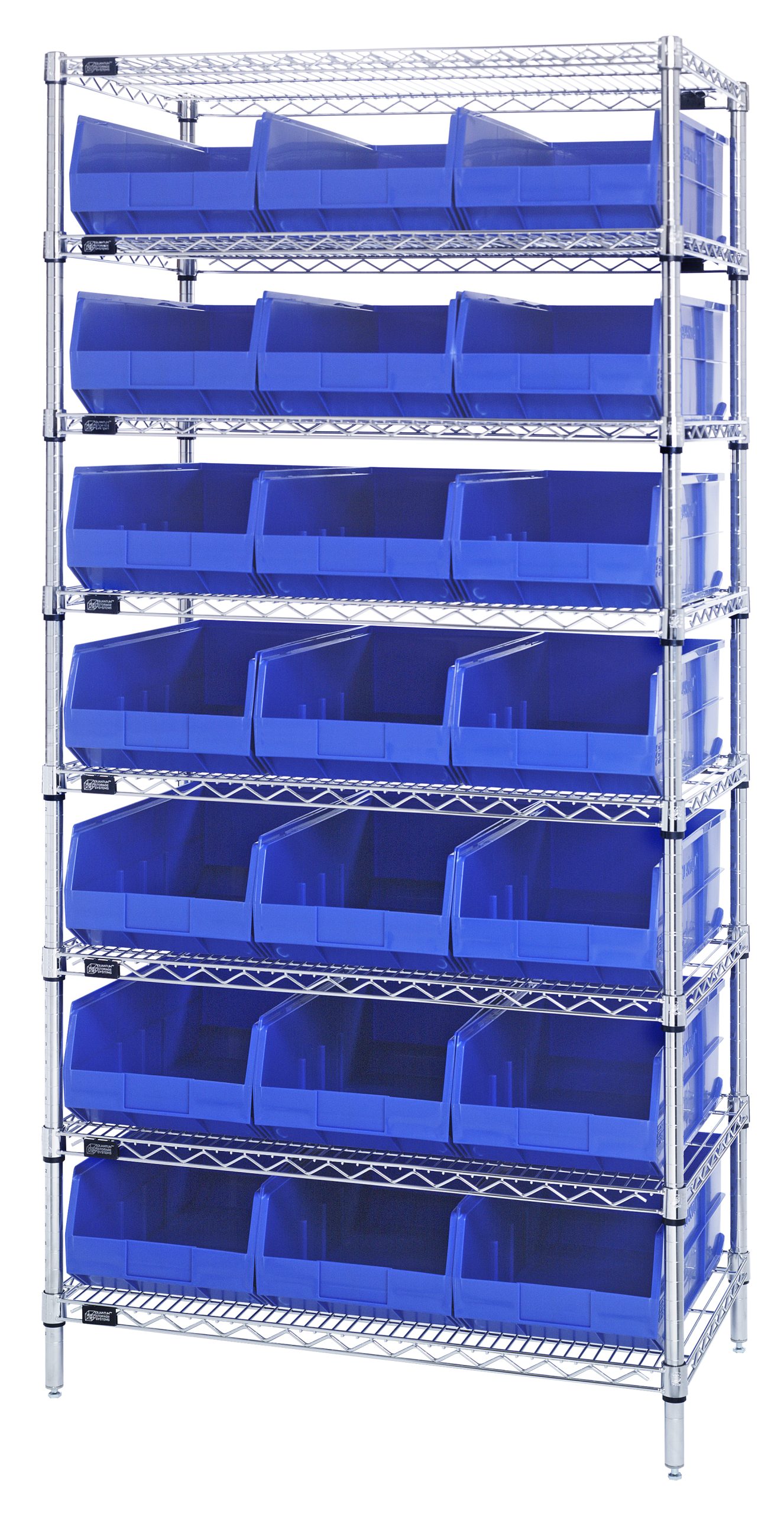
At the station belongs to high-frequency, low-volume items: fasteners, clips, seals, connectors, labels — presented in angled bins on a rail or in shallow flow lanes so the operator picks without leaving the seat or turning their torso. Keep them inside the primary reach zone and keep the bin openings facing the operator, not the aisle.
Near the station is where kits, sub-assemblies and larger components belong — on a flow rack behind the bench, a kitting cart staged by the water spider, or a two-bin replenishment lane the material handler services from the aisle side. The rule that matters: the person building the product should never be the person who goes looking for material.
Off the line entirely is where slow-moving spares, MRO consumables and controlled tooling belong. High-density parts storage keeps those SKUs dense and findable without letting them creep into the assembly cell — see our small parts storage systems and spare parts and MRO storage, and use a secured tool crib for calibrated tools, expensive fixtures and anything with a shrinkage history.
A quick test for any existing station: stand behind the operator for ten builds and count how many times they stand up, turn more than 45 degrees, or search. Each of those is a design defect, not an operator problem.
If the count is high, the fix is usually presentation — bin angle, rail height, kit sequence — long before it is a new bench.
Ergonomics, Working Height and Reach
Working height is set by the task and the operator, not by a standard bench height. The figures below are common starting points used in industrial ergonomics practice — confirm the final height with the people who will actually work at the station.
| Task type | Where to set the work surface | Why |
|---|---|---|
| Precision work (electronics, small mechanisms, inspection) | Above standing elbow height, with forearm support | Brings the work closer to the eyes and steadies the hands; supported forearms reduce shoulder fatigue |
| Light assembly (typical bench work) | At or just below standing elbow height | Neutral shoulders and wrists for repetitive motion over a full shift |
| Heavy or force-applying work (press-fit, torquing, large parts) | Well below standing elbow height | Lets the operator use body weight and leg drive instead of shoulders and back |
| Seated work | Set to seated elbow height, with knee clearance and a footrest | A bench that is right for standing is almost never right for sitting — specify chair and footrest together |
Reach zones
Think of the bench in three bands. The primary zone is what the operator can reach with the upper arm relaxed at the side — this is where every high-frequency part and the primary tool belong. The secondary zone is a full arm extension without leaning, appropriate for fixtures, less-frequent tools, a scanner or the work-instruction screen. Anything beyond that is the tertiary zone, and if a per-unit task lives out there you have a design problem: either bring it in, put it on an arm, or move it off the station.
- Depth is a trap. A deeper bench feels generous and then becomes a shelf for clutter that pushes the work away from the operator. Specify the depth the task needs, then add shelving above rather than surface in front.
- Anti-fatigue matting for any standing station, sized to the actual standing footprint, with beveled edges so carts and chairs do not catch.
- Chairs and stools are part of the station, not an afterthought — height range must overlap the bench height range, and ESD cells need ESD-rated seating.
- Tool balancers and articulating arms take the weight of drivers and torque tools off the operator and keep the tool in the primary zone between cycles.
- Involve the operators before you order. A mock-up built from one adjustable station and a week of feedback prevents an expensive line-wide mistake.
Lighting, Power and Utilities at the Station

Overhead high-bay lighting is designed for the aisle, not for a hand-sized part. Task lighting mounted on the station — positioned so the fixture is above and slightly forward of the work to avoid casting the operator’s own shadow onto it — is one of the cheapest quality improvements available on an assembly line. For inspection, deburring, solder or fine mechanical work, add a magnifier lamp or a dedicated inspection light rather than asking people to lean in.
Power should be planned as part of the station, not run from an extension cord. Count everything up front: hand tools, a torque controller, a label printer, a barcode scanner, a monitor for digital work instructions, a soldering station, and whatever gets added next year. Outlet strips mounted on the uprights, cable trays under the surface and strain-relieved drops keep cords off the floor and out of caster paths — a housekeeping and trip-hazard issue as much as a convenience one.
Compressed air, dust extraction, fume extraction for soldering or adhesives, and network connectivity all need to be located before the stations are set, because moving a drop after the line is running costs far more than routing it correctly the first time. Bring your facilities and EHS people into the workstation layout conversation early — extraction requirements in particular can change the whole station footprint.
ESD Control for Electronics and Defense Manufacturing
If you build, rework or test electronic assemblies, the workstation is the core of your ESD protected area. Getting the furniture right makes the rest of the program straightforward; getting it wrong produces intermittent field failures you will spend months chasing.
Dissipative, not insulative
Work surfaces, mats and shelf liners should be static-dissipative so charge bleeds away in a controlled way. A hard insulating laminate top in an ESD cell quietly defeats everything else you bought.
One common point ground
Bond the mat, the frame, the wrist-strap cord, the shelf and any powered tooling to a single common point ground so nothing in the cell floats at a different potential.
The whole cell, not just the bench
Chair, cart, bins, totes, tool trays and flooring all need to be ESD-rated. A non-rated plastic bin sitting on a perfect ESD bench is the most common gap we find.
Designed to be verified
Ground points must be accessible for periodic resistance testing, and surfaces must survive your cleaning routine without losing their properties. Build the station so an auditor can check it in minutes.
Most manufacturers run their ESD program against the ANSI/ESD S20.20 standard published by the ESD Association, and defense and aerospace suppliers are frequently asked to demonstrate a documented program as part of a customer or prime-contractor audit. To be clear about roles: we supply and configure ESD-rated workstations, seating, bins and carts to your specification — compliance itself is established by your written program, your training, and your own measurement and audit records, not by any product purchase.
Cleanroom-adjacent electronics work adds a second constraint set. If you are building in a controlled environment, see our overview of semiconductor and cleanroom storage considerations before specifying surfaces and frames, because the cleanability requirement and the ESD requirement sometimes push toward different materials and have to be reconciled deliberately.
Choosing a Work Surface
The top is the part operators touch every minute of every shift, and the part most often chosen on price alone. Match it to the actual task, chemistry and cleaning routine.
| Surface | Best for | Watch out for |
|---|---|---|
| Laminate over composite core | General light assembly, inspection, packing, office-adjacent work | Chipping at edges under impact; not appropriate as an ESD surface unless specifically rated |
| Static-dissipative laminate or ESD mat | Electronics, PCB, sensor, defense electronics assembly and rework | Must be grounded and periodically verified; aggressive cleaners can degrade performance |
| Steel or steel-clad | Impact, heat, clamping, fixture mounting, heavy mechanical build | Hard on delicate finished parts; can be noisy and cold to the touch |
| Stainless steel | Cleanroom, medical device, food-contact-adjacent and wash-down environments | Higher cost; shows marks; confirm the grade against your cleaning chemistry |
| Hardwood / butcher block | General fabrication and repair benches where a forgiving surface protects parts | Absorbs fluids; needs periodic refinishing; not for cleanroom or ESD use |
| Chemical-resistant / phenolic | Adhesives, solvents, coatings and other aggressive process chemistry | Verify resistance against your specific chemicals, not a general claim |
How Workstation Design Affects Throughput
Five mechanisms, in the order they usually show up when we walk a line.
Motion inside the cycle
Every reach outside the primary zone, every turn, every step adds seconds that repeat on every unit. Presentation changes here are usually free-standing wins that need no process change at all.
Search and selection error
Mixed bins and similar-looking variants cause hesitation and wrong-part builds. Dedicated, labelled, colour-coded locations remove the decision from the operator entirely.
Line stoppage for replenishment
If the operator has to fetch material, the station stops. Rear-fed flow lanes and a two-bin signal let replenishment happen from the aisle while the build continues.
Fatigue across the shift
Poor height, poor light and no matting show up as a slower, more error-prone final hour — and eventually as recordable injuries and turnover. Ergonomics is a second-half-of-shift throughput lever.
Changeover and line balance
Modular, mobile stations let you rebalance work content between stations when demand shifts. Fixed welded benches lock you into last year’s line balance.
Quality escapes
Defects found at the station cost a fraction of defects found at final test or in the field. Task light, magnification and a clear place for a suspect part make containment the easy option.
How We Specify a Station With You
1. Watch the build. We start at the station, not the catalog — the build sequence, the tools, the parts consumed, the takt time, who works there and across how many shifts, and what changes when the product mix changes.
2. Map the flow into and out of the cell. Where material lands, who moves it, how it is staged, and where finished units go. This is where most of the recoverable time sits, and it is why the review covers plant layout and parts flow rather than just furniture.
3. Define constraints honestly. Load cases, ESD or cleanroom requirements, chemical exposure, utilities, aisle widths, fire and egress clearances, and anything your EHS team requires. Constraints found late are the expensive kind.
4. Lay it out and mock it up. A station drawing plus one physical mock-up in the real cell, with real operators and real parts, for a week. Adjust before the order, not after.
5. Standardize and roll out. One frame family, one accessory set, documented configurations per station type. New stations become an add-on order instead of a fresh design project, and spares fit everything you own.

Common mistakes we are asked to fix
- Buying one bench height for a workforce with a wide range of statures.
- Deep benches that become storage, pushing the actual work out of reach.
- Adding an ESD mat to a non-grounded bench and calling the cell protected.
- No planned power, so every station grows an extension cord and a power strip on the floor.
- Welded, immovable benches on a line whose product mix changes every year.
- Parts replenished from the operator side, stopping the build every time a bin runs dry.
Where These Stations Get Used
Typical applications across the manufacturers and equipment OEMs we support in Utah and the Mountain West.
Electronics & PCB assembly
ESD-safe benches, dissipative bins and seating, magnification, fume extraction for hand soldering and rework.
Aerospace & defense
Documented ESD cells, controlled tooling at the station, traceable kit staging and secured storage for high-value components.
Medical device manufacturing
Cleanable stainless or non-shedding surfaces, controlled-environment-compatible frames, clear separation of released and quarantined material.
Equipment & machinery OEMs
Heavy benches for sub-assembly, mobile stations that follow a large build, kit carts sequenced to the build order.
Wire harness & cable assembly
Long-span benches with board mounting, spool presentation, overhead reels and excellent task lighting.
Test, QC and rework cells
Instrument shelving, monitor arms, dedicated power, and clearly marked locations for suspect and reworked units.
Kitting & line-feed areas
Pick-and-stage benches with flow shelving, cart docking positions and labelled kit locations feeding the assembly line.
Pack-out & final prep
Bench plus carton, dunnage and label presentation at the point of use — see our packing station design guide.
Specification Checklist
Bring these answers to the review and we can usually get to a firm configuration in one pass.
- Task & cycle: what is built, in what sequence, at what takt time
- Operators: how many, how many shifts, seated or standing, stature range
- Load: heaviest part, fixture weight, any point or impact loading
- Footprint: available width and depth, aisle and egress clearances
- Parts at the station: SKU count, pick frequency, bin sizes needed
- Tools: hand, powered, torque-controlled, balancer or arm required
- Utilities: outlet count, air, data, extraction, lighting level needed
- Environment: ESD, cleanroom, wash-down, chemical exposure, temperature
- Mobility: fixed, casters, or relocated between cells
- Growth: stations needed now versus in twelve months, and expected mix changes
Not sure where the constraint actually is? Run the Warehouse Opportunity Scanner or browse all our free planning tools — they give you a usable result on screen before anyone calls you.
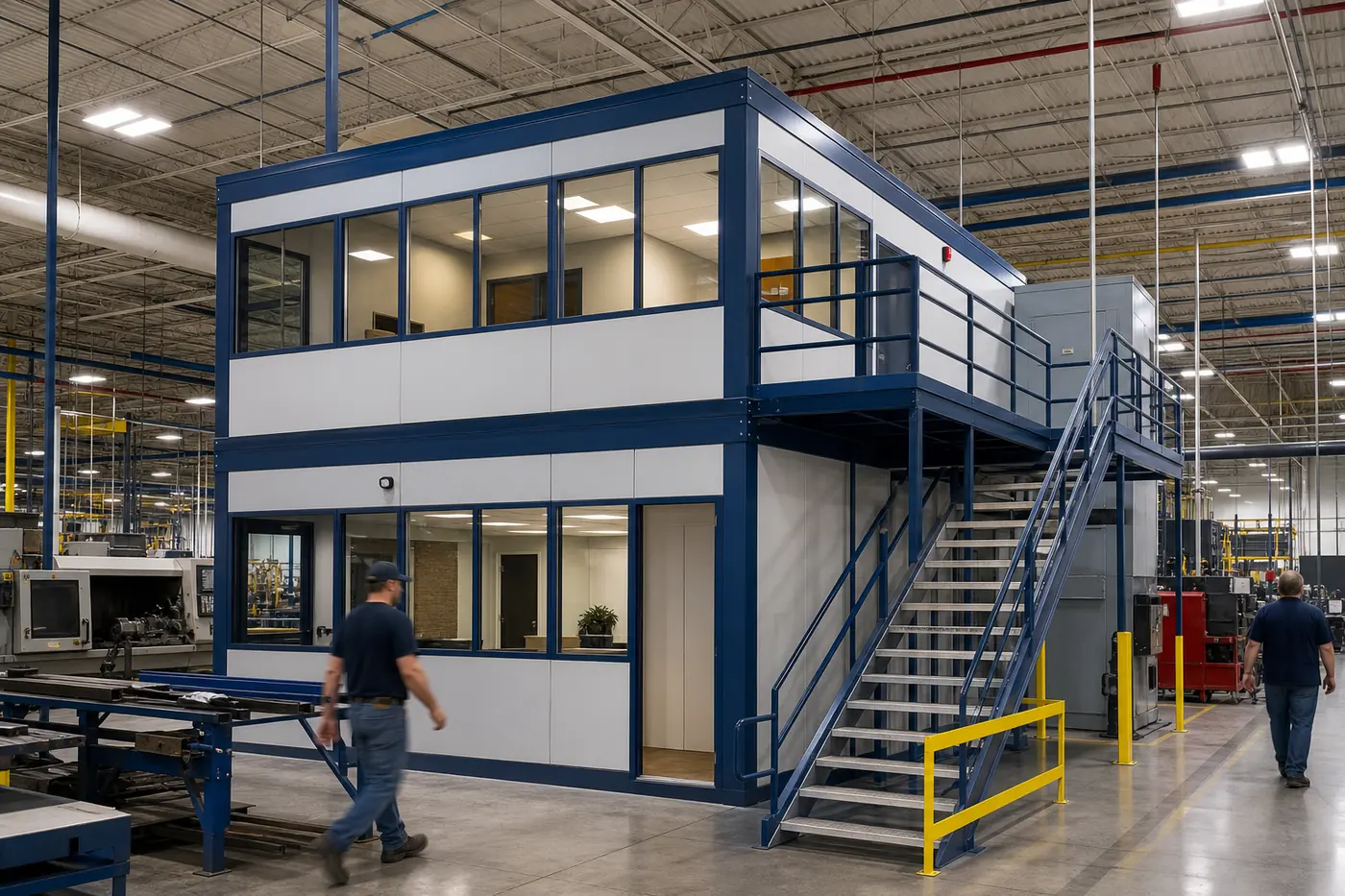
Related Storage for the Production Floor
Workstations rarely stand alone. These are the systems that usually get specified alongside them.



Assembly Workstation FAQs
What is an assembly workstation?
An assembly workstation is a purpose-built work position on a production line: a bench or frame system combined with the parts presentation, tooling, lighting, power and seating an operator needs to complete one step of a build. Unlike a general-purpose table, it is specified around a defined task, cycle time and operator population, and it is normally modular so it can be reconfigured when the product changes.
What height should an assembly workbench be?
There is no single correct height. Working height should be set relative to the operator’s elbow height and the task: precision work sits above elbow height with forearm support, general light assembly at or just below elbow height, and heavy or force-applying work noticeably below it. Because operator statures vary, height-adjustable stations are usually the better answer on any bench shared across shifts.
What makes a workstation ESD-safe?
A static-dissipative work surface or mat, a bonded frame, a wrist-strap connection and every conductive element in the cell tied to one common point ground — extended to the chair, cart, bins and tooling. The furniture is only part of it: ESD compliance is established by your written control program, operator training and periodic resistance testing, most commonly against the ANSI/ESD S20.20 standard. We supply and configure the hardware to fit that program.
Do you offer cleanroom-compatible workstations?
Yes. We specify stations with non-shedding, easily wiped surfaces, stainless or appropriately finished frames, and open under-bench designs that do not trap particulate, selected to tolerate your cleaning chemistry. Cleanroom classification itself is demonstrated by your own validation and monitoring — furniture is specified to support that, not to certify it.
Should assembly workstations be mobile or fixed?
Fixed benches make sense where the load is high, a fixture or press is mounted, or the layout is stable for years. Mobile stations win where product mix changes, where work has to travel to a large assembly, or where you rebalance the line seasonally. Many plants use both — fixed heavy stations for the load-bearing operations, mobile carts for kitting, rework and flexible cells.
How do I decide what parts belong at the workstation?
Use pick frequency and size. High-frequency, small components belong in angled bins inside the primary reach zone. Larger components and full kits belong on a flow lane or cart adjacent to the station, replenished from the aisle side so the build never stops. Slow-moving spares, MRO items and controlled tooling should be stored off the line in a high-density system or a secured tool crib.
Can existing workbenches be upgraded instead of replaced?
Often, yes — and it is usually where we start. Adding bin rails, task lighting, an upright accessory frame, matting, a tool balancer or an ESD mat with a proper ground can resolve most of the motion and quality issues on a structurally sound bench. Replacement makes sense when the height is wrong for the task, the frame cannot carry the load, or the surface is unsuitable for the environment.
What does the Free Manufacturing Storage & Material Flow Review include?
We review your plant layout and parts flow — where material lands, how it reaches the line, how each station is fed, and what the operator reaches for and how often — then come back with a workstation and point-of-use plan plus any supporting storage recommendations. It is a review of how your product moves through the building, not a shelving quote. Call (800) 326-4403 or upload a floor plan to start.
Do you serve manufacturers outside Salt Lake City?
Yes. Material Handling USA is based in Salt Lake City and works with manufacturers and equipment OEMs throughout Utah and the wider Mountain West region, with project support available for facilities beyond it. Call (800) 326-4403 to check coverage for your site.
Get a Free Manufacturing Storage & Material Flow Review
We walk your plant layout and parts flow, then come back with a workstation and point-of-use plan built around how your product is actually assembled. No obligation, and no generic shelving quote.
Part of our Advanced Manufacturing Storage Solutions section — see also Parts Storage & Kitting.
Plan this before you buy
Free planning tools you can use right now — results on screen first, no gate to see them.
- Manufacturing Floor Space Recovery CalculatorSee how much production floor space your current storage is consuming and how much of it comes back with higher-density or vertical storage.
- Parts & Kitting Storage PlannerPlan bin, shelving and flow-rack storage for parts and kitting so line-side picking, replenishment and kit staging actually fit the space you have.