

Parts Availability Is the Whole Job
An MRO or depot maintenance operation lives or dies on how fast a mechanic can find the rotable, consumable or fastener a work order calls for. Every minute spent walking to a parts room, hunting a mislabeled bin, or waiting on a part that is somewhere in the building but not where the system says it is, is a minute the aircraft, vehicle or equipment stays down. The fix is rarely more square footage — it is denser, better-organized storage matched to your actual part mix, plus enough physical control that spares do not walk.
Systems for Maintenance & Depot Floors
 Vertical Lift Modules for SparesAutomated vertical lift modules put a part in front of the picker instead of sending them down an aisle, and reclaim floor space that shelving would otherwise use.
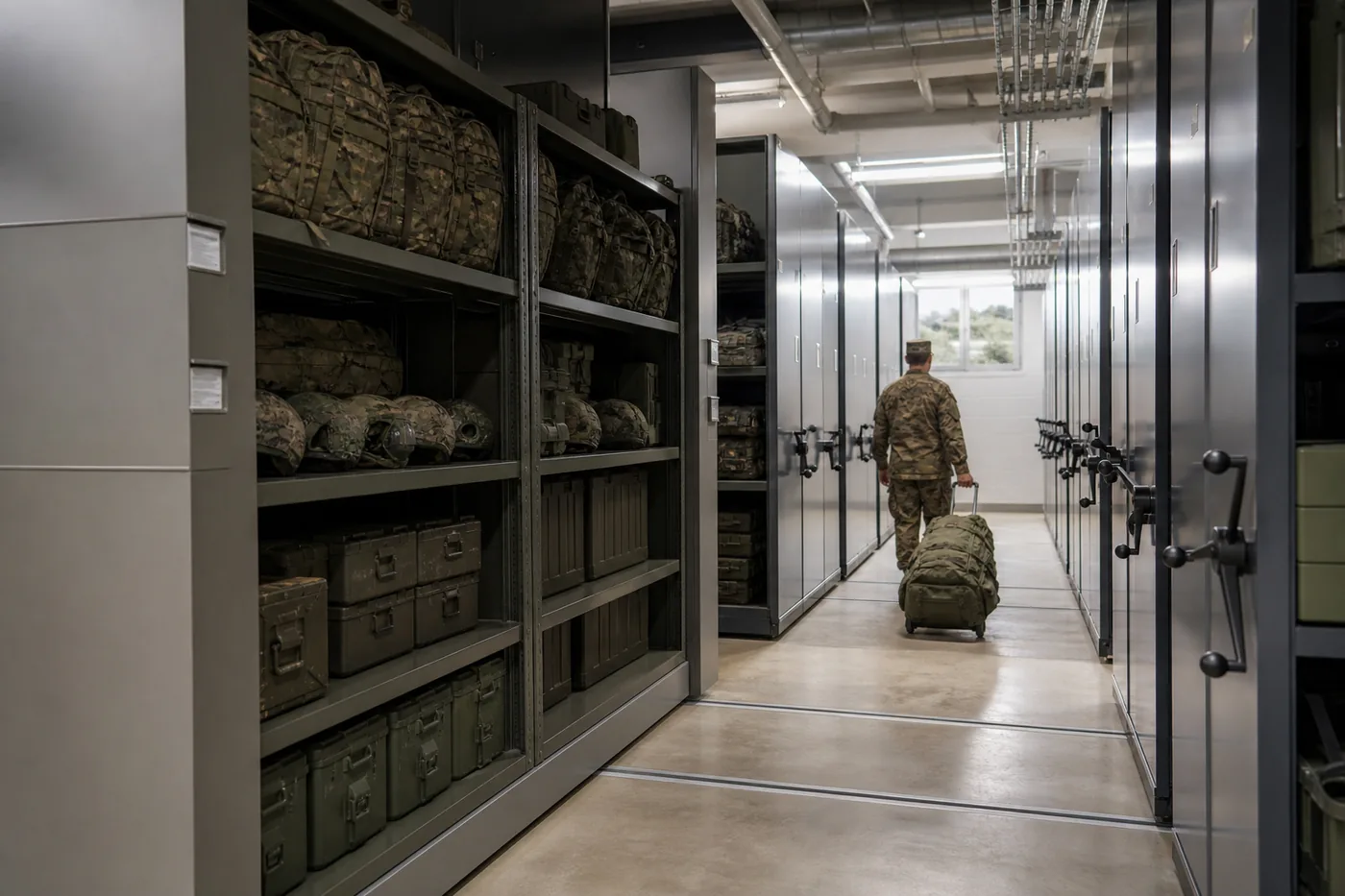 High-Density Mobile Shelving for RotablesMobile carriages double or triple the rotables and spares you can store in the same footprint by eliminating redundant aisles.
 Secured Tool & Consumable CribsWelded wire mesh cribs with a service window so calibrated tooling and consumables are checked out and tracked instead of going missing between shifts.
 Mezzanines for Hangar AccessElevated platforms and mezzanines add a second level for parts storage or work access above the hangar or bay floor without expanding the building footprint.
What Changes When Storage Is Sized Right
- Faster turn times: a mechanic pulling a rotable from a VLM tray gets it in seconds instead of a walk-and-search through open shelving.
- Fewer lost parts: cage-controlled cribs and locked mobile shelving cut down on the shrinkage that shows up as an emergency reorder mid-job.
- More usable floor: reclaiming aisle space with mobile shelving or going vertical with a VLM or mezzanine buys back bay space for the work itself, not more storage.
Sizing an MRO or Depot Parts Room
- Total active SKU count and how many are picked daily — high-mix, high-pick-frequency parts are the best VLM candidates.
- Average rotable size and weight — sets shelving or carriage load rating.
- Current aisle width and whether mobile carriages can fit the existing floor without cutting into work bay clearance.
- Shift pattern and whether the parts room needs to stay accessible 24/7 — affects powered vs. manual mobile shelving drive selection.
- Security requirements for controlled or high-value spares — determines whether a cage crib, a locked VLM, or both are needed.
Most MRO and depot projects are retrofits into an existing building around fixed columns and dock doors — we design around what you already have rather than assuming a blank floor.
What 14 CFR Part 145 Actually Asks of Your Parts Room
Most repair station parts rooms are laid out around the building, not around the rule. That works until a certificate management office walks the floor and starts asking where serviceable stock ends and articles undergoing maintenance begin. The FAA’s housing and facilities requirement for repair stations, 14 CFR §145.103 on eCFR, is short, but almost every line of it is a storage decision:
- Sufficient work space and areas for the proper segregation and protection of articles. Segregation is physical, not a spreadsheet field. If two part conditions share a shelf, the shelf is the finding.
- Segregated work areas so that work such as painting, cleaning, welding, avionics, electronic and machining work does not contaminate other articles or work in progress. That drives room boundaries, dust and fume separation, and where you can and cannot put open shelving.
- Suitable racks, hoists, trays, stands and other segregation means for the storage and protection of all articles undergoing maintenance. The rule names the equipment class directly — a rack is not a nice-to-have, it is the stated means of protection.
- Space sufficient to segregate articles and materials stocked for installation from those undergoing maintenance. This is the single requirement most crowded parts rooms fail, because stocked-for-installation inventory and in-work articles compete for the same convenient bays.
Alongside it, §145.109 requires that the equipment, tools and material needed to perform the work be located on the premises and under the repair station’s control when the work is being done. “Under control” is why a tool crib with a single issue window and a sign-out record is a better answer than open tool shelving on a shop wall: control is easy to demonstrate when there is one way in and one way out.
None of this makes any product compliant on its own. Your certificate, your repair station manual and your local FAA office decide whether a layout is acceptable. What storage design can do is make the required separations obvious, permanent and hard to defeat on a busy shift.
A Three-Zone Parts Room: Serviceable, Unserviceable, Quarantine
The layout that survives audits and night shifts is usually the same one: three zones that never touch, with a single controlled path between them.
| Zone | What lives there | Storage that fits | Control feature that matters |
|---|---|---|---|
| Serviceable / ready for installation | Eligible spares with required records, ready to issue to a work order | Bin shelving, modular drawers, high-density pouch storage, locked vertical storage for high-value rotables | Physical separation from in-work articles; issue only against a work order |
| Unserviceable / awaiting maintenance | Removals, rotables in the repair loop, articles undergoing maintenance | Racks, trays, stands and cradles sized to the article — the §145.103 “segregation means” | Different aisle or a physically bounded area, not a red bin on the same rack |
| Quarantine / hold | Suspect, damaged, expired shelf-life, or paperwork-incomplete items | Small caged or lockable enclosure with restricted key access | Locked, labelled, and only released by a named authority |
Two practical notes from retrofits. First, quarantine is nearly always undersized: it needs to hold the worst week you have had, not the average one, or people improvise and put holds back into serviceable stock. Second, shelf-life and time-limited material wants to live in the serviceable zone but with its own front-facing, first-expiry-first-out face, because tracing an expiry through a deep bin is how expired stock gets issued. Where the quarantine, unserviceable and serviceable zones need a physical boundary rather than a shelf label, see our guide to aviation parts security cages for MRO shops and repair stations.
Choosing Between Vertical Storage, Mobile Shelving, Pouch Storage and Static Rack
Depot parts rooms rarely need one system. They need the right system per inventory band. The variables that decide it are line count, picks per line per day, part envelope, weight, and how much floor and clear height you actually have after cranes, columns and door swings are subtracted.
| Inventory profile | Typical fit | Why | Watch out for |
|---|---|---|---|
| High-value small parts, picked many times a day | Vertical lift or carousel storage | Goods-to-person retrieval, enclosed and lockable, recovers clear height rather than floor | Needs clear height and a maintained machine; a slow-moving tail loaded into it wastes the asset |
| Large slow-moving tail, mixed sizes | Mobile shelving carriages | Removes the aisles instead of the inventory; density without changing pick method | Single open aisle at a time — poor fit if several techs pick the same range simultaneously |
| Long, soft, awkward or bagged items | High-density pouch storage | Stores irregular items by volume rather than forcing them into a fixed bin cube | Not for heavy or rigid articles |
| Rotables, cases, palletised stock and engine hardware | Selective pallet rack, cantilever, stands and cradles | Selectivity and forklift access; article-specific stands protect finished surfaces | Load plaques, anchoring and column protection are part of the scope, not an extra |
Work the decision in that order — profile first, then system, then footprint. Choosing the machine first and then sorting inventory into it is the most common way an MRO storage project ends up with an expensive unit holding slow stock while the fast-moving lines stay on a wall of bin shelving.
Hangar and Depot Retrofit Constraints
Almost every MRO storage project is a retrofit into a building that was designed for aircraft, not for inventory. The constraints that change the design more than any inventory number:
Column grid and crane runs
Bay module and mobile carriage runs must line up with the existing grid, and nothing can foul a crane hook path or bridge travel. Measure the real grid before drawing anything — as-builts and reality disagree often enough that it is worth a tape.
Door swing and aircraft movement
Hangar door tracks, tug paths and wing-tip clearance envelopes define a keep-out zone that no rack row should intrude on, even temporarily during install.
Aisles, egress and housekeeping
OSHA’s storage rule, 29 CFR 1910.176, requires sufficient safe clearances at aisles, loading docks, doorways and turns, permanent aisles marked, storage stable and secure against sliding or collapse, and clearance limits posted where mechanical handling is used. Aisle width is set by the truck you own, not the one in the catalog.
Mezzanines are regulated structures
A mezzanine over a parts room is reviewed by your authority having jurisdiction under the building code. We supply engineered, stamped drawings for that review; the permit, the inspection and the approval belong to you and the AHJ.
The other constraint is the calendar. Depot and MRO floors rarely go dark, so installation is usually phased around check schedules and shift patterns: a bay at a time, with a temporary staging area and a plan for how stock stays issuable while its home is being rebuilt.
Foreign Object Prevention Starts in the Stores Area
FOD control is usually treated as a shop floor problem, but stores is where a lot of it originates: loose hardware in shared bins, packaging that sheds, torn labels, and kits that leave the window with an open bag. Aerospace quality management systems address foreign object prevention within preservation and controlled-conditions requirements, and SAE’s dedicated FOD prevention program standard, AS9146, sets out program requirements where a customer or contract invokes it — note that these requirements apply as applicable to your scope, not universally.
What that means for storage hardware is mundane and effective: closed bins or drawers instead of open trays for small hardware, one part number per compartment, packaging that does not shed, labels that stay attached and legible, kit carts that close, and a clean, sealed floor under the racks so debris is visible rather than hidden.
Sources used for this planning guidance
The requirements above are quoted from the FAA repair station rules on eCFR — 14 CFR §145.103 for housing, segregation and racks, and §145.109 for tools and material under repair station control — along with OSHA 29 CFR 1910.176 for aisle clearance and secure storage, and SAE’s AS9146 for foreign object damage prevention program requirements. We read these directly rather than repeating secondary summaries. MH-USA designs and supplies storage; deciding whether your facility meets your certificate is the job of your accountable manager and your FAA principal inspector, and we do not speak for either.
Start With Your Own Inventory Data
Run your parts master through the free SKU Upload Analyzer
Before anyone quotes equipment, the honest first step is finding out how your catalog behaves. Upload a plain inventory export and the analyzer classifies your part numbers by recorded activity, shows how big the slow-moving tail is, profiles item cube where dimensions exist, and tells you which storage systems that profile actually points to — on screen, before it asks for anything. For a depot with tens of thousands of line items, this is usually the difference between buying density where it pays and buying it where it does not.
Analyze my parts data See aviation MRO parts storage
Already know the layout you want reviewed? Send the floor plan with your column grid and clear heights to a quote request and we will mark up zones, aisles and bay counts against it.
Get a free quote
Tell us what you are storing, the room size and your timeline. A project specialist will follow up with layout options and pricing. Prefer to talk? Call (800) 326-4403.
Common Questions
Is a VLM or mobile shelving the better fit for a parts room?
Can mobile shelving handle a 24/7 maintenance schedule?
Do mezzanines require a building permit?
Can you retrofit an existing hangar or depot bay?
Explore Related Storage Systems
 Aviation MRO Parts Storage — StoreganizerHigh-density pocket shelving purpose-built for aviation maintenance, repair and overhaul parts rooms.
 Aerospace Material Handling Solutions HubBack to the full range of aerospace storage systems, compliance context and audience-specific guidance.
Ready to Speed Up Your Parts Room?
Tell us your part count and pick frequency — we will recommend the mix of VLM, mobile shelving and cage storage that fits your floor.