
Borroughs Shelving › Library Shelving
Borroughs Wilsonstak Library Shelving
Fixed steel library shelving with browsing boxes, periodical displays, and book supports — sold and installed by MH-USA.
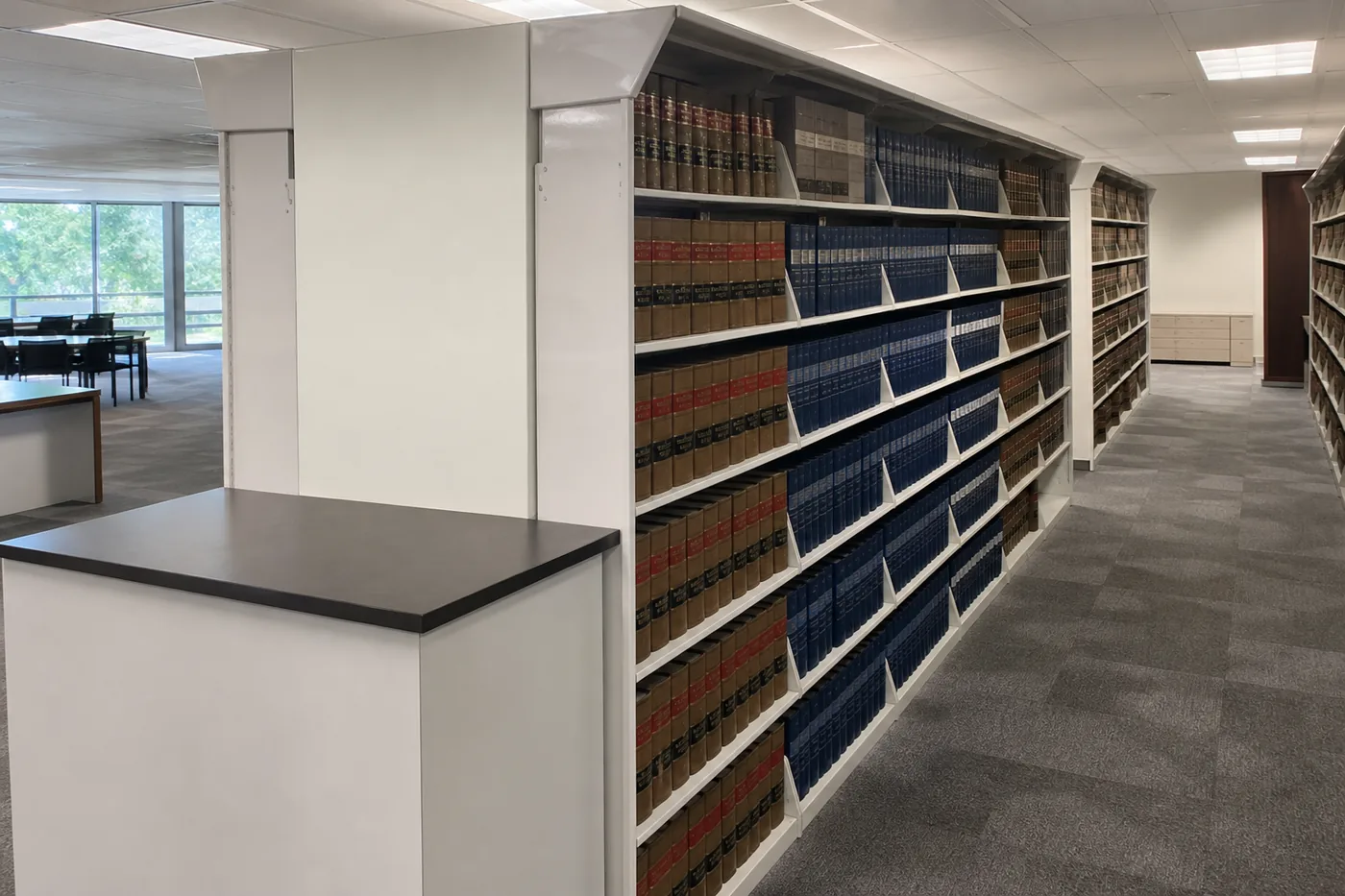
Fixed, single-tier library shelving — a different product from compact shelving
Not every library or media room needs a mobile/compact shelving system closing aisles on rail track. Many reading rooms, branch libraries, and reference collections are better served by fixed, single-tier steel shelving in open aisles — sized for browsing traffic rather than maximum density. MH-USA sells and installs Borroughs Wilsonstak library shelving for that use case. It’s a distinct line from the mobile shelving for library book stacks we also install, which mounts library shelving on rolling carriages to compress storage in rooms where floor space is the binding constraint.
Built around the collection, not just the box
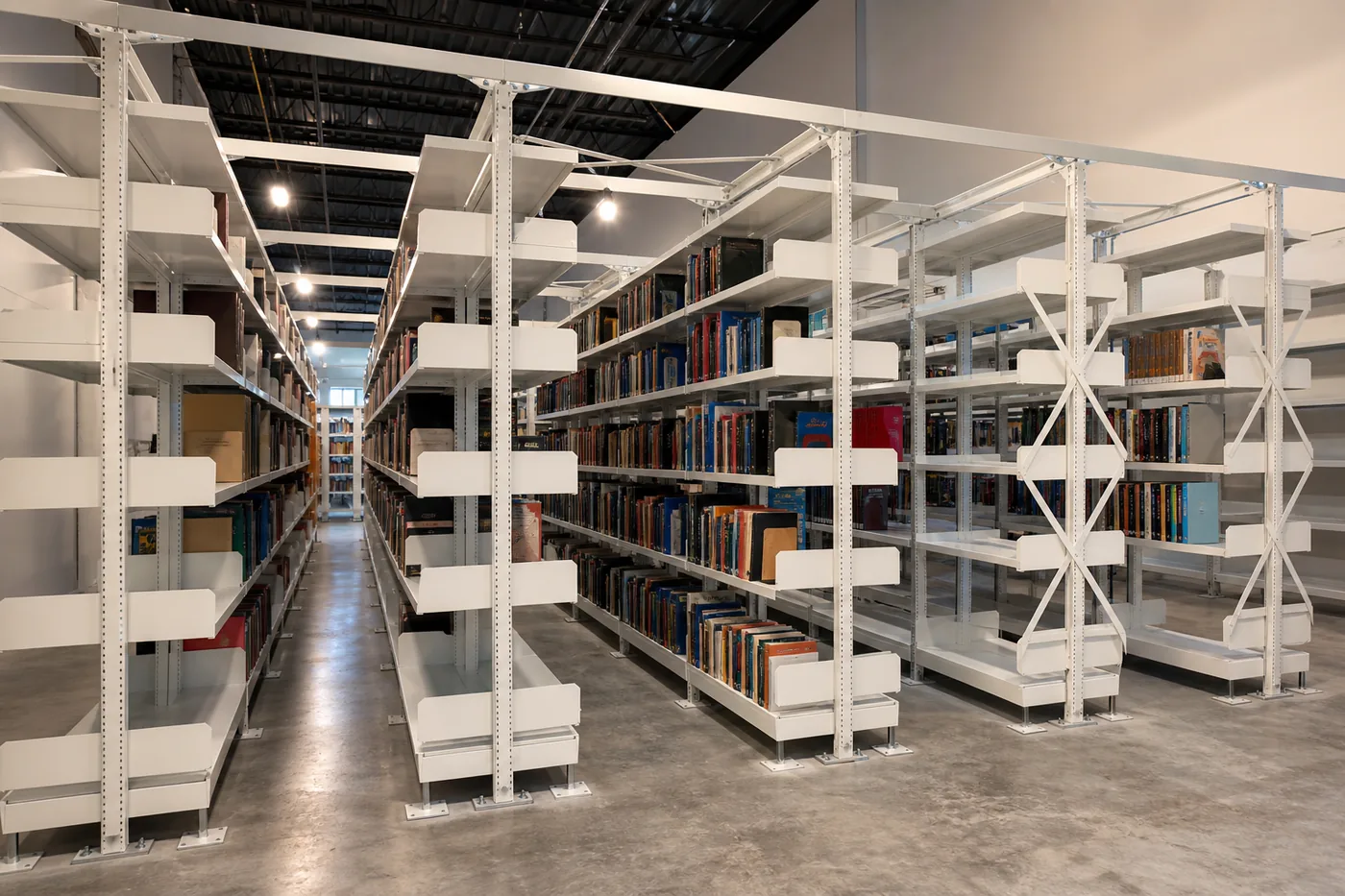
Wilsonstak shelving is a component system built around what a collection actually holds, not a single flat shelf. Current MH-USA catalog components for this line include:
 Media & browsing shelvingPaperback zig-zag shelves and pull-out browsing box bases for media and paperback collections.
 Periodical & newspaper storageHinged periodical shelves and cabinets, newspaper sticks, and sliding reference shelves for current-issue display.
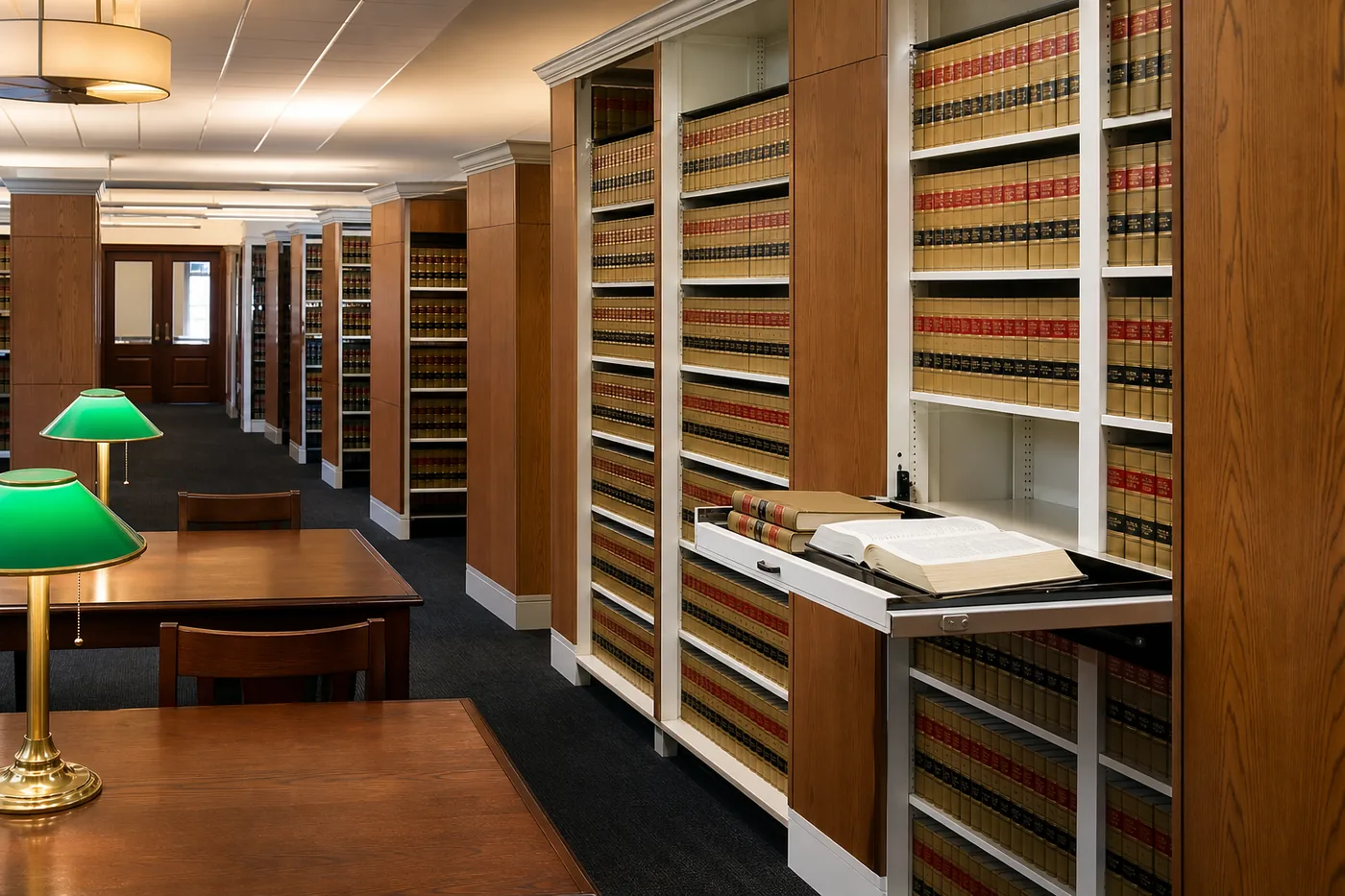 Bookstack & reference shelvingAdjustable shelf dividers, backstops, and sliding book supports for bound-volume reference stacks.
End panels (solid metal, single- or double-faced), canopy brackets for wood tops, and shelf label holders finish out a range so it reads as furniture rather than warehouse shelving in a public or reading-room space.
Planning a static library shelving layout
Library shelving layouts have their own constraints beyond load capacity: aisle width for ADA and patron traffic, sightlines for staff supervision, seismic bracing where required by local code, and shelf depth that actually matches the collection (a reference-book depth is different from a media/DVD depth). We work from your room plan and collection type — bound volumes, periodicals, media, or a mixed reading room — to size bay widths, end panel styles, and accessory placement before ordering hardware.
If your building’s constraint is floor space rather than browsing traffic — a records room or closed-stack collection, for example — a mobile/compact shelving system on the same general shelving platform will usually store more volumes in the same footprint; we quote both and recommend based on how the room is actually used.
Component parts we work with most
Wilsonstak is a component system, and most projects mix and match from a standard parts list. Frequently specified components in our current catalog:
| Component | Use |
|---|---|
| Paperback zig-zag shelf / insert | Angled display for paperback and browsing collections. |
| Pull-out browsing box | Bin-style storage for oversized or picture-book media at browsing height. |
| Hinged periodical shelf / cabinet | Current-issue magazine and newspaper display, some with a locking flipper door. |
| Sliding reference shelf | Pull-out work surface built into a reference stack for on-the-spot use. |
| Adjustable shelf divider / backstop | Keeps bound volumes upright and organized on adjustable shelving. |
| Solid metal end panel (single/double-faced) | Finished end-of-range panel for public-facing aisles. |
Static shelving or mobile shelving for your library?
Open reading rooms and browsing collections usually work better on fixed Wilsonstak shelving. Closed stacks and records rooms where floor space is limited usually do better on a mobile/compact system. We install both and will size your room for the right fit.
Wilsonstak bookstack sizes and the nominal-vs-actual rule
Library shelving is quoted in nominal sizes, but it is installed in actual sizes, and the two are never the same number. Borroughs’ own Wilsonstak Bookstack Planning and Layout Guide (Form #670-012-03, dated June 2008) sets the convention that end panels, fillers, canopy tops and range lengths are all cut from. Get it wrong and the steel still goes up, but the wood tops and finished ends do not fit.
Standard bookstack widths are 24″, 30″ and 36″. Standard frame heights are 42″, 54″, 66″, 78″, 90″ and 93″. Single-face shelf depths are 8″, 9″, 10″ and 12″; double-face depths are 16″, 18″, 20″ and 24″. Special sizes are made to order.
| Dimension | Nominal | Actual, per Borroughs literature |
|---|---|---|
| Adjustable shelf depth | 8″, 9″, 10″, 12″ | Nominal minus 1″ |
| Base shelf / overall unit depth, single face | e.g. 10″ | Nominal plus 1-3/8″ |
| Base shelf / overall unit depth, double face | e.g. 24″ | Source rule: nominal plus 7/16"; verify the production drawing before final millwork sizing |
| Custom end panel, single face | Base shelf nominal | Nominal base shelf depth plus 1-1/2″ |
| Custom end panel, double face | Base shelf nominal | Nominal base shelf depth plus 1″ |
| Length of run / canopy tops | Sum of section widths | Add 1/16″ growth per section (eight 3′ sections = 24′-1/2″) |
Figures above are quoted from Borroughs’ dated Wilsonstak planning literature (June 2008) and the Wilsonstak library shelving products brochure. Borroughs does not currently publish a public Wilsonstak product page, so MH-USA verifies current availability, sizes and configuration with the manufacturer before quoting any Wilsonstak layout.
How many volumes will actually fit? Capacity by collection type
Shelf depth is chosen by what sits on the shelf, not by the room. Borroughs’ planning guide publishes maximum volumes per linear shelf foot together with the recommended depth for each collection type, based on 90″ high units. Those maximums assume a shelf packed solid, which is not how a working collection behaves.
| Collection type | Max volumes per linear shelf foot | Recommended shelf depth |
|---|---|---|
| Circulation, non-fiction | 8 | 8″ |
| Fiction | 8 | 8″ |
| General literature | 7 | 8″ |
| Reference | 6 | 8″ or 10″ |
| History | 7 | 8″ |
| Technical & scientific | 6 | 8″, 10″ or 12″ |
| Law | 5 | 8″ |
| Medical | 5 | 8″ or 10″ |
| Bound periodicals | 5 | 10″ or 12″ |
| Art quartos and folios | 7 | 10″ or 12″ |
| Juvenile octavos | 10 | 8″ |
| Juvenile folios | 12 | 10″ or 12″ |
| Public documents | 5 | 8″ |
| Microfilm | 7 | 4″ or 6″ |
| CD-ROM | 27 | 6″ or 8″ |
| DVD | 18 | 6″ or 8″ |
Two planning rules come with that table. First, Borroughs states plainly that working capacity is between two-thirds and three-quarters of the maximum capacities shown — plan to the working number or your new stacks are full on move-in day. Second, most general collections land on a depth mix of roughly 80–85% of shelving at 8″ deep, 10–15% at 10″, and 2–5% at 12″. Ordering a whole room at 10″ or 12″ wastes both money and floor area.
Applied to range length, at 8 volumes per shelf foot on 36″ wide, 90″ high frames with seven shelves, the guide’s own arithmetic gives 168 volumes single-face / 336 double-face for a 3′ section, 672 / 1,344 for a 12′ range, and 1,680 / 3,360 for a 30′ range. Discount those by the two-thirds to three-quarters working factor and you have a defensible collection-growth number for a bid.
Range spacing, ADA aisles, and stack layout
Aisle clearance is where library shelving layouts fail inspection. The planning guide calls for 36″ clear between stacks and 42″ clear at the perimeter, and notes that a 5-1/2′ aisle is desirable where the floor plate allows it, with 36″ as the minimum. Because clearance is measured between base shelves rather than between frames, the centerline distance you draw depends on the nominal double-face base shelf depth.
| Nominal double-face base shelf | Range centerline to hold a 36″ clear aisle |
|---|---|
| 16″ | 52-1/2″ |
| 18″ | 54-1/2″ |
| 20″ | 56-1/2″ |
| 24″ | 60-1/2″ |
| 32″ | 68-1/2″ |
Borroughs’ literature names seven stack layout patterns worth testing on a floor plan before committing: comb-like, block range, perimeter, in-line, fan, cluster, and diagonally stepped. Each changes sightlines, supervision, wayfinding and the number of ranges a room will hold. Lighting position, ceiling and sprinkler clearance above the top shelf, air circulation and acoustics all follow from the pattern you pick, so pattern selection belongs at the start of the project rather than after the steel is priced.
Freestanding or anchored? The rule that decides your install
This single rule drives install scope, anchor counts, and whether the general contractor needs to be involved. Per Borroughs’ planning literature:
- Freestanding: double-face units with 8″ or 9″ adjustable shelves over a 20″ base shelf, or 10″ or 12″ adjustable shelves over a 24″ base shelf.
- Not freestanding: all double-face units whose adjustable and base shelves share the same nominal depth. These must be floor anchored or tied together at the top with tie struts.
- Not freestanding: all single-face units, without exception. Every single-face run must be secured to the wall.
Anchor labor is estimable rather than guessed: the guide budgets roughly two and a half holes per frame, at about 2.0 minutes per hole for wall or floor anchors and 3.0 minutes per hole for ceiling anchors. Anchoring here is about ordinary stability under load and use; it is not a seismic engineering statement. Where a project is in a seismic design category that requires engineered bracing, that scope is designed and stamped by the project’s engineer of record.
Floor loading data for your architect
Architects and structural engineers ask for load before they approve a stack layout, especially on upper floors and older buildings. Borroughs’ guide gives three usable numbers: a filled single-tier bookstack at typical working capacity runs about 35 lb per cubic foot of range volume; bookstacks plus books can normally be figured safely at 150 lb per square foot; and bookstacks carried on compact mobile carriages run 200–250 lb per square foot. Local code may impose additional live-load allowances on top of these figures, so they are a starting point for the design team, not a substitute for the structural review.
Shelf spacing: how many shelves a frame really holds
Frame height does not tell you shelf count — shelf type does. Borroughs publishes a minimum spacing figure for each shelf type, and specialty shelves consume levels quickly.
| Shelf type | Minimum spacing between shelves |
|---|---|
| Standard adjustable shelf | 8″ |
| Storage shelf with reverse bracket | 4″ |
| 18″ heavy duty with top bracket | 5″ |
| Microfilm shelf | 5″ |
| Fixed periodical shelf | 9″ |
| Sloping media / zig-zag / media single tier | 9″ |
| Browsing box | 12″ |
| Media double tier | 13″ |
| Hinged periodical, phono / record / picture book | 14″ |
| Media hanger rack | 20″ |
| Newspaper rack, 6-stick / 10-stick | 29″ / 37″ |
Worked example from the same table: a 90″ frame on 8″ spacing takes 10 adjustable shelves without a canopy top, and 9 with one. Swap two of those levels for hinged periodical shelves and you lose materially more than two levels of book capacity, which is exactly the kind of trade a browsing or current-periodicals area forces. Accessory selection is therefore a capacity decision, not a finishing decision.
On construction, the brochure is specific: 18 gauge shelves with triple bends on the front and back edges to resist sagging, a 16 gauge welded steel frame, a wrap-around base bracket that becomes part of the frame, and a one-piece base shelf. Borroughs states the Wilsonstak shelf surpasses all American Library Association strength and durability standards, and that the welded frame eliminates the need for sway braces and starter/adder components — every frame is a complete unit that can be configured single- or double-face and joined frame-to-frame into runs, ranges or bays. The line covers general collection bookstacks, archival and multimedia shelving, art storage, and multi-tier structures, and is offered in seven standard powder coat colors with custom color matching.
Turn a room dimension into a stack layout
The fastest way to get from “we have this room and this collection” to a real number of ranges is to hand us the floor plan and the collection inventory. Send room dimensions, ceiling and sprinkler height, the collection breakdown by type, and any fixed obstructions, and we work the same sequence used above: volumes per linear foot by collection type, the two-thirds to three-quarters working-capacity discount, shelves per frame from the spacing table, the 80/15/5 depth mix, and range centerlines that hold a 36″ clear aisle and 42″ perimeter.
Start that on our warehouse design and layout planning page, which is where floor-plan reviews are intaken, then compare against the alternative on our mobile shelving page if closed stacks or a records-heavy collection make aisle recovery worth the carriages. Related Borroughs lines are indexed on the Borroughs shelving hub.
All specification figures on this page are taken from Borroughs’ own Wilsonstak literature: the Bookstack Planning and Layout Guide (Form #670-012-03, June 2008) and the Wilsonstak Library Shelving Products brochure. Because Borroughs does not currently publish a public Wilsonstak product page, MH-USA confirms current availability, sizes, finishes and configuration with the manufacturer before issuing a quote. MH-USA verifies the quoted configuration and current availability before order.
Get a free quote
Tell us what you are storing, the room size and your timeline. A project specialist will follow up with layout options and pricing. Prefer to talk? Call (800) 326-4403.
Library shelving FAQ
What’s the difference between Wilsonstak and mobile library shelving?
Can this shelving handle media and periodicals, not just books?
Does library shelving need seismic bracing?
Do you stock Wilsonstak library shelving?
Can end panels and finishes match our library’s furniture?
Plan Your Library Shelving Layout
Tell us your room dimensions and collection type and we’ll put together a Wilsonstak layout and quote.