
Guard Shack Mounted on a Trailer › Towing & Site Setup
Towing a Trailer-Mounted Guard Shack: Road-Legal Specs and Site Setup
Not every guard shack trailer is road legal. Here is how to tell a highway-rated chassis from a yard-tow trailer, match a tow vehicle to booth weight, meet lighting and brake rules, and set the booth up level and secure once it lands.
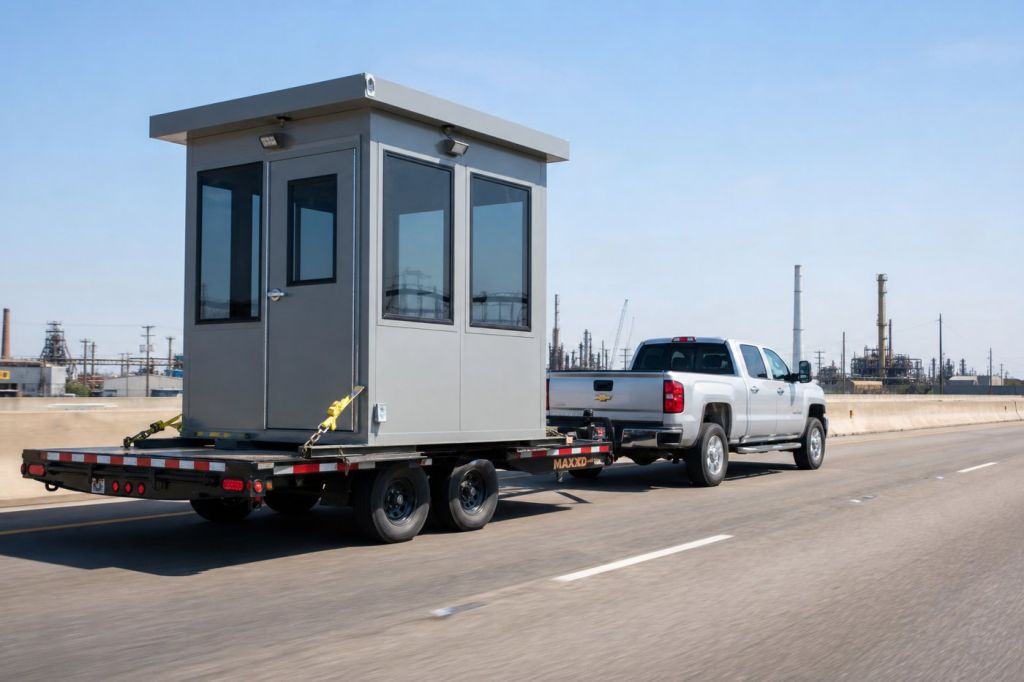
Two Very Different Things Get Called a “Trailer-Mounted Guard Booth”

Buyers shopping for a guard shack mounted on a trailer usually assume the trailer means the booth can be towed anywhere. That is true for some units and flatly untrue for others, and the difference is written in the manufacturer’s own specification sheet rather than in the marketing copy.
Par-Kut’s published specification for its Model 65TLR trailer booth, for example, states a maximum towing speed of 25 MPH and notes the unit is not intended for highway use, even though the trailer bears a valid DOT vehicle identification number. B.I.G. Enterprises, by contrast, advertises its Trailer Booth as a fully self-contained, highway-approved unit built on a DOT highway-approved trailer, and our manufacturer partner lists trailer-mounted guard booths alongside forkliftable and crane-liftable designs as separate mobility options.
Those are three legitimate products that solve three different problems. A yard-tow booth is a booth on wheels: you reposition it around a plant, a yard, or a lay-down area with a pickup or a tractor at walking speed. A highway-rated booth is a road-legal trailer that happens to carry a guard booth: you hook it to a truck, drive it across town or across the state, and drop it at the next project. Buying the first when you needed the second is the single most expensive mistake in this category, because retrofitting a yard chassis into a road-legal one is rarely worth doing.
The one question to ask any vendor
“Is this trailer rated for highway towing, and what is the maximum towing speed on the spec sheet?” If the answer is a speed limit rather than a road rating, the unit is a yard-move booth. Ask for the GVWR, the axle rating and the DOT VIN in writing before you sign.
Chassis Specifications That Actually Matter
A booth trailer is a purpose-built chassis, not a utility trailer with a shed bolted to it. When you compare quotes, compare these line items. They are the ones that show up later as a failed inspection, a bent tongue, or a booth that will not sit level.
| Chassis item | What to look for | Why it matters |
|---|---|---|
| DOT VIN and certification label | A stamped VIN plus a manufacturer certification label showing GVWR and axle rating | Without a VIN you generally cannot title or plate the trailer, which ends the road-legal conversation |
| Frame and bed | Welded steel frame sized to the booth footprint (Par-Kut’s 5×6 ft booth rides on a 6×8 ft bed) | Bed overhang gives you the step and landing area, and keeps tongue weight in a sane range |
| Axle, springs and tires | Axle rating at or above loaded weight, road-rated tires, spare where the route warrants it | Yard trailers often carry small non-highway tires that overheat at road speed |
| Coupler and safety chains | Ball or pintle coupler matched to your hitch, chains rated for gross trailer weight | Coupler class is the fastest way to discover the trailer does not match your truck |
| Tongue jack and corner jacks | Swing-down or drop-leg tongue jack plus four corner leveling jacks | Corner jacks are what make the booth level and stable once parked |
| Platform, step and handrails | Treadplate platform, swing-down step, handrails at the door | Officers work a full shift here; a slick platform is a real injury exposure |
| Tie-down lugs | Optional lugs to anchor the booth or the trailer to the pad | Required when site conditions or wind exposure call for anchoring |
Interior and electrical specifications matter just as much, but they are the same items you would evaluate on any fixed booth: welded galvanized steel walls, insulated glazing, a sliding steel door with a hook-bolt lock, LED lighting over the counter, a heater, duplex outlets, and a small breaker panel fed by a shore cord. Par-Kut’s published trailer specification, for instance, calls for 12-gauge minimum copper wiring in EMT, UL-listed devices, a 120-volt/1500-watt heater and a 10-foot power connection cord on a 120-volt single-phase service.
Matching a Tow Vehicle to Booth Weight
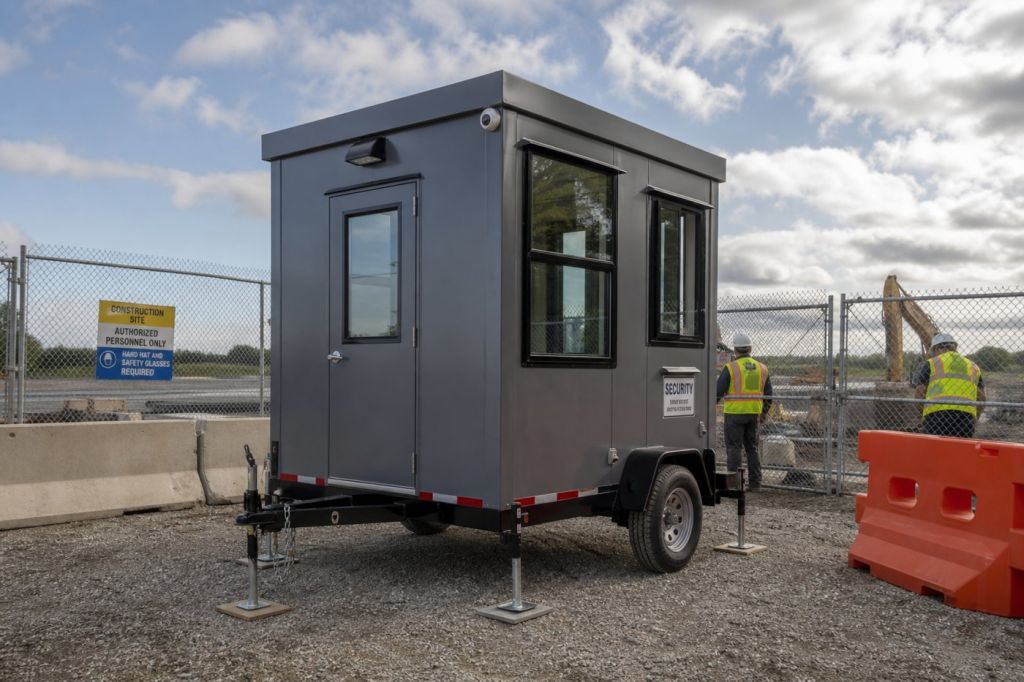
Guard booths are small buildings, and small buildings are heavy. A 4×6 ft steel booth typically lands in the 1,200–1,600 lb range before you add a chassis; a 6×8 ft booth with HVAC runs 2,000–2,800 lbs, and an 8×12 ft booth can reach 4,500–6,000 lbs. Add the trailer itself, then add whatever goes inside — monitors, a radio charger, a space heater, a small safe — and the combined figure is what your truck has to stop, not just pull.
Work from three numbers and you will not get this wrong: the booth’s shipping weight, the trailer’s GVWR from the certification label, and your tow vehicle’s tow rating and payload for the tongue weight. Half-ton pickups handle the smallest single-officer booths on a light chassis. Anything from a two-officer booth upward is realistically three-quarter-ton or one-ton territory, which is exactly why highway-rated booth vendors describe a ¾-ton pickup as the baseline tow vehicle.
If the booth ships to you rather than being towed to you, the same weights drive delivery: a pre-assembled booth arrives on a flatbed and needs a forklift, crane or trailer drop at the receiving end. Plan the unload before the truck shows up.
| Booth footprint | Occupancy | Approx. booth weight | Realistic move method |
|---|---|---|---|
| 4×6 ft | 1 officer | 1,200–1,600 lbs | Light trailer or forklift |
| 5×7 ft | 1 officer plus gear | 1,600–2,000 lbs | Trailer, forklift or crane |
| 6×8 ft | 1–2 officers | 2,000–2,800 lbs | Trailer (¾-ton truck) or crane |
| 7×10 ft | 2 officers | 3,000–4,200 lbs | Trailer or crane |
| 8×12 ft | 2–3 officers | 4,500–6,000 lbs | Heavy trailer or crane |
Weights are typical ranges for steel booths and vary by manufacturer, glazing package and options. Use the quoted unit’s actual shipping weight for tow planning. See our portable guard booth overview for how these footprints compare across forklift, skid and trailer bases.
Brakes, Breakaway Systems and Safety Chains
Once a booth trailer travels on public roads it is a trailer in the eyes of the state, and the equipment rules are not optional. Thresholds vary by state, so verify against your own vehicle code — but Utah is a useful example because most of our booths ship from Salt Lake City.
- Trailer brakes. Under Utah’s vehicle code, a trailer needs brakes once its gross weight reaches 3,000 lbs. Most two-officer booths on a chassis clear that line easily.
- Breakaway system. A brake-equipped trailer needs a breakaway device that stops the trailer if it separates from the tow vehicle. Federally, 49 CFR 393.43 also requires the towing vehicle to retain stopping ability in a breakaway.
- Stopping performance. Utah expects the combination to stop within 40 feet from 20 MPH — a practical reason not to tow a 5,000 lb booth behind an undersized truck.
- Safety chains. Utah requires the trailer to be coupled with a chain or cable connected to the chassis of both vehicles, strong enough to hold the trailer if the hitch fails. Cross them under the tongue so a dropped coupler lands in the chains.
- Width and height. Utah allows trailers up to 102 in wide and 14 ft tall. A booth on a chassis can approach the height limit faster than you expect once you count the roof HVAC or a light bar — measure the loaded unit, not the booth.
Interstate and commercial use
If the booth is towed by a commercial motor vehicle in interstate commerce, the Federal Motor Carrier Safety Regulations in 49 CFR Part 393 apply to lamps, reflectors, brakes and coupling devices on top of state law. Confirm your operating status with your safety manager before the first move.
Lighting, Conspicuity, Plates and Registration
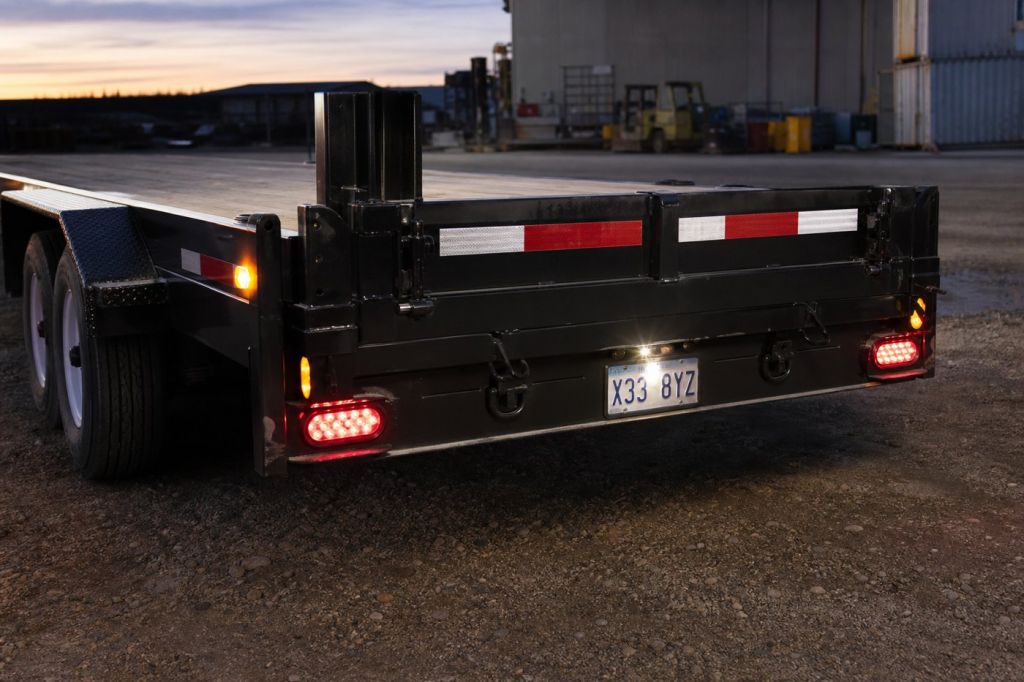
Booth trailers are dark, boxy and slow to accelerate, which makes lighting the equipment item most often cited at a roadside stop. Under 49 CFR 393.11, lamps and reflective devices on commercial vehicles must meet the applicable FMVSS No. 108 requirements in effect when the vehicle was built — tail lamps, stop lamps, turn signals, side marker lamps, license plate lamp and reflex reflectors in their required positions and colors. Trailers 80 inches or wider with a GVWR over 10,000 lbs also need a conspicuity system of retroreflective sheeting or reflectors under 393.11(b).
Registration is separate from equipment. Utah Code 41-1a-202 exempts a narrow set of trailers — unladen weight of 750 lbs or less and not used for hire, and non-commercial single-axle trailers — but a steel guard booth on a chassis used for business almost never lands inside those exemptions. Assume you will title and plate the trailer, and get the VIN and certification label from the manufacturer at the time of purchase rather than the week you need to move it.
Practical field habit: put the trailer’s registration, the certification label photo and the tire pressures in a laminated sheet inside the booth. Whoever tows it next is rarely whoever bought it.
Pre-Tow Checklist
Run this before every move, not just the first one. It takes about ten minutes and it is the difference between a routine relocation and a booth in the median.
Secure the booth interior
Latch the sliding door, lock the windows, stow or strap monitors, chairs, heaters and anything on the counter. Everything inside becomes a projectile at speed.
Couple and connect
Seat the coupler fully and latch it, cross the safety chains to the tow vehicle chassis, attach the breakaway cable to the vehicle (never to the chains), and plug in the lighting connector.
Raise and test
Retract all four corner jacks and the tongue jack, confirm the platform step is up, then walk the trailer with a helper checking running lights, brake lights, both turn signals and the plate lamp.
Check tires and route
Set tires to the sidewall pressure cold, inspect for weather cracking, then confirm height and width clearance on the route — low canopies, drive-through gates and yard entrances are where booths get damaged.
Need a booth that can legally make the trip?
Tell us where the booth has to travel, how often, and what the officers need inside, and we will spec a chassis that matches — or tell you honestly when a skid or forklift base is the better buy.
Request a Quote See trailer booth options Call (800) 326-4403
Site Setup: Pad, Leveling and Wind
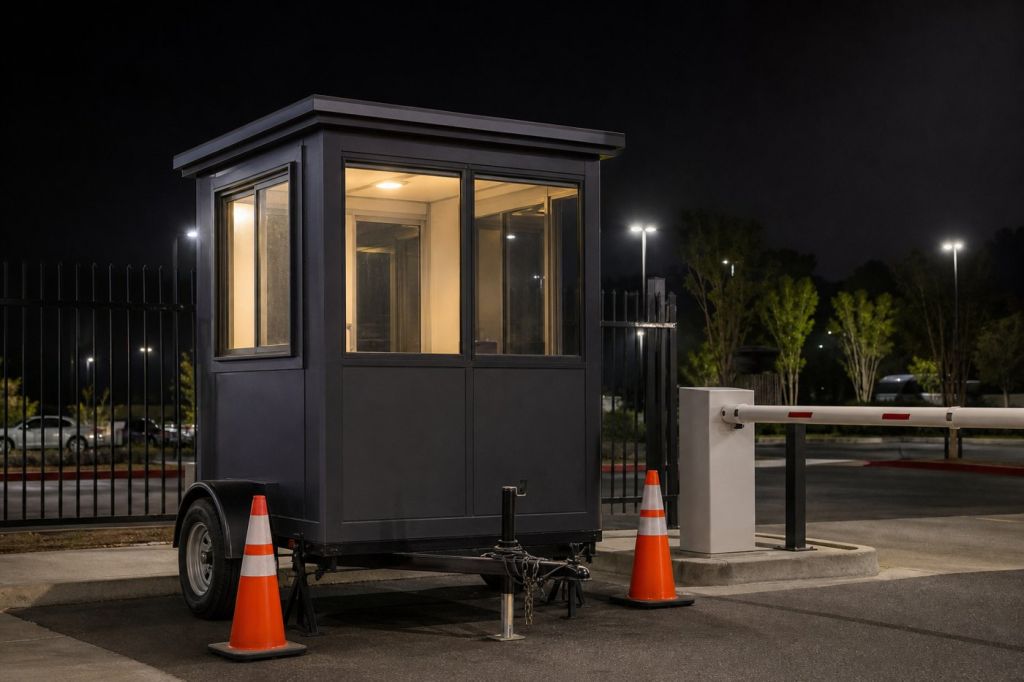
Towing is half the job. A trailer booth that is not level does not work: the sliding door binds, the windows will not latch, and the door lock stops engaging cleanly. Aim for a pad level to roughly a quarter inch per foot, firm enough that the jacks and tires do not sink. Asphalt, existing concrete and well-compacted road base all work. Fresh fill, soft soil and landscaped areas do not, and they are exactly where a temporary checkpoint tends to get placed.
Set the trailer with the door facing the approach lane so officers can see arriving vehicles without leaning out. Chock the wheels, then bring all four corner jacks down onto pads — jack feet punch straight through hot asphalt in July and through soft base after rain. Level across the door threshold first, then front to back.
Wind is the load people underestimate. A booth is a tall, flat-sided box with a large sail area and a relatively light footprint, and it sits on a chassis with wheels. In exposed yards, on ridgelines and in canyon-wind country, anchor it: tie-down lugs into the pad, ballast, or ground anchors rated for the exposure. Ask the manufacturer for the design wind rating — Par-Kut, for example, publishes a minimum 100 MPH wind design load for its booths — and remember that a structural rating for the booth is not the same as a restraint plan for the trailer it sits on.
Power at the Drop Point
The booth arrives wired. What varies is what you can feed it once it is parked, and that decision is usually made too late. Three options cover almost every site:
On construction sites, temporary electrical service brings its own rules: temporary distribution equipment and GFCI protection on construction receptacles are standard requirements in North American electrical codes, and the authority having jurisdiction sets the details. Have the site electrician land the connection rather than running a household extension cord from the trailer office.
How Trailer Mounting Changes the Permit Conversation
This is the quiet advantage of a trailer booth, and the reason project managers keep choosing them over foundations. Permit requirements vary by jurisdiction and by how the booth is used, and many authorities treat a booth that stays on wheels or on an unanchored skid very differently from a structure bolted to a new concrete pad. Manufacturers commonly note that guard buildings under 120 square feet often fall below the permit threshold, while larger prefabricated guard houses typically do require a building permit — but that is a starting point for a phone call, not a rule you can rely on.
- Call the local building department and code enforcement office before the booth ships, and describe it accurately: footprint, whether it stays on the trailer, whether it will be anchored, and how long it stays.
- Ask what changes if you anchor it. Anchoring often converts a vehicle into a structure in the eyes of the code official.
- Ask separately about zoning and land use, electrical permits for the service drop, and any fire access or sightline conditions at the gate.
- Get engineering drawings and load calculations from the manufacturer if a permit is required — reputable booth manufacturers supply stamped drawings on request.
- Document the answer. On multi-year projects, the person who obtained the approval is rarely the person who has to defend it at inspection.
Trailer, Skid or Forklift Base: Which Mobility Option Fits
| Base type | Moves how | Best fit | Watch out for |
|---|---|---|---|
| Highway-rated trailer | Towed on public roads behind a ¾-ton or larger truck | Booths that rotate between job sites, events and seasonal checkpoints | Registration, brakes, lighting and a tow vehicle that is actually rated for it |
| Yard-tow trailer | Towed at low speed within a facility (often a posted 25 MPH maximum) | Repositioning a checkpoint inside a plant, yard or lay-down area | Not road legal — a flatbed and a crane are needed for any real move |
| Forkliftable base | Lifted by a lift truck already on site | Fenced facilities with a forklift and short move distances | Fork pocket rating and a lift truck with the capacity to match booth weight |
| Skid base | Reloaded on a flatbed by crane or lift | Semi-permanent checkpoints that move once every year or two | Requires equipment and a lift plan for every relocation |
Most fleets end up mixing them. A distribution campus keeps a forkliftable booth at the truck gate and a highway-rated trailer booth that follows construction phases. The right question is not which base is best, but how far and how often this specific booth has to travel. If you want the full trailer configuration list — ballistic glazing, HVAC, restroom packages and hurricane-rated builds — start at our guard shack trailer page, then compare it with the mobile guard booth and guard shack lineups.
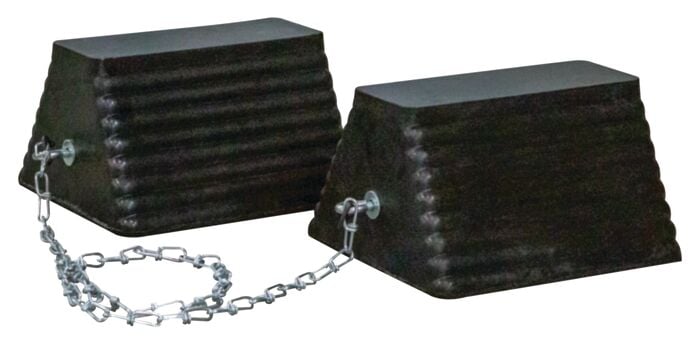
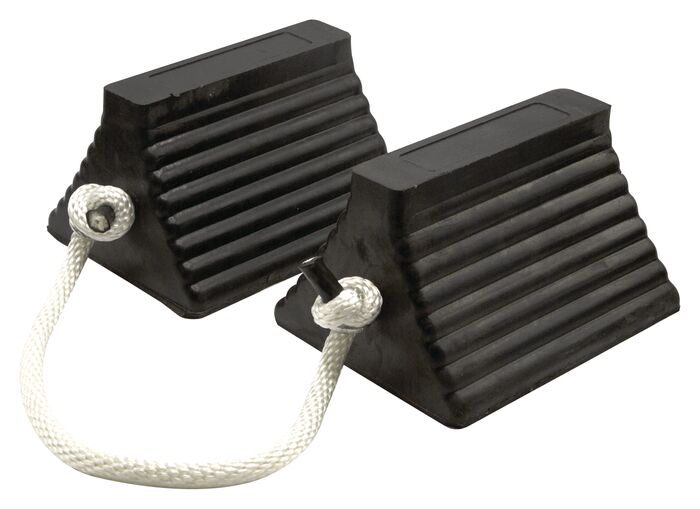
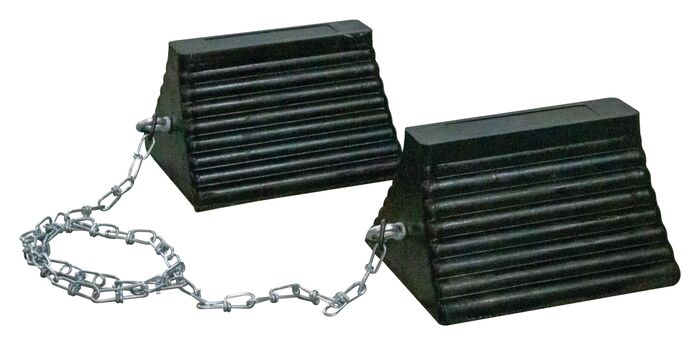
Shop Wheel Chocks Online
Every parked booth trailer gets chocked before the jacks come down. These chocks ship from our online store; call us for booth and chassis quotes.
Trailer-Mounted Guard Shack FAQs
Is a trailer-mounted guard shack street legal?
What size truck do I need to tow a guard booth trailer?
Does a guard booth trailer need brakes and a breakaway system?
Do I have to register and plate the trailer?
Do I need a building permit for a trailer-mounted guard booth?
How do I keep a trailer booth from moving in high wind?
Can a trailer booth run without shore power?
How quickly can a trailer-mounted booth be deployed?
Spec Your Trailer-Mounted Guard Shack
Material Handling USA has been outfitting Intermountain West facilities since 1997. Tell us the site, the shift and the travel plan, and we will quote a booth and chassis that fit.