
Industrial Security Cages for a Maintenance Storeroom: Verso Corporation Case Study
How a paper manufacturer keeps critical spares, bearings, drives and rebuild kits behind welded wire mesh — without slowing down the crew that needs a part at 3 a.m. on a machine that is losing production every minute it is down.
2021–22
Years Material Handling USA supplied security cage and wire mesh partition product to Verso
Paper
Verso Corporation produced coated and specialty papers across North American mills
MRO
Maintenance, repair and operations spares are the most-caged inventory in heavy industry
24/7
Continuous-process plants need controlled storeroom access on every shift
The project
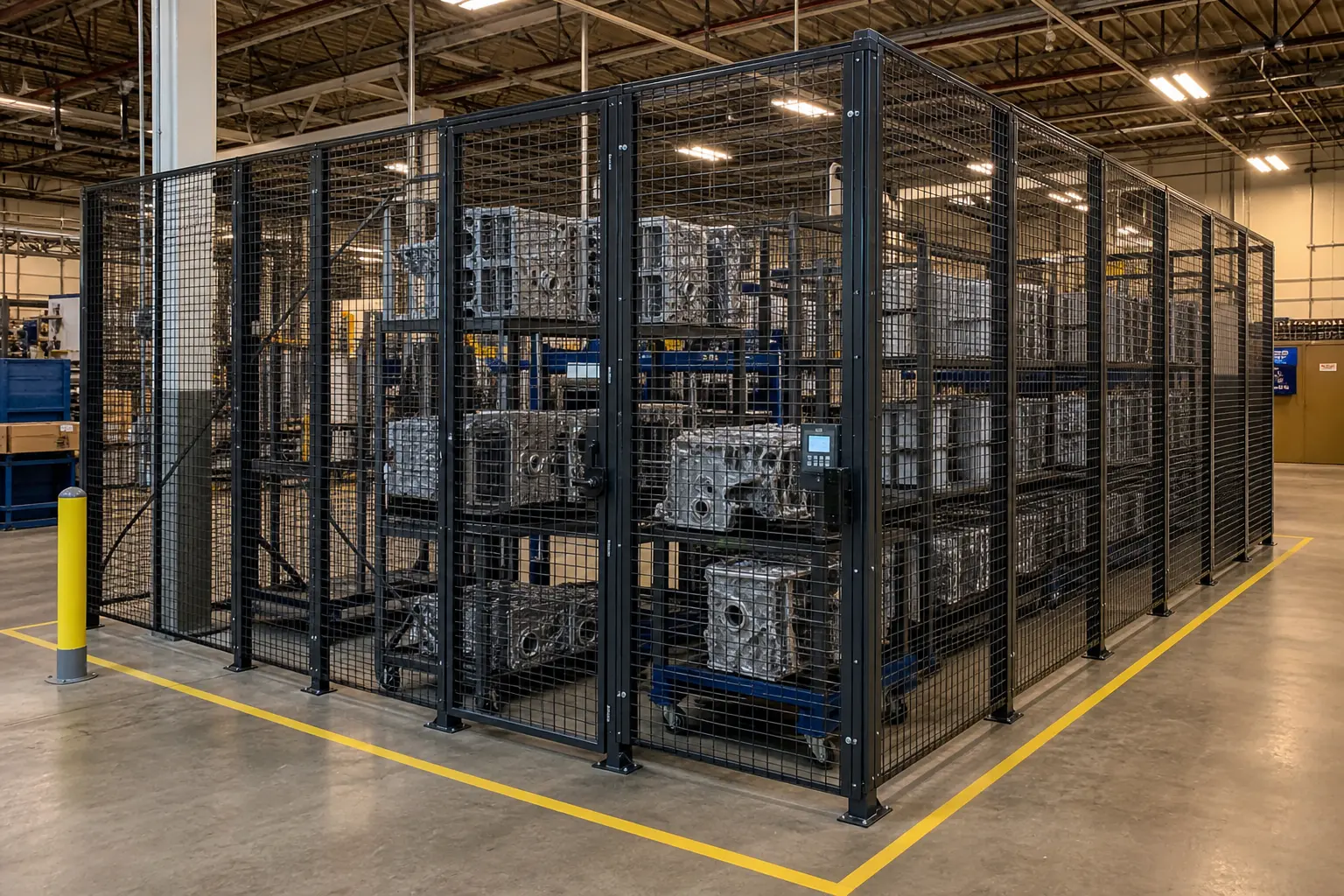
Verso Corporation was a North American producer of coated papers and specialty papers, running large integrated mills and employing roughly 1,700 people before the company was acquired by BillerudKorsnäs in 2022. Material Handling USA supplied welded wire security cage and partition product to Verso in 2021 and again in 2022.
This page sits under our security cage hub and describes a problem class rather than one customer’s building: how a heavy-industry maintenance storeroom is enclosed so critical spares stay controlled and still reach the floor fast. It contains no facility layout, no dimensions, no inventory values and no security detail specific to this customer.
A pulp and paper mill is a useful worst case for storeroom design. The plant runs continuously, the parts are heavy and awkward, a single missing bearing or drive can hold up a machine that generates revenue by the hour, and the people who need parts are working at two in the morning when the storeroom attendant went home at four in the afternoon. Every compromise a mill makes between control and access shows up somewhere else as either lost parts or lost production.
Why maintenance stores end up behind mesh
The value is not obvious from the outside. A pallet of drive components, instrumentation, specialty bearings, seals and hydraulic assemblies can be worth more than the finished goods stacked around it, and none of it looks valuable to anyone walking past.
Shrink here is rarely theft. The dominant loss is uncontrolled draw — a part taken during a breakdown and never recorded, so the system still shows stock and nobody reorders. The shortage is discovered during the next failure, at the worst possible moment.
Contractors are on site constantly. Outage and rebuild work brings crews who do not know the stores discipline and have no reason to learn it. A physical boundary does more than a policy.
Criticality is uneven. Most storeroom SKUs are low value and high traffic. A small share are long-lead, single-source items that determine how long a line stays down. Those deserve a boundary; the consumables mostly do not.
Walls are the wrong answer. Studded rooms block light and air movement, cost far more, need permits, and are difficult to change when the storeroom is reorganized. Mesh gives the boundary while keeping the area visible and sprinklered from the building system.

What actually goes behind the mesh
The useful exercise is not “cage the storeroom” but “decide what needs a boundary.” In heavy industry, the categories that repay enclosure are consistent:
Just as important is what should not go behind mesh. Lubricants and chemicals belong in the storage arrangement their safety data sheets and the building’s fire protection design call for, not in a general-purpose wire enclosure. Gas cylinders need their own restraint and separation. Nothing that requires a rated enclosure gets one by adding wire.

The issue point matters more than the fence
Mills that cage the stores and change nothing else usually see two outcomes: the door gets propped, or the crew starts squirreling parts at the machine because the storeroom is now a delay. Both destroy the reason for building it.
The layouts that hold up share a few features:
- A service window instead of a door for small issues. Most transactions are one small part. A pass window lets the attendant hand it out without opening the enclosure or letting anyone inside.
- A separate wide opening for material movement. Palletized and hoisted items need a double or sliding door sized to the handling equipment, not to a person.
- A clean receiving side. Parts arriving are put away from outside the boundary wherever possible, so deliveries do not require opening the secure area.
- An after-hours issue point. A small controlled sub-enclosure holding the highest-turn critical items, accessible to shift supervision, keeps the main stores closed overnight without stopping repairs.
- Sightlines preserved. Mesh, unlike a wall, lets supervision see the area and keeps the storeroom lit by the building’s own lighting.
Specifying an industrial security cage
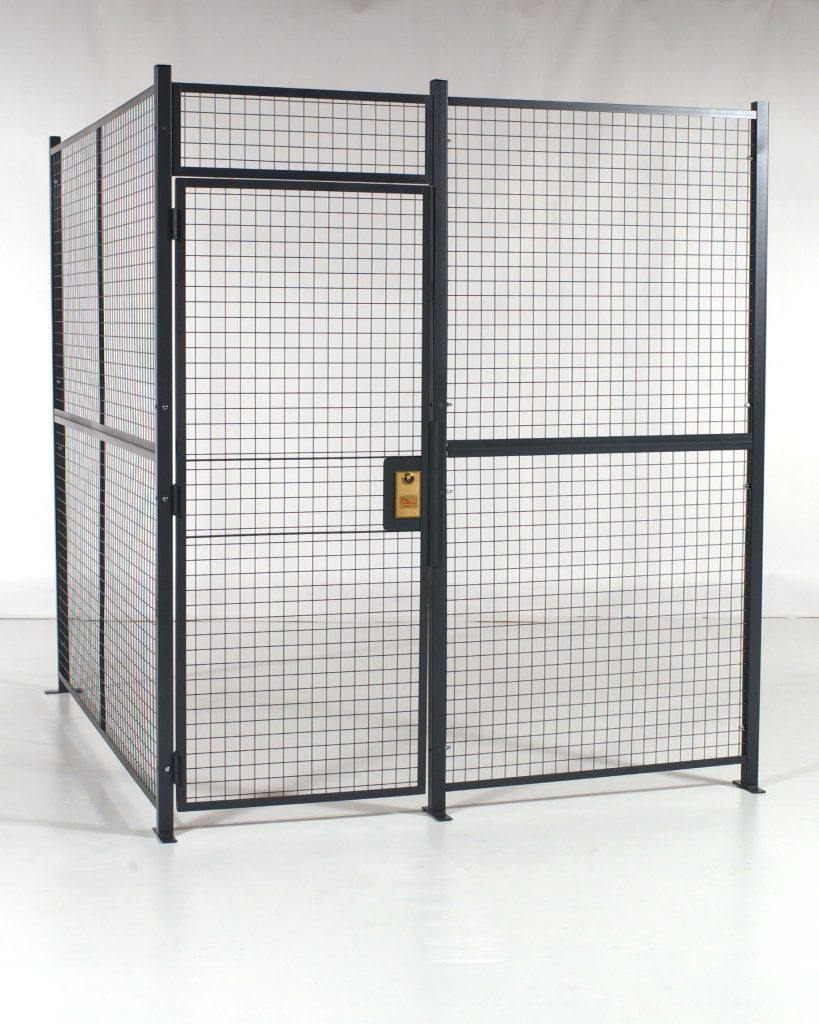
Specification in a mill is driven by abuse, not by burglary. The enclosure has to survive years of forklift traffic, hoisting, wash-down adjacent areas and vibration, and it has to be repairable in place with the plant running.
| Decision | Typical heavy-industry answer | Why |
|---|---|---|
| Panel type | Welded or woven wire mesh partition panels in a steel frame | Rigid, repairable panel by panel, and open to light, air and sprinkler discharge |
| Mesh opening | Smaller openings where small, high-value items are stored | Reach-through is the realistic risk in a storeroom, not cutting |
| Height | Full height to structure, or partial height with a mesh top | Partial-height enclosures next to racking can be climbed or reached over |
| Doors | Personnel door plus a wide sliding or double door | One opening cannot serve both a hand tool and a palletized gearbox |
| Base protection | Bollards, guard rail or heavy angle at traffic-exposed corners | The first failure of any industrial enclosure is a lift truck strike |
| Finish | Powder-coated steel, upgraded finish in damp or corrosive areas | Paper mills, wash-down zones and outdoor bays are hard on plain finishes |
Mesh, gauge and frame options are compared on our wire mesh panel options page, and the difference between welded wire partitions and chain link fabric is covered in our chain link versus wire mesh comparison. For enclosing existing rack bays rather than building a room, see pallet rack security enclosures.
Controlling access without stopping work
The access decision is an operations decision, not a hardware decision. Hardware only implements it. Three questions settle most of it:
Who can enter unaccompanied? In most mills the honest answer is stores personnel and a short list of supervisors — not the whole maintenance department.
What happens at 3 a.m.? If the answer is “call someone at home,” the enclosure will be defeated within a month. Either the night shift has a legitimate route to the critical items, or the boundary becomes theater.
How is a draw recorded? A boundary is only worth building if what leaves it is captured. A cage plus an unchanged paper log usually improves accuracy on its own, simply because the transaction now happens at a defined point.
Keyed, keypad, badge and access-control-integrated hardware are all normal on wire enclosures; options are described on our security cage doors page. Whatever is chosen should fail in the direction of egress: people inside must always be able to get out without a key.

Code and site constraints to check before ordering
A wire enclosure is not a building, but it sits inside one and interacts with several building systems. These are checked at survey, before panels are ordered:
- Sprinkler coverage and clearance. Adding a mesh top or dense shelving changes how water reaches storage below. NFPA 13 and the building’s fire protection design govern; OSHA has also addressed the familiar 18-inch clearance to sprinkler deflectors in its interpretation of 29 CFR 1910.159(c)(10). The mill’s fire protection contractor makes the call, not the cage supplier.
- Egress. An enclosure must not block a required exit route, an exit door swing, or access to an exit stair, and doors on egress paths must open without special knowledge.
- Fire equipment and controls. Extinguishers, hose stations, eyewash, panels and disconnects have required clear access that mesh must not compromise.
- Overhead services. Piping, cable tray, conveyors, monorails and crane travel usually decide the achievable height before the storeroom layout does.
- Floor condition and anchoring. Slab thickness, joints, trenches and existing anchors set what can be fixed where. Post-installed anchors near slab edges and joints need care.
- Seismic and site loads. Where the local code requires it, anchorage and bracing are engineered rather than assumed.
Industry-specific compliance considerations are summarized on our security cage regulations and compliance page.
Installing inside a running plant
Continuous-process plants rarely stop for a storeroom project, so the install is planned around production rather than the other way around.
Maintenance of the enclosure itself is minor but not zero: damaged panels, sagging doors and worn hardware are worth catching on the same rounds that check rack damage. Our maintenance and inspection guide covers what to look for.
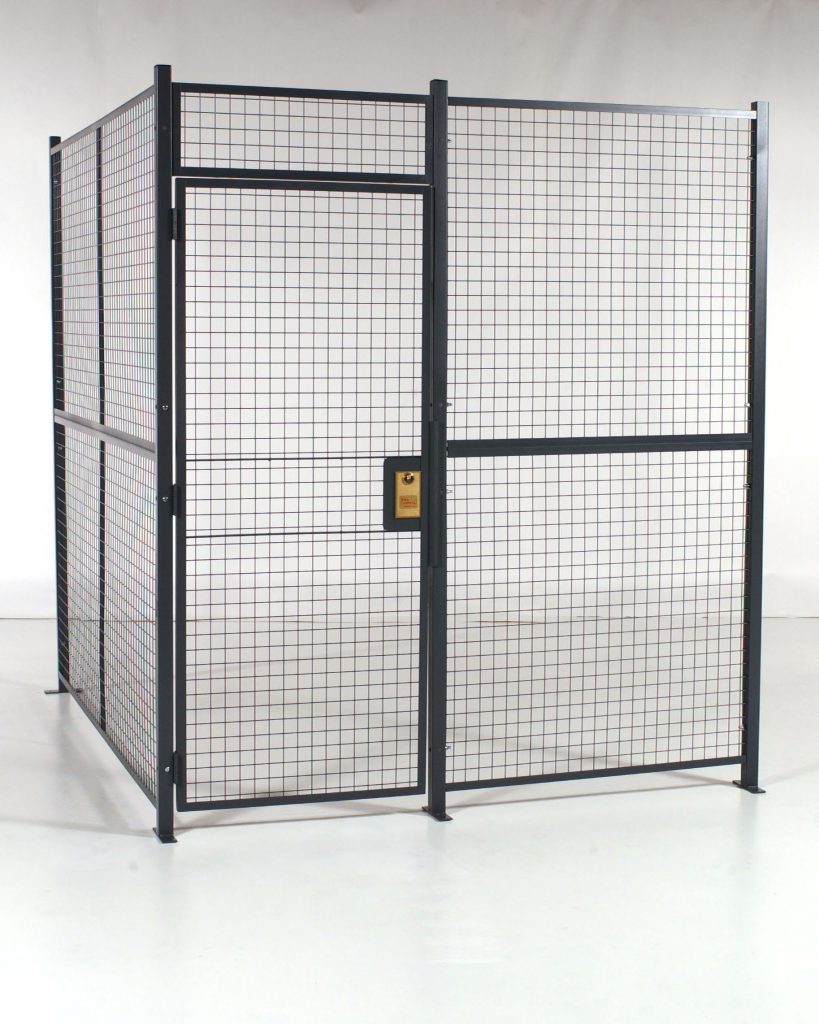
Shop Pre-Configured Wire Mesh Cage Kits Online
Standard-size welded wire cage kits, priced online, for smaller storage needs. Every kit still needs to be anchored to sound concrete — for tall, braced or engineered enclosures, request a quote with your building location and floor details.
Frequently asked questions
What is an industrial security cage?
Why use wire mesh instead of a stud wall for a maintenance storeroom?
Does caging the storeroom slow down maintenance?
What should not be stored in a wire mesh cage?
Can a security cage be installed while the plant is running?
How is a cage affected by sprinklers?
Is welded or woven mesh better for a storeroom?
Can an enclosure be expanded later?
Looking for a project like yours? Browse more manufacturing and tool crib cage case studies, see all security cage case studies.
Control the spares without slowing the crew
Material Handling USA designs, supplies and installs welded wire security cages, tool cribs, storeroom enclosures and rack enclosures for plants and mills nationwide.